Global Low Light Imaging Market Report Overview
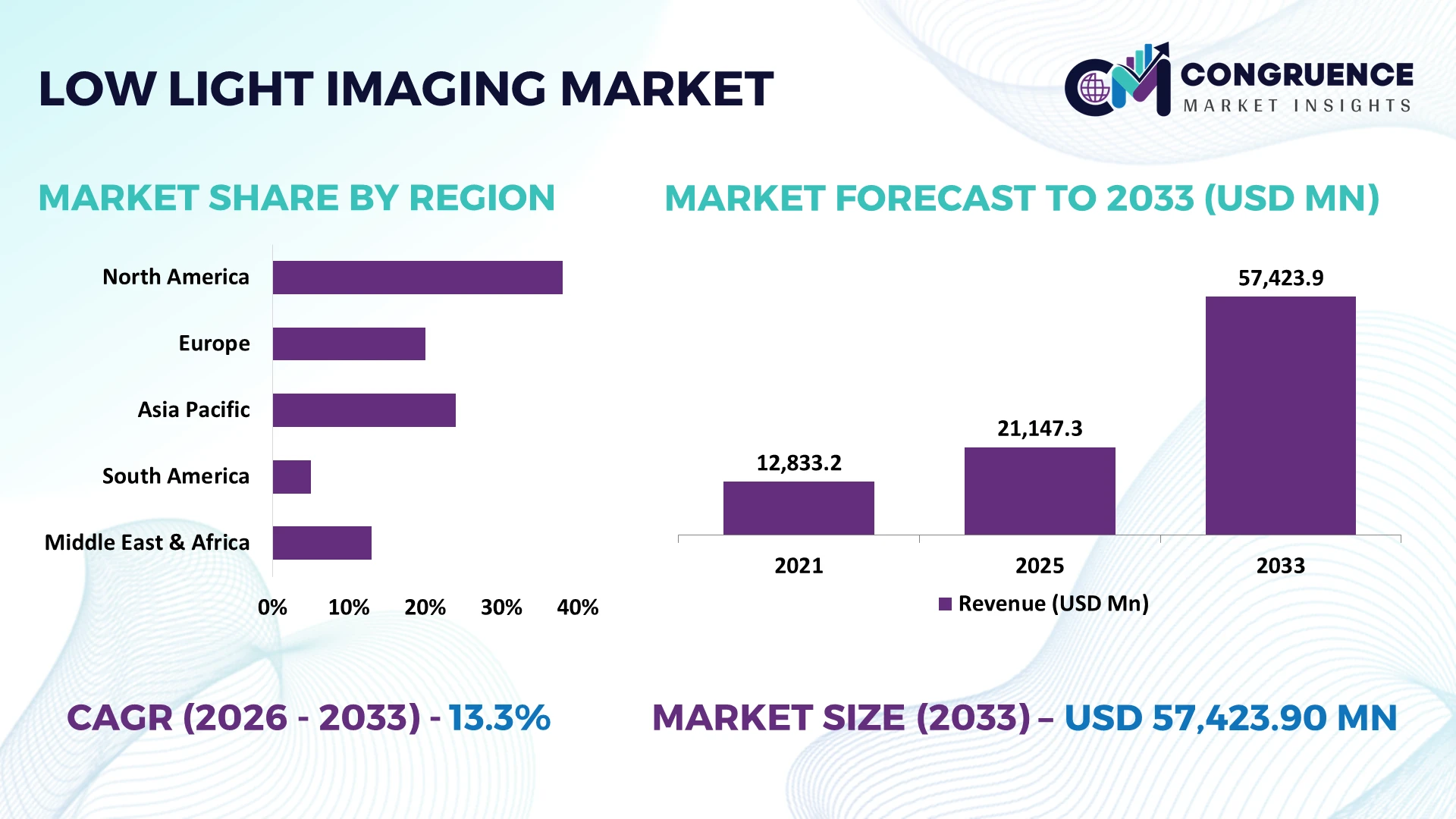
The Global Low Light Imaging Market was valued at USD 21147.26 Million in 2025 and is anticipated to reach a value of USD 57423.9 Million by 2033 expanding at a CAGR of 13.3% between 2026 and 2033. Growth is driven by backside-illuminated CMOS sensors, AI-assisted image enhancement, automotive night-vision integration, and increasing deployment of high-sensitivity surveillance cameras.
Japan maintains a leading position in advanced low light imaging technology through Sony's semiconductor manufacturing infrastructure and extensive CMOS image sensor expertise. Sony controlled approximately 55% of the global image sensor market by sales value in 2024, compared with Samsung's approximately 20%, demonstrating substantial Japanese technology leadership. Sony announced a planned investment of approximately JPY 1.7 trillion in its imaging and sensing business during FY2024–FY2026. Advanced stacked CMOS architectures, including STARVIS security sensors, support industrial inspection, automotive perception, and nighttime surveillance applications.
Manufacturers prioritizing high-quantum-efficiency sensors, integrated image processing, and automotive-grade reliability are positioned to strengthen competitive differentiation in advanced low light imaging systems.
Key Highlights of the Global Low Light Imaging Market
-
Market Size & Growth: USD 21,147.26 million in 2025, projected to reach USD 57,423.9 million by 2033 at 13.3% CAGR, driven by advanced CMOS adoption.
-
Top Growth Drivers: Image sensors, automotive safety, and security surveillance represent 3 major drivers, supported by Sony's approximately 55% sensor market position.
-
Short-Term Forecast: By 2028, sensor development targets improved photon sensitivity, reduced read noise, and faster image processing across 3 performance parameters.
-
Emerging Technologies: Stacked BSI CMOS, AI noise reduction, and single-photon avalanche diodes represent 3 high-impact imaging innovations.
-
Regional Leaders: Asia-Pacific, North America, and Europe lead 3 major technology ecosystems, emphasizing sensor fabrication, defense imaging, and automotive night vision.
-
Consumer/End-User Trends: Smartphone imaging systems increasingly integrate 2–3 camera sensors with computational photography for enhanced nighttime capture.
-
Pilot/Case Example: Sony's 2024 LYT-818 sensor introduced a 50-megapixel architecture with advanced noise reduction and improved low-light imaging performance.
-
Competitive Landscape: Sony leads image sensor sales with approximately 55% share, competing with Samsung, OmniVision, onsemi, and STMicroelectronics.
-
Regulatory & ESG Impact: Europe's General Safety Regulation introduced additional vehicle safety requirements in July 2024, supporting advanced camera-based perception technologies.
-
Investment & Funding: Sony's approximately JPY 1.7 trillion imaging and sensing investment plan supports manufacturing capacity and next-generation sensor development.
-
Innovation & Future Outlook: Quantum imaging, event-based sensing, and AI-enhanced HDR processing establish 3 emerging pathways for low-illumination imaging applications.
The global low light imaging industry is transitioning toward high-sensitivity semiconductor architectures and computational image enhancement. Demand spans smartphone photography, automotive driver assistance, industrial machine vision, defense surveillance, and intelligent security systems. Sony's STARVIS 2 technology delivers more than twice the sensitivity of conventional STARVIS technology in selected near-infrared conditions, strengthening nighttime monitoring capabilities. Meanwhile, stacked CMOS designs and AI-based denoising improve image quality without proportionally increasing sensor dimensions. Semiconductor supply-chain localization and automotive safety requirements are influencing procurement decisions, establishing a strategic foundation for evaluating technology adoption, manufacturing competitiveness, and future investment priorities.
What Is the Strategic Relevance and Future Pathways of the Low Light Imaging Market?
Low light imaging is becoming strategically important as automotive manufacturers, security integrators, and semiconductor companies compete to improve visual performance under limited illumination. Japan's image sensor ecosystem maintains technological leadership, with Sony holding approximately 55% of global image sensor sales in 2024. Semiconductor supply-chain restructuring and increasing automotive safety requirements are accelerating investment in high-sensitivity CMOS architectures, integrated image processing, and specialized optical components. Manufacturers are prioritizing sensor performance differentiation over conventional megapixel-based competition.
Technology advancement is transforming imaging efficiency. Sony's STARVIS 2 architecture delivers more than twice the sensitivity of conventional STARVIS technology under specified near-infrared conditions, enabling improved nighttime monitoring without proportionally increasing illumination requirements. Japan leads advanced sensor fabrication, while South Korea emphasizes stacked semiconductor integration and the United States develops specialized defense imaging technologies. These regional capabilities influence component sourcing, manufacturing partnerships, and product qualification strategies.
Between 2026 and 2028, investment will increasingly target backside-illuminated sensors, embedded AI processing, and low-noise readout circuitry. Automotive camera suppliers are integrating high-dynamic-range CMOS sensors to maintain visibility across changing illumination conditions. Sony, Samsung, and OmniVision are strengthening sensor development and semiconductor manufacturing partnerships. Competitive positioning will depend on reliable low-light sensitivity, efficient image processing, and scalable integration into automotive, industrial, and surveillance platforms.
Low Light Imaging Market Dynamics
DRIVER:
Automotive Vision Integration and Advanced Surveillance Deployment
Automotive safety requirements and intelligent surveillance modernization are accelerating adoption of high-sensitivity imaging technologies. The European Union's General Safety Regulation introduced additional mandatory vehicle safety requirements in July 2024, encouraging advanced perception systems and camera integration. Electric vehicles accounted for more than 20% of global car sales in 2024, expanding the addressable market for sophisticated vehicle electronics. Sony's STARVIS 2 sensors deliver over 100% higher near-infrared sensitivity than earlier STARVIS designs under specified conditions, improving low-illumination monitoring performance. Japan's Sony and South Korea's Samsung are investing in stacked CMOS architectures, while OmniVision develops automotive-grade high-dynamic-range sensors. Suppliers integrating low-noise imaging with onboard processing gain advantages in nighttime object detection and surveillance reliability.
RESTRAINT:
Advanced Semiconductor Concentration and Manufacturing Costs
Low light imaging manufacturers face substantial capital requirements and concentrated semiconductor fabrication capacity. Taiwan accounts for more than 90% of global leading-edge semiconductor manufacturing, creating supply-chain exposure for advanced image-processing electronics. Backside-illuminated CMOS manufacturing requires sophisticated wafer thinning, pixel isolation, and specialized packaging, increasing fabrication complexity compared with conventional frontside designs. The United States provides a 25% investment tax credit for qualifying semiconductor manufacturing expenditures under the CHIPS framework, encouraging domestic production diversification. However, specialized sensor production remains dependent on advanced lithography equipment and high-purity materials. Sony, Samsung, and OmniVision are strengthening manufacturing partnerships and process optimization. Securing reliable fabrication capacity and improving production yields remain essential for protecting component availability and maintaining competitive manufacturing economics.
OPPORTUNITY:
Photon-Counting Sensors and Industrial Imaging Expansion
Single-photon avalanche diode technology and advanced near-infrared imaging are creating opportunities beyond conventional camera applications. Sony's SPAD image sensors demonstrate photon detection efficiency exceeding 20% at selected near-infrared wavelengths, enabling specialized sensing under extremely limited illumination. Industrial inspection systems increasingly combine machine vision with AI-based defect recognition, supporting automated quality control in electronics manufacturing and precision assembly. India's semiconductor development initiatives include a 50% fiscal support framework for eligible semiconductor fabrication projects, encouraging domestic electronics manufacturing investment. Sony, STMicroelectronics, and specialized photonics companies are advancing photon-counting architectures and integrated sensing technologies. Suppliers targeting industrial automation, scientific instrumentation, and specialized security applications can differentiate through higher sensitivity, reduced illumination requirements, and application-specific sensor integration.
CHALLENGE:
Imaging Algorithm Validation and Real-Time Processing Reliability
Deploying low light imaging across safety-critical environments requires consistent image interpretation despite noise, motion blur, and rapidly changing illumination. Automotive cameras must operate across temperatures commonly spanning −40°C to +105°C, creating demanding requirements for sensor stability and electronic reliability. Advanced automotive image sensors support dynamic ranges exceeding 120 dB, but maintaining accurate object recognition across extreme lighting conditions remains technically challenging. Europe's evolving automotive safety framework increases expectations for validated perception performance and dependable software integration. Sony, onsemi, and OmniVision are strengthening high-dynamic-range sensor architectures and embedded image-processing capabilities. Manufacturers must invest in extensive nighttime testing, synchronized sensor calibration, and robust AI validation. Reliable performance under adverse illumination conditions will determine qualification success and long-term competitiveness in autonomous mobility and industrial monitoring.
Low Light Imaging Market Latest Trends
-
Larger Pixels Improve Nighttime Image Quality: Camera manufacturers are optimizing pixel architecture rather than increasing resolution alone. Sony's LYT-818 combines 50-megapixel resolution with a 1/1.28-inch sensor format, supporting improved light collection and reduced image noise. Its 1.22-micrometer pixels integrate advanced readout circuitry and noise reduction. Smartphone manufacturers are adopting larger sensor formats and multi-frame processing, strengthening nighttime photography while differentiating premium devices through image quality rather than megapixel specifications.
-
Computational Photography Reduces Exposure Limitations: Smartphone imaging platforms increasingly combine multi-frame fusion, motion compensation, and neural image processing. Google's Night Sight technology merges multiple exposures, while modern mobile processors support computational photography across 2–3 camera modules. Samsung and Google are integrating AI-based noise reduction and scene optimization into image-processing pipelines. This transition improves usable nighttime photographs without requiring proportionally larger optical assemblies, reducing hardware design constraints.
-
Event-Based Cameras Enable Faster Motion Detection: Neuromorphic imaging technologies capture pixel-level brightness changes instead of transmitting complete image frames. Sony and Prophesee developed event-based sensors featuring 1.28 million pixels, supporting asynchronous motion detection with microsecond-level temporal resolution. Industrial automation suppliers are integrating these devices into high-speed inspection systems. Reduced redundant image transmission improves processing efficiency and enables more precise motion analysis in difficult lighting conditions.
-
High-Dynamic-Range Sensors Reshape Camera Design: Security and industrial camera manufacturers are deploying sensors capable of capturing bright and dark scene regions simultaneously. Advanced CMOS devices provide dynamic ranges exceeding 120 dB, while conventional imaging architectures commonly operate below 80 dB. OmniVision and onsemi are advancing staggered exposure and pixel-level processing technologies. These developments improve visual detail across challenging illumination transitions and reduce dependence on separate exposure-control hardware.
Segmentation Analysis
By Type
CMOS Sensors Dominate High-Sensitivity Imaging Integration
CMOS Sensors represent the leading technology category in the global low light imaging market, supported by semiconductor manufacturing scalability, low power consumption, and integration with digital image-processing circuits. Sony's approximately 55% share of global image sensor sales in 2024 demonstrates the competitive importance of advanced CMOS fabrication. Backside-illuminated architectures improve photon collection, while stacked designs integrate processing functions without substantially increasing sensor dimensions. CCD Sensors retain relevance in specialized scientific and medical imaging applications requiring established imaging characteristics. Image Intensifiers remain important for military night-vision equipment, providing visual amplification under extremely limited ambient illumination.
Near-Infrared Imaging Systems are positioned for accelerated adoption through industrial inspection, surveillance, and specialized machine vision applications. Sony's STARVIS 2 technology delivers more than twice the sensitivity of earlier STARVIS designs under selected near-infrared conditions. Thermal Imaging Sensors provide complementary capabilities by detecting emitted infrared radiation rather than relying on reflected visible light. Sony, OmniVision, and Teledyne are investing in advanced sensor architectures, integrated processing, and application-specific imaging products to strengthen competitive positioning.
- Sony Semiconductor Solutions introduced the IMX925 global-shutter CMOS image sensor in 2025, featuring approximately 24.55 effective megapixels and high-speed industrial imaging capabilities. The development reinforces investment in integrated sensor performance, precision inspection, and advanced semiconductor imaging architectures.
By Application
Surveillance and Security Leads Imaging Deployment
Surveillance and Security represents a major application category in the global low light imaging market, supported by continuous monitoring requirements across commercial facilities, transportation infrastructure, and public security networks. High-sensitivity CMOS cameras enable nighttime observation with reduced dependence on artificial illumination. Sony's STARVIS 2 architecture improves near-infrared sensitivity by more than 100% under specified conditions, strengthening security camera performance. Military and Defense applications utilize image intensification, thermal sensing, and near-infrared systems for nighttime reconnaissance and situational awareness. Industrial Inspection increasingly incorporates low-noise imaging for automated quality assessment under controlled lighting conditions.
Automotive Night Vision is positioned for accelerated adoption as vehicle manufacturers integrate advanced perception sensors and camera-based safety functions. Electric vehicles accounted for more than 20% of global car sales in 2024, expanding deployment opportunities for advanced automotive electronics. Medical Imaging applications utilize sensitive detectors for fluorescence visualization and specialized diagnostic procedures, while Wildlife Monitoring relies on infrared-capable cameras for nocturnal observation. Sony, Teledyne FLIR, and OmniVision are expanding application-specific imaging technologies and strengthening integration with intelligent processing platforms.
- The International Energy Agency's Global EV Outlook 2025 reported worldwide electric car sales exceeding 17 million units in 2024. This substantial vehicle electronics market supports broader integration opportunities for advanced imaging sensors and automotive perception technologies.
By End-User
Security Companies Anchor Commercial Imaging Procurement
Security and Surveillance Companies represent a major end-user category in the global low light imaging market, supported by extensive deployment of nighttime monitoring cameras, intelligent video analytics, and integrated security infrastructure. Commercial security providers prioritize sensor sensitivity, image-processing performance, and reliable operation under variable illumination. Sony's STARVIS 2 technology offers more than twice the near-infrared sensitivity of earlier STARVIS architectures under selected conditions, strengthening equipment differentiation. Law Enforcement Agencies deploy low light imaging for public safety monitoring, tactical operations, and evidence collection. Defense and Military Agencies utilize image intensifiers, thermal cameras, and specialized reconnaissance equipment across demanding operational environments.
Automotive Manufacturers are positioned for accelerated adoption as advanced driver assistance systems incorporate high-dynamic-range imaging and improved nighttime perception. Advanced automotive sensors increasingly exceed 120 dB dynamic range, supporting visibility across challenging lighting transitions. Healthcare Providers employ sensitive imaging technologies in diagnostic and fluorescence-based procedures, while Industrial Enterprises integrate low-noise cameras into automated inspection systems. Sony, onsemi, and Teledyne FLIR are strengthening customer-specific sensor portfolios, embedded processing capabilities, and long-term component supply arrangements.
- The European Commission's General Safety Regulation introduced additional vehicle safety requirements in July 2024, including expanded advanced driver assistance provisions. These requirements strengthen the importance of reliable automotive sensing and validated camera performance for manufacturers supplying European vehicle platforms.
Region-Wise Market Insights
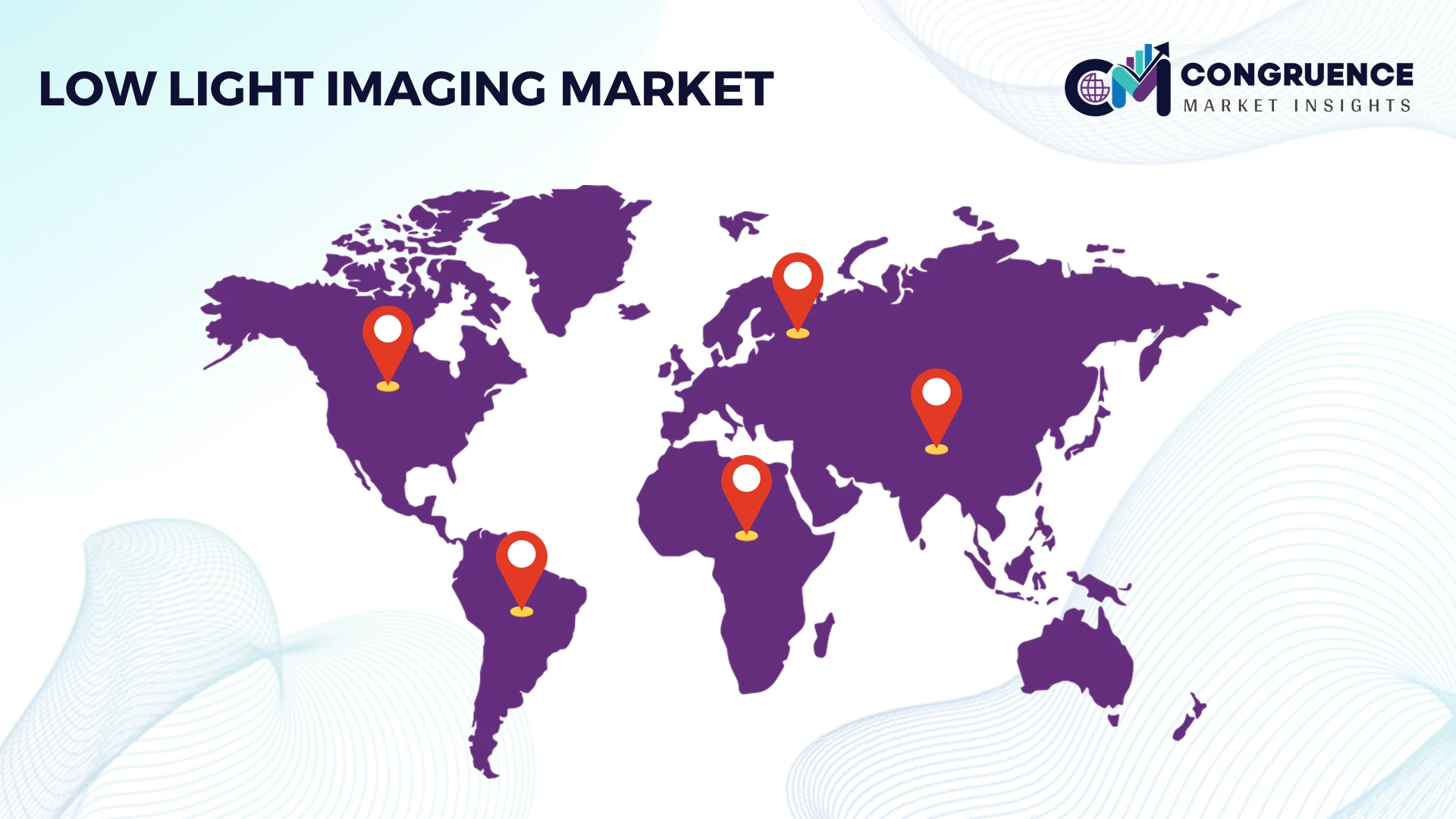
Asia-Pacific accounted for the largest market share at an estimated 43% in 2025 however, Asia-Pacific is expected to register the fastest growth, expanding at a CAGR of approximately 15% between 2026 and 2033.
North America Low Light Imaging Market
Defense-Grade Imaging and Computational Vision Integration
North America represents a major technology development and procurement center for low light imaging, particularly in defense surveillance, industrial machine vision, scientific instrumentation, and automotive perception. The United States concentrates specialized detector development through Teledyne FLIR, onsemi, and defense technology manufacturers, while Canada contributes advanced imaging research and industrial camera engineering. Defense procurement emphasizes thermal sensing, image intensification, and electro-optical surveillance systems capable of operating without conventional visible illumination. The US Department of Defense's Defense Innovation Unit supports commercial technology integration into military applications, encouraging adoption of advanced imaging components. Teledyne FLIR's Boson thermal camera family includes compact modules with 320 × 256 and 640 × 512 detector configurations, enabling integration into unmanned systems and portable equipment. Regional differentiation increasingly depends on ruggedized electronics, embedded image analytics, and domestic component qualification for security-sensitive applications.
United States Market Outlook: The United States maintains specialized expertise in thermal detectors, intensified night-vision systems, and low-noise imaging electronics. Teledyne FLIR develops uncooled thermal imaging modules, while onsemi supplies advanced automotive image sensors. The US Army's Enhanced Night Vision Goggle–Binocular program integrates image intensification and thermal imaging, improving operational flexibility across changing visibility conditions. Domestic defense procurement favors qualified suppliers capable of delivering secure manufacturing, long-term component availability, and reliable imaging performance under demanding environmental conditions.
Europe Low Light Imaging Market
Automotive Perception Standards and Precision Imaging Development
Europe's low light imaging ecosystem combines automotive electronics engineering, scientific instrumentation, defense optics, and industrial automation. Germany anchors automotive camera development and machine vision integration, while France maintains specialized infrared detector manufacturing through Lynred and established defense electro-optical capabilities. The United Kingdom contributes advanced scientific imaging and surveillance technologies. European automotive suppliers increasingly emphasize high-dynamic-range image capture, reliable object detection, and camera performance across difficult illumination transitions. The European Union's General Safety Regulation expanded mandatory vehicle safety requirements in July 2024, reinforcing demand for validated sensing architectures. Industrial manufacturers are also integrating sensitive imaging devices into automated inspection systems where controlled lighting is difficult or expensive to maintain. Europe's competitive strength lies in application-specific engineering, stringent component qualification, and integration with established automotive and industrial equipment supply chains rather than high-volume smartphone sensor fabrication.
Germany Market Outlook: Germany benefits from concentrated automotive engineering, precision optics manufacturing, and industrial machine vision expertise. Bosch, Continental, and specialized camera suppliers develop perception technologies for advanced vehicle safety functions. Germany produced approximately 4.1 million passenger cars in 2024, sustaining a substantial domestic engineering base for automotive electronics integration. Industrial manufacturers also use sensitive cameras for surface inspection, robotic guidance, and quality assurance, supporting demand for low-noise sensors and application-specific optical systems.
Asia-Pacific Low Light Imaging Market
Semiconductor Manufacturing Scale and Advanced Sensor Integration
Asia-Pacific holds the strongest manufacturing position in low light imaging, supported by semiconductor fabrication capacity, smartphone assembly, automotive electronics production, and precision optical component supply chains. Japan leads high-performance CMOS sensor engineering, South Korea specializes in stacked semiconductor architectures, and China concentrates camera module assembly and commercial surveillance equipment manufacturing. Taiwan contributes foundry capacity and semiconductor packaging expertise, strengthening the regional component ecosystem. Sony announced approximately JPY 1.7 trillion in planned imaging and sensing investment for FY2024–FY2026, reinforcing advanced manufacturing and sensor development. Chinese smartphone manufacturers integrate sophisticated nighttime photography functions into premium devices, while South Korean electronics producers emphasize compact camera modules and computational imaging. Production advantages extend beyond wafer fabrication to lens manufacturing, packaging, testing, and system assembly. Suppliers controlling these interconnected processes achieve faster product qualification and greater flexibility in sensor customization.
Japan Market Outlook: Japan remains a critical technology center through Sony Semiconductor Solutions, Canon, and specialized optical manufacturers. Sony's global image sensor sales share reached approximately 55% in 2024, demonstrating its manufacturing and technology influence. Japanese suppliers develop stacked CMOS sensors, advanced pixel structures, and high-sensitivity imaging components for smartphones, industrial equipment, and automotive applications. Domestic strengths in semiconductor materials, precision machinery, and optical engineering support sensor performance improvements and manufacturing reliability.
South America Low Light Imaging Market
Urban Security Modernization and Infrastructure Monitoring
South America's low light imaging market is primarily deployment-oriented, with demand concentrated in urban surveillance, industrial security, transportation monitoring, and environmental observation. Brazil represents the largest industrial and security equipment market in the region, supported by established electronics distribution networks and extensive infrastructure monitoring requirements. Colombia emphasizes metropolitan security and transport surveillance, while Chile deploys specialized imaging equipment across mining, logistics, and remote industrial facilities. Brazil's approximately 8.5 million square kilometers of territory creates substantial monitoring requirements across geographically dispersed infrastructure. Commercial integrators increasingly combine infrared-capable cameras with network video management and automated incident detection. However, imported semiconductor components, uneven telecommunications coverage, and public procurement constraints influence deployment economics. Equipment suppliers gain an advantage by offering locally supported camera systems, flexible connectivity, and maintenance arrangements suited to geographically distributed installations.
Brazil Market Outlook: Brazil provides the strongest commercial deployment base through metropolitan surveillance networks, industrial facilities, ports, and transportation infrastructure. Its coastline extends approximately 7,500 kilometers, creating extensive maritime and coastal monitoring requirements. Brazilian security integrators deploy infrared-capable IP cameras and thermal imaging equipment across logistics terminals, energy infrastructure, and industrial properties. Domestic system integration expertise supports equipment customization, while dependence on imported advanced image sensors encourages partnerships with international component manufacturers.
Middle East & Africa Low Light Imaging Market
Smart Infrastructure Surveillance and Critical Asset Protection
The Middle East & Africa low light imaging market is shaped by infrastructure security, border monitoring, energy facility protection, and smart-city surveillance investment. The United Arab Emirates and Saudi Arabia lead technology-intensive deployments through integrated urban monitoring, transportation infrastructure, and industrial security modernization. Israel contributes specialized electro-optical engineering and thermal imaging capabilities, while South Africa maintains established commercial security equipment distribution and industrial monitoring expertise. Dubai International Airport handled approximately 92.3 million passengers in 2024, illustrating the operational scale of transport infrastructure requiring continuous security monitoring. Oil and gas operators also use thermal imaging for perimeter protection and equipment condition assessment. Across African markets, power availability, communications reliability, and equipment servicing remain important procurement considerations. Suppliers offering ruggedized cameras, efficient edge processing, and integrated maintenance support are positioned to address these operational requirements.
United Arab Emirates Market Outlook: The UAE maintains a strong deployment position through aviation infrastructure, urban security networks, ports, and critical industrial facilities. Dubai's Roads and Transport Authority operates an extensive intelligent transport infrastructure, creating applications for nighttime traffic monitoring and incident detection. The country's Operation 300bn industrial strategy targets AED 300 billion in industrial-sector GDP contribution by 2031, supporting broader advanced technology adoption. Security integrators increasingly prioritize high-resolution infrared cameras, centralized monitoring platforms, and reliable imaging performance in demanding outdoor environments.
Market Competition Landscape
Sony, Samsung, and OmniVision compete for high-sensitivity CMOS design wins, while onsemi targets automotive perception and Teledyne FLIR specializes in thermal imaging. Sony's approximately 55% share of global image sensor sales illustrates concentration, although a verified combined top-five share specifically for low light imaging remains unavailable. Competition centers on photon sensitivity, manufacturing yield, qualification speed, and integration costs. Sony's STARVIS 2 delivers over 100% higher sensitivity under specified near-infrared conditions, while automotive sensors exceeding 120 dB dynamic range address demanding illumination transitions. Manufacturers pursue stacked semiconductor architectures, specialized packaging, and partnerships with camera module integrators. The competitive shift favors computational imaging and vertically integrated sensor processing over resolution-based differentiation. Advanced fabrication access, proprietary pixel designs, and automotive qualification requirements constrain market entry. Suppliers challenging established manufacturers must combine demonstrable imaging improvements, secure semiconductor capacity, application-specific customization, and dependable long-term component support to win demanding OEM procurement programs across global markets.
Companies Profiled in the Low Light Imaging Market Report
-
Sony Group Corporation
-
Samsung Electronics Co., Ltd.
-
OMNIVISION Technologies, Inc.
-
onsemi
-
Teledyne Technologies Incorporated
-
STMicroelectronics N.V.
-
Canon Inc.
-
Panasonic Holdings Corporation
-
Hamamatsu Photonics K.K.
-
Hikvision Digital Technology Co., Ltd.
-
Axis Communications AB
-
HENSOLDT AG
-
BAE Systems plc
-
Basler AG
Technology Insights for the Low Light Imaging Market
Current low light imaging systems increasingly use backside-illuminated CMOS sensors, stacked pixel architectures, and digital noise suppression to improve photon capture. Sony's STARVIS 2 technology delivers more than twice the sensitivity of earlier STARVIS designs under specified near-infrared conditions, representing over 100% improvement. Compared with conventional frontside illumination, backside designs reduce obstruction from pixel wiring and improve light collection. Automotive and security manufacturers integrate high-dynamic-range sensors exceeding 120 dB, improving visibility across headlights, shadows, and nighttime environments.
Emerging technologies include single-photon avalanche diodes, event-based imaging, and embedded neural processing. Sony's event-based sensor collaboration with Prophesee produced approximately 1.28 million effective pixels, enabling asynchronous detection of brightness changes with microsecond-level temporal resolution. Photon-counting architectures improve detection under extremely weak illumination, while computational imaging combines multiple exposures to suppress noise. Industrial inspection suppliers benefit from reduced redundant image processing and more precise motion detection in challenging lighting conditions.
Between 2026 and 2028, manufacturers will prioritize integrated sensor processing, lower-power imaging modules, and application-specific semiconductor designs. Smartphone manufacturers favor compact stacked architectures, while industrial equipment suppliers require predictable image quality and long-term component availability. Companies combining advanced pixel engineering, efficient processing, and scalable fabrication will strengthen competitive positioning across specialized imaging applications.
Recent Developments in the Global Low Light Imaging Market
-
September 2024: Sony Semiconductor Solutions commercialized the LYT-818 CMOS sensor, delivering 50 megapixels and 0.95-electron random noise. Its advanced conversion-gain circuitry improves nighttime smartphone photography, while single-exposure HDR strengthens image consistency across challenging illumination conditions. Source: sony-semicon.com
-
March 2025: Teledyne FLIR introduced radiometric Boson+ and Hadron 640R+ camera modules with thermal sensitivity of 20 millikelvin or better. Pixel-level temperature measurement expands industrial inspection and defense applications, enabling equipment manufacturers to integrate compact thermal sensing capabilities. Source: oem.flir.com
-
April 2025: Axis Communications announced two AI-powered PTZ cameras featuring OptimizedIR surveillance coverage extending 300 meters. ARTPEC-9 processing enables onboard analytics, while improved low-light sensitivity strengthens perimeter monitoring and reduces dependence on external illumination infrastructure. Source: axis.com
-
September 2025: OMNIVISION launched its OV50R image sensor, combining 50-megapixel resolution with up to 110 dB dynamic range. The single-exposure HDR architecture supports smartphone and action-camera video capture, improving detail retention across simultaneous bright and dark scene regions. Source: ovt.com
Scope of the Low Light Imaging Market Report
The Low Light Imaging Market Report examines technology adoption, manufacturing capabilities, and competitive developments between 2026 and 2033. Type segmentation covers CMOS Sensors, CCD Sensors, Image Intensifiers, Thermal Imaging Sensors, and Near-Infrared Imaging Systems. Application analysis evaluates Surveillance and Security, Military and Defense, Automotive Night Vision, Medical Imaging, Industrial Inspection, and Wildlife Monitoring. End-user coverage includes defense agencies, law enforcement, automotive manufacturers, healthcare providers, industrial enterprises, and security companies, distinguishing high-volume procurement from specialized imaging requirements.
Regional analysis spans North America, Europe, Asia-Pacific, South America, and the Middle East & Africa, emphasizing semiconductor supply chains, deployment infrastructure, and industrial integration. Technology assessment addresses stacked sensor architectures, photon-counting detection, computational imaging, and embedded analytics. Competitive evaluation covers 14 manufacturers and integrators, supporting investment prioritization, supplier selection, geographic expansion, and differentiated product development.
Low Light Imaging Market Report Summary
| Report Attribute/Metric | Report Details |
|---|
Market Revenue in 2025 | USD 21147.26 Million |
Market Revenue in 2033 | USD 57423.9 Million |
CAGR (2026 - 2033) | 13.3% |
Base Year | 2025 |
Forecast Period | 2026 - 2033 |
Historic Period | 2021 - 2025 |
Segments Covered | By TypeNear-Infrared Imaging Systems
By ApplicationSurveillance and Security
By End-UserDefense and Military Agencies Security and Surveillance Companies
|
Key Report Deliverable | Revenue Forecast, Growth Trends, Market Dynamics, Segmental Overview, Regional and Country-wise Analysis, Competition Landscape |
Region Covered | North America, Europe, Asia-Pacific, South America, Middle East, Africa |
Key Players Analyzed | Sony Group Corporation, Samsung Electronics Co., Ltd., OMNIVISION Technologies, Inc., onsemi, Teledyne Technologies Incorporated, STMicroelectronics N.V., Canon Inc., Panasonic Holdings Corporation, Hamamatsu Photonics K.K., Hikvision Digital Technology Co., Ltd., Axis Communications AB, HENSOLDT AG, BAE Systems plc, Basler AG |
Customization & Pricing | Available on Request (10% Customization is Free) |