
Reports
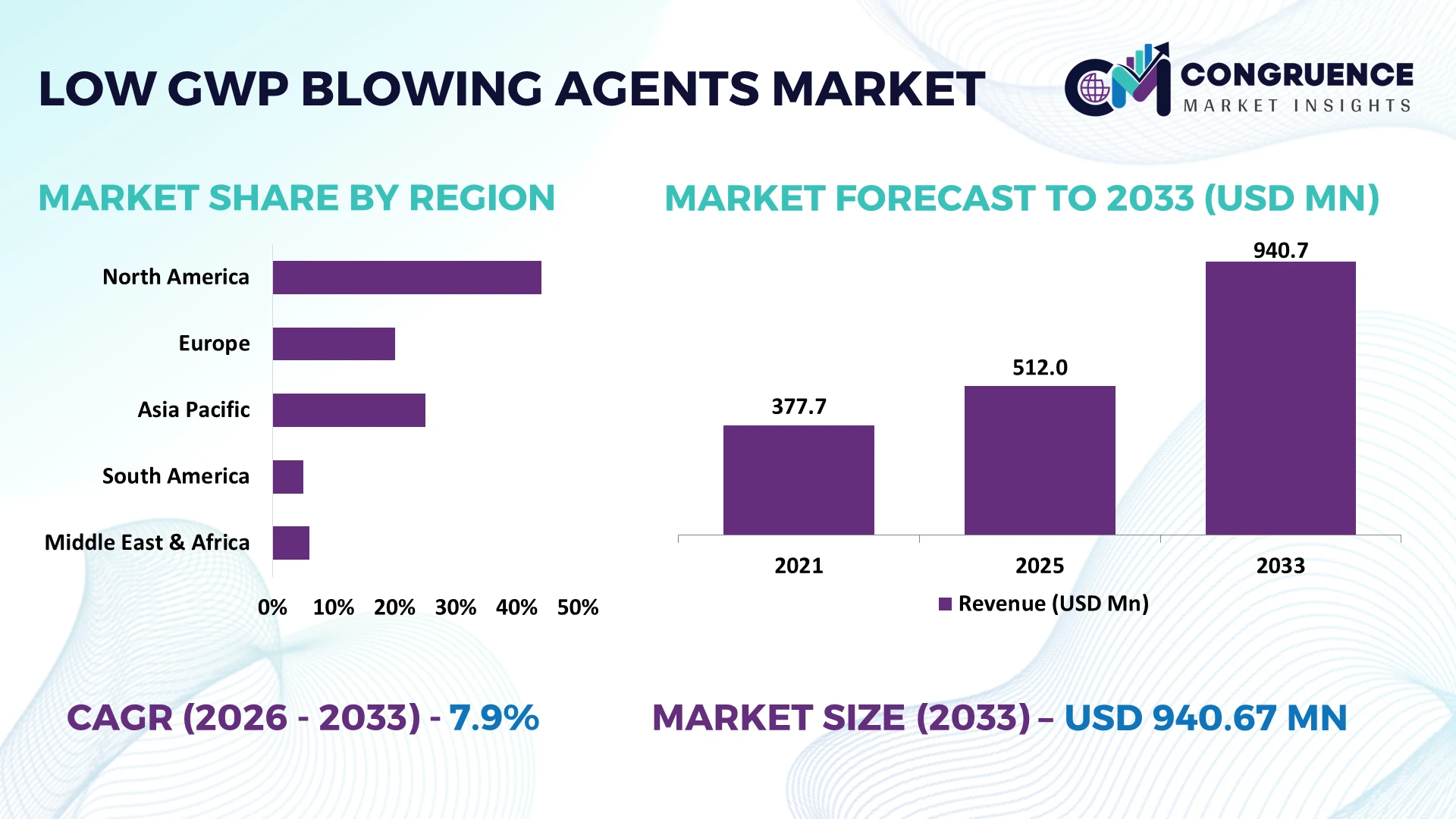
The Global Low GWP Blowing Agents Market was valued at USD 512 Million in 2025 and is anticipated to reach a value of USD 940.67 Million by 2033 expanding at a CAGR of 7.9% between 2026 and 2033. Growth is driven by the replacement of high-global-warming-potential hydrofluorocarbon (HFC) blowing agents with hydrofluoroolefins (HFOs), hydrocarbons, and other lower-impact alternatives in polyurethane insulation, extruded polystyrene, and energy-efficient building materials.
China maintains a strategic manufacturing position through its polyurethane chemicals, appliance production, and construction-material supply chains, while the United States is accelerating technology substitution through enforceable HFC restrictions. Effective January 1, 2025, US regulations established a global warming potential (GWP) limit of 150 for several foam categories, including polyurethane and extruded polystyrene products. The American Innovation and Manufacturing Act targets an 85% reduction in HFC production and consumption from baseline levels by 2036. These measures strengthen the commercial case for compliant formulations and production-line upgrades.
Strategic implication: Prioritize scalable low-GWP formulations that meet regional compliance limits while preserving insulation performance, processing efficiency, and cost competitiveness; regulatory readiness and reliable supply will be decisive procurement criteria.
Market Size & Growth: The global market is projected to expand from USD 512 million in 2025 to USD 940.67 million by 2033 at a 7.9% CAGR, supported by the shift to compliant foam-blowing technologies.
Top Growth Drivers: Regulatory substitution, with an 85% HFC phasedown target by 2036; construction insulation, accounting for an estimated 45.21% of 2026 end-use demand; and HFO adoption, representing an estimated 42.56% of 2026 product demand, shape growth priorities.
Short-Term Forecast: By 2028, US foam manufacturers face continuing compliance and product-transition requirements, increasing the urgency of formulation qualification, equipment assessment, and inventory transition.
Emerging Technologies: HFO and HCFO formulations, water-blown systems, and automated foam-process monitoring expand options for balancing thermal performance, emissions, and production consistency.
Regional Leaders: Asia-Pacific accounts for an estimated 39.74% of the 2026 market; North America and Europe remain major adoption regions as regulatory compliance and insulation performance influence purchasing.
Consumer/End-User Trends: Construction represents an estimated 45.21% of 2026 end-use demand, prioritizing insulation products that combine low-GWP chemistry with thermal performance and durability.
Pilot/Case Example: Selected panel and spray-foam formulation optimization initiatives target 40–60% reductions in blowing-agent loading, improving the potential cost-performance balance where technically validated.
Competitive Landscape: Honeywell, Chemours, Arkema, AGC, and BASF are key suppliers; a reliable individual leader market-share percentage is not established.
Regulatory & ESG Impact: US rules introduced a GWP threshold of 150 for several foam categories from January 2025, making formulation compliance a direct market-access requirement.
Investment & Funding: Conversion programs and capacity-expansion initiatives focus on low-GWP chemistry and formulation support; a reliable consolidated investment total for this specific market segment is not established.
Innovation & Future Outlook: Next-generation additives, optimized HFO blends, and improved foam-cell control are shifting competition toward integrated chemical supply, formulation expertise, and consistent manufacturing performance.
Demand for low GWP blowing agents is concentrated in rigid polyurethane insulation, extruded polystyrene boards, appliance insulation, and spray-foam systems, where thermal efficiency and regulatory compliance directly influence product selection. HFOs accounted for an estimated 42.56% of product demand in 2026, reinforcing their importance in advanced foam formulations. Recent formulation advances are improving processing stability and helping manufacturers optimize additive compatibility. Meanwhile, US restrictions effective from 2025 and evolving international HFC controls are accelerating qualification cycles and reshaping procurement strategies. Suppliers that combine compliant chemistry with dependable supply and technical support are positioned to strengthen customer retention and expand market access.
Low GWP blowing agents are becoming strategically important as chemical producers, insulation manufacturers, and appliance companies compete to meet refrigerant and foam-sector emissions requirements without compromising thermal performance or manufacturing economics. The US phasedown targets an 85% reduction in HFC production and consumption from baseline levels by 2036, while restrictions effective January 2025 established a GWP limit of 150 for several foam applications. These requirements are shifting investment toward compliant formulations, application testing, and dependable chemical supply chains.
Technology selection now determines both compliance costs and product performance. HFO-based systems offer low-GWP alternatives to legacy HFC formulations, while hydrocarbon and water-blown technologies provide additional options depending on foam chemistry, equipment, and safety requirements. Hydrocarbon systems require appropriate flammability controls, whereas HFO adoption often involves formulation qualification and material-compatibility testing. China benefits from its large-scale chemical manufacturing base; the United States places greater emphasis on regulatory compliance and advanced formulation transitions.
Over the next two to three years, manufacturers will prioritize production-line qualification, supplier diversification, and customer-specific foam optimization. For example, insulation producers can validate alternative blowing-agent blends on pilot lines before converting full-scale operations, reducing disruption during product transitions. Chemical suppliers are strengthening technical partnerships and directing investment toward application laboratories, formulation development, and regional distribution. Competitive advantage will depend on delivering compliant chemistry at industrial scale while maintaining insulation efficiency, process reliability, and predictable conversion costs.
Regulatory restrictions are accelerating the transition from high-GWP hydrofluorocarbons to HFOs, hydrocarbons, and other compliant blowing agents. US requirements introduced in January 2025 established a GWP limit of 150 for several foam applications, while the national HFC phasedown targets an 85% reduction from baseline levels by 2036. HFOs represented an estimated 42.56% of product demand in 2026, reflecting their role in advanced insulation formulations. China’s July 2026 prohibition on HCFC-141b in polyurethane foam production further strengthens substitution pressure. Chemical suppliers are expanding formulation development and technical partnerships, while foam manufacturers are prioritizing compliant products that preserve insulation performance and production consistency.
High acquisition costs remain a structural barrier to low-GWP blowing-agent adoption, particularly for smaller foam manufacturers operating with limited capital. Industry assessments indicate that HFO-based alternatives can cost approximately three times as much as conventional HFC blowing agents. Hydrocarbon systems offer lower operating costs but require engineered ventilation, gas detection, and explosion-prevention measures. Manufacturers must therefore evaluate both chemical expenditure and facility-conversion costs rather than comparing purchase prices alone. In India, price-sensitive insulation producers face additional pressure to maintain competitive finished-product pricing. Suppliers are responding through localized distribution, long-term procurement agreements, and application-specific blends. The key operational priority is reducing total conversion cost without compromising safety or foam quality.
Next-generation blowing-agent formulations create opportunities in high-performance building insulation, refrigerated appliances, cold-storage facilities, and industrial sandwich panels. HFOs accounted for an estimated 42.56% of product demand in 2026, while US restrictions impose a GWP ceiling of 150 across several foam applications. In India, expanding cold-chain infrastructure and demand for energy-efficient buildings create opportunities for tailored low-GWP formulations that balance thermal conductivity, dimensional stability, and processing cost. Manufacturers can strengthen market access by investing in pilot-scale testing, application laboratories, and partnerships with polyurethane system houses. A particularly valuable opportunity lies in optimizing blends to reduce agent consumption per unit of insulation while maintaining specified thermal resistance and production throughput.
Scaling low-GWP formulations from laboratory trials to continuous manufacturing remains a technical challenge because changes in blowing-agent chemistry affect foam-cell structure, density, thermal conductivity, and dimensional stability. With a 150 GWP regulatory ceiling applying to several US foam categories since January 2025, manufacturers must demonstrate formulation compliance while maintaining repeatable product quality. HFOs held an estimated 42.56% of product demand in 2026, but broader adoption still requires application-specific validation and reliable supply. Hydrocarbon-based systems introduce additional combustible-gas management requirements, particularly at facilities without established safety infrastructure. Companies must invest in process monitoring, operator training, automated dosing, and supplier qualification. Competitive differentiation will depend on consistent production yields and verified insulation performance across commercial-scale operations.
Regulatory Compliance Reshapes Formulation Portfolios US restrictions effective January 2025 established a GWP limit of 150 for several foam applications, accelerating reformulation and product recertification. The US HFC phasedown targets an 85% reduction from baseline levels by 2036. Manufacturers are prioritizing compliant product portfolios, laboratory validation, and customer-specific technical support to protect market access and avoid disruptive last-minute conversions.
Supply-Chain Localization Gains Strategic Importance Chemical manufacturers are reassessing sourcing concentration as regulatory transitions increase dependence on specialized low-GWP formulations. China’s established chemical-processing ecosystem supports manufacturing scale, while US producers prioritize compliant supply and formulation security. Companies are strengthening regional distribution, qualifying alternative suppliers, and negotiating longer-term procurement arrangements to reduce delivery uncertainty and protect production continuity.
Automated Foam Processing Improves Consistency Precision dosing, inline monitoring, and automated process controls are gaining importance as manufacturers introduce alternative blowing agents. Changes in gas solubility, reaction kinetics, and foam-cell formation increase the need for tighter process control. Producers are integrating process sensors and quality monitoring to reduce batch variability, improve material utilization, and accelerate qualification of new formulations without compromising insulation specifications.
Thermal Performance Drives Product Differentiation Building-envelope upgrades and stricter energy-efficiency requirements are increasing attention to foam thermal conductivity and long-term dimensional stability. The International Energy Agency identifies buildings as a major focus of global energy-efficiency improvement. Manufacturers are refining blowing-agent blends and foam structures to balance insulation performance, chemical loading, and lifecycle costs, strengthening their position in technically demanding construction and appliance applications.
Hydrofluoroolefins (HFOs) represent the leading type in the Low GWP Blowing Agents Market, accounting for an estimated 42.56% share in 2026. Their low global warming potential, strong insulation performance, and suitability for demanding foam applications support adoption where regulatory compliance and product performance must coexist. HFOs are gaining importance in polyurethane and polyisocyanurate formulations, although higher chemical costs influence purchasing decisions. Hydrocarbons remain commercially relevant in high-volume appliance insulation and panel production, where established processing systems support cost efficiency but require flammability controls.
Hydrofluorocarbons (HFCs) face substitution pressure in regulated applications, while carbon dioxide and water offer alternatives for manufacturers prioritizing lower environmental impact and reduced dependence on fluorinated chemicals. Methyl formate, methylal, and other specialized formulations serve application-specific requirements involving compatibility, processing, and foam properties. Companies are increasingly allocating formulation-development budgets toward HFO blends and alternative blowing-agent systems. The strategic priority is matching chemistry to production infrastructure, safety requirements, and end-product specifications rather than pursuing a single universal replacement.
Polyurethane foam is a central application for low-GWP blowing agents because it combines thermal insulation, lightweight construction, and adaptable processing across building envelopes, appliances, and industrial panels. Insulation-focused applications accounted for an estimated 44.82% of the low-GWP blowing-agents market in 2026, highlighting the importance of foam insulation requirements. Extruded polystyrene foam also remains relevant for rigid insulation boards, while polyisocyanurate foam serves applications requiring strong thermal resistance and fire-performance characteristics. Phenolic foam supports specialized insulation needs, and flexible foam continues to require blowing-agent selection suited to its mechanical properties and manufacturing processes.
Insulation panels and spray foam insulation offer distinct deployment pathways. Factory-produced panels enable controlled dosing and repeatable quality, whereas spray foam supports on-site application across complex building geometries. Manufacturers are responding by qualifying low-GWP formulations against density, thermal conductivity, adhesion, and dimensional-stability requirements. Investments in metering systems and application-specific product development help limit production variability. The commercial priority is to expand compliant formulations without sacrificing installation productivity or long-term insulation performance.
Building and construction represents the leading end-user segment, accounting for an estimated 45.21% of the Low GWP Blowing Agents Market in 2026. Demand is supported by rigid insulation used in walls, roofs, sandwich panels, and other building-envelope applications. Energy-efficiency standards and restrictions on high-GWP blowing agents are encouraging construction-material manufacturers to qualify alternative formulations. Automotive applications require lightweight foam components with consistent mechanical performance, while refrigeration and air conditioning depend on insulation that limits thermal losses. Appliances also represent an established market for rigid polyurethane foam, where cabinet insulation performance directly influences electricity consumption.
Packaging, furniture and bedding, and industrial insulation serve additional demand requirements involving cushioning, comfort, thermal control, and process-specific performance. Adoption patterns differ by buyer: construction manufacturers prioritize building-code compliance and insulation specifications, while appliance producers emphasize repeatable component quality and thermal efficiency. Companies are responding through customized formulations, partnerships with foam-system suppliers, and application-specific technical validation. India offers opportunities linked to commercial-building efficiency requirements and expanding cold-chain infrastructure. Competitive positioning increasingly depends on supplying compliant chemistry that meets the technical and cost requirements of each end-user industry.
Asia-Pacific accounted for the largest market share at 39.74% in 2025, while North America is projected to register the fastest growth between 2026 and 2033, driven by stringent HFC regulations, accelerated adoption of low-GWP alternatives, and increasing investment in advanced foam insulation technologie

Regulatory Conversion and Formulation Qualification Reshape Supply Chains
North America’s market is shaped by mandatory HFC transitions, advanced foam manufacturing, and demand for high-performance building insulation. The United States is the principal regulatory catalyst, with restrictions effective January 2025 setting a GWP limit of 150 for several foam applications. The federal HFC phasedown targets an 85% reduction from baseline levels by 2036, encouraging producers to qualify replacement chemistries and strengthen compliant product portfolios. Canada’s climate commitments reinforce the importance of lower-impact insulation materials, although implementation requirements differ by application. Manufacturers are investing in laboratory testing, formulation support, and production-line validation to minimize conversion disruptions. The key commercial differentiator is the ability to deliver compliant blowing agents with predictable availability, repeatable foam quality, and manageable transition costs.
United States Market Outlook: The United States leads regional regulatory implementation and advanced formulation qualification. Its established polyurethane insulation, appliance, and construction-material industries provide a substantial base for alternative blowing-agent deployment. Federal restrictions create a direct incentive to replace noncompliant formulations, while the HFC phasedown target of 85% by 2036 supports continued investment in lower-GWP chemistry. Suppliers that combine application testing, reliable distribution, and manufacturing support are positioned to capture demand from industrial customers.
Environmental Compliance Accelerates Chemical Substitution
Europe’s market is shaped by climate regulation, building-energy performance requirements, and chemical-sector innovation. The European Union’s revised F-gas framework strengthens the transition away from high-GWP fluorinated gases, while the Energy Performance of Buildings Directive supports improvements in building efficiency. These policies influence insulation manufacturers’ selection of blowing agents and increase the importance of documented environmental performance. Germany, France, and Italy provide established construction-material and industrial manufacturing bases, creating opportunities for technically differentiated formulations. However, manufacturers must navigate application-specific safety requirements, product testing, and changing compliance obligations. Suppliers are responding through formulation redesign, technical collaboration with foam producers, and closer integration between chemical development and downstream processing. Commercial success depends on meeting environmental requirements without undermining thermal performance or production economics.
Germany Market Outlook: Germany benefits from a strong industrial base spanning construction materials, chemical processing, refrigeration equipment, and energy-efficient building systems. Building renovation and insulation modernization create opportunities for low-GWP formulations that meet demanding thermal-performance specifications. Manufacturers serving German customers must align product qualification, workplace safety, and environmental documentation with stringent industrial expectations. Investment in application engineering and dependable technical support provides suppliers with a competitive advantage in this quality-sensitive market.
Manufacturing Scale Supports Faster Formulation Transition
Asia-Pacific combines large-scale chemical production, expanding appliance manufacturing, and sustained construction-material demand. China anchors regional manufacturing capacity, while Japan, South Korea, and India contribute through advanced materials, electronics and appliance production, and infrastructure development. China’s manufacturing ecosystem supports scale and supplier integration, but regulatory changes are also reshaping product portfolios. In July 2026, China prohibited the use of HCFC-141b in polyurethane foam production, strengthening the shift toward alternatives. Manufacturers are adapting through formulation substitution, process validation, and supplier qualification. Japan and South Korea emphasize technical performance and manufacturing consistency, whereas Indian producers place greater weight on cost-performance balance and localized availability. The region’s strategic advantage lies in integrating chemical production with downstream foam manufacturing, although technical capabilities and compliance readiness vary by country.
China Market Outlook: China combines extensive polyurethane processing, appliance production, and chemical-manufacturing infrastructure. Its prohibition of HCFC-141b in polyurethane foam production from July 2026 creates a direct requirement for compliant alternative formulations. Domestic chemical suppliers can leverage established industrial networks to scale production and support foam manufacturers through conversion. Investment priorities center on formulation reliability, competitive input costs, and maintaining product quality across high-volume manufacturing operations.
Construction Modernization Meets Uneven Supply Infrastructure
South America’s market is supported by building insulation requirements, refrigeration demand, appliance manufacturing, and industrial modernization, with Brazil representing the region’s principal industrial base. Adoption depends on the availability of competitively priced blowing agents, access to technical formulation support, and the capacity of foam manufacturers to modify existing equipment. Brazil’s construction and refrigeration sectors offer opportunities for compliant polyurethane systems, while Argentina and Chile provide more selective demand linked to industrial applications and building projects. Dependence on imported specialty chemicals can expose manufacturers to currency fluctuations, shipping delays, and procurement volatility. Suppliers are responding through regional distribution partnerships, technical-service arrangements, and targeted customer qualification programs. The strongest opportunities lie in applications where improved thermal performance offsets the additional cost of conversion and where customers can secure consistent supply.
Brazil Market Outlook: Brazil offers the region’s broadest industrial platform for low-GWP blowing-agent adoption, supported by construction materials, refrigeration, appliances, and polyurethane processing. Manufacturers serving Brazilian customers must balance environmental compliance with price sensitivity and supply reliability. Local distribution partnerships and application-specific formulation support can reduce procurement friction and accelerate product qualification. Suppliers that establish dependable delivery networks and demonstrate measurable insulation performance are better positioned to expand across industrial customer segments.
Infrastructure Investment Elevates Insulation Performance Requirements
The Middle East and Africa market is shaped by commercial construction, cold-chain expansion, refrigeration demand, and investment in industrial infrastructure. Gulf economies require insulation systems that withstand high ambient temperatures while limiting cooling-energy consumption, creating opportunities for rigid polyurethane panels and spray-foam applications. South Africa provides an additional industrial base through construction, refrigeration, and manufacturing activity. Adoption remains uneven because specialty chemical availability, technical expertise, and conversion financing differ substantially across markets. Suppliers are focusing on distributor partnerships, localized technical support, and formulations designed for demanding thermal conditions. The commercial opportunity extends beyond chemical substitution: consistent foam quality can improve building-envelope performance and refrigerated-storage efficiency. Companies must nevertheless account for project-specific safety standards, supply logistics, and the cost of qualifying alternative blowing agents before expanding production commitments.
Saudi Arabia Market Outlook: Saudi Arabia’s construction pipeline, industrial diversification, and investment in logistics and temperature-controlled facilities create opportunities for low-GWP insulation materials. High cooling loads increase the importance of effective thermal envelopes and reliable refrigeration systems. Suppliers can strengthen their position through partnerships with panel manufacturers, construction-material producers, and insulation contractors. Technical support tailored to high-temperature operating conditions and consistent chemical availability will be essential to winning large industrial and infrastructure projects.
The Low GWP Blowing Agents Market features global chemical leaders Honeywell, Chemours, Arkema, and BASF competing through formulation technology, product qualification, and supply reliability. AGC and regional chemical manufacturers add pressure through specialized fluorochemical capabilities and localized customer relationships. Competition centers on replacing legacy HFCs while preserving foam insulation performance, production efficiency, and regulatory compliance. HFOs represented an estimated 42.56% of product demand in 2026, reinforcing the importance of advanced formulation portfolios. US restrictions imposing a GWP limit of 150 across several foam applications intensify competitive pressure on product development and technical support. Large suppliers leverage established distribution networks and application laboratories, while regional producers compete on procurement flexibility, cost, and customer responsiveness. Companies are investing in alternative formulations, technical partnerships, and manufacturing capabilities to secure long-term supply agreements. High development costs, qualification requirements, and chemical-handling infrastructure create entry barriers. Winning requires compliant chemistry, dependable supply, competitive conversion economics, and measurable performance across industrial-scale foam production.
Honeywell International Inc.
The Chemours Company
Arkema S.A.
BASF SE
AGC Inc.
Daikin Industries, Ltd.
Solvay S.A.
Foam Supplies, Inc.
Harp International Ltd.
A-Gas International
Linde plc
Air Liquide
Koura Global
HARP International Ltd.
Hydrofluoroolefin (HFO) technology is reshaping foam manufacturing by combining low global warming potential with insulation performance and compatibility with established production equipment. Arkema’s Forane FBA 1233zd has a reported GWP of 1, representing a 99.9% reduction compared with legacy HFC alternatives. This enables manufacturers to reduce the climate impact of blowing agents without automatically replacing entire processing lines. However, formulation validation remains essential because reaction kinetics, foam-cell structure, and thermal conductivity vary by application.
Hydrocarbon blowing systems and water-based technologies provide alternative pathways, particularly where raw-material economics and established process capabilities influence purchasing. Hydrocarbons can lower chemical costs but require flammability controls; water-blown systems avoid fluorinated blowing agents but demand careful management of foam density and thermal performance. Adoption varies substantially by product category, and a single reliable global deployment percentage is not established. Automated dosing, temperature monitoring, and formulation-control systems help manufacturers improve consistency and reduce material waste.
Between 2026 and 2028, investment priorities will increasingly favor scalable HFO production, optimized blends, and digital process control. Arkema’s 15-kilotonne annual 1233zd production unit demonstrates industrial-scale capacity expansion. Global chemical leaders with proprietary formulations and technical-service networks benefit from this shift, while smaller producers must prioritize partnerships and application expertise. Companies that qualify alternatives early can protect market access, improve production reliability, and reduce disruption from changing environmental requirements.
The Low GWP Blowing Agents Market Report examines industry structure, technology adoption, regulatory transitions, and competitive positioning across the global market. Type coverage includes hydrofluoroolefins (HFOs), hydrocarbons, hydrofluorocarbons (HFCs), carbon dioxide, water, methyl formate, and methylal. Application analysis covers polyurethane foam, extruded polystyrene foam, polyisocyanurate foam, phenolic foam, flexible foam, insulation panels, and spray foam insulation. End-user coverage spans building and construction, automotive, refrigeration and air conditioning, appliances, packaging, furniture and bedding, and industrial insulation.
Regional analysis evaluates North America, Europe, Asia-Pacific, South America, and the Middle East and Africa, highlighting country-level manufacturing capabilities, regulatory requirements, supply-chain conditions, and adoption patterns. The report assesses HFO formulation advances, alternative blowing-agent technologies, production expansion, and supplier strategies. Competitive analysis supports supplier benchmarking, investment prioritization, market-entry decisions, capacity planning, and expansion strategies for 2026–2033.
| Report Attribute/Metric | Report Details |
|---|---|
Market Revenue in 2025 | USD 512 Million |
Market Revenue in 2033 | USD 940.67 Million |
CAGR (2026 - 2033) | 7.9% |
Base Year | 2025 |
Forecast Period | 2026 - 2033 |
Historic Period | 2021 - 2025 |
Segments Covered | By Type
By Application
By End-User
|
Key Report Deliverable | Revenue Forecast, Growth Trends, Market Dynamics, Segmental Overview, Regional and Country-wise Analysis, Competition Landscape |
Region Covered | North America, Europe, Asia-Pacific, South America, Middle East, Africa |
Key Players Analyzed | Honeywell International Inc., The Chemours Company, Arkema S.A., BASF SE, AGC Inc., Daikin Industries, Ltd., Solvay S.A., Foam Supplies, Inc., Harp International Ltd., A-Gas International, Linde plc, Air Liquide, Koura Global, HARP International Ltd |
Customization & Pricing | Available on Request (10% Customization is Free) |




