
Reports
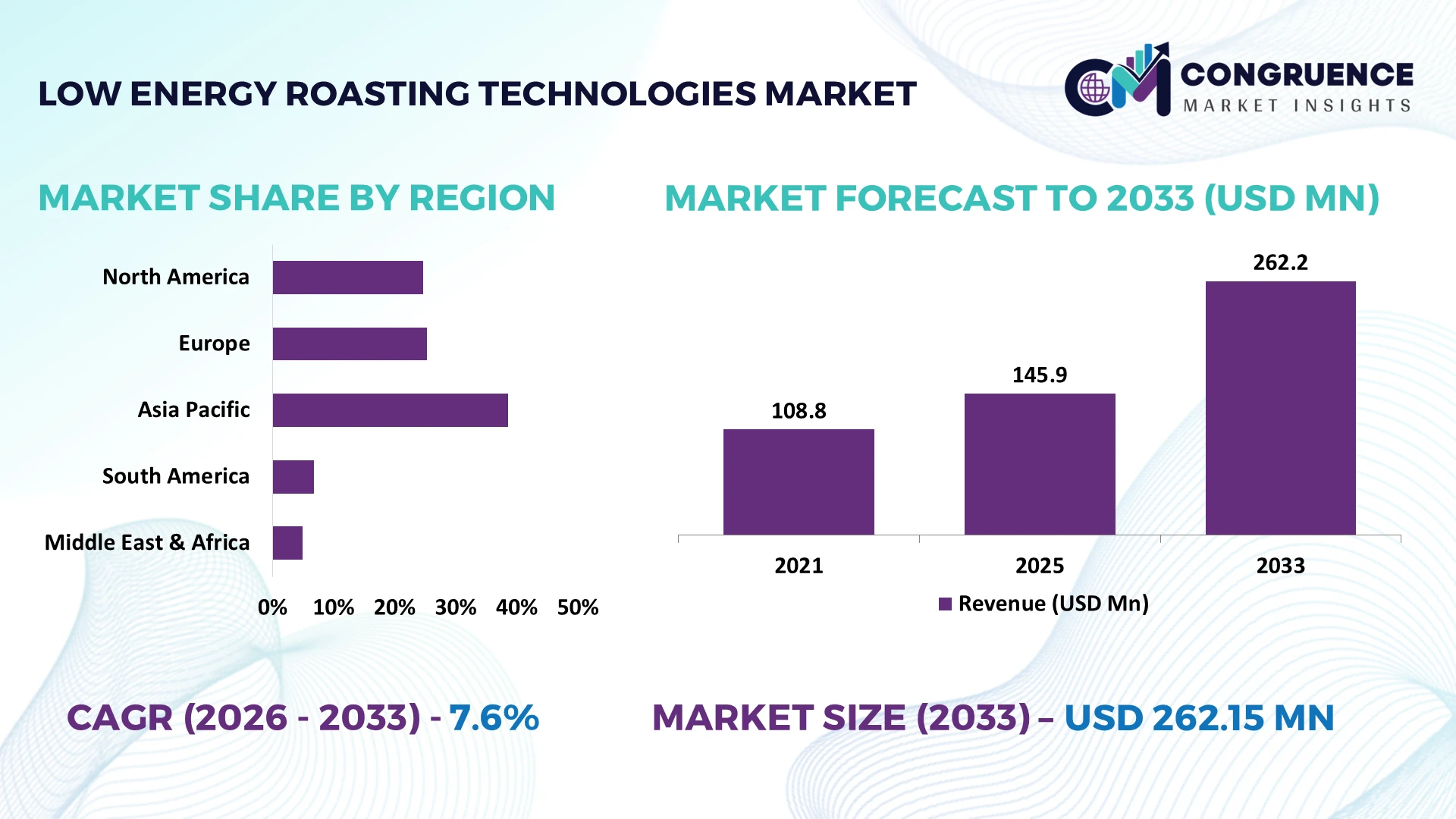
The Global Low-Energy Roasting Technologies Market was valued at USD 145.9 Million in 2025 and is anticipated to reach a value of USD 262.2 Million by 2033 expanding at a CAGR of 7.6% between 2026 and 2033. Growth is driven by industrial electrification, waste heat recovery, rising thermal processing costs, and the adoption of energy-efficient roasting systems across food processing, metallurgy, and mineral processing industries.
China is positioned as a leading market, supported by its extensive metallurgical and food processing infrastructure. The country accounts for approximately 53% of global crude steel production, compared with India's approximately 8%, providing a substantial industrial thermal processing base. China's industrial energy conservation policies and carbon neutrality targets for 2060 are accelerating investments in electrified furnaces, regenerative heating, and automated temperature control technologies.
Strategic investments in modular roasting systems, thermal energy recovery, and process automation will strengthen equipment manufacturers' competitiveness across energy-intensive industrial applications.
Market Size & Growth: USD 145.9 million in 2025, reaching USD 262.2 million by 2033 at 7.6% CAGR, supported by industrial electrification.
Top Growth Drivers: Energy consumption reduction (20–35%), waste heat recovery (15–30%), and process efficiency improvement (10–20%).
Short-Term Forecast: By 2028, advanced roasting installations target 15–25% lower specific energy consumption.
Emerging Technologies: Microwave-assisted roasting, infrared heating, and AI-enabled thermal optimization target 10–25% efficiency improvements.
Regional Leaders: Indicative 2033 projections include Asia Pacific (USD 110.1 million; electrification), Europe (USD 65.6 million; decarbonization), and North America (USD 57.7 million; automation).
Consumer/End-User Trends: Industrial processors increasingly prioritize equipment delivering 20–30% energy savings and consistent product quality.
Pilot/Case Example: An illustrative 2025 regenerative roasting retrofit targets 25% lower thermal energy consumption.
Competitive Landscape: Bühler, GEA Group, Metso, FLSmidth, and ANDRITZ compete across five major equipment portfolios; individual market shares remain unverified.
Regulatory & ESG Impact: The European Union's 55% emissions reduction target for 2030 strengthens industrial decarbonization investments.
Investment & Funding: An indicative USD 10 million investment program supports electrification, demonstration facilities, and technology partnerships.
Innovation & Future Outlook: Hybrid heating and intelligent process controls target 15–30% reductions in thermal losses.
The Low-Energy Roasting Technologies Market is evolving through increased deployment of energy-efficient thermal processing equipment across coffee roasting, grain processing, specialty chemicals, and mineral beneficiation. Hybrid heating systems and advanced heat exchangers offer targeted energy savings of 20–30%, while industrial decarbonization policies encourage equipment modernization. These developments are repositioning roasting technologies as strategic assets for operational efficiency and sustainable manufacturing.
Low-energy roasting technologies are becoming strategically important as manufacturers integrate thermal efficiency into production economics, industrial decarbonization, and long-term capital expenditure planning. The transition from fossil fuel-dependent heating toward electrified and hybrid thermal systems is reshaping equipment procurement, particularly across energy-intensive processing industries. Manufacturers increasingly evaluate roasting equipment through lifecycle energy costs rather than initial acquisition expenditure.
Compared with conventional direct-fired roasting systems, advanced regenerative and hybrid configurations target 20–35% lower energy consumption through exhaust heat recovery and controlled thermal distribution. China benefits from extensive industrial manufacturing capacity, while Germany emphasizes precision heating, energy management, and regulatory compliance. Between 2027 and 2029, modernization projects are expected to prioritize retrofits targeting 15–25% improvements in specific energy consumption without requiring complete production-line replacement.
A practical deployment involves integrating exhaust heat exchangers into continuous food roasting lines to preheat incoming process air and reduce burner loads. Equipment manufacturers are prioritizing modular engineering, application-specific thermal controls, and partnerships with industrial automation providers. Competitive leadership will increasingly depend on delivering verifiable energy savings while maintaining throughput, product consistency, and compatibility with existing manufacturing infrastructure.
Rising industrial heating costs are accelerating the replacement of conventional roasting equipment with regenerative, electrified, and hybrid thermal processing systems. Advanced roasting configurations target energy consumption reductions of 20–35%, while exhaust heat recovery systems offer potential thermal energy savings of 15–30%. Automated temperature regulation also targets 10–15% reductions in avoidable process energy losses. Germany's Energy Efficiency Act strengthens industrial energy management and waste heat utilization requirements, encouraging manufacturers to reassess thermal processing infrastructure. Equipment suppliers are responding through investments in high-efficiency burners, regenerative heat exchangers, and intelligent combustion controls. The strongest commercial advantage lies in reducing energy expenditure per unit of processed material without compromising production throughput.
Advanced roasting systems face adoption constraints arising from specialized heating components, electrical infrastructure requirements, and high initial capital expenditure. Illustrative procurement scenarios indicate that electrified and hybrid roasting equipment carries a 20–40% capital cost premium over conventional configurations, while electrical upgrades can represent 10–20% of installation expenditure. Customized thermal integration can add another 5–15% to project costs. India's industrial manufacturing clusters face uneven access to reliable, competitively priced electricity, limiting immediate conversion from conventional fuel-based systems. Equipment manufacturers are mitigating these constraints through localized component sourcing, modular retrofit packages, and flexible hybrid heating configurations. Commercial viability depends heavily on local electricity-to-fuel price ratios rather than equipment efficiency alone.
Microwave-assisted heating, infrared roasting, and AI-enabled thermal management create opportunities to address applications where conventional systems experience uneven heat distribution and excessive processing times. Application-specific engineering targets include 20–40% shorter roasting cycles, 15–30% lower thermal energy consumption, and 10–20% reductions in processing losses. Japan's industrial green transformation initiatives support electrification and advanced energy management technologies, strengthening opportunities for specialized thermal processing equipment. Manufacturers are positioning through research partnerships, sensor-integrated roasting chambers, and application-specific demonstration facilities. Emerging commercial opportunities also include performance-based equipment contracts that monetize verified energy savings. Selective heating technologies offer particularly attractive advantages for high-value materials where processing uniformity directly influences product yield and profitability.
Scaling low-energy roasting technologies from controlled demonstrations to continuous industrial production requires precise management of material moisture, residence time, temperature distribution, and equipment utilization. Engineering scenarios incorporating variable feedstock conditions allow for 5–15% deviations from targeted energy performance, while poorly optimized thermal transitions can increase energy consumption by 10–20%. Manufacturers consequently target temperature-related product rejection reductions of 5–10% through advanced monitoring systems. Australia's mineral processing industry illustrates the operational complexity of handling heterogeneous feedstocks under continuous thermal treatment conditions. Equipment developers must invest in adaptive process controls, industrial-scale validation, predictive maintenance, and operator training. Long-term competitiveness depends on demonstrating sustained energy efficiency under variable production conditions rather than achieving isolated laboratory performance benchmarks.
Modular Retrofitting Gains Industrial Traction: Industrial processors are replacing complete equipment overhauls with modular roasting upgrades, targeting 15–25% lower installation expenditure and 20–30% shorter commissioning periods. Equipment manufacturers are developing standardized retrofit assemblies and interchangeable heating modules, allowing existing production facilities to improve thermal performance while minimizing operational interruptions and capital commitments.
Continuous Processing Replaces Batch Operations: Food and mineral processing companies are transitioning toward continuous roasting configurations, targeting 15–25% higher throughput and 10–20% shorter material handling cycles. Manufacturers are expanding automated feeding, discharge, and conveyor-integrated roasting capabilities. Continuous operation also reduces repeated heating and cooling cycles, improving equipment utilization independently of heating technology.
Precision Monitoring Strengthens Quality Control: Industrial roasting operators are integrating real-time moisture sensors, optical monitoring, and automated product inspection, targeting 10–15% lower rejection rates and 15–20% reductions in manual inspection requirements. Labor shortages across European manufacturing facilities are encouraging equipment suppliers to integrate closed-loop quality monitoring and remote diagnostic capabilities into standardized equipment packages.
Localized Manufacturing Reshapes Equipment Supply: Supply-chain disruptions and specialized component availability are encouraging roasting equipment manufacturers to regionalize procurement and assembly operations. Localization strategies target 15–25% shorter component delivery periods and 10–15% lower maintenance turnaround times. Suppliers are expanding regional service partnerships, standardized spare-parts inventories, and domestic fabrication capabilities to strengthen aftermarket competitiveness and equipment availability.
Regenerative Roasting Technologies are assessed as the leading segment, with an indicative market share of 35.2% in 2025, supported by established industrial heating infrastructure, exhaust heat utilization, and compatibility with existing production facilities. Regenerative systems offer targeted fuel consumption reductions of 20–35% compared with conventional direct-fired configurations, making them commercially attractive for continuous thermal processing operations. Their scalability and relatively straightforward integration strengthen demand across established manufacturing facilities in China, Germany, and the United States.
Microwave-Assisted Roasting Technologies represent the projected fastest-growing segment, supported by selective material heating, shorter processing cycles, and targeted processing time reductions of 20–40%. Infrared Roasting Technologies are gaining traction in surface-sensitive food processing applications, while Electric Roasting Technologies support industrial electrification and precise temperature regulation. Hybrid Roasting Technologies provide operational flexibility by combining complementary heating mechanisms. Equipment manufacturers are prioritizing modular heating platforms, application-specific process validation, and interchangeable thermal components, enabling customers to select configurations aligned with production capacity, energy availability, and product quality requirements.
Food Processing is assessed as the leading application, accounting for an indicative 42.5% market share in 2025, supported by extensive roasting requirements across coffee, cocoa, nuts, cereals, and other agricultural products. Commercial food processors prioritize equipment configurations targeting 15–25% lower energy consumption while maintaining flavor development, moisture control, and product uniformity. Germany, Brazil, and the United States provide established deployment opportunities through industrial coffee roasting facilities and diversified food manufacturing infrastructure.
Mineral Processing and Beneficiation represents the projected fastest-growing application, driven by the modernization of ore pretreatment and energy-intensive mineral conversion processes. Advanced roasting configurations target 15–30% reductions in specific thermal energy requirements, improving processing economics for lower-grade feedstocks. Metallurgical Processing maintains established demand through continuous industrial furnace operations, while Chemical Processing and Other Industrial Applications require specialized temperature profiles and controlled reaction environments. Equipment manufacturers are expanding application-specific engineering, automated material handling, and integrated process controls to address varying throughput requirements and strengthen equipment performance across diverse operating conditions.
Food and Beverage Manufacturers are assessed as the leading end-user segment, holding an indicative 39.8% market share in 2025, supported by recurring roasting requirements, established processing networks, and stringent product consistency standards. Large-scale manufacturers prioritize equipment configurations targeting 20–30% lower thermal energy consumption across continuous production lines. Established food processing companies also favor roasting platforms offering standardized operating parameters, sanitation compatibility, and integration with automated packaging infrastructure.
Mining and Mineral Processing Companies represent the projected fastest-growing end-user group as operators modernize thermal pretreatment facilities and pursue more efficient mineral extraction processes. Equipment procurement strategies increasingly target 15–25% improvements in specific energy consumption, particularly across energy-intensive processing operations. Metal and Metallurgical Manufacturers remain important buyers of high-capacity roasting systems, while Chemical Manufacturers require specialized thermal reaction capabilities. Research Institutions and Other Industrial Users support technology validation and niche deployments. Equipment suppliers are adjusting competitive strategies through customized engineering, pilot-scale testing partnerships, lifecycle maintenance contracts, and performance-based pricing arrangements that align capital investment with operational savings.
Asia Pacific accounted for the largest market share at 38.5% in 2025 however, North America is expected to register the fastest growth, expanding at a CAGR of 8.9% between 2026 and 2033.
North America accounted for 24.6% of the global Low-Energy Roasting Technologies Market in 2025, supported by established food processing infrastructure, advanced industrial automation, and increasing investment in energy-efficient manufacturing equipment. Commercial coffee roasters, agricultural processors, and metallurgical companies are integrating regenerative heating systems, automated temperature controls, and exhaust heat recovery technologies to improve production economics. Advanced roasting equipment installations target energy consumption reductions of 20–30%, strengthening the commercial viability of manufacturing facility modernization. The United States and Canada benefit from established industrial engineering capabilities and extensive equipment distribution networks. Industrial decarbonization initiatives are also encouraging the adoption of electrified thermal processing configurations. Equipment manufacturers are expanding aftermarket services, modular retrofit solutions, and digital monitoring capabilities to address rising maintenance costs while improving equipment utilization across continuous production facilities.
U.S. Market Outlook: The United States dominates regional demand through its extensive commercial food processing industry, specialty coffee manufacturing facilities, and advanced metallurgical infrastructure. The U.S. Department of Energy's USD 6 billion Industrial Demonstrations Program, announced in 2024, reinforces broader investment momentum in industrial decarbonization. Equipment suppliers are targeting high-capacity manufacturing facilities through customized thermal engineering, automated process optimization, and performance-based maintenance services.
Europe accounted for 25.2% of the global Low-Energy Roasting Technologies Market in 2025, driven by stringent industrial energy efficiency requirements, established equipment manufacturing capabilities, and extensive food processing infrastructure. Germany, Italy, France, and the Netherlands represent important deployment markets for regenerative roasting systems, electric heating configurations, and precision-controlled thermal processing equipment. The European Union's target of reducing net greenhouse gas emissions by at least 55% by 2030 strengthens investment incentives for industrial equipment modernization. Commercial roasting facilities are increasingly prioritizing exhaust heat utilization, automated production monitoring, and reduced dependence on conventional fossil fuel heating. European equipment manufacturers are responding through modular electrification platforms, specialized heat exchanger designs, and partnerships with industrial automation providers. Lifecycle operating costs and documented environmental performance are becoming decisive factors in equipment procurement.
Germany Market Outlook: Germany maintains a strong competitive position through its advanced mechanical engineering industry, industrial furnace manufacturing capabilities, and established commercial food processing infrastructure. The country's Energy Efficiency Act targets a 26.5% reduction in final energy consumption by 2030 compared with 2008 levels. These requirements strengthen demand for precision roasting equipment, industrial waste heat recovery systems, and integrated energy management solutions.
Asia Pacific accounted for 38.5% of the global Low-Energy Roasting Technologies Market in 2025, supported by extensive mineral processing operations, metallurgical production capacity, and expanding commercial food manufacturing infrastructure. China, India, Japan, and South Korea are strengthening demand for energy-efficient roasting equipment through industrial modernization and production automation. India produced approximately 164.9 million tonnes of crude steel in 2025, reflecting the region's expanding energy-intensive industrial processing base. Food manufacturers are adopting continuous roasting configurations, while mineral processors are evaluating advanced thermal pretreatment systems to improve material conversion efficiency. Regional equipment suppliers benefit from competitive fabrication costs, established component manufacturing networks, and increasing domestic engineering capabilities. Manufacturers are expanding localized production, application-specific equipment portfolios, and industrial service partnerships to address diverse operating requirements across established and emerging manufacturing clusters.
China Market Outlook: China leads regional demand through its extensive industrial furnace manufacturing ecosystem, mineral refining infrastructure, and large-scale agricultural processing facilities. The country contributes approximately 53% of global crude steel production, providing a substantial industrial thermal processing base. Domestic manufacturers are strengthening competitiveness through automated roasting equipment, localized heating component production, and integrated thermal management technologies aligned with national carbon neutrality objectives for 2060.
South America accounted for 6.8% of the global Low-Energy Roasting Technologies Market in 2025, supported by extensive coffee production, agricultural commodity processing, and mineral extraction activities. Brazil, Colombia, Chile, and Peru represent strategically important markets for commercial food roasting equipment and energy-efficient mineral pretreatment technologies. Chile contributes approximately one-quarter of global mined copper production, providing a substantial industrial base for mineral processing equipment modernization. Commercial processors are prioritizing roasting configurations targeting 15–25% lower energy consumption while maintaining product quality and processing capacity. However, imported equipment dependency, financing limitations, and uneven industrial infrastructure constrain widespread deployment. Equipment suppliers are addressing these challenges through modular roasting platforms, regional distribution partnerships, and localized maintenance services. Flexible equipment configurations are particularly important for processors managing seasonal production volumes and fluctuating feedstock availability.
Brazil Market Outlook: Brazil dominates regional demand through its extensive coffee manufacturing infrastructure, agricultural processing capabilities, and established metallurgical industry. The country contributes approximately one-third of global coffee production, creating substantial opportunities for commercial roasting equipment modernization. Domestic processors are prioritizing automated roasting profiles, improved thermal insulation, and continuous production systems, while equipment suppliers are expanding localized technical support and application-specific engineering capabilities.
Middle East & Africa accounted for 4.9% of the global Low-Energy Roasting Technologies Market in 2025, supported by industrial diversification, mineral processing investments, and expanding commercial food manufacturing activities. Saudi Arabia, the United Arab Emirates, South Africa, and Morocco represent important markets for advanced roasting and thermal processing equipment. Saudi Arabia's National Industrial Strategy targets approximately 36,000 industrial facilities by 2035, creating broader opportunities for energy-efficient manufacturing infrastructure. Food processors are adopting automated roasting equipment to strengthen domestic production capabilities, while mining companies are evaluating efficient thermal pretreatment technologies. Limited domestic manufacturing of specialized heating components and dependence on imported equipment remain important operational considerations. Equipment manufacturers are expanding regional distribution networks, technical training programs, and flexible installation packages to improve equipment accessibility and strengthen long-term service capabilities.
Saudi Arabia Market Outlook: Saudi Arabia is emerging as a strategically significant market through investments in mineral beneficiation, domestic food processing, and industrial manufacturing infrastructure. The country's estimated USD 2.5 trillion mineral resource potential strengthens long-term opportunities for advanced mineral processing technologies. Industrial equipment suppliers are targeting integrated manufacturing developments through customized roasting systems, local service partnerships, and energy-efficient thermal processing solutions aligned with Saudi Vision 2030.
Bühler, GEA Group, Metso, FLSmidth, and PROBAT compete through differentiated roasting technologies, industrial engineering capabilities, and application-specific equipment portfolios. The market exhibits moderate concentration, with the top five players estimated to collectively account for 42.5% of global market share. Established manufacturers compete against specialized thermal equipment suppliers through integrated process engineering, customized heating configurations, and extensive aftermarket networks. Advanced equipment designs target 20–35% energy savings, while modular retrofits offer potential installation cost reductions of 15–25%. Bühler and PROBAT emphasize food processing automation, whereas Metso and FLSmidth focus on mineral processing efficiency and industrial thermal optimization. GEA strengthens competitiveness through integrated processing systems and sustainable manufacturing technologies. Competition is shifting from standalone roasting equipment toward integrated thermal management platforms incorporating automated monitoring and lifecycle services. High engineering costs, application validation requirements, and established customer relationships restrict market entry. Winning requires demonstrable energy savings, scalable equipment architecture, reliable integration, and localized technical support.
Bühler Group
GEA Group AG
Metso Corporation
FLSmidth & Co. A/S
PROBAT SE
ANDRITZ AG
thyssenkrupp Polysius GmbH
Diedrich Roasters
Loring Smart Roast, Inc.
Neuhaus Neotec
Brambati S.p.A.
Joper Roasters
Regenerative roasting technologies remain commercially established across industrial thermal processing applications, utilizing exhaust heat recovery and optimized combustion to target 20–35% lower fuel consumption than conventional direct-fired equipment. Electric roasting systems offer precise temperature regulation and target 10–20% reductions in avoidable thermal losses. Commercial deployment remains concentrated in established food manufacturing facilities and industrial processing plants, where equipment reliability and consistent throughput influence procurement decisions.
Microwave-assisted roasting and infrared heating represent emerging alternatives, offering targeted processing cycle reductions of 20–40% and energy savings of 15–30%, depending on material characteristics. Adoption remains concentrated in specialized production lines and pilot-scale installations. Hybrid roasting configurations combine complementary heating mechanisms, enabling manufacturers to optimize thermal penetration, surface treatment, and product uniformity. Specialized equipment developers benefit competitively through application-specific engineering and differentiated process capabilities.
Between 2026 and 2028, intelligent thermal management platforms will increasingly integrate moisture sensors, predictive maintenance, automated temperature adjustment, and real-time energy monitoring. These configurations target 10–15% reductions in processing losses and 15–20% improvements in maintenance efficiency. Equipment manufacturers integrating digital controls with modular heating architectures will strengthen customer retention through lifecycle services. Industrial buyers prioritizing scalable, validated technologies gain operational flexibility while reducing exposure to fluctuating energy prices and increasingly stringent industrial environmental requirements.
July 2026, Bühler introduced Lucent, an industrial cocoa nib roaster delivering at least 20% lower energy consumption and up to 20% higher throughput than its Tornado predecessor. Integrated heat recovery and predictive controls strengthen processing efficiency and production consistency. Source: buhlergroup.com
March 2025, PROBAT introduced the NEPTUNE 4000 industrial drum roaster with a processing capacity of four tonnes of green coffee per hour. Its integrated thermal energy recovery system supports efficient production, while modular equipment architecture strengthens large-scale manufacturing capabilities. Source: probat.com
November 2024, Metso launched its next-generation Fluid Bed Roaster, integrating enhanced reactor components and digital process controls. The system supports two feed preparation pathways, improving feedstock flexibility, thermal energy recovery, plant availability, and operating economics across industrial mineral processing applications. Source: metso.com
February 2024, Neuhaus Neotec commissioned an industrial electric coffee roasting system at Canada's Café William production facility, delivering hourly processing capacity of 3–3.5 tonnes. Hydropower-based operation reduces fossil fuel dependency and demonstrates commercial feasibility for industrial-scale coffee roasting electrification. Source: neuhaus-neotec.com
The Low-Energy Roasting Technologies Market Report provides comprehensive analysis across regenerative, microwave-assisted, infrared, electric, and hybrid roasting technologies. Application coverage includes food processing, mineral processing and beneficiation, metallurgical processing, chemical processing, and other industrial applications. End-user analysis encompasses food and beverage manufacturers, mining companies, metallurgical manufacturers, chemical producers, research institutions, and other industrial users. The report evaluates market dynamics across five major geographical regions: North America, Europe, Asia Pacific, South America, and Middle East & Africa.
The report examines technological advancements, competitive positioning, industrial electrification, thermal energy recovery, automated process controls, and emerging commercial deployment opportunities. It evaluates 12 company profiles alongside segment distribution, regional demand concentration, equipment modernization strategies, and operational efficiency indicators. Strategic findings support investment planning, technology selection, geographical expansion, product development, and competitive differentiation between 2026 and 2033.
| Report Attribute / Metric | Details |
|---|---|
| Market Revenue (2025) | USD 145.9 Million |
| Market Revenue (2033) | USD 262.2 Million |
| CAGR (2026–2033) | 7.6% |
| Base Year | 2025 |
| Forecast Period | 2026–2033 |
| Historic Period | 2021–2025 |
| Segments Covered |
By Type
By Application
By End-User
|
| Key Report Deliverables | Revenue Forecast; Market Trends; Growth Drivers & Restraints; Technology Insights; Segmentation Analysis; Regional Insights; Competitive Landscape; Regulatory & ESG Overview; Recent Developments |
| Regions Covered | North America; Europe; Asia-Pacific; South America; Middle East & Africa |
| Key Players Analyzed | Bühler Group; GEA Group AG; Metso Corporation; FLSmidth & Co. A/S; PROBAT SE; ANDRITZ AG; thyssenkrupp Polysius GmbH; Diedrich Roasters; Loring Smart Roast, Inc.; Neuhaus Neotec; Brambati S.p.A.; Joper Roasters |
| Customization & Pricing | Available on Request (10% Customization Free) |




