
Reports
The Global Low-Density Polyurethane Foam Market was valued at USD 4,685.0 Million in 2025 and is anticipated to reach a value of USD 6,461.2 Million by 2033 expanding at a CAGR of 4.1% between 2026 and 2033. Growth is driven by rising use of lightweight insulation foams in automotive interiors, cold-chain packaging, and energy-efficient building systems.
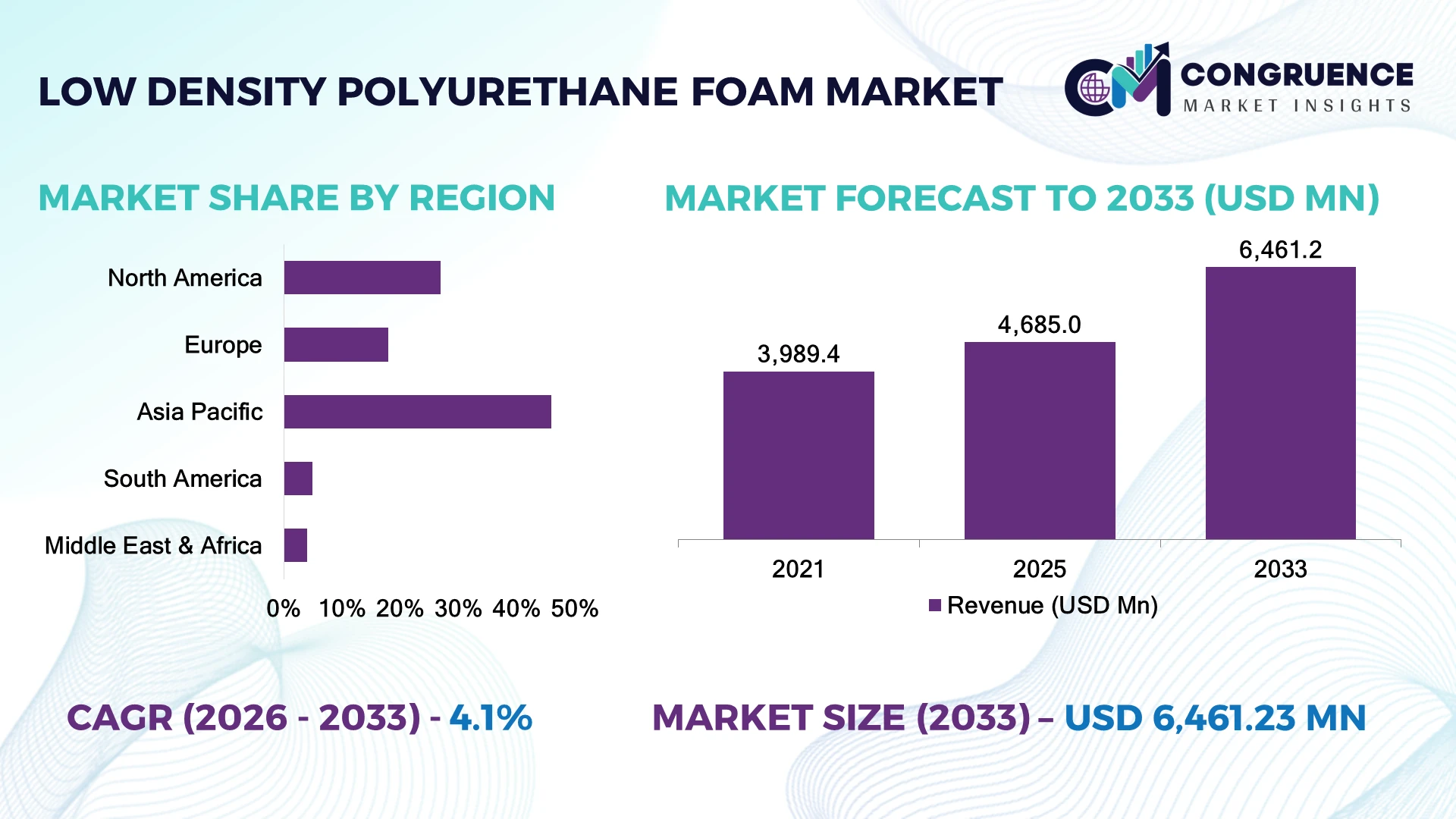
China dominates the market with approximately 34% share, supported by polyurethane production capacity exceeding 12 million tons annually and strong automotive manufacturing investments. The country’s electric vehicle sector consumed increasing volumes of lightweight foam components in 2025. The United States follows with nearly 22% share, driven by construction renovation and appliance insulation demand. China’s production scale remains over 1.5 times higher than North America’s capacity.
Strategic localization of raw materials and advanced foam processing capabilities will define competitive advantage.
Market Size & Growth: Valued at USD 4.69 billion in 2025 and projected at USD 6.46 billion by 2033, expanding at 4.1% CAGR through insulation, automotive, and packaging innovation.
Top Growth Drivers: Energy-efficient construction (38%), automotive lightweighting (31%), and protective packaging adoption (24%) are key demand contributors.
Short-Term Forecast: By 2028, automated foam production systems reduce material waste by 12% and improve manufacturing efficiency by 18%.
Emerging Technologies: Advanced recycling methods, AI-based foam formulation, and bio-based polyurethane materials are reshaping production strategies.
Regional Leaders: Asia Pacific reaches USD 3.1 billion with EV expansion; North America reaches USD 1.8 billion with green buildings; Europe reaches USD 1.2 billion with circular material adoption.
Consumer/End-User Trends: More than 45% of new insulation projects integrate low-density foam solutions for thermal performance improvements.
Pilot/Case Example: In 2024, automotive foam optimization projects reduced component weight by 15% and improved interior efficiency.
Competitive Landscape: Leading producers hold nearly 40% combined share, including BASF, Covestro, Dow, Huntsman, and Recticel.
Regulatory & ESG Impact: Sustainability regulations are driving 20% higher adoption of recycled-content polyurethane solutions.
Investment & Funding: Over USD 2 billion invested in polyurethane innovation, recycling facilities, and regional manufacturing expansion.
Innovation & Future Outlook: Next-generation foams emphasize renewable feedstocks, digital manufacturing, and high-performance insulation applications.
Low-Density Polyurethane Foam is gaining importance across automotive seating, furniture cushioning, construction insulation, and temperature-controlled logistics. Manufacturers are introducing low-emission formulations and recyclable foam technologies, with approximately 30% of new product launches targeting sustainability improvements. Supply-chain diversification after global logistics disruptions is encouraging localized production and strategic partnerships, creating stronger industrial adoption pathways.
Low-Density Polyurethane Foam is becoming strategically important as manufacturers prioritize lightweight materials, energy efficiency, and sustainable product design across automotive, construction, and consumer industries. Supply-chain restructuring following geopolitical disruptions has encouraged companies in China, India, and the United States to strengthen domestic chemical production and secure raw material availability.
Advanced foam manufacturing technologies are improving operational performance. Automated formulation systems deliver approximately 15% higher production consistency compared with traditional manual processes, while digital monitoring reduces defects and material losses. Europe emphasizes circular polyurethane initiatives, whereas Asia focuses on large-scale manufacturing capacity and rapid industrial deployment.
Automotive suppliers are expanding foam applications in electric vehicles to reduce weight and enhance passenger comfort. Construction companies are integrating low-density foams into insulation upgrades to meet stricter energy standards. Over the next three years, manufacturers are expected to increase investments in recycling technologies, regional production facilities, and strategic partnerships. Companies that combine sustainable materials, efficient production, and localized supply networks will secure stronger competitive positioning in this evolving market.
The shift toward lightweight and energy-efficient materials is strengthening Low-Density Polyurethane Foam adoption across automotive and construction industries. Electric vehicle manufacturers are increasing foam usage, with lightweight components contributing to approximately 10–15% vehicle weight optimization. Building insulation upgrades account for nearly 35% of new foam applications in developed markets. China’s expanding EV manufacturing ecosystem and India’s infrastructure modernization programs are accelerating demand. Companies are responding through production expansion, bio-based foam development, and partnerships with automotive suppliers. The strategic advantage lies in combining thermal performance with reduced material consumption, enabling manufacturers to meet efficiency targets while maintaining product durability.
Raw material price fluctuations remain a major constraint due to dependence on petrochemical derivatives such as polyols and isocyanates. Feedstock volatility has increased production costs by nearly 15% during recent supply disruptions. Europe’s stricter chemical regulations have added compliance requirements, affecting smaller manufacturers with limited resources. Supply concentration among major chemical producers creates operational risks during geopolitical disruptions. Companies are reducing exposure through supplier diversification, long-term contracts, and investment in alternative feedstocks. The key operational challenge is maintaining competitive pricing while absorbing fluctuations in energy costs, transportation expenses, and regulatory compliance investments.
Sustainable polyurethane innovations are opening opportunities through recycled content, bio-based materials, and advanced manufacturing processes. Bio-based polyurethane adoption is increasing by approximately 20% annually in selected applications as companies target lower environmental impact. Digital foam optimization technologies improve material efficiency by 10–15%, creating cost advantages for manufacturers. Japan and Germany are investing in circular material systems to support recycling-based production models. Companies are expanding R&D programs and forming technology partnerships to develop low-emission foam solutions. The strongest opportunity lies in combining sustainability with performance improvements, allowing manufacturers to serve premium automotive, green construction, and specialty packaging markets.
Scaling next-generation Low-Density Polyurethane Foam production remains challenging due to technology integration barriers, recycling infrastructure limitations, and skilled workforce requirements. Recycling systems currently process only a limited portion of polyurethane waste, with recovery rates below 20% in many markets. Manufacturers face difficulties integrating sustainable feedstocks without affecting foam quality and production speed. The global chemical industry is also managing evolving environmental standards and reporting requirements. Companies must invest in advanced recycling infrastructure, workforce training, and collaborative technology platforms. Long-term competitiveness will depend on balancing sustainable production goals with consistent quality, supply reliability, and operational scalability.
Recycled Foam Integration Rising Manufacturers are accelerating recycled polyurethane adoption as sustainability regulations tighten in Europe and North America. Recycled-content foam usage has increased by nearly 20%, while waste recovery initiatives target 30% higher material circularity by 2030. Companies are partnering with chemical recyclers and redesigning production workflows to reduce dependency on virgin feedstocks. This shift improves compliance readiness, lowers material risks, and strengthens ESG positioning.
Digital Production Optimization Expands Foam producers are deploying AI monitoring and automated formulation systems to improve manufacturing precision. Smart production platforms reduce material waste by 10–15% and increase process consistency by approximately 18%. Automotive and insulation suppliers are integrating real-time quality analytics into plants. Companies are investing in connected manufacturing to address labor shortages and improve operational efficiency.
Regional Supply Networks Restructure Global supply-chain disruptions are pushing manufacturers toward localized polyurethane production hubs. China, India, and the United States are increasing domestic sourcing strategies, reducing logistics dependency by nearly 15%. Companies are expanding supplier networks, establishing regional partnerships, and securing long-term chemical contracts. This restructuring improves delivery reliability and reduces exposure to geopolitical disruptions.
Bio-Based Foam Development Accelerates Enterprises are increasing investment in renewable polyurethane formulations as demand for sustainable materials grows. Bio-based foam adoption has expanded by around 25% in selected premium applications, particularly automotive interiors and green construction. Companies are scaling pilot projects, collaborating with material innovators, and improving performance characteristics. The transition creates opportunities for differentiated products with lower environmental impact.
Flexible Low-Density Polyurethane Foam remains the leading type, accounting for approximately 62% market share due to its extensive use in furniture, automotive seating, and consumer comfort applications. Its lightweight structure, cushioning performance, and manufacturing scalability provide cost advantages over specialized alternatives. Rigid foam holds nearly 28% share and maintains strong demand in insulation applications, while spray foam and specialty variants serve niche industrial requirements.
Flexible foam is also the fastest-growing type in advanced mobility applications, supported by increasing electric vehicle production and interior lightweighting requirements. Adoption in automotive interiors has expanded by approximately 15%, while sustainable flexible foam solutions are gaining nearly 20% higher interest among manufacturers. Companies are prioritizing recyclable formulations, customized densities, and regional production expansion to capture evolving demand. Investment focus is shifting toward high-performance flexible foams that combine comfort, durability, and environmental compliance.
Construction insulation represents the leading application segment with approximately 40% market share, supported by energy-efficiency regulations and renovation programs across developed economies. Low-density polyurethane foam provides superior thermal resistance, moisture control, and installation flexibility compared with conventional insulation materials. Automotive applications contribute nearly 30% share, with demand increasing through lightweight vehicle design and electric mobility expansion.
Automotive interiors are the fastest-growing application area, driven by manufacturers seeking weight reduction and improved passenger comfort. Electric vehicle platforms have increased foam integration by around 18%, while automated manufacturing has improved component processing efficiency by 12%. Packaging, furniture, and appliance applications continue supporting stable demand through protective and cushioning requirements. Companies are expanding application-specific formulations, forming OEM partnerships, and investing in automated deployment systems to strengthen market penetration.
The automotive industry leads Low-Density Polyurethane Foam consumption with approximately 35% market share due to large-scale use in seats, dashboards, headliners, and interior components. Vehicle manufacturers prioritize lightweight materials to improve efficiency, with foam-based components contributing around 10–15% weight optimization opportunities. Construction companies represent nearly 30% share, supported by insulation modernization and sustainable building initiatives.
The fastest-growing end-user group is electric vehicle manufacturers, where foam adoption is increasing by approximately 20% as battery efficiency and passenger comfort become critical design priorities. Furniture producers and appliance manufacturers maintain steady demand through cushioning and insulation applications. Companies are responding through customized foam solutions, supplier collaborations, and localized manufacturing partnerships. Future competitive positioning depends on developing application-specific materials that balance performance, sustainability, and production efficiency.
Asia-Pacific accounted for the largest market share at 46% in 2025 however, Asia-Pacific is expected to register the fastest growth, expanding at a CAGR of 4.6% between 2026 and 2033.
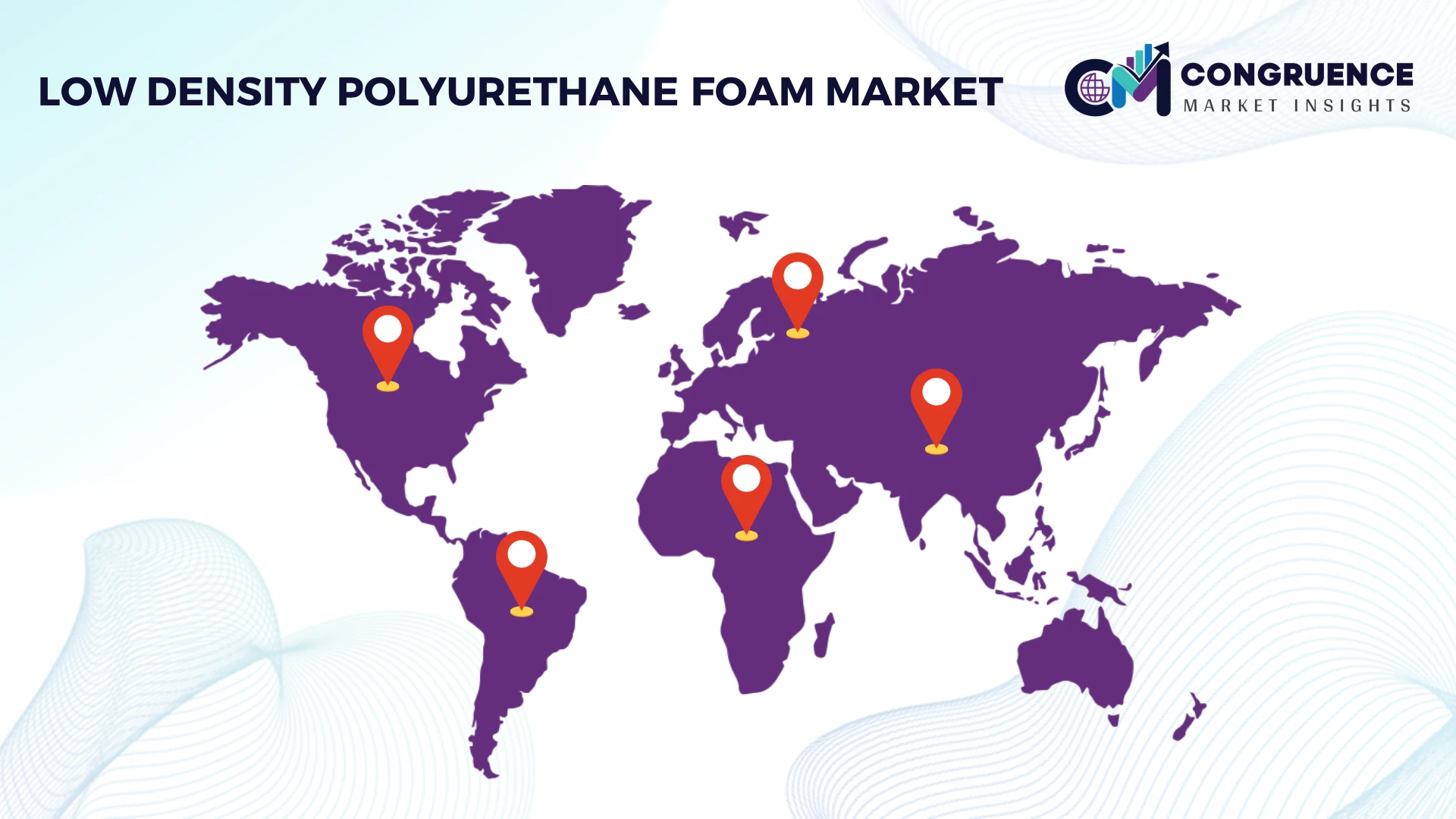
North America represents approximately 27% of the global Low-Density Polyurethane Foam Market, supported by advanced automotive manufacturing, building renovation programs, and appliance insulation demand. The United States contributes the majority of regional consumption due to established polyurethane processing infrastructure and high adoption of energy-efficient materials. Automotive suppliers are increasing foam integration in electric vehicles, with lightweight interior solutions improving material efficiency by nearly 12%. Companies are expanding domestic production networks and investing in recycled polyurethane technologies to address sustainability requirements. Strategic partnerships between chemical producers and manufacturers are strengthening supply reliability amid global raw material fluctuations.
United States Market Outlook: The United States remains the regional manufacturing hub, supported by strong construction modernization and automotive production capacity. More than 40% of new commercial insulation upgrades incorporate advanced foam solutions. Manufacturers are prioritizing localized supply chains, automation, and sustainable formulations to improve operational resilience.
Europe accounts for nearly 18% of global demand, influenced by strict energy-efficiency standards, sustainable construction policies, and circular economy initiatives. Germany, France, and Italy represent major consumption centers due to automotive production and industrial insulation requirements. Regulatory pressure on material recycling has accelerated adoption of low-emission polyurethane technologies, with sustainable foam developments increasing by approximately 15% annually. Companies are forming recycling partnerships and upgrading manufacturing facilities to meet environmental compliance targets. The region’s focus on building efficiency and carbon reduction is shifting investments toward advanced foam formulations with improved lifecycle performance.
Germany Market Outlook: Germany leads European adoption through its automotive ecosystem and industrial engineering capabilities. More than 30% of new vehicle platforms utilize advanced lightweight materials, encouraging foam suppliers to develop customized solutions. Manufacturers are investing in circular production systems and automated processing technologies.
Asia-Pacific dominates with approximately 46% market share due to extensive polyurethane production capacity, expanding automotive output, and rapid infrastructure development. China, India, Japan, and South Korea drive regional consumption through construction, electronics, transportation, and packaging industries. China accounts for nearly 34% of global demand, supported by large-scale chemical manufacturing and electric vehicle expansion. Regional producers are increasing automation adoption, improving production efficiency by 10–15%, and expanding export capabilities. Companies are investing in localized facilities to reduce supply-chain dependency and support growing domestic applications.
China Market Outlook: China maintains its leadership through integrated chemical supply chains and strong manufacturing capacity. The country produces more than half of Asia’s polyurethane materials and continues expanding EV-related foam applications. Manufacturers are focusing on recycling technologies, smart production systems, and premium-performance formulations.
South America contributes approximately 5% of global demand, with Brazil and Argentina representing major consumption markets. Growth is supported by residential construction upgrades, furniture manufacturing, automotive assembly, and cold-chain logistics expansion. Brazil accounts for nearly 60% of regional consumption due to its industrial base and infrastructure investments. However, limited recycling infrastructure and dependence on imported chemical inputs affect operational scalability. Companies are responding through regional partnerships, supply diversification, and investment in local processing capabilities. Increasing demand for thermal insulation solutions is encouraging manufacturers to introduce application-specific foam products.
Brazil Market Outlook: Brazil remains the strongest regional market due to construction activity and automotive manufacturing concentration. More than 25% of new residential developments incorporate improved insulation materials. Companies are expanding distribution networks and developing cost-efficient foam solutions to address regional infrastructure requirements.
The Middle East & Africa region represents nearly 4% of global consumption, supported by infrastructure modernization, commercial construction, and industrial development projects. Gulf countries are increasing adoption of polyurethane foam for insulation applications due to extreme climate conditions and energy-efficiency requirements. Saudi Arabia and the UAE are leading demand centers, with large-scale construction projects driving material consumption. Regional manufacturers are investing in processing facilities and partnerships to improve supply availability. Infrastructure projects linked to urban development are creating opportunities for advanced insulation technologies while encouraging companies to adopt efficient production methods.
Saudi Arabia Market Outlook: Saudi Arabia is emerging as a strategic market through construction expansion and industrial diversification programs. The country’s infrastructure projects have increased demand for thermal insulation materials by approximately 20%. Companies are strengthening local partnerships and expanding technical capabilities to support large-scale development initiatives.
The Low-Density Polyurethane Foam Market is shaped by global chemical producers BASF, Covestro, Dow, Huntsman, and Wanhua Chemical competing against regional foam manufacturers and specialty formulators. The top five companies hold approximately 40–45% combined market share, creating a moderately consolidated environment. Competition is based on advanced formulations, pricing efficiency, raw material security, customization, and production scalability. Premium foam solutions deliver 10–15% performance advantages through improved insulation, durability, and lightweight properties. Global leaders are expanding through recycling technologies, capacity investments, and strategic partnerships, while regional players compete through cost advantages and faster customization. The market is shifting toward sustainable materials, localized supply chains, and automated manufacturing. High capital investment, technical expertise, and regulatory compliance create significant entry barriers. Long-term winners will combine material innovation, supply reliability, and application-specific solutions to outperform established competitors.
Covestro AG
Dow Inc.
Huntsman Corporation
Wanhua Chemical Group Co., Ltd.
Recticel NV/SA
Carpenter Co.
Rogers Corporation
INOAC Corporation
Sekisui Chemical Co., Ltd.
Trelleborg AB
UBE Corporation
Mitsui Chemicals, Inc.
Woodbridge Foam Corporation
Low-density polyurethane foam technology is advancing through sustainable chemistry, digital manufacturing, and high-performance formulation development. Bio-based polyols, recycled polyurethane feedstocks, and AI-enabled production monitoring are gaining adoption as manufacturers target lower emissions and improved efficiency. Automated foam processing systems reduce material waste by 10–15% and improve production consistency compared with conventional manual operations, creating advantages for large-scale manufacturers.
Recycling technologies are becoming a major competitive differentiator as companies invest in chemical recycling and closed-loop polyurethane recovery systems. Advanced recycling methods improve resource recovery efficiency by approximately 20% compared with traditional disposal approaches. Global chemical companies are integrating recycled content into foam formulations to meet sustainability requirements while maintaining mechanical performance.
Between 2026 and 2028, smart manufacturing, renewable materials, and application-specific foam engineering will reshape competitive strategies. Automotive suppliers benefit from lightweight foam technologies that improve vehicle efficiency by 5–10%, while construction companies gain from advanced insulation solutions. Companies investing early in automation, circular materials, and digital production platforms will strengthen operational efficiency and market positioning.
March 2025 BASF Performance Materials expands sustainable polyurethane recycling solutions introduced its “Loop” polyurethane recycling portfolio at CHINAPLAS 2025, offering recycled-content PU solutions for automotive, footwear, and synthetic leather applications. BASF’s patented recycling technology converts PU waste into high-quality recycled materials, strengthening circular manufacturing strategies and reducing dependence on virgin raw materials. Source: BASF
July 2025 Covestro launches advanced flame-retardant encapsulation foam for EV batteries launched Baysafe® BEF, a flame-retardant polyurethane encapsulation foam designed for electric vehicle battery safety applications. The technology supports China’s evolving EV safety requirements and improves thermal propagation control between battery cells, strengthening Covestro’s position in advanced mobility materials. Source: Covestro
September 2025 Dow and Gruppo Fiori develop polyurethane recycling process Dow partnered with Gruppo Fiori to develop a new recycling process for recovering polyurethane foam from end-of-life vehicles without dismantling components. The initiative targets automotive circularity, addressing approximately 10–15 kg of PU foam materials found in typical vehicle seats and interiors. Source: Dow
March 2026 Covestro and Fraunhofer UMSICHT sign polyurethane recycling pilot agreement Covestro and Fraunhofer UMSICHT initiated a smart pyrolysis pilot plant project for rigid polyurethane foam recycling with 2 kt annual processing capacity. The facility aims to produce high-purity recycled aniline for MDI production with up to 40% improved carbon footprint performance. Source: Covestro
The Low-Density Polyurethane Foam Market Report evaluates industry performance across flexible foam, rigid foam, spray foam, and specialty formulations, covering applications including insulation, automotive, packaging, furniture, appliances, and industrial uses. The report analyzes demand across construction, transportation, manufacturing, consumer goods, and other major end-user industries. Regional assessment covers North America, Europe, Asia-Pacific, South America, and Middle East & Africa, highlighting production centers, adoption patterns, infrastructure development, and investment activity.
The study examines emerging technologies such as recycled polyurethane systems, bio-based materials, automated manufacturing, and advanced formulation techniques. It provides strategic insights into competitive positioning, supplier capabilities, innovation priorities, and market expansion strategies. Companies can use the analysis to identify growth opportunities, optimize supply-chain decisions, evaluate partnerships, and strengthen competitive strategies during 2026–2033.
| Report Attribute / Metric | Details |
|---|---|
| Market Revenue (2025) | USD 4,685.0 Million |
| Market Revenue (2033) | USD 6,461.2 Million |
| CAGR (2026–2033) | 4.1% |
| Base Year | 2025 |
| Forecast Period | 2026–2033 |
| Historic Period | 2021–2025 |
| Segments Covered |
By Type
By Application
By End-User
|
| Key Deliverables | Revenue Forecast; Market Trends; Growth Drivers & Restraints; Technology Insights; Segmentation Analysis; Regional Insights; Competitive Landscape; Regulatory & ESG Overview; Recent Developments |
| Regions Covered | North America; Europe; Asia-Pacific; South America; Middle East & Africa |
| Companies Profiled | BASF SE; Covestro AG; Dow Inc.; Huntsman Corporation; Wanhua Chemical Group Co., Ltd.; Recticel NV/SA; Carpenter Co.; Rogers Corporation; INOAC Corporation; Sekisui Chemical Co., Ltd.; Trelleborg AB; UBE Corporation; Mitsui Chemicals, Inc.; Woodbridge Foam Corporation |
| Customization & Pricing | Available on Request (10% Customization Free) |




