
Reports
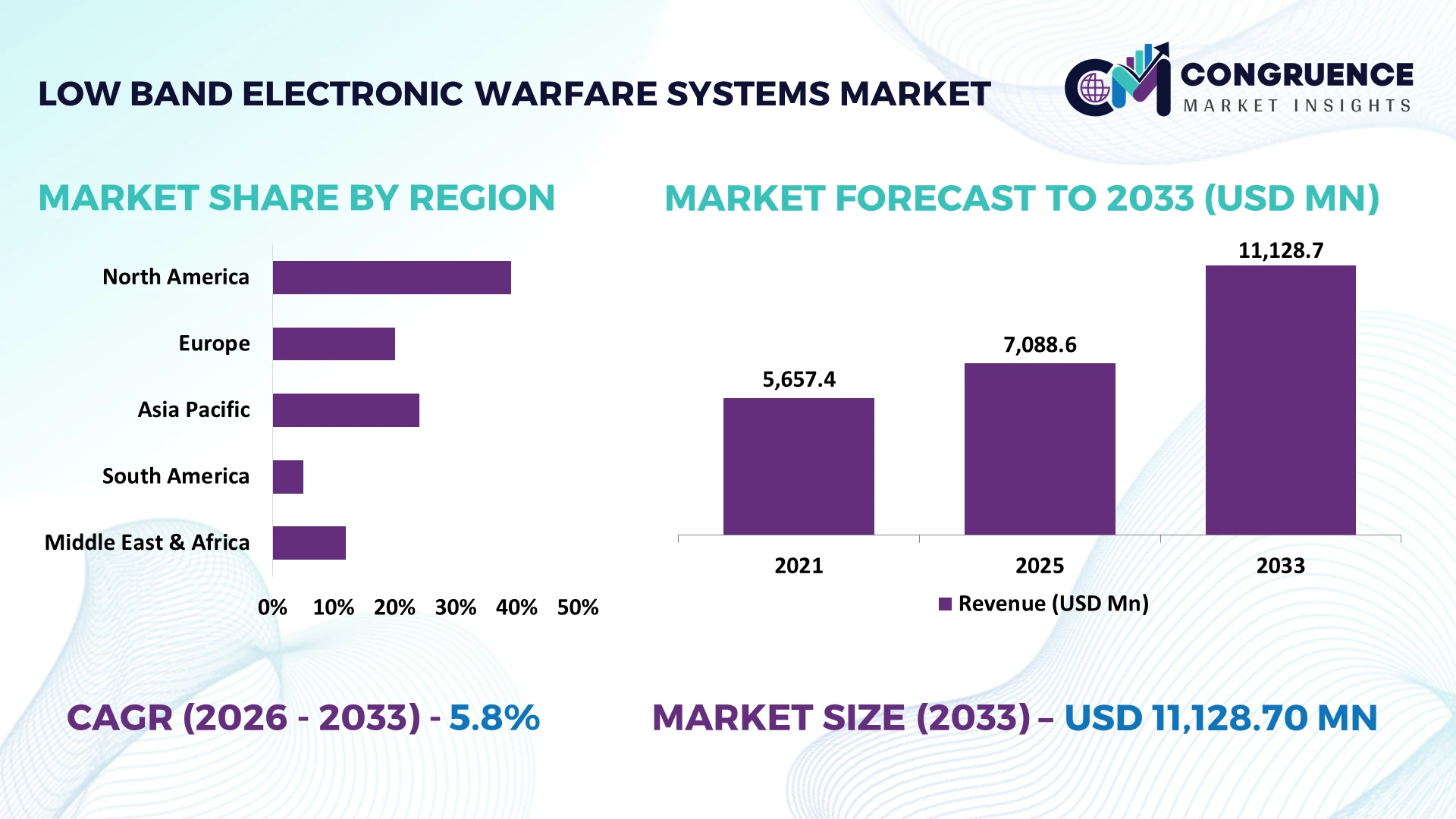
The Global Low-Band Electronic Warfare Systems Market was valued at USD 7088.6 Million in 2025 and is anticipated to reach a value of USD 11128.7 Million by 2033 expanding at a CAGR of 5.8% between 2026 and 2033. Growth is driven by VHF/UHF electronic surveillance modernization, counter-drone spectrum monitoring, software-defined electronic support receivers, and military electromagnetic spectrum operations.
The United States leads advanced low-band electronic warfare development through established defense electronics manufacturing, military research infrastructure, and integrated spectrum operations programs. US military expenditure represented approximately 37% of global defense spending in 2024, compared with China's approximately 12%. The US Navy's Next Generation Jammer Low Band program strengthens investment in airborne electronic attack capabilities, while L3Harris, Northrop Grumman, and RTX maintain relevant electronic warfare engineering capabilities. Russia's war in Ukraine has intensified requirements for resilient spectrum surveillance, programmable receivers, and adaptable electronic protection systems.
Strategically, defense suppliers should prioritize US naval electronic warfare modernization and allied spectrum interoperability, leveraging the 37% defense expenditure concentration and expanding demand for software-configurable low-band systems.
Market Size & Growth: USD 7,088.6 million in 2025, reaching USD 11,128.7 million by 2033 at 5.8% CAGR, supported by programmable electronic warfare modernization.
Top Growth Drivers: Electromagnetic spectrum modernization (40%), counter-drone detection (35%), and software-defined receiver adoption (25%), representing illustrative driver weightings.
Short-Term Forecast: By 2027, upgraded digital signal processing targets 20% faster signal classification during controlled military testing.
Emerging Technologies: AI-assisted signal recognition, gallium nitride amplifiers, and cognitive electronic warfare represent 3 priority technology developments.
Regional Leaders: Illustrative 2033 allocations place North America at USD 4.45 billion, Europe at USD 3.12 billion, and Asia-Pacific at USD 2.56 billion, reflecting defense modernization priorities.
Consumer/End-User Trends: The US Navy's Next Generation Jammer program includes 2 frequency-band development increments, supporting specialized airborne electronic attack procurement.
Pilot/Case Example: In 2024, the Next Generation Jammer Mid-Band entered initial operational capability, demonstrating 1 major electronic attack modernization milestone.
Competitive Landscape: Northrop Grumman, L3Harris, RTX, BAE Systems, and Saab compete through electronic warfare integration; verified low-band supplier shares remain unreported.
Regulatory & ESG Impact: US military spectrum operations follow Department of Defense electromagnetic spectrum governance, requiring coordination across multiple military communication bands.
Investment & Funding: The US Department of Defense's FY2025 budget request included approximately USD 849.8 billion in national defense funding, supporting electronic warfare modernization priorities.
Innovation & Future Outlook: Between 2026 and 2033, 3 technologies—cognitive signal processing, distributed sensing, and open architecture integration—will reshape procurement priorities.
The Low-Band Electronic Warfare Systems Market is transitioning toward software-defined architectures, adaptive signal processing, and integrated electromagnetic spectrum awareness. Military demand concentrates on VHF/UHF surveillance, radar warning, electronic support measures, and airborne electronic attack capabilities. Gallium nitride power amplifiers and digital receiver technologies improve signal processing flexibility and platform integration. The US Navy's Next Generation Jammer Low Band program highlights demand for advanced airborne electronic attack equipment. Russia's war in Ukraine has also exposed the importance of electromagnetic resilience and rapid signal library updates. Manufacturers are strengthening semiconductor partnerships, modular hardware development, and secure software integration capabilities, establishing spectrum adaptability as a central competitive requirement.
Low-band electronic warfare systems are becoming strategically critical as military forces prioritize electromagnetic spectrum dominance, resilient communications, and advanced electronic attack capabilities. Russia's war in Ukraine has demonstrated the operational importance of rapid signal identification and electronic countermeasure adaptation. Defense procurement is shifting from fixed-function receivers toward software-defined architectures supporting programmable frequency coverage and continuous capability upgrades. The United States leads advanced electronic warfare integration through naval aviation modernization, while NATO members prioritize interoperable electronic support systems and coordinated spectrum operations.
Modern digital receivers provide operational advantages over legacy analog architectures. In illustrative laboratory scenarios, automated signal classification targets 20% faster processing and 15% lower operator workload compared with manual identification workflows. Gallium nitride amplifiers improve power density, supporting compact airborne electronic attack configurations. The United States emphasizes integrated airborne systems, while European manufacturers prioritize distributed sensing and modular equipment integration. These differences influence supplier qualification, platform compatibility, and investment in specialized semiconductor technologies.
Between 2026 and 2028, procurement priorities will increasingly favor cognitive signal processing, open architecture interfaces, and resilient electronic protection. The US Navy's Next Generation Jammer Low Band program demonstrates practical integration of advanced electronic attack technologies into existing aircraft platforms. Manufacturers expanding secure software development, spectrum testing infrastructure, and military partnerships will gain stronger competitive positioning through faster upgrades and reliable operational integration.
Military modernization programs are strengthening demand for low-band electronic warfare systems capable of detecting, classifying, and responding to complex electromagnetic signals. The United States accounted for approximately 37% of global military expenditure in 2024, supporting substantial defense electronics procurement capacity. NATO's 2025 defense investment framework established a 5% GDP commitment by 2035, including 3.5% for core defense requirements. Russia's war in Ukraine has reinforced the importance of electronic protection and spectrum situational awareness during contested operations. Defense contractors are expanding digital receiver development, gallium nitride amplifier integration, and programmable signal processing capabilities. The US Navy's electronic attack modernization programs are strengthening procurement opportunities for specialized airborne systems. Software upgrade flexibility increasingly determines long-term equipment competitiveness.
Low-band electronic warfare equipment production faces constraints from specialized radio-frequency semiconductors, high-performance converters, and secure processing components. US export controls on advanced electronics and China's restrictions on selected critical materials have increased supply-chain compliance requirements. In illustrative procurement scenarios, a 15% increase in gallium nitride component costs raises amplifier subsystem expenses, while 10% longer qualification cycles delay production readiness. Military-grade RF components require stringent environmental testing, electromagnetic compatibility validation, and secure sourcing procedures. Manufacturers are reducing exposure through domestic semiconductor partnerships, alternative component qualification, and long-term supplier agreements. Modular RF architectures support component replacement without complete system redesign. Securing qualified electronics capacity is essential for protecting delivery schedules and maintaining competitive manufacturing economics.
Cognitive electronic warfare technologies are creating opportunities for automated signal classification, distributed sensor coordination, and software-based capability upgrades. Illustrative engineering targets include 25% faster signal identification and 20% lower manual analysis requirements through machine learning-assisted processing. Open architecture integration also targets 15% shorter software upgrade cycles across compatible electronic warfare platforms. India's defense electronics localization initiatives create opportunities for domestic receiver development and specialized RF component manufacturing. Manufacturers are investing in programmable processors, advanced antenna arrays, and secure edge computing platforms. Partnerships between defense contractors, semiconductor developers, and military research institutions support technology validation. The strategic opportunity lies in delivering upgradeable electronic warfare capabilities through reusable software architectures rather than replacing complete hardware systems.
Long-term electronic warfare effectiveness depends on reliable signal recognition, secure software integration, and consistent performance across complex electromagnetic environments. Russia's war in Ukraine has demonstrated the rapid evolution of battlefield signal characteristics and electronic countermeasures. Illustrative military validation targets include 95% signal classification accuracy and 99% operational availability under defined laboratory conditions. However, integrating adaptive algorithms into classified military networks creates cybersecurity, verification, and configuration management challenges. The United States requires rigorous military system accreditation and electromagnetic compatibility testing before operational deployment. Manufacturers must invest in representative signal datasets, hardware-in-the-loop laboratories, and secure software update processes. Partnerships with military testing organizations strengthen validation quality. Competitive advantage increasingly depends on maintaining trustworthy performance as threat libraries and operating conditions evolve.
Digital Receiver Consolidation Reduces Equipment Complexity: Defense electronics manufacturers are consolidating multiple signal monitoring functions into wideband receiver assemblies. Illustrative engineering targets include 20% fewer processing modules and 15% lower equipment maintenance requirements. US military platform upgrades are encouraging integrated receiver designs that simplify equipment installation. L3Harris and other electronic warfare suppliers are strengthening digital hardware integration capabilities, improving platform compatibility and reducing long-term support complexity.
Gallium Nitride Manufacturing Gains Industrial Priority: Advanced radio-frequency semiconductor production is shifting toward higher power-density components for compact electronic warfare equipment. Illustrative design targets include 20–25% improved amplifier power density and 10% lower cooling requirements under comparable operating conditions. US semiconductor supply-chain initiatives are encouraging domestic manufacturing partnerships. Defense contractors are expanding qualified supplier networks and investing in thermal engineering, strengthening component availability and reducing dependence on specialized imported assemblies.
Automated Spectrum Testing Reshapes Qualification Workflows: Electronic warfare manufacturers are introducing automated measurement equipment and digital test records into production validation. Illustrative factory targets include 25% shorter calibration cycles and 15% fewer manual inspection activities. Military electromagnetic compatibility requirements are driving repeatable testing procedures across receiver and transmitter assemblies. Companies are expanding automated test infrastructure and standardized documentation processes, improving production consistency while reducing qualification-related scheduling disruptions.
Compact Antenna Integration Changes Platform Design: Military aircraft and naval platforms increasingly require low-band antenna configurations compatible with constrained installation spaces. Engineering programs target 15% lower assembly weight and 20% fewer installation interfaces through integrated antenna structures. Aircraft modernization schedules are encouraging closer collaboration between platform manufacturers and electronic warfare suppliers. Companies are developing conformal antenna technologies and integrated mounting assemblies, reducing installation complexity and improving maintenance accessibility.
Electronic Support Systems Lead Spectrum Monitoring Integration
Electronic Support (ES) Systems represent the leading segment of the Low-Band Electronic Warfare Systems Market, with an indicative 36% share in 2025. Their dominance reflects established military requirements for signal detection, emitter identification, and electromagnetic environment monitoring. ES platforms support persistent spectrum awareness across aircraft, naval vessels, and ground installations. Electronic Attack (EA) Systems account for an estimated 29%, supported by airborne electronic attack modernization and specialized radio-frequency transmission requirements. Defense manufacturers are integrating advanced receivers, high-performance antennas, and programmable processing architectures to improve equipment flexibility. Established ES equipment suppliers retain competitive advantages through military qualification experience, installed system compatibility, and long-term support contracts.
Integrated Electronic Warfare Systems represent the fastest-growing type, with an indicative 22% share, reflecting procurement demand for combined electronic support, attack, and protection functions. Electronic Protection (EP) Systems account for approximately 13%, supporting communications resilience and electromagnetic interference management. Manufacturers are developing interoperable electronic architectures and shared processing hardware to reduce equipment duplication. Northrop Grumman, RTX, and BAE Systems are strengthening platform integration capabilities and software development partnerships. Procurement strategies increasingly favor suppliers offering comprehensive electronic warfare functionality with adaptable mission configurations.
Radar Detection and Jamming Dominates Operational Demand
Radar Detection and Jamming represents the leading application in the Low-Band Electronic Warfare Systems Market, with an indicative 34% share in 2025. Demand concentrates on detecting radar emissions, supporting electronic attack operations, and maintaining situational awareness in contested electromagnetic environments. Communications Intelligence accounts for approximately 26%, supported by military requirements for radio-frequency monitoring and communication signal characterization. US and European defense organizations are strengthening electronic warfare integration across airborne and naval platforms. Manufacturers are developing high-sensitivity receiver assemblies, advanced signal processing hardware, and mission-specific electronic attack equipment. Established military procurement programs support continued investment in qualified radar detection and electronic countermeasure technologies.
Threat Detection and Countermeasures represents the fastest-growing application, with an indicative 23% share, reflecting increased emphasis on adaptive electromagnetic threat awareness. Signal Interception and Analysis accounts for approximately 17%, supporting specialized intelligence collection and technical signal evaluation. Defense contractors are integrating automated classification tools, configurable receiver software, and secure data processing infrastructure. Military buyers increasingly prioritize faster threat identification, improved system interoperability, and reduced operator workload. Companies expanding software engineering capabilities and electronic warfare testing infrastructure are strengthening their position in modernization contracts and specialized defense electronics procurement.
Armed Forces Dominate Electronic Warfare Procurement
Armed Forces represent the dominant end-user segment, accounting for an indicative 64% share of the Low-Band Electronic Warfare Systems Market in 2025. Their leadership reflects extensive aircraft, naval vessel, and ground platform integration requirements, alongside established defense procurement infrastructure. Defense Intelligence Agencies account for approximately 17%, supporting specialized electromagnetic signal collection, technical intelligence processing, and strategic monitoring operations. Military buyers emphasize equipment reliability, interoperability, and compatibility with existing electronic warfare platforms. Manufacturers are strengthening defense acquisition partnerships, expanding qualified product portfolios, and investing in integrated system support capabilities. Large military modernization programs provide established suppliers with advantages in engineering scale and long-term maintenance services.
Homeland Security Agencies represent the fastest-growing end-user segment, with an indicative 11% share, supported by demand for spectrum monitoring and specialized electromagnetic threat awareness. Defense Contractors account for approximately 8%, reflecting equipment procurement for development, testing, and integration activities. Suppliers are developing configurable receiver platforms, compact monitoring systems, and specialized technical support services to address different institutional requirements. Procurement differentiation increasingly depends on secure data handling, equipment adaptability, and lifecycle support. Companies investing in modular product families and specialized integration partnerships are positioned to address expanding institutional applications.
North America accounted for the largest market share at an estimated 40% in 2025 however, Asia-Pacific is expected to register the fastest growth, expanding at a projected CAGR of 7.2% between 2026 and 2033.

Naval Electronic Attack Modernization Strengthens Regional Leadership
North America accounted for an estimated 40% of the global Low-Band Electronic Warfare Systems Market in 2025, supported by advanced defense electronics manufacturing, military spectrum research, and established airborne electronic warfare programs. The United States dominates regional procurement through naval aviation modernization and integrated electromagnetic spectrum operations. Canada contributes specialized radio-frequency engineering, defense communications research, and electronic surveillance capabilities. The US Navy's Next Generation Jammer Low Band program represents a major development initiative supporting EA-18G Growler electronic attack modernization. Northrop Grumman, RTX, and L3Harris maintain substantial engineering capabilities across advanced receivers, signal processors, and military electronic warfare integration. Regional manufacturers are investing in gallium nitride technology, programmable electronics, and secure software architectures. Established military testing infrastructure and specialized semiconductor partnerships strengthen supplier qualification and accelerate the transition toward digitally configurable electronic warfare systems.
United States Market Outlook: The United States maintains leadership through integrated defense electronics manufacturing, advanced semiconductor research, and established military acquisition infrastructure. The US Navy operates approximately 150 EA-18G Growler aircraft, supporting sustained demand for airborne electronic warfare modernization. Domestic manufacturers are strengthening electronic attack integration, advanced antenna engineering, and secure software development capabilities. Military procurement increasingly prioritizes qualified domestic components, mission adaptability, and long-term equipment support.
NATO Interoperability Accelerates Electronic Warfare Integration
Europe represented an estimated 28% of the global Low-Band Electronic Warfare Systems Market in 2025, supported by military modernization, defense electronics innovation, and expanding electromagnetic spectrum operations requirements. The United Kingdom, Germany, France, Sweden, and Italy maintain established electronic warfare engineering capabilities. NATO's 2025 defense investment commitment targets 5% of GDP by 2035, including 3.5% for core defense requirements, strengthening long-term military modernization priorities. European manufacturers are developing integrated electronic support receivers, advanced antenna systems, and programmable signal processing technologies. BAE Systems, Saab, Thales, and Leonardo maintain relevant electronic warfare product portfolios supporting airborne, naval, and ground applications. Regional procurement emphasizes interoperable equipment, secure communications, and standardized electronic warfare interfaces. Cross-border defense partnerships strengthen technology integration and manufacturing resilience, while export compliance requirements influence supplier qualification and international equipment deployment.
United Kingdom Market Outlook: The United Kingdom maintains a strong electronic warfare position through BAE Systems, specialized defense research institutions, and advanced military aviation capabilities. The Royal Air Force operates 40 Typhoon aircraft within its Project Centurion enhancement framework's original scope, demonstrating the importance of electronic warfare integration in combat aircraft modernization. British suppliers are investing in digital receiver development, electronic protection technologies, and secure mission software supporting domestic and allied procurement requirements.
Indigenous Defense Electronics Manufacturing Reshapes Procurement
Asia-Pacific accounted for an estimated 23% of the global Low-Band Electronic Warfare Systems Market in 2025, supported by military modernization, domestic electronics manufacturing expansion, and increasing electromagnetic spectrum security requirements. China, India, Japan, South Korea, and Australia maintain significant defense technology development activities. India is strengthening indigenous electronic warfare capabilities through the Defence Research and Development Organisation and Bharat Electronics Limited. The Indian government allocated approximately INR 6.81 trillion to defense in FY2025–26, supporting equipment modernization and domestic industrial development. Regional manufacturers are expanding programmable receiver production, military semiconductor integration, and electronic surveillance system development. Japan and Australia emphasize interoperability with US military platforms, while China maintains extensive domestic defense electronics manufacturing capabilities. Procurement strategies increasingly favor local technology ownership, secure supply chains, and adaptable electronic warfare architectures.
India Market Outlook: India maintains expanding low-band electronic warfare capabilities through DRDO research laboratories, Bharat Electronics Limited, and domestic defense electronics suppliers. The Ministry of Defence allocated approximately 75% of the FY2025–26 capital acquisition budget to domestic industry, reinforcing indigenous equipment procurement. Indian manufacturers are developing electronic support systems, radar warning receivers, and integrated electronic warfare suites. Localization policies strengthen domestic engineering investment and reduce dependence on imported military electronics.
Airborne Surveillance Modernization Drives Specialized Equipment Demand
South America represented an estimated 4% of the global Low-Band Electronic Warfare Systems Market in 2025, supported by military aircraft modernization, border surveillance requirements, and specialized defense electronics integration. Brazil leads regional manufacturing through established aerospace engineering capabilities and domestic military technology institutions. Colombia and Chile contribute demand for electronic surveillance, spectrum monitoring, and military communication protection. Brazil's airspace covers approximately 22 million square kilometers under national air traffic management responsibility, highlighting extensive monitoring infrastructure requirements. Regional defense organizations are evaluating programmable receivers and integrated electronic support equipment for aircraft and ground installations. Procurement remains constrained by imported semiconductor dependence, specialized testing infrastructure requirements, and competing military investment priorities. Manufacturers are developing local integration partnerships and maintenance arrangements to strengthen equipment availability and reduce lifecycle support costs.
Brazil Market Outlook: Brazil maintains regional leadership through Embraer's aerospace manufacturing infrastructure, military electronics research, and established defense integration capabilities. The Brazilian Air Force has ordered 36 Gripen E/F fighter aircraft, supporting advanced avionics and electronic warfare integration requirements. Domestic technology companies are strengthening radio-frequency engineering, electronic surveillance development, and specialized maintenance capabilities. Aerospace partnerships provide opportunities for local component integration and technical workforce development.
Defense Localization Strengthens Spectrum Security Investment
The Middle East & Africa accounted for an estimated 5% of the global Low-Band Electronic Warfare Systems Market in 2025, supported by military modernization, advanced electronic surveillance requirements, and domestic defense manufacturing initiatives. Israel, Saudi Arabia, the United Arab Emirates, and South Africa maintain relevant electronic warfare research and industrial capabilities. Saudi Arabia's Vision 2030 targets localization of more than 50% of military expenditure, encouraging defense electronics partnerships and technology transfer. Israel maintains advanced electronic warfare engineering through Elbit Systems and Israel Aerospace Industries. The United Arab Emirates is expanding domestic defense technology capabilities through EDGE Group and international industrial collaborations. Regional procurement emphasizes electromagnetic situational awareness, military communication protection, and equipment integration. Manufacturers are strengthening local technical support, semiconductor sourcing arrangements, and specialized system testing capabilities to improve procurement competitiveness.
Israel Market Outlook: Israel maintains advanced electronic warfare capabilities through established military research institutions, defense electronics manufacturing, and operational experience in contested electromagnetic environments. Military expenditure reached approximately 8.8% of GDP in 2024, reflecting substantial defense investment intensity. Elbit Systems and Israel Aerospace Industries develop electronic intelligence, electronic support, and protection technologies. Domestic manufacturers benefit from integrated sensor engineering, advanced signal processing expertise, and established international defense partnerships.
The Low-Band Electronic Warfare Systems Market is shaped by competition between established defense electronics contractors and specialized radio-frequency technology suppliers. Northrop Grumman, RTX, L3Harris, BAE Systems, and Thales compete through airborne electronic attack integration, digital receivers, and military platform compatibility. An indicative market model assigns these leading companies a combined 52% share, although independently verified supplier allocations remain unavailable. Advanced digital processing targets 20% faster signal classification, while modular architectures aim to reduce equipment integration time by 15%. Established contractors leverage military qualification experience, classified program access, and long-term support contracts. Specialized suppliers compete through antenna innovation, semiconductor engineering, and adaptable software platforms. Companies are expanding gallium nitride capabilities, strengthening domestic component sourcing, and forming defense technology partnerships. Export controls, electromagnetic compatibility testing, and secure software certification restrict market entry. Winning requires proven operational performance, reliable supply chains, rapid upgrades, and sustained military integration expertise.
Northrop Grumman Corporation
RTX Corporation
L3Harris Technologies, Inc.
BAE Systems plc
Thales S.A.
Leonardo S.p.A.
Saab AB
Elbit Systems Ltd.
Israel Aerospace Industries Ltd.
HENSOLDT AG
Bharat Electronics Limited
Rohde & Schwarz GmbH & Co. KG
Indra Sistemas, S.A.
Aselsan Elektronik Sanayi ve Ticaret A.Ş.
Current low-band electronic warfare technologies integrate digital receivers, programmable signal processors, phased-array antennas, and gallium nitride amplifiers. Software-defined architectures enable frequency coverage adjustments without replacing complete receiver assemblies. Compared with legacy analog processing, digital classification workflows target 20% faster signal identification and 15% fewer manual analysis steps under illustrative test conditions. Military deployment spans airborne electronic attack, naval surveillance, and ground-based spectrum monitoring. Manufacturers benefit from standardized electronics, simplified maintenance, and improved compatibility with existing defense platforms.
Emerging technologies emphasize machine learning-assisted emitter recognition, distributed sensing, and compact radio-frequency components. Automated classification targets 25% shorter analysis cycles, while advanced amplifier designs pursue 15% higher power density under comparable thermal conditions. Open architecture interfaces support integration across multiple military platforms. Established contractors including Northrop Grumman and BAE Systems leverage qualification expertise, whereas specialized semiconductor suppliers compete through component efficiency and faster design iteration.
Between 2026 and 2028, cognitive spectrum management, digital twin testing, and secure software updates will reshape electronic warfare engineering. Simulation-based validation targets 20% shorter prototype testing cycles, while automated diagnostics pursue 10% lower maintenance downtime. These figures represent engineering objectives rather than verified market averages. Suppliers investing in trustworthy algorithms, electromagnetic compatibility laboratories, and resilient component sourcing will secure stronger procurement positions as military systems require increasingly adaptable performance.
October 2026: L3Harris secured an $876.4 million US Navy contract modification advancing Next Generation Jammer Low Band engineering, prototype production, cybersecurity, and testing. The award accelerates development while strengthening the company's position in airborne electronic attack modernization. Source: l3harris.com
July 2026: CPI Aerostructures finalized a $13.6 million contract from L3Harris to manufacture Next Generation Jammer Low Band pod structures. The agreement strengthens specialized aerospace manufacturing capacity and supports delivery of operational prototypes for US Navy testing. Source: globenewswire.com
June 2025: Honeywell announced selection by L3Harris to support Next Generation Jammer Low Band development following its 2024 acquisition of CAES. Production activities at its Pennsylvania facility strengthen domestic electronic warfare manufacturing and specialized component supply capabilities. Source: honeywellaerospace.com
September 2024: L3Harris received a US Navy development contract covering Next Generation Jammer Low Band integration for EA-18G Growler aircraft. The program includes eight operational prototype pods, supporting fleet assessment and replacement of aging electronic attack equipment. Source: navair.navy.mil
The Low-Band Electronic Warfare Systems Market Report evaluates military procurement, technology modernization, industrial capabilities, and competitive positioning between 2026 and 2033. Type segmentation covers Electronic Support, Electronic Attack, Electronic Protection, and Integrated Electronic Warfare Systems. Application analysis includes Radar Detection and Jamming, Communications Intelligence, Signal Interception and Analysis, and Threat Detection and Countermeasures. End-user coverage examines Armed Forces, Defense Intelligence Agencies, Homeland Security Agencies, and Defense Contractors.
Regional assessment encompasses North America, Europe, Asia-Pacific, South America, and the Middle East & Africa. Indicative segmentation assigns North America 40% of global demand and Electronic Support Systems 36% by type. Technology coverage examines programmable receivers, gallium nitride amplifiers, cognitive processing, and integrated spectrum monitoring. Competitive evaluation supports semiconductor sourcing, manufacturing localization, defense partnerships, investment planning, and specialized electronic warfare procurement strategies.
| Report Attribute/Metric | Report Details |
|---|---|
Market Revenue in 2025 | USD 7088.6 Million |
Market Revenue in 2033 | USD 11128.7 Million |
CAGR (2026 - 2033) | 5.8% |
Base Year | 2025 |
Forecast Period | 2026 - 2033 |
Historic Period | 2021 - 2025 |
Segments Covered | By Type
By Application
By End-User
|
Key Report Deliverable | Revenue Forecast, Growth Trends, Market Dynamics, Segmental Overview, Regional and Country-wise Analysis, Competition Landscape |
Region Covered | North America, Europe, Asia-Pacific, South America, Middle East, Africa |
Key Players Analyzed | Northrop Grumman Corporation, RTX Corporation, L3Harris Technologies, Inc., BAE Systems plc, Thales S.A., Leonardo S.p.A., Saab AB, Elbit Systems Ltd., Israel Aerospace Industries Ltd., HENSOLDT AG, Bharat Electronics Limited, Rohde & Schwarz GmbH & Co. KG, Indra Sistemas, S.A., Aselsan Elektronik Sanayi ve Ticaret A.Ş. |
Customization & Pricing | Available on Request (10% Customization is Free) |




