
Reports
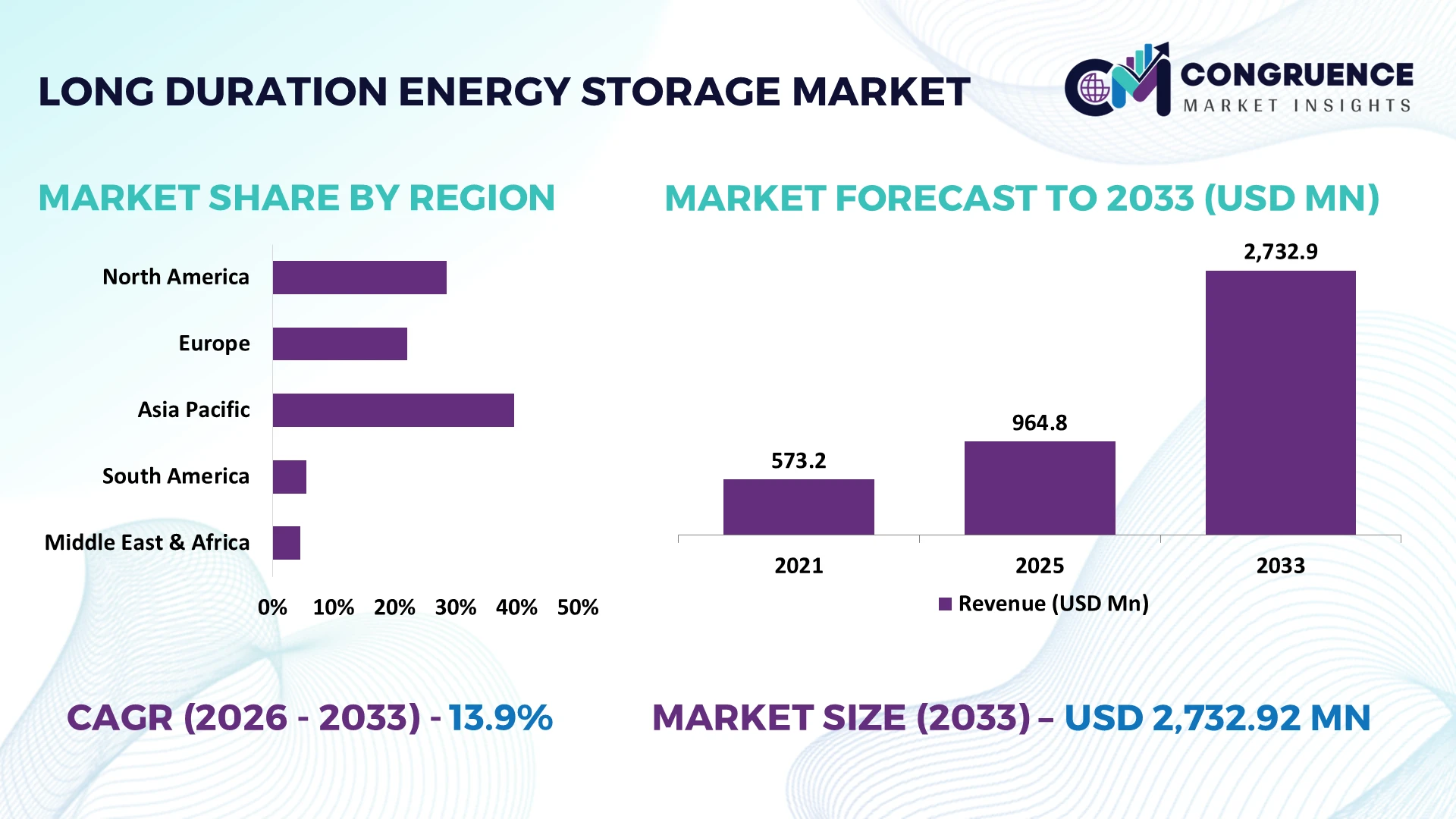
The Global Long Duration Energy Storage Market was valued at USD 964.8 Million in 2025 and is anticipated to reach a value of USD 2,732.9 Million by 2033 expanding at a CAGR of 13.9% between 2026 and 2033. Accelerating renewable energy integration, rising grid congestion, coal-fired power plant retirements, and increasing requirements for multi-day electricity storage are driving market expansion.
China dominates installed long-duration energy storage capacity when pumped hydro is included, accounting for approximately 40% of global pumped storage capacity, with installations exceeding 58 GW by 2024 compared with approximately 22 GW in the United States. China's renewable energy expansion, national energy security policies, and investments in compressed air energy storage and vanadium redox flow batteries strengthen deployment across utilities and industrial infrastructure.
Strategic investments in scalable storage technologies, domestic component manufacturing, and utility partnerships will determine competitive positioning in emerging electricity flexibility markets.
Market Size & Growth: USD 964.8 million in 2025, reaching USD 2,732.9 million by 2033 at 13.9% CAGR, driven by renewable energy integration.
Top Growth Drivers: Renewable integration (42%), grid reliability (34%), and industrial decarbonization (24%), based on indicative driver weightings.
Short-Term Forecast: By 2028, emerging storage technologies target approximately 15–25% system cost reductions.
Emerging Technologies: Iron-air batteries, AI-enabled energy management, and advanced flow batteries support storage durations exceeding 10 hours.
Regional Leaders: Illustrative 2033 projections include Asia Pacific (USD 1,093.2 million; utility expansion), North America (USD 765.2 million; grid resilience), and Europe (USD 601.2 million; renewable integration).
Consumer/End-User Trends: Utilities increasingly prioritize storage configurations delivering 8–100 hours of continuous discharge.
Pilot/Case Example: China's 2024 Zhangjiakou compressed air storage project demonstrated approximately 70.4% system efficiency.
Competitive Landscape: Sumitomo Electric is an established flow battery supplier, competing with Form Energy, ESS Inc., Invinity Energy Systems, and Hydrostor; comparable market shares remain unverified.
Regulatory & ESG Impact: The United States introduced a 30% base investment tax credit for qualifying storage projects meeting applicable requirements.
Investment & Funding: Form Energy secured USD 405 million in 2024 Series F funding, supporting manufacturing expansion.
Innovation & Future Outlook: Multi-day storage exceeding 100 hours represents a strategic shift toward weather-resilient electricity infrastructure.
The Long Duration Energy Storage Market is experiencing structural transformation across utility-scale power generation, industrial microgrids, renewable energy installations, and critical infrastructure. Advanced flow batteries achieve approximately 65–85% round-trip efficiency, while iron-air systems extend discharge capabilities across multiple days. Electricity market reforms increasingly recognize extended-duration capacity, strengthening the commercial relevance of storage technologies within integrated energy infrastructure strategies.
Long duration energy storage is becoming a strategic infrastructure investment as electricity networks transition from dispatchable fossil fuel generation toward weather-dependent renewable resources. Utilities increasingly require storage assets capable of maintaining electricity availability beyond conventional four-hour battery configurations. Capacity market reforms and coal plant retirements are consequently shifting procurement priorities toward technologies delivering extended discharge durations and dependable seasonal flexibility.
Advanced vanadium flow batteries offer approximately 15,000–20,000 operating cycles compared with around 3,000–6,000 cycles for many conventional lithium-ion configurations, reducing replacement frequency in suitable applications. China prioritizes large-scale pumped hydro and compressed air installations, while the United States emphasizes emerging electrochemical technologies. Through 2028–2029, procurement is expected to increasingly incorporate storage durations exceeding 10 hours.
China's 300 MW Yingcheng compressed air energy storage project demonstrates the commercial potential of geological storage infrastructure for renewable electricity balancing. Companies are responding through manufacturing expansion, utility partnerships, and modular system development to reduce project delivery costs. Competitive advantage will increasingly depend on lifecycle economics, technology bankability, and the ability to monetize extended-duration flexibility across evolving electricity markets.
Increasing penetration of variable renewable electricity is strengthening demand for storage technologies capable of balancing prolonged generation fluctuations. Renewable energy accounted for approximately 92.5% of global power capacity additions in 2024, while wind and solar collectively generated approximately 15% of global electricity. China's rapid renewable infrastructure expansion and coal-dependent electricity balancing requirements are accelerating investments in extended-duration storage. Conventional four-hour batteries remain insufficient for managing prolonged renewable generation deficits. Companies including Form Energy, Hydrostor, and Invinity Energy Systems are expanding technology portfolios and establishing utility partnerships. The principal commercial advantage lies in converting otherwise curtailed renewable electricity into dispatchable capacity, improving infrastructure utilization without proportional transmission expansion.
Elevated upfront capital requirements and varying conversion efficiencies restrict commercial deployment across cost-sensitive electricity markets. Vanadium redox flow batteries typically deliver 65–85% round-trip efficiency, while compressed air energy storage systems operate at approximately 40–70%, compared with 85–95% for conventional lithium-ion batteries. These conversion losses increase electricity procurement requirements and reduce arbitrage margins where charging prices remain elevated. Geological storage technologies additionally face site-specific construction expenses, while China's substantial vanadium production concentration exposes international manufacturers to electrolyte price fluctuations. Suppliers are mitigating these limitations through electrolyte leasing, localized manufacturing, modular engineering, and alternative storage chemistries. Commercial viability increasingly depends on capacity payments rather than energy arbitrage alone.
Emerging iron-air batteries, advanced thermal storage, and next-generation flow battery chemistries are creating opportunities beyond conventional daily electricity balancing. The United States Department of Energy targets a 90% reduction in grid-scale long-duration storage costs through its Long Duration Storage Shot initiative. Iron-air battery developers target approximately 90% lower energy-capacity costs than conventional lithium-ion alternatives, while advanced thermal storage configurations achieve heat-to-heat efficiencies exceeding 90%. Industrial facilities requiring continuous process heat represent an underserved commercial opportunity because direct thermal utilization avoids electricity reconversion losses. Companies including Form Energy, Rondo Energy, and ESS Inc. are pursuing manufacturing expansion, industrial partnerships, and technology validation to establish differentiated positions across extended-duration applications.
Scaling long-duration storage requires dependable performance validation, standardized interconnection frameworks, and financing structures aligned with extended asset lifetimes. Approximately 80% of electricity transmission lines in the United States are more than 20 years old, complicating infrastructure integration. Meanwhile, approximately 13% of global electricity generation originated from wind and solar in 2023, intensifying requirements for coordinated dispatch as renewable penetration increases. Emerging storage technologies must demonstrate operational availability approaching 95% to compete effectively for dependable capacity contracts. Developers face challenges in validating degradation profiles, establishing performance guarantees, and integrating heterogeneous control architectures. Companies must strengthen utility collaboration, independent technology certification, predictive maintenance capabilities, and long-term service agreements to secure institutional financing.
Modular Storage Architecture Gains Traction: Manufacturers are transitioning toward standardized storage modules supporting discharge durations of 8–24 hours and independently scalable power and energy capacities. Factory-assembled configurations reduce site-specific engineering requirements and simplify maintenance. Invinity Energy Systems and ESS Inc. are advancing modular flow battery platforms to streamline installation workflows and improve project delivery consistency.
Long-Term Capacity Contracts Reshape Procurement: Utilities are shifting from merchant electricity arbitrage toward contracted storage availability through agreements spanning 15–25 years. The United Kingdom's long-duration electricity storage cap-and-floor framework targets technologies providing at least eight hours of discharge. Developers are restructuring financing arrangements around predictable capacity payments, reducing exposure to short-term electricity price fluctuations.
Existing Power Infrastructure Undergoes Repurposing: Retired thermal power generation facilities are emerging as deployment sites for advanced storage systems, utilizing existing transmission connections and industrial infrastructure. Thermal storage technologies operating at temperatures exceeding 600°C support configurations delivering 10–100 hours of storage. Technology providers are partnering with power producers to reuse infrastructure and minimize greenfield development requirements.
Digital Dispatch Optimization Becomes Standard: Storage operators are integrating predictive analytics, automated dispatch scheduling, and real-time performance monitoring across systems targeting operational availability above 95%. Advanced control platforms evaluate electricity prices and renewable generation forecasts at intervals of 5–15 minutes. Companies are expanding software partnerships to improve asset utilization, maintenance planning, and contracted capacity delivery.
Compressed Air Energy Storage (CAES) leads emerging long-duration storage technologies, accounting for approximately 45.0% of newly installed capacity in 2025, excluding conventional pumped hydro. Its dominance reflects large-scale storage capabilities, extended discharge durations, and comparatively long operating lifetimes. Thermal Energy Storage accounted for approximately 33.0% of installations, supported by industrial heating applications and renewable electricity integration. Thermal storage is positioned among the fastest-growing technologies as manufacturers adopt electrified process heating and recover surplus renewable electricity for continuous industrial operations.
Electrochemical Energy Storage, particularly vanadium redox flow batteries, represented approximately 21.0% of installations, benefiting from independent power and energy scalability. Pumped Hydro Energy Storage remains an established technology with substantial installed infrastructure but faces geographical and environmental development constraints. Hydrogen Energy Storage addresses seasonal electricity balancing, although conversion losses restrict near-term commercial adoption. Companies including Hydrostor, Highview Power, Rondo Energy, and Invinity Energy Systems are expanding engineering capabilities, manufacturing infrastructure, and technology partnerships. Investment priorities increasingly favor application-specific storage architectures that balance discharge duration, operational reliability, and lifecycle costs.
Grid Stabilization and Load Balancing represents the leading application, supported by electricity network modernization and increasing requirements for dispatchable capacity. Grid-side projects accounted for approximately 64.9% of China's newly installed energy storage power capacity during the first half of 2025, demonstrating the scale of network-level demand. Renewable Energy Integration is positioned among the fastest-growing applications as electricity producers seek to minimize generation curtailment and extend power delivery beyond intermittent operating periods. Source-side projects represented approximately 26.7% of China's new storage installations by power capacity during the same period.
Peak Shaving and Energy Arbitrage remain established applications, enabling electricity operators to optimize procurement costs and manage extended periods of elevated demand. Backup Power and Emergency Power Supply applications are strengthening across data centers, manufacturing facilities, and critical infrastructure requiring prolonged operational continuity. Other applications, including industrial process heat management, are gaining commercial relevance through electrification initiatives. Technology providers are integrating automated dispatch platforms, customized discharge configurations, and advanced energy management systems. Demand is increasingly shifting toward storage assets capable of combining multiple grid services with dependable electricity availability during prolonged supply disruptions.
Utilities and Power Generation Companies constitute the leading end-user group, reflecting their responsibility for grid reliability, electricity balancing, and large-scale infrastructure development. Utility-oriented projects dominate deployment activity, with standalone storage representing approximately 51.2% of China's cumulative new energy storage capacity at the end of 2025. Industrial and Commercial Enterprises represent an emerging high-growth buyer group as energy-intensive manufacturing facilities prioritize dependable electricity availability, peak demand management, and industrial heat electrification. Industrial buyers increasingly evaluate storage investments against avoided production interruptions and long-term energy procurement costs rather than electricity savings alone.
Renewable Energy Developers are incorporating extended-duration storage into solar and wind installations to improve dispatchability and secure dependable power purchase agreements. Government and Public Infrastructure Organizations prioritize energy security, emergency resilience, and electricity network modernization. Other End-Users, including data center operators and microgrid developers, are exploring customized storage configurations supporting continuous operations. Companies are responding through long-term performance contracts, storage-as-a-service models, and integrated engineering partnerships. Commercial positioning increasingly depends on tailoring storage duration, contractual availability, system architecture, and maintenance requirements to distinct buyer profiles.
Asia Pacific accounted for the largest market share at 39.5% in 2025 however, North America is expected to register the fastest growth, expanding at a CAGR of 14.1% between 2026 and 2033.
North America accounted for 28.5% of the global Long Duration Energy Storage Market in 2025, supported by electricity infrastructure modernization, renewable energy integration, and increasing requirements for dependable grid capacity. Utilities are diversifying beyond conventional lithium-ion batteries through investments in iron-air, compressed air, and advanced flow battery technologies. The United States and Canada are strengthening domestic energy storage manufacturing capabilities through public funding and private-sector partnerships. Hydrostor's proposed 500 MW Willow Rock Energy Storage Center in California is designed to provide 4,000 MWh of storage capacity, demonstrating the increasing scale of advanced compressed air installations. Data center expansion and industrial electrification are further strengthening requirements for extended electricity availability. Technology providers are prioritizing utility procurement agreements, domestic manufacturing, and performance guarantees to improve commercial bankability and reduce project development risks.
United States Market Outlook: The United States leads regional technology commercialization through federal incentives, utility demonstration programs, and domestic manufacturing investments. Form Energy's West Virginia manufacturing facility supports the production of iron-air batteries designed to deliver electricity for up to 100 hours. Increasing participation from independent power producers and infrastructure investors is strengthening commercial opportunities for multi-day storage across capacity-constrained electricity networks.
Europe accounted for 22.0% of the global Long Duration Energy Storage Market in 2025, driven by electricity market restructuring, industrial decarbonization, and increasing dependence on intermittent renewable generation. Germany, the United Kingdom, Spain, and France are advancing storage infrastructure to reduce electricity curtailment and improve cross-border energy flexibility. The European Union's objective of achieving at least 42.5% renewable energy consumption by 2030 strengthens the strategic importance of extended-duration storage. Germany's industrial sector is exploring thermal energy storage to reduce dependence on natural gas for process heating, while Spain benefits from established pumped hydro infrastructure. Technology developers are increasingly integrating storage systems with renewable generation facilities and industrial energy networks. Long-term capacity contracts, standardized procurement mechanisms, and infrastructure partnerships are becoming essential for attracting institutional investment and accelerating commercial deployment.
United Kingdom Market Outlook: The United Kingdom is advancing long-duration storage commercialization through its cap-and-floor regulatory framework, improving investment predictability for infrastructure developers. Highview Power's Carrington liquid air energy storage project is designed to deliver 50 MW of power and 300 MWh of storage capacity. Established electricity trading mechanisms and increasing offshore wind penetration strengthen opportunities for flexible storage infrastructure.
Asia Pacific accounted for 39.5% of the global Long Duration Energy Storage Market in 2025, supported by extensive renewable energy installations, competitive manufacturing capabilities, and government-backed electricity infrastructure investments. China dominates regional deployment through compressed air energy storage, pumped hydro, and advanced electrochemical systems, while Japan maintains technological expertise in flow batteries. India's expanding renewable electricity network is strengthening requirements for dispatchable storage capacity, particularly across solar-intensive states. China's 300 MW Yingcheng compressed air energy storage project provides approximately 1,500 MWh of storage capacity, demonstrating the region's large-scale engineering capabilities. Australia is expanding storage procurement to support coal-fired generation retirements and electricity network reliability. Regional manufacturers are leveraging localized component supply chains, integrated engineering capabilities, and government-supported demonstration projects to improve cost competitiveness and accelerate technology commercialization across domestic and international markets.
China Market Outlook: China benefits from integrated battery material supply chains, state-backed infrastructure financing, and extensive power equipment manufacturing capabilities. The Dalian vanadium redox flow battery project features an initial configuration of 100 MW and 400 MWh, demonstrating domestic expertise in large-scale electrochemical storage. National energy security priorities and renewable electricity expansion continue to strengthen demand for diversified storage technologies.
South America accounted for 5.5% of the global Long Duration Energy Storage Market in 2025, supported by expanding renewable electricity infrastructure, mining electrification, and increasing requirements for reliable industrial power supplies. Chile and Brazil represent strategically important markets because of their extensive renewable energy resources and electricity transmission requirements. Chile's Atacama Desert provides favorable conditions for solar-linked storage, while mining operators require dependable electricity for continuous processing activities. The Cerro Dominador concentrated solar power facility incorporates 110 MW of generating capacity and approximately 17.5 hours of thermal storage, demonstrating extended-duration electricity delivery capabilities. Brazil's established hydropower infrastructure provides operational expertise relevant to pumped storage development. However, financing constraints, transmission bottlenecks, and evolving storage remuneration frameworks restrict deployment. International technology providers are pursuing local utility partnerships and customized engineering solutions to address these limitations.
Chile Market Outlook: Chile is emerging as a strategically significant market through its solar-intensive electricity network and energy-intensive copper mining industry. The country's objective of achieving 80% renewable electricity generation by 2030 strengthens requirements for extended storage capacity. Mining companies and independent power producers are evaluating integrated renewable storage configurations to improve electricity supply continuity and reduce dependence on fossil fuel generation.
Middle East & Africa accounted for 4.5% of the global Long Duration Energy Storage Market in 2025, supported by renewable energy diversification, industrial infrastructure modernization, and electricity supply reliability requirements. Saudi Arabia, the United Arab Emirates, Morocco, and South Africa are developing storage opportunities aligned with national energy transition strategies. Morocco's Noor III concentrated solar power facility incorporates 150 MW of generating capacity and approximately 7.5 hours of thermal storage, demonstrating the operational relevance of extended-duration technologies in high-solar-resource environments. South Africa's electricity supply constraints are strengthening interest in storage-backed industrial microgrids and dispatchable renewable generation. Gulf countries are evaluating thermal storage, pumped hydro, and advanced electrochemical systems to support industrial diversification. Technology suppliers are prioritizing climate-resilient system designs, government partnerships, and integrated engineering services to address demanding environmental conditions and infrastructure requirements.
United Arab Emirates Market Outlook: The United Arab Emirates is strengthening its long-duration storage capabilities through integrated renewable electricity infrastructure and government-backed utility investments. Dubai's Hatta pumped storage hydroelectric project is designed to provide 250 MW of generating capacity and 1,500 MWh of energy storage. Domestic infrastructure financing capabilities and advanced engineering partnerships support the commercialization of diversified storage technologies across utility and industrial applications.
The Long Duration Energy Storage Market features competition between Hydrostor, Form Energy, Sumitomo Electric Industries, Invinity Energy Systems, and Highview Power, combining infrastructure developers with specialized technology manufacturers. The top five players’ combined market share remains unverified, preventing reliable concentration assessment. Competition centers on storage duration, lifecycle economics, manufacturing scalability, and project bankability. Vanadium flow batteries deliver approximately 65–85% round-trip efficiency, while compressed air systems achieve approximately 40–70%, influencing technology selection across utility applications. Form Energy is expanding iron-air battery manufacturing, while Hydrostor advances utility partnerships and infrastructure development. Sumitomo Electric and Invinity emphasize modular configurations, electrolyte management, and extended operating lifetimes. Competitive positioning is shifting from standalone equipment supply toward integrated storage solutions incorporating performance guarantees and contracted capacity delivery. Capital-intensive demonstration requirements, lengthy permitting processes, and technology certification create substantial entry barriers. Winning requires proven operational reliability, competitive lifecycle costs, scalable manufacturing, and dependable partnerships with major electricity utilities.
Form Energy
Hydrostor Inc.
Sumitomo Electric Industries, Ltd.
Invinity Energy Systems plc
Highview Power
ESS Tech, Inc.
Energy Vault Holdings, Inc.
Eos Energy Enterprises, Inc.
Rondo Energy, Inc.
Malta Inc.
Antora Energy, Inc.
Energy Dome
VRB Energy
CellCube
Advanced compressed air energy storage and vanadium redox flow batteries represent commercially established alternatives to conventional short-duration lithium-ion systems. Compressed air configurations achieve approximately 40–70% round-trip efficiency, while vanadium flow batteries deliver 65–85%. Independent scaling of electrolyte capacity and power stacks enables extended discharge without proportionally increasing power conversion equipment. Commercial installations exceeding 100 MW demonstrate increasing technology maturity and utility acceptance.
Iron-air batteries and advanced thermal storage are disrupting conventional storage economics through abundant materials and application-specific energy conversion. Iron-air developers target energy-capacity costs approximately 90% below lithium-ion alternatives, while direct thermal storage achieves heat-to-heat efficiencies exceeding 90%. Compared with conventional four-hour battery configurations, emerging 100-hour iron-air systems provide 2,400% longer nominal discharge duration, strengthening electricity supply resilience during prolonged renewable generation deficits.
Between 2026 and 2028, AI-enabled dispatch optimization, modular manufacturing, and integrated renewable storage architectures will influence commercial procurement. Utilities benefit from improved capacity availability, while industrial manufacturers gain opportunities to electrify continuous process heating. Technology providers combining automated performance monitoring, standardized engineering, and flexible discharge configurations will strengthen competitive positioning. Investment priorities increasingly favor systems demonstrating predictable degradation, reliable performance guarantees, and competitive lifecycle economics, enabling developers to secure long-term infrastructure financing and differentiated electricity service contracts.
June 2026, Energy Dome signed its first bilateral commercial contract with Google for a 23 MW/200 MWh CO₂ battery project in Ireland. The agreement advances commercial deployment, strengthens electricity grid flexibility, and expands opportunities for storage infrastructure serving technology enterprises. Source: energydome.com
December 2025, Hydrostor received final permitting approval from the California Energy Commission for its Willow Rock Energy Storage Center. The 500 MW/4,000 MWh compressed air storage project strengthens the company's infrastructure development pipeline and reduces regulatory barriers to commercial construction. Source: hydrostor.ca
December 2024, Invinity Energy Systems commercially launched ENDURIUM, its fourth-generation vanadium flow battery, delivering up to double the site-level energy density of its previous VS3 platform. The innovation improves installation scalability, optimizes land utilization, and strengthens competitiveness in utility-scale applications. Source: invinity.com
October 2024, Form Energy secured USD 405 million in Series F financing led by T. Rowe Price to expand iron-air battery manufacturing and commercial operations. The investment strengthens production scalability and supports deployment of multi-day storage systems across electricity networks. Source: formenergy.com
The Long Duration Energy Storage Market Report provides comprehensive analysis across storage technologies, applications, end-users, and geographical markets. Technology coverage includes Pumped Hydro Energy Storage, Compressed Air Energy Storage, Thermal Energy Storage, Electrochemical Energy Storage, and Hydrogen Energy Storage. Application analysis encompasses grid stabilization, renewable energy integration, peak shaving, energy arbitrage, and backup power. End-user coverage includes utilities, power generation companies, industrial enterprises, renewable energy developers, and public infrastructure organizations.
The report evaluates market positioning across North America, Europe, Asia Pacific, South America, and Middle East & Africa, examining infrastructure investments, regulatory frameworks, and commercial deployment patterns. Coverage extends to emerging iron-air batteries, advanced flow batteries, and multi-day storage configurations exceeding 100 hours. Strategic insights support investment planning, technology selection, geographical expansion, competitive positioning, partnership development, and infrastructure procurement decisions between 2026 and 2033.
| Report Attribute / Metric | Details |
|---|---|
| Market Revenue (2025) | USD 964.8 Million |
| Market Revenue (2033) | USD 2,732.9 Million |
| CAGR (2026–2033) | 13.9% |
| Base Year | 2025 |
| Forecast Period | 2026–2033 |
| Historic Period | 2021–2025 |
| Segments Covered |
By Type
By Application
By End-User
|
| Key Report Deliverables | Revenue Forecast; Market Trends; Growth Drivers & Restraints; Technology Insights; Segmentation Analysis; Regional Insights; Competitive Landscape; Regulatory & ESG Overview; Recent Developments |
| Regions Covered | North America; Europe; Asia-Pacific; South America; Middle East & Africa |
| Key Players Analyzed | Form Energy; Hydrostor Inc.; Sumitomo Electric Industries, Ltd.; Invinity Energy Systems plc; Highview Power; ESS Tech, Inc.; Energy Vault Holdings, Inc.; Eos Energy Enterprises, Inc.; Rondo Energy, Inc.; Malta Inc.; Antora Energy, Inc.; Energy Dome; VRB Energy; CellCube |
| Customization & Pricing | Available on Request (10% Customization Free) |




