
Reports
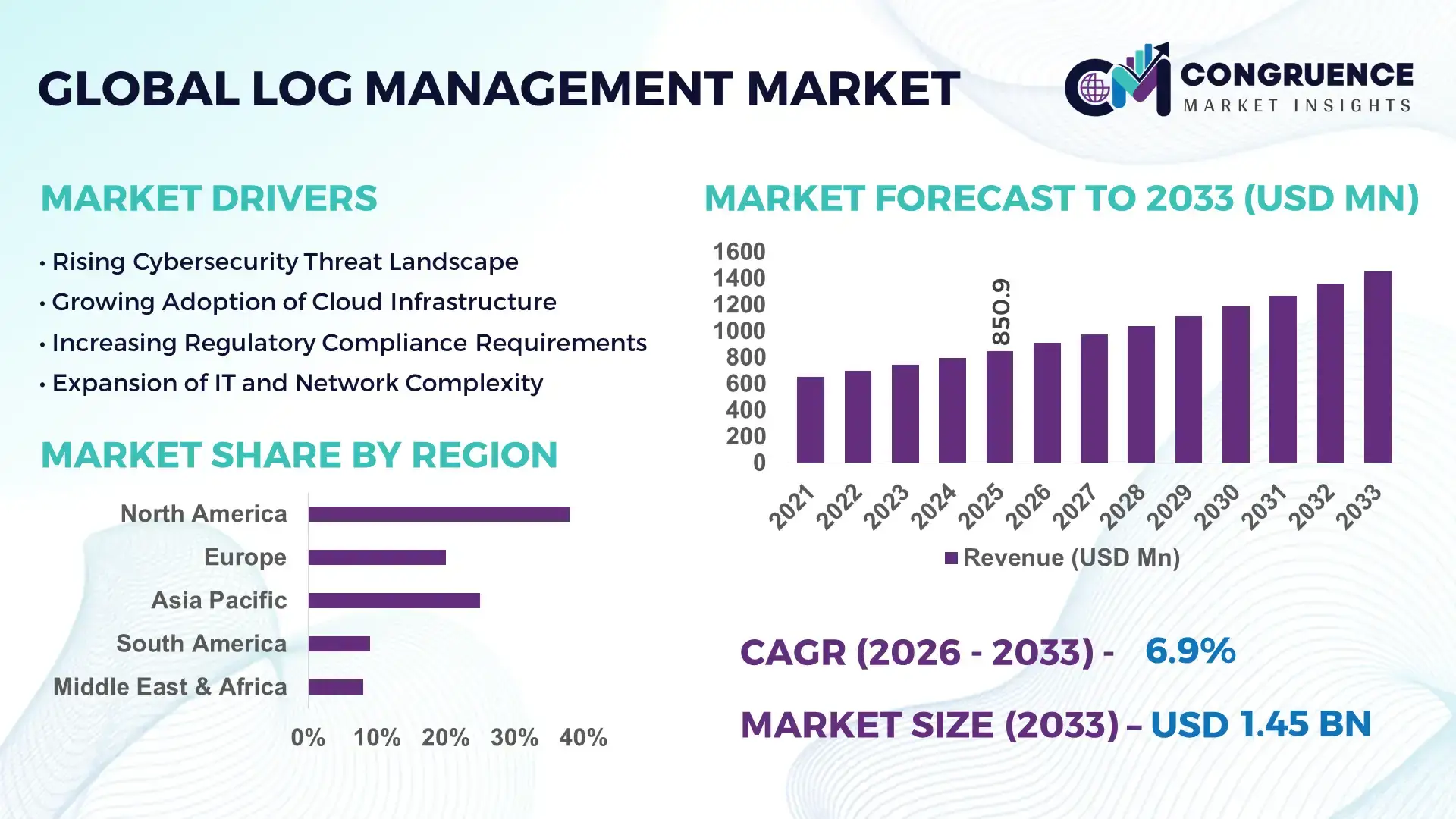
The Global Log Management Market was valued at USD 850.89 Million in 2025 and is anticipated to reach a value of USD 1451.1 Million by 2033 expanding at a CAGR of 6.9% between 2026 and 2033. Growth is primarily supported by increasing enterprise focus on cybersecurity visibility and centralized IT infrastructure monitoring.
The United States represents the most technologically advanced environment for log management deployment, supported by large-scale digital infrastructure and sustained cybersecurity investments. Enterprises across the country process billions of log events daily from cloud, hybrid, and on-premise systems. Annual spending on security analytics and monitoring platforms exceeds USD 2 billion, with over 70% adoption across industries such as BFSI, healthcare, and government. Advanced use of AI-driven log correlation, automated incident triage, and compliance reporting tools is widely integrated into SOC operations. Continuous innovation in machine learning models and real-time threat intelligence integration strengthens large-scale operational monitoring capabilities.
• Market Size & Growth: Market valued at USD 850.89M in 2025, projected to reach USD 1451.1M by 2033 at a 6.9% CAGR, driven by demand for real-time security analytics and IT operations visibility.
• Top Growth Drivers: Cloud log adoption (65%), compliance automation demand (58%), real-time threat detection enhancement (47%).
• Short-Term Forecast: By 2028, enterprises are expected to reduce incident response time by 30% and improve operational performance monitoring efficiency by 45%.
• Emerging Technologies: AI-powered log correlation, predictive analytics engines, and edge-to-cloud log ingestion architectures.
• Regional Leaders: North America (USD 620M by 2033 with strong SOC integration), Europe (USD 340M by 2033 driven by regulatory logging mandates), Asia Pacific (USD 280M by 2033 fueled by enterprise digital transformation).
• Consumer/End-User Trends: High adoption among banking, telecom, healthcare, and public sector organizations, with increasing preference for SaaS-based centralized logging platforms.
• Pilot or Case Example: A 2025 enterprise banking pilot achieved 27% reduction in critical downtime and 35% fewer false-positive alerts using automated log intelligence.
• Competitive Landscape: Leading vendor holds approximately 24% market presence, followed by major global cybersecurity and observability solution providers.
• Regulatory & ESG Impact: Data protection laws and cybersecurity compliance frameworks are expanding log retention, auditability, and secure data governance requirements.
• Investment & Funding Patterns: Around USD 1.3B invested recently in AI-driven and cloud-native log management platforms, reflecting strong venture and enterprise funding trends.
• Innovation & Future Outlook: Convergence with XDR, observability platforms, and automated remediation systems is shaping next-generation intelligent log ecosystems.
Log management solutions are heavily utilized across IT services, telecommunications, finance, manufacturing, and government sectors, where compliance monitoring and security operations drive substantial usage volumes. Innovations such as high-speed ingestion engines, behavioral analytics, and centralized observability dashboards enhance operational intelligence. Regulatory requirements on data traceability, audit trails, and breach reporting remain key adoption enablers, while digital transformation in emerging economies increases enterprise log data generation. Regional demand is accelerating in Asia Pacific and Middle East markets as organizations modernize IT infrastructures. Future growth is linked to predictive threat detection, integration with broader observability stacks, and automation of incident response processes, positioning log management as a core enterprise resilience capability.
The Log Management Market has become strategically critical as enterprises generate over 2.5 quintillion bytes of data daily, with machine logs representing a substantial portion of security and operational intelligence streams. Organizations increasingly treat log data as a strategic asset for threat detection, compliance assurance, and infrastructure optimization. Advanced analytics embedded into centralized logging platforms now support automated root-cause analysis, reducing mean time to resolution (MTTR) by up to 35% in digitally mature enterprises. From a technology standpoint, AI-driven log correlation delivers 40% faster anomaly detection compared to rule-based monitoring systems.
Regionally, North America dominates in data volume due to hyperscale cloud infrastructure, while Europe leads in adoption, with over 68% of enterprises deploying centralized logging to meet regulatory mandates. By 2028, AI-based predictive analytics is expected to improve incident response efficiency by 45% across enterprise SOC environments. Sustainability initiatives are also influencing deployment strategies, with firms committing to 30% data center energy efficiency improvements by 2030 through optimized log storage and processing architectures.
In 2025, a multinational telecom operator achieved a 32% reduction in service outages through AI-assisted log pattern analysis, demonstrating measurable operational gains. As digital ecosystems expand, the Log Management Market is positioned as a foundational pillar of operational resilience, regulatory compliance, and sustainable technology governance.
Escalating cyber threats and the complexity of enterprise IT ecosystems are primary growth drivers for the Log Management Market. Organizations face an average of 1,200 cyberattack attempts per week, increasing reliance on centralized logging for forensic investigation and real-time threat detection. Security operations centers utilize log data to correlate events across endpoints, networks, and cloud workloads, enabling detection accuracy improvements exceeding 40%. Regulatory compliance requirements also compel firms to maintain detailed activity logs for audit readiness. The rise of remote work and IoT endpoints further multiplies log sources, intensifying demand for scalable ingestion and analytics capabilities. As enterprises adopt zero-trust frameworks, continuous log monitoring becomes essential for identity verification and access control enforcement, reinforcing its strategic importance.
The exponential growth of log data introduces infrastructure and cost burdens that can hinder adoption. Enterprises generating multi-terabyte daily log volumes require high-performance storage, indexing engines, and long-term archival solutions, increasing operational overhead. Data retention policies often mandate storage periods of 12–24 months, significantly expanding capacity requirements. Processing latency also poses a challenge; high ingestion rates can impact system performance if not supported by distributed architectures. Additionally, data privacy regulations restrict cross-border log transfers, complicating centralized deployment models for multinational organizations. Smaller enterprises often lack skilled personnel to manage log pipelines and analytics tuning, creating barriers to effective implementation and limiting full utilization of advanced capabilities.
AI and machine learning integration present significant opportunities to enhance log data value. Intelligent pattern recognition can reduce false positives by over 35%, enabling security teams to focus on high-risk alerts. Predictive maintenance models use operational logs to forecast system failures with accuracy improvements nearing 30%, supporting proactive infrastructure management. Cloud-native logging platforms further expand accessibility, allowing mid-sized enterprises to deploy scalable monitoring without extensive hardware investments. Edge computing growth also creates demand for distributed log processing solutions to manage latency-sensitive environments such as manufacturing and smart cities. These technological advancements expand use cases beyond security into performance optimization and business continuity planning.
Frequent updates to data protection and cybersecurity regulations increase the complexity of maintaining compliant log management infrastructures. Organizations must align retention policies, encryption standards, and audit reporting formats across jurisdictions, often requiring system redesigns. Integration with diverse legacy systems, proprietary applications, and multi-cloud platforms presents interoperability hurdles. Studies show that over 40% of IT teams face difficulties correlating logs across heterogeneous environments. Furthermore, talent shortages in cybersecurity and data engineering limit the ability to fine-tune analytics models and maintain continuous monitoring. These factors raise deployment timelines and operational risks, challenging organizations seeking rapid scalability while maintaining governance and performance standards.
• AI-Driven Log Analytics Reducing Incident Response Time by 40% Enterprise security teams are increasingly deploying AI-enabled log analytics engines to manage high-velocity data streams. Advanced behavioral models now process over 15 million events per second in large SOC environments, improving anomaly detection accuracy by 35%. Automated log triage tools have reduced mean time to detect threats by 40% while cutting false-positive alerts by nearly 30%, enhancing operational efficiency.
• Cloud-Native Log Management Adoption Surpassing 65% of Enterprises Organizations are migrating log workloads to SaaS and cloud-native platforms to handle scalability challenges. Over 65% of mid-to-large enterprises now centralize multi-cloud logs into unified observability layers. Cloud-based ingestion pipelines support 50% faster deployment compared to legacy on-premise setups and enable elastic storage scaling of up to 70% during peak traffic periods, ensuring continuous monitoring resilience.
• Edge Log Processing Expanding with 45% Growth in Distributed Monitoring Nodes The rise of IoT and edge computing is driving distributed log processing architectures. Industrial and telecom networks report 45% more edge monitoring nodes compared to two years ago. Localized log filtering reduces bandwidth usage by 38% while enabling real-time response in latency-sensitive environments such as manufacturing automation and smart infrastructure networks.
• Compliance Automation Increasing Log Retention Efficiency by 33% Regulatory mandates are pushing enterprises toward automated log governance frameworks. Policy-driven retention systems have improved audit readiness by 50% and reduced manual compliance workload by 33%. Encryption and tokenization technologies now protect over 75% of archived logs in regulated industries, strengthening data security while aligning with evolving cybersecurity and privacy requirements.
The Log Management market is segmented by type, application, and end-user, reflecting the diverse operational and security requirements of modern digital enterprises. Solution types vary based on deployment architecture and functionality, with cloud-native and hybrid platforms gaining prominence as organizations manage over 10–20 terabytes of log data daily. Application-wise segmentation shows strong concentration in security analytics, compliance monitoring, and IT operations management, where automated log correlation improves detection precision by more than 35%. End-user segmentation indicates dominance of highly regulated and data-intensive industries, including BFSI, healthcare, telecom, and government, which collectively account for over 60% of enterprise log volumes. Adoption patterns reveal that large enterprises maintain centralized log repositories integrating more than 150 data sources on average, while mid-sized firms increasingly adopt SaaS-based logging to reduce infrastructure complexity by nearly 40%. These segmentation dynamics highlight the market’s evolution from basic log storage toward intelligent, analytics-driven operational ecosystems.
Log Management solutions are categorized into on-premise, cloud-based, and hybrid platforms. Cloud-based log management currently leads with approximately 48% adoption due to scalability, elastic storage expansion of up to 70% during peak loads, and simplified deployment across distributed infrastructures. Hybrid solutions account for nearly 32%, supporting enterprises that process sensitive logs locally while leveraging cloud analytics for high-volume correlation. On-premise platforms represent about 20%, preferred in sectors with strict data residency mandates.
Cloud-native platforms represent the fastest-growing type, expanding at an estimated 9.2% CAGR, driven by multi-cloud adoption and increasing reliance on SaaS observability stacks. Their growth is supported by automated updates, AI-driven indexing, and integration with over 200 third-party tools in large IT ecosystems. Hybrid models remain relevant for organizations transitioning legacy infrastructure, while on-premise systems serve niche environments such as defense and critical infrastructure.
Security and threat detection applications dominate, representing nearly 44% of log management usage, as enterprises rely on log intelligence to detect advanced threats and reduce breach dwell time by up to 30%. IT operations and performance monitoring follow with around 31%, where log analytics improve infrastructure uptime and reduce system failure diagnosis time by 25%. Compliance and audit management contributes approximately 17%, ensuring regulatory reporting accuracy and automated log retention enforcement. Remaining applications, including business analytics and DevOps monitoring, hold a combined 8% share, supporting performance optimization and release cycle acceleration.
Security analytics is also the fastest-growing application, expanding at roughly 10.1% CAGR, driven by zero-trust adoption and a 40% increase in endpoint-generated logs. IT operations growth is fueled by observability convergence, while compliance demand stems from data governance regulations requiring log traceability.
The BFSI sector leads end-user adoption with approximately 26% share, processing high log volumes for fraud detection, transaction monitoring, and regulatory compliance. Telecom follows at about 21%, leveraging log data to monitor network performance and manage over 1 million events per second in large carrier networks. Healthcare accounts for 14%, where electronic health record systems generate extensive access logs to ensure patient data protection. Government and defense sectors together contribute 13%, focusing on national cybersecurity monitoring. Remaining industries, including manufacturing, retail, and energy, hold a combined 26%, utilizing log data for operational analytics and industrial IoT monitoring.
Telecom represents the fastest-growing end-user segment with an estimated 9.5% CAGR, supported by 5G rollout and a 50% increase in edge-generated logs. BFSI continues strong adoption due to digital banking expansion, while healthcare growth is linked to data protection mandates.
North America accounted for the largest market share at 38% in 2025 however, Asia Pacific is expected to register the fastest growth, expanding at a CAGR of 8.4% between 2026 and 2033.
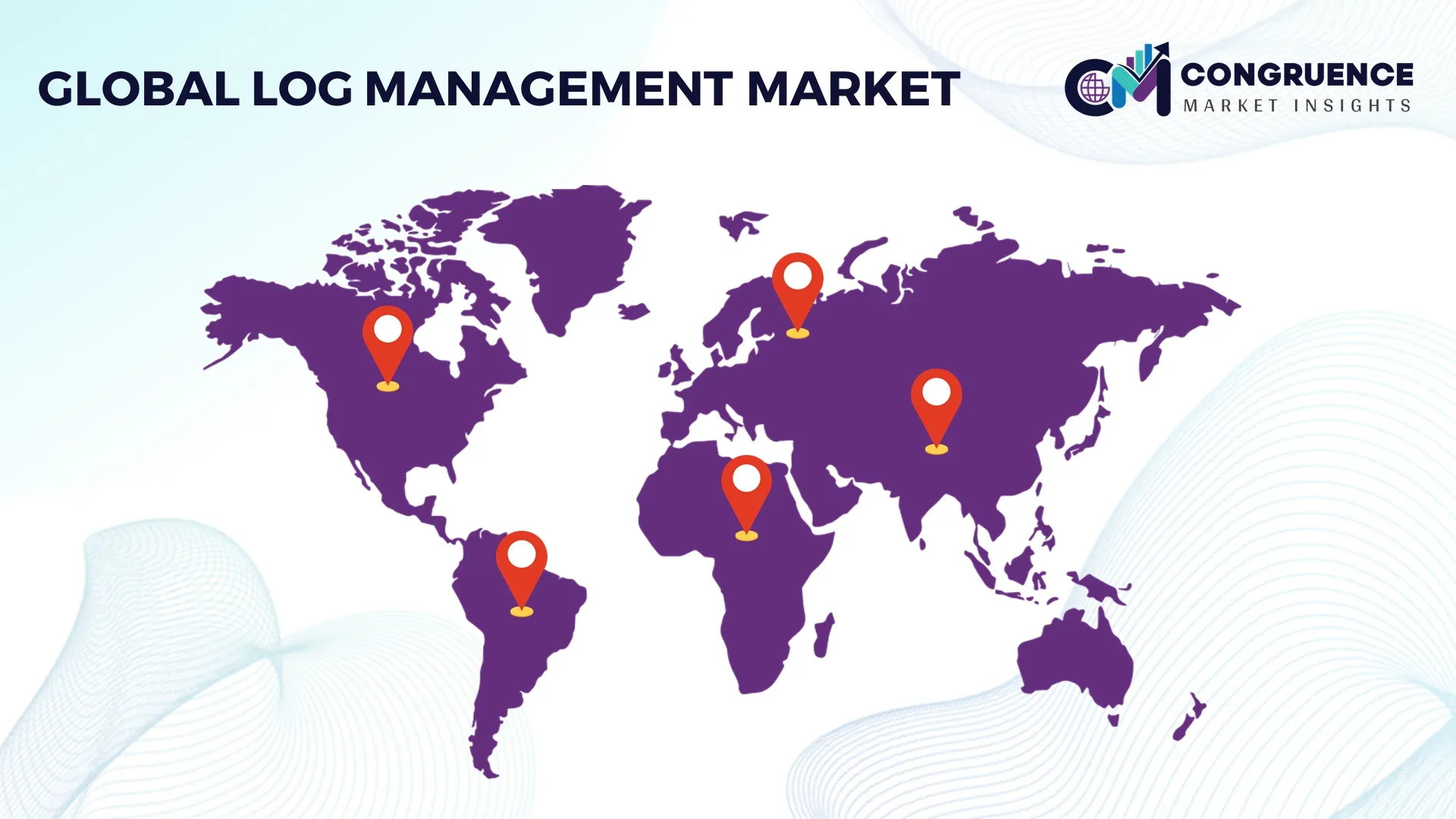
Regional performance reflects differences in digital maturity, regulatory frameworks, and enterprise IT infrastructure scale. Europe holds approximately 27% share, supported by stringent data governance policies across more than 30 regulated industries. Asia Pacific contributes nearly 22% of global log data volumes, with enterprises in China, India, and Japan collectively generating over 9 terabytes of machine logs daily. South America represents about 7% of adoption, driven by financial services modernization, while Middle East & Africa account for close to 6%, supported by smart infrastructure investments exceeding 20% of public-sector IT budgets in select Gulf economies. Across all regions, cloud-based deployments now exceed 60% of new implementations, while automated log analytics improves security event detection precision by over 35%.
How are advanced enterprise security infrastructures shaping demand patterns?
This region holds nearly 38% of global adoption, reflecting mature digital ecosystems and extensive enterprise IT environments. Key industries include BFSI, healthcare, telecommunications, and federal government agencies, where organizations process over 12 terabytes of log data daily. Regulatory frameworks emphasize breach disclosure, auditability, and cybersecurity readiness, encouraging centralized log retention policies exceeding 18 months. Digital transformation investments continue to prioritize AI-based security operations, with more than 65% of enterprises integrating automated log correlation into SOC workflows. A prominent regional cybersecurity vendor recently enhanced its cloud logging platform to process 20 million events per second, strengthening large-scale monitoring capabilities. Consumer behavior reflects higher enterprise adoption in healthcare and financial services, where compliance monitoring and fraud detection are primary drivers.
Why are compliance-focused enterprises accelerating adoption of explainable analytics?
Europe represents roughly 27% of market activity, with Germany, the UK, and France accounting for over 60% of regional deployments. Data protection regulations require detailed log retention and traceability, influencing solution design and audit automation. More than 70% of regulated enterprises deploy centralized logging for security and compliance use cases. Sustainability initiatives encourage energy-efficient data center operations, with log storage optimization reducing infrastructure power use by nearly 18%. Adoption of AI-powered observability tools is increasing, with 52% of large enterprises implementing predictive analytics in IT operations. A regional software firm recently introduced encrypted log lifecycle management, supporting multi-country compliance. Consumer behavior indicates regulatory pressure driving demand for transparent and explainable log intelligence platforms.
How is digital infrastructure expansion accelerating centralized monitoring adoption?
Asia Pacific contributes approximately 22% of global market activity and ranks highest in growth momentum. China, India, and Japan collectively account for more than 65% of regional log volumes, with enterprises in these countries processing over 8–10 terabytes daily. Rapid e-commerce growth and 5G network rollouts increase edge-generated logs by nearly 45% year-over-year. Technology hubs emphasize AI-driven analytics integration, while smart city initiatives expand distributed monitoring nodes by over 30%. A regional technology provider recently deployed AI-based log intelligence across 50 enterprise campuses, improving system fault detection by 33%. Consumer patterns show growth driven by digital banking, online services, and mobile-first platforms.
How is financial and media sector modernization influencing monitoring technologies?
This region accounts for about 7% of global adoption, with Brazil and Argentina representing more than 60% of regional activity. Financial institutions and digital media platforms drive demand, generating up to 4 terabytes of logs daily in large urban data centers. Government initiatives to modernize digital infrastructure have increased cloud adoption by 28% over three years. Trade policies promoting regional data centers support localized log storage. A domestic IT services provider recently implemented centralized monitoring across 15 banking networks, reducing system outage detection time by 26%. Consumer trends show demand linked to digital payments expansion and streaming services growth.
How are smart infrastructure and energy digitization shaping monitoring investments?
Middle East & Africa contribute nearly 6% of global adoption, led by the UAE and South Africa. Oil & gas, construction, and smart city projects are key sectors, generating extensive operational logs from IoT and industrial systems. Public-sector digital transformation programs allocate up to 25% of IT budgets toward cybersecurity and monitoring technologies. Regional modernization includes AI-enabled data centers and cross-border cloud partnerships. A regional systems integrator recently deployed automated log analytics across 12 smart infrastructure projects, improving incident detection by 31%. Consumer behavior reflects rising enterprise awareness of cybersecurity resilience and infrastructure reliability.
United States Log Management Market – 34% share: Strong enterprise cybersecurity infrastructure, large-scale cloud adoption, and high regulatory compliance requirements drive sustained demand.
Germany Log Management Market – 11% share: Advanced industrial digitization and strict data protection frameworks support extensive deployment across manufacturing and financial services sectors.
The Log Management market exhibits a moderately fragmented competitive structure with over 45 active global and regional solution providers competing across cloud-native, hybrid, and on-premise deployment segments. The top five vendors collectively account for approximately 54% of total industry presence, reflecting strong but not absolute concentration. Market leaders differentiate through AI-powered analytics, scalable ingestion engines exceeding 15–20 million events per second, and integration ecosystems supporting more than 200 third-party security and observability tools.
Strategic initiatives include more than 30 technology partnerships formed in the past two years to enhance SIEM, XDR, and SOAR interoperability. Product innovation cycles have accelerated, with vendors releasing updates every 6–9 months to incorporate predictive analytics, automated remediation, and edge log processing capabilities. Mergers and acquisitions remain active, with at least 12 consolidation deals recorded recently to expand cloud logging portfolios and regional service networks. Competitive positioning increasingly depends on SaaS delivery efficiency, where leading platforms reduce deployment time by nearly 50% compared to legacy models. Vendors are also investing in ESG-aligned data center optimization, lowering log storage energy consumption by up to 20%, strengthening their value proposition for enterprises prioritizing sustainable IT operations.
IBM
Splunk
Elastic
LogRhythm
Sumo Logic
SolarWinds
Graylog
Datadog
ManageEngine
Rapid7
McAfee Enterprise
Fortinet
Technological evolution in the Log Management market is centered on scalability, automation, and intelligent analytics. Modern platforms process between 10–25 million log events per second in large enterprise environments, supported by distributed ingestion architectures and high-speed indexing engines. AI and machine learning algorithms are now embedded into over 60% of enterprise logging systems, enabling automated anomaly detection and reducing false-positive security alerts by nearly 35%. These capabilities allow security operations centers to prioritize high-risk incidents while maintaining continuous monitoring across hybrid infrastructures.
Cloud-native logging technologies are transforming deployment models, with containerized architectures and microservices-based pipelines improving system scalability by up to 70% during traffic spikes. Edge log processing is gaining importance as IoT deployments expand; localized filtering reduces data transmission loads by approximately 40% and supports real-time decision-making in manufacturing, telecom, and smart infrastructure applications. Additionally, serverless ingestion frameworks now handle burst workloads without dedicated hardware provisioning, increasing operational efficiency.
Integration with broader observability and security ecosystems is another key advancement. More than 55% of enterprises integrate log management with SIEM, XDR, and SOAR platforms to enable automated incident response workflows. Encryption, tokenization, and role-based access control technologies secure over 75% of stored log data in regulated industries. Emerging innovations such as predictive analytics, behavioral baselining, and automated remediation engines are further strengthening the role of log management as a core pillar of enterprise cybersecurity, compliance assurance, and IT performance optimization.
• In May 2024, Sumo Logic unveiled enhanced AI and Real-Time Threat Intelligence capabilities that better align security and development teams around a unified log analytics platform, breaking down operational silos and accelerating DevSecOps workflows through advanced AI-driven insights. (Sumo Logic)
• In Q2 2024, Elastic announced the general availability of its Elastic AI Assistant for Observability, designed to help enterprises analyze logs and telemetry data using generative AI techniques, broadening the scope of real-time analysis and operational diagnostics.
• In Q3 2024, Graylog secured $39 million in growth funding aimed at accelerating product innovation and expanding its global footprint, signaling increased investment momentum in scalable and flexible log management and SIEM capabilities worldwide.
• In 2025, Microsoft entered a strategic partnership with Datadog to integrate Datadog’s log analytics with Azure Monitor, enabling seamless cross-platform log collection and correlation across cloud environments and enhancing multi-cloud observability workflows.
The Log Management Market Report encompasses a comprehensive examination of solutions, technologies, deployment models, and end-use industry applications. It includes detailed segmentation across product types such as on-premise, cloud-based, and hybrid log management platforms, analyzing functional capabilities like real-time ingestion, indexing, storage optimization, and AI-powered analytics. The report also covers key use cases including security monitoring, compliance reporting, IT performance tracking, and operational analytics. Geographic coverage spans major regions — North America, Europe, Asia Pacific, South America, and Middle East & Africa — with insights into regional adoption patterns, infrastructure maturity levels, and regulatory influences shaping deployment strategies.
Technology segments analyzed include AI/ML integration, cloud-native architectures, edge log processing, integration with SIEM/XDR/SOAR ecosystems, and encryption and data governance technologies critical for regulated environments. The report further identifies niche and emerging areas such as predictive analytics, automated anomaly detection, and observability convergence. Industry focus spans BFSI, healthcare, telecom, government, and enterprise IT services where centralized log management underpins operational resilience. Quantitative indicators include deployment volumes, infrastructure capacity metrics, and adoption rates for advanced analytics and automation features. The scope also evaluates competitive dynamics, vendor strategies, innovations, and strategic investments driving market evolution. This broad coverage supports decision-makers in technology selection, investment prioritization, and long-term operational planning.
| Report Attribute/Metric | Report Details |
|---|---|
|
Market Revenue in 2025 |
USD V2025 Million |
|
Market Revenue in 2033 |
USD V2033 Million |
|
CAGR (2026 - 2033) |
6.9% |
|
Base Year |
2025 |
|
Forecast Period |
2026 - 2033 |
|
Historic Period |
2021 - 2025 |
|
Segments Covered |
By Types
By Application
By End-User
|
|
Key Report Deliverable |
Revenue Forecast, Growth Trends, Market Dynamics, Segmental Overview, Regional and Country-wise Analysis, Competition Landscape |
|
Region Covered |
North America, Europe, Asia-Pacific, South America, Middle East, Africa |
|
Key Players Analyzed |
IBM, Splunk , Elastic, LogRhythm, Sumo Logic , SolarWinds, Graylog, Datadog, ManageEngine, Rapid7 , McAfee Enterprise, Fortinet |
|
Customization & Pricing |
Available on Request (10% Customization is Free) |




