
Reports
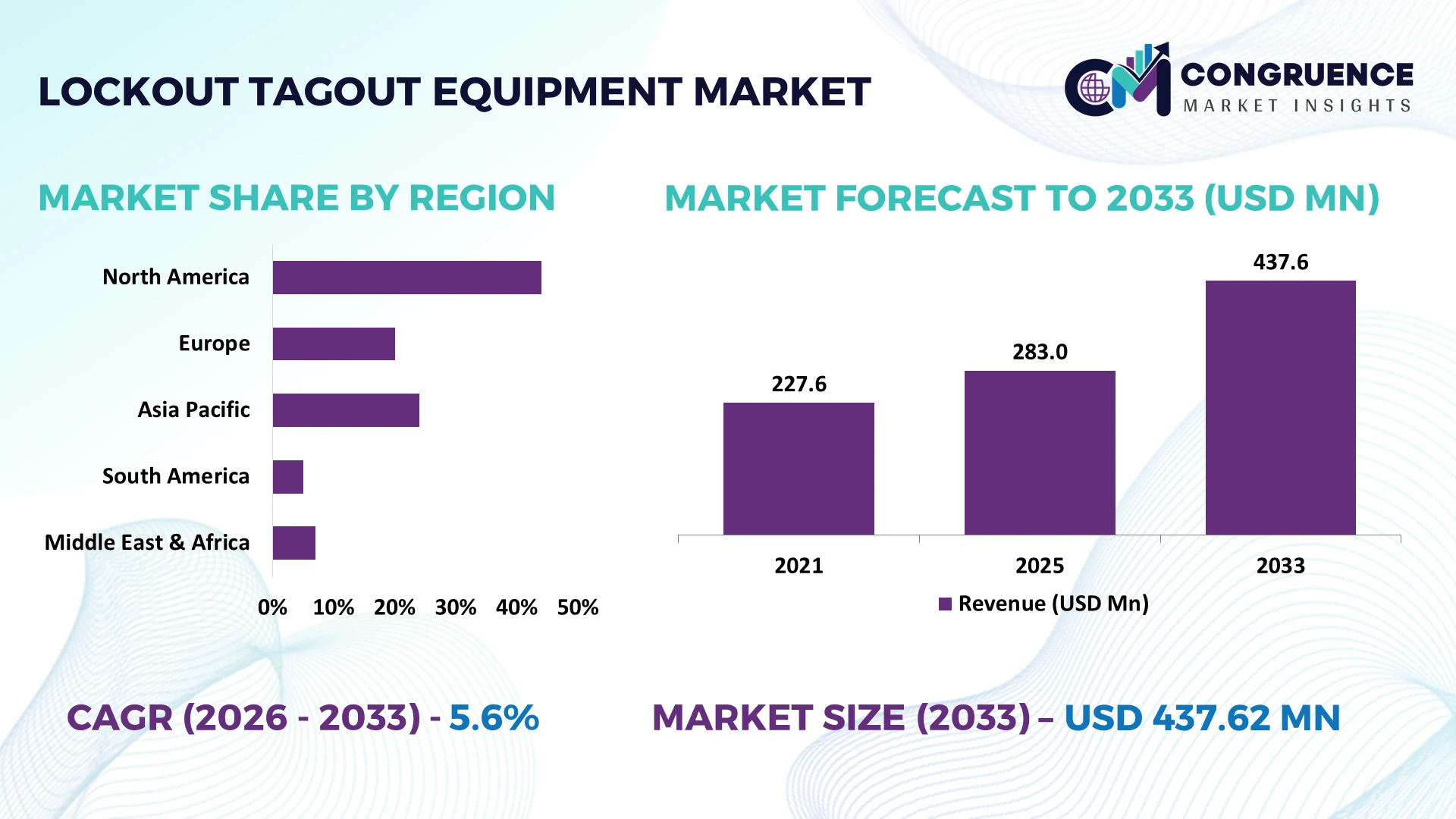
The Global Lockout Tagout Equipment Market was valued at USD 283 Million in 2025 and is anticipated to reach a value of USD 437.62 Million by 2033 expanding at a CAGR of 5.6% between 2026 and 2033. Growth is driven by OSHA hazardous-energy compliance, expanding automated production lines, electrical-safety programs, and standardized lockout procedures across manufacturing, utilities, chemicals, mining, and logistics facilities.
The United States dominates the global lockout tagout equipment market with an estimated 30–32% share, supported by OSHA 29 CFR 1910.147 enforcement and approximately 13 million workers covered by lockout/tagout protections. Manufacturing contributes roughly 10% of U.S. economic output, creating extensive machine-isolation requirements; adoption remains materially higher than in India, where factory modernization is rapidly expanding formal LOTO deployment. U.S. reshoring under CHIPS Act and advanced-manufacturing investments is increasing automated equipment density, making documented energy-isolation procedures more operationally critical.
Strategically, suppliers combining compliant hardware, visual standardization, connected auditing, and plant-wide lockout programs will gain advantage as safety procurement shifts from individual devices toward integrated hazardous-energy management.
Market Size & Growth: USD 283 million in 2025 reaches USD 437.62 million by 2033 at 5.6% CAGR, driven by industrial automation and hazardous-energy compliance.
Top Growth Drivers: Automation expansion 35%, regulatory compliance 40%, and electrical-safety modernization 25% represent the three strongest demand catalysts.
Short-Term Forecast: By 2028, digitally managed LOTO workflows can reduce authorization and documentation time by approximately 15–25% across complex industrial facilities.
Emerging Technologies: QR-enabled tags, RFID identification, connected padlocks, and mobile permit systems are integrating physical isolation with digital worker verification.
Regional Leaders: North America approaches USD 140 million, Europe USD 115 million, and Asia-Pacific USD 130 million by 2033 as standardized LOTO adoption broadens.
End-User Trends: Manufacturing remains the largest user base, representing approximately 35–40% of equipment demand through machinery, electrical, robotic, and maintenance isolation.
Pilot/Case Example: 2025 digital LOTO deployments demonstrated approximately 20% faster permit verification by replacing paper-heavy authorization workflows with centralized electronic records.
Competitive Landscape: Brady leads with an estimated 12–15% share, competing with Master Lock, 3M, Panduit, and ABUS across standardized industrial safety portfolios.
Regulatory & ESG Impact: OSHA estimates proper lockout/tagout compliance prevents approximately 120 fatalities and 50,000 injuries annually, strengthening mandatory procedural investment.
Investment & Funding: More than USD 100 billion in U.S. semiconductor manufacturing commitments are expanding automated facilities requiring formal hazardous-energy control infrastructure.
Innovation & Future Outlook: By 2030, connected LOTO ecosystems integrating RFID, mobile authorization, and digital audit trails can cut compliance-administration workloads by approximately 20%.
The Lockout Tagout Equipment Market is increasingly shaped by automated factories, electrical infrastructure, utilities, chemicals, logistics, and high-risk maintenance operations. Connected padlocks, QR/RFID identification, and digital permit workflows are extending conventional mechanical isolation into traceable safety systems. With manufacturing representing roughly 35–40% of equipment demand, OSHA enforcement and expanding automated production environments are making integrated hazardous-energy control a strategic operational priority.
Lockout tagout equipment is becoming strategically important as factories, utilities, data centers, logistics hubs, and energy assets increase automation density while regulatory scrutiny of hazardous-energy control intensifies. OSHA’s lockout/tagout standard covers roughly 13 million U.S. workers, making compliance a recurring operational requirement rather than a discretionary safety purchase. The market shift is moving from standalone padlocks and tags toward standardized, digitally documented isolation workflows integrated with maintenance and permit-to-work systems.
Compared with paper-based procedures, QR/RFID-enabled LOTO systems and mobile authorization platforms can reduce verification and documentation time by roughly 15–25% while strengthening audit traceability. The United States leads in formal compliance deployment, Europe emphasizes harmonized machinery safety and energy isolation, while India and Southeast Asia are expanding adoption alongside new automotive, electronics, and process-industry capacity. Through 2028, connected lock management and digital permit integration will gain traction in high-complexity facilities.
A large automotive plant can replace department-specific lock sets with centrally controlled keyed systems and digital authorization, reducing duplicate inventory and improving isolation accountability. Suppliers are responding through software partnerships, customized lock programs, multilingual identification, and regional distribution expansion. Competitive advantage will increasingly depend on combining certified hardware, workflow integration, training support, and auditable safety performance.
Industrial automation is increasing the number of hazardous energy points that maintenance teams must isolate before intervention. In the United States, lockout/tagout requirements protect about 13 million workers, while manufacturing accounts for roughly 35–40% of equipment demand. Automated cells can contain 20–30% more isolation points than conventional machinery because electrical, pneumatic, hydraulic, and robotic systems operate together. OSHA enforcement and advanced-manufacturing expansion are therefore pushing plants toward standardized lockout stations, group lock boxes, and visual identification systems. Suppliers are responding with engineered lockout programs, keyed-alike systems, multilingual tags, and site audits. The sharp operational insight is that higher automation does not reduce lockout demand; it multiplies isolation complexity, increasing the value of standardized hazardous-energy control across entire facilities.
The market remains constrained by inconsistent site-level procedures, uneven training quality, and resistance to replacing low-cost manual practices. Small industrial facilities can spend 15–25% less upfront by relying on basic padlocks and printed procedures rather than integrated lockout programs, but this often creates inventory duplication and weak traceability. In India and parts of Southeast Asia, smaller manufacturers frequently operate mixed-age machinery fleets, making standardization difficult across electrical, pneumatic, hydraulic, and mechanical isolation points. Procurement fragmentation also limits scalability when each department selects different lock formats or tag systems. Vendors are reducing these barriers through modular kits, standardized keyed systems, distributor training, and plant-wide audits. The strategic constraint is organizational inconsistency rather than equipment availability, which slows conversion from product purchases to unified safety programs.
Digital lockout management creates a high-value opportunity beyond conventional physical safety hardware. RFID, QR-coded identification, mobile permits, electronic worker authorization, and connected lock cabinets can reduce administrative time by roughly 15–25% and improve isolation traceability by more than 20% in complex facilities. U.S. semiconductor, battery, and automated logistics investments are increasing demand for digitally documented maintenance workflows, while India’s expanding electronics and automotive plants create greenfield opportunities to standardize LOTO from commissioning. Suppliers are positioning through software integration, mobile applications, connected cabinets, and partnerships with EHS and maintenance platforms. A non-obvious opportunity lies in data services: once isolation events become digitally recorded, vendors can support compliance analytics, training optimization, and recurring audit services, creating a broader lifecycle relationship beyond hardware replacement.
Long-term market execution depends on maintaining procedural discipline across contractors, technicians, operators, and increasingly connected maintenance systems. Even well-equipped facilities face compliance gaps when shift changes, outsourced maintenance, or multilingual workforces disrupt standardized isolation practices. Contractor-heavy plants can involve 20–30% more authorization complexity because responsibility spans employers, site owners, and maintenance teams. Digital LOTO also introduces integration requirements with CMMS, EHS software, access-control systems, and mobile devices, creating cybersecurity and interoperability concerns. In the United States and Germany, skilled maintenance shortages intensify reliance on standardized digital workflows but also increase training pressure. Companies must invest in user authentication, role-based access, recurring training, and system integration. The decisive challenge is ensuring that advanced technology strengthens, rather than complicates, human compliance at the point of maintenance.
Standardized Plantwide Lockout Programs: Large manufacturers are consolidating fragmented lockout inventories into standardized padlock, hasp, valve, and electrical isolation systems. Centralized programs can reduce duplicate device inventories by 15–20% and shorten equipment identification time by 10–15%. U.S. enforcement pressure remains significant, with lockout/tagout ranked fourth among OSHA’s most-cited standards in FY2025. Suppliers are expanding keyed systems, visual management stations, and site-specific lockout configurations.
Electrical Isolation Becomes More Specialized: Electrification of machinery, automated production cells, battery systems, and industrial control cabinets is increasing demand for breaker-specific and nonconductive lockout devices. Advanced facilities now manage 20–30% more electrical isolation points than comparable legacy production lines. Manufacturers are adding compact breaker lockouts, dielectric padlocks, and modular electrical kits while distributors broaden application-specific inventories for maintenance technicians.
Group Lockout Workflows Expand: Industrial shutdowns increasingly involve multiple contractors and simultaneous maintenance teams, accelerating deployment of group lock boxes and multi-user hasps. Standardized group-isolation workflows can reduce authorization handoffs by approximately 15–25% and improve accountability during complex turnarounds. Refining, chemical, and utility operators are restructuring shutdown procedures around centralized isolation authorities while suppliers develop portable stations and high-capacity lock-management systems.
Identification Systems Gain Operational Value: Color coding, laser engraving, serialized keys, photo identification, and multilingual tags are becoming procurement priorities alongside physical lock strength. Standardized visual identification can reduce lock-selection errors by roughly 10–20% and accelerate worker verification. Labor mobility and multilingual workforces reinforce adoption. Vendors are expanding custom-printing capabilities, preconfigured kits, and facility-specific identification services, turning personalization into a recurring commercial differentiator.
Safety padlocks lead the Lockout Tagout Equipment Market with an estimated 34–37% share because virtually every formal energy-isolation procedure requires a personal locking device. Their scalability across electrical, mechanical, hydraulic, pneumatic, and process equipment supports high-volume purchasing by manufacturing plants and utilities. Nonconductive bodies, keyed-different systems, color coding, and engraving have strengthened differentiation, while standardized key management can reduce lock-selection and accountability errors by approximately 10–15%. Lockout hasps remain a mature complementary segment where multiple authorized employees share responsibility for a single isolation point.
Circuit breaker lockouts represent the fastest-growing type as factories increase automation, electrical panels, drives, robotics, and distributed control equipment. Electrical isolation points can rise 20–30% when conventional lines are converted to automated cells, increasing demand for miniature, molded-case, and universal breaker devices. Valve lockouts remain critical in chemical processing and oil operations, while electrical lockout kits gain importance where technicians require portable multi-device coverage. Suppliers are concentrating product development on universal fit, dielectric materials, modular kits, and standardized facility-wide padlock systems.
Electrical maintenance accounts for an estimated 31–34% of application demand, supported by frequent servicing of switchboards, breakers, motor controls, robotic equipment, drives, and automated machinery. Facilities with high electrical equipment density require repeatable isolation across multiple voltage and control points, sustaining demand for padlocks, breaker lockouts, hasps, and portable kits. Formal electrical lockout programs can reduce authorization ambiguity and isolation errors by approximately 15–20%. Mechanical maintenance remains a major established application across conveyors, presses, pumps, machine tools, and rotating equipment where stored mechanical, pneumatic, and hydraulic energy must be controlled.
Industrial shutdowns are the fastest-expanding application as refineries, chemical plants, utilities, and large manufacturing sites coordinate dozens or hundreds of simultaneous maintenance tasks. Group lockout systems can streamline multi-worker isolation handoffs by roughly 15–25%, increasing adoption of lock boxes and high-capacity hasps. Equipment servicing remains broadly distributed across factories, while pipeline maintenance concentrates demand for valve isolation. Suppliers are adapting through shutdown-specific kits, centralized lock stations, contractor identification systems, and portable group-isolation solutions.
Manufacturing represents approximately 38–41% of Lockout Tagout Equipment Market demand because automated production lines, presses, conveyors, CNC systems, robotics, packaging machinery, and processing equipment create numerous hazardous-energy isolation points. Plastic-product manufacturers and machine shops were among industries prominently associated with lockout/tagout violations during 2025 enforcement activity, reinforcing recurring compliance spending. Standardized plant-wide lockout programs can reduce duplicate device inventories by approximately 15–20%. Chemical processing and oil & gas remain mature, procedure-intensive users because valve networks, rotating assets, pressure systems, and shutdown maintenance require multi-energy isolation.
Energy & utilities is emerging as the fastest-growing end-user segment as grid modernization, renewables, battery storage, substations, and distributed energy assets expand maintenance complexity. Large utility operations can involve 20–30% more distributed isolation locations as networks become increasingly decentralized. Construction maintains project-driven demand for temporary electrical and equipment isolation. Vendors are targeting these groups through sector-specific kits, nonconductive locks, valve devices, contractor programs, and partnerships with industrial safety distributors, shifting competitive focus toward application engineering and standardized enterprise deployment.
North America accounted for the largest market share at 36% in 2025 however, Asia-Pacific is expected to register the fastest growth, expanding at a CAGR of 7.2% between 2026 and 2033.
Regulatory Enforcement Sustains Standardized Deployment
North America represents approximately 36% of global Lockout Tagout Equipment Market demand, anchored by stringent hazardous-energy control requirements across manufacturing, utilities, chemicals, logistics, oil and gas, and construction. The United States dominates deployment because OSHA 29 CFR 1910.147 establishes formal requirements covering roughly 13 million workers. Lockout/tagout remained among OSHA’s most frequently cited standards in FY2025, with more than 2,000 preliminary violations, reinforcing recurring expenditure on padlocks, hasps, breaker lockouts, valve devices, training, and written procedures. Canadian industrial facilities increasingly align isolation practices with CSA safety requirements, particularly across energy and heavy industry. U.S. semiconductor, battery, and advanced-manufacturing expansion is simultaneously increasing automated equipment density. Vendors are responding through facility-wide keyed systems, customized identification, distributor partnerships, and integrated electrical lockout portfolios.
United States Market Outlook: The United States combines the world’s strongest formal LOTO enforcement environment with extensive manufacturing, utilities, refining, warehousing, and advanced-technology infrastructure. OSHA estimates proper hazardous-energy control prevents approximately 120 fatalities and 50,000 injuries annually. Growing semiconductor fabs, battery factories, automated warehouses, and data-center infrastructure are expanding multi-energy isolation points, supporting demand for standardized group lockout, breaker-specific devices, and auditable plant-wide programs.
Machinery Safety Drives Isolation Standardization
Europe accounts for an estimated 25% of global demand, supported by Germany, France, the United Kingdom, Italy, and Poland. Machinery safety requirements, electrical standards, contractor management, and increasingly automated factories are strengthening formal energy-isolation practices beyond traditional heavy industry. Germany’s manufacturing sector contributes approximately one-fifth of national economic output, creating dense deployment across automotive, chemicals, machinery, metals, and industrial equipment. European users increasingly favor nonconductive padlocks, multilingual identification, standardized valve isolation, and engineered lockout stations that accommodate cross-border workforces. Expansion of battery manufacturing, renewable-energy infrastructure, and automated logistics adds new electrical and mechanical isolation requirements. Suppliers are adapting with localized product portfolios, CE-aligned safety solutions, training programs, and distributor networks. Procurement increasingly evaluates procedural compatibility and worker usability alongside device durability, particularly at multinational production sites.
Germany Market Outlook: Germany provides Europe’s strongest industrial base for sophisticated lockout deployment through automotive plants, chemical complexes, machinery manufacturing, energy infrastructure, and automated production systems. More than 4 million passenger cars were produced domestically in 2025, sustaining extensive maintenance requirements across robotics, conveyors, presses, machining cells, and electrical equipment. Companies increasingly standardize visual identification and group isolation procedures across multiple factories to simplify worker training and contractor control.
Factory Automation Accelerates Safety Formalization
Asia-Pacific represents approximately 24% of global demand but provides the strongest expansion pathway as China, India, Japan, South Korea, and Southeast Asian manufacturing hubs formalize hazardous-energy control. Asia produced more than 59 million motor vehicles in 2025, exceeding 60% of worldwide output and creating substantial maintenance exposure across robotic welding, machining, assembly, battery, and component operations. Electronics, semiconductor, chemicals, steel, and logistics investments further increase electrical isolation complexity. Multinational manufacturers are transferring corporate LOTO protocols into supplier plants, indirectly raising adoption among local manufacturers. China provides scale, Japan emphasizes highly standardized factory safety, while India combines greenfield manufacturing with regulatory modernization. Vendors are expanding local distribution, multilingual labeling, economical lockout kits, and application training. The strongest commercial opportunity sits where automation investment is advancing faster than legacy maintenance-safety practices.
China Market Outlook: China’s industrial scale makes it Asia-Pacific’s largest addressable national market, with 34.5 million vehicles produced in 2025 alongside enormous electronics, machinery, steel, chemicals, and battery manufacturing capacity. Automated production lines are increasing electrical, pneumatic, hydraulic, and robotic isolation requirements. Domestic safety suppliers compete aggressively on price, while multinational brands retain advantages in engineered lockout programs, material quality, standardized key management, and multinational-factory specifications.
Industrial Compliance Centers on Brazil
South America accounts for approximately 6% of global lockout tagout equipment demand, concentrated in Brazil’s manufacturing, mining, oil and gas, chemicals, automotive, steel, and food-processing industries. Brazil’s NR-12 machinery safety framework reinforces requirements around machinery intervention and hazardous-energy control, supporting structured isolation practices at larger facilities. The country produces more than 2 million vehicles annually, sustaining maintenance activity across presses, robotic cells, conveyors, machining equipment, and assembly operations. Mining operations in Brazil, Chile, and Peru create additional demand for rugged padlocks, group lockout devices, and electrical isolation kits. Adoption remains less standardized among smaller enterprises, where training availability and safety budgets constrain deployment. Suppliers therefore emphasize distributor education, affordable modular kits, Portuguese and Spanish identification, and durable products suitable for remote industrial operations.
Brazil Market Outlook: Brazil represents the region’s most strategically significant market because automotive manufacturing, mining, steelmaking, petrochemicals, utilities, and food processing generate diverse hazardous-energy requirements. NR-12 provides a regulatory foundation for machinery safety, while large multinational plants increasingly apply corporate isolation standards exceeding minimum requirements. São Paulo’s manufacturing concentration and Minas Gerais’ mining ecosystem create particularly strong demand for electrical, mechanical, and group lockout solutions supported by local training and distribution.
Energy Infrastructure Elevates Isolation Requirements
Middle East & Africa represents approximately 9% of global demand, led by Saudi Arabia, the UAE, South Africa, and major hydrocarbon-producing economies. Oil and gas facilities remain central because refineries, pipelines, petrochemical complexes, compressors, pumps, and electrical systems require rigorous multi-energy isolation during maintenance and turnarounds. Saudi Arabia’s industrial diversification under Vision 2030 is expanding manufacturing, mining, logistics, utilities, and downstream processing infrastructure, widening LOTO applications beyond hydrocarbons. Renewable power and data-center investment in the UAE adds electrical-isolation requirements, while South African mining and utility operations sustain demand for rugged field equipment. International operators increasingly transfer global EHS protocols to contractors and joint ventures. Suppliers are responding with valve lockouts, corrosion-resistant devices, contractor kits, multilingual tags, local distribution, and technical training suited to large, geographically dispersed facilities.
Saudi Arabia Market Outlook: Saudi Arabia offers the strongest strategic demand concentration through Saudi Aramco’s extensive energy infrastructure, petrochemical operations, mining expansion, and emerging manufacturing clusters. Vision 2030 industrial localization is increasing the installed base of machinery and electrical equipment requiring formal isolation. Large projects favor standardized contractor-management systems, durable valve lockouts, group lock boxes, and clearly identified personal locks capable of supporting complex turnaround and commissioning environments.
Brady, Master Lock, ABUS, Panduit, and Rockwell Automation compete across industrial lockout portfolios, while specialized safety suppliers challenge them through application customization and pricing. The top five players hold an estimated 42–47% combined share, reflecting advantages in distribution, certification, brand recognition, and enterprise relationships. Brady and Master Lock compete strongly in standardized padlocks, identification, and lockout stations; Panduit leverages electrical infrastructure expertise, while ABUS emphasizes locking durability. Premium engineered programs command approximately 15–25% pricing advantages over basic alternatives, while standardized keyed systems can reduce inventory duplication by 10–20%. Players expand through distributor partnerships, customized engraving, electrical lockout innovation, training, and integrated identification systems. Competition is shifting from individual hardware toward facility-wide hazardous-energy management and digital traceability. Qualification standards, channel access, product reliability, and enterprise safety approvals create substantial entry pressure. Winning requires certified products, application breadth, rapid customization, dependable availability, and scalable plant-wide safety integration.
Brady Corporation
Master Lock Company
ABUS
Panduit
Rockwell Automation
Schneider Electric
Honeywell International
IDEAL Industries
Kasp Security
Castell Safety International
ESC Services
Reece Safety Products
LOTO Safety Products
Cirlock
Current lockout tagout technology combines nonconductive safety padlocks, universal breaker lockouts, keyed management, QR identification, and digitally stored energy-control procedures. Connected platforms increasingly link physical isolation with mobile workflows, while RFID and barcode verification improve asset identification. Digital procedure management can reduce documentation time by roughly 15–25%, and standardized key systems can cut duplicate-lock inventory by 10–20%. Adoption is strongest in automated manufacturing, utilities, mining, chemicals, and data centers.
Emerging systems integrate Bluetooth padlocks, cloud dashboards, electronic permits, real-time isolation status, and role-based authorization. Compared with legacy paper-and-key workflows, connected LOTO can improve verification speed by approximately 20% while strengthening audit readiness and reducing manual handoffs. Deployment remains concentrated in complex facilities rather than small workshops, but multinational plants are increasingly piloting centralized software. Suppliers with combined hardware, training, and digital workflow capabilities gain an advantage over device-only competitors.
Disruptive development is moving toward API-connected LOTO, offline-capable mobile workflows, geofenced authorization, and predictive safety analytics linked with CMMS and EHS platforms. Between 2026 and 2028, digital adoption will expand across high-risk maintenance environments as enterprises standardize multi-site procedures. Companies acting now can lower administrative friction, improve isolation visibility, and lock customers into integrated safety ecosystems with measurable compliance performance gains.
August 2024 — Master Lock unveiled cLOTO, combining web software, mobile applications, and safety padlocks to digitize lockout workflows with real-time procedure visibility. The platform was scheduled for 2025 market availability, strengthening connected compliance management across industrial maintenance teams. Source: IEN
October 2024 — Brady Corporation reported 382 lockout-tagout procedure-writing projects during FY2024, producing approximately 56,000 procedures alongside 58 LOTO training sessions. The service expansion strengthened Brady’s position beyond hardware by embedding standardized hazardous-energy control within customer operations. Source: Brady
July 2025 — Smartlox expanded Digital LOTO into ski-lift and cableway maintenance, deploying Bluetooth padlocks with IP67 protection, ATEX Zone 1 certification, and two-year battery life. The solution extended connected isolation into harsh, geographically dispersed operating environments and resorts. Source: Smartlox
July 2026 — Mainline Industrial Solutions strengthened electrical and mechanical lockout training through an annual safety program supported by field coaching, equipment inspections, and ongoing education. The four-layer approach reinforced technician consistency across pumps, control panels, and infrastructure maintenance. Source: Mainline
The Lockout Tagout Equipment Market Report covers safety padlocks, lockout hasps, circuit breaker lockouts, valve lockouts, and electrical lockout kits across electrical maintenance, mechanical maintenance, equipment servicing, pipeline maintenance, and industrial shutdowns. End-user analysis includes manufacturing, energy and utilities, construction, oil and gas, and chemical processing. Manufacturing represents approximately 38–41% of demand, while North America accounts for nearly 36% of deployment.
Regional coverage spans North America, Europe, Asia-Pacific, South America, and Middle East & Africa, with emphasis on regulatory enforcement, automation density, industrial localization, and maintenance practices. Technology assessment includes Bluetooth padlocks, QR/RFID identification, digital LOTO software, mobile authorization, cloud audit trails, and CMMS/EHS integration. Through 2026–2033, the report supports investment prioritization, distribution expansion, product development, partnership strategy, competitive benchmarking, and positioning around increasingly connected hazardous-energy management.
| Report Attribute/Metric | Report Details |
|---|---|
Market Revenue in 2025 | USD 283 Million |
Market Revenue in 2033 | USD 437.62 Million |
CAGR (2026 - 2033) | 5.6% |
Base Year | 2025 |
Forecast Period | 2026 - 2033 |
Historic Period | 2021 - 2025 |
Segments Covered | By Type
By Application
By End-User
|
Key Report Deliverable | Revenue Forecast, Growth Trends, Market Dynamics, Segmental Overview, Regional and Country-wise Analysis, Competition Landscape |
Region Covered | North America, Europe, Asia-Pacific, South America, Middle East, Africa |
Key Players Analyzed | Brady Corporation, Master Lock Company, ABUS, Panduit, Rockwell Automation, Schneider Electric, Honeywell International, IDEAL Industries, Kasp Security, Castell Safety International, ESC Services, Reece Safety Products, LOTO Safety Products, Cirlock |
Customization & Pricing | Available on Request (10% Customization is Free) |




