
Reports
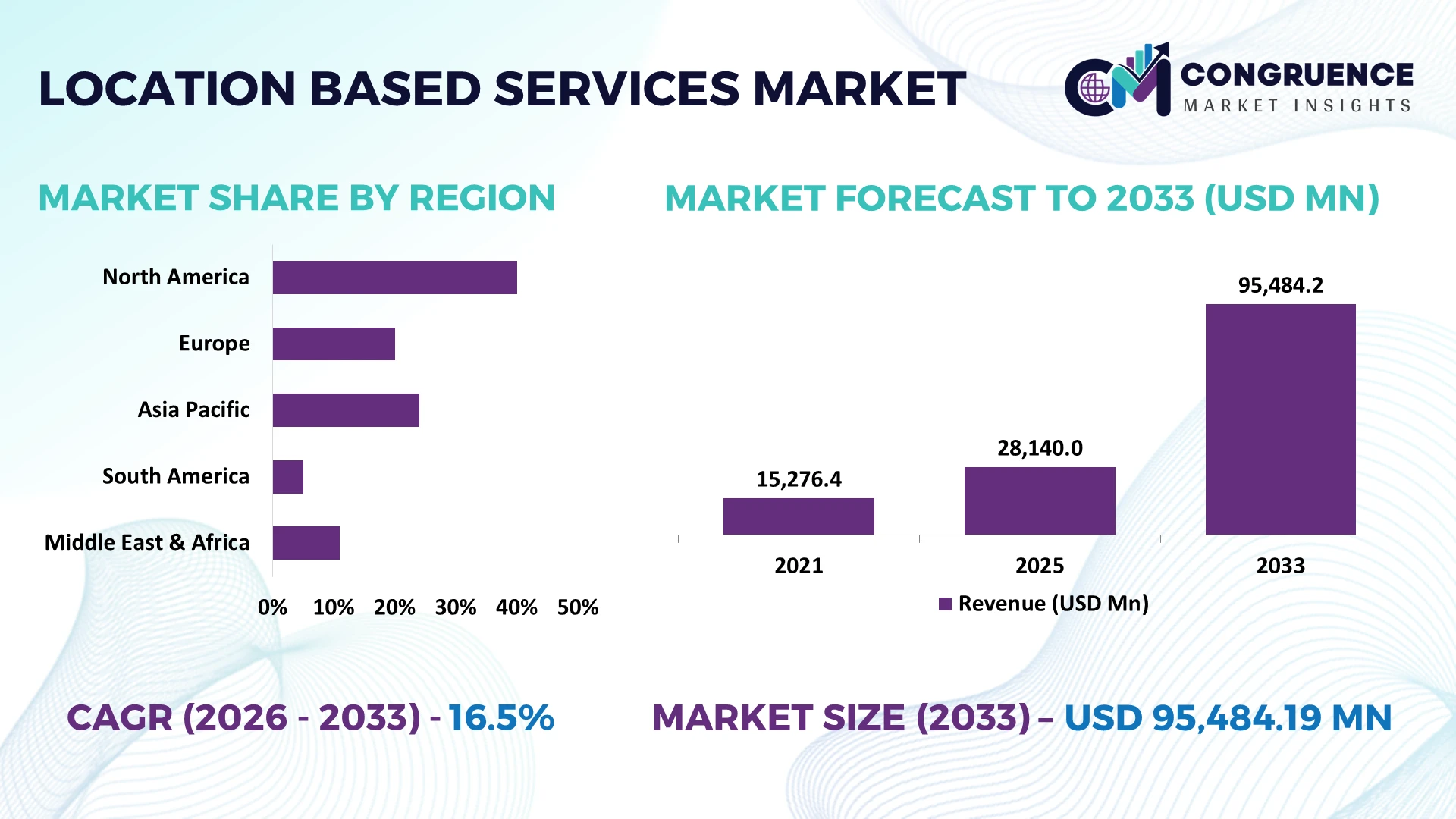
The Global Location-Based Services Market was valued at USD 28140 Million in 2025 and is anticipated to reach a value of USD 95484.19 Million by 2033 expanding at a CAGR of 16.5% between 2026 and 2033. Growth is driven by enterprise deployment of AI-enabled geospatial analytics, 5G-powered positioning, connected mobility platforms, and precision location intelligence across retail, logistics, public safety, and smart city operations.
The United States remains the dominant market, accounting for approximately 34% of global deployment activity, supported by large-scale investments in digital infrastructure, autonomous mobility, retail analytics, and defense applications, while China contributes nearly 27% through rapid smart city expansion and large-scale navigation ecosystem adoption. More than 72% of large enterprises in the U.S. integrate advanced location intelligence into customer engagement and fleet optimization, compared with approximately 61% across major Chinese industries. Strengthened digital infrastructure initiatives following global supply chain realignment have accelerated enterprise adoption across strategic sectors.
Organizations prioritizing scalable, privacy-compliant location intelligence platforms gain stronger operational visibility, faster decision-making, and sustainable competitive positioning.
Market Size & Growth: USD 28140 Million in 2025, reaching USD 95484.19 Million by 2033 at a CAGR of 16.5%, driven by AI-powered geospatial intelligence and expanding 5G infrastructure.
Top Growth Drivers: AI location analytics improve operational efficiency by 32%, 5G positioning expands deployment by 29%, and connected fleet management reduces routing time by 24%.
Short-Term Forecast: By 2028, enterprise location intelligence lowers logistics costs by 18% while increasing field workforce productivity by 22%.
Emerging Technologies: AI mapping, edge computing, digital twins, and satellite-based high-precision positioning improve location accuracy by up to 35%.
Regional Leaders: North America exceeds USD 31 billion, Asia-Pacific approaches USD 29 billion, and Europe surpasses USD 20 billion, supported by smart mobility and digital infrastructure expansion.
Consumer/End-User Trends: More than 74% of mobile users actively utilize location-enabled applications, while enterprise adoption exceeds 63% across logistics and retail sectors.
Pilot/Case Example: A 2026 smart mobility deployment improved emergency response routing efficiency by 27% and reduced dispatch delays by 21%.
Competitive Landscape: The top five providers collectively control approximately 46% of the global market, competing through AI capabilities, cloud integration, mapping accuracy, and enterprise ecosystems.
Regulatory & ESG Impact: Privacy-first frameworks reduced unauthorized location data processing by nearly 19%, strengthening enterprise compliance across international operations.
Investment & Funding: More than USD 9 billion supports platform expansion, AI mapping, strategic partnerships, and regional digital infrastructure amid global supply chain diversification.
Innovation & Future Outlook: Real-time digital twins, AI-driven predictive mobility, and centimeter-level positioning accelerate enterprise automation and strengthen next-generation location intelligence strategies.
Location-Based Services Market demand continues to expand across connected transportation, retail personalization, industrial asset tracking, and emergency response systems. AI-enhanced geospatial analytics, ultra-precise positioning, and edge-based processing have improved operational decision accuracy by approximately 28%, while privacy-focused compliance requirements reshape deployment strategies. Growing cross-border logistics modernization and digital infrastructure investments are reinforcing enterprise adoption, setting the foundation for the strategic market assessment that follows.
Location-Based Services have become a strategic capability for enterprises seeking competitive differentiation through real-time operational intelligence, personalized customer engagement, and data-driven asset management. Infrastructure modernization, expanding 5G coverage, and stricter digital governance are accelerating enterprise investment in high-precision positioning platforms across transportation, retail, manufacturing, and public services. As supply-chain networks become more distributed, organizations increasingly depend on location intelligence to improve inventory visibility, workforce coordination, and delivery precision while strengthening compliance with evolving data privacy frameworks.
Modern AI-enabled geospatial platforms process location events nearly 40% faster than legacy GPS-only systems while reducing routing errors by approximately 22% through predictive analytics and edge computing integration. The United States leads large-scale commercial deployment with mature enterprise ecosystems, whereas India records faster implementation across logistics, mobility, and digital commerce due to expanding smartphone penetration and national digital infrastructure initiatives. Over the next two to three years, enterprise adoption of integrated location intelligence platforms is expected to exceed 68% among large logistics operators, supported by cloud-native deployment models and automated spatial analytics.
A practical example is warehouse-to-last-mile fleet orchestration, where dynamic route optimization reduces fuel consumption by approximately 16% while improving delivery accuracy. Companies are strengthening market position through AI partnerships, geospatial software acquisitions, and cloud ecosystem expansion, creating scalable location intelligence platforms that deliver operational resilience, stronger customer experiences, and long-term competitive advantage.
Enterprise demand for real-time spatial intelligence has become the primary growth engine as organizations digitize logistics, retail operations, and connected mobility services. More than 69% of large logistics operators now integrate advanced location analytics, while AI-assisted route optimization lowers delivery time by approximately 21% and reduces fleet operating costs by nearly 17%. India's rapid digital commerce expansion and nationwide 5G deployment are accelerating enterprise-scale implementation across transportation and field service industries. This structural technology shift enables predictive asset visibility and automated decision-making. In response, leading companies are expanding cloud-based geospatial platforms, forming telecommunications partnerships, and investing in AI-powered mapping capabilities to strengthen enterprise service portfolios and secure long-term customer contracts.
Complex data privacy regulations and fragmented technology ecosystems continue to restrict seamless deployment across multinational enterprises. Approximately 34% of organizations report integration challenges between legacy enterprise systems and modern location intelligence platforms, while compliance-related implementation costs have increased by nearly 15% for highly regulated industries. Germany's strict digital privacy environment requires extensive data governance processes before commercial deployment, extending implementation timelines. These structural limitations increase operational complexity, delay platform scalability, and affect project profitability. Companies are reducing exposure through localized data hosting, standardized APIs, strategic software alliances, and diversified cloud infrastructure, enabling more consistent compliance while improving interoperability across heterogeneous enterprise environments.
The convergence of artificial intelligence, edge computing, and digital twin technology creates significant opportunities beyond conventional navigation services. AI-enabled spatial analytics improve infrastructure utilization by approximately 26%, while predictive location intelligence reduces maintenance planning costs by nearly 18%. Japan's investment in smart transportation corridors and intelligent urban infrastructure supports broader deployment of precision positioning technologies across industrial and public sectors. Companies are accelerating research partnerships, expanding geospatial software capabilities, and developing ecosystem-based platforms integrating IoT sensors with real-time analytics. A unique strategic opportunity lies in location-enabled industrial automation, where continuous spatial visibility enhances operational coordination and unlocks new subscription-based enterprise service models.
Long-term market expansion depends on integrating diverse positioning technologies, cloud architectures, and enterprise software without compromising performance or cybersecurity. Nearly 31% of large deployments experience integration delays because of fragmented geospatial data standards, while cybersecurity incidents targeting connected infrastructure have increased by approximately 20% in digitally intensive industries. The United States continues to experience rising pressure to secure critical location-enabled infrastructure supporting transportation and public services. These execution challenges affect deployment consistency, platform scalability, and enterprise confidence. Companies must strengthen secure cloud architectures, invest in interoperable software frameworks, develop specialized geospatial talent, and establish long-term technology partnerships to maintain resilient, high-performance location intelligence ecosystems.
AI-Driven Spatial Decision Platforms Enterprise adoption of AI-powered location intelligence platforms has exceeded 64% among large organizations, while automated spatial analytics reduce route planning time by nearly 27% and improve operational decisions by approximately 24%. U.S. logistics providers increasingly integrate predictive mapping into supply-chain control towers following continued network restructuring. Companies are expanding AI partnerships and embedding geospatial analytics into enterprise resource planning platforms to improve planning accuracy and reduce manual intervention across high-volume operations.
Privacy-Centric Location Intelligence Stricter digital privacy frameworks are reshaping deployment models, with more than 58% of enterprises implementing consent-based location management and encrypted data processing. Compliance automation lowers audit preparation effort by approximately 19% while reducing data governance risks. European enterprises are accelerating privacy-by-design deployment strategies as regulatory expectations become more rigorous. Vendors are restructuring cloud architectures, strengthening identity management, and introducing localized processing capabilities to maintain enterprise trust without reducing analytical performance.
Indoor Positioning Gains Momentum Advanced indoor positioning deployments have increased by approximately 31% across manufacturing facilities, airports, and hospitals, while Bluetooth Low Energy and ultra-wideband technologies improve asset visibility by nearly 29%. Japan continues expanding smart industrial facilities where precise indoor navigation supports automation and workforce coordination. Companies are integrating indoor mapping with digital twins and IoT infrastructure, creating continuous operational visibility that extends beyond traditional outdoor navigation applications.
Edge-Enabled Enterprise Operations Edge computing integration now processes nearly 42% of enterprise location workloads closer to operational sites, reducing response latency by approximately 35% and lowering cloud data transmission requirements by 18%. Growing industrial automation and real-time decision requirements are accelerating decentralized computing architectures. Organizations are scaling edge-enabled geospatial platforms through telecommunications partnerships and distributed infrastructure investments, enabling faster field execution while improving resilience across mission-critical operations.
Software remains the leading segment, accounting for approximately 41% of market deployment due to its scalability, seamless cloud integration, and advanced analytics capabilities. Enterprises prioritize software-driven location intelligence because centralized management improves operational visibility by nearly 26% while reducing implementation complexity by approximately 18%. Hardware maintains strategic relevance for positioning infrastructure and sensor deployment, particularly across transportation and industrial environments where precision and reliability remain essential.
Platforms represent the fastest-growing segment as enterprises consolidate mapping, analytics, AI, and application programming interfaces into unified ecosystems. Adoption of integrated platforms has increased by nearly 30% among large organizations seeking interoperable enterprise solutions. Services continue expanding through consulting, deployment, and managed operations supporting complex digital transformation initiatives. Companies are increasing investment in cloud-native software, expanding platform ecosystems, and strengthening technology partnerships to capture enterprise modernization projects while balancing hardware innovation with recurring software-driven business models.
Navigation continues as the largest application, representing approximately 38% of deployments because of widespread integration across mobility, logistics, ride-hailing, and consumer digital services. Advanced routing technologies reduce travel time by nearly 22% while improving delivery accuracy by approximately 19%, making navigation indispensable for enterprise operations. Fleet Management follows closely as organizations optimize transportation assets through predictive route planning and real-time operational monitoring.
Asset Tracking is the fastest-growing application as manufacturers, warehouses, and healthcare providers demand continuous visibility across distributed assets. Enterprise deployment has expanded by nearly 32%, supported by IoT connectivity and AI-powered monitoring. Location-Based Advertising remains strategically important as retailers improve campaign precision, increasing customer engagement rates by approximately 17% through contextual personalization. Companies are expanding cloud integration, automating workflow management, and strengthening analytics capabilities to address rising enterprise demand for operational intelligence beyond traditional navigation services.
Transportation & Logistics remains the dominant end-user segment with approximately 36% of total deployments due to its dependence on fleet optimization, shipment visibility, and real-time operational coordination. Advanced location intelligence improves fleet utilization by nearly 24% while reducing delivery delays by approximately 20%, making deployment strategically essential for large logistics operators. Retail continues strengthening adoption through personalized customer engagement and omnichannel fulfillment capabilities.
Healthcare represents the fastest-growing end-user segment as hospitals deploy real-time asset tracking, patient navigation, and emergency response optimization. Adoption has increased by approximately 29% as digital healthcare infrastructure expands across developed economies. Government agencies continue investing in smart mobility and public safety platforms, while BFSI institutions integrate geolocation for fraud detection and secure digital transactions. Companies are tailoring industry-specific platforms, expanding strategic partnerships, and developing customized deployment models to strengthen competitive positioning across high-value enterprise sectors.
North America accounted for the largest market share at 36% in 2025 however, Asia-Pacific is expected to register the fastest growth, expanding at a 19.1% between 2026 and 2033.
Strategic Enterprise Digital Infrastructure Leadership
North America maintains the highest deployment concentration through mature cloud infrastructure, advanced 5G networks, and widespread enterprise adoption of geospatial intelligence. The region contributes approximately 36% of global implementation activity, supported by logistics, retail, public safety, and connected mobility applications. More than 71% of large enterprises integrate location intelligence into operational workflows, while AI-enabled routing solutions reduce transportation delays by nearly 22%. Continued investment in edge computing and satellite positioning improves service reliability for industrial users. Strategic partnerships between telecommunications providers, cloud vendors, and software developers are expanding enterprise-grade location ecosystems that improve operational visibility and strengthen digital infrastructure resilience across high-value industries.
United States Market Outlook: The United States leads regional deployment because of extensive enterprise digitization, advanced cloud ecosystems, and strong investment in AI-powered geospatial platforms. More than 72% of Fortune-level enterprises deploy location intelligence for logistics, customer analytics, and field operations. Federal infrastructure modernization and expanding connected vehicle initiatives continue accelerating commercial implementation, while technology companies strengthen market leadership through cloud integration, AI innovation, and long-term enterprise partnerships.
Privacy-Led Digital Transformation and Smart Mobility
Europe continues strengthening its market position through secure digital infrastructure, intelligent transportation systems, and privacy-focused location services. The region represents approximately 27% of global deployment, supported by advanced automotive, logistics, and public infrastructure sectors. Nearly 61% of enterprise deployments incorporate privacy-enhancing technologies to comply with evolving digital governance requirements. Smart mobility initiatives and intelligent traffic management projects continue improving operational efficiency while reducing congestion. Technology providers increasingly localize cloud infrastructure and strengthen cybersecurity capabilities to meet regulatory expectations while expanding partnerships supporting industrial digitalization and sustainable urban mobility.
Germany Market Outlook: Germany remains the regional technology leader through advanced manufacturing, automotive innovation, and industrial digital transformation. Approximately 65% of large industrial enterprises integrate location-enabled operational platforms across manufacturing and logistics. Industrial automation, intelligent transportation systems, and secure enterprise data management continue driving adoption, while domestic technology providers expand AI-enabled mapping capabilities and strategic collaborations supporting precision industrial operations.
Large-Scale Digital Ecosystem Expansion
Asia-Pacific records the fastest deployment momentum as digital infrastructure, smartphone penetration, and smart city investments expand across major economies. The region accounts for approximately 31% of global deployment activity, with enterprise implementation increasing by nearly 28% across logistics, mobility, and digital commerce. National 5G rollouts and AI-enabled mapping platforms continue accelerating adoption in industrial and consumer applications. Companies are expanding cloud data centers, strengthening regional software ecosystems, and investing in scalable location intelligence platforms supporting high-volume digital operations and cross-border supply-chain optimization.
China Market Outlook: China dominates regional deployment through large-scale digital infrastructure, smart city initiatives, and advanced navigation ecosystems. More than 68% of enterprise logistics operators integrate intelligent location platforms into daily operations. Continued investment in satellite navigation, autonomous mobility, and AI-driven mapping technologies strengthens operational efficiency while enabling technology providers to expand integrated digital ecosystems serving transportation, manufacturing, and retail sectors.
Logistics Modernization Accelerates Enterprise Adoption
South America is strengthening enterprise deployment through logistics modernization, digital commerce expansion, and transportation optimization. The region contributes approximately 5% of global market activity while adoption continues increasing across fleet management, agricultural technology, and urban mobility services. Enterprise fleet optimization has improved operational efficiency by nearly 18% through AI-assisted routing and connected asset monitoring. Infrastructure disparities remain a deployment constraint, encouraging organizations to prioritize cloud-based solutions requiring lower capital investment. Technology vendors continue forming regional partnerships and expanding localized service capabilities to improve scalability and accelerate commercial implementation.
Brazil Market Outlook: Brazil leads regional adoption through its extensive logistics network, expanding digital retail ecosystem, and transportation modernization initiatives. Nearly 57% of large logistics providers deploy advanced fleet monitoring and route optimization technologies. Telecommunications expansion, enterprise cloud adoption, and investments in smart mobility applications continue strengthening operational efficiency while creating attractive opportunities for software providers and enterprise platform developers.
Smart Infrastructure and Digital Investment Momentum
The Middle East & Africa market continues advancing through national digital transformation strategies, smart infrastructure investments, and intelligent mobility initiatives. The region represents approximately 4% of global deployment activity, supported by large-scale urban modernization projects and expanding enterprise digitization. Intelligent transportation deployments improve traffic management efficiency by nearly 20%, while cloud-enabled location services continue expanding across logistics and public services. Strategic collaborations between governments, telecommunications operators, and technology companies accelerate deployment of secure digital infrastructure supporting long-term operational modernization.
United Arab Emirates Market Outlook: The United Arab Emirates serves as the regional innovation hub through smart city development, advanced telecommunications infrastructure, and government-led digital transformation programs. More than 63% of public-sector digital initiatives integrate location intelligence capabilities supporting transportation, emergency response, and municipal operations. Continued investment in AI platforms, autonomous mobility, and enterprise cloud infrastructure strengthens commercial deployment while positioning the country as a regional technology benchmark.
Global technology leaders including Google, HERE Technologies, TomTom, Esri, and Mapbox compete against regional mapping specialists, telecom-integrated platform providers, and enterprise geospatial software vendors. The top five players collectively command approximately 48% of the market through mapping accuracy, AI-driven analytics, cloud integration, and developer ecosystems. Competition increasingly centers on platform intelligence rather than price alone, with AI reducing route-processing time by nearly 24% and cloud-native deployment lowering enterprise implementation effort by about 18%. Companies strengthen positions through strategic acquisitions, telecommunications partnerships, API expansion, and vertical integration across mobility, logistics, and retail ecosystems. Technology disruption is shifting competitive advantage toward real-time analytics, privacy-compliant data processing, and edge-enabled location services, while proprietary mapping databases create a significant barrier for new entrants. Winning requires scalable geospatial platforms, continuous innovation, enterprise-grade security, broad developer support, and long-term ecosystem partnerships that deliver measurable operational value.
HERE Technologies
TomTom
Esri
Mapbox
Trimble
Hexagon AB
Qualcomm
Apple
Garmin
Foursquare
Cisco Systems
Oracle
Telenav
Artificial intelligence, high-precision GNSS, and cloud-native geospatial platforms define the current technology landscape. More than 66% of enterprise deployments now integrate AI-driven location analytics, improving route optimization efficiency by approximately 24% while reducing manual planning effort by nearly 18%. Real-time data fusion combining satellite positioning, IoT sensors, and 5G connectivity enables continuous asset visibility across logistics, retail, and mobility operations. Organizations adopting unified location platforms gain faster operational decisions and stronger customer engagement through context-aware services.
Emerging technologies include edge computing, ultra-wideband (UWB), digital twins, and computer vision-assisted positioning. Edge-enabled processing reduces response latency by approximately 34%, while UWB improves indoor positioning accuracy by nearly 30% compared with conventional Bluetooth-based systems. Nearly 42% of large industrial facilities are deploying hybrid indoor-outdoor location intelligence to support automation and workforce coordination. Compared with legacy GPS-only architectures, AI-enhanced multi-source positioning improves location precision by about 27% while lowering operational disruptions through predictive analytics and automated workflow integration.
Disruptive innovation between 2026 and 2028 will center on satellite-terrestrial convergence, privacy-preserving geospatial AI, and autonomous mobility ecosystems. Technology leaders investing in interoperable mapping platforms and real-time spatial intelligence benefit from faster enterprise adoption and stronger ecosystem partnerships than vendors offering standalone navigation products. Early adopters are expected to improve operational productivity by approximately 20% while establishing durable competitive differentiation through scalable, intelligent location infrastructure.
July 2024 TomTom expanded its long-term collaboration with Microsoft, extending location technology across Azure Maps, Microsoft 365, Bing, and Power BI while introducing AI-enabled mapping capabilities reaching hundreds of millions of users. Business impact: broader enterprise adoption and stronger cloud integration. Source: tomtom.com
July 2025 HERE Technologies partnered with Genesys International to develop next-generation in-vehicle navigation for India, integrating live traffic, ADAS features, and dynamic mapping. The platform targets improved road safety with real-time navigation capabilities for connected vehicles. Business impact: accelerated software-defined mobility deployment.
August 2025 HERE Technologies partnered with Samsara to integrate advanced mapping and geolocation into connected fleet operations, enabling more precise routing, smarter dispatch, and real-time visibility across commercial vehicles. Business impact: improved fleet efficiency and operational performance.
July 2026 HERE Technologies and Esri signed a three-year agreement to jointly develop AI-ready location analytics and visualization solutions built on ArcGIS, expanding a partnership spanning more than 20 years. Business impact: strengthened enterprise geospatial intelligence and accelerated AI workflow adoption. Source: here.com
The report provides comprehensive analysis of the Location-Based Services market across Hardware, Software, Services, and Platforms, covering Navigation, Fleet Management, Asset Tracking, and Location-Based Advertising applications. It evaluates demand across Transportation & Logistics, Retail, Healthcare, Government, and BFSI while assessing deployment trends throughout North America, Europe, Asia-Pacific, South America, and the Middle East & Africa. More than 50% of the assessment focuses on enterprise adoption patterns, technology integration, and operational deployment strategies shaping competitive positioning.
The study further examines AI-enabled geospatial analytics, edge computing, indoor positioning, satellite navigation, cloud-native platforms, and privacy-focused location intelligence. Strategic evaluation includes competitive benchmarking, regional deployment intensity, investment priorities, technology adoption trends, and enterprise ecosystem development between 2026 and 2033. The report supports business expansion planning, product portfolio optimization, partnership evaluation, market entry decisions, and long-term competitive strategy through detailed segmentation, operational insights, and forward-looking technology assessment.
| Report Attribute/Metric | Report Details |
|---|---|
Market Revenue in 2025 | USD 28140 Million |
Market Revenue in 2033 | USD 95484.19 Million |
CAGR (2026 - 2033) | 16.5% |
Base Year | 2025 |
Forecast Period | 2026 - 2033 |
Historic Period | 2021 - 2025 |
Segments Covered | By Type
By Application
By End-User
|
Key Report Deliverable | Revenue Forecast, Growth Trends, Market Dynamics, Segmental Overview, Regional and Country-wise Analysis, Competition Landscape |
Region Covered | North America, Europe, Asia-Pacific, South America, Middle East, Africa |
Key Players Analyzed | Google, HERE Technologies, TomTom, Esri, Mapbox, Trimble, Hexagon AB, Qualcomm, Apple, Garmin, Foursquare, Cisco Systems, Oracle, Telenav |
Customization & Pricing | Available on Request (10% Customization is Free) |




