
Reports
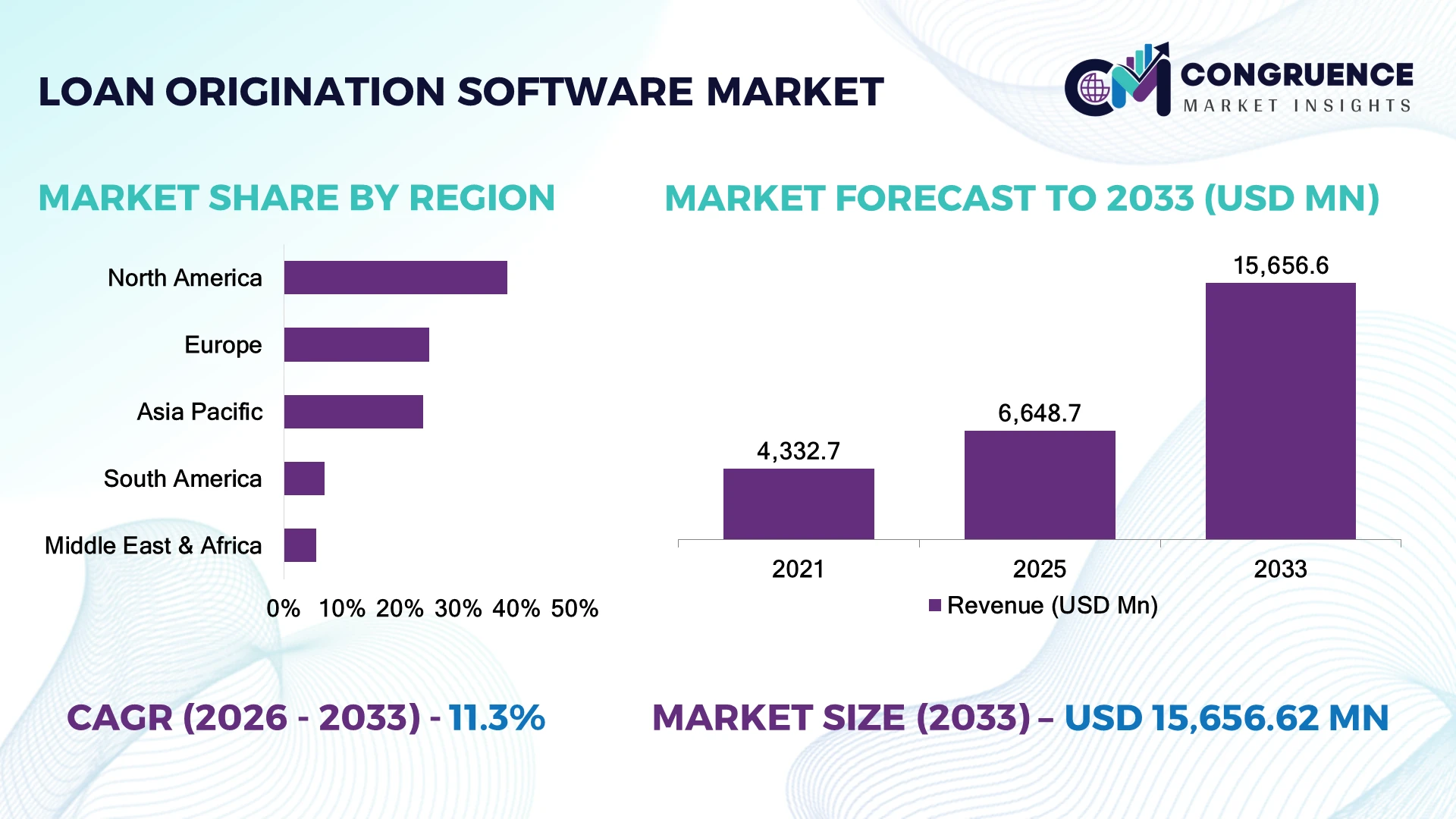
The Global Loan Origination Software Market was valued at USD 6,648.7 Million in 2025 and is anticipated to reach a value of USD 15,656.6 Million by 2033 expanding at a CAGR of 11.3% between 2026 and 2033. Growth is driven by automated credit underwriting, digital borrower onboarding, real-time identity verification, and integration of lending platforms with banking core systems and alternative data sources.
The United States remains a major loan origination software market, supported by a large mortgage industry, established digital lending providers, and continued investment in cloud-based financial infrastructure. Banks, credit unions, mortgage lenders, and fintech companies are deploying automated workflows to reduce manual processing and improve credit-decision consistency. Regulatory requirements for fair lending, consumer-data protection, and model governance are increasing demand for auditable decision systems. Compared with fragmented legacy workflows, integrated platforms can automate document collection, verification, and underwriting steps, although performance improvements vary by loan type and implementation quality. India's expanding digital lending ecosystem offers a contrasting opportunity through mobile-first borrower acquisition and digital identity infrastructure.
Vendors should prioritize configurable underwriting, explainable automation, secure integrations, and measurable reductions in loan-processing time to strengthen lender adoption.
Market Size & Growth: The market reached USD 6.65 billion in 2025 and is projected to reach USD 15.66 billion by 2033, supported by digital lending and automated credit workflows.
Top Growth Drivers: Automated underwriting, digital borrower onboarding, and cloud-based deployment are improving lending operations and reducing manual intervention across loan products.
Short-Term Forecast: By 2028, lenders prioritizing workflow automation and document intelligence will target shorter application-processing cycles, fewer manual reviews, and improved application visibility.
Emerging Technologies: Generative AI, machine-learning credit assessment, intelligent document processing, and API-based integrations are reshaping underwriting and application management.
Regional Leaders: North America benefits from mature lending infrastructure, Europe emphasizes compliance and data governance, and Asia-Pacific is expanding digital lending through mobile-first financial services.
Consumer/End-User Trends: Banks, mortgage lenders, credit unions, and fintech platforms increasingly expect digital applications, faster status updates, and reduced documentation burdens for borrowers.
Pilot/Case Example: In 2025–2026, lenders continued deploying AI-assisted document processing and automated verification to reduce repetitive review work and improve application completeness before underwriting.
Competitive Landscape: ICE Mortgage Technology, nCino, Finastra, FIS, and Temenos compete through lending workflow depth, core-system integration, configurability, and cloud deployment options.
Regulatory & ESG Impact: Fair-lending obligations, privacy requirements, and model-risk governance are increasing demand for explainable decisions, access controls, audit trails, and consistent documentation.
Investment & Funding: Financial institutions are directing technology budgets toward cloud modernization, AI-enabled operations, fraud controls, and integration projects that connect origination with servicing systems.
Innovation & Future Outlook: Competitive differentiation is shifting toward intelligent decisioning, configurable lending journeys, real-time risk signals, and end-to-end automation with human oversight.
The loan origination software market supports banks, mortgage lenders, credit unions, consumer-finance providers, and fintech companies managing applications from initial submission through credit decision and approval. Demand is shifting from isolated application tools toward integrated platforms combining digital onboarding, document verification, underwriting, fraud screening, and compliance workflows. Cloud deployment and API connectivity help lenders connect origination software with core banking, credit bureaus, identity services, and loan servicing systems. AI-assisted document extraction and risk assessment can reduce repetitive work, but regulated lenders still require explainability, auditability, and appropriate human review. Vendors that combine configurable workflows with secure integration and measurable operational improvements are positioned to address increasingly complex lending requirements.
Loan origination software is becoming strategically important because lenders compete on approval speed, borrower experience, credit quality, and operating cost while managing increasingly complex compliance requirements. Digital-first lenders have raised expectations for application visibility and rapid decisions, putting pressure on traditional institutions that rely on manual document handling and disconnected underwriting systems. Modern platforms connect customer acquisition, identity verification, credit assessment, and approval into a traceable workflow.
Legacy systems often depend on manual data entry and separate point solutions, whereas integrated platforms use APIs, automated document extraction, and configurable decision rules to reduce duplicate processing. Automation can materially shorten handling time in suitable workflows, but actual improvements depend on loan complexity, data quality, and integration maturity. North American lenders focus heavily on mortgage and consumer-credit workflows, while Indian lenders increasingly connect digital onboarding with identity verification and mobile-based applications. Both markets prioritize security and reliable decisioning, though their product mixes and regulatory environments differ.
During 2026–2028, lenders are expected to increase investment in AI-assisted underwriting, fraud detection, cloud migration, and real-time portfolio signals. For example, automated document classification can route complete applications directly to underwriting while flagging exceptions for human review. Vendors are strengthening partnerships with core banking providers, credit bureaus, identity-verification companies, and cloud infrastructure firms. Competitive advantage will depend on demonstrable processing improvements, explainable credit decisions, secure integrations, and the ability to adapt workflows without costly platform redevelopment.
Lenders are replacing fragmented application processes with digital workflows that combine identity verification, document collection, credit assessment, and approval. Automated data extraction and configurable decision rules reduce repetitive handling and help underwriters concentrate on complex cases. In the United States, continued mortgage-platform modernization is strengthening demand for integrated loan workflows, while India's digital lending ecosystem supports mobile-first application journeys. Open banking, electronic identity checks, and API connectivity are improving access to verified borrower information, although implementation results vary by product and lender. Providers are responding with cloud-native platforms, AI-assisted document processing, and partnerships with credit bureaus and core banking vendors. The strategic advantage comes from automating routine applications while preserving transparent escalation paths for exceptions and higher-risk decisions.
Loan origination platforms often need to connect with decades-old core banking systems, document repositories, credit bureaus, identity services, and servicing applications. Integration complexity raises implementation costs and can delay the expected return from automation. Even a well-designed platform cannot eliminate rework when source data are inconsistent or underwriting policies are poorly standardized. Lenders also face privacy, fair-lending, cybersecurity, and model-governance obligations that require continuing investment in controls and documentation. Smaller institutions may struggle to fund extensive customization while maintaining existing systems. Vendors are reducing these barriers through prebuilt connectors, modular deployment, migration support, and configurable workflows. Buyers should prioritize integration readiness and total implementation cost, not just subscription pricing or advertised automation features.
AI-assisted document intelligence, real-time fraud signals, and configurable decision engines create opportunities to streamline loan processing across consumer, small-business, mortgage, and vehicle finance. Intelligent extraction can convert unstructured income statements, tax records, and bank statements into reviewable data, while risk models help prioritize applications for manual assessment. Embedded lending also enables platforms to integrate credit offers directly into merchant, automotive, and business-software workflows. Providers are investing in explainable AI, orchestration layers, and partnerships with financial-data and identity-verification services. A less obvious opportunity lies in exception management: directing incomplete or inconsistent applications to the correct specialist can improve throughput without fully automating sensitive credit decisions. Vendors that prove accuracy, traceability, and controlled deployment can differentiate in regulated environments.
Scaling AI across loan origination requires reliable training data, documented decision logic, consistent model monitoring, and controls against discriminatory outcomes. Lenders must explain adverse decisions, protect borrower information, and demonstrate that automated rules operate within approved credit policies. Models trained on incomplete or historically biased data can generate inconsistent results, undermining trust and creating regulatory exposure. Cross-border lenders face additional complexity when privacy and consumer-credit requirements differ between jurisdictions. Companies need governance frameworks that combine model validation, audit logs, human review, and ongoing performance testing. Vendors are investing in explainability features, role-based access, and policy-management tools, while lenders are establishing model-risk oversight and escalation procedures. Long-term adoption depends on proving that faster decisions remain fair, secure, and defensible under scrutiny.
AI Document Processing Expands — Lenders are using intelligent document processing to classify applications, extract borrower information, and flag missing records before underwriting. Automated workflows reduce repetitive handling and help teams focus on exceptions. Providers are integrating AI with audit trails and human review so efficiency gains do not compromise traceability or lending-policy controls.
Cloud Platforms Replace Siloed Workflows — Banks and nonbank lenders are moving origination workloads toward configurable cloud platforms and API-connected services. This shift improves access to software updates and supports integration with credit bureaus, identity providers, and servicing systems. Vendors are emphasizing modular deployment and migration tools to reduce disruption while modernizing legacy lending infrastructure.
Fraud Controls Move Earlier — Identity checks, device signals, and document validation are increasingly embedded at application intake rather than left until final underwriting. Early screening helps lenders route suspicious applications for review before expensive processing work accumulates. Providers are strengthening integrations with verification services and adding risk-based workflows that distinguish routine applications from higher-risk cases.
Explainable Decisioning Gains Priority — As AI becomes more involved in credit assessment, lenders are emphasizing documented decision factors, model monitoring, and audit-ready records. Fair-lending obligations and evolving AI governance expectations are reinforcing demand for transparent controls. Vendors are adding configurable policies, decision histories, and human escalation features to support defensible lending decisions across products and jurisdictions.
Cloud-based loan origination software accounted for an estimated 60% of the market in 2025, supported by faster deployment, scalable computing capacity, and simpler integration with credit bureaus, identity-verification services, and core banking systems. Subscription-based platforms also reduce the need for lenders to maintain extensive on-premises infrastructure. On-premises solutions retain an important position among institutions requiring tighter control over sensitive borrower information, internal systems, and deployment environments. Their relevance is strongest where legacy architecture, data-residency requirements, or internal governance policies constrain migration. The commercial distinction increasingly centers on implementation flexibility, security controls, and total ownership costs rather than deployment architecture alone.
Cloud-based platforms are positioned for faster adoption as lenders modernize digital application journeys and integrate AI-assisted document processing. Industry surveys in 2026 indicate that AI deployment in lending is expanding rapidly, reinforcing demand for cloud infrastructure capable of supporting evolving workflows. On-premises vendors are responding through hybrid deployment options, API modernization, and stronger interoperability. Providers are also embedding configurable decision engines and audit capabilities to address regulatory expectations. For lenders, the priority is matching architecture to application complexity, security obligations, and internal technology capacity. Vendors that combine scalable deployment with reliable integration and transparent governance are better positioned to capture modernization budgets.
Mortgage lending represents an estimated 39% of loan origination software application demand, reflecting complex eligibility checks, extensive documentation, collateral assessment, and compliance requirements. Mortgage platforms must coordinate borrower information, income verification, property details, underwriting, and approval workflows across multiple stakeholders. Consumer lending provides a different demand profile, with higher-volume applications and more standardized decision rules favoring automated processing. Commercial lending requires configurable workflows for financial statements, collateral, cash-flow analysis, and relationship-based credit assessment. These differences encourage software providers to develop specialized decision engines rather than rely on a single standardized workflow for every loan category.
Digital consumer and small-business lending are gaining strategic importance as lenders use alternative financial data, automated verification, and embedded application journeys to reach underserved borrowers. In India, account-aggregator infrastructure is helping lenders evaluate applicants with limited conventional credit histories. Mortgage providers continue prioritizing document accuracy and auditability, while consumer lenders emphasize rapid decisions and low-cost processing. Commercial lenders value configurable risk assessment and integration with business financial data. Software vendors are adapting through modular underwriting, real-time data connections, and application-specific automation. Investment priorities increasingly favor platforms that can process routine applications efficiently while routing complex or higher-risk cases to specialist review.
Banks represent an estimated 43% of loan origination software end-user demand, supported by broad lending portfolios, established customer bases, and substantial requirements for compliance, auditability, and integration with core banking systems. Their software needs span mortgages, personal loans, vehicle finance, and commercial credit, often requiring complex approval hierarchies and differentiated risk policies. Credit unions prioritize affordable platforms that support member service and operational efficiency, while mortgage lenders and brokers need specialized document management, borrower communication, and underwriting workflows. Non-bank lenders and fintech companies generally emphasize faster product launches, flexible integrations, and automated decisioning to compete with established institutions.
Non-bank and digital-first lenders are gaining strategic importance as embedded finance, mobile applications, and alternative-data assessment broaden access to credit. Experian's 2025 research found that 79% of surveyed Indian lending decision-makers believed machine learning opened access to new customer segments. Traditional banks are responding with cloud migration, digital onboarding, and partnerships with fintech providers, while smaller lenders increasingly favor configurable platforms that reduce implementation complexity. Credit unions require cost-effective deployment and strong member-facing workflows; mortgage specialists prioritize regulatory documentation and transaction coordination. Vendors are differentiating through modular pricing, prebuilt integrations, and tailored implementation support. Future demand will favor providers that serve both enterprise-scale governance requirements and the faster deployment cycles of emerging digital lenders.
North America accounted for the largest market share at 38.4% in 2025 however, Asia-Pacific is expected to register the fastest growth, expanding at a CAGR of 13.2% between 2026 and 2033.
Mortgage Modernization and AI-Assisted Underwriting Reshape Lending Operations
North America holds a leading position in the loan origination software market, supported by established mortgage infrastructure, extensive consumer-credit operations, and mature fintech ecosystems. The United States drives regional adoption as banks, mortgage lenders, and credit unions modernize legacy workflows with cloud platforms, automated document processing, and integrated underwriting. Competition increasingly centers on reducing application-processing friction while maintaining auditability and fair-lending controls. Canada contributes through digital banking adoption and modernization of consumer and commercial lending systems. In 2025, lenders continued prioritizing AI-enabled document review and workflow automation to address operating costs and inconsistent legacy data. Vendors are responding with configurable mortgage platforms, API-based integration, and stronger fraud controls. Institutions that modernize without disrupting core lending systems are better positioned to improve turnaround times and borrower experience.
United States Market Outlook: The United States remains the region's principal market because of its large mortgage-servicing ecosystem, diverse consumer-credit products, and established lending technology providers. Mortgage lenders must coordinate borrower documentation, property valuation, credit checks, underwriting, and compliance across complex workflows. Federal consumer-protection and fair-lending requirements increase demand for traceable decisions and consistent documentation. Lenders are investing in cloud migration, automated income verification, and AI-assisted processing, while maintaining human review for exceptions. Vendors with deep mortgage integrations and proven implementation support are well positioned to win modernization contracts.
Regulatory Alignment and Open Banking Drive Platform Modernization
Europe's loan origination software market is shaped by digital banking adoption, stringent data-protection obligations, and increasing demand for transparent credit decisions. Banks in Germany, the United Kingdom, France, and the Nordic countries are modernizing application workflows while retaining strong controls over borrower data and model governance. Open banking enables lenders to access consent-based financial information, improving assessment of applicants whose conventional credit files provide limited insight. The European Union's Digital Operational Resilience Act became applicable in January 2025, strengthening technology-risk management expectations for financial institutions. Vendors are prioritizing secure cloud deployment, auditable decision engines, and standardized integrations. Differences in national lending practices and regulatory interpretation continue to favor configurable platforms over uniform, one-size-fits-all implementations.
United Kingdom Market Outlook: The United Kingdom benefits from a mature fintech ecosystem, established mortgage intermediaries, and widespread digital financial services. Open banking infrastructure supports consent-based sharing of account information, allowing lenders to strengthen affordability assessments and reduce dependence on manually submitted documents. Competition among banks, specialist mortgage lenders, and digital-first providers is encouraging investment in faster application journeys and automated verification. Providers that integrate securely with credit bureaus, banking platforms, and broker systems can help lenders reduce repetitive processing while preserving compliance and clear decision records.
Digital Public Infrastructure Accelerates Data-Driven Lending
Asia-Pacific is positioned for the fastest expansion as lenders adopt mobile-first applications, alternative-data assessment, and cloud-based credit workflows. India, China, Australia, and Southeast Asian markets differ in maturity, but all present opportunities to automate borrower onboarding and decision processing. India's Account Aggregator framework had enabled more than 2.2 billion financial accounts for consent-based data sharing by September 2025, strengthening the infrastructure available to lenders evaluating applicants. Banks and non-bank finance companies are integrating digital identity, bank-statement analysis, and credit-bureau data to improve application assessment. Vendors are adapting products for local languages, regulatory requirements, and varied lending models. The strongest opportunity lies in connecting verified financial data with explainable decisioning rather than simply digitizing paper-based application forms.
India Market Outlook: India is a strategically important market because of its digital identity infrastructure, expanding fintech ecosystem, and large population of individuals and small businesses seeking formal credit. The Account Aggregator framework had 112.34 million users who had linked accounts by September 2025, enabling consent-based access to financial information. Loan origination providers can use these connections to streamline income verification, reduce document collection, and assess borrowers with limited traditional credit histories. Competition will favor platforms that combine local regulatory compliance, mobile-first interfaces, fraud prevention, and integrations with banks and non-bank lenders.
Open Finance and Digital Credit Expand Lending Access
South America's loan origination software market is led by Brazil, where digital banking, instant payments, and open-finance infrastructure support increasingly connected lending journeys. Financial institutions are improving application intake, borrower verification, and credit assessment as competition from digital banks and fintech lenders intensifies. Brazil's Open Finance ecosystem supports consent-based sharing of financial data across participating institutions, creating opportunities for more tailored credit assessment and simplified loan applications. Argentina, Chile, and Colombia also present demand for digital consumer lending and small-business finance. Currency volatility, uneven technology budgets, and legacy banking systems can slow large-scale implementation. Vendors are responding with modular deployments, local integration partners, and cloud-based products that allow lenders to modernize specific workflows before replacing broader technology infrastructure.
Brazil Market Outlook: Brazil leads regional opportunity through its large banking sector, developed fintech market, and established digital financial infrastructure. The Central Bank of Brazil reported that its Open Finance ecosystem served 52 million clients and processed 3.3 billion data requests weekly in 2025. This infrastructure creates opportunities to improve borrower-data access, affordability assessment, and credit portability. Lenders are increasingly able to build workflows around consent-based financial information rather than relying exclusively on manual documents. Vendors that support secure APIs, local compliance, and scalable consumer and small-business lending processes can strengthen their position.
Fintech Licensing and Digital Banking Modernization Reshape Credit Delivery
The Middle East and Africa market is developing through digital banking initiatives, fintech licensing, and demand for more accessible consumer and business credit. Saudi Arabia and the United Arab Emirates are investing in financial technology ecosystems, while South Africa provides an established base for digital banking and consumer finance. In Saudi Arabia, the central bank permitted four fintech startups to test solutions in its regulatory sandbox in February 2025, including peer-to-peer lending and open banking initiatives. These developments create opportunities for configurable loan origination platforms, automated verification, and digital credit assessment. Adoption remains uneven because of differences in banking infrastructure, data availability, and regulatory frameworks. Vendors are emphasizing localized compliance, mobile-enabled workflows, integration support, and partnerships with licensed financial institutions.
Saudi Arabia Market Outlook: Saudi Arabia offers a significant opportunity as financial-sector modernization and fintech development expand digital credit services. The Saudi Central Bank licensed Tamara Finance in March 2025, bringing the number of licensed and permitted finance companies to 65. This expanding institutional landscape increases the need for controlled application processing, borrower verification, and auditable credit decisions. Loan origination software providers can compete through configurable consumer-finance workflows, integration with local banking systems, and strong compliance controls. Local partnerships and dependable implementation support will be important for serving both established lenders and newer digital-finance providers.
ICE Mortgage Technology competes with nCino, Finastra, FIS, and Fiserv, while Blend, MeridianLink, and Abrigo target digital-first lenders. The market remains moderately concentrated: the five leading providers are estimated to hold roughly 40% of loan origination software activity, with concentration higher in U.S. mortgage platforms. Competition centers on implementation cost, integration depth, underwriting automation, compliance controls, and deployment speed. AI-assisted workflows reduce repetitive review, while ICE reports automation of 95–100% of loan-boarding and post-boarding audit reviews. Vendors are expanding through cloud migration, data partnerships, and embedded decisioning; nCino is extending AI across mortgage processes, while Salesforce and Deloitte have collaborated with Godrej Capital on digital lending. Consolidation and platform bundling are shifting competition from standalone application tools toward connected origination-to-servicing ecosystems. Entry barriers include regulatory validation, sensitive-data security, legacy integration, and lender switching costs. Winning requires measurable cycle-time gains, auditable decisions, dependable integrations, and implementation that fits lender risk policies.
Cloud-based loan origination platforms are replacing fragmented workflows by connecting application intake, document extraction, credit checks, and underwriting through APIs across consumer, mortgage, and commercial lending portfolios. In a 2026 survey, 79% of 100 U.S. banking leaders said their institutions had piloted or integrated AI into lending, up from 34% in late 2025. Adoption is moving toward controlled production, making audit trails and data quality essential consistently.
AI document intelligence classifies income records, identifies missing evidence, and routes exceptions before underwriters review files. A 2026 customer study found that one leading platform supported 15.5% more closings without additional staff; this result is not universal. Compared with manual handling, integrated automation reduces repetitive checks, but benefits depend on reliable data connections and well-configured credit policies. Enterprise providers gain by bundling workflow, data, and compliance capabilities for complex lending operations.
From 2026 to 2028, generative AI will increasingly assist document follow-up, policy checks, and loan-officer tasks, while humans review exceptions and adverse decisions. Cloud-native challengers can deploy features quickly; incumbents benefit from trusted systems of record and lender integrations. Institutions should measure application-to-decision time, rework, exception rates, and cost per funded loan, while requiring explainability, privacy controls, and model monitoring before scaling.
The report evaluates loan origination software across cloud-based, on-premises, and hybrid deployment models, covering mortgage, consumer, commercial, small-business, vehicle, and other specialized lending workflows. End-user analysis includes banks, credit unions, mortgage lenders, non-bank finance companies, and fintech lenders, with attention to differences in underwriting complexity, application volumes, compliance needs, and technology budgets.
Regional coverage spans North America, Europe, Asia-Pacific, South America, and the Middle East and Africa, highlighting country-level digital lending infrastructure, regulatory conditions, and adoption priorities. Technology analysis examines AI-assisted document processing, automated decision engines, API integrations, cloud migration, fraud screening, and audit-ready model governance. With AI pilots or deployments reported by 79% of surveyed U.S. banking leaders in 2026, the report helps decision-makers evaluate modernization priorities, partner selection, expansion opportunities, competitive positioning, and operational measures for the 2026–2033 planning horizon.
| Report Attribute/Metric | Report Details |
|---|---|
|
Market Revenue in 2025 |
USD 6,648.7 Million |
|
Market Revenue in 2033 |
USD 15,656.6 Million |
|
CAGR (2026 - 2033) |
11.3% |
|
Base Year |
2025 |
|
Forecast Period |
2026 - 2033 |
|
Historic Period |
2021 - 2025 |
|
Segments Covered |
By Type
By Application
By End-User
|
|
Key Report Deliverable |
Revenue Forecast, Growth Trends, Market Dynamics, Segmental Overview, Regional and Country-wise Analysis, Competition Landscape |
|
Region Covered |
North America, Europe, Asia-Pacific, South America, Middle East, Africa |
|
Key Players Analyzed |
ICE Mortgage Technology, nCino, Inc., Finastra, FIS, Fiserv, Inc., Temenos AG, MeridianLink, Inc., Blend Labs, Inc., Abrigo, Pegasystems Inc., TurnKey Lender, Tavant Technologies, Newgen Software Technologies Limited |
|
Customization & Pricing |
Available on Request (10% Customization is Free) |