
Reports
The Global Live Poultry Vaccine Market was valued at USD 1,206.5 Million in 2025 and is anticipated to reach a value of USD 1,981.8 Million by 2033 expanding at a CAGR of 6.4% between 2026 and 2033. Growth is being driven by intensifying Newcastle disease, infectious bronchitis, and avian influenza control programs, alongside rapid adoption of hatchery-based live vaccine administration.
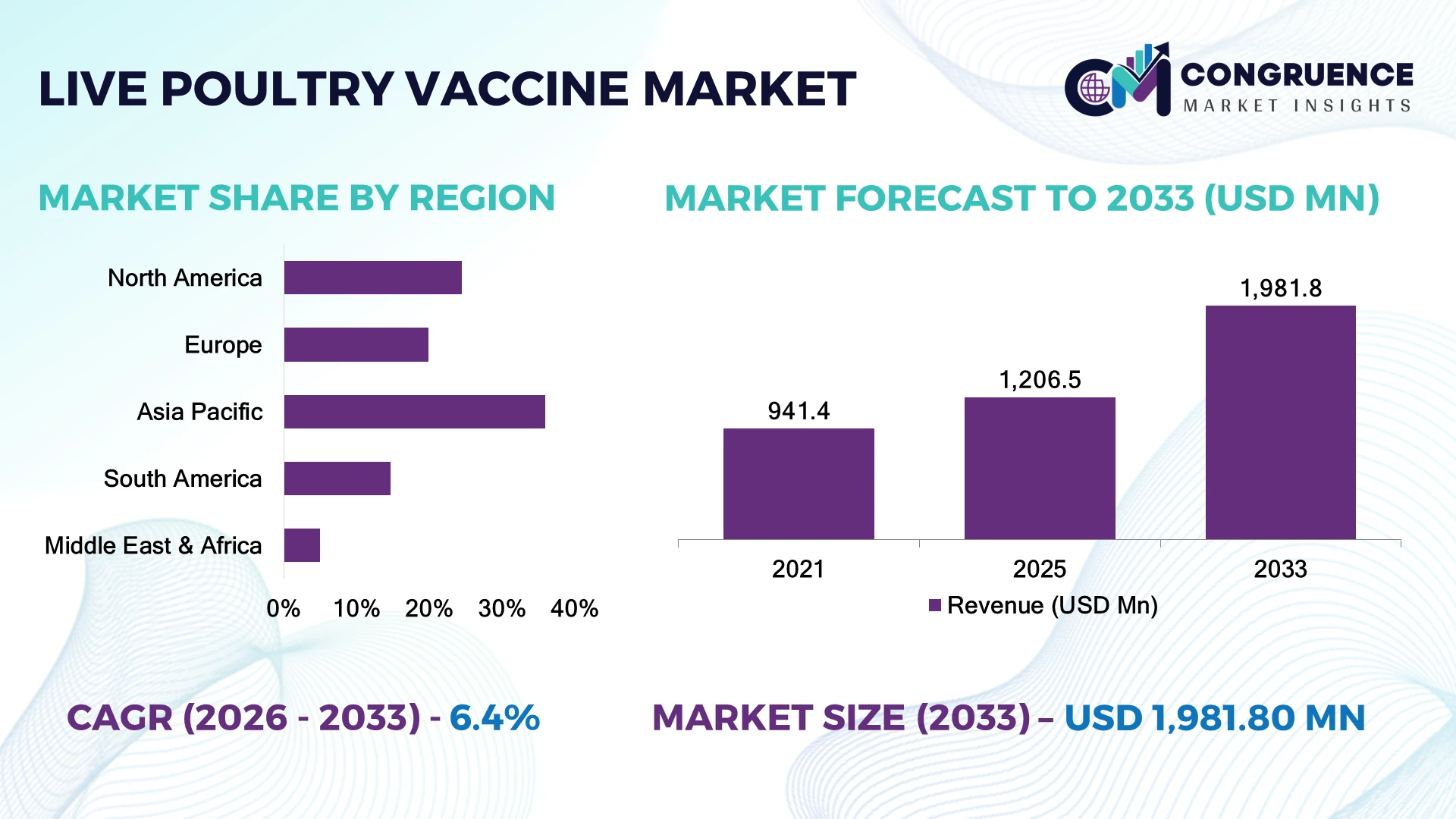
Asia Pacific held approximately 35.9% of the live poultry vaccine market in 2025, supported by intensive broiler and layer production, while North America represented about 24.5%. China remains a major production center, with approximately 15.35 million tonnes of chicken meat production in 2024/25, compared with 21.34 million tonnes in the United States. Commercial hatchery vaccination is increasingly automated, with in-ovo systems operating at up to 100,000 eggs per hour.
The strategic priority is to combine strain-matched live vaccines with high-throughput delivery systems, localized manufacturing, and stronger disease-surveillance capabilities.
Market Size & Growth: USD 1,206.5 million in 2025 to USD 1,981.8 million by 2033 at 6.4% CAGR, driven by disease-control intensification and hatchery vaccination.
Top Growth Drivers: Asia Pacific: 35.9%; live attenuated vaccines: 38.4%; infectious bronchitis vaccines: 22.85%.
Short-Term Forecast: By 2028, automated hatchery vaccination can increase dosing consistency by 10–20% versus manual farm administration.
Emerging Technologies: In-ovo injection, automated spray cabinets, thermostable live vaccines, and digitally monitored vaccine delivery are reshaping flock immunization.
Regional Leaders: Asia Pacific: approximately USD 711.5 million; North America: USD 484.5 million; Europe: USD 394.4 million on a 2033 share-maintenance basis.
Consumer/End-User Trends: Commercial broiler and layer operations increasingly centralize vaccination at hatcheries, with in-ovo technology deployed in more than 90% of commercial hatcheries globally.
Pilot/Case Example: 2025 hatchery automation demonstrates throughput of up to 100,000 eggs/hour, reducing handling intensity and improving dose uniformity.
Competitive Landscape: Leading suppliers include Boehringer Ingelheim, Ceva Santé Animale, Merck Animal Health, Zoetis, and Elanco, competing through strain coverage, delivery technology, and supply reliability.
Regulatory & ESG Impact: Avian-influenza vaccination programs increasingly require surveillance integration, with international veterinary authorities emphasizing monitoring alongside vaccination to preserve disease-status credibility.
Investment & Funding: Large poultry-integrator programs are directing investment toward hatchery automation, cold-chain infrastructure, and localized vaccine supply to strengthen biosecurity.
Innovation & Future Outlook: Next-generation live vaccines will emphasize thermostability, combination protection, precision delivery, and faster strain matching as poultry systems become increasingly integrated.
The Live Poultry Vaccine Market is increasingly concentrated around intensive broiler and layer production, hatchery vaccination, and diseases requiring frequent flock protection. Live attenuated products represented approximately 38.4% of poultry vaccine demand in 2025, while infectious bronchitis vaccines accounted for 22.85%. In-ovo and automated spray systems are reducing manual handling and strengthening dose consistency, particularly in large commercial hatcheries. Disease surveillance and vaccine-strain matching are becoming operational requirements as countries manage avian-influenza risks and international poultry trade.
Live poultry vaccines are becoming strategically important because disease control increasingly determines flock productivity, mortality exposure, antibiotic-use strategies, and export continuity. Avian influenza has intensified government and integrator attention to vaccination as part of broader surveillance and biosecurity programs. International veterinary guidance emphasizes that vaccination must operate alongside surveillance and other control measures, making vaccine stewardship increasingly important for commercial producers.
Technology is shifting vaccination from labor-intensive farm administration toward centralized hatchery delivery. In-ovo systems can process up to 100,000 eggs per hour, compared with substantially slower individual handling, while providing more consistent dosing. More than 90% of commercial hatcheries were reported to use in-ovo vaccination technology, creating a strong installed base for automated live-vaccine deployment.
Over the next 2–3 years, adoption will concentrate on thermostable formulations, automated spray systems, in-ovo delivery, and integrated monitoring. Asia Pacific will remain scale-driven, while North America will emphasize disease surveillance and technology-intensive production. Vaccine manufacturers are strengthening hatchery partnerships, regional production, cold-chain capacity, and strain-development programs. Competitive advantage will increasingly depend on delivering reliable flock protection through scalable, precisely controlled vaccination systems rather than vaccine formulation alone.
Disease-control intensity is increasing demand for live vaccines as commercial poultry systems prioritize early flock protection. Live attenuated vaccines represented approximately 38.4% of poultry vaccine demand, while infectious bronchitis vaccines accounted for about 22.9%, creating sustained requirements for repeat immunization programs. In the United States, large integrated producers increasingly use centralized hatchery vaccination to standardize flock coverage and reduce labor exposure. Automated in-ovo systems can process up to 100,000 eggs per hour, shifting vaccination from farm-level execution toward industrialized hatchery workflows. Vaccine manufacturers are responding through combination formulations, hatchery partnerships, and expanded production capacity. The strategic advantage is operational consistency: early-life administration reduces dependence on variable farm-level execution and strengthens disease-control protocols.
Live vaccines remain sensitive to temperature excursions, creating infrastructure pressure across emerging poultry markets. Storage conditions commonly require controlled temperatures around 2–8°C, while potency can deteriorate rapidly when handling protocols fail. In countries with fragmented rural distribution, cold-chain gaps can affect 10–20% of vaccine-handling points during difficult logistics periods, increasing wastage and replacement costs. Live vaccines also require careful reconstitution and rapid administration, limiting flexibility compared with some inactivated products. Manufacturers are reducing exposure through thermostable formulations, regional warehouses, distributor training, and tighter temperature-monitoring systems. The non-obvious constraint is not vaccine availability but last-mile potency preservation; companies that improve cold-chain visibility can protect effective coverage while reducing avoidable product losses.
Thermostable live vaccines represent a significant opportunity for poultry producers operating outside highly controlled hatchery environments. Formulations capable of maintaining acceptable potency across wider temperature excursions can reduce cold-chain dependency and improve deployment reliability, particularly in India, Brazil, Indonesia, and parts of Africa. Even a 10–15% reduction in vaccine wastage can materially improve flock-level immunization economics for high-volume integrators. Automated spray systems and combination vaccines provide additional efficiency by consolidating administration steps. Manufacturers are investing in strain engineering, stabilizers, and hatchery partnerships to commercialize more resilient products. A distinctive opportunity lies in integrating vaccine delivery with digital flock records, enabling producers to link vaccination timing, dosage, mortality, and production performance rather than treating immunization as an isolated farm activity.
Genetic variation among circulating poultry pathogens creates a persistent execution challenge because vaccine performance depends on antigenic relevance, administration quality, and flock immunity. Infectious bronchitis viruses can exhibit substantial strain diversity, while avian-influenza programs require continuous surveillance alongside vaccination. A mismatch between vaccine strain and circulating field strain can materially reduce protection even when administration coverage exceeds 90%. Companies therefore face pressure to shorten strain-selection cycles, expand surveillance partnerships, and validate combination vaccines across production systems. The operational challenge becomes sharper in integrated poultry operations where millions of birds must receive consistent protection within narrow hatchery windows. Investment in molecular surveillance, rapid diagnostics, regional strain libraries, and adaptable vaccine platforms is becoming essential for sustaining competitiveness and reducing disease-related production disruption.
Hatchery Automation Gains Momentum: Centralized vaccination is replacing fragmented farm-level administration as commercial producers prioritize uniform flock coverage. In-ovo equipment can process up to 100,000 eggs per hour, while automated spray systems reduce repetitive manual handling. Vaccine manufacturers are strengthening hatchery partnerships and integrating delivery equipment with standardized vaccination protocols.
Thermostability Becomes Commercial Priority: Manufacturers are developing live vaccines with improved temperature tolerance to address distribution losses in markets where refrigeration infrastructure remains inconsistent. Even a 10–15% reduction in temperature-related wastage improves procurement economics. Regional production hubs and monitored distribution networks are increasingly being paired with stabilized formulations.
Combination Vaccines Simplify Protocols: Producers are consolidating protection against multiple respiratory and enteric pathogens to reduce handling events and labor requirements. Combination live vaccines can eliminate separate administration steps within compatible programs, improving workflow efficiency by approximately 5–10%. Suppliers are expanding multivalent portfolios and conducting broader compatibility validation for integrated poultry systems.
Surveillance Shapes Vaccine Selection: Molecular diagnostics and genomic sequencing are increasingly influencing strain-selection decisions as pathogen diversity becomes more visible. Commercial producers are linking laboratory surveillance with vaccination schedules rather than relying solely on fixed programs. A 10% improvement in strain-match relevance can materially strengthen flock protection, encouraging manufacturers to invest in regional monitoring partnerships and faster formulation updates.
Live attenuated vaccines represent the leading type, accounting for approximately 38.4% of poultry vaccine demand, supported by established manufacturing platforms, strong immunogenicity, and compatibility with spray, drinking-water, and hatchery administration. Recombinant and vectored live vaccines remain smaller but strategically important, particularly where producers require targeted protection and improved safety profiles. Inactivated vaccines retain relevance for programs requiring specific immune responses but are less aligned with the high-throughput economics of live administration.
Live attenuated products remain mature, while recombinant and vectored platforms are gaining attention as pathogen diversity increases. Companies are investing in strain development, multivalent formulations, thermostability, and automated delivery compatibility. The fastest-moving investment area is therefore not simply replacing conventional live vaccines, but improving their precision, stability, and integration with hatchery workflows. For manufacturers, scalable production and strain-matching capability increasingly determine competitiveness.
A 2025 poultry-vaccine technology review reported that in-ovo vaccination is used in more than 90% of commercial hatcheries worldwide, reinforcing the strategic importance of live-vaccine compatibility with automated hatchery delivery.
Newcastle disease represents the leading application, accounting for approximately 32.0% of the global live poultry vaccine market in 2025. Its dominance reflects widespread disease pressure, routine vaccination schedules, and the severe productivity consequences associated with outbreaks. Infectious bronchitis follows at approximately 24.3%, while Marek’s disease and infectious bursal disease account for about 17.8% and 16.0%, respectively. This distribution gives manufacturers a broad recurring base rather than dependence on a single disease program.
Infectious bronchitis is the fastest-growing application, driven by strain variation, respiratory performance losses, and increasing demand for multivalent or strain-matched protection. Companies are expanding combination vaccines, updating circulating-strain coverage, and strengthening diagnostic partnerships. Newcastle-focused products remain optimized for cost-efficient mass administration, while emerging infectious-bronchitis programs increasingly emphasize formulation flexibility and surveillance-led vaccine selection. The business implication is clear: suppliers with broad disease portfolios and rapid strain-response capabilities can secure deeper integrator relationships.
WOAH reported 807 additional H5N1 animal outbreaks between March 1 and July 1, 2025, including 268 poultry outbreaks, reinforcing the operational importance of surveillance-linked vaccination strategies.
Commercial poultry farms represent the dominant end-user group, accounting for approximately 70% of live poultry vaccine consumption because integrated broiler, layer, and breeder operations require standardized immunization across large bird populations. Hatcheries represent the fastest-growing deployment environment as centralized vaccination improves dose consistency and reduces labor dependence. Smaller independent farms and veterinary channels remain important, particularly in emerging poultry markets, but their fragmented purchasing patterns create less predictable volumes.
Large integrators increasingly favor suppliers capable of combining vaccines with technical services, hatchery equipment compatibility, cold-chain support, and flock-health monitoring. Hatchery-centered deployment can cover thousands of birds within tightly controlled production cycles, while automated systems reduce manual intervention. Companies are therefore strengthening direct enterprise partnerships, regional distribution, and customized vaccination programs. The competitive opportunity is shifting toward integrated flock-health solutions rather than individual vaccine sales, particularly in China, the United States, Brazil, and India.
A 2025 India poultry-health assessment identified 851 million poultry birds nationally and documented 41 HPAI outbreak epicentres across 10 states and union territories through July 31, underscoring the scale of commercial disease-control requirements.
Asia Pacific accounted for the largest market share at 35.9% in 2025 however, North America is expected to register the fastest growth, expanding at a CAGR of 6.8% between 2026 and 2033.

Hatchery precision is shifting vaccination toward integrated flock-health systems
North America accounted for approximately 24.5% of the global live poultry vaccine market in 2025, supported by highly integrated broiler production, centralized hatcheries, and established veterinary infrastructure. The United States dominates regional demand, with commercial hatcheries routinely using in-ovo vaccination for Marek’s disease and other early-life programs. Automated hatchery systems are increasingly favored because they standardize dosing across high-volume production cycles and reduce manual bird handling. Vector vaccines combining protection against multiple diseases are also gaining relevance, allowing producers to consolidate vaccination steps. Companies are strengthening direct relationships with poultry integrators, expanding technical-service teams, and integrating vaccine programs with hatchery equipment. The strategic shift is toward vaccination as a standardized production-control process rather than a standalone veterinary intervention.
United States Market Outlook: The United States remains the region’s principal market because vertically integrated poultry companies operate large hatchery and broiler networks. Most commercial broiler hatcheries use in-ovo systems for Marek’s disease vaccination, typically at 17–19 days of embryonation. This installed infrastructure gives vaccine manufacturers a strong platform for expanding automated live-vaccine delivery.
Biosecurity and traceability are reshaping vaccine procurement
Europe represented approximately 19.9% of global live poultry vaccine demand in 2025, with Germany, France, Spain, Italy, Poland, and the United Kingdom forming important production centers. The market is shaped by strict animal-health controls, traceability requirements, and heightened attention to antimicrobial stewardship. Commercial producers increasingly prioritize vaccines supported by robust monitoring and documented flock-health protocols. Layer and breeder operations require particularly structured immunization programs because production cycles extend well beyond broiler systems. Manufacturers are responding through multivalent vaccines, improved strain coverage, and technical partnerships with veterinary networks. The region’s competitive distinction is specification-driven procurement, where regulatory compliance and disease-control evidence increasingly influence purchasing decisions alongside product price.
Germany Market Outlook: Germany combines advanced poultry production, sophisticated veterinary infrastructure, and stringent biosecurity requirements. Commercial producers increasingly integrate vaccination with diagnostic surveillance and documented flock-health programs. The country’s industrialized production structure favors suppliers capable of consistent cold-chain delivery, technical support, and validated vaccine protocols across breeder, layer, and broiler operations.
Production scale is accelerating localized vaccine capacity
Asia Pacific led the global live poultry vaccine market with approximately 35.9% share in 2025, supported by China, India, Indonesia, and other high-volume poultry markets. China alone produced 28.37 million tonnes of poultry meat in 2025, up 20.2% from 2020, strengthening the addressable base for routine flock vaccination. Intensive broiler and layer systems are increasing demand for hatchery vaccination, combination products, and reliable cold-chain distribution. Manufacturers are expanding local production, strengthening distributor networks, and developing formulations suited to country-specific disease profiles. The region’s defining advantage is scale: large bird populations allow vaccine suppliers to justify localized manufacturing and high-throughput distribution infrastructure.
China Market Outlook: China is the region’s largest poultry production base and a central demand center for live poultry vaccines. Poultry meat output reached 28.37 million tonnes in 2025, creating substantial recurring vaccination requirements across commercial broiler and layer operations. Domestic manufacturing capacity and extensive veterinary distribution networks support rapid product deployment and localized strain-management strategies.
Export-oriented poultry production is raising biosecurity intensity
South America is anchored by Brazil, where industrial poultry production creates substantial recurring demand for vaccination programs across broilers, breeders, and layers. Brazil produced 14.2 million tonnes of chicken meat in 2025, a 3.4% increase from 2024, reinforcing the scale of commercial disease-control requirements. Export-oriented producers place particular emphasis on flock health, traceability, and biosecurity because disease events can affect processing schedules and market access. Vaccine companies are strengthening relationships with large integrators, expanding technical support, and adapting programs to regional disease profiles. Distribution remains more fragmented outside Brazil, creating opportunities for local veterinary partnerships and regional cold-chain investment.
Brazil Market Outlook: Brazil is the region’s dominant poultry market and a major global chicken exporter. Its 2025 chicken production reached a record 14.2 million tonnes, supporting high-volume vaccination across vertically integrated production systems. Large processors and integrators favor standardized vaccination protocols, while suppliers benefit from direct enterprise relationships, regional technical teams, and dependable vaccine availability.
Commercial poultry expansion is driving biosecurity modernization
Middle East & Africa represented approximately 5.0% of global live poultry vaccine demand in 2025, with Saudi Arabia, South Africa, the UAE, Egypt, and Morocco providing the strongest commercial opportunities. Commercial poultry expansion is increasing requirements for Newcastle disease, infectious bronchitis, and other routine vaccination programs. Saudi Arabia and the UAE are investing in modern poultry production systems that emphasize controlled housing, hatchery management, and biosecurity. However, fragmented distribution and uneven cold-chain infrastructure remain important operational constraints in several African markets. Manufacturers are responding through regional distributors, localized veterinary partnerships, and technical training. The strategic opportunity is concentrated in commercial integrators capable of supporting consistent vaccination protocols across increasingly professionalized production systems.
Saudi Arabia Market Outlook: Saudi Arabia is the region’s most strategically significant market because poultry self-sufficiency initiatives have encouraged investment in domestic production capacity, modern farms, and integrated animal-health systems. Large commercial producers require dependable vaccine supply and controlled vaccination programs. Suppliers with localized distribution, cold-chain capability, and veterinary support are positioned to capture recurring demand as production systems become more technologically intensive.
Boehringer Ingelheim, Ceva Santé Animale, Merck Animal Health, Zoetis, and Elanco compete as global vaccine leaders, while regional manufacturers challenge them on price, localized strains, and distribution. The top five players collectively hold approximately 55% of global poultry-vaccine sales, indicating a concentrated leadership structure. Competition centers on strain coverage, delivery technology, regulatory speed, and supply reliability; hatchery-based programs can deliver over 90% flock coverage, while automated administration improves dosing consistency. Companies are expanding through localized manufacturing, hatchery partnerships, combination vaccines, and veterinary-service integration. Ceva combines vaccines with hatchery equipment and services, while Zoetis is accelerating strain-matched development for emerging disease threats. The competitive shift is toward recombinant and immune-complex platforms, integrated vaccination services, and faster regulatory access rather than commodity live-vaccine pricing. Entry barriers include biological R&D, regulatory validation, cold-chain infrastructure, and field efficacy evidence. Winning requires validated disease protection, scalable hatchery delivery, rapid strain adaptation, and dependable regional supply.
Boehringer Ingelheim Animal Health
Ceva Santé Animale
Merck Animal Health
Zoetis Inc.
Elanco Animal Health
HIPRA
Vaxxinova
Hester Biosciences
Indian Immunologicals Limited
Venky’s India Limited
Biovet
Pharmavet
Anicon Laboratorios
Lohmann Animal Health
Current technology is centered on live attenuated, recombinant-vector, and immune-complex vaccines compatible with hatchery administration. In-ovo and day-old vaccination already exceed 90% adoption across commercial hatchery operations, supporting standardized flock protection. Automated delivery can improve dosing consistency by approximately 10–20% compared with manual administration, while reducing repetitive labor. Ceva's immune-complex platforms and vector technologies demonstrate the shift toward targeted protection against multiple disease threats.
Emerging systems combine vaccine delivery with hatchery automation, cold-chain monitoring, and digital flock-health records. In-ovo equipment can process up to 100,000 eggs per hour, creating substantial throughput advantages over manual vaccination. The strongest competitive benefit goes to integrated poultry producers and vaccine suppliers that connect formulation, equipment, veterinary support, and monitoring. Combination and vector vaccines also reduce separate administration events by approximately 5–10% in compatible programs.
Through 2026–2028, thermostable formulations, recombinant vectors, immune-complex technology, and precision hatchery delivery will gain strategic importance. Zoetis's 2026 European authorization of a single-dose recombinant HVT-ND vaccine illustrates the shift toward multi-disease protection through one administration. Companies investing now in strain matching, automated delivery compatibility, and localized manufacturing can improve deployment speed while reducing operational complexity. The technology race is shifting from vaccine potency alone toward integrated disease-control performance.
January 2025 Boehringer Ingelheim received USDA authorization to import two live avian metapneumovirus vaccines, NEMOVAC for chickens and AVIFFA RTI for turkeys, for emergency U.S. use. The move expanded immediate disease-control options during respiratory disease pressure. Source: Boehringer Ingelheim
February 2025 Zoetis received a USDA conditional license for its H5N2 killed-virus avian influenza vaccine for chickens, following safety and efficacy evidence. More than 150 million U.S. birds had been affected by HPAI since February 2022, strengthening demand for updated vaccine technologies. Source: Zoetis
February 2025 Ceva Philippines hosted Chick Day 2025 with participation from more than 90% of the country's poultry-industry producers and unveiled Nextmune IBD. The launch strengthened immune-complex vaccine adoption and expanded hatchery-focused disease-control solutions for commercial producers. Source: Ceva
January 2026 Elanco and HIPRA introduced two avian metapneumovirus vaccines to U.S. poultry producers, expanding respiratory-disease protection for turkeys, broilers, layers, and breeders. The partnership broadened commercial vaccine access and strengthened integrated disease-management options for high-density poultry operations. Source: elanco.com
The report evaluates live attenuated, recombinant-vector, immune-complex, and other live vaccine platforms across Newcastle disease, infectious bronchitis, infectious bursal disease, Marek’s disease, avian metapneumovirus, and other poultry diseases. End-user coverage includes commercial poultry farms, hatcheries, integrators, veterinary channels, and specialized breeder and layer operations. Regional analysis spans North America, Europe, Asia Pacific, South America, and the Middle East & Africa.
Technology coverage examines in-ovo vaccination, automated spray delivery, thermostable formulations, combination vaccines, genomic strain matching, cold-chain monitoring, and digital flock-health integration. The study assesses disease-specific demand, regulatory pathways, manufacturing localization, distribution infrastructure, and enterprise adoption. With live attenuated vaccines representing approximately 38.4% of demand and automated hatchery vaccination exceeding 90% adoption, the report supports investment planning, manufacturing expansion, portfolio prioritization, partnership strategy, competitive positioning, and technology decisions through 2026–2033.
| Report Attribute/Metric | Report Details |
|---|---|
|
Market Revenue in 2025 |
USD 1,206.5 Million |
|
Market Revenue in 2033 |
USD 1,981.8 Million |
|
CAGR (2026 - 2033) |
6.4% |
|
Base Year |
2025 |
|
Forecast Period |
2026 - 2033 |
|
Historic Period |
2021 - 2025 |
|
Segments Covered |
By Type
By Application
By End-User
|
|
Key Report Deliverable |
Revenue Forecast, Growth Trends, Market Dynamics, Segmental Overview, Regional and Country-wise Analysis, Competition Landscape |
|
Region Covered |
North America, Europe, Asia-Pacific, South America, Middle East, Africa |
|
Key Players Analyzed |
Boehringer Ingelheim Animal Health, Ceva Santé Animale, Merck Animal Health, Zoetis Inc., Elanco Animal Health, HIPRA, Vaxxinova, Hester Biosciences, Indian Immunologicals Limited, Venky’s India Limited, Biovet, Pharmavet, Anicon Laboratorios, Lohmann Animal Health |
|
Customization & Pricing |
Available on Request (10% Customization is Free) |




