
Reports
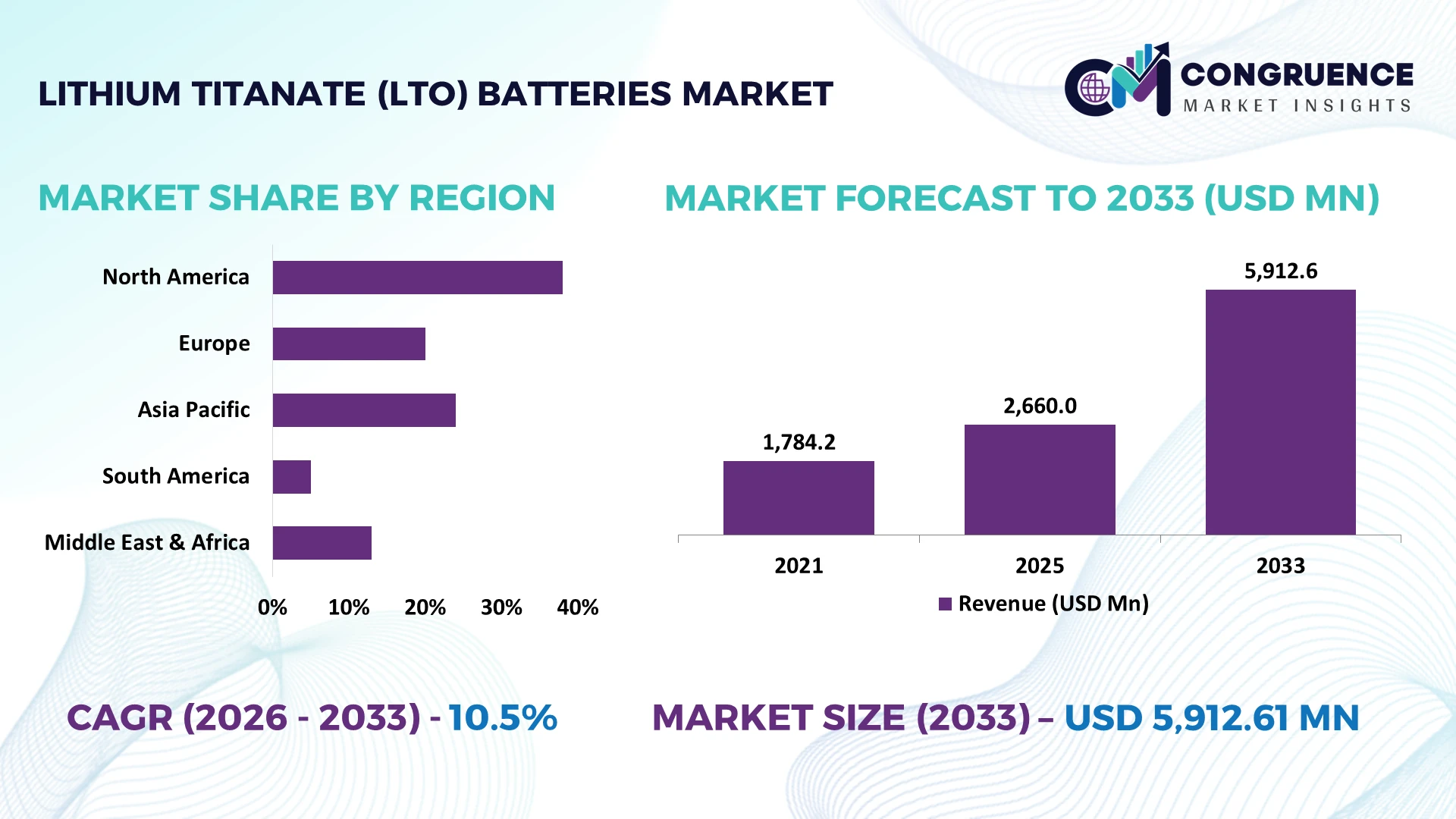
The Global Lithium-Titanate (LTO) Batteries Market was valued at USD 2660 Million in 2025 and is anticipated to reach a value of USD 5912.61 Million by 2033 expanding at a CAGR of 10.5% between 2026 and 2033. Growth is driven by rapid charging requirements in electric buses, industrial energy storage, automated logistics equipment, and grid frequency regulation, supported by LTO battery cycle life exceeding 20,000 cycles in selected commercial applications.
China dominates the global lithium titanate battery industry through established battery manufacturing infrastructure, electric bus electrification, and domestic energy storage deployment. Chinese manufacturers including Gree Altairnano operate in a market where lithium ion batteries account for more than 95% of electric vehicle battery demand. China's 2024 electric car sales exceeded 11 million units, compared with approximately 1.6 million in the United States. Government supported public transport electrification, advanced battery manufacturing investments, and domestic lithium processing strengthen China's competitive position in specialized LTO applications.
Strategically, manufacturers should prioritize applications requiring charging within 10 minutes and operational lifetimes exceeding 15,000 cycles, where durability and asset utilization justify higher initial battery costs.
Market Size & Growth: USD 2,660 million in 2025, reaching USD 5,912.61 million by 2033 at 10.5% CAGR, supported by rapid charging industrial battery systems.
Top Growth Drivers: LTO technology supports approximately 80% charging in 6 to 10 minutes, over 90% capacity retention after thousands of cycles under suitable conditions, and higher fleet utilization.
Short Term Forecast: By 2028, manufacturers targeting a 10% reduction in pack integration costs will strengthen competitiveness in commercial transportation.
Emerging Technologies: Three priorities include AI battery management, automated cell manufacturing, and advanced lithium titanate anode formulations improving power delivery and temperature stability.
Regional Leaders: Indicative 2033 planning allocations place Asia Pacific at USD 3,488.44 million, Europe at USD 1,300.77 million, and North America at USD 827.77 million, reflecting transport electrification, grid storage, and industrial fleet adoption respectively.
Consumer / End User Trends: Commercial operators prioritize battery systems supporting more than 15,000 cycles, particularly for buses, automated guided vehicles, and industrial equipment.
Pilot / Case Example: In 2017, Toshiba introduced its SCiB battery technology demonstrating 90% charging in approximately 6 minutes under specified operating conditions.
Competitive Landscape: Toshiba, Gree Altairnano, Leclanché, Microvast, and Yinlong affiliated battery operations compete through cycle durability, charging performance, and industrial partnerships.
Regulatory & ESG Impact: The European Union requires 70% lithium recovery from waste batteries by the end of 2031, increasing recycling and material recovery priorities.
Investment & Funding: China's battery manufacturing ecosystem benefits from more than USD 230 billion in estimated government support for electric vehicles between 2009 and 2023, strengthening adjacent battery supply chains.
Innovation & Future Outlook: Next generation LTO systems emphasize 20,000 cycle durability, intelligent thermal controls, and modular battery integration for high utilization energy storage.
Lithium titanate batteries are gaining strategic relevance in applications where charging speed, safety, and operating lifetime outweigh energy density limitations. Electric buses, port equipment, railway systems, and grid stabilization facilities benefit from high power performance and frequent charging capabilities. Advanced LTO cells deliver more than 20,000 charge cycles in selected operating conditions, substantially exceeding conventional lithium ion battery durability. Toshiba's SCiB technology and automated battery management platforms demonstrate progress in industrial energy storage integration. China's battery supply chain concentration and Europe's evolving battery sustainability requirements are accelerating procurement diversification, creating opportunities for specialized manufacturers and infrastructure developers.
Lithium Titanate (LTO) batteries are becoming strategically important as transportation electrification, industrial automation, and grid modernization increase demand for rapid charging and extended battery service life. LTO systems support more than 20,000 charging cycles under specified conditions, compared with approximately 2,000 to 5,000 cycles for many conventional lithium ion configurations. This durability changes procurement economics for operators managing continuously utilized assets, encouraging investment in battery longevity rather than maximum energy density.
China maintains a manufacturing advantage through established battery supply chains and electric bus infrastructure, while Japan emphasizes advanced cell engineering through Toshiba's SCiB technology. Europe prioritizes railway electrification and stationary storage integration. LTO batteries can achieve approximately 80% charging within 6 minutes in selected configurations, compared with 30 to 60 minutes for conventional systems under less aggressive charging conditions. During 2026 to 2028, industrial operators are expected to prioritize charging infrastructure upgrades, predictive battery diagnostics, and modular energy storage installations.
Practical deployment in electric buses demonstrates how rapid opportunity charging reduces vehicle downtime and supports intensive daily schedules. Manufacturers are strengthening partnerships with fleet operators, power electronics suppliers, and infrastructure developers to integrate specialized battery systems. Competitive differentiation increasingly depends on lifecycle operating costs, charging reliability, and application specific engineering rather than battery capacity alone.
Commercial fleet electrification is accelerating LTO battery adoption because high frequency charging and extended operating life directly improve vehicle availability. Selected LTO systems support approximately 80% charging within 6 minutes and maintain over 80% capacity after thousands of cycles, depending on operating conditions. China's electric bus electrification programs have established operational demand for batteries capable of repeated charging throughout daily service. LTO chemistry also reduces lithium plating risks associated with aggressive charging, strengthening reliability in intensive duty cycles. Manufacturers including Toshiba and Gree Altairnano are emphasizing advanced cell engineering, battery management integration, and transportation partnerships. Fleet operators consequently gain shorter charging interruptions, improved scheduling flexibility, and reduced battery replacement frequency across heavily utilized vehicles.
LTO batteries face structural disadvantages because their energy density typically ranges between 50 and 100 Wh/kg, compared with approximately 150 to 250 Wh/kg for conventional lithium ion battery packs and cells across selected configurations. This difference creates substantial weight and packaging penalties for passenger electric vehicles requiring extended driving range. LTO anodes also operate at approximately 1.55 volts versus lithium, reducing cell voltage and increasing material requirements per usable kilowatt hour. China's concentrated battery materials processing infrastructure further exposes international manufacturers to procurement dependency and logistics disruptions. Suppliers are responding through localized module assembly, long duration procurement agreements, and application specific pack optimization. Competitive positioning therefore depends on targeting applications where charging frequency and durability compensate for lower energy density.
Grid modernization creates opportunities for LTO batteries in frequency regulation, renewable energy smoothing, and industrial power buffering. Advanced LTO systems can achieve round trip efficiencies approaching 90% to 95% under suitable operating conditions, while high power configurations support repeated charging without the accelerated degradation associated with less suitable chemistries. India's expanding renewable electricity infrastructure creates potential demand for storage technologies capable of frequent cycling and rapid power response. AI enabled battery management platforms offer additional opportunities to optimize state of charge estimation, thermal performance, and maintenance scheduling. Manufacturers are developing modular storage architectures and partnerships with industrial energy management providers. The strategic opportunity lies in monetizing battery throughput and availability rather than maximizing installed energy capacity.
Scaling LTO battery deployments requires coordinated engineering across power electronics, charging infrastructure, thermal management, and digital monitoring systems. High power charging installations operating above 90% conversion efficiency still generate substantial thermal loads during continuous industrial operation. Battery management systems must maintain reliable cell balancing and temperature monitoring across thousands of charging events, while communication compatibility remains essential for integration with existing energy management platforms. Japan's industrial battery manufacturers face demanding qualification requirements for railway, transportation, and stationary storage applications. Companies must invest in standardized interfaces, accelerated lifecycle testing, cybersecurity protection, and specialized engineering capabilities. Long term competitiveness depends on demonstrating predictable degradation, reliable system interoperability, and consistent operating performance across geographically distributed installations.
Advanced Battery Diagnostics Integration: LTO manufacturers are integrating digital monitoring platforms that track cell voltage, temperature, and state of health throughout operational cycles. Selected systems target state of charge estimation errors below 3% and monitoring availability above 99%. Japanese battery suppliers are expanding diagnostic software integration to improve warranty management, reduce unexpected maintenance, and strengthen lifecycle performance verification across industrial battery installations.
Automated Cell Production and Quality: Battery manufacturers are increasing automation across electrode coating, cell assembly, and inspection processes to improve manufacturing consistency. Production optimization programs target defect reductions of 10% to 15% and equipment availability exceeding 90%. Chinese suppliers are strengthening machine vision inspection and automated testing capabilities, reducing manual quality control requirements while improving production traceability and consistency across specialized LTO cell formats.
Battery Traceability and Material Transparency: European battery regulations are accelerating digital product identification and material documentation across industrial battery supply chains. Battery passport requirements beginning in 2027 affect qualifying batteries above 2 kWh, while lithium recovery targets reach 50% by 2027. Manufacturers are preparing serialized component records, supplier verification systems, and lifecycle documentation to improve regulatory readiness and strengthen access to European industrial customers.
Modular Architecture Standardization Across Industries: Equipment manufacturers are increasingly adopting configurable LTO battery modules to simplify maintenance and system replacement. Standardized module platforms target integration time reductions of 15% to 20% and component reuse exceeding 70% across compatible configurations. Suppliers are consolidating enclosure designs, communication interfaces, and service procedures, allowing industrial customers to reduce spare parts inventories while maintaining application specific power configurations.
LTO Battery Packs represent an estimated 35% of the global market, reflecting their suitability for complete energy storage installations requiring integrated battery management, thermal protection, and power distribution. Industrial customers favor assembled packs because standardized electrical interfaces simplify equipment integration and reduce engineering requirements. LTO Battery Modules represent an estimated 25% share and are positioned as the fastest growing type, supported by configurable architectures that enable manufacturers to adjust voltage, capacity, and discharge performance without redesigning complete battery systems. Pack manufacturers are strengthening partnerships with industrial equipment suppliers to improve installation efficiency and expand application compatibility.
LTO Prismatic Cells support compact industrial assemblies where mechanical stability and space utilization are important. LTO Cylindrical Cells benefit from established automated manufacturing processes and consistent thermal characteristics, while LTO Pouch Cells offer flexible packaging for specialized equipment. Manufacturers are prioritizing modular product development, advanced cell balancing, and standardized mechanical interfaces. Investment is shifting toward integrated solutions that reduce customer engineering complexity and improve battery maintenance economics.
Electric Vehicles account for an estimated 38% of LTO battery demand, supported by electric buses, specialized commercial fleets, and transportation equipment requiring frequent charging and extended service life. LTO technology supports charging times below 10 minutes in selected configurations, making it attractive for intensive transportation schedules where conventional charging interruptions reduce operational productivity. Grid Energy Storage is positioned as the fastest growing application, particularly for installations requiring frequent cycling, rapid response, and sustained power delivery. Manufacturers are developing application specific control systems and power conversion interfaces to improve deployment reliability.
Industrial Backup Power maintains relevance in facilities requiring dependable short duration energy delivery and repeated discharge capability. Renewable Energy Storage increasingly emphasizes battery durability under variable operating conditions, while Fast Charging Systems benefit from LTO technology's high charge acceptance. Railway Energy Storage supports regenerative braking recovery and onboard auxiliary power applications. Japanese manufacturers are emphasizing transportation reliability, while Chinese suppliers are expanding integrated battery solutions. Competitive investment is concentrating on high utilization applications where operating lifetime and charging availability outweigh energy density disadvantages.
Automotive Manufacturers represent an estimated 40% of LTO battery demand, supported by electric bus production, commercial vehicle electrification, and specialized transportation platforms. Procurement decisions emphasize charging availability, battery durability, and predictable maintenance requirements. LTO systems offering more than 15,000 charging cycles under suitable operating conditions provide an operational advantage for vehicles with intensive daily utilization. Manufacturers are strengthening relationships with battery technology developers to customize pack configurations, thermal controls, and charging interfaces for commercial vehicle platforms.
Utility Companies represent the fastest growing end user category as electricity networks expand flexible power infrastructure and require storage systems capable of frequent charging and discharging. Industrial Facilities maintain demand for reliable backup systems, automated equipment, and high power industrial operations. Renewable Energy Operators increasingly evaluate LTO batteries for installations prioritizing cycle durability and rapid response over maximum energy capacity. Suppliers are responding through specialized engineering services, modular product portfolios, and maintenance agreements. Competitive positioning increasingly depends on matching battery performance to customer duty cycles and demonstrating measurable reductions in equipment downtime.
Asia Pacific accounted for the largest market share at an estimated 59% in 2025 however, Asia Pacific is expected to register the fastest growth, expanding at a CAGR of approximately 12.2% between 2026 and 2033.
Industrial Electrification and Specialized Energy Storage Deployment
North America represents an estimated 14% of the global Lithium Titanate Batteries Market, supported by industrial automation, transportation electrification, and specialized energy storage infrastructure. The United States accounts for the largest regional demand concentration, particularly across industrial equipment, commercial transportation, and mission critical power applications. LTO battery systems delivering more than 15,000 charging cycles offer operational advantages in facilities requiring frequent power delivery and predictable maintenance schedules. Canada's electrified transportation programs and industrial equipment manufacturing capabilities provide additional deployment opportunities. Battery suppliers are strengthening relationships with power electronics manufacturers and industrial integrators to improve system compatibility. The United States Inflation Reduction Act established production incentives for qualifying battery components, encouraging domestic manufacturing investment. Regional competition increasingly centers on lifecycle economics, application engineering, and reliable access to specialized battery materials.
United States Market Outlook: The United States benefits from advanced industrial automation infrastructure, transportation electrification programs, and established battery research capabilities. The Department of Energy's battery development initiatives support domestic manufacturing and technology diversification. Federal battery production incentives include a potential USD 35 per kWh credit for qualifying battery cells, strengthening the economics of localized production. Industrial equipment manufacturers increasingly evaluate LTO technology for applications where battery replacement downtime creates substantial operating costs.
Battery Sustainability Regulations and Transportation Infrastructure Modernization
Europe holds an estimated 22% share of the global LTO battery market, supported by railway modernization, industrial electrification, and advanced battery engineering. Germany, France, and the United Kingdom represent important deployment centers for specialized transportation and industrial storage systems. European battery regulations require qualifying industrial batteries above 2 kWh to carry digital battery passports beginning in 2027, increasing demand for traceability and lifecycle documentation. LTO batteries offering extended cycling durability support applications where replacement frequency and maintenance accessibility influence procurement decisions. European manufacturers are emphasizing modular battery architectures, standardized monitoring interfaces, and specialized power electronics integration. Railway energy recovery systems and industrial backup installations provide differentiated commercial opportunities. Battery suppliers are also strengthening material documentation and recycling partnerships to satisfy increasingly demanding procurement requirements across regulated industrial applications.
Germany Market Outlook: Germany maintains a strong position through automotive engineering, railway technology, and industrial automation capabilities. Its established manufacturing ecosystem supports specialized battery integration into factory equipment and transportation infrastructure. German railway modernization programs create opportunities for batteries capable of absorbing repeated regenerative braking energy. The country's objective of achieving 80% renewable electricity consumption by 2030 also strengthens the strategic importance of flexible power infrastructure and durable industrial storage technologies.
Manufacturing Scale and High Utilization Battery Applications
Asia Pacific commands an estimated 59% of the global LTO battery market, supported by China's battery manufacturing concentration, Japan's advanced cell technology, and expanding industrial electrification across India and South Korea. China maintains substantial manufacturing advantages through integrated electrode processing, battery assembly, and commercial vehicle production. Japanese manufacturers emphasize high reliability applications, including railway systems and industrial equipment requiring rapid charging. Toshiba's SCiB battery technology demonstrates charging capabilities reaching approximately 80% within 6 minutes under specified conditions. China's electric vehicle ecosystem recorded more than 11 million electric car sales in 2024, supporting extensive battery supply chain development. Regional suppliers are investing in automated manufacturing, specialized cell formats, and industrial integration partnerships. Competitive differentiation increasingly depends on converting established production capabilities into durable, application specific battery systems rather than competing solely on manufacturing volume.
China Market Outlook: China dominates specialized LTO manufacturing through established battery producers, domestic material processing, and extensive commercial transportation infrastructure. Gree Altairnano has developed LTO battery systems for electric buses and industrial applications. China's electric car sales represented more than 40% of domestic car sales in 2024, illustrating the scale of its electrification ecosystem. Domestic manufacturers benefit from established component sourcing, integrated battery engineering, and proximity to commercial vehicle assembly operations.
Commercial Fleet Electrification and Industrial Power Reliability
South America represents an estimated 3% of the global LTO battery market, with demand concentrated in Brazil, Chile, and selected industrial transportation applications. Electric bus electrification and mining equipment modernization create opportunities for batteries capable of frequent charging and extended operational service. Chile's established electric bus ecosystem demonstrates regional commitment to transportation electrification, while Brazil's automotive manufacturing infrastructure supports specialized battery integration. LTO technology offers advantages for industrial vehicles operating under demanding schedules, although higher initial equipment costs and limited specialized charging infrastructure constrain broader adoption. Battery suppliers are prioritizing partnerships with transportation operators, industrial distributors, and engineering integrators rather than establishing extensive dedicated production facilities. Regional procurement increasingly emphasizes maintenance requirements, charging availability, and equipment utilization, particularly in industrial operations where unplanned downtime directly affects productivity.
Brazil Market Outlook: Brazil provides the region's strongest industrial manufacturing foundation through automotive production, mining operations, and established electrical equipment suppliers. São Paulo's transportation electrification initiatives create opportunities for specialized battery systems in commercial fleets. Brazil produced approximately 2.55 million motor vehicles in 2024, demonstrating its manufacturing scale. Battery suppliers can leverage existing automotive component networks and industrial service providers to support localized assembly, maintenance, and specialized energy storage deployment.
Infrastructure Diversification and Industrial Energy Resilience
The Middle East and Africa account for an estimated 2% of global LTO battery demand, supported by infrastructure modernization, industrial electrification, and specialized power reliability requirements. Saudi Arabia and the United Arab Emirates are expanding industrial development programs that create opportunities for durable energy storage technologies. Mining operations, transportation infrastructure, and industrial automation represent potential deployment environments where repeated charging and dependable power delivery are operational priorities. LTO batteries can operate across demanding temperature conditions when supported by appropriate thermal management systems. Regional procurement remains concentrated in specialized industrial projects rather than mass market transportation applications. Suppliers are pursuing engineering partnerships, system integration agreements, and maintenance service networks to overcome limited local battery manufacturing capacity. Investment priorities increasingly favor installations demonstrating measurable operational reliability and reduced equipment replacement requirements.
Saudi Arabia Market Outlook: Saudi Arabia offers significant industrial opportunities through Vision 2030 infrastructure development, manufacturing diversification, and renewable energy expansion. The National Industrial Development and Logistics Program supports investment in industrial technology and logistics infrastructure. Saudi Arabia targets approximately 50% renewable electricity generation by 2030, creating a broader market for energy storage technologies. Specialized LTO applications are particularly relevant to industrial logistics, transportation facilities, and high frequency power systems requiring reliable operation under demanding environmental conditions.
The global Lithium Titanate Batteries Market features competition between Japanese technology specialists, Chinese manufacturing leaders, and diversified battery system suppliers. Toshiba competes through SCiB cell engineering, while Gree Altairnano emphasizes commercial transportation and industrial storage integration. Leclanché, Microvast, and Echion Technologies target specialized applications through battery architecture, advanced materials, and engineering partnerships. The five leading suppliers collectively represent an estimated 55% of specialized LTO market activity. Competition centers on charging performance, cycle durability, integration flexibility, and manufacturing efficiency. Selected LTO systems achieve approximately 80% charging within 6 minutes, while advanced configurations target more than 20,000 operating cycles. Manufacturers are expanding automated production, strengthening equipment partnerships, and developing application specific battery modules. Supply chain integration and qualification requirements create barriers for emerging suppliers. Chinese production scale challenges Japanese technology differentiation, while European specialists emphasize customized industrial solutions. Competitive success requires validated durability, dependable manufacturing capacity, and superior lifecycle operating economics.
Toshiba Corporation
Gree Electric Appliances, Inc. (Gree Altairnano)
Leclanché SA
Microvast Holdings, Inc.
Echion Technologies Ltd.
Amperex Technology Limited (ATL)
Nichicon Corporation
GS Yuasa Corporation
LTO Energy Co., Ltd.
Zenaji Pty Ltd.
Tianneng Battery Group Co., Ltd.
Lithium Werks B.V.
Current LTO battery technology emphasizes rapid charge acceptance, thermal stability, and extended cycle durability. Toshiba SCiB cells demonstrate approximately 80% charging within 6 minutes under specified conditions, while advanced configurations support more than 20,000 cycles. Compared with conventional lithium ion systems requiring 30 minutes for comparable charging, specialized LTO technology reduces charging duration by approximately 80%. Intelligent battery management improves voltage balancing, temperature monitoring, and operational reliability, benefiting electric bus manufacturers and industrial equipment operators.
Emerging technologies include advanced electrode coatings, automated cell inspection, and predictive battery diagnostics. AI enabled monitoring platforms target state of charge estimation accuracy exceeding 97%, while manufacturing automation programs pursue defect reductions of 10% to 15%. Modular battery architectures simplify integration into railway equipment, industrial machinery, and specialized transportation systems. Manufacturers investing in standardized electrical interfaces gain advantages through reduced engineering complexity, faster maintenance, and improved component interchangeability.
Disruptive developments increasingly combine LTO chemistry with digital twins, intelligent power electronics, and adaptive thermal management. During 2026 to 2028, suppliers are expected to prioritize automated qualification, predictive maintenance, and configurable battery modules. These technologies strengthen lifecycle economics, improve deployment consistency, and differentiate manufacturers competing for intensive industrial applications where battery availability determines equipment productivity and procurement decisions.
April 2025: Toshiba launched its SCiB battery module featuring approximately twice the heat dissipation performance of earlier modules. The aluminum baseplate supports sustained power delivery in electric buses, ships, and stationary storage, improving thermal management and operational reliability. Source: toshiba.com
September 2024: Leclanché introduced the XN50 cell incorporating Echion Technologies' niobium based XNO anode, offering more than 10,000 cycles. This alternative to conventional LTO chemistry strengthens battery options for railway, maritime, and mining equipment requiring durable power systems. Source: leclanche.com
November 2024: Echion Technologies and CBMM inaugurated a niobium anode manufacturing facility in Brazil, providing 2,000 tonnes of annual production capacity. The expansion strengthens industrial battery material supply chains and supports commercialization of advanced fast charging technologies. Source: argusmedia.com
October 2024: Toshiba partnered with Rinko Bus and Drive Electro Technology to develop an electric bus demonstration using approximately 10 minute pantograph charging. The project targets improved vehicle utilization and reduced charging interruptions in Japanese urban transportation. Source: automotive-technology.com
The Lithium Titanate Batteries Market Report evaluates industry developments across LTO Pouch Cells, Prismatic Cells, Cylindrical Cells, Battery Modules, and Battery Packs. Application coverage includes Electric Vehicles, Grid Energy Storage, Industrial Backup Power, Renewable Energy Storage, Fast Charging Systems, and Railway Energy Storage. End user analysis examines Automotive Manufacturers, Utility Companies, Industrial Facilities, and Renewable Energy Operators. The report assesses five major regions, identifying manufacturing concentration, deployment patterns, infrastructure requirements, and specialized industrial applications.
Technology coverage examines advanced anode materials, intelligent battery management, thermal optimization, and modular integration. Competitive analysis evaluates supplier positioning, manufacturing capabilities, strategic partnerships, and commercialization priorities. With advanced LTO systems supporting more than 20,000 charging cycles, the report identifies investment opportunities in high utilization equipment and specialized energy storage. Its 2026 to 2033 outlook supports capacity planning, geographic expansion, procurement strategy, and technology investment decisions.
| Report Attribute/Metric | Report Details |
|---|---|
Market Revenue in 2025 | USD 2660 Million |
Market Revenue in 2033 | USD 5912.61 Million |
CAGR (2026 - 2033) | 10.5% |
Base Year | 2025 |
Forecast Period | 2026 - 2033 |
Historic Period | 2021 - 2025 |
Segments Covered | By Type
By Application
By End-User
|
Key Report Deliverable | Revenue Forecast, Growth Trends, Market Dynamics, Segmental Overview, Regional and Country-wise Analysis, Competition Landscape |
Region Covered | North America, Europe, Asia-Pacific, South America, Middle East, Africa |
Key Players Analyzed | Toshiba Corporation, Gree Electric Appliances, Inc. (Gree Altairnano), Leclanché SA, Microvast Holdings, Inc., Echion Technologies Ltd., Amperex Technology Limited (ATL), Nichicon Corporation, GS Yuasa Corporation, LTO Energy Co., Ltd., Zenaji Pty Ltd., Tianneng Battery Group Co., Ltd., Lithium Werks B.V. |
Customization & Pricing | Available on Request (10% Customization is Free) |




