
Reports
The Global Lithium Tantalate Crystal Market was valued at USD 170.0 Million in 2025 and is anticipated to reach a value of USD 232.3 Million by 2033 expanding at a CAGR of 3.98% between 2026 and 2033. Growth is driven by 5G radio-frequency filtering, wider adoption of surface acoustic wave devices, and migration toward lithium-tantalate-on-insulator platforms for advanced photonic and high-speed communication applications.
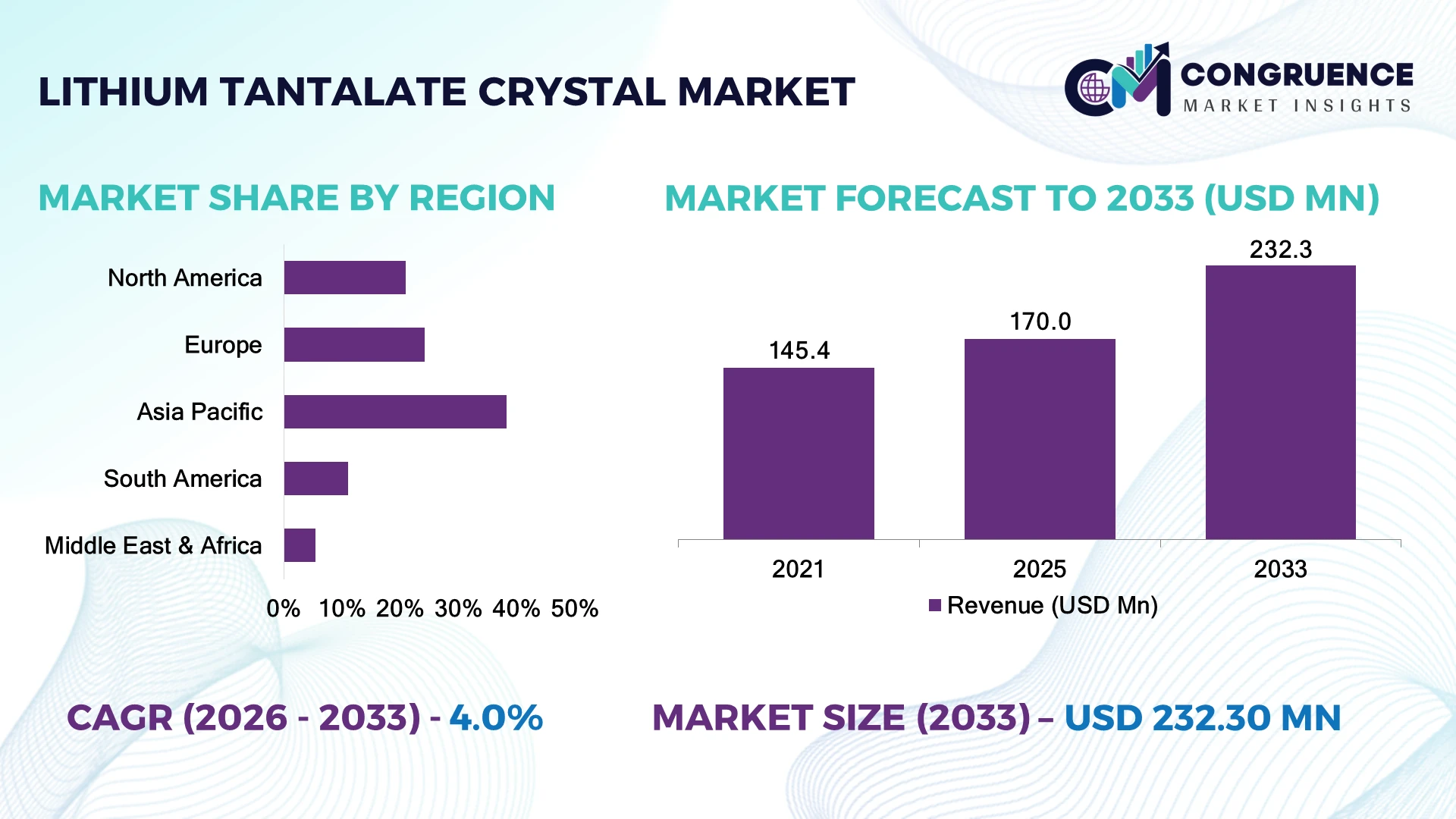
China holds a leading position across the lithium tantalate ecosystem, supported by extensive 5G infrastructure, semiconductor fabrication, and electronics manufacturing, while Japan maintains strong crystal-growth and wafer-processing capabilities. SAW devices represented about 57% of application demand, with Asia-Pacific accounting for approximately 37% of market contribution. China’s electronics scale exceeds Japan’s, while Japan retains an advantage in precision wafer processing. The geopolitical push for semiconductor supply-chain localization further strengthens domestic capacity investment.
Strategically, suppliers that combine high-purity crystal growth, larger wafer formats, and localized processing capacity will secure stronger positions in telecom and advanced electronics value chains.
Market Size & Growth: Market value rises from USD 170.0 million in 2025 to USD 232.3 million by 2033 at a 3.98% CAGR, driven by 5G SAW filters and advanced RF architectures.
Top Growth Drivers: 5G filtering contributes 1.8%, IoT sensor adoption 1.2%, and quartz-to-lithium-tantalate migration 0.9% to growth momentum.
Short-Term Forecast: By 2028, near-stoichiometric crystal adoption is positioned to improve filter temperature stability by 21.18% while insertion loss falls 7.3%.
Emerging Technologies: LTOI photonics, AI-enabled optical interconnects, and advanced thin-film acoustic devices are expanding lithium tantalate applications beyond conventional SAW filters.
Regional Leaders: Asia-Pacific approaches USD 85 million by 2033, North America exceeds USD 55 million, and Europe approaches USD 42 million, supported respectively by 5G, secure electronics, and photonics deployment.
Consumer/End-User Trends: Telecommunications accounts for nearly 48% of end-use demand, reflecting rising filter requirements in smartphones, base stations, and connected devices.
Pilot/Case Example: In 2024, near-stoichiometric wafers delivered a 21.18% reduction in temperature coefficient and 7.3% lower insertion loss in SAW filters.
Competitive Landscape: The top five suppliers control approximately 55% of market value, with Sumitomo Metal Mining, Shin-Etsu Chemical, Murata, TDK, and Taiyo Yuden competing through precision processing and capacity expansion.
Regulatory & ESG Impact: Semiconductor localization programs increasingly direct incentives toward domestic materials capacity, with selected Chinese programs covering up to 20% of eligible capital expenditure.
Investment & Funding: Advanced crystal and wafer programs are directing tens of millions of dollars toward larger-diameter processing, photonics integration, and regional supply-chain localization.
Innovation & Future Outlook: LTOI platforms, 6G-ready RF architectures, and near-stoichiometric crystals are shifting competition toward higher-performance materials, tighter defect control, and vertically integrated manufacturing.
Lithium tantalate crystals are gaining traction across RF filters, optical modulators, infrared sensing, and advanced photonic devices, with SAW/filter applications representing about 57% of demand. Thin-film LTOI architectures are extending the material into high-speed optical computing and data-center connectivity. Supply-chain localization across China, Japan, and other Asian electronics hubs is increasingly influencing procurement and capacity decisions.
Lithium tantalate has become strategically important because RF front-end complexity, photonic bandwidth requirements, and semiconductor localization are increasing the value of precision piezoelectric substrates. More than 60 communication frequency bands are associated with 5G architectures, increasing filter density and reinforcing demand for high-quality crystal wafers. The shift from conventional telecom components toward integrated photonics is also broadening the addressable technology base.
Material engineering is creating measurable performance advantages. Near-stoichiometric lithium tantalate wafers have demonstrated a 21.18% reduction in temperature coefficient of frequency and a 7.3% reduction in insertion loss versus conventional material. Japan emphasizes precision crystal growth and wafer processing, while China prioritizes high-volume semiconductor and telecom manufacturing. India is emerging as a faster-expanding electronics manufacturing location.
Over the next 2–3 years, suppliers will prioritize 150 mm-class processing, defect reduction, LTOI integration, and qualified domestic supply. Companies are strengthening partnerships across crystal growth, wafer fabrication, and RF-device manufacturing rather than relying on standalone material sales. This integrated approach provides greater yield control, shorter qualification cycles, and stronger supply assurance, making process depth a decisive competitive advantage.
The expansion of 5G is increasing lithium tantalate consumption because advanced handsets and radio units require more compact, wider-band RF filtering. SAW devices represented about 57% of application demand, while telecommunications accounted for nearly 48% of end-use demand. 5G architectures support more than 60 communication bands, increasing filter complexity versus earlier generations. Japan is expanding precision wafer capabilities while Chinese manufacturers scale domestic processing to support telecom supply chains. Companies are responding with larger wafer formats, improved crystal orientation control, and near-stoichiometric material development. The strategic advantage is shifting from crystal availability toward yield, defect density, and RF performance consistency, making process optimization as important as production capacity.
Lithium tantalate production remains exposed to raw-material volatility and technically demanding crystal growth. Crystal twinning and defect formation can reduce usable boule output, while tantalum supply chains remain vulnerable to geopolitical disruption. Production economics therefore depend heavily on yield optimization, with high-quality wafer processing requiring tight orientation and surface specifications. Asia-Pacific controls approximately 37% of market contribution in one market assessment, concentrating processing activity in a relatively limited industrial base. Japanese producers emphasize precision and quality, whereas Chinese manufacturers increasingly focus on localized volume production. Companies are reducing exposure through multi-source procurement, long-term material contracts, process automation, and domestic wafer processing. The operational priority is improving usable crystal yield rather than simply increasing furnace capacity.
LTOI technology is opening a high-value pathway beyond traditional acoustic devices by enabling lithium tantalate in photonic integrated circuits, optical communications, and AI infrastructure. Near-stoichiometric materials already demonstrate 7.3% lower insertion loss and 21.18% lower temperature sensitivity in SAW testing, supporting broader performance optimization. India’s electronics ecosystem is also becoming attractive as semiconductor and telecommunications manufacturing expands. Companies are investing in thin-film transfer, wafer bonding, and photonic integration partnerships to capture applications in high-speed optical links and data centers. The non-obvious opportunity lies in leveraging lithium tantalate’s established 5G manufacturing ecosystem to reduce the commercialization barrier for photonic devices. This cross-application manufacturing advantage can accelerate adoption while improving equipment utilization.
The central long-term challenge is scaling crystal quality and wafer uniformity without compromising manufacturing economics. Advanced RF and photonic applications demand tight crystallographic orientation, low defect density, controlled thickness, and consistent surface quality across larger wafers. Current 150 mm processing remains more established than larger formats, while next-generation applications increasingly require tighter process windows. Wafer-level packaging and thin-film bonding also introduce integration complexity across fabrication stages. Companies must invest in automated metrology, real-time process monitoring, workforce specialization, and joint qualification programs with RF and photonic-device manufacturers. The operational pressure is particularly high as supply chains diversify beyond established Japanese production hubs. Competitive sustainability will depend on achieving repeatable high-yield production while maintaining stringent electronic and optical performance.
Acoustic Grade Capacity Scaling: Acoustic-grade crystals continue to dominate procurement, reaching about 60.4% share in 2025, as SAW-filter manufacturers increase wafer throughput for wireless devices. Japanese producers are emphasizing precision crystal growth, while Chinese manufacturers expand high-volume slicing. This shift improves supply responsiveness and supports tighter defect-control targets as telecom qualification cycles become more demanding.
Thin-Film Processing Acceleration: Thin-film lithium tantalate is moving from specialized development toward commercial photonic and sensor workflows. Sub-100-micron wafers represented about 8% of shipments in 2024, while advanced facilities improved manufacturing yields from roughly 85% to 92%. Companies are investing in wafer bonding, thin-film transfer, and automated metrology to reduce material waste and improve device-level consistency.
Optical Applications Diversifying: Optical-grade material is gaining share as electro-optic and nonlinear-optics applications broaden beyond conventional RF components. Optical-grade crystals represented approximately 33.3% of 2025 demand, while electro-optic modulators accounted for about 19.8% of application demand. Suppliers are increasingly tailoring crystal homogeneity, surface quality, and orientation for high-speed optical systems rather than relying solely on standard bulk specifications.
Supply Chains Localize Further: Tantalum-related sourcing pressure and semiconductor localization policies are encouraging manufacturers to shorten qualification and procurement chains. China and Japan remain important production hubs, while U.S. trade measures on Chinese critical minerals introduced additional sourcing pressure in 2026. Companies are responding through multi-source contracts, regional processing, and inventory buffers, making supply assurance increasingly important alongside crystal performance.
Acoustic Grade remains the leading type, accounting for approximately 60.4% of the global market in 2025. Its dominance reflects established use in SAW filters, resonators, and frequency-control components where precise crystallographic orientation, low acoustic loss, and stable piezoelectric behavior are essential. Optical Grade follows at about 33.3%, serving electro-optic and nonlinear optical applications that require higher optical homogeneity. Other Types represent roughly 6.4% and remain concentrated in specialized research and lower-volume applications. The mature Acoustic Grade segment benefits from established manufacturing infrastructure and repeat telecom procurement, while Optical Grade is gaining strategic importance as photonic systems expand.
Optical Grade represents the faster-moving investment area because manufacturers increasingly require tighter defect specifications and application-specific material characteristics. Companies are expanding precision processing, wafer inspection, and customized crystal engineering rather than competing only on bulk volume. The resulting investment shift favors suppliers capable of serving both high-volume acoustic requirements and higher-value optical specifications.
SAW Filters lead the application landscape with approximately 45.0% share in 2025, reflecting extensive deployment in mobile communications, RF filtering, and wireless infrastructure. Pyroelectric/IR Detectors follow at about 25.4%, supported by infrared sensing and thermal-detection requirements, while Electro-Optic Modulators account for nearly 19.8%. Nonlinear Optics remains smaller at approximately 9.9%, but its specialized role in frequency conversion and advanced optical systems gives it strategic value. The concentration in SAW Filters provides suppliers with predictable volume, whereas optical applications generate higher specification requirements and more customized procurement.
Electro-Optic Modulators represent the faster-evolving application as high-speed optical communications demand tighter modulation performance and integrated photonic architectures. Companies are responding by improving wafer uniformity, expanding thin-film processing, and developing partnerships across crystal growth and photonic-device fabrication. The business implication is a gradual shift from commodity-oriented crystal supply toward application-qualified materials with stronger margins and longer customer qualification cycles.
Telecom represents the leading end-user group, accounting for approximately 47.9% of market demand, supported by 5G infrastructure, mobile-device RF filtering, and communication-system upgrades. Electronics is the second major buyer category, benefiting from frequency-control components, sensors, and optical devices embedded in high-volume equipment. Defense and Research represent smaller but strategically important segments, where procurement emphasizes customized crystal specifications, reliability, and optical performance rather than volume alone. Telecom therefore provides scale and recurring demand, while specialized buyers support higher-value product development.
Defense is among the faster-expanding specialized end-user groups as governments increase spending on advanced sensing, communications, and electro-optic systems. Research institutions are also pushing customized crystal geometries and higher-purity materials for emerging photonic applications. Companies are responding with differentiated product lines, technical partnerships, and application-specific qualification programs. The competitive shift favors suppliers that can maintain telecom-scale production while supporting lower-volume, high-specification defense and research orders.
Asia-Pacific accounted for the largest market share at 38.3% in 2025 however, Europe is expected to register the fastest growth, expanding at a CAGR of 5.19% between 2026 and 2033.
North America represented approximately 21.0% of global lithium tantalate crystal demand in 2025, with the United States accounting for the overwhelming share of regional consumption. Demand is concentrated around telecommunications, defense electronics, RF components, and advanced photonics rather than high-volume crystal manufacturing. U.S. defense and semiconductor programs are increasing emphasis on qualified domestic and allied suppliers as supply-chain security becomes a procurement criterion. A U.S. fabrication retrofit scheduled for 2026 is positioned to process approximately 100,000 wafers annually, strengthening domestic downstream capability. Suppliers are responding through qualification partnerships, wafer-processing investments, and inventory diversification. The region's strategic advantage lies less in raw crystal volume and more in high-value device integration, defense qualification, and technology-intensive applications.
United States Market Outlook: The United States remains the region's primary demand center because of its semiconductor, aerospace, defense, and telecommunications ecosystem. Federal semiconductor localization initiatives are encouraging domestic materials qualification, while defense procurement increasingly prioritizes secure sourcing. The country's strong photonics research base also supports adoption of higher-specification lithium tantalate for modulators, sensing, and RF applications.
Europe held approximately 24.2% of global lithium tantalate crystal demand in 2025, making it the second-largest regional market. Germany, the United Kingdom, and France account for a substantial portion of regional activity, supported by photonics, aerospace, industrial sensing, automotive electronics, and optical communications. European demand increasingly favors application-qualified material with tight surface specifications and consistent optical performance. Germany alone represented approximately 34.3% of the European market in 2025, reflecting its strong photonics and advanced-manufacturing base. European manufacturers are also aligning production with resource-efficiency requirements and tighter chemical-management expectations. Companies are expanding R&D partnerships, strengthening wafer-processing capabilities, and targeting LTOI applications where precision provides greater value than commodity-scale production.
Germany Market Outlook: Germany is Europe's most strategically significant market, supported by advanced photonics research, industrial automation, automotive electronics, and precision optical manufacturing. Its approximately 34.3% European share gives domestic suppliers and downstream users substantial influence over specification standards and procurement. Strong industrial R&D capabilities support the transition toward higher-performance lithium tantalate substrates for optical and sensing applications.
Asia-Pacific commanded approximately 38.3% of global demand in 2025, with China, Japan, and South Korea forming the core manufacturing and downstream consumption network. The region benefits from vertically connected crystal growth, wafer processing, RF-component manufacturing, telecommunications equipment, and consumer-electronics assembly. China is expanding domestic crystal and wafer capabilities, while Japan retains an important position in high-precision crystal growth and processing. Provincial incentives in China have supported advanced crystal-production investments covering up to 20% of eligible capital expenditure. Companies are increasing automation, larger-wafer development, and domestic sourcing to shorten lead times and reduce exposure to external supply disruptions. The region's key advantage is the ability to move rapidly from material qualification to high-volume electronic-component production.
China Market Outlook: China represents the most strategically significant country because of its scale across telecommunications, electronics manufacturing, semiconductor materials, and RF components. Domestic suppliers are increasing crystal-growth and wafer-processing capabilities to reduce import dependence. Government-backed semiconductor investment and extensive 5G infrastructure provide a large downstream qualification base, while localized production improves lead-time control for high-volume customers.
South America accounted for approximately 11.1% of global lithium tantalate crystal demand in 2025, with Brazil representing the principal market. Demand remains concentrated in telecommunications, industrial inspection, medical infrared systems, research, and specialized defense applications rather than large-scale crystal manufacturing. Regional penetration remains below 5% in several specialized downstream applications because of currency volatility, smaller equipment budgets, and limited local wafer-processing infrastructure. Brazil's expanding telecommunications infrastructure and industrial automation programs are creating selective procurement opportunities, while local research institutions support optical and sensing applications. Companies are primarily using distributor partnerships, application-specific imports, and technical collaborations instead of establishing full crystal-growth facilities. The strategic opportunity is therefore downstream integration, where localized testing and device assembly can capture more value without requiring capital-intensive crystal production.
Brazil Market Outlook: Brazil is the region's most significant market because of its comparatively large electronics base, telecommunications infrastructure, industrial automation activity, and defense-related sensing requirements. Optical and infrared applications are particularly relevant to specialized users. Local certification and testing requirements can favor suppliers capable of providing technical documentation, compliance support, and application engineering alongside imported crystal and wafer products.
Middle East & Africa represented approximately 5.4% of global lithium tantalate crystal demand in 2025, making it the smallest major regional market but an increasingly specialized demand center. Saudi Arabia, the UAE, South Africa, and Egypt account for much of regional activity across defense optics, telecommunications, research, and industrial sensing. Saudi Arabia represented approximately 34.9% of regional demand in 2025, supported by defense-oriented optical systems, while the UAE accounted for about 25.4% as telecom and advanced-technology investment expanded. Limited local wafer processing means imports remain dominant, creating procurement sensitivity around delivery reliability and qualification. Companies are responding through regional distribution agreements, strategic inventory, and partnerships with defense and telecommunications integrators rather than broad manufacturing expansion.
Saudi Arabia Market Outlook: Saudi Arabia leads regional demand through defense modernization, electro-optic systems, telecommunications infrastructure, and technology-localization initiatives. Its approximately 34.9% regional share demonstrates the concentration of advanced-material procurement in government-linked and defense-oriented programs. Suppliers with secure logistics, technical qualification support, and long-term contracts are better positioned than volume-focused distributors as procurement increasingly emphasizes supply assurance.
Global lithium tantalate crystal competition is led by Shin-Etsu Chemical, Sumitomo Metal Mining, Korth Kristalle, Oxide Corporation, and Crystalwise Technology, with Japanese leaders competing against European and Asian specialists on crystal quality, wafer scale, and delivery reliability. The top five players are estimated to control about 55% of the market, indicating a moderately concentrated structure. Technology accounts for roughly 40% of competitive differentiation, while supply-chain reliability contributes about 30% and customization around 20%. Shin-Etsu and Sumitomo emphasize vertically integrated crystal growth and wafer processing; Korth and Oxide compete through precision materials, while Crystalwise targets application-specific supply. Competition is shifting toward larger wafers, near-stoichiometric materials, thin-film processing, and localized sourcing. Entry barriers remain high because crystal-growth expertise, defect control, qualification cycles, and wafer processing constrain new suppliers. The pressure point is balancing output with cost discipline. Winning requires yield, wafer consistency, secure feedstock, customization, and partnerships with RF and photonic-device manufacturers.
Shin-Etsu Chemical Co., Ltd.
Sumitomo Metal Mining Co., Ltd.
Korth Kristalle GmbH
Oxide Corporation
Crystalwise Technology, Inc.
Castech Inc.
MTI Corporation
United Crystal
XIMEI Resources Holding Limited
Mitsui Kinzoku Co., Ltd.
TDK Corporation
Murata Manufacturing Co., Ltd.
Thin-film lithium tantalate on insulator (LTOI) is the most disruptive technology for 2026–2028. Conventional bulk lithium tantalate remains dominant in SAW filters, while LTOI enables compact photonic integrated circuits, optical modulators, and nonlinear devices. Demonstrated LTOI photonic circuits achieve optical loss of 5.6 dB/m and electro-optic bandwidth up to 40 GHz, establishing a performance pathway beyond legacy platforms. Commercial adoption is still emerging, but the technology is moving from laboratory fabrication toward scalable wafer processing.
Near-stoichiometric crystal engineering is improving material consistency for demanding RF and photonic applications. Compared with conventional compositions, optimized crystals can reduce temperature sensitivity by about 21%, while improved processing can lower insertion loss by roughly 7%. Automated metrology, wafer bonding, deep-ultraviolet patterning, and defect inspection are becoming integrated into production workflows. These changes improve yield control, shorten qualification cycles, and reduce scrap exposure, benefiting suppliers that operate precision wafer infrastructure.
From 2026 to 2028, the competitive advantage will shift toward suppliers combining crystal growth, thin-film transfer, and device-level qualification. Japan-based materials specialists benefit from established SAW manufacturing, while Chinese photonics and semiconductor ecosystems gain from volume-oriented processing. Companies that commercialize LTOI through partnerships, process-design kits, and larger-wafer manufacturing will capture photonic demand faster than suppliers relying on bulk-crystal sales.
March 2026 Mitsui Kinzoku invested in Gaianixx to commercialize advanced single-crystal lithium tantalate and lithium niobate thin films using spin-coating technology. The collaboration, begun in April 2025, targets functional wafers and next-generation communication devices, accelerating commercialization from 2026. Source: mitsui-kinzoku.com
September 2025 Sumitomo Metal Mining reported productivity improvements in its crystal-materials business through Toyota Production System deployment, equipment optimization, and automation. Customer certification was targeted for FY2025, strengthening production efficiency and supporting higher consistency for lithium tantalate substrates. Source: smm.co.jp
July 2025 Shin-Etsu Chemical continued positioning lithium tantalate within its Advanced Materials portfolio, maintaining 4-inch and 6-inch crystal and wafer availability. Its integrated Czochralski growth-to-wafer processing model supports stable SAW-filter supply and strengthens qualification control for communications applications. Source: shinetsu.co.jp
April 2025 XIMEI Resources highlighted lithium-tantalate photonic integrated circuits delivering optical loss as low as 5.6 dB/m and electro-optical bandwidth up to 40 GHz. The performance supports optical communications, strengthening the case for lithium tantalate beyond RF applications. Source: hkexnews.hk
The Lithium Tantalate Crystal Market Report provides structured coverage of Acoustic Grade, Optical Grade, and Other Types, alongside SAW Filters, Pyroelectric/IR Detectors, Electro-Optic Modulators, and Nonlinear Optics. End-user analysis spans Telecom, Electronics, Defense, and Research, with assessment of mature demand centers and emerging application niches. Regional coverage includes North America, Europe, Asia-Pacific, South America, and Middle East & Africa, supported by country-level analysis.
The report evaluates crystal growth, wafer processing, near-stoichiometric materials, thin-film lithium tantalate, LTOI photonics, precision metrology, and advanced RF technologies. With the leading application representing about 45% of demand and telecom accounting for roughly 48%, the study identifies concentration points and diversification opportunities. Competitive analysis covers key manufacturers, technology positioning, supply-chain strategies, partnerships, and expansion priorities, supporting investment planning, market entry, capacity decisions, competitive positioning, and strategic direction through 2033.
| Report Attribute / Metric Details | Details |
|---|---|
| Market Revenue (2025) | USD 170.0 Million |
| Market Revenue (2033) | USD 232.3 Million |
| CAGR (2026–2033) | 3.98% |
| Base Year | 2025 |
| Forecast Period | 2026–2033 |
| Historic Period | 2021–2025 |
| Segments Covered |
By Type
By Application
By End-User
|
| Key Deliverables | Revenue Forecast; Market Trends; Growth Drivers & Restraints; Technology Insights; Segmentation Analysis; Regional Insights; Competitive Landscape; Regulatory & ESG Overview; Recent Developments |
| Regions Covered | North America; Europe; Asia-Pacific; South America; Middle East & Africa |
| Companies Profiled | Shin-Etsu Chemical Co., Ltd.; Sumitomo Metal Mining Co., Ltd.; Korth Kristalle GmbH; Oxide Corporation; Crystalwise Technology, Inc.; Castech Inc.; MTI Corporation; United Crystal; XIMEI Resources Holding Limited; Mitsui Kinzoku Co., Ltd.; TDK Corporation; Murata Manufacturing Co., Ltd. |
| Customization & Pricing | Available on Request (10% Customization Free) |




