
Reports
The Global Lithium-Ion Battery Separator Market was valued at USD 830.0 Million in 2025 and is anticipated to reach a value of USD 1,418.6 Million by 2033 expanding at a CAGR of 6.93% between 2026 and 2033. Rapid expansion of electric vehicle giga-factories and high-energy-density battery production is accelerating demand for advanced ceramic-coated and microporous separator technologies.
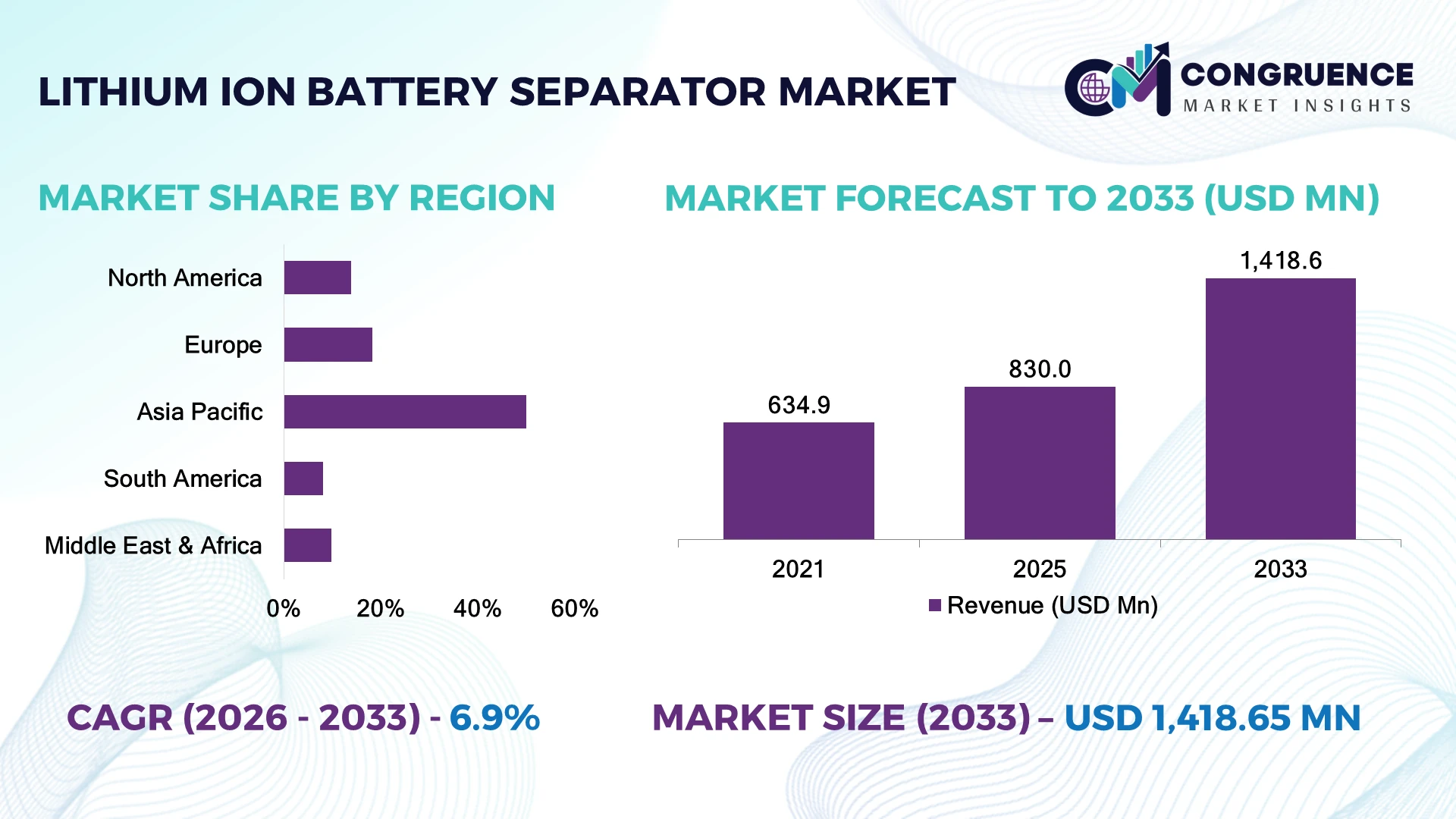
China dominates the global lithium-ion battery separator landscape with approximately 58% of global separator manufacturing capacity, supported by investments exceeding USD 12 billion across battery supply-chain projects and strong adoption by EV and energy storage industries. China’s battery cell output exceeds 70% of global production, compared with South Korea’s nearly 12%, while separator localization rates surpass 85% in major Chinese manufacturing clusters. Trade realignments and critical mineral security initiatives continue to reinforce domestic capacity expansion.
Strategic implication companies with localized separator production, advanced coating technologies, and integrated battery supply-chain partnerships are securing stronger competitive positioning and procurement advantages.
Market Size & Growth: USD 830.0 million in 2025 progressing toward USD 1,418.6 million by 2033, supported by EV battery localization, energy storage deployment, and advanced separator innovation.
Top Growth Drivers: EV battery demand (+28%), grid-scale energy storage installations (+24%), and high-performance battery manufacturing expansion (+19%) remain the primary catalysts.
Short-Term Forecast: By 2028, ceramic-coated separator adoption is expected to increase manufacturing efficiency by 15% while reducing battery safety incidents by nearly 12%.
Emerging Technologies: AI-enabled quality inspection, nanoceramic coatings, and ultra-thin multilayer separators are improving defect detection rates by over 30%.
Regional Leaders: Asia Pacific exceeds USD 780 million by 2033 through battery manufacturing expansion, North America approaches USD 250 million through domestic localization, and Europe surpasses USD 220 million through EV ecosystem investments.
Consumer/End-User Trends: More than 65% of newly commissioned battery plants prioritize high-thermal-stability separators for next-generation EV platforms.
Pilot/Case Example: In 2024, several gigafactory separator automation projects improved production yield by approximately 18% while reducing material waste by 10%.
Competitive Landscape: Top manufacturers control nearly 55% of global supply, led by Asahi Kasei, SK IE Technology, SEMCORP, Toray Industries, and Entek.
Regulatory & ESG Impact: Battery localization incentives and carbon-reduction policies contributed to over 20% growth in domestic battery component sourcing initiatives.
Investment & Funding: More than USD 15 billion has been allocated globally toward battery materials expansion, strategic partnerships, and separator manufacturing facilities.
Innovation & Future Outlook: Solid-state battery compatibility, advanced coating platforms, and supply-chain regionalization are reshaping long-term competitive dynamics.
Lithium-ion battery separators have become a critical enabling component across electric mobility, utility-scale energy storage, consumer electronics, and industrial power systems. Manufacturers are accelerating development of ceramic-coated and ultra-thin separator architectures to improve thermal stability and energy density. More than 40% of newly announced battery projects now incorporate advanced separator specifications, while localization initiatives and battery supply-chain diversification continue to influence procurement strategies, setting the stage for deeper strategic market evaluation.
Lithium-ion battery separators have evolved from a supporting battery component into a strategic technology layer that directly influences safety, performance, and manufacturing competitiveness. As governments and manufacturers restructure battery supply chains to reduce import dependency, separator production is increasingly viewed as a critical industrial capability. The ongoing localization of battery ecosystems in China, the United States, and Germany is reshaping investment priorities and supplier relationships.
Technology differentiation is becoming a key competitive factor. Advanced ceramic-coated separators deliver up to 20% higher thermal resistance compared with conventional polyolefin separators while improving battery safety performance under high-load conditions. China maintains unmatched production scale and cost efficiency, whereas South Korea and Japan continue to lead in premium separator technologies designed for high-performance electric vehicles and energy storage applications. This contrast is driving both competition and cross-border partnerships.
Over the next two to three years, battery manufacturers are expected to increase procurement of high-performance separators as energy storage deployments accelerate. Several gigafactory operators are integrating automated separator inspection systems to improve yield consistency and reduce production defects. Companies are responding through capacity expansions, technology licensing agreements, and strategic joint ventures. Organizations that secure advanced separator technologies and resilient supply networks will strengthen operational advantage and long-term market relevance.
The accelerating shift toward electric mobility and large-scale energy storage is creating sustained demand for advanced lithium-ion battery separators. Global EV production expanded by more than 25% during the past year, while utility-scale battery storage installations increased by nearly 30%. High-energy-density battery designs increasingly require separators with superior thermal stability and puncture resistance. This demand is prompting manufacturers in China, South Korea, and the United States to expand coating and film-processing capacity. Several leading suppliers have increased investment in ceramic-coated separator production lines to address rising safety requirements. The operational impact is significant: improved separator performance supports longer battery life, lower defect rates, and enhanced safety compliance. Companies that integrate advanced materials and automated manufacturing systems are achieving stronger supply reliability and securing long-term contracts with battery cell producers.
Separator manufacturing remains vulnerable to fluctuations in polypropylene and polyethylene feedstock costs, which can account for over 40% of production expenses. Energy-intensive processing operations have experienced cost increases of approximately 12–18% in key manufacturing regions. In addition, dependence on concentrated supply networks for specialty coating materials creates procurement challenges. China currently controls a dominant share of battery component processing capacity, exposing global manufacturers to trade disruptions and logistics volatility. These pressures directly affect production economics, inventory planning, and contract pricing strategies. To mitigate risks, separator manufacturers are pursuing localized sourcing, multi-country procurement networks, and long-term raw material agreements. A notable strategic insight is that companies with vertically integrated supply chains demonstrate stronger margin resilience during periods of feedstock volatility and transportation disruption.
The emergence of solid-state batteries, fast-charging EV platforms, and grid-scale storage systems is creating new opportunities for separator innovation. Advanced ceramic-coated separators can improve thermal stability by more than 20%, while ultra-thin separator designs enhance energy density by approximately 10–15%. Japan and South Korea are increasing research investment in separators compatible with next-generation battery chemistries. Regulatory support for domestic battery ecosystems is also accelerating technology commercialization. Beyond traditional automotive demand, industrial energy storage and data-center backup systems represent underpenetrated opportunities. Companies are positioning through collaborative R&D programs, material science partnerships, and pilot-scale manufacturing projects. A particularly valuable strategic opportunity lies in developing multifunctional separators that simultaneously improve safety, lifespan, and charging performance, enabling premium pricing and stronger differentiation.
Producing high-performance separators at industrial scale remains a complex operational challenge. Defect rates above 2–3% can significantly impact battery safety and production yields, making precision manufacturing essential. Advanced coating technologies require sophisticated process control systems and highly specialized engineering expertise. Workforce shortages in battery manufacturing hubs and increasing quality certification requirements are adding further complexity. As battery plants expand, maintaining uniform separator thickness and coating integrity across high-volume production lines becomes increasingly difficult. These challenges affect deployment consistency, customer qualification timelines, and long-term competitiveness. Manufacturers are investing heavily in AI-driven inspection systems, automated process monitoring, and digital quality management platforms. A critical strategic insight is that operational excellence in manufacturing consistency is becoming as important as material innovation in securing long-term supplier status with leading battery producers.
Ceramic Coating Moves Mainstream: Ceramic-coated separators are moving beyond premium EV cells as thermal-safety requirements tighten, with coated variants expanding at more than 20% annually and shutdown-temperature requirements increasingly exceeding 175°C. Manufacturers are adding inline coating capacity and integrating inspection systems, reducing yield losses below 2% while supporting thinner, higher-performance membranes.
Supply Chains Become Localized: Battery-component sourcing is shifting toward domestic production as the U.S., Europe, and India strengthen local-content strategies. China still produced more than 80% of global battery cells in 2025, while announced overseas capacity is accelerating diversification. Separator suppliers are responding through regional plants, dual sourcing, and partnerships with gigafactory operators rather than relying solely on exports.
Storage Changes Procurement Priorities: Global battery-storage additions reached 108 GW in 2025, up 40% year over year, with utility-scale projects representing roughly 80% of new capacity. This is shifting separator procurement toward cycle-life consistency, mechanical durability, and cost-efficient high-volume production. Suppliers are adapting dry-process lines and standardized separator platforms for large stationary-storage contracts.
Automation Tightens Quality Control: High-speed separator production is increasingly using AI-assisted inspection, automated thickness measurement, and inline defect detection. Advanced systems can improve defect identification by more than 30%, while multilayer automotive shipments already account for roughly one-third of relevant separator demand. The non-obvious shift is that digital process control is becoming a qualification advantage, prompting suppliers to invest in connected production lines rather than simply adding capacity.
Wet-process polyolefin remained the leading separator type in 2025, accounting for approximately 60.5% of global lithium-ion battery separator demand. Its dominance reflects highly controlled pore formation, strong electrolyte wettability, and mature high-volume manufacturing, making it particularly suitable for EV and high-energy-density cells. Dry-process polyolefin remains strategically important where simpler processing and cost efficiency are prioritized, particularly in selected stationary-storage applications. Companies are retaining both process routes to avoid overexposure to a single cell architecture.
Ceramic-coated separators are the fastest-shifting type, with adoption advancing at roughly 22.9% annually as automakers increase thermal-propagation safeguards. Coated membranes support higher-temperature operation while enabling thinner designs; advanced automotive programs increasingly specify shutdown performance above 175°C. Suppliers are therefore expanding coating capacity, developing multilayer structures, and forming cell-maker partnerships. The strategic implication is clear: wet-process polyolefin remains the volume foundation, but investment is moving disproportionately toward coated platforms where safety qualification creates stronger pricing power.
Electric vehicles represented the leading application, accounting for approximately 56.3% of lithium-ion battery separator demand in 2025. Demand concentration reflects larger battery packs, fast-charging requirements, and expanding cell-production capacity. EV programs increasingly favor thin, thermally stable separators that preserve energy density without compromising safety. Consumer electronics remains a mature application, retaining demand for compact, consistent membranes, while power tools and medical devices continue to prioritize reliability and application-specific specifications. Suppliers are responding with differentiated thickness, coating, and multilayer portfolios.
Stationary energy storage is the fastest-expanding application, supported by rapid grid-scale deployment and renewable integration. Global battery-storage additions reached 108 GW in 2025, with roughly 80% of new capacity deployed at utility scale. This is changing procurement from predominantly automotive qualification toward long-cycle, cost-sensitive separator specifications. Manufacturers are scaling standardized platforms and strengthening partnerships with storage-system integrators. The business implication is significant: EVs provide the largest volume base, but energy storage is becoming an increasingly important source of incremental separator demand and production-line utilization.
Electric vehicle manufacturers represent the dominant end-user group, with approximately 48.3% of global lithium-ion battery separator demand in 2025. Their purchasing power is driven by large-scale cell procurement, expanding battery-pack capacity, and stringent safety qualification. Automotive buyers increasingly require multilayer and ceramic-coated separators for high-power and fast-charging platforms. Consumer electronics producers remain a mature buyer group focused on thinness, dimensional consistency, and cost, while industrial users prioritize durability and application-specific performance. Suppliers are responding through dedicated automotive qualification programs and long-term supply agreements.
Energy-storage companies are the fastest-shifting end-user group, supported by rapid utility-scale battery deployment and renewable-grid modernization. Utility-scale systems represented approximately 80% of new global battery-storage capacity additions in 2025, while total additions reached 108 GW. This buyer group places greater emphasis on lifecycle consistency, predictable procurement costs, and high-volume availability than premium EV applications. Manufacturers are therefore developing standardized separator products for storage integrators and expanding regional supply arrangements. The competitive shift is toward balancing automotive-grade performance with storage-grade cost efficiency, creating a distinct procurement strategy for high-volume stationary systems.
Asia-Pacific accounted for the largest market share at 50.0% in 2025 however, North America is expected to register the fastest growth, expanding at a CAGR of 22.0% between 2026 and 2033.
North America accounted for 13.9% of the global lithium-ion battery separator market in 2025. The United States represents the dominant share of regional demand, supported by expanding EV-cell manufacturing, stationary energy storage, and battery-component localization. Separator investments are increasingly concentrated around Michigan, Ohio, Georgia, Nevada, and Indiana, where battery plants are creating qualified downstream demand. ENTEK's Indiana project is designed around approximately 1.2 billion m² of annual separator capacity, strengthening domestic supply availability. The region is also shifting toward coated and multilayer separators as automakers prioritize thermal stability and safety. The strategic change is from import-dependent procurement toward local qualification and long-term supply agreements. Manufacturers are responding through domestic capacity additions, technology partnerships, and localized coating operations. North America's projected 22.0% CAGR makes it the fastest-growing regional market despite its substantially smaller current manufacturing base compared with Asia-Pacific.
United States Market Outlook: The United States is the strategic center of North America's separator market because its EV and battery-storage manufacturing base is expanding rapidly. ENTEK's planned 1.2 billion m² annual capacity represents a major step toward domestic separator availability. The project is positioned to serve automotive and energy-storage battery programs while reducing reliance on imported separator materials. This localization is strengthening supplier qualification opportunities and encouraging manufacturers to establish production closer to U.S. cell factories.
Europe accounted for 18.2% of the global lithium-ion battery separator market in 2025. Germany, Poland, Hungary, and France form the region's most important battery-manufacturing and automotive clusters, creating concentrated demand for high-performance separator products. European cell manufacturing is increasingly emphasizing traceability, thermal safety, sustainability, and supply-chain resilience, encouraging separator suppliers to establish closer relationships with local battery producers. The region remains more dependent on Asian separator technology and manufacturing than its downstream automotive industry, creating opportunities for localized production and technical partnerships. Companies are responding with European coating operations, supplier qualification programs, and integrated contracts with cell manufacturers. The strategic priority is shifting away from pure cost optimization toward supply security and compliance-ready separator architectures as European battery sustainability requirements become more demanding.
Germany Market Outlook: Germany remains Europe's most strategically significant country because of its automotive manufacturing concentration and expanding stationary-storage infrastructure. The country had nearly 2 million battery-storage systems in operation by mid-2025, creating demand beyond EV applications. Separator suppliers are increasingly targeting German automotive and storage customers with products emphasizing thermal stability, dimensional consistency, and long cycle life. Germany's engineering base also supports qualification of advanced separator technologies.
Asia-Pacific accounted for 50.0% of the global lithium-ion battery separator market in 2025, making it the largest regional market. China provides the dominant manufacturing foundation, while Japan and South Korea contribute advanced film-processing and coating technologies. China controls approximately 75% of global separator capacity, giving domestic producers substantial advantages in scale, integrated raw-material sourcing, and production economics. Chinese separator costs are estimated at approximately 30–40% below Japanese peers for comparable commodity grades, strengthening export competitiveness. South Korean and Japanese manufacturers are increasingly placing coating and finishing operations closer to North American and European battery plants while retaining core manufacturing in Asia. This creates a two-tier supply structure: high-volume production remains concentrated in Asia, while premium finishing and localization increasingly move closer to overseas customers.
China Market Outlook: China is the dominant country market because its separator industry is deeply integrated with EV, battery-cell, electrolyte, and materials manufacturing. Its large domestic customer base enables rapid capacity utilization and technology commercialization. Senior Technology Material's agreement to supply Volkswagen's PowerCo with 2.09 billion m² of separators through 2032 demonstrates how Chinese manufacturers are converting domestic scale into long-term international contracts.
South America accounted for 8.1% of the global lithium-ion battery separator market in 2025. Brazil represents the region's principal industrial center because of its automotive manufacturing base, renewable-power infrastructure, and developing electric-mobility ecosystem. Unlike China, Japan, South Korea, or the United States, South America has limited upstream separator manufacturing, leaving much of its battery-component supply dependent on imports. This creates a different competitive structure in which technical distribution, customer qualification, and battery-assembly partnerships are more important than immediate large-scale separator production. Brazil's automotive industry provides the strongest pathway for EV-related separator demand, while stationary storage creates an additional application channel. Companies are responding through regional distribution networks, technical partnerships, and selective localization rather than large standalone facilities. The key strategic opportunity is establishing customer relationships before local battery-component manufacturing reaches larger commercial scale.
Brazil Market Outlook: Brazil is the strongest South American market because its automotive, electrical-equipment, and renewable-energy industries provide multiple potential lithium-ion battery applications. Growing electrification is encouraging battery assemblers and vehicle manufacturers to develop more localized supply relationships. Separator suppliers can use Brazil as a regional entry point through technical distribution, customer qualification, and partnerships with battery and energy-storage companies before committing to dedicated manufacturing capacity.
The Middle East & Africa accounted for 9.8% of the global lithium-ion battery separator market in 2025. Saudi Arabia and the UAE are driving regional activity through renewable-energy investment, EV manufacturing initiatives, grid modernization, and industrial diversification. The region remains heavily dependent on imported separator and battery technologies, but large-scale renewable and storage projects are creating a stronger downstream opportunity. Saudi Arabia's renewable-energy strategy targets 110 GW of renewable capacity by 2030, strengthening the long-term requirement for energy-storage systems. Companies are therefore prioritizing strategic partnerships, technology licensing, distribution agreements, and integration with large storage projects rather than immediately replicating Asian-scale separator plants. The competitive advantage will increasingly come from early positioning around battery and energy-storage projects as regional manufacturing capabilities develop.
Saudi Arabia Market Outlook: Saudi Arabia is the region's most strategically important country because battery development is closely connected with its industrial-diversification strategy. The country's 110 GW renewable-energy target for 2030 provides a substantial potential foundation for grid-scale storage. Emerging EV and battery manufacturing initiatives can also create demand for separator technologies. Suppliers with strong thermal-stability, long-cycle-life, and energy-storage separator portfolios are well positioned to establish early partnerships as the country's battery ecosystem develops.
Asahi Kasei, SEMCORP, SK IE Technology, Toray Industries, and ENTEK compete, with Chinese cost leaders challenging Japanese and Korean technology specialists while ENTEK targets localized North American supply. The top five suppliers held about 50.7% of the battery-separator market in 2025, indicating moderate concentration. Competition centers on price, coating performance, supply security, and qualification speed: Chinese suppliers held more than 80% of 2024 shipments, while advanced coated products command premium positioning. Players are expanding plants, securing capacity agreements, integrating coating and film production, and forming OEM partnerships. Asahi Kasei partnered with Honda for Canadian production; ENTEK is scaling Indiana capacity; SEMCORP is combining ultra-thin films with flame-retardant coatings. The competitive shift is toward localized production and differentiated safety architectures as Chinese oversupply pressures commodity pricing. High capital intensity, process know-how, customer qualification, and scale remain major entry barriers. Winning requires localized capacity, proven reliability, advanced coatings, and cost discipline together.
Toray Industries, Inc.
SK IE Technology Co., Ltd.
SEMCORP Co., Ltd.
ENTEK International LLC
UBE Corporation
Sumitomo Chemical Co., Ltd.
W-SCOPE Corporation
Shenzhen Senior Technology Material Co., Ltd.
Cangzhou Mingzhu Plastic Co., Ltd.
Sinoma Science & Technology Co., Ltd.
Freudenberg Performance Materials
Wet-process polyolefin remains the manufacturing benchmark, but ceramic-coated and ultra-thin membranes are redefining performance. SEMCORP’s 5 μm separator cuts thickness 28.5% versus conventional 7 μm films, while increasing puncture strength 16.7% and ionic conductivity 13.3%. This enables higher active-material loading and stronger fast-charging performance without sacrificing mechanical integrity. Ceramic and aramid coatings increasingly target thermal stability, while solvent-free coating and solid-state-compatible materials advance toward qualification; SEMCORP’s ten-ton solid-state electrolyte pilot line is operational.
SEMCORP’s flame-retardant separator reduced coating base weight by more than 40% versus alumina ceramic coatings, improving energy density and material efficiency. Advanced inspection, inline metrology, and automated defect classification are also becoming production requirements, with digital inspection improving defect detection by more than 30% in production. By 2026–2028, EV and energy-storage programs will increasingly favor thin, coated, high-strength membranes.
Technology leaders benefit through qualification advantages and higher-value contracts, while cost-focused Chinese producers retain scale leverage in commodity grades. Suppliers combining coating expertise, automation, and localized manufacturing will gain competitive advantage as customers demand shorter qualification cycles and greater traceability across regionalized battery supply chains. This transition raises the value of pore control, coating uniformity, and process analytics, making intelligence a differentiator alongside material science.
April 2024 Asahi Kasei announced a Canadian Hipore separator plant with approximately ¥180 billion investment and 700 million m² annual capacity. The project localizes North American supply, strengthens EV-battery partnerships, and targets commercial production in 2027. Source: asahi-kasei.com
November 2025 Sumitomo Chemical announced restructuring of its PERVIO separator business, ending production at Japan’s Ohe Works by March 2026 and consolidating manufacturing in South Korea. The move targets higher productivity and strengthens competitiveness for EV applications through production efficiency. Source: sumitomo-chem.co.jp
September 2025 ENTEK secured an $800 million investment from I Squared Capital for its Terre Haute gigafactory. The first two phases will produce 1.4 billion m² annually, strengthening domestic U.S. separator supply and supporting battery manufacturers seeking localized sourcing eligibility. Source: entek.com
October 2025 SEMCORP unveiled a flame-retardant separator at the North America Battery Show that reduces coating base weight by over 40% versus alumina ceramic coatings and moisture by more than 20%, improving energy density and cycle-life potential for battery cells. Source: semcorp.com
The report evaluates the global lithium-ion battery separator market across By Type, By Application, and By End-User, covering wet-process and dry-process separator technologies, advanced coated architectures, EV batteries, energy-storage systems, consumer electronics, and other industrial applications. It assesses established high-volume products alongside emerging ultra-thin, ceramic-coated, flame-retardant, and solid-state-compatible separator technologies.
Geographically, the study covers North America, Europe, Asia-Pacific, South America, and Middle East & Africa, with detailed country-level analysis of manufacturing concentration, localization, battery-cell capacity, supply-chain restructuring, and technology adoption. Competitive coverage examines 12 major market participants, while regional shares are standardized across the five geographic markets. The analysis supports investment planning, manufacturing expansion, supplier qualification, partnership strategy, technology prioritization, and competitive positioning through 2026–2033, with particular emphasis on localization, advanced materials, automation, and next-generation battery architectures.
| Report Attribute / Metric | Details |
|---|---|
| Market Revenue (2025) | USD 830.0 Million |
| Market Revenue (2033) | USD 1,418.6 Million |
| CAGR (2026–2033) | 6.93% |
| Base Year | 2025 |
| Forecast Period | 2026–2033 |
| Historic Period | 2021–2025 |
| Segments Covered |
By Type
By Application
By End-User
|
| Key Deliverables | Revenue Forecast; Market Trends; Growth Drivers & Restraints; Technology Insights; Segmentation Analysis; Regional Insights; Competitive Landscape; Regulatory & ESG Overview; Recent Developments |
| Regions Covered | North America; Europe; Asia-Pacific; South America; Middle East & Africa |
| Companies Profiled | Asahi Kasei Corporation; Toray Industries, Inc.; SK IE Technology Co., Ltd.; SEMCORP Co., Ltd.; ENTEK International LLC; UBE Corporation; Sumitomo Chemical Co., Ltd.; W-SCOPE Corporation; Shenzhen Senior Technology Material Co., Ltd.; Cangzhou Mingzhu Plastic Co., Ltd.; Sinoma Science & Technology Co., Ltd.; Freudenberg Performance Materials |
| Customization & Pricing | Available on Request (10% Customization Free) |




