
Reports
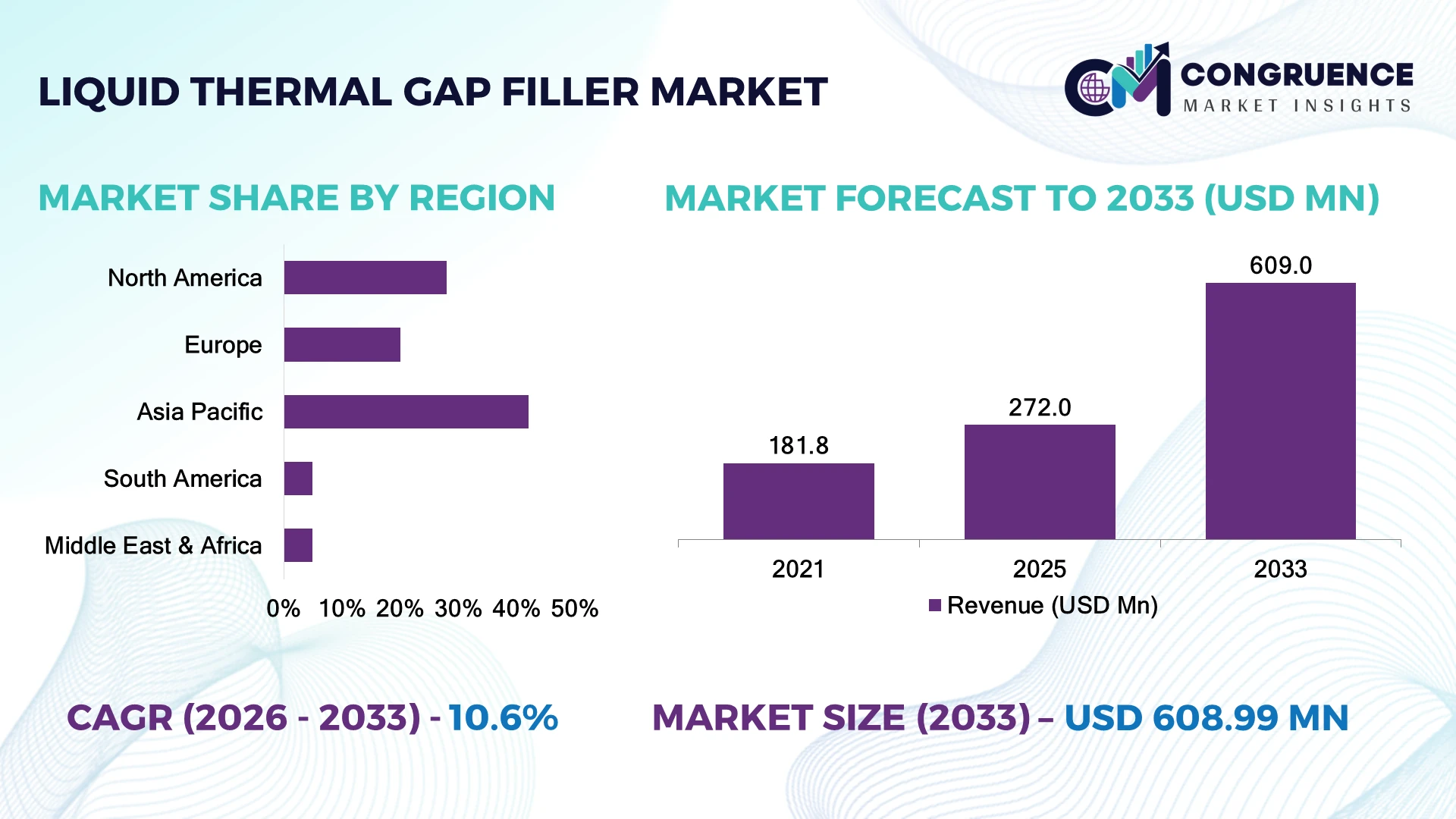
The Global Liquid Thermal Gap Filler Market was valued at USD 272.0 Million in 2025 and is anticipated to reach a value of USD 609.0 Million by 2033 expanding at a CAGR of 10.6% between 2026 and 2033. Growth is driven by rising adoption of advanced thermal management materials in electric vehicles, high-power electronics, and semiconductor cooling systems requiring improved heat dissipation and reliability.
China accounted for a dominant position with nearly 35% share in global liquid thermal gap filler consumption, supported by EV battery manufacturing, semiconductor investments, and electronics production capacity exceeding 300 GWh annually. The United States follows with strong demand from data centers and aerospace applications, while China’s EV supply chain scale remains over 2 times larger.
Strategic localization of thermal material production will define competitive advantage.
Market Size & Growth: USD 272.0 Million in 2025 to USD 609.0 Million by 2033 at 10.6% CAGR, driven by EV battery thermal safety requirements.
Top Growth Drivers: EV adoption 25%+, data center expansion 15%+, semiconductor demand 12% growth.
Short-Term Forecast: By 2028, thermal interface material efficiency improves 20% through advanced silicone and filler formulations.
Emerging Technologies: AI-based thermal simulation, automated dispensing systems, and nano-enhanced fillers reshape product development.
Regional Leaders: Asia Pacific reaches USD 300+ Million, North America USD 150+ Million, Europe USD 120+ Million with EV and electronics adoption.
Consumer/End-User Trends: Over 60% of new EV platforms integrate liquid thermal management solutions for battery performance.
Pilot/Case Example: 2024 battery cooling projects achieved 18% temperature reduction using optimized gap filler applications.
Competitive Landscape: Henkel leads with approximately 15% share, alongside Dow, Parker Hannifin, Momentive, and Shin-Etsu.
Regulatory & ESG Impact: Energy efficiency standards improve thermal system optimization, reducing cooling-related power consumption by 10%–15%.
Investment & Funding: More than USD 1 billion invested in EV battery and thermal management supply chains through partnerships and capacity expansion.
Innovation & Future Outlook: Next-generation fillers target higher conductivity, automated manufacturing integration, and sustainable material development.
Liquid Thermal Gap Filler solutions are becoming essential for electric mobility, semiconductor packaging, and high-performance computing applications. Demand is increasing as manufacturers prioritize compact designs and thermal reliability, with advanced formulations improving conductivity performance by nearly 20%. Supply-chain diversification following global semiconductor disruptions is encouraging localized production and strategic partnerships, creating new opportunities across automotive and electronics industries.
Liquid Thermal Gap Filler is becoming strategically important as industries transition toward compact, high-power electronic systems requiring efficient heat management. Electric vehicle manufacturers, semiconductor companies, and data center operators are redesigning thermal architectures to improve reliability and reduce operational losses. Supply-chain restructuring after semiconductor shortages has accelerated regional sourcing strategies, particularly in China, the United States, and Europe.
Compared with traditional thermal pads, liquid gap fillers provide improved surface coverage and reduce interface resistance by approximately 15%–30%, enabling better cooling performance in complex assemblies. North America emphasizes advanced computing and aerospace deployment, while Asia Pacific leads through large-scale EV manufacturing and electronics production ecosystems.
Companies are increasing investments in automated dispensing technologies, material innovation, and strategic supplier partnerships. Battery manufacturers in China and South Korea are integrating advanced thermal materials into next-generation platforms to support higher energy density designs. Over the next 2–3 years, adoption will accelerate through automated production lines, localized manufacturing, and improved thermal testing capabilities. Competitive positioning will depend on material performance, supply security, and integration expertise.
The rapid transition toward electric vehicles and advanced electronics is strengthening demand for liquid thermal gap fillers. EV battery systems require efficient thermal control, with battery pack production increasing by more than 20% annually in major manufacturing hubs. Semiconductor facilities in Taiwan and South Korea are adopting advanced thermal materials to support higher processing loads. Companies are expanding production capacity and forming partnerships to secure specialty silicone and filler materials. The shift toward compact power electronics creates demand for high-conductivity solutions capable of managing increasing heat density. Manufacturers responding with automated dispensing and customized formulations gain advantages through improved reliability and reduced assembly complexity.
High raw material costs and dependency on specialty chemical suppliers limit broader adoption of liquid thermal gap fillers. Silicone-based formulations account for a significant portion of product costs, with price fluctuations of 10%–20% affecting manufacturing margins. Supply disruptions in chemical manufacturing hubs create challenges for consistent availability. Companies in Japan, China, and Europe are reducing exposure through supplier diversification, regional sourcing, and long-term contracts. The need for specialized processing equipment also increases initial deployment costs for smaller manufacturers. Strategic localization of material production is becoming essential to maintain profitability and improve supply chain resilience.
Innovation in advanced fillers, automation, and next-generation electronics creates new market opportunities. Nano-enhanced thermal materials can improve conductivity performance by 20%–40% compared with conventional formulations. Growing demand from AI servers, renewable energy storage systems, and autonomous vehicles is expanding application areas. Companies are investing in research partnerships and localized manufacturing facilities to capture emerging demand. India’s expanding electronics manufacturing ecosystem and government-supported semiconductor initiatives create additional opportunities for thermal material suppliers. Strategic development of lightweight, recyclable, and high-performance formulations will enable companies to differentiate products and access premium industrial applications.
Maintaining consistent application performance across different manufacturing environments remains a major challenge. Automated dispensing systems require precise control, with process variations above 5% potentially affecting thermal performance. Growing demand for high-density electronics increases pressure on manufacturers to improve reliability testing and quality control. Companies must address workforce skill gaps, equipment optimization, and compatibility issues across diverse platforms. Automotive and semiconductor industries require long validation cycles, increasing commercialization timelines. Investment in digital monitoring, simulation tools, and manufacturing partnerships will be critical for achieving consistent deployment and sustaining long-term competitiveness.
Automated Thermal Dispensing Growth: Automotive and electronics manufacturers are increasing automated dispensing adoption, with production efficiency improving 15%–25% and material waste declining by nearly 10%. Companies are integrating robotic systems to improve application consistency, especially in EV battery assembly plants in China and Germany. This shift is reducing labor dependency and accelerating high-volume thermal management workflows.
Advanced Filler Formulation Shift: Manufacturers are developing high-conductivity liquid fillers using improved silicone and hybrid materials, achieving thermal performance improvements of 20%–35%. Semiconductor and AI server companies are adopting these materials to handle rising heat loads. Supply-chain pressure on specialty chemicals has encouraged companies to expand regional sourcing and strengthen material partnerships.
EV Platform Thermal Optimization: Electric vehicle producers are redesigning battery cooling systems, with more than 60% of new EV platforms adopting advanced thermal interface solutions. Automakers in South Korea and the United States are prioritizing lightweight thermal materials to improve battery reliability. Companies are collaborating with material suppliers to customize formulations for higher energy-density platforms.
Digital Thermal Engineering Adoption: Electronics manufacturers are using AI-driven simulation and digital testing tools to shorten thermal design cycles by 20%–30%. The transition toward faster product development is helping enterprises optimize material selection before manufacturing. Companies are investing in virtual validation platforms to reduce prototype costs and improve deployment speed.
Silicone-based liquid thermal gap fillers represent the leading type segment, accounting for approximately 55% of market adoption due to superior flexibility, durability, and compatibility with complex electronic assemblies. Their ability to maintain performance under temperature variations makes them widely preferred in EV batteries, power electronics, and industrial equipment. Water-based and epoxy-based alternatives together contribute nearly 30% share, mainly serving cost-sensitive and specialized applications.
The fastest-growing segment is hybrid liquid thermal gap fillers, supported by demand for improved conductivity and lightweight designs. Adoption is increasing by nearly 20% among advanced electronics manufacturers seeking higher thermal efficiency. Companies are investing in hybrid formulations, expanded production facilities, and partnerships with automotive OEMs to address next-generation cooling requirements. The shift from traditional materials toward multifunctional thermal solutions is reshaping product development priorities.
Electric vehicle batteries represent the leading application segment with approximately 45% market share, driven by increasing thermal safety requirements and higher battery energy density. Battery manufacturers are adopting liquid thermal gap fillers to improve heat transfer efficiency and reduce temperature variations by 15%–25%. Consumer electronics and semiconductor applications remain important segments, contributing nearly 35% combined demand.
Data centers and industrial electronics are emerging as the fastest-growing applications as AI workloads increase thermal management requirements. Adoption in high-performance computing facilities is expanding as operators seek improved cooling efficiency and reliability. Companies are scaling production capacity, developing customized materials, and forming technology partnerships to support specialized applications. The growing need for compact cooling solutions is shifting investment toward advanced thermal interface technologies.
Automotive manufacturers and suppliers represent the leading end-user segment with approximately 50% market share due to large-scale EV battery deployment and thermal reliability requirements. Companies in China, Japan, and Germany are integrating liquid thermal gap fillers into electric mobility platforms to improve battery performance. Electronics manufacturers and semiconductor companies account for nearly 30% combined demand, supported by increasing chip complexity.
Data center operators are emerging as the fastest-growing end-user group as AI infrastructure expansion increases cooling requirements. Adoption is rising by more than 15% as enterprises upgrade thermal systems for high-performance computing environments. Companies are responding through customized material solutions, strategic supplier agreements, and expanded manufacturing capabilities. Future demand is shifting toward industries requiring continuous operation, higher efficiency, and improved thermal reliability.
Asia-Pacific accounted for the largest market share at 42% in 2025 however, North America is expected to register the fastest growth, expanding at a CAGR of 11.2% between 2026 and 2033.
North America holds approximately 28% of the global liquid thermal gap filler market, supported by electric vehicle manufacturing, semiconductor investments, and high-performance computing infrastructure. The United States dominates regional adoption through automotive electrification projects and data center expansion, with more than 30% of new EV platforms integrating advanced thermal management materials. Semiconductor manufacturers are increasing investments in localized production following supply-chain restructuring initiatives. Companies are strengthening partnerships with material suppliers to improve thermal reliability, reduce assembly complexity, and support next-generation electronics. The region’s focus on domestic manufacturing and technology security is accelerating adoption of high-performance thermal interface solutions.
United States Market Outlook: The United States remains the strategic hub due to strong automotive, aerospace, and semiconductor ecosystems. Over 20 major semiconductor fabrication projects are advancing domestic capacity, increasing demand for advanced thermal materials. Data center operators are also adopting liquid thermal solutions to manage rising AI computing loads and improve operational efficiency.
Europe contributes nearly 20% of global liquid thermal gap filler demand, driven by EV production, industrial automation, and strict energy efficiency requirements. Germany, France, and the United Kingdom represent key adoption centers due to automotive manufacturing strength and electronics engineering capabilities. The region’s transition toward sustainable mobility has increased demand for thermal materials that support battery durability and safety. More than 50% of new European vehicle platforms are incorporating advanced thermal management designs. Companies are expanding local production partnerships and investing in customized formulations to meet automotive quality standards. Regulatory focus on energy efficiency and carbon reduction is encouraging manufacturers to adopt advanced cooling technologies.
Germany Market Outlook: Germany leads European adoption through its automotive manufacturing base and engineering expertise. Major vehicle manufacturers are integrating advanced thermal materials into electric platforms, while industrial automation facilities increasingly require reliable heat management solutions. The country’s strong supplier ecosystem supports faster commercialization of innovative thermal technologies.
Asia-Pacific represents the largest market with approximately 42% share, supported by extensive EV manufacturing, electronics production, and semiconductor ecosystems. China, Japan, South Korea, and India are driving demand through battery production and high-volume electronics assembly. China’s EV manufacturing capacity exceeds 10 million vehicles annually, creating significant demand for thermal management materials. Companies are expanding production facilities, forming regional partnerships, and localizing supply chains to reduce dependency risks. Semiconductor expansion and electronics manufacturing growth are further strengthening adoption. The region’s manufacturing advantage enables faster integration of advanced liquid gap filler technologies across automotive and industrial applications.
China Market Outlook: China remains the dominant country due to its extensive EV battery ecosystem and electronics manufacturing capacity. The country produces more than half of global electric vehicles and continues investing in battery technology, semiconductor infrastructure, and localized thermal material production to support advanced mobility platforms.
South America accounts for approximately 5% of global liquid thermal gap filler demand, supported by automotive manufacturing, renewable energy projects, and industrial modernization. Brazil and Mexico-linked supply chains are influencing regional adoption through vehicle production and electronics assembly activities. Limited local manufacturing capacity remains a challenge, increasing reliance on imported thermal materials. However, industrial automation projects and electric mobility initiatives are creating new opportunities. Companies are developing distribution partnerships and regional supply agreements to improve availability. The growing adoption of energy-efficient systems is encouraging industries to upgrade thermal management solutions, particularly in automotive and power applications.
Brazil Market Outlook: Brazil represents the largest opportunity center in South America due to its automotive industry and expanding renewable energy infrastructure. The country produces over 2 million vehicles annually, creating potential demand for advanced thermal solutions as electrification and industrial modernization accelerate.
Middle East & Africa contributes nearly 5% of global liquid thermal gap filler adoption, with demand concentrated in data centers, energy infrastructure, telecommunications, and industrial projects. Countries such as the United Arab Emirates and Saudi Arabia are investing heavily in digital infrastructure and advanced manufacturing capabilities. Data center development across Gulf economies is increasing demand for efficient thermal management systems, with new facilities requiring improved cooling performance. Companies are entering partnerships with technology providers and expanding distribution networks to address emerging applications. Infrastructure modernization programs and diversification strategies are supporting adoption beyond traditional industrial sectors.
Saudi Arabia Market Outlook: Saudi Arabia is emerging as a strategic market through investments in digital infrastructure, industrial diversification, and smart city developments. The country’s data center expansion and technology-focused projects are increasing demand for advanced cooling materials, while industrial modernization initiatives support long-term adoption of thermal management solutions.
The liquid thermal gap filler market features global material leaders competing with regional specialty suppliers and OEM-focused innovators. Henkel, Dow, Shin-Etsu Chemical, Parker Hannifin, and Momentive compete through advanced formulations, while regional manufacturers challenge pricing and customization. The top five players collectively account for approximately 45%–50% market share. Competition centers on thermal conductivity improvement, dispensing efficiency, supply reliability, and application-specific engineering, with performance improvements of 15%–30% influencing buyer decisions. Leading companies are expanding production capacity, partnering with automotive OEMs, and developing high-performance silicone and hybrid materials. The market is shifting toward vertically integrated supply chains as EV and AI infrastructure demand increases. High qualification requirements, material expertise, and long customer validation cycles create entry barriers. Winning requires superior thermal performance, scalable manufacturing, reliable supply networks, and rapid customization capabilities aligned with automotive, semiconductor, and computing applications.
Dow Inc.
Shin-Etsu Chemical Co., Ltd.
Momentive Performance Materials Inc.
Parker Hannifin Corporation
3M Company
Wacker Chemie AG
H.B. Fuller Company
LORD Corporation
Fujipoly Co., Ltd.
Electrolube
Polytec PT GmbH
Boyd Corporation
Liquid thermal gap filler technology is advancing through high-conductivity silicone systems, hybrid polymer formulations, and automated dispensing integration. New-generation materials deliver thermal conductivity above 10 W/mK compared with traditional solutions below 5 W/mK, improving heat transfer performance by nearly 30%. EV manufacturers and semiconductor suppliers are adopting automated dispensing platforms that reduce material waste by 10%–20% and improve production consistency.
Hybrid fillers incorporating advanced ceramic particles, low-volatility compounds, and customized formulations are replacing conventional materials in high-power electronics. These solutions provide 15%–25% better thermal reliability while supporting thinner designs. AI-assisted thermal simulation is also reducing development cycles by approximately 20%, allowing companies to optimize material selection before production. Technology leaders benefit through faster qualification and stronger OEM relationships.
Between 2026 and 2028, adoption will accelerate across EV batteries, AI data centers, and semiconductor equipment as thermal loads continue rising. Companies investing in automated manufacturing, sustainable materials, and application-specific formulations will gain competitive advantages through improved efficiency, reduced operating costs, and stronger supply-chain positioning.
July 2025 Henkel expanded its Bergquist portfolio with TGF 2100LVO thermal gap filler for automotive electronics, delivering 2.2 W/mK conductivity and improved dispensing reliability. The launch strengthens EV thermal management capabilities and supports high-volume production efficiency. Source: Henkel
December 2025 Henkel introduced Bergquist TGF 10000, a liquid gap filler achieving 10 W/mK thermal conductivity for automotive, computing, and telecommunications applications. The product enhances heat dissipation performance and expands advanced thermal material adoption in high-power systems. Source: Henkel
October 2025 Henkel commercialized Loctite TCF 14001 for AI data center optical transceivers, providing 14.5 W/mK thermal conductivity for 800G and 1.6T modules. The innovation addresses rising AI infrastructure heat challenges and improves high-density computing reliability. Source: Henkel
July 2026 Henkel launched Bergquist TGF 6500LVO with 6.5 W/mK conductivity for automotive electronics and ADAS applications. The solution supports automated production lines and improves thermal performance in compact vehicle systems. Source: Henkel
The report covers the global liquid thermal gap filler market across major material types, including silicone-based, hybrid, and specialized formulations, along with applications spanning electric vehicle batteries, consumer electronics, semiconductor systems, data centers, and industrial equipment. The analysis evaluates demand patterns across North America, Europe, Asia-Pacific, South America, and Middle East & Africa, highlighting manufacturing hubs and emerging deployment areas.
The study examines technology adoption, competitive positioning, supplier strategies, product innovation, and end-user requirements across automotive, electronics, energy, and industrial sectors. With more than 10 major companies participating in advanced thermal material development, the report supports investment planning, expansion decisions, partnership evaluation, and competitive strategy development from 2026 to 2033. It provides insights into evolving thermal management requirements, supply-chain shifts, and future technology priorities.
| Report Attribute / Metric | Details |
|---|---|
| Market Revenue (2025) | USD 272.0 Million |
| Market Revenue (2033) | USD 609.0 Million |
| CAGR (2026–2033) | 10.6% |
| Base Year | 2025 |
| Forecast Period | 2026–2033 |
| Historic Period | 2021–2025 |
| Segments Covered |
By Type
By Application
By End-User
|
| Key Deliverables | Revenue Forecast; Market Trends; Growth Drivers & Restraints; Technology Insights; Segmentation Analysis; Regional Insights; Competitive Landscape; Regulatory & ESG Overview; Recent Developments |
| Regions Covered | North America; Europe; Asia-Pacific; South America; Middle East & Africa |
| Companies Profiled | Henkel AG & Co. KGaA; Dow Inc.; Shin-Etsu Chemical Co., Ltd.; Momentive Performance Materials Inc.; Parker Hannifin Corporation; 3M Company; Wacker Chemie AG; H.B. Fuller Company; LORD Corporation; Fujipoly Co., Ltd.; Electrolube; Polytec PT GmbH; Boyd Corporation |
| Customization & Pricing | Available on Request (10% Customization Free) |




