
Reports
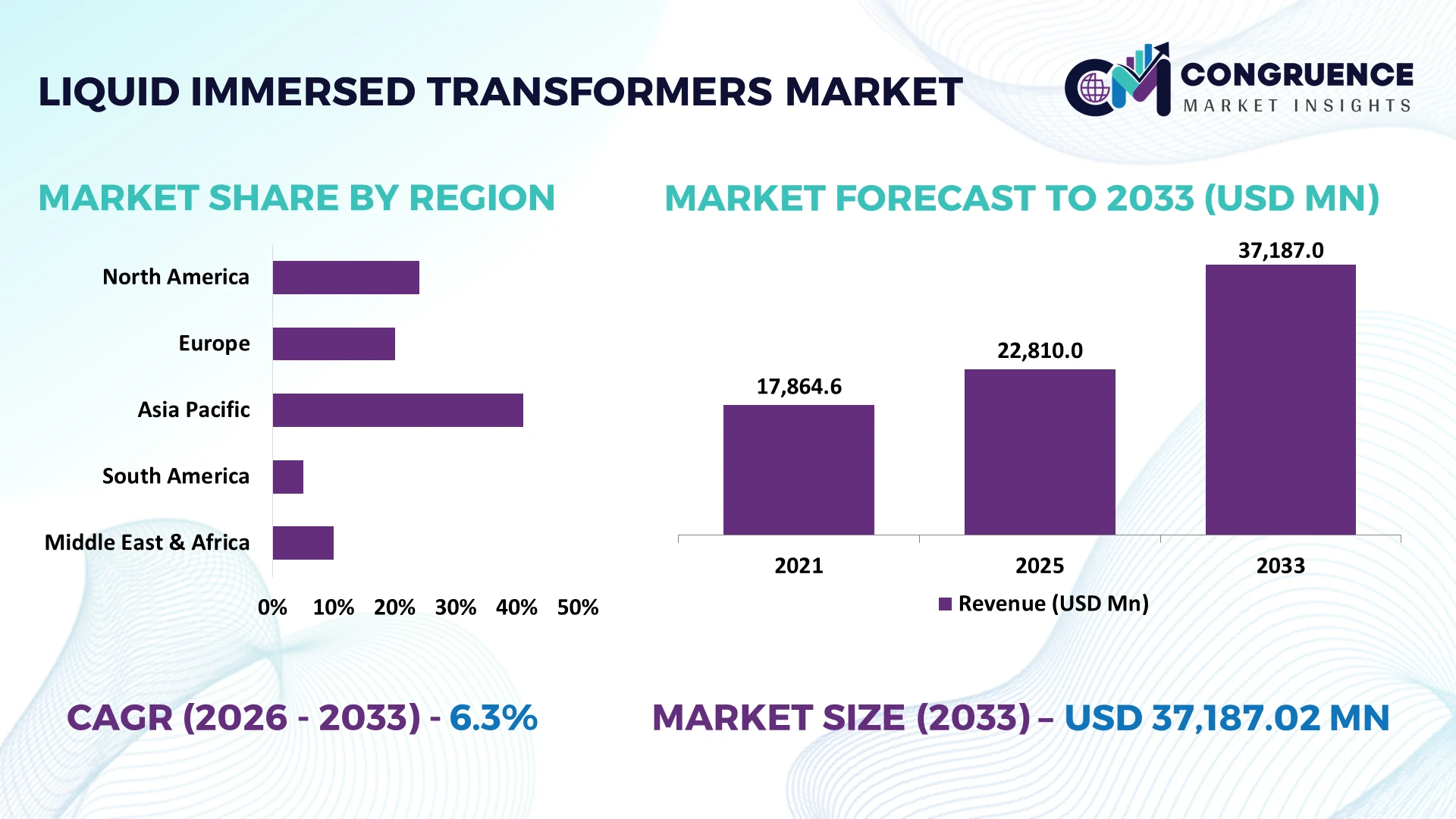
The Global Liquid-Immersed Transformers Market was valued at USD 22810 Million in 2025 and is anticipated to reach a value of USD 37187.02 Million by 2033 expanding at a CAGR of 6.3% between 2026 and 2033. Growth is driven by high-voltage transmission expansion, renewable energy grid integration, replacement of aging power transformers, and increasing adoption of high-efficiency ester-filled transformer technology.
China dominates the global liquid-immersed transformers industry through extensive electricity transmission infrastructure, domestic transformer manufacturing capacity, and large-scale renewable energy integration. China's State Grid and China Southern Power Grid support procurement across transmission and distribution networks, while the country's renewable power installations exceeded 1,400 GW of combined wind and solar capacity in 2024. India represents an important competing manufacturing and deployment market, supported by its target of 500 GW of non-fossil electricity capacity by 2030. China's ultra-high-voltage transmission program strengthens demand for large-capacity oil-immersed transformers.
Manufacturers prioritizing high-voltage equipment, low-loss magnetic cores, and domestic insulation-fluid supply chains are positioned to capture grid modernization contracts and improve procurement competitiveness.
Market Size & Growth: USD 22,810 million in 2025, reaching USD 37,187.02 million by 2033 at 6.3% CAGR, supported by transmission infrastructure expansion.
Top Growth Drivers: Global grid investment increased 9% in 2024; Chinese renewable capacity expanded 25%; solar installations increased 45%, accelerating transformer procurement.
Short-Term Forecast: By 2028, grid operators face procurement pressure as large power transformer lead times reach up to 4 years.
Emerging Technologies: AI-based dissolved gas analysis, digital monitoring, and natural ester insulation strengthen 3 critical capabilities: diagnostics, thermal management, and environmental protection.
Regional Leaders: Asia-Pacific leads manufacturing, North America prioritizes replacement, and Europe advances low-loss transformers; regional revenue projections remain unspecified.
Consumer/End-User Trends: Distribution networks received approximately 67% of global grid investment in 2024, reinforcing utility procurement demand.
Pilot/Case Example: China's 2024 renewable expansion added 373 GW, demonstrating substantial demand for grid-connected transformation infrastructure.
Competitive Landscape: Hitachi Energy, Siemens Energy, GE Vernova, Schneider Electric, and TBEA compete through manufacturing scale, insulation technology, and utility contracts.
Regulatory & ESG Impact: US transformer efficiency standards require compliance from April 2029, targeting USD 824 million in annual electricity savings across covered equipment.
Investment & Funding: Global grid investment reached USD 390 billion in 2024, directing capital toward transmission equipment and distribution modernization.
Innovation & Future Outlook: Advanced magnetic cores, biodegradable insulating fluids, and predictive maintenance support the transition toward digitally monitored, high-efficiency transformer fleets.
The global liquid-immersed transformers industry serves transmission utilities, renewable power developers, industrial substations, and high-capacity data center infrastructure. Advanced products increasingly incorporate online dissolved gas monitoring, vacuum tap changers, biodegradable dielectric fluids, and thermally optimized winding designs to improve operational reliability. Natural ester insulation offers an alternative to conventional mineral oil where fire safety and environmental performance influence equipment selection. Global electricity consumption is projected to grow close to 4% annually through 2027, intensifying pressure on transmission networks and transformer availability. These developments establish equipment efficiency, manufacturing localization, and lifecycle reliability as central considerations for strategic investment decisions.
Liquid-immersed transformers are becoming strategically important as electricity networks transition toward renewable integration, industrial electrification, and higher-capacity transmission systems. The International Energy Agency estimates that approximately 80 million kilometers of electricity grids require addition or refurbishment by 2040. This infrastructure transition is restructuring transformer procurement, with utilities prioritizing domestic manufacturing, shorter delivery schedules, and high-efficiency equipment. Manufacturers are consequently expanding production capacity and securing long-term agreements for electrical steel, copper conductors, and insulation components.
Technology differentiation increasingly influences lifecycle economics. Advanced amorphous-metal transformer cores can reduce no-load losses by approximately 60–70% compared with conventional grain-oriented silicon-steel designs, improving operating efficiency across continuously energized distribution networks. China emphasizes ultra-high-voltage transmission deployment, while the United States prioritizes aging infrastructure replacement and domestic manufacturing resilience. India combines distribution network modernization with renewable evacuation infrastructure, creating distinct opportunities for transformer manufacturers specializing in different voltage classes and cooling technologies.
Between 2026 and 2028, utilities are expected to prioritize digital condition monitoring, biodegradable insulating fluids, and standardized transformer platforms. Online dissolved gas analysis enables earlier detection of insulation deterioration and thermal faults, supporting condition-based maintenance. Manufacturers are investing in automated winding production, testing facilities, and utility partnerships to strengthen delivery reliability. Competitive advantage will increasingly depend on verified electrical performance, manufacturing flexibility, and lifetime asset management capabilities.
Large-scale grid reinforcement is accelerating procurement of liquid-immersed power and distribution transformers. China's installed solar capacity increased approximately 45% during 2024, while wind capacity expanded around 18%, intensifying requirements for grid interconnection and voltage transformation. India's renewable energy expansion similarly supports demand for high-capacity substations and specialized transformer configurations. Renewable generation introduces variable loading conditions, requiring improved thermal performance, insulation reliability, and voltage regulation. Manufacturers are responding through expanded transformer assembly operations, advanced cooling systems, and partnerships with transmission utilities. The strategic advantage lies in supplying transformers engineered for fluctuating renewable generation rather than conventional steady-load operation, improving equipment utilization and reducing grid integration constraints.
Material price escalation and concentrated component sourcing constrain liquid-immersed transformer manufacturing economics. International grid equipment assessments indicate that power transformer prices increased approximately 75% between 2018 and 2025, while procurement lead times for major components nearly doubled after 2021. Copper, grain-oriented electrical steel, and specialized insulating materials remain critical cost exposures. In the United States, limited domestic electrical steel processing capacity increases dependence on specialized supply networks, complicating procurement schedules and inventory planning. Manufacturers are negotiating multiyear material contracts, qualifying alternative suppliers, and localizing core fabrication. Securing electrical steel availability before accepting fixed-price transformer orders is increasingly essential for protecting production margins and contractual delivery commitments.
Advanced transformer retrofits create opportunities beyond conventional equipment replacement. India's electricity demand increased 5.8% in 2024, while national peak electricity load reached 250 GW, approximately 68% above its 2014 level. These conditions strengthen the commercial case for thermally optimized distribution transformers and digital condition assessment. Amorphous-metal cores can deliver 60–70% lower no-load losses than conventional silicon-steel cores, particularly benefiting continuously energized networks with variable loading. Emerging integration of fiber-optic temperature sensors, online dissolved gas analysis, and predictive analytics supports maintenance optimization. Manufacturers are developing modular monitoring packages and partnering with utilities to retrofit existing fleets. The strongest opportunity combines transformer efficiency upgrades with recurring diagnostic and lifecycle management services.
Scaling advanced liquid-immersed transformer deployment requires coordinated engineering, commissioning, and long-term maintenance capabilities. Global grid construction and maintenance employs approximately 8 million workers, with an additional 1.5 million required by 2030 to meet existing policy objectives, representing nearly 19% workforce expansion. In India, electricity demand increased 8.5% during the first half of 2024, highlighting the operational pressure created by seasonal load fluctuations. Integrating transformers with digital substations requires compatible communication protocols, cybersecurity controls, and accurate thermal loading models. Manufacturers must expand technician certification, automated testing, and digital engineering capabilities. Competitive differentiation increasingly depends on commissioning accuracy, cybersecurity readiness, and reliable performance under rapidly changing grid operating conditions.
Automated Transformer Manufacturing Gains Momentum: Transformer manufacturers are expanding robotic winding, automated core stacking, and vacuum drying processes to improve production consistency. Global transformer prices increased approximately 75% between 2018 and 2025, while procurement lead times for large units extended toward 4 years. Hitachi Energy and Siemens Energy are expanding manufacturing operations and advanced testing capabilities to address equipment shortages. Automated production reduces dependence on manual assembly processes and strengthens quality control across high-voltage transformer platforms.
Ester Fluid Adoption Reshapes Insulation: Natural ester dielectric fluids offer fire points above 300°C, compared with approximately 170°C for conventional mineral transformer oil. Their biodegradability exceeds 90% under recognized testing conditions, supporting deployment near sensitive infrastructure. Utilities increasingly specify ester-compatible sealing systems, insulation materials, and thermal designs. Manufacturers are expanding ester-filled transformer portfolios and collaborating with fluid suppliers to strengthen fire safety performance and simplify environmental compliance.
Digital Transformer Diagnostics Become Standardized: Online dissolved gas analysis increasingly combines hydrogen detection, moisture measurement, and thermal monitoring within integrated asset management platforms. Modern systems monitor up to 9 diagnostic gases, compared with traditional periodic laboratory sampling. Utilities are adopting continuous monitoring for critical transmission assets, while equipment manufacturers integrate communication interfaces and automated alarm functions. This transition improves fault visibility and supports more precise maintenance scheduling.
Domestic Manufacturing Restructures Equipment Procurement: United States transformer supply chains are shifting toward localized assembly, component sourcing, and capacity reservation agreements. Domestic production currently satisfies approximately 20% of large power transformer requirements, reflecting substantial import dependence. Federal infrastructure programs and utility replacement schedules are encouraging manufacturers to expand local facilities. Strategic sourcing agreements increasingly prioritize guaranteed delivery capacity, specialized electrical steel availability, and equipment qualification over conventional lowest-price procurement.
Oil-Immersed Transformers represent the broad equipment category, while Mineral Oil Transformers remain the dominant insulation configuration across conventional transmission and distribution networks. Their installed-base dominance reflects established manufacturing processes, standardized maintenance procedures, and compatibility with existing utility infrastructure. Mineral oil generally offers dielectric strength exceeding 30 kV under standard breakdown testing, supporting reliable operation across multiple voltage classes. Conservator-Type Transformers remain important for large-capacity installations requiring oil expansion management and continuous thermal operation. Sealed-Type Transformers serve compact distribution installations where reduced moisture ingress and simplified maintenance are priorities. Manufacturers continue refining core construction, cooling arrangements, and insulation processing to improve lifecycle performance.
Natural Ester Transformers represent an expanding technology category, supported by environmental protection requirements and improved fire safety characteristics. Natural ester fluids offer fire points above 300°C and biodegradability exceeding 90% under appropriate test conditions. Synthetic Ester Transformers provide an alternative where controlled dielectric performance and high fire resistance are required. Suppliers are broadening ester-compatible equipment portfolios, investing in fluid qualification, and adapting transformer designs for different viscosity and cooling characteristics.
Power Distribution represents the principal application for liquid-immersed transformers, supported by extensive medium-voltage networks, utility substations, and electricity delivery infrastructure. Distribution networks accounted for approximately 67% of worldwide grid investment in 2024, indicating the scale of infrastructure spending supporting transformer procurement. Oil-filled distribution transformers remain important for managing voltage conversion, feeder loading, and electricity losses across urban and rural networks. Power Transmission requires larger transformer capacities and specialized insulation systems for high-voltage interconnections. Grid Substations depend on high-reliability equipment with advanced cooling, voltage regulation, and protection compatibility. Manufacturers are expanding standardized distribution transformer platforms while retaining customized engineering capabilities for transmission installations.
Renewable Energy Integration represents a rapidly expanding application as solar and wind generation reshape power flows. The International Energy Agency projects approximately 4,600 GW of renewable capacity additions between 2025 and 2030, with solar accounting for nearly 80% of expansion. Industrial Power Supply requires equipment designed for continuous operation and fluctuating production loads, while Railway Electrification emphasizes traction-compatible transformer configurations. Suppliers are strengthening project engineering, automated testing, and application-specific product development.
Power Utilities constitute the dominant end-user group for liquid-immersed transformers, reflecting their responsibility for transmission assets, distribution networks, and substation reliability. Approximately two-thirds of global grid investment was allocated to distribution infrastructure in 2024, demonstrating the concentration of equipment procurement within regulated electricity networks. Utilities favor standardized transformer specifications, established maintenance procedures, and long-duration service agreements to control lifecycle expenditure. Industrial Manufacturing represents another important customer category, particularly across steelmaking, chemicals, cement production, and continuous-process facilities. Oil and Gas operators require robust insulation and cooling performance, while Mining companies prioritize mechanical durability and dependable operation under variable electrical loads. Manufacturers are adapting warranties, maintenance contracts, and technical support to these operating environments.
Data Centers represent a rapidly expanding end-user category as artificial intelligence infrastructure increases electricity requirements. Global data center electricity consumption increased 17% in 2025, compared with 3% growth in overall electricity demand. Renewable Energy Operators are procuring specialized transformers for generation interconnection, while Railways and Commercial Infrastructure require compact, reliable voltage conversion equipment. Suppliers are strengthening partnerships with engineering contractors and developing application-specific transformer packages to capture high-value installations.
Asia-Pacific accounted for the largest market share at approximately 45% in 2025 however, Middle East & Africa is expected to register the fastest growth, expanding at a CAGR of approximately 7.5% between 2026 and 2033.
Grid Asset Replacement and Domestic Manufacturing Expansion
North America represents a major liquid-immersed transformers market, supported by aging electricity infrastructure, utility modernization programs, and expanding high-voltage transmission requirements. The United States accounts for the largest regional deployment base, while Canada contributes demand through hydropower infrastructure and interprovincial transmission development. Approximately 70% of US transmission lines are approaching the latter half of their expected service lives, increasing requirements for transformer replacement and substation refurbishment. The US Department of Energy has identified transformer supply availability as a critical infrastructure concern, encouraging domestic production and manufacturing capacity expansion. Canadian utilities are investing in grid interconnections and equipment capable of operating under severe climatic conditions. Manufacturers are responding with localized assembly, enhanced insulation systems, and long-term procurement agreements. Regional competition increasingly centers on equipment delivery certainty, utility qualification, and lifecycle maintenance capabilities.
United States Market Outlook: The United States leads regional transformer procurement through extensive transmission infrastructure, electricity distribution networks, and industrial electrification projects. The Department of Energy's Grid Resilience and Innovation Partnerships program provides approximately USD 10.5 billion in funding opportunities for grid modernization. Domestic manufacturers are expanding transformer production facilities, while utilities prioritize high-efficiency equipment and condition monitoring technologies to strengthen network reliability.
Eco-Design Compliance and Cross-Border Grid Modernization
Europe's liquid-immersed transformers industry is shaped by stringent energy efficiency regulations, aging distribution infrastructure, and cross-border electricity integration. The European Union's Ecodesign Regulation 548/2014 establishes transformer efficiency requirements, with Tier 2 standards applying since July 2021. Germany, France, Italy, and the United Kingdom represent important equipment procurement and manufacturing markets. The European Commission estimates that approximately EUR 584 billion in electricity grid investment is required by 2030, strengthening demand for high-voltage transformers and distribution network equipment. Manufacturers are developing lower-loss magnetic cores, ester-compatible insulation systems, and digitally monitored transformer configurations. Offshore wind connections and transmission reinforcement are creating opportunities for specialized high-capacity equipment. Procurement decisions increasingly reflect lifetime energy losses, environmental compliance, and interoperability with advanced grid management systems rather than initial equipment pricing alone.
Germany Market Outlook: Germany maintains a strong position through its electrical engineering industry, industrial power infrastructure, and transmission network expansion. The country generated approximately 59% of its public net electricity production from renewable sources in 2024. Major transmission operators are advancing high-voltage grid projects, creating demand for transformers with advanced cooling, voltage regulation, and diagnostic capabilities. Domestic engineering expertise supports customized equipment development.
Manufacturing Scale and Ultra-High-Voltage Deployment Leadership
Asia-Pacific dominates the global liquid-immersed transformers market through concentrated manufacturing capacity, extensive power transmission investment, and large-scale industrial electricity consumption. China leads regional production and deployment, supported by State Grid infrastructure programs and established transformer component supply chains. India represents an important expansion market through transmission reinforcement, industrial electrification, and distribution infrastructure modernization. Japan and South Korea contribute advanced insulation engineering, high-efficiency magnetic materials, and specialized transformer manufacturing capabilities. China's ultra-high-voltage transmission network includes projects operating at 1,000 kV AC and ±800 kV DC, supporting long-distance electricity transfer between generation centers and industrial demand clusters. Manufacturers are expanding automated winding operations, high-voltage testing facilities, and localized component production. Regional suppliers benefit from manufacturing economies of scale, established electrical steel processing capabilities, and proximity to major utility procurement programs.
China Market Outlook: China anchors regional transformer manufacturing through vertically integrated electrical equipment production and extensive transmission construction. State Grid announced plans to invest more than CNY 650 billion in electricity networks during 2025. Manufacturers including TBEA and China XD Electric supply high-capacity transformers for domestic and international infrastructure projects. Advanced manufacturing capabilities support equipment customization, export competitiveness, and ultra-high-voltage engineering leadership.
Renewable Transmission Expansion and Utility Network Reinforcement
South America's liquid-immersed transformers market is supported by hydroelectric generation, renewable electricity expansion, and transmission infrastructure modernization. Brazil dominates regional equipment procurement through its extensive interconnected electricity system and established transformer manufacturing industry. Chile contributes demand through solar generation integration and long-distance transmission projects, while Argentina requires network reinforcement and industrial power infrastructure upgrades. Brazil's electricity generation mix exceeded 88% renewable sources in 2024, creating substantial requirements for reliable voltage transformation and transmission connectivity. Regional manufacturers are prioritizing transformers designed for tropical operating conditions, variable generation profiles, and remote installations. Import dependence for specialized components and infrastructure permitting requirements influence project schedules. Utilities increasingly structure procurement around equipment durability, local servicing capabilities, and long-term maintenance arrangements to improve operational resilience.
Brazil Market Outlook: Brazil leads regional deployment through hydroelectric infrastructure, industrial electricity consumption, and expanding renewable generation connections. The country's electricity regulator, ANEEL, conducts transmission auctions that support new substations and network reinforcement. Domestic manufacturing operations, including facilities serving high-voltage equipment markets, provide procurement advantages through localized engineering, technical support, and reduced dependence on fully assembled transformer imports.
Utility Infrastructure Investment and Industrial Electrification
The Middle East & Africa liquid-immersed transformers market is shaped by electricity infrastructure investment, industrial diversification, and increasing requirements for reliable high-voltage transmission. Saudi Arabia and the United Arab Emirates are expanding grid capacity to accommodate industrial development, large-scale construction, and renewable generation. Egypt contributes demand through electricity network reinforcement and regional interconnection projects, while South Africa prioritizes equipment replacement and transmission reliability. Saudi Arabia targets approximately 50% renewable electricity generation by 2030, requiring extensive grid integration and transformer capacity expansion. Equipment suppliers are developing configurations suited to high ambient temperatures, dust exposure, and demanding industrial operating conditions. Regional manufacturing partnerships and localized servicing arrangements are becoming important procurement considerations. Utility investment increasingly favors equipment with enhanced cooling, robust insulation, and dependable maintenance support.
Saudi Arabia Market Outlook: Saudi Arabia represents a strategically important transformer market through Saudi Electricity Company's transmission infrastructure programs and the country's industrial diversification agenda. The Kingdom targets 130 GW of renewable energy capacity by 2030. Grid expansion associated with renewable integration, industrial zones, and large infrastructure developments supports procurement of high-capacity liquid-immersed transformers. Local manufacturing partnerships strengthen equipment availability and technical servicing capabilities.
The global liquid-immersed transformers market features competition between multinational engineering leaders Hitachi Energy, Siemens Energy, and GE Vernova and manufacturing-focused challengers TBEA, China XD Electric, and HD Hyundai Electric. The five leading power transformer suppliers collectively represent approximately 41% of global market value, indicating moderate concentration. Competition centers on high-voltage engineering, delivery reliability, electrical efficiency, and localized manufacturing. Amorphous-metal cores offer approximately 60–70% lower no-load losses, while natural ester insulation provides biodegradability exceeding 90%, strengthening product differentiation. Hitachi Energy and Siemens Energy are expanding transformer manufacturing capacity, while GE Vernova strengthens integrated grid equipment capabilities. Chinese manufacturers leverage domestic component ecosystems and large-scale production to compete on procurement costs. Increasing utility qualification requirements, specialized electrical steel availability, and high-voltage testing infrastructure create substantial entry barriers. Winning suppliers combine certified performance, dependable delivery schedules, application-specific engineering, and comprehensive lifecycle service capabilities to secure long-term utility relationships worldwide.
Hitachi Energy
Siemens Energy
GE Vernova
TBEA Co., Ltd.
China XD Electric Co., Ltd.
HD Hyundai Electric
Hyosung Heavy Industries
Mitsubishi Electric Corporation
Toshiba Energy Systems & Solutions Corporation
CG Power and Industrial Solutions Limited
Bharat Heavy Electricals Limited
WEG S.A.
Schneider Electric SE
Elsewedy Electric
Current liquid-immersed transformer technology emphasizes low-loss magnetic cores, optimized winding geometries, and advanced dielectric insulation. Amorphous-metal cores reduce no-load losses by approximately 60–70% compared with conventional silicon-steel designs, improving efficiency in continuously energized distribution networks. Natural ester insulating fluids provide fire points above 300°C, against approximately 170°C for mineral oil, while achieving biodegradability exceeding 90% under applicable testing conditions. Utilities increasingly specify ester-compatible transformers for environmentally sensitive installations, encouraging manufacturers to expand insulation qualification and thermal engineering capabilities.
Emerging technologies integrate online dissolved gas analysis, fiber-optic temperature sensing, and automated condition monitoring. Advanced diagnostic platforms measure up to nine dissolved gases, enabling earlier identification of insulation deterioration, overheating, and electrical discharge. Digital monitoring is increasingly deployed on critical transmission transformers rather than entire distribution fleets. Manufacturers integrating sensor hardware with asset management software gain advantages through maintenance contracts, equipment diagnostics, and improved service differentiation.
Between 2026 and 2028, transformer innovation will prioritize intelligent cooling controls, digital twins, and automated manufacturing inspection. Machine-learning diagnostics will combine thermal loading histories with dielectric condition measurements to support maintenance decisions. High-voltage equipment suppliers investing in interoperable monitoring platforms and advanced testing infrastructure will strengthen utility qualification, operational reliability, and lifecycle competitiveness.
May 2025: GE Vernova secured a POWERGRID contract to supply over 70 units of 765 kV transformers and shunt reactors for Indian renewable transmission corridors. Manufacturing in Vadodara strengthens domestic equipment availability and supports high-voltage grid expansion. Source: gevernova.com.
September 2026: Hitachi Energy announced a $528 million transformer manufacturing facility in Mississippi, designed to double local production capacity and create over 700 jobs. The expansion strengthens domestic distribution transformer supply and supports electricity infrastructure resilience. Source: reuters.com.
February 2024: Siemens Energy announced a $150 million investment in Charlotte, North Carolina, establishing domestic large power transformer manufacturing. Planned production reaches 57 units annually at full capacity, reducing import dependence and strengthening utility equipment supply reliability. Source: siemens-energy.com.
April 2024: The US Department of Energy finalized updated distribution transformer efficiency standards, establishing a five-year compliance transition. The regulations target $824 million in annual electricity savings, encouraging manufacturers to improve magnetic core efficiency and domestic production readiness. Source: energy.gov.
The Liquid-Immersed Transformers Market Report evaluates industry performance from 2025 through 2033, covering equipment technologies, application requirements, end-user procurement, and competitive positioning. Type segmentation examines oil-immersed, mineral oil, natural ester, synthetic ester, sealed-type, and conservator-type transformers. Application coverage includes power transmission, distribution, renewable energy integration, industrial power supply, grid substations, and railway electrification. End-user analysis addresses utilities, renewable operators, manufacturing, oil and gas, mining, railways, commercial infrastructure, and data centers.
Regional assessment covers North America, Europe, Asia-Pacific, South America, and Middle East & Africa, examining manufacturing concentration, procurement priorities, and infrastructure investment. Technology coverage evaluates amorphous cores delivering 60–70% lower no-load losses, digital diagnostics, advanced cooling, and biodegradable insulation. Competitive analysis supports manufacturing investment, supplier selection, geographic expansion, and strategic positioning throughout 2026–2033.
| Report Attribute/Metric | Report Details |
|---|---|
Market Revenue in 2025 | USD 22810 Million |
Market Revenue in 2033 | USD 37187.02 Million |
CAGR (2026 - 2033) | 6.3% |
Base Year | 2025 |
Forecast Period | 2026 - 2033 |
Historic Period | 2021 - 2025 |
Segments Covered | By Type
By Application
By End-User
|
Key Report Deliverable | Revenue Forecast, Growth Trends, Market Dynamics, Segmental Overview, Regional and Country-wise Analysis, Competition Landscape |
Region Covered | North America, Europe, Asia-Pacific, South America, Middle East, Africa |
Key Players Analyzed | Hitachi Energy, Siemens Energy, GE Vernova, TBEA Co., Ltd., China XD Electric Co., Ltd., HD Hyundai Electric, Hyosung Heavy Industries, Mitsubishi Electric Corporation, Toshiba Energy Systems & Solutions Corporation, CG Power and Industrial Solutions Limited, Bharat Heavy Electricals Limited, WEG S.A., Schneider Electric SE, Elsewedy Electric |
Customization & Pricing | Available on Request (10% Customization is Free) |




