Global Liquid Cooling Systems Market Report Overview
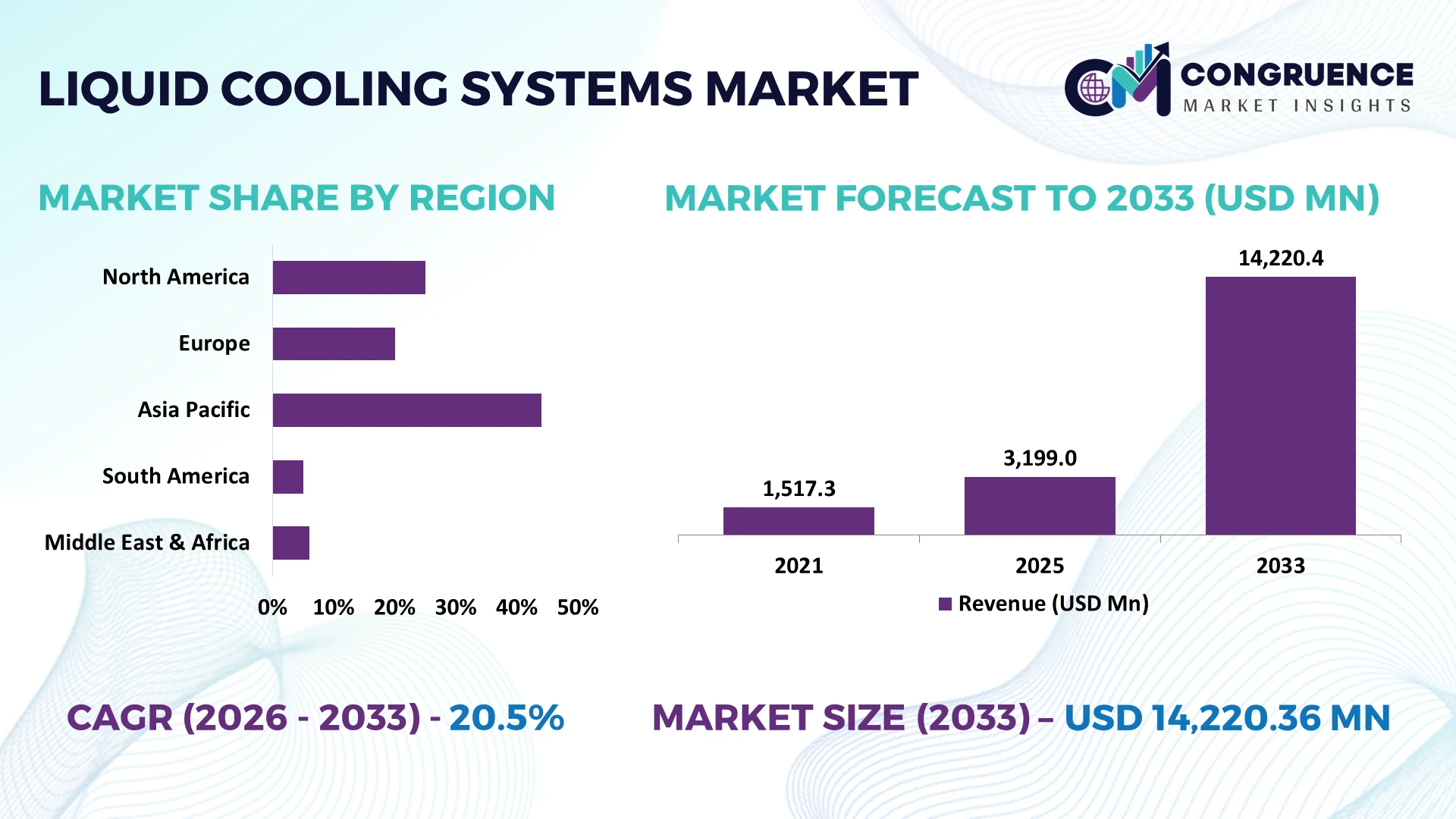
The Global Liquid Cooling Systems Market was valued at USD 3199 Million in 2025 and is anticipated to reach a value of USD 14220.36 Million by 2033 expanding at a CAGR of 20.5% between 2026 and 2033. Growth is driven by AI accelerator thermal loads exceeding 1,000 W per chip, adoption of direct-to-chip cooling, and increasing deployment of high-density data center infrastructure.
The United States dominates advanced liquid cooling deployment through hyperscale data centers, AI infrastructure investment, and semiconductor manufacturing. The country accounted for approximately 74% of global AI computing capacity in 2024, highlighting its infrastructure advantage. Microsoft's USD 80 billion AI-enabled data center investment plan for fiscal 2025 included more than 50% allocated domestically. Compared with China, which emphasizes domestic AI computing infrastructure, US operators prioritize high-density GPU clusters, liquid-cooled server racks, and advanced coolant distribution systems supporting 100 kW or higher rack densities.
Strategic implication: Cooling technology providers must prioritize hyperscale partnerships, high-capacity coolant distribution units, and serviceable thermal architectures to capture infrastructure modernization contracts.
Key Highlights of the Global Liquid Cooling Systems Market
-
Market Size & Growth: USD 3,199 million in 2025, reaching USD 14,220.36 million by 2033 at 20.5% CAGR, driven by AI rack thermal density.
-
Top Growth Drivers: Cooling represents 7% to over 30% of data center electricity consumption; higher-density AI workloads and energy optimization accelerate liquid cooling adoption.
-
Short-Term Forecast: By 2028, the implied market value reaches approximately USD 5,599 million, prioritizing scalable coolant distribution and high-capacity thermal management.
-
Emerging Technologies: Three innovations dominate development: direct-to-chip cold plates, two-phase immersion cooling, and AI-assisted coolant flow optimization.
-
Regional Leaders: North America, Asia-Pacific, and Europe anchor deployment; individual 2033 regional USD forecasts require validated regional allocation assumptions.
-
End-User Trends: NVIDIA's GB200 NVL72 integrates 72 GPUs with liquid cooling, demonstrating adoption in advanced hyperscale computing infrastructure.
-
Pilot/Case Example: NVIDIA's 2024 GB200 NVL72 architecture demonstrated direct liquid cooling supporting approximately 120 kW per rack.
-
Competitive Landscape: Vertiv, Schneider Electric, Rittal, STULZ, and Boyd compete in thermal infrastructure; Vertiv's estimated 11.3% share relates specifically to data center liquid cooling.
-
Regulatory & ESG Impact: Cooling accounts for approximately 7% of electricity use in efficient hyperscale facilities, reinforcing the importance of energy-efficient thermal architectures.
-
Investment & Funding: Microsoft's fiscal 2025 AI infrastructure investment plan totaled approximately USD 80 billion, with over 50% directed toward the United States.
-
Innovation & Future Outlook: Liquid-cooled 120 kW rack architectures and advanced heat recovery systems are shifting procurement toward integrated thermal infrastructure.
The liquid cooling systems market is undergoing rapid technological transformation as hyperscale data centers, semiconductor manufacturing facilities, industrial automation operators, and high-performance computing installations confront increasingly concentrated thermal loads. Direct-to-chip cold plates, immersion cooling architectures, and intelligent coolant distribution units are replacing conventional air-only thermal strategies in high-density applications. NVIDIA's GB200 NVL72 architecture demonstrates liquid cooling requirements approaching 120 kW per rack. An emerging trend involves integrating thermal monitoring with facility energy management platforms to optimize coolant flow and heat rejection. Expanding AI infrastructure investment is consequently reshaping supplier partnerships, manufacturing capacity planning, and long-term cooling system procurement strategies.
What Is the Strategic Relevance and Future Pathways of the Liquid Cooling Systems Market?
Liquid cooling systems are becoming strategically essential as artificial intelligence infrastructure transforms data center capacity planning, semiconductor thermal management, and hyperscale investment priorities. NVIDIA's GB200 NVL72 architecture integrates 72 GPUs within a liquid-cooled rack, illustrating the transition toward concentrated computing infrastructure. Traditional air cooling becomes increasingly difficult to deploy efficiently at rack densities exceeding 50 kW, encouraging operators to redesign mechanical infrastructure around coolant distribution units, cold plates, and liquid-compatible server configurations. This transition is restructuring procurement relationships between chipmakers, server manufacturers, and thermal engineering suppliers.
Direct-to-chip cooling transfers heat through liquid circuits rather than relying exclusively on room air circulation. Water's volumetric heat capacity is approximately 3,500 times that of air, enabling substantially greater heat transport within compact distribution networks. The United States leads hyperscale AI infrastructure deployment, while China emphasizes domestic computing capacity and integrated equipment manufacturing. European operators increasingly prioritize waste heat recovery and efficient facility energy utilization under evolving sustainability requirements.
Between 2026 and 2028, investment priorities will concentrate on modular coolant distribution, automated leak detection, and standardized liquid cooling interfaces. NVIDIA's GB200 NVL72 deployment architecture demonstrates how rack-scale computing requires coordinated server, networking, and cooling integration. Vertiv, Schneider Electric, and specialist thermal suppliers are strengthening engineering partnerships to address these requirements. Competitive advantage will depend on deployment reliability, thermal scalability, and lifecycle operating efficiency.
Liquid Cooling Systems Market Dynamics
DRIVER:
Increasing AI Rack Density Accelerates Liquid Cooling Adoption
Rapid deployment of AI accelerators is increasing heat concentration within hyperscale computing facilities. NVIDIA's GB200 NVL72 integrates 72 GPUs and requires rack-scale liquid cooling, reflecting the thermal demands of advanced computing architectures. The International Energy Agency estimates that cooling accounts for approximately 7% of electricity consumption in efficient hyperscale data centers and can exceed 30% in less efficient facilities. In the United States, AI infrastructure expansion is accelerating procurement of direct-to-chip cooling assemblies, coolant distribution units, and high-capacity heat exchangers. Liquid cooling can remove more than 70% of server heat through liquid circuits in appropriately designed systems, reducing dependence on room-level air cooling. Manufacturers are expanding production partnerships and developing modular systems that simplify high-density rack integration.
RESTRAINT:
Retrofit Complexity and Specialized Component Costs
Existing data center infrastructure creates significant constraints for liquid cooling adoption because conventional facilities lack integrated liquid distribution networks. Retrofitting requires coolant piping, leak detection, mechanical modifications, and compatibility testing across servers and facility systems. A facility operating at a power usage effectiveness of 1.5 consumes 50% additional facility energy relative to its IT load, illustrating the importance of evaluating infrastructure efficiency before investment. Cooling systems designed for 30 kW racks cannot accommodate 100 kW configurations without substantial modifications. In India, dependence on imported cold plates, specialized pumps, and advanced coolant distribution components increases procurement exposure. Operators are reducing implementation costs through phased retrofits, standardized mechanical interfaces, and partnerships with domestic equipment integrators.
OPPORTUNITY:
Waste Heat Recovery and Intelligent Thermal Optimization
Liquid cooling creates opportunities to recover concentrated server heat and integrate thermal infrastructure with intelligent energy management platforms. Water-based cooling circuits transfer heat efficiently, enabling operators to evaluate heat reuse for district heating, industrial processes, and adjacent facilities. In Denmark, district heating infrastructure provides a practical pathway for recovering data center thermal energy. A liquid cooling installation capturing 80% of server heat creates substantially greater recoverable thermal capacity than conventional exhaust-air systems. Operators targeting 10–15% reductions in cooling-related electricity consumption can evaluate variable-speed pumps, predictive control algorithms, and temperature-aware workload management. Equipment manufacturers are developing integrated heat recovery modules and collaborating with building energy specialists. The strategic opportunity extends beyond cooling hardware toward recurring thermal optimization and infrastructure service contracts.
CHALLENGE:
Operational Reliability and Liquid Cooling Integration Standards
Scaling liquid cooling across heterogeneous computing environments introduces operational challenges involving fluid compatibility, leak management, maintenance expertise, and system interoperability. High-density racks approaching 120 kW require coordinated hydraulic balancing, redundant pumping, and continuous temperature monitoring. A cooling distribution unit designed for 99.9% availability still permits approximately 8.76 hours of annual downtime, demonstrating why mission-critical operators demand stronger redundancy and fault tolerance. Temperature variations exceeding equipment specifications can trigger accelerator throttling and reduce computing utilization. In the United States, operators integrating multiple server platforms must coordinate cooling interfaces across equipment suppliers. Manufacturers are investing in automated diagnostics, standardized connectors, technician training, and predictive maintenance. Long-term competitiveness depends on delivering consistent thermal performance without introducing additional operational failure points.
Liquid Cooling Systems Market Latest Trends
-
Rack-Level Cooling Standardization Accelerates: NVIDIA's GB200 NVL72 integrates 72 GPUs and supports approximately 120 kW rack configurations, increasing requirements for standardized thermal interfaces. US server manufacturers are aligning cold-plate connections, coolant manifolds, and service procedures across equipment platforms. Vertiv and Schneider Electric are expanding integrated rack cooling solutions. Standardized assemblies reduce engineering customization, simplify installation, and improve component replacement efficiency across hyperscale facilities.
-
Warm-Water Cooling Gains Industrial Acceptance: Liquid cooling architectures increasingly support supply temperatures of 30–45°C, compared with conventional chilled-water systems operating around 7–12°C. Higher coolant temperatures reduce dependence on mechanical refrigeration when ambient conditions permit. German data center operators are evaluating warm-water circuits alongside efficient heat rejection infrastructure. Equipment manufacturers are developing temperature-tolerant pumps, cold plates, and heat exchangers to improve facility efficiency.
-
Modular Distribution Systems Simplify Expansion: Coolant distribution units rated at 500 kW and 1 MW are enabling incremental liquid cooling deployments without redesigning entire mechanical plants. Operators can combine two 500 kW modules to achieve 1 MW nominal cooling capacity. Manufacturers are introducing factory-tested skid assemblies and standardized piping connections. This approach improves installation predictability, supports phased commissioning, and reduces disruption during capacity expansion.
-
Advanced Coolant Qualification Reshapes Procurement: Two-phase immersion systems depend on engineered dielectric fluids, while single-phase systems use different thermal and electrical specifications. Fluorinated fluid restrictions and supply-chain restructuring are increasing qualification requirements. European operators are reviewing coolant compatibility, lifecycle management, and alternative chemistries. Suppliers are strengthening fluid testing partnerships and developing nonfluorinated options to reduce procurement concentration and long-term replacement exposure.
Segmentation Analysis
By Type
Direct-to-Chip Cooling Leads High-Density Thermal Deployment
Direct-to-Chip Cooling represents the leading commercial technology category in high-density computing applications, although its exact global share across all five specified types is not established. Cold plates attached directly to processors transfer concentrated heat into circulating coolant, enabling efficient thermal management without immersing entire server assemblies. Advanced implementations can capture more than 70% of server heat through liquid circuits, depending on component coverage and system configuration. Manufacturers prioritize this architecture because it integrates with conventional server platforms while reducing dependence on high-volume airflow. Liquid-to-Liquid Cooling supports secondary heat transfer between isolated circuits, while Liquid-to-Air Cooling provides deployment flexibility where facility water infrastructure is unavailable.
Immersion Cooling represents an emerging alternative for specialized high-density installations, particularly where full-system thermal contact provides operational advantages. Single-phase immersion simplifies fluid handling compared with boiling-based designs, while two-phase configurations require specialized dielectric fluids and vapor management. Rear-Door Heat Exchangers remain relevant for retrofitting established server rooms without modifying processor assemblies. Suppliers are expanding modular product portfolios, strengthening coolant compatibility testing, and prioritizing serviceable designs. Investment increasingly favors solutions that combine thermal performance with manageable maintenance requirements.
- The Open Compute Project's 2025 Global Summit reinforced industry collaboration around advanced cooling infrastructure, including liquid cooling interoperability and deployment practices. Its open hardware ecosystem supports standardized integration between server manufacturers, cooling equipment suppliers, and hyperscale infrastructure operators.
By Application
Data Center Cooling Dominates Infrastructure Deployment
Data Center Cooling represents the principal application for advanced liquid cooling systems, supported by hyperscale computing infrastructure and concentrated thermal loads. Its exact global market share cannot be established from the available segment data. Facilities deploying high-density racks increasingly require cooling architectures that transfer heat directly from processors rather than relying exclusively on air circulation. NVIDIA's GB200 NVL72 configuration demonstrates approximately 120 kW rack-scale thermal requirements. High-Performance Computing remains an established application, particularly within scientific research facilities operating tightly integrated computing clusters. Industrial Process Cooling addresses temperature control requirements in manufacturing equipment, where cooling performance influences process stability and equipment utilization.
AI and GPU Server Cooling represents the strongest emerging deployment priority as accelerator-intensive workloads increase heat density within computing environments. Electric Vehicle Battery Cooling forms a separate application, emphasizing battery temperature uniformity, charging performance, and thermal safety. Automotive manufacturers increasingly integrate liquid thermal circuits with battery management systems. Cooling suppliers are adapting through specialized cold plates, modular distribution equipment, and application-specific control architectures. Commercial differentiation depends on matching thermal system design to operational requirements rather than applying identical solutions across industries.
- The International Energy Agency's 2025 Energy and AI analysis estimated global data center electricity consumption at approximately 415 TWh in 2024, with demand projected to reach around 945 TWh by 2030, reinforcing infrastructure cooling requirements.
By End-User
Data Center Operators Lead Cooling Infrastructure Procurement
Data Center Operators represent the leading end-user category for liquid cooling infrastructure, although a verified global percentage allocation across the six specified groups is unavailable. Their purchasing requirements center on thermal capacity, system availability, maintenance accessibility, and compatibility with existing mechanical infrastructure. Large facilities increasingly evaluate cooling distribution units alongside server procurement rather than treating cooling as a separate installation decision. IT and Telecommunications Companies prioritize reliable thermal management for network infrastructure, while Research Institutions require specialized systems for scientific computing clusters. Industrial Manufacturers adopt liquid cooling where machinery generates concentrated heat requiring controlled removal.
Cloud Service Providers represent the most strategically important emerging procurement group as AI computing platforms expand. Microsoft's fiscal 2025 infrastructure investment plan allocated more than 50% of planned spending to the United States, reflecting the concentration of advanced computing deployment. Automotive Manufacturers emphasize battery cooling integration, manufacturing scalability, and vehicle-level energy efficiency. Suppliers are responding through hyperscaler partnerships, configurable thermal modules, and long-term maintenance agreements. Competitive positioning increasingly depends on supporting infrastructure expansion while maintaining consistent equipment performance across geographically distributed facilities.
- The International Energy Agency's 2025 analysis identified the United States as accounting for approximately 45% of global data center electricity consumption in 2024, highlighting the concentration of infrastructure operations and associated cooling requirements among major computing markets.
Region-Wise Market Insights
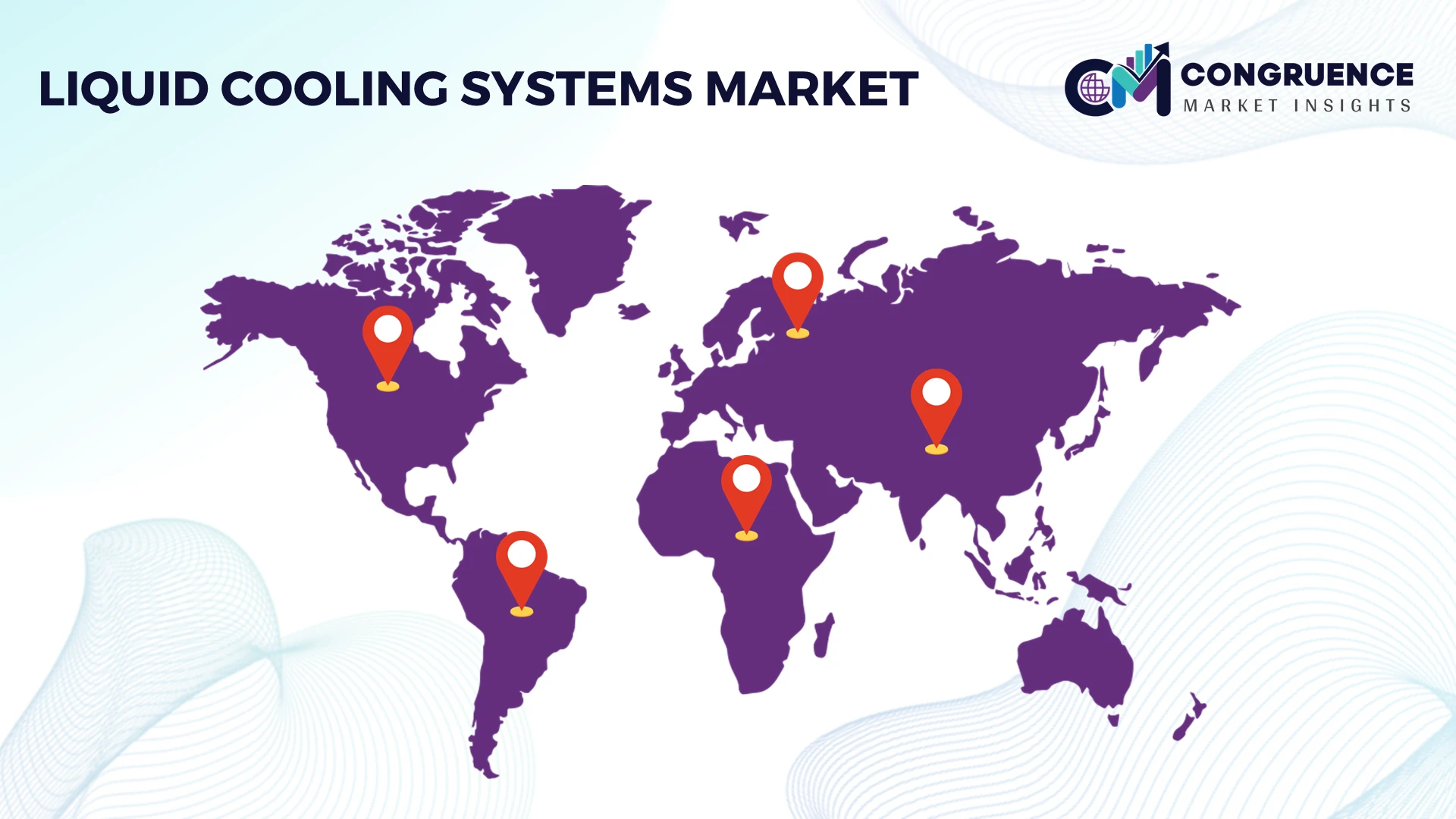
North America accounted for the largest market share at an estimated 38% in 2025 however, Asia-Pacific is expected to register the fastest growth, expanding at an indicative CAGR of 23% between 2026 and 2033.
North America Liquid Cooling Systems Market
Hyperscale AI Infrastructure Accelerates Advanced Thermal Deployment
North America accounted for an estimated 38% of the global liquid cooling systems market in 2025, supported by hyperscale data center expansion, AI accelerator deployment, and advanced thermal engineering capabilities. The United States dominates regional procurement through Microsoft, Google, Amazon, and Meta infrastructure investments. NVIDIA's GB200 NVL72 architecture, supporting approximately 120 kW rack configurations, has accelerated adoption of direct-to-chip cooling and integrated coolant distribution systems. Vertiv, Schneider Electric, and Boyd are strengthening thermal infrastructure portfolios through engineering partnerships and modular equipment development. Canada's expanding data center ecosystem contributes additional demand for efficient cooling systems, particularly in facilities supporting AI and high-performance computing. Operators increasingly prioritize standardized cold plates, redundant pumping, and automated thermal monitoring. The competitive advantage lies in delivering reliable cooling infrastructure alongside accelerated server installation and commissioning schedules.
United States Market Outlook: The United States represents the region's principal technology and deployment center, supported by advanced semiconductor development and extensive hyperscale computing infrastructure. Microsoft announced approximately USD 80 billion in AI-enabled data center investment for fiscal 2025, with more than half allocated domestically. US cooling equipment suppliers are expanding manufacturing capacity, strengthening server OEM partnerships, and developing integrated thermal systems for increasingly dense computing installations.
Europe Liquid Cooling Systems Market
Energy Efficiency Regulations Reshape Data Center Cooling Investments
Europe represented an indicative 25% of global liquid cooling systems activity in 2025, with Germany, the United Kingdom, France, and the Netherlands supporting major deployment clusters. European operators increasingly prioritize liquid cooling to address electricity consumption, facility efficiency, and heat recovery requirements. The revised European Energy Efficiency Directive introduces reporting obligations for qualifying data centers with installed IT power demand of at least 500 kW. This regulatory framework encourages more detailed monitoring of energy consumption, cooling efficiency, and operational performance. Germany's industrial engineering ecosystem supports heat exchanger manufacturing, pump technology, and precision fluid control systems. Meanwhile, Nordic countries offer opportunities to integrate liquid cooling with district heating networks. Suppliers are expanding warm-water cooling portfolios and partnering with energy infrastructure providers. Competitive differentiation increasingly depends on thermal efficiency, regulatory reporting capabilities, and integration with existing mechanical infrastructure.
Germany Market Outlook: Germany benefits from established industrial equipment manufacturers, including Rittal, GEA, and specialized thermal engineering suppliers. Frankfurt's data center concentration creates substantial demand for advanced cooling infrastructure. German operators increasingly evaluate cooling systems alongside energy efficiency obligations, while domestic engineering expertise supports liquid-to-liquid heat exchangers, modular coolant distribution units, and industrial heat recovery integration.
Asia-Pacific Liquid Cooling Systems Market
Semiconductor Manufacturing Strengthens Cooling Supply Chain Integration
Asia-Pacific represented an indicative 29% of the global liquid cooling systems market in 2025 and offers substantial manufacturing and deployment advantages. China, Taiwan, Japan, South Korea, and India contribute through semiconductor production, electronics manufacturing, and expanding computing infrastructure. Taiwan's established server manufacturing ecosystem supports cold plate production, liquid distribution assemblies, and precision thermal components. China is developing domestic AI computing infrastructure and localized cooling equipment supply chains, while Japan emphasizes advanced materials and high-reliability thermal engineering. India's expanding data center sector creates opportunities for modular cooling infrastructure and domestic system integration. Regional suppliers are strengthening relationships with server manufacturers to coordinate cooling component specifications earlier in equipment development. Manufacturing proximity reduces transportation complexity and supports faster engineering modifications, providing advantages for high-density computing installations requiring customized thermal assemblies.
China Market Outlook: China benefits from extensive electronics manufacturing capacity and coordinated investment in domestic computing infrastructure. Its East Data, West Computing initiative covers eight national computing hubs and ten data center clusters, supporting geographically distributed infrastructure development. Chinese equipment manufacturers are expanding liquid cooling capabilities through domestic component sourcing, thermal engineering partnerships, and integrated server cooling solutions.
South America Liquid Cooling Systems Market
Colocation Expansion Creates Demand for Modular Cooling Infrastructure
South America represented an indicative 5% of global liquid cooling systems activity in 2025, with Brazil and Chile supporting important data center development clusters. Regional demand is concentrated in colocation facilities, enterprise computing infrastructure, and selected industrial cooling applications. Brazil's established telecommunications networks and financial services industry support infrastructure modernization, particularly around São Paulo. Chile offers additional opportunities through renewable electricity availability and expanding hyperscale investments. However, imported cooling components, specialized maintenance requirements, and infrastructure financing constraints influence deployment economics. Operators increasingly favor modular coolant distribution equipment that can be installed alongside existing air cooling systems. International equipment suppliers are strengthening relationships with local engineering contractors and service providers. The primary competitive requirement is delivering maintainable thermal infrastructure without increasing dependence on overseas technical support or complex replacement component logistics.
Brazil Market Outlook: Brazil is the region's most important data center infrastructure market, supported by São Paulo's enterprise computing concentration and established telecommunications connectivity. Scala Data Centers has developed major hyperscale infrastructure projects in the country. Brazil's 18% share of global renewable electricity generation in 2023 highlights its wider energy sector significance, while local engineering partnerships support cooling equipment installation, maintenance, and operational continuity.
Middle East & Africa Liquid Cooling Systems Market
Sovereign AI Investment Drives High-Density Cooling Modernization
The Middle East & Africa accounted for an indicative 3% of global liquid cooling systems activity in 2025, with the United Arab Emirates, Saudi Arabia, and South Africa representing important deployment markets. Government-supported digital infrastructure programs and sovereign AI investments are accelerating requirements for advanced thermal management. Saudi Arabia's expanding computing infrastructure supports procurement of high-capacity cooling systems, while the UAE is developing large-scale AI data center projects. High ambient temperatures increase the importance of efficient heat rejection, water management, and system redundancy. South Africa's established colocation industry provides additional opportunities for liquid cooling integration in high-density computing environments. Equipment manufacturers are developing regional distribution partnerships and emphasizing modular cooling configurations compatible with challenging climatic conditions. Competitive success depends on reliable thermal performance, service availability, and infrastructure designs that minimize operational resource constraints.
United Arab Emirates Market Outlook: The UAE is strengthening its position through advanced digital infrastructure investment and international technology partnerships. In May 2025, the United States and UAE announced plans for a 5 GW AI campus in Abu Dhabi, with an initial 1 GW phase. Such infrastructure requires substantial thermal engineering capacity, creating opportunities for direct-to-chip cooling, automated coolant distribution, and advanced heat rejection systems.
Market Competition Landscape
Vertiv, Schneider Electric, Rittal, STULZ, and CoolIT Systems compete across integrated infrastructure, precision cooling, and processor-level thermal management. The five leading suppliers' combined global market share remains unverified, reflecting inconsistent boundaries between cooling equipment and integrated infrastructure contracts. Vertiv and Schneider Electric emphasize modular coolant distribution, while CoolIT specializes in direct-to-chip assemblies. Rittal and STULZ leverage established enclosure and environmental control expertise. Liquid cooling architectures can capture over 70% of server heat through coolant circuits, while modular 500 kW systems support scalable deployment. Automated pumping optimization offers project-specific efficiency improvements, although standardized savings percentages remain unavailable. Suppliers are expanding manufacturing, partnering with server manufacturers, and integrating monitoring software. Competition is shifting toward standardized interfaces, serviceable equipment, and dependable component availability. Qualification requirements, fluid compatibility, and installation expertise restrict market entry. Winning requires validated thermal performance, resilient supply chains, rapid commissioning, and reliable maintenance support across hyperscale installations.
Companies Profiled in the Liquid Cooling Systems Market Report
Technology Insights for the Liquid Cooling Systems Market
Direct-to-chip cooling, liquid-to-liquid heat exchangers, and intelligent coolant distribution units are transforming thermal management across high-density computing infrastructure. Advanced cold plates remove concentrated processor heat through circulating liquid, with appropriately designed systems capturing over 70% of server thermal output. Water offers approximately 3,500 times greater volumetric heat capacity than air, enabling compact heat transfer architectures. NVIDIA's GB200 NVL72 demonstrates deployment at approximately 120 kW per rack. Compared with conventional air-only cooling, liquid systems reduce airflow requirements and enable substantially higher computing density without proportional expansion of cooling infrastructure.
Emerging technologies include two-phase immersion cooling, microchannel cold plates, and AI-assisted hydraulic optimization. Single-phase immersion systems eliminate direct reliance on server fans, potentially reducing fan-related electricity consumption by 90–100% in compatible configurations. Predictive controls adjust pump speeds according to processor temperatures, supporting project-specific energy savings. Vertiv, Schneider Electric, and CoolIT Systems benefit from integrated engineering capabilities, while specialized immersion suppliers compete through differentiated dielectric fluids and modular tank designs.
Between 2026 and 2028, technology investment will prioritize standardized quick-disconnect interfaces, automated leak detection, and warm-water cooling circuits operating around 30–45°C. Manufacturers integrating digital monitoring with modular cooling equipment will improve commissioning consistency, maintenance accessibility, and infrastructure scalability across increasingly heterogeneous computing environments.
Recent Developments in the Global Liquid Cooling Systems Market
-
October 2024: Schneider Electric announced its acquisition of a 75% controlling stake in Motivair for approximately $850 million, expanding direct-to-chip cooling capabilities. The transaction strengthened Schneider's integrated thermal infrastructure portfolio and accelerated its competitive positioning in AI data centers. Source: reuters.com
-
March 2025: LiquidStack opened a second manufacturing facility in Carrollton, Texas, adding 17,000 square feet for cooling equipment production, research, and training. The expansion strengthened domestic manufacturing capacity and supported increasing demand for high-density coolant distribution systems. Source: liquidstack.com
-
March 2025: CoolIT Systems unveiled a prototype single-phase cold plate capable of cooling processors rated up to 4,000 W. The innovation more than doubled previously accepted cooling limits, strengthening direct liquid cooling's competitiveness for next-generation AI accelerator deployments. Source: datacenterdynamics.com
-
June 2025: Vertiv expanded its CoolChip coolant distribution portfolio across Europe, the Middle East, and Africa, introducing three models rated at 70, 100, and 600 kW. The expansion improved deployment flexibility for retrofits and new high-density computing installations. Source: vertiv.com
Scope of the Liquid Cooling Systems Market Report
The Liquid Cooling Systems Market Report evaluates industry developments from 2026 to 2033 across five technologies: Direct-to-Chip Cooling, Immersion Cooling, Rear-Door Heat Exchangers, Liquid-to-Air Cooling, and Liquid-to-Liquid Cooling. Application analysis covers Data Center Cooling, High-Performance Computing, AI and GPU Server Cooling, Industrial Process Cooling, and Electric Vehicle Battery Cooling. Six end-user categories are examined, including Data Center Operators, IT and Telecommunications Companies, Cloud Service Providers, Automotive Manufacturers, Industrial Manufacturers, and Research Institutions.
Regional analysis covers North America, Europe, Asia-Pacific, South America, and the Middle East & Africa, evaluating deployment concentration, manufacturing infrastructure, and technology adoption. Competitive assessment profiles 14 equipment suppliers, while technology coverage examines 120 kW rack architectures, modular coolant distribution, advanced cold plates, and immersion systems. Findings support capacity planning, supplier selection, infrastructure investment, and expansion strategies.
Liquid Cooling Systems Market Report Summary
| Report Attribute/Metric | Report Details |
|---|
Market Revenue in 2025 | USD 3199 Million |
Market Revenue in 2033 | USD 14220.36 Million |
CAGR (2026 - 2033) | 20.5% |
Base Year | 2025 |
Forecast Period | 2026 - 2033 |
Historic Period | 2021 - 2025 |
Segments Covered | By TypeRear-Door Heat Exchangers
By ApplicationHigh-Performance Computing AI and GPU Server Cooling Industrial Process Cooling Electric Vehicle Battery Cooling
By End-UserIT and Telecommunications Companies
|
Key Report Deliverable | Revenue Forecast, Growth Trends, Market Dynamics, Segmental Overview, Regional and Country-wise Analysis, Competition Landscape |
Region Covered | North America, Europe, Asia-Pacific, South America, Middle East, Africa |
Key Players Analyzed | Vertiv Holdings Co., Schneider Electric SE, Rittal GmbH & Co. KG, STULZ GmbH, CoolIT Systems Inc., Boyd Corporation, nVent Electric plc, LiquidStack Holding B.V., Submer Technologies SL, GRC (Green Revolution Cooling), Delta Electronics, Inc., Alfa Laval AB, Asetek A/S, Carrier Global Corporation |
Customization & Pricing | Available on Request (10% Customization is Free) |





