
Reports
The Global Liquid Coffee Concentrates Market was valued at USD 2,270.0 Million in 2025 and is anticipated to reach a value of USD 3,959.0 Million by 2033 expanding at a CAGR of 7.2% between 2026 and 2033. Growth is driven by cold-brew adoption, premium ready-to-drink formats, foodservice portion standardization, and aseptic packaging that improves shelf stability while reducing preparation complexity.
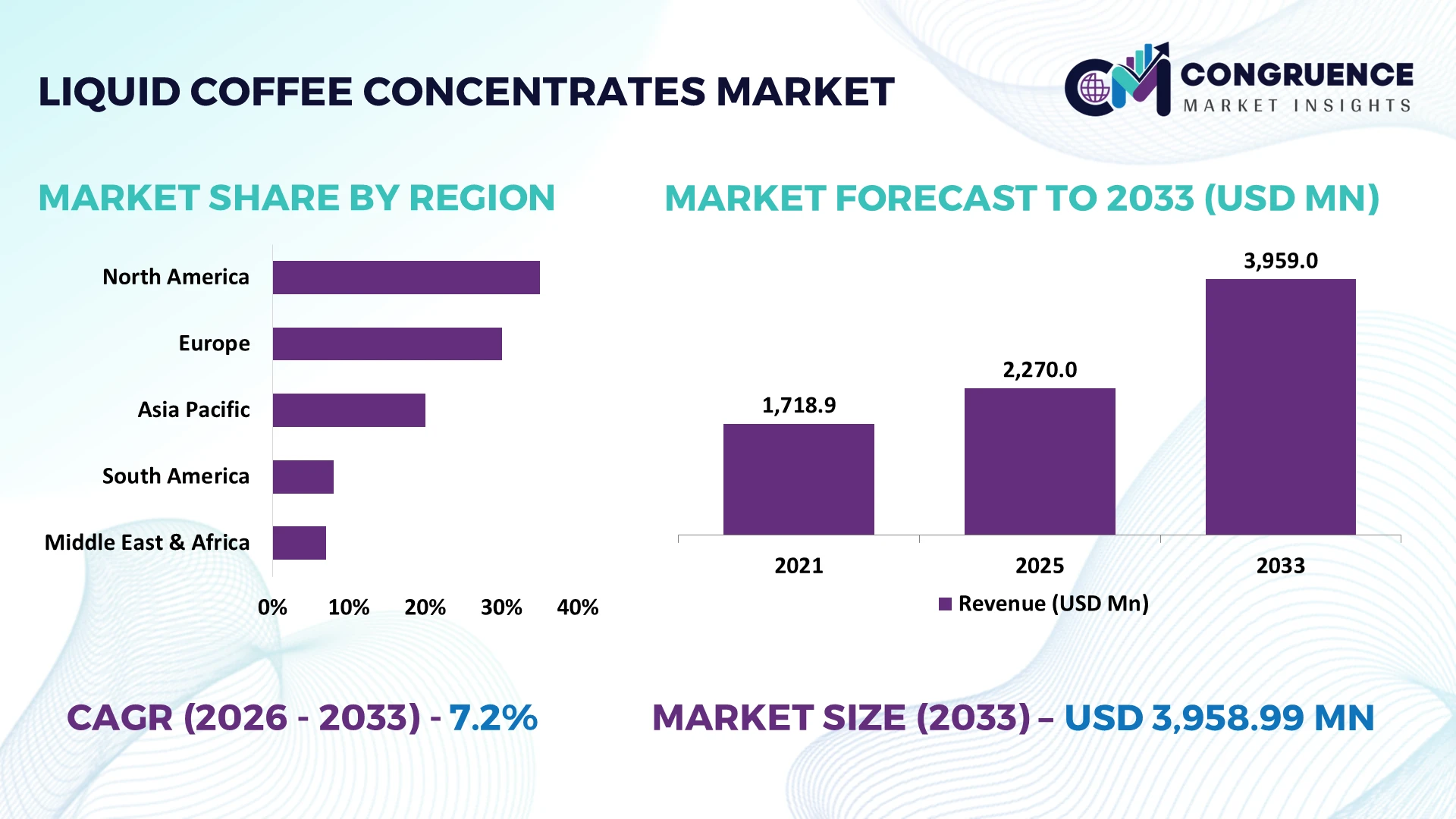
North America holds the dominant position with approximately 42.8% share, supported by mature specialty-coffee channels, established foodservice infrastructure, and strong cold-brew penetration. The United States leads regional consumption, while Japan and South Korea are accelerating concentrated coffee adoption through RTD and café formats. Cold-brew concentrate represents about 38.2% of product demand, reinforcing premium extraction and convenience-led positioning. Supply-chain restructuring linked to global coffee sourcing is increasing the value of localized production and inventory efficiency.
Strategically, companies should prioritize scalable concentrate platforms, high-barrier packaging, foodservice partnerships, and expansion into fast-adopting Asian markets.
Market Size & Growth: Market value rises from USD 2.27 billion in 2025 to USD 3.96 billion by 2033 at a 7.2% CAGR, driven by cold-brew and convenience-led beverage formats.
Top Growth Drivers: Cold-brew concentrates hold 38.2%, foodservice represents 44.8%, and online distribution is expanding at 11.8%, strengthening high-growth channel opportunities.
Short-Term Forecast: By 2028, automated dosing and standardized concentrate ratios are positioned to reduce beverage preparation time by 20% and improve serving consistency by 15%.
Emerging Technologies: Aseptic filling, oxygen-barrier packaging, AI-assisted formulation, and precision extraction are improving shelf stability, flavor consistency, and production control.
Regional Leaders: North America approaches USD 972 million, Europe represents about USD 599 million, while Asia Pacific reaches roughly USD 429 million, with Asian markets accelerating RTD adoption.
Consumer/End-User Trends: Cold-brew concentrate captures 38.2% share as consumers shift toward customizable iced beverages, premium at-home preparation, and rapid café-style serving.
Pilot/Case Example: In 2025, aseptic concentrate packaging programs demonstrated up to 18-month sealed shelf stability, reducing dependence on refrigerated handling and improving distribution flexibility.
Competitive Landscape: Nestlé holds approximately 18.2% share, while Starbucks, Grady's Cold Brew, Stumptown Coffee Roasters, and High Brew Coffee strengthen competition across retail and specialty channels.
Regulatory & ESG Impact: High-barrier flexible packaging can achieve up to 92% pallet-volume utilization, supporting lower packaging weight and more efficient logistics while helping brands address sustainability targets.
Investment & Funding: Industry investment is shifting toward automated extraction, aseptic filling, packaging modernization, and specialty-coffee partnerships, with expansion focused on scalable foodservice and online channels.
Innovation & Future Outlook: Next-generation concentrates are moving beyond coffee preparation into functional beverages, non-dairy lattes, protein drinks, and nitro-style formats, positioning concentrates as modular beverage platforms.
Liquid coffee concentrates are gaining traction across foodservice, retail, and beverage manufacturing as concentrated formats simplify preparation and support consistent flavor. Approximately 38.2% of demand is associated with cold-brew concentrate, reflecting strong consumer interest in smoother, customizable beverages. Aseptic processing and barrier packaging are also reducing refrigerated distribution requirements, while supply-chain volatility in coffee sourcing is encouraging manufacturers to strengthen procurement and regional production capabilities.
Liquid coffee concentrates are becoming strategically important because they convert coffee preparation into a standardized, scalable input for cafés, restaurants, retailers, and beverage manufacturers. Concentrates reduce brewing complexity, shorten service cycles, and allow brands to maintain consistent flavor across multiple locations. The shift toward RTD beverages and premium cold coffee is also changing procurement priorities from conventional roasted-bean supply toward extraction technology and shelf-stable formulation.
Aseptic processing provides a measurable operational advantage over conventional refrigerated systems by extending product stability and reducing cold-chain dependence. Automated dosing can reduce preparation time by approximately 20%, while standardized extraction improves serving consistency by around 15%. North America remains the largest commercial base, whereas Japan and South Korea are emphasizing compact RTD and café applications.
Over the next 2–3 years, manufacturers are expected to increase investment in automated extraction, high-barrier packaging, and localized filling. A practical deployment model is centralized concentrate production combined with regional packaging and foodservice distribution. Partnerships between coffee producers, packaging suppliers, and beverage companies are therefore becoming increasingly important. Competitive positioning will depend on extraction consistency, logistics efficiency, formulation flexibility, and the ability to scale premium formats without compromising product quality.
Cold-brew adoption is strengthening concentrate demand as cafés and restaurants seek faster preparation and consistent beverage output. Cold-brew products account for approximately 38.2% of demand, while foodservice applications represent nearly 44.8%, creating a strong operational base for standardized concentrate formats. In the United States, automated dosing and pre-formulated concentrate systems are increasingly replacing labor-intensive brewing steps, reducing preparation time by about 20%. Companies are responding by investing in aseptic filling, precision extraction, and foodservice partnerships. The non-obvious advantage is inventory flexibility: concentrates allow operators to separate coffee production from final beverage preparation, helping multi-site businesses manage peak-hour demand with fewer preparation variables.
Volatility in green coffee procurement remains a structural restraint because concentrate manufacturers depend on consistent bean quality, extraction characteristics, and formulation costs. Coffee input prices can fluctuate by more than 20% during periods of supply disruption, while packaging and transportation expenses add further pressure to manufacturing margins. Brazil and Vietnam remain critical sourcing markets, making weather conditions, logistics disruptions, and commodity-market movements operationally significant. Companies are responding through multi-origin sourcing, longer procurement contracts, and formulation flexibility across Arabica and Robusta blends. The key business impact is margin compression when concentrate prices cannot be adjusted quickly enough. Strategic procurement and localized processing therefore provide stronger cost protection than relying solely on downstream price increases.
Aseptic concentrate systems create opportunities to expand beyond conventional coffee into RTD beverages, specialty lattes, functional drinks, and foodservice bases. Shelf-stable formats can reduce refrigerated logistics requirements by up to 30%, while automated dosing can improve preparation efficiency by approximately 20%. Japan and South Korea offer particularly relevant opportunities because compact beverage formats and café automation are already well established. Companies are investing in high-barrier packaging, precision extraction, and modular formulations that allow one concentrate platform to support multiple beverage recipes. A less obvious opportunity lies in private-label manufacturing, where retailers can launch differentiated coffee beverages without building their own extraction infrastructure. Strategic partnerships between coffee processors and beverage formulators can accelerate this model.
Scaling concentrate production without compromising flavor, aroma, and microbial stability remains a major execution challenge. Extraction parameters can vary by more than 10% with changes in bean composition, grind characteristics, temperature, and processing time, creating consistency pressures across large production batches. Automated facilities also require integration between extraction, filtration, dosing, filling, quality control, and traceability systems. In the United States and Europe, increasingly detailed packaging and food-safety requirements add compliance complexity as product formats diversify. Companies must invest in real-time process monitoring, automated quality controls, workforce training, and interoperable production systems. The strategic challenge is not simply increasing capacity; it is maintaining identical sensory performance across plants, batches, and distribution channels while controlling operational variability.
Digital Retail Gains Share: Online sales are capturing about 38% of liquid coffee concentrate distribution, while more than 60% of buyers in India and the U.K. use digital purchasing channels. Subscription models and rapid delivery are changing replenishment patterns, prompting companies to expand direct-to-consumer fulfillment and use online demand data to refine pack sizes and flavor portfolios.
Flavor Innovation Expands: Original Coffee retains more than 58% of sales, but Flavored Coffee is gaining traction among younger consumers, with 71% of U.S. Gen Z coffee consumers preferring flavored options. Manufacturers are increasing vanilla, mocha, caramel, and seasonal formulations, while flexible production systems allow faster SKU rotation without disrupting high-volume original concentrate production.
Retail Shelf Space Shifts: Comprehensive Supermarkets account for approximately 33% of sales, while Convenience Stores contribute 15%, creating stronger demand for compact and single-serve formats. Japanese retailers have expanded liquid coffee shelf space by approximately 27%, encouraging suppliers to restructure merchandising, packaging, and replenishment programs. The shift shows that physical retail remains critical for discovery even as digital channels accelerate repeat purchasing.
Shelf-Life Optimization Advances: Aseptic filling and oxygen-barrier packaging are extending sealed concentrate stability toward 18 months while reducing dependence on refrigerated distribution. Packaging redesign can improve logistics utilization by approximately 20%, helping manufacturers offset transportation and storage pressures. Companies are increasingly localizing filling operations and diversifying packaging suppliers, making packaging engineering an operational advantage rather than simply a preservation requirement.
Original Coffee remains the leading type, accounting for approximately 58% of market sales, supported by broad consumer acceptance, simpler formulation requirements, and consistent deployment across household and commercial coffee preparation. Its standardized flavor profile enables longer production runs and lower SKU complexity, making it the preferred volume platform for manufacturers. Approximately 65% of regular European coffee drinkers prefer unflavored coffee variants, reinforcing its mature position. Companies continue investing in high-volume extraction and packaging capacity for Original Coffee while using established formulations to protect cost efficiency.
Flavored Coffee represents approximately 42% of sales and is the faster-moving type as consumers seek customization and café-style experiences. About 71% of U.S. Gen Z coffee consumers prefer flavored options, supporting expansion of mocha, vanilla, caramel, hazelnut, and seasonal profiles. Manufacturers are directing more product-development resources toward flexible flavor systems and smaller production batches. The strategic shift is toward dual portfolio management: Original Coffee provides scale and operational stability, while Flavored Coffee supports premiumization and faster product rotation.
Online Sales represent the leading application channel at approximately 38% share, supported by product variety, subscription purchasing, direct-to-consumer fulfillment, and rapid delivery. More than 60% of concentrate consumers in India and the U.K. purchase through online channels, giving manufacturers direct access to consumer purchasing patterns. Companies are expanding digital-exclusive multipacks, subscription programs, and targeted promotions while using customer data to optimize product launches. The business implication is significant: online channels increasingly function as real-time product-testing environments before wider retail expansion.
Comprehensive Supermarkets account for approximately 33% of sales, followed by Convenience Stores at 15% and Community Supermarkets at 14%. Japanese supermarket chains have increased liquid coffee shelf space by approximately 27%, demonstrating continued physical-retail importance despite digital expansion. Companies are therefore integrating e-commerce analytics with store-level inventory planning rather than shifting completely away from physical outlets. This omnichannel model allows supermarkets to drive product discovery while digital platforms capture repeat purchases and subscription demand.
The specified Liquid Coffee Concentrates market segmentation does not provide End-User categories. The researched segmentation identifies Type as Original Coffee and Flavored Coffee and Application as Comprehensive Supermarket, Community Supermarket, Online Sales, and Convenience Store. Introducing separate End-User categories would therefore move beyond the defined segmentation structure and create unsupported market classifications.
Accordingly, no End-User market share or fastest-growing End-User segment is assigned. Available industry evidence nevertheless indicates that commercial beverage operators are an important consumption base, with approximately 62% of surveyed coffee shops and casual restaurants reporting concentrate usage during 2024–2026, compared with approximately 38% in 2020. This operational adoption is linked to preparation efficiency and consistency, encouraging suppliers to develop foodservice-oriented pack sizes, dosing systems, and formulation partnerships.
North America accounted for the largest market share at 35% in 2025 however, Asia Pacific is expected to register the fastest growth, expanding at a CAGR of 7.45% between 2026 and 2033.
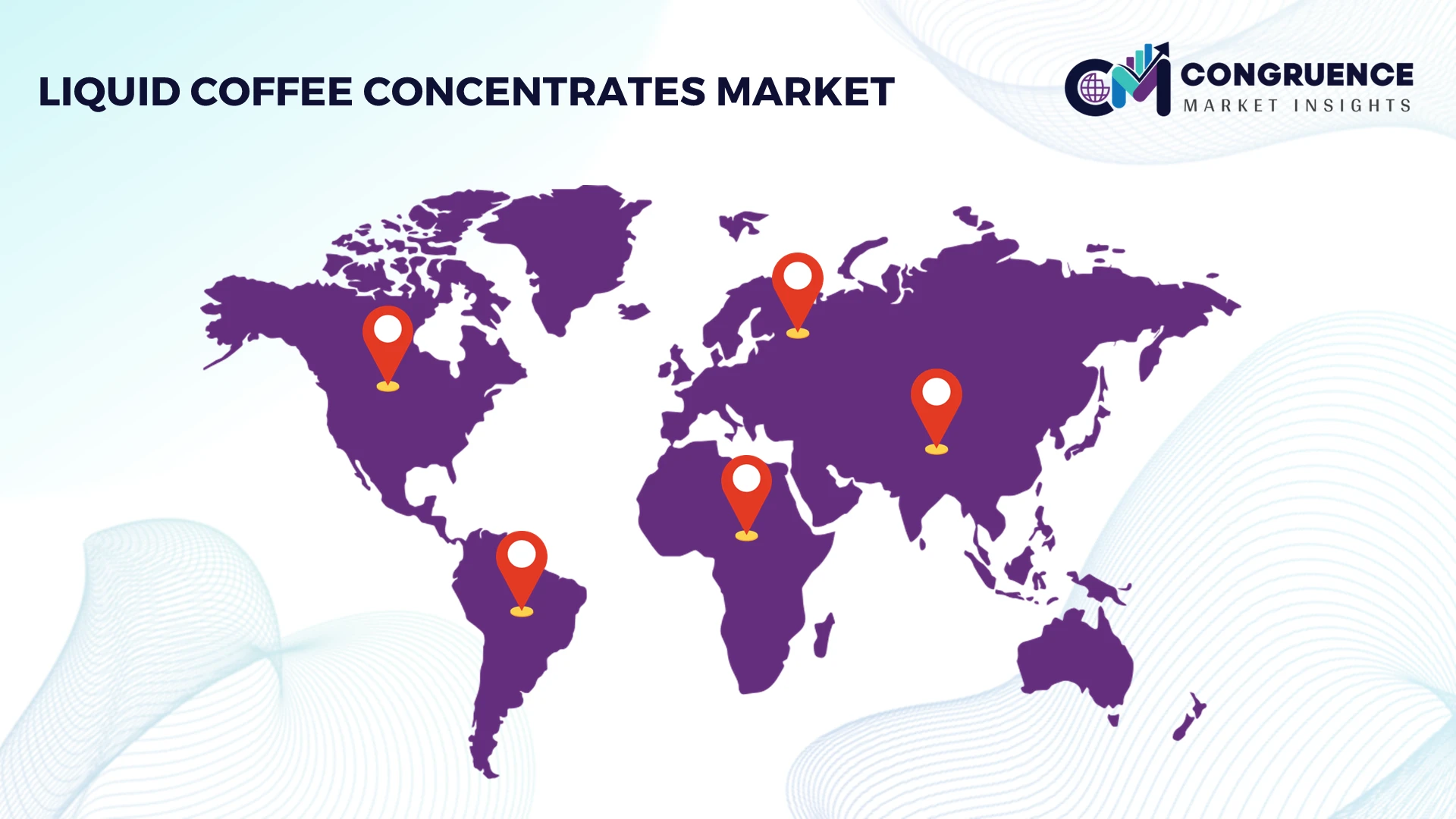
North America remains the largest regional market, supported by established cold-brew consumption, specialty cafés, foodservice infrastructure, and extensive retail distribution. The region represents approximately 35% of global liquid coffee concentrate demand, with the U.S. accounting for the overwhelming share of regional consumption. In 2026, 66% of U.S. adults reported drinking coffee on a past-day basis, while specialty coffee reached 47%, creating strong demand for premium concentrate formats. Companies are expanding concentrate portfolios across grocery, foodservice, subscription, and convenience channels, while automated dispensing and ready-to-mix formats improve preparation efficiency. The U.S. market is also benefiting from strong at-home consumption, with 82% of past-day coffee drinkers preparing coffee at home.
United States Market Outlook: The United States is the principal North American market, supported by high household coffee penetration, specialty-coffee adoption, and advanced retail infrastructure. Nearly 195 million American adults drink coffee weekly, providing a substantial consumer base for concentrate products. The country's strong café, grocery, e-commerce, and foodservice ecosystem enables manufacturers to launch products rapidly across multiple channels while using consumer purchasing data to refine flavors and pack formats.
Europe represents approximately 30% of the global liquid coffee concentrates market, supported by mature coffee consumption, established supermarket networks, specialty cafés, and strong demand for convenient premium beverages. Germany, the U.K., France, Italy, and the Netherlands provide concentrated commercial demand, while the region's established retail infrastructure supports broad product availability. European coffee consumption remains structurally high, with European Union domestic consumption estimated at approximately 41.9 million 60-kg bags for 2025/26. Sustainability requirements and packaging-efficiency priorities are also encouraging manufacturers to optimize material usage, concentrate transportation, and shelf stability. Companies are responding through recyclable packaging, localized filling, premium formulations, and partnerships with retailers and foodservice operators.
Germany Market Outlook: Germany represents one of Europe's most strategically significant coffee markets because of its large consumer base, developed grocery infrastructure, and established preference for convenient coffee formats. European Union coffee consumption remains above 40 million 60-kg bags annually, providing a strong underlying platform for concentrated products. Manufacturers are increasingly targeting German supermarkets, specialty retail, and foodservice operators with premium and convenient concentrate formats.
Asia-Pacific holds approximately 20% of global liquid coffee concentrate demand and represents the fastest-expanding major regional market, driven by urbanization, café-chain development, e-commerce penetration, and rising preference for premium coffee beverages. Japan, China, South Korea, India, and Australia are the principal demand centers, with Japan and South Korea showing particularly mature ready-to-drink and convenience-oriented coffee cultures. U.S. Department of Agriculture estimates place 2025/26 coffee consumption at 6.72 million 60-kg bags in Japan, 5.85 million in China, 3.40 million in South Korea, and 1.36 million in India. Companies are increasing local partnerships, regional filling capabilities, and digital distribution to accommodate diverse consumption patterns.
Japan Market Outlook: Japan offers a strategically important combination of high coffee consumption, sophisticated convenience retail, and established ready-to-drink beverage infrastructure. Domestic coffee consumption is estimated at approximately 6.72 million 60-kg bags for 2025/26, creating a substantial base for concentrated and convenience-oriented formats. Manufacturers are focusing on compact packaging, consistent flavor profiles, and products compatible with both household and on-the-go preparation.
South America accounts for approximately 8% of global liquid coffee concentrate demand, with Brazil representing the dominant commercial and production base. The region combines exceptional coffee availability with growing urban café consumption, creating opportunities to integrate concentrate manufacturing closer to raw-material sources. Brazil's domestic coffee consumption is estimated at approximately 22.28 million 60-kg bags for 2025/26, while Colombia contributes a further 2.27 million bags. Supply-chain proximity provides processors with potential advantages in sourcing and formulation control, although infrastructure differences across markets constrain uniform distribution. Companies are therefore prioritizing Brazil-centered production, regional distributor partnerships, and premium concentrate formats rather than pursuing identical channel strategies across every country.
Brazil Market Outlook: Brazil is the region's principal strategic market because it combines one of the world's largest coffee industries with substantial domestic consumption. Domestic coffee consumption is projected at approximately 22.28 million 60-kg bags in 2025/26, creating strong raw-material availability and a broad consumer base. Concentrate producers can leverage established coffee-processing capabilities to develop localized formulations, shorten sourcing routes, and supply both domestic foodservice operators and modern retail channels.
Middle East & Africa represents approximately 7% of global liquid coffee concentrate demand, with GCC markets providing the strongest commercial opportunities through premium cafés, hotels, restaurants, quick-service chains, and modern retail. Saudi Arabia and the United Arab Emirates are important demand centers as café infrastructure expands and consumers increasingly adopt specialty beverage formats. Saudi Arabia's coffee consumption is estimated at approximately 1.50 million 60-kg bags for 2025/26, demonstrating a substantial established consumption base. Companies are responding through distributor partnerships, localized product portfolios, and concentrate formats designed for high-throughput foodservice environments. The region's fragmented logistics and regulatory requirements make local distribution capabilities particularly important for scaling beyond major urban centers.
Saudi Arabia Market Outlook: Saudi Arabia is the most strategically significant market in the region because of its substantial coffee consumption, expanding café ecosystem, and large modern-retail base. Consumption is estimated at approximately 1.50 million 60-kg bags in 2025/26, supporting continued investment in premium coffee formats. Manufacturers are increasingly working with foodservice distributors and café chains to introduce concentrated products that reduce preparation time and improve consistency across high-volume beverage operations.
Nestlé and Starbucks compete as global branded leaders, while JDE Peet’s, Jot, Chameleon Organic Coffee, and specialty concentrate suppliers compete through distinct retail, foodservice, and direct-to-consumer channels. The top five players are estimated to control about 42% of market value, leaving fragmented space for regional specialists. Price remains decisive, with premium concentrates commonly commanding 20–40% higher positioning than conventional coffee formats, while concentrate efficiency can reduce preparation time by over 80%. Competition increasingly centers on proprietary extraction, shelf stability, packaging, and rapid flavor customization. Nestlé is scaling liquid concentrate production in Malaysia, while Starbucks expands flavored cold-brew formats and Jot emphasizes subscription distribution. Vertical sourcing and localized production are gaining importance as coffee input volatility pressures margins. Entry barriers include formulation consistency, shelf-life validation, brand recognition, and retail access. The competitive shift favors companies combining scalable technology with flexible channel execution, localized sourcing, differentiated flavors, and rapid product launches rather than competing through price alone.
Nestlé S.A.
Starbucks Corporation
JDE Peet’s N.V.
Jot
Chameleon Organic Coffee
Califia Farms
Wandering Bear Coffee
Grady’s Cold Brew
Lavazza Group
Stumptown Coffee Roasters
Slingshot Coffee Co.
Dekáf Coffee Roasters
Liquid concentrate technology is shifting from slow cold-steeping toward controlled extraction, proprietary enrichment, and digitally monitored production. Jot uses a closed enrichment process, while industrial producers increasingly combine extraction control with automated filling and shelf-stability systems. These approaches can shorten preparation from hours to seconds for consumers, creating over 80% time savings versus conventional home cold-brew preparation.
Freeze-drying and cold-soluble technology are emerging alongside liquid concentrates, allowing coffee to dissolve in cold liquids without conventional hot preparation. Nestlé’s new freeze-drying technique targets smoother cold dissolution, while liquid espresso concentrates deliver approximately 20 servings from a 300-milliliter bottle. Controlled processing can improve dissolution performance and formulation consistency by roughly 10–15%, strengthening premium positioning and reducing preparation variability.
From 2026–2028, digitally enabled concentrate lines, precision dosing, recyclable packaging, and localized production will shape competitive advantage. Nestlé’s Malaysia line demonstrates this shift toward regional manufacturing and faster distribution. Starbucks’ 1:1 dilution architecture also shows how standardized dosing simplifies consumer preparation. Companies with proprietary extraction, automated quality control, and flexible flavor platforms will gain speed, consistency, and channel responsiveness as adoption expands.
May 2024 — Nestlé launched Nescafé Espresso Concentrate, its first premium liquid espresso concentrate, responding to cold-coffee growth. The 100% Arabica format targets customized at-home beverages and established a scalable platform for subsequent international expansion. Source: nestle.com
May 2024 — Starbucks introduced two new Cold Brew Concentrates, Dark Chocolate Hazelnut and Sweetened Black, alongside its first cold-specific at-home blends. The 32-fl-oz concentrate uses a 1:1 dilution format, expanding premium cold-coffee occasions through retail. Source: about.starbucks.com
December 2024 — Chameleon Organic Coffee shifted its 10-ounce ready-to-drink and 32-ounce concentrate bottles from imported Egyptian glass to U.S.-made packaging. The change delivered nearly 30% lower estimated bottle carbon footprint while strengthening domestic supply resilience.
August 2025 — Nestlé launched its first coffee-concentrate production line in Asia at Sri Muda, Malaysia. The investment forms part of CHF 150 million planned through 2028, increasing regional supply capacity and supporting faster distribution across Asian cold-coffee markets. Source: nestle.com
The Liquid Coffee Concentrates Market Report covers Original Coffee and Flavored Coffee across Comprehensive Supermarkets, Community Supermarkets, Online Sales, and Convenience Stores, with analysis extending to consumer, foodservice, retail, and specialty applications. The study evaluates North America, Europe, Asia Pacific, South America, and Middle East & Africa, highlighting concentrated demand in the United States, Germany, Japan, Brazil, and Saudi Arabia.
The scope assesses extraction systems, cold-brew processing, freeze-drying, automated production, precision dosing, shelf-stable formulations, and recyclable packaging. It tracks emerging single-serve, premium, flavored, specialty, and digitally distributed concentrate formats alongside established multi-serve products. Competitive assessment covers global brands, specialty producers, regional suppliers, and technology-driven entrants, supporting investment planning, geographic expansion, channel selection, product positioning, supply-chain decisions, and strategic market direction from 2026 through 2033.
| Report Attribute / Metric | Details |
|---|---|
| Market Revenue (2025) | USD 2,270.0 Million |
| Market Revenue (2033) | USD 3,959.0 Million |
| CAGR (2026–2033) | 7.2% |
| Base Year | 2025 |
| Forecast Period | 2026–2033 |
| Historic Period | 2021–2025 |
| Segments Covered |
By Type
By Application
By End-User
|
| Key Deliverables | Revenue Forecast; Market Trends; Growth Drivers & Restraints; Technology Insights; Segmentation Analysis; Regional Insights; Competitive Landscape; Regulatory & ESG Overview; Recent Developments |
| Regions Covered | North America; Europe; Asia Pacific; South America; Middle East & Africa |
| Companies Profiled | Nestlé S.A.; Starbucks Corporation; JDE Peet’s N.V.; Jot; Chameleon Organic Coffee; Califia Farms; Wandering Bear Coffee; Grady’s Cold Brew; Lavazza Group; Stumptown Coffee Roasters; Slingshot Coffee Co.; Dekáf Coffee Roasters |
| Customization & Pricing | Available on Request (10% Customization Free) |




