
Reports
The Global Liquefied Petroleum Gas (LPG) Market was valued at USD 1,629.8 Million in 2025 and is anticipated to reach a value of USD 2,689.2 Million by 2033 expanding at a CAGR of 6.46% between 2026 and 2033. Growth is driven by expanding autogas adoption, rising industrial LPG consumption, refinery-linked supply expansion, and modernization of cylinder distribution and bottling infrastructure.
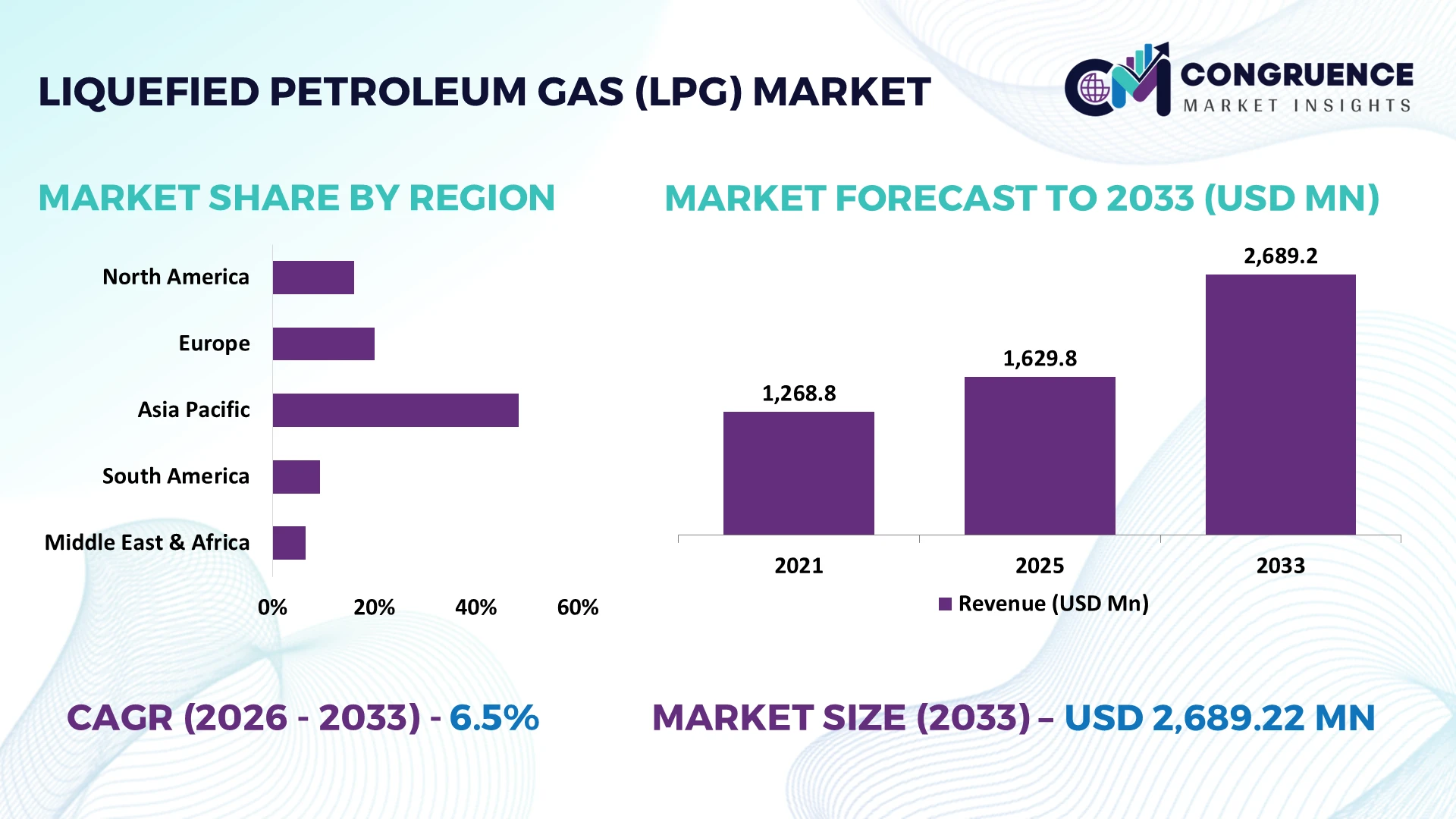
Asia Pacific holds the dominant position with a 48.34% share in 2025, supported by large-scale household, commercial, petrochemical, and transport consumption. India alone had 32.94 crore active domestic LPG consumers by March 2025, including 10.33 crore PMUY connections, while LPG coverage approached saturation. India also imports about 60% of domestic LPG requirements, making storage and supplier diversification strategically important. The India-U.S. LPG sourcing agreement for 2.2 million tonnes annually further illustrates the shift toward diversified supply chains and reduced dependence on concentrated Middle Eastern sourcing.
Strategically, companies should prioritize resilient sourcing, automated bottling, high-throughput logistics, and digitally managed LPG infrastructure to secure operating efficiency and supply continuity.
Market Size & Growth: The market stands at USD 1,629.8 million in 2025 and is projected at USD 2,689.2 million by 2033, supported by autogas expansion and industrial fuel switching.
Top Growth Drivers: Autogas adoption, industrial LPG consumption, and cleaner cooking initiatives represent three major demand drivers, with industrial and commercial LPG use reaching about 16% of India’s demand in FY2025.
Short-Term Forecast: India’s LPG consumption is projected to reach 33–34 million tonnes in FY2026, while overall demand growth is expected at 7–9%, reinforcing logistics and storage requirements.
Emerging Technologies: AI-based cylinder inspection, IoT monitoring, robotic loading, and PLC-controlled bottling are shifting operations toward automated, safer, and higher-throughput LPG handling.
Regional Leaders: Asia Pacific represented 48.34% of the 2025 market, Europe 19.67%, and North America 15.97%; Asia Pacific is increasingly adopting automated distribution and high-volume storage infrastructure.
Consumer/End-User Trends: India’s PMUY beneficiaries increased average consumption from 3.68 refills in FY2021–22 to 4.47 in FY2024–25, indicating stronger recurring LPG usage rather than connection-led expansion.
Pilot/Case Example: In 2025, automated LPG bottling improvements demonstrated a 67% reduction in defective products and an 83% reduction in reprocessing, highlighting the operational value of Industry 4.0 integration.
Competitive Landscape: Major participants include BP, ExxonMobil, Shell, TotalEnergies, Chevron, ConocoPhillips, and major national energy companies competing through supply capacity, terminals, downstream networks, and integrated logistics.
Regulatory & ESG Impact: India’s LPG coverage moved from 62% in 2016 to near saturation, while targeted subsidies support cleaner household fuel adoption and reduce reliance on traditional solid fuels.
Investment & Funding: India approved INR 12,000 crore for targeted PMUY LPG subsidies for FY2025–26, while long-term supply partnerships are increasingly securing imported volumes and strengthening energy resilience.
Innovation & Future Outlook: Advanced cylinder tracking, robotic loading, AI inspection, predictive maintenance, and digital supply-chain platforms are moving LPG operations toward lower manual intervention, faster throughput, and stronger asset utilization.
Liquefied Petroleum Gas (LPG) demand is increasingly concentrated in household cooking, foodservice, petrochemicals, industrial heating, and transport applications, with commercial and industrial consumption gaining structural importance. In India, these applications represented about 16% of LPG demand in FY2025, while automated bottling, digital logistics, and robotic handling are reshaping operational models amid tighter supply-chain requirements.
Liquefied Petroleum Gas (LPG) is becoming strategically important because energy security, industrial fuel flexibility, and decentralized distribution are increasingly shaping downstream investment decisions. India’s LPG consumption reached about 31.3 million metric tons in FY2025, while commercial and industrial applications expanded to approximately 16% of total demand. This broadening demand base is shifting investment from household connectivity alone toward bulk storage, terminals, bottling capacity, and logistics optimization.
Technology is becoming a direct competitive lever. AI-enabled cylinder inspection can increase processing throughput from 12 to 40 cylinders per minute while improving number-reading precision from 90% to 97%. Robotic loading and PLC-based bottling systems similarly reduce manual handling and improve safety consistency.
Regional priorities differ sharply. Asia Pacific emphasizes high-volume distribution and household access, while Europe places greater emphasis on energy diversification and lower-emission fuel pathways. Over the next 2–3 years, companies are expected to prioritize automated plants, predictive maintenance, diversified import contracts, and digital fleet management. India’s 2.2-million-tonne-per-year U.S. supply agreement demonstrates how procurement partnerships are becoming part of competitive positioning.
Industrial diversification is strengthening LPG consumption beyond household cooking. India’s bulk and commercial LPG demand grew about 6% annually between FY2017 and FY2025, while commercial and industrial applications reached approximately 16% of total demand in FY2025 from 10% in FY2017. Autogas remains another structural demand channel where LPG competes with conventional fuels. Companies are responding by expanding bulk storage, strengthening distributor networks, and securing long-term supply contracts. The operational insight is significant: as household connectivity approaches saturation, incremental volume increasingly depends on refill intensity and industrial applications rather than new connections.
Import dependency remains a structural constraint in major consuming markets. India imports approximately 60% of domestic LPG requirements, exposing oil marketing companies to international benchmark movements, freight costs, and geopolitical supply disruptions. The Saudi CP benchmark increased 63% between July 2023 and February 2025, creating pressure on procurement economics even as targeted subsidies moderated consumer prices. Companies are reducing exposure through supplier diversification, long-term contracts, expanded domestic infrastructure, and strategic storage. The key operational challenge is balancing affordability with landed-cost volatility without weakening distribution margins or service reliability.
Digital transformation creates a measurable opportunity across bottling, inspection, and logistics. Automated LPG inspection has demonstrated throughput improvement from 12 to 40 cylinders per minute, while precision increased from 90% to 97%. Industry 4.0 bottling models have also demonstrated an 83% reduction in reprocessing. Companies can capture these gains through AI vision systems, IoT sensors, predictive maintenance, automated carousels, and robotic loading. India’s rapidly expanding digital LPG infrastructure provides a strong deployment environment, particularly for high-volume plants where small cycle-time improvements translate into substantial annual throughput gains.
Long-term competitiveness depends on integrating expanding LPG volumes with resilient storage, transportation, cybersecurity, and workforce systems. India’s LPG network already includes more than 32 crore active domestic consumers, creating substantial requirements for reliable cylinder circulation, depot capacity, fleet coordination, and safety monitoring. Digitalization introduces another execution layer because connected bottling and terminal systems require secure industrial-control architectures and trained personnel. Companies must therefore invest simultaneously in automation, cybersecurity, predictive maintenance, and technical workforce development. The strategic issue is no longer simply adding LPG capacity; it is maintaining consistent throughput and safety across increasingly complex, digitally connected distribution networks.
Automated Cylinder Handling Expands: LPG bottling plants are shifting toward AI vision inspection, robotic loading, and PLC-controlled filling, with inspection throughput demonstrated at 40 cylinders per minute versus 12 previously and reading precision improving from 90% to 97%. Companies are scaling automation to reduce manual intervention, improve safety, and increase plant throughput.
Supply Chains Diversify Beyond Gulf: Import-dependent markets are restructuring procurement as geopolitical and freight exposure increases. India sources 55–60% of LPG demand through imports, while its 2.2-million-tonne-per-year U.S. agreement is shifting procurement toward diversified long-term contracts. Companies are expanding storage and supplier portfolios to reduce concentration risk and improve landed-cost visibility.
Refill Intensity Outpaces Connections: Mature household markets are increasingly driven by recurring consumption rather than new connections. India’s LPG consumption reached 31.3 million tonnes in FY2025, while PMUY beneficiary refills rose to about 4.5 cylinders per household annually. Companies are consequently prioritizing delivery reliability, distributor productivity, and refill analytics instead of connection-led expansion alone.
Commercial Demand Gains Weight: Commercial and industrial LPG use in India increased from about 10% of demand in FY2017 to 16% in FY2025, reducing the market’s historical dependence on household consumption. Foodservice, institutional kitchens, and small manufacturing clusters are driving this shift, prompting suppliers to expand bulk delivery, dedicated storage, and enterprise contracts.
Propane remains the leading type, accounting for approximately 47.3% of the global market in 2025, supported by extensive use across residential heating, cooking, commercial fuel systems, industrial operations, agriculture, and transportation. Its lower boiling point provides dependable vaporization in colder climates, while its role as petrochemical feedstock strengthens industrial integration. Propane therefore maintains a broader application footprint than butane, while propane-butane mixtures gain relevance where climatic flexibility and cost optimization matter.
Propane-butane mixtures represent the faster-shifting category, with demand supported by flexible combustion characteristics and expanding use across household, commercial, and autogas systems. Butane retains strategic importance in warmer climates, aerosols, portable equipment, and chemical applications. The market distinction is becoming operational rather than purely geographic: producers are optimizing blend composition around climate, equipment, and end-use requirements. Companies are consequently increasing blending capabilities, strengthening regional storage, and tailoring product specifications rather than relying on a uniform LPG formulation. The non-obvious implication is that formulation flexibility increasingly becomes a supply-chain advantage when temperature and logistics conditions vary sharply.
Residential cooking and heating represents the largest application segment, supported by widespread cylinder penetration, clean-cooking initiatives, and continued substitution of biomass and kerosene. In 2025, residential applications accounted for approximately 44% of total LPG consumption in one global market assessment, while India’s LPG consumption reached about 31.3 million metric tons. Commercial applications are expanding alongside foodservice and institutional kitchens, creating a more diversified consumption profile.
Autogas is emerging as a faster-changing application as fleet operators seek lower-emission alternatives and fuel-cost flexibility, while industrial LPG continues gaining importance for process heating and manufacturing. Petrochemical feedstock remains strategically significant because propane and butane can be integrated directly into olefin production. Power generation and agriculture remain smaller but specialized applications, with demand tied to backup power, crop drying, and controlled heating. Companies are therefore moving from household-only distribution toward bulk contracts, fleet fueling infrastructure, and integrated industrial supply. In India, commercial and industrial applications reached about 16% of LPG demand in FY2025, demonstrating the increasing importance of non-household consumption.
Domestic users remain the largest LPG end-user group, accounting for approximately 45% of the market in 2026, supported by extensive household cooking and water-heating consumption. Commercial buyers form the next major demand pool, particularly restaurants, hotels, institutional kitchens, and small businesses requiring dependable high-frequency fuel delivery. Agriculture maintains specialized consumption for crop drying and controlled heating, while industrial users increasingly favor LPG for process heat where cleaner combustion and flexible onsite storage provide operational advantages.
Industrial and chemical users represent the strongest structural shift as LPG increasingly serves manufacturing processes and petrochemical feedstock requirements. Transport users are also gaining relevance through autogas deployment, while refinery-fuel consumption remains closely connected to integrated petroleum operations. Chemical users benefit from propane and butane integration into downstream production, creating stronger links between fuel suppliers and petrochemical complexes. Companies are responding with segment-specific contracts, bulk-storage solutions, dedicated delivery fleets, and integrated supply agreements. India illustrates the changing demand mix: commercial and industrial consumption increased from roughly 10% of LPG demand in FY2017 to 16% in FY2025, reducing dependence on domestic consumption alone.
Asia Pacific accounted for the largest market share at 48.3% in 2025 however, Asia Pacific is expected to register the fastest growth, expanding at a CAGR of 6.46% between 2026 and 2033.
North America accounted for 16.0% of the global LPG market in 2025, with the United States serving as the region’s primary production and export hub. U.S. propane exports averaged a record 1.8 million barrels per day in 2025, while total natural gas plant liquids exports reached 3.1 million barrels per day, up 7% year over year. Expanding Gulf Coast terminals, fractionation capacity, pipelines, and VLGC connectivity are strengthening export economics. Asian buyers are increasingly absorbing U.S. propane, with India’s purchases rising sharply in 2025. Companies are responding through terminal expansions, long-term offtake agreements, and logistics optimization, positioning North America as a flexible counterweight to Middle Eastern supply disruptions.
United States Market Outlook: The United States combines abundant shale-derived NGL production with sophisticated fractionation and export infrastructure. Propane exports reached a record 1.8 million barrels per day in 2025, while terminal expansions have added more than 700,000 barrels per day of export capability since 2019. This infrastructure advantage supports competitive international pricing and strengthens U.S. influence across Asian and Latin American LPG supply chains.
Europe represented approximately 20.0% of the global LPG market in 2025, with demand increasingly shaped by energy diversification, industrial fuel flexibility, and supply-security requirements. The Russia-Ukraine conflict accelerated European restructuring of energy procurement and storage strategies, while tighter emissions policies are encouraging cleaner-burning fuel alternatives in selected commercial and industrial applications. Five countries—Germany, Italy, France, the Netherlands, and Austria—collectively hold about two-thirds of EU gas-storage capacity, illustrating the concentration of energy infrastructure. LPG distributors are consequently emphasizing decentralized storage, flexible import sourcing, and automated delivery systems. Bio-LPG and renewable-feedstock pathways are also gaining attention as companies seek lower-carbon molecules without replacing existing LPG-compatible equipment.
Germany Market Outlook: Germany remains strategically important because of its extensive energy-import infrastructure, industrial base, and large storage network. The country met its 2025 gas-storage target of 70% across its facilities, demonstrating the importance of inventory management after European supply disruptions. LPG suppliers benefit from Germany’s industrial clusters, logistics connectivity, and demand for flexible heating and process-fuel solutions.
Asia Pacific held the largest regional position with 48.3% of the global market in 2025, supported by China’s petrochemical demand, India’s extensive cylinder network, and expanding consumption across Southeast Asia. China, India, Japan, and South Korea remain major LPG consumption and import centers, while petrochemical facilities increasingly compete with household markets for propane and butane cargoes. U.S. propane exports to Asia increased 13% in 2024, demonstrating the strength of the trans-Pacific supply corridor. Companies are expanding import terminals, storage tanks, PDH capacity, and integrated distribution networks. The strategic shift is from LPG as primarily a household fuel toward a dual-use commodity connecting cooking, industrial heat, and petrochemical feedstock markets.
China Market Outlook: China is the region’s most strategically significant LPG market because of its large petrochemical conversion base and extensive PDH infrastructure. Propane demand is closely linked to polypropylene production, while import terminals and coastal storage support large-scale cargo handling. China’s PDH capacity reached about 22.6 million tonnes, creating sustained feedstock requirements and strengthening the country’s influence over Asian LPG procurement patterns.
South America is supported by Brazil’s large household cylinder market, industrial consumption, and established LPG distribution infrastructure with a market share of 9.3%. Brazil remains the region’s central demand and logistics hub, while Argentina, Chile, Colombia, and Peru contribute through residential, commercial, and industrial applications. The regional market benefits from LPG’s portability in areas where pipeline-gas infrastructure remains limited, but storage capacity and import logistics continue to influence supply reliability. Brazil’s regulator maintains detailed monthly LPG sales data by distributor, product, destination, and packaging, supporting greater visibility into market flows. Companies are responding with cylinder-network optimization, bulk storage, regional distribution partnerships, and investments in delivery efficiency. The key opportunity is improving logistics productivity rather than simply adding consumption capacity.
Brazil Market Outlook: Brazil’s LPG market benefits from a mature cylinder-distribution ecosystem serving millions of households and commercial users across geographically dispersed areas. The country’s regulatory framework tracks LPG sales by product, packaging, distributor, and state, creating detailed market visibility. Producers and distributors are increasingly focused on bulk supply, cylinder circulation, and logistics efficiency to reduce delivery costs and strengthen service reliability.
The Middle East & Africa market accounted for approximately 6.4% of the global LPG market in 2025, with the Gulf states providing the strongest production and export base. Saudi Arabia, the UAE, Qatar, and Iran remain central to regional supply, while African markets are expanding residential and commercial LPG use as governments improve clean-cooking access. The Middle East produced about 72 million tonnes of LPG in 2024 and exported approximately 39 million tonnes, demonstrating its importance as a global supply source. Companies are investing in export terminals, storage, petrochemical integration, and domestic cylinder infrastructure. Current geopolitical disruption around the Strait of Hormuz is also reinforcing the strategic value of diversified shipping routes and regional inventories.
Saudi Arabia Market Outlook: Saudi Arabia is the region’s largest LPG consumer and producer, accounting for about 56% of Middle Eastern consumption in 2024. Its integrated refining, gas-processing, storage, and petrochemical infrastructure provides a strong platform for both domestic supply and international exports. Companies operating in the country are increasingly linking LPG production with chemical conversion and downstream manufacturing, improving feedstock utilization and value capture.
Saudi Aramco, Shell, ExxonMobil, TotalEnergies, and Sinopec compete as suppliers, while SHV Energy and regional distributors challenge them through cylinder networks. The top five players collectively represent 25% of global market activity, leaving space for specialists. Competition centers on delivered price, supply security, terminal access, and distribution reach; automated filling can increase throughput by more than 200%, while digital inspection can raise precision from 90% to 97%. Integrated players are expanding export terminals, securing long-term offtake contracts, linking refining with petrochemicals, and funding clean-cooking programs. Regional operators counter with storage expansion, last-mile delivery, and customer-specific contracts. Competitive advantage is shifting from commodity pricing toward control of logistics, infrastructure, and dependable supply as geopolitical disruptions reshape procurement. Capital requirements for terminals, pipelines, storage, and safety systems restrict entry, while volatile freight and feedstock costs pressure smaller distributors. Winning requires integrated supply, scalable infrastructure, automation, and reliable delivery across volatile trade corridors.
Saudi Aramco
Shell plc
Exxon Mobil Corporation
BP plc
TotalEnergies SE
Chevron Corporation
ConocoPhillips
Sinopec
China National Petroleum Corporation (CNPC)
Indian Oil Corporation Limited
Reliance Industries Limited
SHV Energy N.V.
QatarEnergy
Enterprise Products Partners L.P.
LPG operations are moving from manual handling to automated inspection, robotic loading, IoT monitoring, and digital dispatch. AI-enabled cylinder inspection can lift throughput from 12 to 40 cylinders per minute and improve reading precision from 90% to 97%. IoT tracking can reduce inventory and routing losses by 5%–10%, strengthening asset visibility.
Automated bottling combines PLC-controlled filling, carousel systems, machine vision, and predictive maintenance. Automated workflows can cut reprocessing by 83%, while inspection automation improves processing speed by more than 200% versus manual checks. Adoption is strongest at high-volume plants, where standardized equipment supports consistent safety and faster turnaround. Large distributors benefit most because they can replicate systems across networks.
Digital pay-as-you-cook platforms reduce upfront payment barriers, while connected cylinders improve replenishment planning and customer retention. By 2026–2028, integrated automation, digital logistics, and remote monitoring should improve utilization by 5%–10% and reduce downtime. The competitive edge will favor suppliers combining technology with terminals, pipelines, and distribution scale. Companies acting now can lock in standardized workflows, reduce labor dependence, strengthen compliance, and respond faster to supply disruptions while smaller operators face higher technology and integration costs. These gains support centralized control, predictive alerts, and faster incident response across dispersed LPG assets globally.
May 2024 TotalEnergies committed more than USD 400 million to LPG clean-cooking development for 100 million people in Africa and India by 2030, adding pay-as-you-cook technology. The investment expands affordability while strengthening cylinder, storage, and filling infrastructure networks. Source: totalenergies.com
September 2025 GAIL approved expansion of India’s Jamnagar-Loni LPG pipeline from 3.25 to 6.5 MMTPA, investing about INR 5,350 crore. The 1,107-km project strengthens safer, lower-carbon fuel transportation and improves regional supply reliability across five major states nationwide. Source: gailonline.com
August 2025 SUPERGAS inaugurated its 16th LPG filling plant in Coimbatore, featuring two 125-MT storage vessels and annual capacity above 51,000 MT. The automated facility strengthens southern distribution, improves supply reliability, and creates scalable capacity for regional expansion. Source: shvenergy.com
July 2024 Enterprise Products Partners advanced Houston Ship Channel expansion adding refrigeration capacity for 300,000 BPD of propane and butane exports. The project, targeted for end-2026 service, increases loading capability and strengthens U.S. LPG access to global markets. Source: enterpriseproducts.com
The report evaluates the global Liquefied Petroleum Gas (LPG) market across propane, butane, and propane-butane mixtures, with application coverage spanning residential cooking and heating, commercial, industrial, autogas, petrochemical feedstock, power generation, agriculture, and other uses. End-user analysis covers domestic, commercial, agricultural, industrial, transport, chemical, and refinery demand patterns.
Regional coverage includes North America, Europe, Asia Pacific, South America, and Middle East & Africa, with country-level assessment of production, imports, distribution, and consumption hubs. The study evaluates automated bottling, AI-enabled cylinder inspection, IoT tracking, digital distribution, storage modernization, pipeline logistics, and clean-cooking technologies. Competitive analysis profiles 14 major market participants, supporting investment planning, infrastructure expansion, supply-chain diversification, technology adoption, partnership decisions, competitive positioning, and strategic market direction through 2026–2033.
| Report Attribute / Metric | Details |
|---|---|
| Market Revenue (2025) | USD 1,629.8 Million |
| Market Revenue (2033) | USD 2,689.2 Million |
| CAGR (2026–2033) | 6.46% |
| Base Year | 2025 |
| Forecast Period | 2026–2033 |
| Historic Period | 2021–2025 |
| Segments Covered |
By Type
By Application
By End-User
|
| Key Deliverables | Revenue Forecast; Market Trends; Growth Drivers & Restraints; Technology Insights; Segmentation Analysis; Regional Insights; Competitive Landscape; Regulatory & ESG Overview; Recent Developments |
| Regions Covered | North America; Europe; Asia Pacific; South America; Middle East & Africa |
| Companies Profiled | Saudi Aramco; Shell plc; Exxon Mobil Corporation; BP plc; TotalEnergies SE; Chevron Corporation; ConocoPhillips; Sinopec; China National Petroleum Corporation (CNPC); Indian Oil Corporation Limited; Reliance Industries Limited; SHV Energy N.V.; QatarEnergy; Enterprise Products Partners L.P. |
| Customization & Pricing | Available on Request (10% Customization Free) |




