
Reports
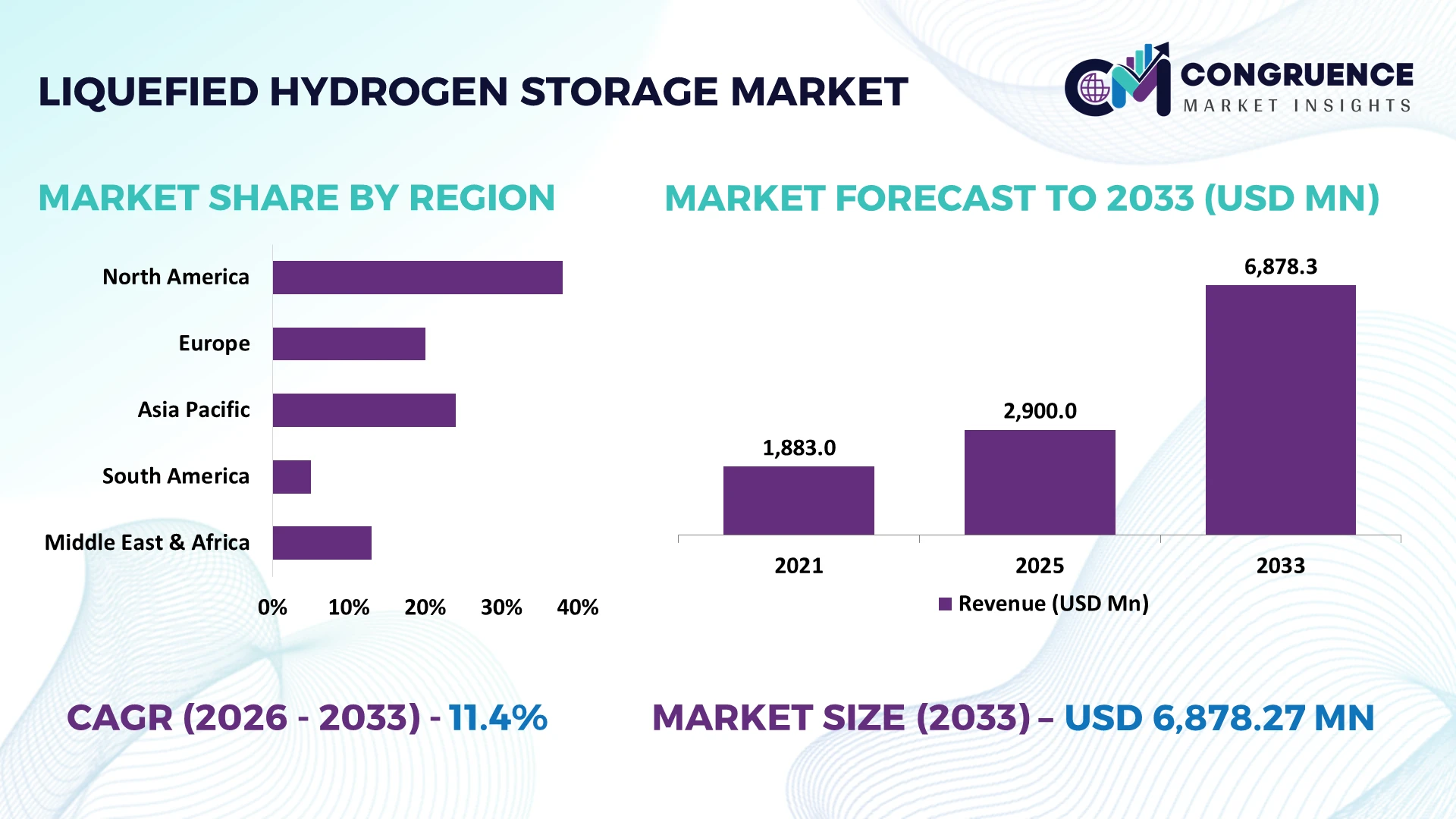
The Global Liquefied Hydrogen Storage Market was valued at USD 2900 Million in 2025 and is anticipated to reach a value of USD 6878.27 Million by 2033 expanding at a CAGR of 11.4% between 2026 and 2033. Growth is driven by hydrogen aviation programs, space launch activity, long distance hydrogen transport, cryogenic refueling infrastructure, and deployment of large vacuum insulated storage tanks for industrial hydrogen hubs.
The United States holds a leading position through aerospace, space launch, industrial gas infrastructure, and hydrogen mobility investment. NASA operates liquid hydrogen storage at Kennedy Space Center, including a new 1.25 million gallon sphere that expands cryogenic capacity for Artemis missions. The country also targets 10 million metric tons of clean hydrogen production annually by 2030. Compared with Japan, which emphasizes imported hydrogen supply chains, US deployment combines domestic production with aerospace demand amid intensifying global competition over clean energy technology.
Suppliers controlling cryogenic tank engineering, insulation performance, boil off management, and hydrogen infrastructure integration are positioned to capture the highest value projects.
Market Size & Growth: USD 2.9 billion in 2025 reaches USD 6.88 billion by 2033 at 11.4% CAGR, driven by cryogenic hydrogen infrastructure deployment.
Top Growth Drivers: Hydrogen mobility contributes 31%, industrial storage 27%, and aerospace applications 18% to incremental equipment demand.
Short Term Forecast: By 2028, advanced insulation and active boil off management target hydrogen losses below 1% daily across optimized storage installations.
Emerging Technologies: Vacuum insulation, composite cryogenic tanks, and zero boil off systems target 20% lower thermal losses versus conventional storage configurations.
Regional Leaders: By 2033, North America approaches USD 2.3 billion, Asia Pacific USD 2.2 billion, and Europe USD 1.7 billion as hydrogen hubs scale.
End User Trends: Aviation concepts increasingly target liquid hydrogen because its volumetric energy density is roughly 70% higher than compressed hydrogen at 700 bar.
Pilot/Case Example: NASA's 2025 hydrogen infrastructure includes a 1.25 million gallon storage sphere supporting higher capacity cryogenic operations for Artemis missions.
Competitive Landscape: Chart Industries holds an estimated 18% position, competing with Linde, Air Liquide, Kawasaki Heavy Industries, and INOXCVA across cryogenic storage engineering.
Regulatory & ESG Impact: US clean hydrogen policy targets 10 million metric tons annually by 2030, creating infrastructure requirements spanning liquefaction, storage, transfer, and distribution.
Investment & Funding: The United States allocated USD 7 billion to seven regional clean hydrogen hubs, accelerating integrated production, storage, transportation, and end use infrastructure.
Innovation & Future Outlook: Next generation zero boil off systems target near 100% hydrogen retention, shifting competitive advantage toward integrated thermal management and cryogenic controls.
The Liquefied Hydrogen Storage Market is moving beyond specialized aerospace use into hydrogen transport, aviation, industrial hubs, marine applications, and large scale energy infrastructure. Liquid hydrogen offers roughly 70% greater volumetric energy density than hydrogen compressed at 700 bar, strengthening its relevance where storage footprint and payload efficiency are critical. Advanced multilayer insulation, composite cryogenic vessels, automated pressure management, and zero boil off technologies are improving storage performance. Meanwhile, government backed hydrogen hubs in the United States and import infrastructure development in Japan are creating distinct supply chain models, setting up the strategic pathways shaping investment priorities.
Liquefied hydrogen storage is becoming strategically important as aerospace, heavy transport, industrial hubs, and international hydrogen supply chains require higher volumetric density than compressed gas can provide. Liquid hydrogen stores roughly 70% more hydrogen per unit volume than 700 bar compressed storage. Infrastructure modernization is accelerating as the United States develops seven regional hydrogen hubs while Japan advances imported hydrogen handling infrastructure.
Modern vacuum insulated vessels paired with active thermal management can target daily boil off below 1%, compared with several percent in less optimized cryogenic systems. North America combines aerospace and domestic hydrogen infrastructure, Europe emphasizes industrial decarbonization, while Japan prioritizes maritime imports. Through 2028, deployment will increasingly favor larger tanks, automated pressure control, improved insulation, and integrated liquefaction storage terminals.
NASA's 1.25 million gallon Kennedy Space Center sphere demonstrates practical scaling of cryogenic hydrogen storage for high volume operations. Equipment suppliers are investing in multilayer insulation, transfer systems, digital monitoring, and partnerships spanning liquefaction through dispensing. Competitive advantage will increasingly depend on minimizing hydrogen losses while delivering safe, scalable storage integrated with production and transport infrastructure.
Large hydrogen hubs are creating concentrated requirements for liquefaction, bulk storage, transfer, and distribution infrastructure. The United States targets 10 million metric tons of clean hydrogen production annually by 2030, while federal planning established seven regional hydrogen hubs. Liquid hydrogen offers roughly 70% greater volumetric storage density than hydrogen compressed at 700 bar, strengthening its economics where transport volume and site footprint matter. Aerospace and heavy mobility programs further increase demand for cryogenic storage. Companies are responding with larger vacuum insulated tanks, integrated liquefaction systems, specialized pumps, and terminal partnerships. The non obvious advantage lies in infrastructure utilization: larger storage buffers can separate production schedules from dispensing demand, allowing electrolyzers and liquefiers to operate more consistently while downstream consumption fluctuates.
Hydrogen liquefaction remains structurally energy intensive because gas must be cooled to about minus 253 degrees Celsius before storage. Conventional liquefaction can consume roughly 25% to 35% of hydrogen's energy content, creating a substantial cost penalty compared with compressed storage for shorter supply chains. Stored liquid also absorbs ambient heat, causing pressure buildup and potential boil off losses that optimized installations target below 1% daily. Japan's import oriented hydrogen strategy highlights the additional infrastructure required across liquefaction, shipping, terminals, and storage. Suppliers are reducing exposure through larger liquefiers, improved heat exchangers, multilayer insulation, and boil off recovery systems. The decisive constraint is utilization: expensive cryogenic infrastructure requires high throughput to spread liquefaction energy and capital intensity across sufficient hydrogen volumes.
Zero boil off technology creates a high value opportunity by converting hydrogen retention from passive insulation into actively managed thermal performance. Liquid hydrogen's volumetric density is about 70% higher than 700 bar compressed hydrogen, making it attractive for aviation, maritime transport, aerospace, and constrained industrial sites. Advanced insulation and cryocoolers can push storage losses toward 0%, protecting valuable hydrogen during extended holding periods. The United States aerospace ecosystem provides an immediate proving ground, while Japan's maritime hydrogen programs support larger transfer and terminal systems. Suppliers are investing in cryogenic refrigeration, composite vessel development, automated pressure management, and digital condition monitoring. A less obvious opportunity is storage as operational flexibility: low loss tanks allow producers to accumulate hydrogen during favorable electricity periods and release it when industrial or mobility demand peaks.
Scaling liquefied hydrogen requires storage tanks, liquefiers, pumps, valves, transfer lines, sensors, vent systems, and safety controls to operate reliably at about minus 253 degrees Celsius. Hydrogen can escape through extremely small pathways, while thermal cycling places repeated stress on seals, insulation, and structural interfaces. Large installations such as NASA's 1.25 million gallon storage sphere demonstrate the engineering scale required, while commercial projects must simultaneously manage losses below 1% daily and maintain safe pressure. Another execution challenge is limited standardization across aviation, maritime, industrial, and mobility interfaces. Companies must invest in cryogenic testing, digital leak detection, predictive maintenance, specialized workforce development, and equipment partnerships. Long term competitiveness depends on proving repeatable transfer efficiency and safety across complete hydrogen systems, not simply manufacturing larger storage vessels.
Storage Tanks Move to Commercial Scale: Japan is moving from 2,250 cubic meter demonstration storage toward a 50,000 cubic meter cylindrical tank holding roughly 3,550 tonnes of liquid hydrogen. The design targets 0.26% daily boil off. Kawasaki Heavy Industries is scaling tank fabrication and terminal integration, shifting procurement from demonstration equipment toward infrastructure engineered for commercial hydrogen supply chains.
Aviation Storage Enters Integrated Testing: Airbus is advancing a hydrogen aircraft architecture using two liquid hydrogen tanks feeding four 2 megawatt propulsion systems. Integrated ground testing is planned for 2027. Aircraft developers are coordinating tank, distribution, propulsion, and airport handling development, increasing demand for lightweight vacuum insulated vessels and creating qualification requirements beyond conventional stationary cryogenic storage.
Airport Refueling Becomes Operational Focus: The GOLIAT program is moving liquid hydrogen aviation infrastructure toward real airport workflows through demonstrations at three European airports over four years. Development now concentrates on high flow transfer, ground handling, safety procedures, and infrastructure integration. Airbus and partners are combining equipment development with airport planning, reducing the operational gap between cryogenic storage technology and commercial aircraft turnaround requirements.
Boil Off Control Gains Value: NASA's newer cryogenic architecture combines advanced insulation with active storage management. Glass bubble insulation testing demonstrated up to 46% lower hydrogen boil off, while integrated refrigeration targets elimination of routine evaporation. Operators are therefore treating hydrogen retention as an operating cost variable, encouraging suppliers to integrate refrigeration, monitoring, and thermal management instead of competing solely on vessel capacity.
Vacuum Insulated Tanks hold an estimated 44% market share, reflecting their established role in limiting heat ingress at minus 253 degrees Celsius across stationary, fueling, industrial, and aerospace installations. Their mature engineering base supports capacities from smaller shop manufactured vessels to large storage systems. Double Wall Tanks provide additional containment and structural protection, while Spherical Tanks remain important where pressure distribution and established aerospace handling experience matter. Cylindrical Tanks provide installation flexibility across stationary configurations and packaged systems.
Mobile Storage Tanks are the fastest advancing type as distributed hydrogen consumption creates demand beyond fixed terminals. Their growth is linked to temporary fueling, industrial delivery, testing programs, and early infrastructure where permanent pipelines remain uneconomic. Manufacturers are strengthening vacuum jackets, transfer interfaces, telemetry, and trailer integration. Investment is consequently dividing between very large stationary Cylindrical Tanks and transportable storage, while Spherical and Double Wall designs retain specialized operational roles.
Industrial Hydrogen represents an estimated 32% of liquid hydrogen storage demand, supported by established consumption in chemical processing, specialty manufacturing, testing, and operations requiring dependable high purity hydrogen. Hydrogen Transport follows as liquefaction enables substantially greater volumetric density than high pressure gaseous storage. Hydrogen Fueling is moving from demonstration installations toward heavier mobility applications, while Power Generation and Energy Storage remain more selective because conversion losses influence project economics.
Aerospace Propulsion is the fastest advancing application as aircraft developers transfer decades of space sector cryogenic knowledge into commercial aviation programs. Airbus now proposes two liquid hydrogen tanks supplying four 2 megawatt electric propulsion systems, while integrated ground testing is scheduled for 2027. Companies are therefore connecting storage engineering with pumps, distribution lines, refueling interfaces, and propulsion controls. Hydrogen Transport also gains strategic importance as larger terminals emerge. The investment shift favors complete cryogenic systems capable of controlling storage, transfer, pressure, and thermal losses across application boundaries.
Hydrogen Producers represent an estimated 30% of end user demand because liquefaction projects require storage buffers between production, transportation, and downstream delivery. Their installations typically demand larger vessels, transfer equipment, instrumentation, and boil off management than individual consumption sites. Chemical Plants provide established industrial demand, while Aerospace Companies require exceptionally controlled cryogenic systems. Fueling Stations and Transportation Companies increasingly favor modular equipment where hydrogen distribution networks remain fragmented.
Aerospace Companies are the fastest advancing buyer group as commercial aircraft development extends liquid hydrogen requirements beyond launch operations. NASA's Space Launch System holds roughly 600,000 gallons of liquid hydrogen, illustrating the storage intensity already established in aerospace operations. Power Utilities and Research Institutions remain strategically important for demonstration, validation, and long duration storage development. Suppliers are targeting users with customized vessel geometries, integrated transfer systems, monitoring, and engineering partnerships. Future competitive positioning increasingly depends on serving complete operating ecosystems rather than selling standalone cryogenic tanks.
North America accounted for the largest market share at 36% in 2025 however, Asia Pacific is expected to register the fastest growth, expanding at a CAGR of 13.2% between 2026 and 2033.
Aerospace Infrastructure Anchors Cryogenic Scale
North America accounts for an estimated 36% of liquefied hydrogen storage demand, supported by aerospace operations, industrial gases, hydrogen hubs, heavy mobility development, and cryogenic engineering expertise. The United States provides the region's deepest operational base through NASA launch infrastructure and private hydrogen projects. Kennedy Space Center has added a 1.25 million gallon liquid hydrogen storage sphere, expanding capacity available for Artemis launch operations. Industrial suppliers are advancing vacuum insulated vessels, cryogenic pumps, transfer systems, and automated monitoring as customers demand integrated storage rather than standalone tanks. The seven United States clean hydrogen hubs also broaden the addressable infrastructure base across production, transport, and consumption clusters. This combination of established aerospace use and emerging commercial infrastructure gives suppliers a practical pathway for transferring proven cryogenic engineering into industrial and transportation deployments.
United States Market Outlook: The United States combines mature aerospace hydrogen handling with expanding clean hydrogen infrastructure. National policy targets 10 million metric tons of clean hydrogen production annually by 2030. Suppliers positioned around Gulf Coast industrial clusters, California mobility networks, and major aerospace facilities gain access to concentrated demand for liquefaction, bulk storage, transfer, and dispensing equipment.
Aviation Programs Reshape Storage Engineering
Europe represents an estimated 27% of market activity, with Germany, France, the Netherlands, and other industrial economies advancing hydrogen infrastructure alongside aerospace decarbonization programs. Aviation is creating technically demanding requirements for lightweight tanks, rapid refueling, airport storage, and cryogenic distribution. Airbus is developing a hydrogen aircraft architecture using two liquid hydrogen tanks connected to four 2 megawatt propulsion units, with integrated ground testing targeted for 2027. The GOLIAT initiative additionally brings liquid hydrogen handling into airport environments, concentrating development on high flow refueling and operational safety. Industrial gas companies are integrating liquefaction, storage, distribution, and engineering capabilities around emerging hydrogen clusters. Regulatory pressure to decarbonize aviation and heavy industry is therefore shifting investment toward storage systems capable of meeting both stationary infrastructure requirements and demanding mobility specifications.
Germany Market Outlook: Germany combines industrial hydrogen demand with advanced engineering, chemical production, mobility research, and hydrogen infrastructure planning. Its national hydrogen strategy targets 10 gigawatts of domestic electrolysis capacity by 2030. This creates a strong ecosystem for cryogenic equipment suppliers serving industrial users while German aviation and transport research strengthens demand for advanced liquid hydrogen storage and transfer technologies.
Japan Scales Maritime Hydrogen Infrastructure
Asia Pacific holds an estimated 25% market share, with Japan, South Korea, China, and Australia developing hydrogen production, import, transportation, and storage capabilities. Japan is particularly advanced in liquid hydrogen handling because its energy strategy emphasizes overseas hydrogen supply chains. Kawasaki Heavy Industries is progressing from a 2,250 cubic meter spherical storage tank toward a 50,000 cubic meter cylindrical vessel designed to store roughly 3,550 tonnes of liquid hydrogen. The planned system targets daily boil off near 0.26%, demonstrating the operational improvements required for commercial scale imports. Australia complements this model through renewable hydrogen production potential and export oriented project development. Equipment suppliers are consequently focusing on larger terminal tanks, marine transfer equipment, vacuum insulation, pumps, and boil off management, creating an integrated supply chain linking hydrogen production locations with major importing economies.
Japan Market Outlook: Japan has established practical experience across liquid hydrogen shipping, unloading, storage, and terminal operations. The Suiso Frontier demonstrated maritime liquid hydrogen transport using a 1,250 cubic meter cargo tank. Japan's next infrastructure phase prioritizes substantially larger storage capacity, positioning domestic engineering companies to commercialize cryogenic technology across future international hydrogen trade routes.
Export Projects Create Storage Potential
South America represents an estimated 5% of market activity, with Chile and Brazil emerging as important hydrogen production locations because renewable electricity resources can support electrolysis at industrial scale. Chile's northern solar resources and southern wind potential support export oriented hydrogen strategies, while Brazil combines renewable electricity, ports, industrial demand, and established energy infrastructure. Liquid hydrogen storage remains earlier in deployment than ammonia based export pathways because cryogenic handling requires specialized liquefaction, tanks, and terminals. Developers are therefore concentrating initially on production hubs, port infrastructure, and international partnerships rather than widespread storage deployment. This creates a selective opportunity for cryogenic suppliers as projects move from feasibility into engineering. Companies that integrate liquefaction and storage engineering early can influence terminal specifications before large scale export infrastructure becomes locked into alternative hydrogen carrier formats.
Chile Market Outlook: Chile targets 25 gigawatts of electrolysis capacity by 2030 under its hydrogen strategy, supported by exceptionally strong solar and wind resources. Port linked hydrogen projects create future demand for bulk storage and transfer systems. Cryogenic suppliers must compete with ammonia and derivative pathways by demonstrating lower losses, dependable logistics, and efficient terminal integration.
Export Hubs Drive Infrastructure Planning
Middle East and Africa represents an estimated 7% of market activity, with Saudi Arabia, the United Arab Emirates, Oman, Egypt, Morocco, and Namibia advancing large hydrogen and derivative projects. Current investment concentrates heavily on renewable hydrogen production and export infrastructure, creating future requirements for storage, terminal handling, and specialized transport systems. Saudi Arabia's NEOM project is designed to produce up to 600 tonnes of clean hydrogen daily, establishing industrial scale hydrogen output in a location connected to international shipping routes. Liquid hydrogen must compete with ammonia as an export carrier, making liquefaction efficiency and boil off control decisive for deployment. Cryogenic technology companies are positioning through engineering partnerships and integrated infrastructure capabilities rather than isolated equipment sales, particularly where future terminals require coordinated production, storage, loading, and maritime transport.
Saudi Arabia Market Outlook: Saudi Arabia combines large renewable energy resources, industrial investment capacity, port access, and hydrogen export ambitions. NEOM's planned 600 tonnes per day hydrogen output creates substantial downstream handling requirements. Suppliers able to connect liquefaction, cryogenic storage, transfer equipment, and digital monitoring can capture specialized infrastructure opportunities as export pathways diversify beyond ammonia.
Linde, Air Liquide, Chart Industries, Kawasaki Heavy Industries, and INOXCVA compete across liquefaction, cryogenic vessels, pumps, terminals, and integrated hydrogen infrastructure, with the top five estimated to control about 52% of specialized liquid hydrogen storage activity. Linde and Air Liquide leverage vertically integrated hydrogen supply chains, while Kawasaki differentiates through maritime storage and transfer engineering. Chart Industries and INOXCVA compete through specialized cryogenic equipment and customization. Advanced insulation can reduce boil off losses by more than 40% versus conventional configurations, while optimized large tanks target daily losses below 1%. Competition increasingly centers on thermal efficiency, vessel scale, engineering integration, delivery reliability, and lifecycle service. Players are expanding manufacturing, forming hydrogen project partnerships, and integrating digital monitoring with storage hardware. Qualification requirements, cryogenic engineering expertise, specialized materials, and safety certification create substantial entry barriers. Winning requires proven hydrogen handling performance, scalable manufacturing, low loss storage, and integration across liquefaction, transfer, transport, and dispensing infrastructure.
Linde plc
Air Liquide
Chart Industries
Kawasaki Heavy Industries
INOXCVA
Cryolor
Taylor Wharton
Air Products and Chemicals
IHI Corporation
Hylium Industries
GenH2
Gardner Cryogenics
MAN Energy Solutions
Hexagon Purus
Current liquid hydrogen storage relies on vacuum insulated tanks, multilayer insulation, cryogenic transfer lines, and automated pressure control. Air Liquide operates five hydrogen liquefiers exceeding 60 tonnes daily and 800,000 operating hours. Liquid transport also replaces up to 16 compressed hydrogen trucks with one 3.6 tonne trailer, improving logistics utilization.
Emerging systems integrate subcooled hydrogen, cryogenic pumps, digital leak monitoring, and active refrigeration. Air Liquide stations can refuel an 80 kilogram tank within 15 minutes, while liquid to gas configurations handle up to 12 trucks hourly. Compared with conventional passive storage, NASA glass bubble insulation testing reduced boil off by 46%, protecting hydrogen inventory.
Disruptive development is moving toward composite aviation tanks, superconducting pumps, and zero boil off architectures. Japan's commercial terminal combines a 50,000 cubic meter tank with high flow superconducting pumping, while European aviation research has developed 1,000 liter load bearing composite concepts. Through 2026 to 2028, integration will shift from isolated vessels toward controlled storage, transfer, and refueling systems. Cryogenic specialists with validated insulation, pumping, controls, and manufacturing scale gain the competitive advantage because customers increasingly require complete infrastructure performance rather than tank capacity alone. Acting now secures qualification positions before commercial hydrogen logistics standards solidify.
January 2026 Torishima received Kawasaki Heavy Industries' order for superconducting liquid hydrogen pumps serving Japan's commercial scale terminal with a 50,000 cubic meter storage tank, enabling high flow transfer while limiting cryogenic heat generation during operations.
August 2025 Kawasaki Heavy Industries began manufacturing a 50,000 cubic meter liquid hydrogen tank after completing regulatory design review, moving Japan from spherical demonstration storage toward commercial scale cylindrical infrastructure for future domestic and international supply chains.
July 2025 NASA completed final ground system verification of its additional liquid hydrogen sphere at Kennedy Space Center, supporting Space Launch System loading of roughly 600,000 gallons and reducing turnaround constraints between Artemis launch attempts operationally.
March 2024 Chart Industries secured Element Resources' hydrogen equipment order for California's Lancaster Clean Energy Center, integrating liquefaction, storage tanks and transport equipment for a facility designed to produce over 20,000 tons of renewable hydrogen annually.
The Liquefied Hydrogen Storage Market Report evaluates Vacuum Insulated Tanks, Double Wall Tanks, Spherical Tanks, Cylindrical Tanks, and Mobile Storage Tanks across Hydrogen Fueling, Industrial Hydrogen, Aerospace Propulsion, Hydrogen Transport, Power Generation, and Energy Storage. End user coverage includes Hydrogen Producers, Fueling Stations, Aerospace Companies, Power Utilities, Chemical Plants, Transportation Companies, and Research Institutions. Technology assessment examines multilayer insulation, active refrigeration, composite vessels, superconducting pumps, and automated cryogenic controls.
Regional coverage spans North America, Europe, Asia Pacific, South America, and Middle East and Africa, comparing infrastructure maturity, industrial deployment, hydrogen logistics, and technology investment. Japan's 50,000 cubic meter commercial scale tank illustrates the transition toward larger infrastructure. The report supports 2026 through 2033 investment planning, geographic expansion, technology selection, partnership strategy, competitive positioning, and emerging aviation and maritime storage opportunities.
| Report Attribute/Metric | Report Details |
|---|---|
Market Revenue in 2025 | USD 2900 Million |
Market Revenue in 2033 | USD 6878.27 Million |
CAGR (2026 - 2033) | 11.4% |
Base Year | 2025 |
Forecast Period | 2026 - 2033 |
Historic Period | 2021 - 2025 |
Segments Covered | By Type
By Application
By End-User
|
Key Report Deliverable | Revenue Forecast, Growth Trends, Market Dynamics, Segmental Overview, Regional and Country-wise Analysis, Competition Landscape |
Region Covered | North America, Europe, Asia-Pacific, South America, Middle East, Africa |
Key Players Analyzed | Linde plc, Air Liquide, Chart Industries, Kawasaki Heavy Industries, INOXCVA, Cryolor, Taylor Wharton, Air Products and Chemicals, IHI Corporation, Hylium Industries, GenH2, Gardner Cryogenics, MAN Energy Solutions, Hexagon Purus |
Customization & Pricing | Available on Request (10% Customization is Free) |




