
Reports
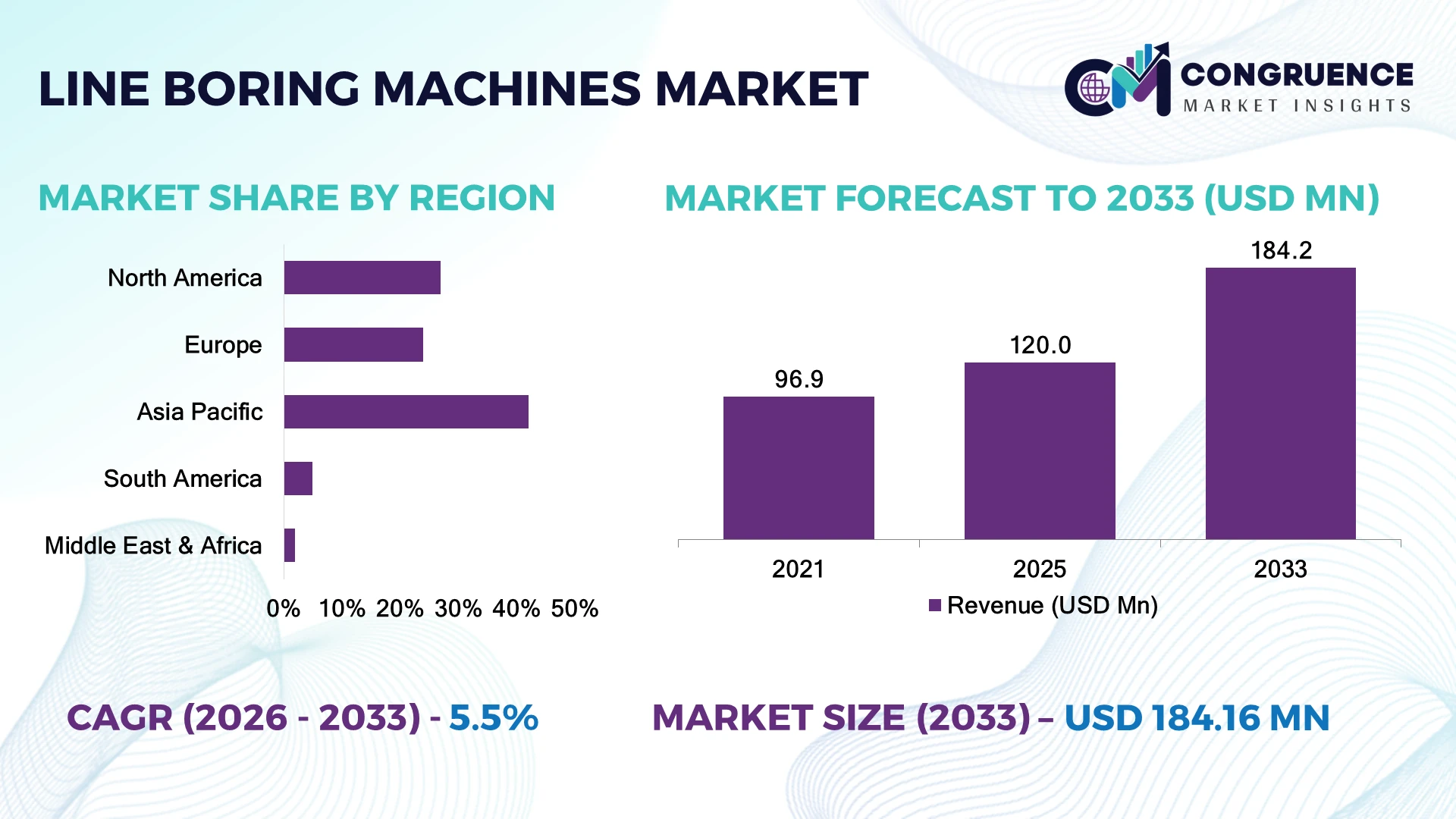
The Global Line Boring Machines Market was valued at USD 120.0 Million in 2025 and is anticipated to reach a value of USD 184.2 Million by 2033 expanding at a CAGR of 5.5% between 2026 and 2033. Growth is being driven by rising heavy-equipment refurbishment cycles, mining fleet maintenance requirements, and infrastructure asset life-extension programs requiring precision in-situ machining solutions.
China remains the dominant country, accounting for approximately 32% of global heavy-equipment manufacturing output, supported by multi-billion-dollar infrastructure programs and extensive mining operations. More than 65% of large industrial repair facilities in China have adopted portable machining technologies, compared with roughly 48% in India. Ongoing industrial modernization linked to global supply-chain diversification has accelerated demand for high-precision line boring systems across construction, energy, and transport sectors.
Strategically, manufacturers that strengthen portable automation capabilities and aftermarket service networks are best positioned to capture long-term industrial maintenance spending.
Market Size & Growth: USD 120.0 Million in 2025 reaching USD 184.2 Million by 2033, supported by expanding heavy-equipment refurbishment and precision maintenance demand.
Top Growth Drivers: Mining maintenance demand (+18%), infrastructure equipment servicing (+16%), and industrial asset life-extension programs (+14%).
Short-Term Forecast: By 2028, advanced line boring operations are expected to reduce maintenance downtime by nearly 22%.
Emerging Technologies: CNC-integrated portable systems, IoT-enabled diagnostics, and automated alignment technologies are improving machining precision.
Regional Leaders: Asia Pacific (~USD 70 Million), North America (~USD 42 Million), and Europe (~USD 36 Million), driven by equipment modernization initiatives.
Consumer/End-User Trends: Over 58% of large maintenance contractors increasingly prefer portable machining over component replacement.
Pilot/Case Example: A 2024 mining equipment refurbishment project improved bore alignment accuracy by 30% while reducing repair time by 25%.
Competitive Landscape: Top manufacturers control nearly 45% market share; key players include CLIMAX, York Portable Machine Tools, Sir Meccanica, Elsa, and American Machine Tools.
Regulatory & ESG Impact: Asset-repair strategies reduce material waste by up to 20%, supporting industrial sustainability targets.
Investment & Funding: More than USD 90 Million has been directed toward portable machining expansion and service-center development.
Innovation & Future Outlook: Digital calibration, remote monitoring, and modular boring platforms are reshaping global maintenance operations.
Line boring machines play a critical role in restoring precision tolerances across mining equipment, construction machinery, shipbuilding assets, and industrial processing systems. Recent innovations include digitally assisted alignment systems and CNC-enabled portable units that improve machining accuracy by over 25%. Increasing emphasis on equipment lifecycle optimization, combined with ongoing supply-chain disruptions affecting replacement components, is encouraging greater adoption of advanced field-machining solutions, setting the stage for deeper strategic market evaluation.
The line boring machines market has become strategically important as industrial operators prioritize equipment uptime, lifecycle extension, and maintenance efficiency over costly asset replacement. Infrastructure modernization programs, mining fleet expansion, and global supply-chain restructuring are increasing demand for field-service machining capabilities that reduce operational interruptions and improve asset utilization. Companies are viewing precision maintenance technologies as a competitive differentiator rather than a support function.
Modern CNC-assisted portable line boring systems deliver measurable advantages over conventional manual boring equipment, including up to 30% higher machining accuracy and nearly 20% lower repair-cycle duration. North American operators focus heavily on predictive maintenance integration and digital service workflows, while China emphasizes large-scale deployment across construction and mining fleets. Over the next two to three years, adoption of digitally enabled machining systems is expected to accelerate as industrial operators seek greater maintenance visibility and workforce productivity.
A practical example is the refurbishment of excavator and haul-truck pivot assemblies directly at mining sites, eliminating transport delays and reducing equipment downtime. Manufacturers are expanding service partnerships, investing in automation-ready platforms, and strengthening aftermarket support networks. Organizations that combine precision machining expertise with digital service capabilities will secure stronger competitive positioning, operational resilience, and long-term relevance across industrial maintenance ecosystems.
Mining, construction, and energy operators are increasingly extending equipment service life instead of replacing high-value assets. More than 60% of large mining fleets now prioritize refurbishment programs, while maintenance spending on heavy machinery has increased by approximately 15% over the past three years. Infrastructure modernization initiatives in China and India have further accelerated demand for precision bore restoration services. This shift directly increases utilization of portable line boring systems because in-field machining minimizes equipment transportation and operational downtime. In response, manufacturers are expanding service centers, introducing CNC-assisted portable platforms, and strengthening dealer networks. A notable strategic insight is that maintenance providers are increasingly bundling line boring with predictive maintenance services, creating recurring revenue opportunities while improving customer retention and equipment availability.
Advanced portable line boring systems require significant capital investment, with CNC-enabled units costing 25–40% more than conventional alternatives. Small and mid-sized maintenance contractors often face financing constraints, limiting technology adoption despite operational benefits. In addition, approximately 35% of industrial repair providers operate with fragmented service capabilities, creating inconsistencies in machining quality and deployment standards. Supply-chain disruptions affecting precision tooling and electronic control components have also increased procurement lead times by nearly 20% in some industrial markets. To mitigate these challenges, manufacturers are localizing component sourcing, establishing long-term supplier agreements, and offering equipment leasing models. A key operational insight is that flexible financing structures increasingly influence purchasing decisions as much as machine performance specifications.
The integration of automation, digital measurement, and remote diagnostics presents a significant opportunity for market participants. Automated alignment technologies can improve machining precision by more than 25%, while digital setup systems reduce operator preparation time by nearly 30%. Australia and Canada are witnessing growing demand for intelligent field-machining solutions across remote mining operations where equipment downtime carries substantial production costs. Companies are investing in smart sensors, cloud-connected maintenance platforms, and AI-assisted calibration systems to enhance productivity. A notable emerging trend is the development of hybrid machining ecosystems that combine portable equipment with digital asset-management platforms. This creates opportunities not only in equipment sales but also in software-enabled service contracts and long-term maintenance partnerships.
A persistent challenge involves the shortage of experienced machinists capable of operating advanced portable machining systems. Industry estimates indicate that nearly 28% of specialized machining positions remain difficult to fill across major industrial economies. At the same time, integration of digital controls, measurement systems, and maintenance software increases implementation complexity for end users. In the United States and Germany, industrial employers are reporting longer training cycles as machining environments become more technology intensive. These workforce constraints can affect deployment consistency, service quality, and scalability. Companies are responding through technical training programs, certification partnerships, and investments in user-friendly automation features. The most successful firms will be those that reduce skill dependency while maintaining machining precision and operational reliability across diverse industrial environments.
Portable CNC Systems Expansion Portable CNC-enabled line boring machines are gaining traction as industrial operators prioritize on-site repairs. Adoption of digitally controlled portable units has increased by nearly 28%, while setup times have fallen by approximately 22% through automated alignment functions. Labor shortages across mining and construction maintenance teams are accelerating deployment of user-friendly systems. Manufacturers are responding by scaling modular product platforms and integrating touchscreen diagnostics, enabling faster field operations and reducing dependence on highly specialized machining personnel.
Predictive Maintenance Integration Rising Industrial enterprises are increasingly linking line boring operations with predictive maintenance workflows. More than 40% of large equipment operators now use condition-monitoring systems to identify bore wear before failure occurs, reducing unplanned downtime by nearly 18%. This shift is changing maintenance scheduling from reactive repair to planned intervention. Equipment suppliers are forming partnerships with industrial software providers to connect machining services with asset-performance platforms, creating higher-value maintenance ecosystems and improving equipment availability.
Mining Fleet Refurbishment Acceleration Mining operators in Australia, Canada, and Chile are extending equipment life cycles as replacement lead times remain elevated. Refurbishment activity has increased by approximately 24%, while component replacement costs have risen by nearly 15% in certain heavy-equipment categories. Instead of purchasing new assemblies, operators are prioritizing bore restoration and precision re-machining. Service providers are expanding regional machining hubs and mobile field-service fleets to capture rising maintenance demand while reducing equipment transport delays.
Automation-Driven Accuracy Improvements Automated measurement technologies and laser-guided alignment systems are transforming machining precision standards. Advanced alignment solutions improve bore accuracy by nearly 30% and reduce calibration errors by approximately 20%. Industrial customers increasingly require documented machining tolerances to support quality assurance programs and equipment reliability targets. In response, manufacturers are investing in digital metrology, automated reporting tools, and integrated inspection capabilities, creating a competitive advantage through traceability, repeatability, and operational consistency.
Portable line boring machines account for approximately 68% of total market demand, making them the dominant segment due to their flexibility, lower deployment costs, and ability to perform precision machining directly at industrial sites. Mining, construction, marine, and heavy-equipment operators increasingly prefer portable systems because they eliminate costly component transportation and reduce equipment downtime by nearly 25%. Their compatibility with digital alignment tools and modular machining accessories further strengthens adoption across field-service operations. Manufacturers continue expanding portable product portfolios while introducing automated setup and measurement capabilities to enhance operational efficiency. Stationary line boring machines represent the fastest-evolving segment in high-precision industrial environments, particularly within manufacturing and remanufacturing facilities. Adoption of advanced stationary systems has increased by roughly 16% as enterprises prioritize repeatability and high-volume machining requirements. While portable units dominate maintenance-driven applications, stationary solutions are gaining importance where dimensional consistency and process automation are critical. Companies are investing in CNC integration, digital controls, and specialized tooling partnerships to improve throughput and machining accuracy. This divergence is shaping investment priorities between field-service flexibility and factory-based precision machining capabilities.
Mining equipment maintenance remains the leading application, representing approximately 34% of total market demand. High utilization rates of excavators, haul trucks, loaders, and drilling equipment generate continuous requirements for bore restoration and precision repair. Many mining operators report maintenance-cycle extensions exceeding 20% when precision line boring procedures are incorporated into refurbishment programs. The operational need to minimize downtime in remote locations further reinforces adoption. Equipment service providers are expanding mobile machining capabilities and field-service coverage to support growing mining-sector requirements. Construction equipment maintenance is emerging as the fastest-growing application as infrastructure development projects intensify across major industrial economies. Demand within this segment has increased by nearly 18%, supported by larger fleets of excavators, cranes, and earthmoving machinery requiring lifecycle extension. Marine equipment repair, industrial machinery servicing, and energy-sector maintenance continue contributing stable demand through specialized applications. Companies are investing in deployment expansion, service automation, and technician training programs to support a broader range of application environments. Demand is increasingly shifting toward rapid-response maintenance solutions capable of reducing operational interruptions across multiple industries.
Mining companies, construction contractors, marine operators, energy enterprises, and industrial manufacturing facilities collectively form the largest end-user group, with mining operators accounting for approximately 31% of overall demand. Their dominance stems from continuous exposure to heavy wear conditions, high equipment utilization rates, and substantial maintenance budgets. Large fleet operators increasingly deploy precision machining programs that reduce equipment downtime by nearly 20% while extending component service life. Manufacturers are targeting these customers through customized service packages, equipment leasing models, and dedicated aftermarket support networks. Construction contractors represent the fastest-expanding end-user category, supported by rising infrastructure investment and growing machinery fleets. Adoption among construction-focused maintenance providers has increased by roughly 17% as equipment owners prioritize asset optimization over replacement expenditures. Marine operators continue investing in precision machining for propulsion and structural systems, while energy-sector users require specialized solutions for turbines and heavy industrial equipment. Companies are strengthening partnerships with fleet operators, expanding regional service capabilities, and developing industry-specific machining solutions to capture evolving demand patterns. Competitive positioning increasingly depends on service responsiveness, technical expertise, and application-specific customization.
Asia-Pacific accounted for the largest market share at 42% in 2025 however, North America is expected to register the fastest growth, expanding at a CAGR of 6.1% between 2026 and 2033.
North America represents approximately 27% of global market activity, supported by extensive mining, construction, energy, and heavy-equipment maintenance operations. The region is increasingly focused on predictive maintenance, equipment lifecycle optimization, and digitally assisted field machining. Large fleet operators are integrating portable CNC line boring systems into maintenance workflows to reduce equipment downtime and improve service consistency. More than 55% of major industrial maintenance contractors have expanded mobile machining capabilities to support remote operational sites. Growing investments in mining equipment refurbishment and infrastructure asset maintenance continue strengthening demand. Equipment suppliers are responding through service-network expansion, technician training programs, and partnerships focused on digital maintenance integration, improving operational responsiveness across industrial sectors.
United States Market Outlook: The United States remains the largest contributor within North America due to its extensive mining, construction, defense, and industrial manufacturing sectors. Large-scale fleet ownership and a mature maintenance ecosystem support continuous demand for precision bore restoration solutions. More than 60% of major equipment service providers now offer portable machining services as part of integrated maintenance contracts. The country also benefits from strong adoption of digital diagnostics and predictive maintenance technologies, enabling higher equipment availability and improved operational efficiency across heavy industrial applications.
Europe accounts for approximately 24% of global demand and benefits from a highly developed industrial base, advanced manufacturing capabilities, and strong equipment refurbishment practices. Heavy machinery operators increasingly prioritize asset-life extension strategies as sustainability objectives encourage repair and remanufacturing over replacement. Industrial service providers are deploying precision machining technologies to support mining, marine, rail, and energy-sector equipment maintenance. Adoption of digitally controlled machining systems has increased by nearly 20% among specialized maintenance operators. Manufacturers are investing in automation, metrology integration, and service-center modernization to improve machining precision and throughput. This focus on operational efficiency is strengthening demand across both field-service and workshop-based applications.
Germany Market Outlook: Germany serves as the region’s strategic center for industrial engineering, manufacturing excellence, and advanced maintenance technologies. Its strong industrial equipment base creates consistent demand for precision refurbishment and bore restoration services. Industrial enterprises increasingly deploy digitally assisted machining systems to support productivity and quality objectives. Approximately half of large industrial maintenance organizations have expanded investments in automated machining and measurement technologies, reinforcing Germany’s leadership in precision engineering and industrial equipment lifecycle management.
Asia-Pacific leads the global market with approximately 42% share, supported by large-scale infrastructure development, mining activity, manufacturing expansion, and construction equipment deployment. Demand remains concentrated in industrial hubs where heavy machinery utilization rates are among the highest globally. Portable machining adoption has increased significantly as operators seek to minimize downtime and reduce equipment transportation costs. Several industrial enterprises have expanded refurbishment programs, resulting in maintenance-related equipment utilization improvements exceeding 20%. Equipment manufacturers continue strengthening distribution networks, regional service centers, and localized support capabilities. The combination of industrial scale and expanding maintenance requirements positions the region as the primary demand center for line boring solutions.
China Market Outlook: China remains the dominant country in the region due to its vast construction machinery fleet, mining operations, and manufacturing infrastructure. Large industrial operators increasingly emphasize equipment refurbishment to improve asset productivity and reduce maintenance expenditure. More than 65% of large heavy-equipment maintenance facilities utilize portable machining technologies for critical repairs. Continued investment in industrial modernization, transportation infrastructure, and mining productivity initiatives supports sustained demand for advanced line boring systems across multiple end-use industries.
South America accounts for approximately 5% of global market activity, with demand concentrated around mining, construction, and industrial maintenance operations. Equipment refurbishment is becoming increasingly important as operators seek to maximize asset utilization in resource-intensive industries. Mining contractors are expanding maintenance capabilities to reduce operational interruptions and improve fleet reliability. Refurbishment-related service activity has increased by nearly 18% across key mining corridors, creating stronger demand for portable machining solutions. Despite infrastructure and logistics challenges in certain markets, growing investment in mining productivity and industrial maintenance services continues to support equipment deployment. Companies are expanding field-service networks and regional maintenance partnerships to strengthen operational coverage.
Brazil Market Outlook: Brazil represents the largest market within South America due to its extensive mining industry, construction activity, and industrial equipment base. Large-scale mining operations require continuous maintenance of excavators, haul trucks, and processing equipment operating under demanding conditions. Equipment service providers are increasingly deploying mobile machining units closer to mining regions to accelerate repair response times. The country's ongoing industrial modernization efforts and expanding maintenance-service ecosystem continue to strengthen demand for precision field-machining technologies.
The Middle East & Africa region accounts for approximately 2% of global market demand and is increasingly influenced by industrial diversification initiatives, energy-sector modernization, and infrastructure expansion programs. Demand is concentrated in mining, oil and gas, marine, and heavy construction applications where equipment reliability is critical. Industrial operators are investing in maintenance capabilities to reduce dependency on imported replacement components and minimize downtime. Several large industrial projects have expanded localized maintenance requirements by more than 15%, creating opportunities for portable machining deployment. Service providers are responding through regional partnerships, technical training investments, and equipment localization strategies that improve operational support across key industrial markets.
Saudi Arabia Market Outlook: Saudi Arabia remains the most strategically significant market within the region due to large-scale industrial diversification programs, energy-sector investments, and infrastructure development activity. The country continues expanding industrial maintenance capabilities to support heavy equipment operating across construction, mining, and energy projects. Industrial operators increasingly prioritize localized repair solutions to improve equipment availability and reduce maintenance delays. Growing deployment of advanced maintenance technologies and specialized machining services is strengthening the country's position as a key market for precision line boring equipment and associated field-service operations.
The competitive landscape is led by global portable machining specialists including CLIMAX Portable Machining & Welding Systems, York Portable Machine Tools, Sir Meccanica, Elsa S.r.l., American Machine Tools, and a growing group of cost-focused Asian manufacturers. Competition is primarily between premium technology leaders and regional value-driven suppliers, while OEM-integrated service providers increasingly compete against independent field-machining contractors. The top five players collectively account for approximately 48% of market activity, creating a moderately consolidated structure. Competitive differentiation centers on machining accuracy, deployment speed, service coverage, and lifecycle support. Advanced CNC-assisted systems improve setup efficiency by nearly 25%, while digital alignment technologies reduce calibration time by approximately 20%. Portable solutions capable of cutting repair duration by over 30% command premium positioning. Leading companies are expanding service networks, introducing automation-ready platforms, forming maintenance partnerships, and strengthening aftermarket capabilities. The current shift favors digitally enabled machining ecosystems over standalone equipment sales. High technical expertise requirements and customer trust create significant entry barriers. Winning requires precision, rapid field deployment, strong service infrastructure, and continuous technology innovation.
York Portable Machine Tools
Sir Meccanica S.p.A.
Elsa S.r.l.
American Machine Tools Company
Bore Repair Systems Inc.
Mirage Machines Ltd.
Mactech Europe Ltd.
Metalock Engineering Group
DWT GmbH
Dongguan Portable Tools Co., Ltd.
GBC Industrial Tools S.p.A.
International Revere Machining Corporation (IRM)
The market is rapidly transitioning from manual line boring systems toward CNC-assisted portable machining platforms. Modern digital alignment technologies improve bore accuracy by approximately 25% while reducing setup time by nearly 20%. More than 45% of large industrial maintenance providers now utilize digitally assisted machining workflows. Integration of laser measurement systems, electronic feed controls, and automated calibration functions is improving operational consistency across mining, marine, and heavy-equipment maintenance applications. These technologies help operators minimize downtime while improving machining repeatability in field environments.
Emerging technologies include IoT-enabled diagnostics, cloud-connected maintenance reporting, and servo-motor-driven boring systems. Compared with conventional manual platforms, advanced servo-controlled systems deliver up to 30% higher positioning precision and significantly smoother machining performance. Adoption is strongest among enterprise maintenance contractors and fleet-service providers managing critical industrial assets. Companies that deploy intelligent machining systems benefit from improved service efficiency, stronger quality assurance, and enhanced customer retention.
Disruptive innovation is increasingly focused on predictive maintenance integration, automated metrology, and digital asset management. Between 2026 and 2028, deployment of connected machining solutions is expected to accelerate as industrial operators seek real-time maintenance visibility. Technology leaders capable of combining machining equipment, software analytics, and service ecosystems will gain a substantial competitive advantage through faster response times, lower operating costs, and superior asset-performance outcomes.
June 2025 – CLIMAX Portable Machining & Welding Systems highlighted deployment of its BB8100 line boring machine in the restoration of a 4,000-ton Ajax forging press in Chicago, supporting precision crank-bore recovery on critical industrial infrastructure. The project involved a 4,000-ton production asset and reinforced CLIMAX’s leadership in heavy-duty field machining applications. Business impact: strengthened positioning in large-scale industrial refurbishment. Source: www.climaxportable.com
March 2025 – Dongguan Portable Tools Co., Ltd. reported broader implementation of servo-motor technology across portable boring equipment, improving motion control precision and operational stability. The company highlighted enhanced machining consistency through upgraded drive systems. Business impact: accelerated adoption of digitally controlled field-machining solutions across industrial maintenance environments. Source: www.portable-machines.com
June 2025 – Dongguan Portable Tools Co., Ltd. showcased deployment of its LBM150 Portable Line Boring Machine for shipyard stern-rudder machining applications, emphasizing high-precision on-site restoration capabilities. The solution supported complex marine repair operations while minimizing component removal requirements. Business impact: strengthened penetration into maritime maintenance and repair markets. Source: www.portable-machines.com
2025 – S.F.E. Group / CLIMAX introduced 1.5 kW and 3.1 kW Servo Motor Conversion Kits designed for BB4500 and BB5000 line boring machines, expanding automation functionality and equipment adaptability. Business impact: improved upgrade pathways for existing machine fleets while supporting greater machining control and productivity.
This report provides a comprehensive assessment of the global line boring machines market across portable and stationary equipment categories, covering key applications in mining equipment maintenance, construction machinery servicing, marine repair, industrial manufacturing, and energy-sector operations. The analysis evaluates demand distribution across major end-user groups, deployment trends, equipment utilization patterns, and technology adoption levels. Regional coverage spans North America, Europe, Asia-Pacific, South America, and the Middle East & Africa, highlighting operational concentration, industrial activity, and competitive positioning across major markets.
The study examines technological developments including CNC-assisted machining, digital alignment systems, servo-driven controls, predictive maintenance integration, and intelligent metrology solutions. More than 60% of demand remains linked to heavy-equipment maintenance and refurbishment activities, while digitally enabled field-machining solutions continue expanding their share of industrial deployments. The report supports investment planning, market-entry evaluation, partnership strategies, competitive benchmarking, and expansion decisions by identifying emerging opportunities, operational shifts, technology priorities, and strategic market developments expected to influence industry direction between 2026 and 2033.
| Report Attribute / Metric | Details |
|---|---|
| Market Revenue (2025) | USD 120.0 Million |
| Market Revenue (2033) | USD 184.2 Million |
| CAGR (2026–2033) | 5.5% |
| Base Year | 2025 |
| Forecast Period | 2026–2033 |
| Historic Period | 2021–2025 |
| Segments Covered |
By Type
By Application
By End-User
|
| Key Deliverables | Revenue Forecast; Market Trends; Growth Drivers & Restraints; Technology Insights; Segmentation Analysis; Regional Insights; Competitive Landscape; Regulatory & ESG Overview; Recent Developments |
| Regions Covered | North America; Europe; Asia-Pacific; South America; Middle East & Africa |
| Companies Profiled | CLIMAX Portable Machining & Welding Systems; York Portable Machine Tools; Sir Meccanica S.p.A.; Elsa S.r.l.; American Machine Tools Company; Bore Repair Systems Inc.; Mirage Machines Ltd.; Mactech Europe Ltd.; Metalock Engineering Group; DWT GmbH; Dongguan Portable Tools Co., Ltd.; GBC Industrial Tools S.p.A.; International Revere Machining Corporation (IRM). |
| Customization & Pricing | Available on Request (10% Customization Free) |




