
Reports
The Global Light-Sport Aircraft Market was valued at USD 1844.5 Million in 2025 and is anticipated to reach a value of USD 2809.33 Million by 2033 expanding at a CAGR of 5.4% between 2026 and 2033. Growth is being driven by FAA MOSAIC regulatory expansion, rising flight-training utilization, electric propulsion, composite airframes, and demand for lower-operating-cost personal aircraft.
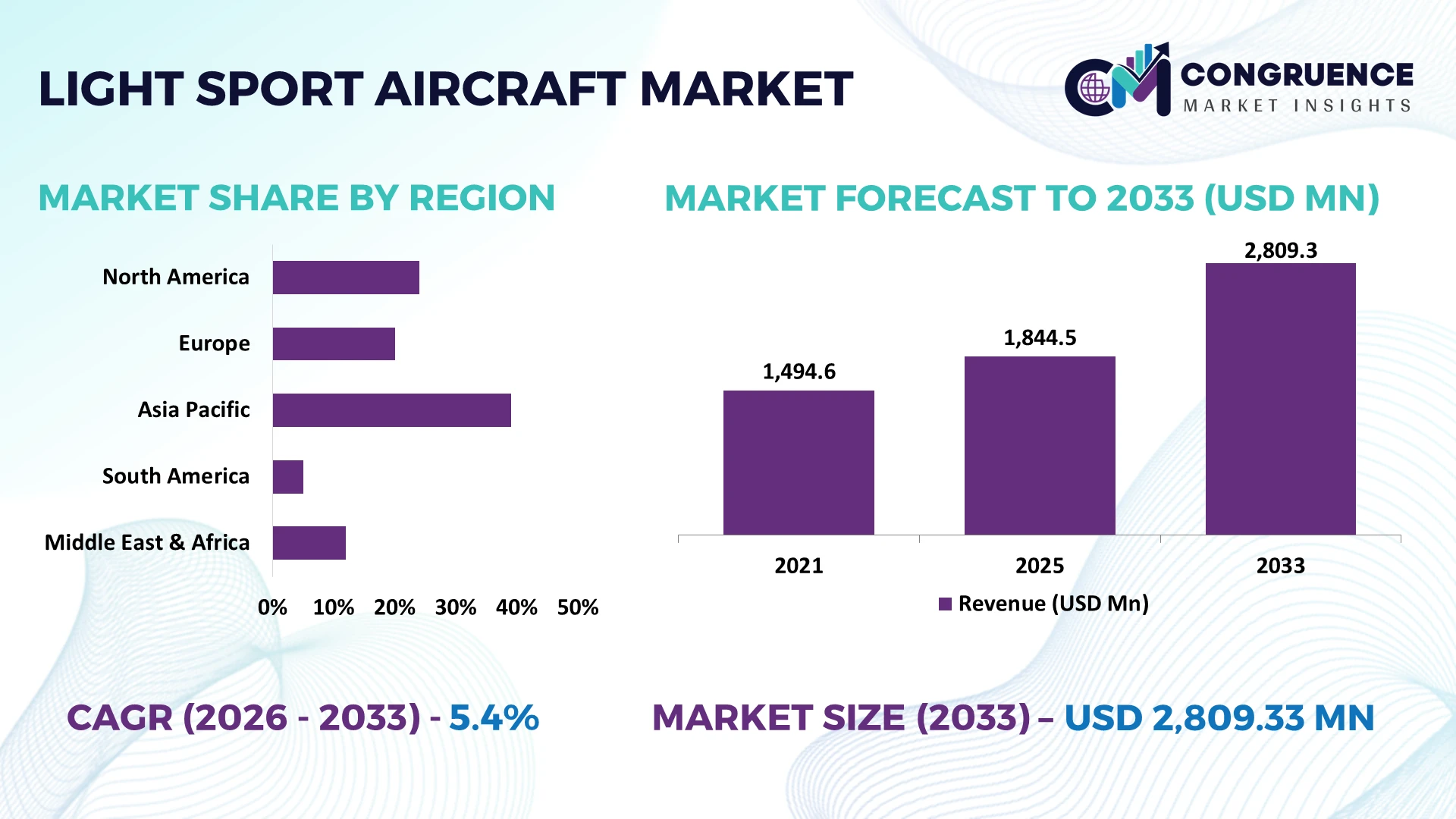
The United States dominates the global light-sport aircraft market with an estimated 38–40% share, supported by the world’s largest general aviation ecosystem and 1,782 piston-aircraft deliveries globally in 2025. FAA MOSAIC expanded eligible airplanes from 2 to 4 seats and maximum airspeed from 120 to 250 knots, widening manufacturer design flexibility. Europe remains stronger in electric LSA innovation, led by aircraft programs in Slovenia, Italy, Germany, and the Czech Republic. U.S.-European aerospace supply-chain and trade pressures are simultaneously increasing the strategic value of localized components and certification flexibility.
Strategically, manufacturers prioritizing MOSAIC-compatible platforms, training fleets, electric propulsion, advanced avionics, and localized supply chains will capture the strongest replacement and fleet-expansion opportunities.
Market Size & Growth: USD 1.84 billion in 2025 advances toward USD 2.81 billion by 2033 at 5.4%, supported by MOSAIC-enabled aircraft diversification and training-fleet modernization.
Top Growth Drivers: Flight-training modernization contributes approximately 35%, recreational aviation 30%, and regulatory aircraft-category expansion 25% to incremental demand momentum.
Short-Term Forecast: By 2028, next-generation LSA designs are positioned to improve useful-load and mission flexibility by approximately 15–20% through composites, upgraded propulsion, and regulatory redesign.
Emerging Technologies: Electric propulsion, glass cockpits, simplified flight controls, and lightweight composites are advancing; certified electric trainers already operate with 57.6-kW propulsion systems.
Regional Leaders: North America approaches USD 1.08 billion, Europe USD 0.77 billion, and Asia-Pacific USD 0.65 billion by 2033, with training modernization supporting adoption.
Consumer/End-User Trends: FAA MOSAIC increases eligible airplane seating from 2 to 4, strengthening demand among training schools, recreational pilots, and personal-aircraft buyers.
Pilot/Case Example: Pipistrel’s Velis Electro operates at approximately 60 dBA with zero in-flight emissions, demonstrating practical electric propulsion for repetitive flight-training missions.
Competitive Landscape: Tecnam holds an estimated 10–12% competitive position, alongside ICON Aircraft, Pipistrel, Flight Design, and Czech Aircraft Group across advanced light-aircraft platforms.
Regulatory & ESG Impact: MOSAIC raises permissible maximum airspeed from 120 to 250 knots while removing prescribed weight limits, materially expanding design and safety-equipment flexibility.
Investment & Funding: Global general aviation deliveries reached 4,234 aircraft in 2025, reinforcing manufacturer investment in production capacity, avionics integration, certification, and resilient aerospace supply chains.
Innovation & Future Outlook: MOSAIC now enables electric motors, turbines, rotorcraft, powered-lift, retractable landing gear, and simplified controls, shifting competition toward multifunctional next-generation recreational and training aircraft.
The light-sport aircraft market is transitioning from weight-restricted recreational platforms toward higher-performance aircraft serving flight training, personal mobility, tourism, and specialized aerial operations. FAA MOSAIC expanded allowable airplane airspeed from 120 to 250 knots, while electric propulsion, composite structures, glass cockpits, and simplified controls are widening design possibilities. Against continuing aerospace supply-chain and trade pressures, manufacturers combining regulatory-ready platforms with efficient propulsion and localized component sourcing are gaining strategic relevance, setting the stage for deeper competitive analysis.
The light-sport aircraft market is becoming strategically important as certification reform, training-fleet renewal, and propulsion diversification expand the category beyond basic recreational flying. FAA MOSAIC materially changes competitive economics by allowing broader aircraft configurations, electric motors, turbine engines, powered-lift designs, and greater performance flexibility. This regulatory reset is encouraging manufacturers to redesign platforms around higher useful load, improved avionics, and wider mission capability rather than legacy weight-constrained architectures.
Technology economics are also shifting. Electric trainers can reduce direct energy and routine powertrain maintenance costs by roughly 30–40% versus conventional piston aircraft in repetitive training cycles, although battery utilization limits endurance. The United States benefits from the largest general-aviation fleet and regulatory scale, while Slovenia, Italy, Germany, and the Czech Republic retain stronger specialization in lightweight composite and electric aircraft engineering. Global piston-aircraft deliveries reached 1,782 units in 2025, confirming sustained demand for efficient small-aircraft platforms.
Through 2026–2028, MOSAIC-compliant four-seat aircraft, digital cockpits, simplified controls, and electric training fleets will gain operational relevance. Flight schools deploying electric aircraft for short-duration circuits already reduce fuel exposure and turnaround complexity. Manufacturers are increasing certification spending, propulsion partnerships, and U.S. distribution capacity. Competitive advantage will increasingly depend on platform flexibility, operating economics, certification speed, and support-network scale.
FAA MOSAIC is the strongest structural driver because it expands what qualifies for light-sport certification and what sport pilots can operate. The framework raises permitted maximum airspeed from 120 knots to 250 knots, increases seating from 2 to 4 occupants, and removes prescriptive weight limitations that previously constrained aircraft design. This change directly improves payload flexibility, cabin utility, and mission suitability for training, personal transportation, and aerial work. U.S. manufacturers are redesigning aircraft around retractable gear, advanced avionics, electric propulsion, and higher-performance engines rather than optimizing solely for minimum weight. With piston-aircraft deliveries reaching 1,782 units in 2025, manufacturers have a sizeable replacement and training market to address. The non-obvious advantage is certification leverage: compliant manufacturers can serve several mission classes using one adaptable airframe family.
Electric and advanced light-sport platforms still face structural cost and infrastructure constraints that limit fleet-wide deployment. Battery-electric aircraft typically carry energy densities more than 70% below aviation gasoline on a usable-mass basis, restricting endurance and payload flexibility despite lower operating costs. Charging infrastructure is also uneven across smaller U.S. airports, while battery replacement can represent 15–25% of lifecycle propulsion expense depending on utilization. Conventional piston fleets therefore remain operationally attractive for cross-country training and private touring. Supply-chain exposure adds pressure because composite materials, avionics, engines, and certified electronics often come from specialized suppliers concentrated in Europe and North America. Manufacturers are responding through modular battery systems, dual-propulsion portfolios, localized component sourcing, and long-term supplier agreements. The key restraint is not aircraft demand but whether operating infrastructure and component economics can support high-utilization deployment.
Flight training offers the strongest near-term opportunity because repetitive short missions favor low-noise, low-maintenance electric aircraft. Electric propulsion can cut direct energy and powertrain maintenance expenditure by approximately 30–40%, while motor efficiency exceeds 90% versus roughly 30–35% for conventional piston combustion engines. MOSAIC further expands opportunity by permitting electric motors and more capable training configurations under light-sport certification. The United States is strategically attractive because flight schools require frequent fleet utilization, while Slovenia and Italy provide established electric-aircraft engineering and production expertise. Between 2026 and 2028, manufacturers can exploit a non-obvious business model: bundling aircraft, charging infrastructure, battery management, maintenance analytics, and financing into fleet-service packages. Companies are already prioritizing propulsion partnerships, digital fleet monitoring, and instructor-oriented cockpit standardization to lower adoption friction and improve aircraft utilization.
The long-term challenge is scaling after-sales support as light-sport aircraft become faster, more technologically complex, and more diverse. MOSAIC expands maximum airspeed to 250 knots and enables technologies including turbines, electric motors, powered lift, and retractable landing gear, increasing maintenance and technician skill requirements beyond traditional basic LSA servicing. Meanwhile, 1,585 single-engine piston and electric aircraft were delivered globally in 2025, demonstrating growing fleet volume that requires parts, software, battery, and avionics support. Smaller manufacturers risk operational inconsistency if service networks fail to match geographic sales expansion. Cybersecurity and software configuration also become more relevant as glass cockpits and connected diagnostics proliferate. Companies must invest in technician training, remote diagnostics, standardized parts inventories, and certified service partnerships. Competitive durability will depend on support-network density as much as aircraft performance or purchase price.
MOSAIC Redefines Aircraft Configuration: U.S. manufacturers are redesigning platforms around FAA MOSAIC, which lifts the traditional 1,320-pound prescriptive ceiling, permits up to 4 seats, and raises allowable maximum airspeed to 250 knots. The rule shift expands payload, avionics, propulsion, and mission flexibility. Producers are accelerating certification work and modular airframe programs, reducing the need to maintain separate recreational and higher-performance product families.
Digital Cockpits Become Standard: Glass cockpits, integrated engine monitoring, autopilot functions, and connected diagnostics are moving downward from certified general aviation into light-sport platforms. Modern avionics can reduce pilot workload by roughly 15–20%, while digital engine monitoring shortens fault-identification cycles by about 20%. Manufacturers are standardizing Garmin- and Dynon-class architectures, simplifying training transitions and improving resale appeal for flight schools and private owners.
Composite Production Gains Priority: Composite-intensive airframes are expanding as manufacturers seek lower structural weight, corrosion resistance, and more efficient aerodynamic shaping. Advanced composites can reduce structural mass by approximately 15–25% versus comparable conventional metallic assemblies, while smoother molded surfaces improve aerodynamic efficiency by roughly 5–8%. Czech, Italian, and Slovenian producers are refining molded-component workflows and supplier partnerships to increase output without proportionally expanding skilled sheet-metal labor.
Fleet Economics Drive Equipment Choices: Operators increasingly evaluate aircraft through utilization economics rather than acquisition price alone. GAMA recorded 1,782 piston-airplane deliveries in 2025, up 0.6%, while total airplane shipments increased 2.2%. High-cycle users are responding by selecting fuel-efficient engines, condition-monitoring systems, standardized avionics, and interchangeable training configurations. The non-obvious shift is toward fleet commonality, which reduces instructor conversion time, spare-parts complexity, and maintenance scheduling friction.
Light Sport Aircraft represent the leading type, accounting for an estimated 52–55% of segment demand due to their balance of payload capability, certified operating flexibility, relatively low ownership cost, and suitability for both recreation and structured flight training. FAA MOSAIC strengthens this position by allowing airplanes with as many as 4 seats and substantially broader performance envelopes. Manufacturers are therefore moving beyond traditional two-seat, low-speed configurations toward higher-useful-load aircraft incorporating glass cockpits, automated propeller control, and more capable propulsion.
Gyroplanes represent the fastest-growing type, supported by compact operating footprints, improved stability systems, and rising interest in recreational and specialized aerial use. Their share is estimated near 12–14%, compared with approximately 15–18% for Ultralight Aircraft. Motor Gliders remain relevant for training and soaring communities, while Light-Sport Seaplanes occupy a smaller but strategically attractive niche tied to tourism and water-access operations. Producers are investing in composite construction, simplified controls, and multi-mission variants as capital shifts toward platforms able to address several operating categories from one airframe.
Recreational Flying remains the largest application, representing an estimated 40–43% of light-sport aircraft demand because lower operating costs, simpler pilot pathways, and broad private-airfield access favor leisure ownership. Sports Aviation adds approximately 18–20%, supported by enthusiast communities, fly-ins, and club-based operations. Personal Transportation is gaining relevance as MOSAIC enables higher-performance aircraft, although its adoption remains constrained by weather capability, payload, and airport access compared with conventional general aviation.
Flight Training is the fastest-growing application, approaching an estimated 25–28% share as schools seek fuel-efficient, standardized platforms for primary instruction and hour-building. FAA operating rules explicitly allow special light-sport aircraft to conduct compensated flight training, reinforcing their commercial utility. Aerial Photography remains a smaller application but benefits from stable low-speed flight, glass cockpits, and lower mission cost. Manufacturers are adapting by offering training packages, dual controls, digital flight displays, and fleet-maintenance support. The business implication is clear: recurrent institutional utilization increasingly provides more predictable aircraft demand than discretionary private ownership alone.
Private Pilots remain the dominant end-user group, accounting for an estimated 45–48% of light-sport aircraft demand because personal ownership remains closely tied to recreational flying, sport aviation, and lower-cost general aviation access. Aviation Clubs contribute roughly 18–20%, using shared ownership to spread fixed costs across multiple pilots. Aircraft Rental Companies maintain a smaller but commercially important position where utilization density supports hourly leasing and fleet replacement economics.
Flight Schools represent the fastest-growing buyer group, approaching 25–27% of demand as standardized cockpit layouts, lower fuel burn, and simpler maintenance improve training economics. High-cycle training operations also favor aircraft with predictable inspection schedules, robust landing gear, and digital engine monitoring. Government Agencies remain selective users for patrol, observation, and training functions rather than mainstream buyers. Manufacturers are responding with fleet discounts, instructor configurations, financing programs, maintenance agreements, and standardized avionics packages. Competitive positioning is shifting toward lifecycle support: winning institutional buyers increasingly requires dispatch reliability, parts availability, and rapid technician access rather than the lowest aircraft purchase price.
North America accounted for the largest market share at 39% in 2025 however, Asia-Pacific is expected to register the fastest growth, expanding at a CAGR of 7.2% between 2026 and 2033.

MOSAIC Reshapes Fleet and Product Strategy
North America holds approximately 39% of global light-sport aircraft demand, anchored by the United States’ extensive general aviation infrastructure, flight-training ecosystem, recreational pilot population, and aircraft service network. FAA MOSAIC is fundamentally widening deployment possibilities by replacing rigid weight-based constraints with performance-oriented criteria. Eligible airplanes can accommodate up to 4 seats and maximum airspeeds reaching 250 knots, enabling manufacturers to develop higher-utility platforms for training and personal transportation. Canada adds demand through recreational aviation, remote-airfield operations, and established pilot-training infrastructure. Digital avionics, composite airframes, and fuel-efficient piston engines remain central procurement priorities as operators focus on lifecycle economics. OEMs are consequently expanding U.S. dealer coverage, certification programs, maintenance partnerships, and MOSAIC-compatible product development rather than concentrating exclusively on traditional two-seat recreational aircraft.
United States Market Outlook: The United States offers the strongest operational platform through thousands of public-use airports, mature flight schools, active general aviation communities, and the world’s most consequential light-sport regulatory framework. MOSAIC’s 59-knot clean-stall threshold and four-seat allowance expand aircraft capability significantly. Manufacturers positioned around domestic service availability, standardized avionics, financing, and rapid parts support gain a decisive fleet-sales advantage.
Composite Engineering Supports Export Leadership
Europe represents approximately 28% of light-sport aircraft activity and remains an important manufacturing and technology center, particularly across Italy, the Czech Republic, Slovenia, Germany, and Austria. European manufacturers compete through composite-intensive structures, efficient Rotax-class propulsion, aerodynamic optimization, and export-oriented production rather than domestic scale alone. Electric flight is more operationally advanced here: certified platforms such as the Velis Electro demonstrate zero in-flight emissions and approximately 60 dBA external noise characteristics, making short-duration training a practical electrification pathway. Regulatory differences between European ultralight categories and U.S. light-sport standards require manufacturers to maintain adaptable certification configurations. OEMs including Tecnam and specialist Central European producers increasingly integrate digital cockpits, ballistic recovery systems, and modular powerplants. The strategic advantage lies in engineering aircraft that can be configured efficiently for multiple national certification environments and international distribution channels.
Italy Market Outlook: Italy combines established light-aircraft engineering with strong training-aircraft manufacturing and export capabilities. Tecnam’s product architecture spans recreational, training, and higher-capability piston platforms, creating manufacturing commonality across missions. Italian suppliers also benefit from proximity to European avionics, composite, engine, and aerospace engineering clusters, strengthening configuration flexibility and supporting international fleet customers requiring standardized training platforms and lifecycle services.
Training Infrastructure Unlocks New Demand
Asia-Pacific accounts for approximately 21% of global light-sport aircraft demand, with Australia, China, India, and New Zealand providing distinct deployment pathways. Australia has a mature recreational aviation ecosystem, while India is increasing pilot-training capacity to support rapidly expanding commercial aviation requirements. China combines domestic aircraft manufacturing ambitions with general aviation infrastructure development, although controlled airspace and operating permissions continue to influence private flying activity. India’s expanding flying-training organization network creates an important opportunity for efficient two-seat and next-generation four-seat trainers. Manufacturers are positioning through distributor agreements, local maintenance relationships, and training-oriented aircraft packages rather than relying solely on private ownership. Australia remains important for established recreational demand, whereas India offers stronger institutional fleet potential. The operational priority across emerging markets is dependable aircraft utilization supported by spare parts, instructor familiarity, and locally accessible maintenance.
India Market Outlook: India is strategically important because airline expansion is intensifying demand for trained pilots and increasing utilization of flying-training organizations. The country has more than 35 approved flying-training organizations operating across over 50 bases. Efficient light aircraft can address early-stage instruction and hour-building, creating opportunities for OEMs offering robust airframes, standardized glass cockpits, financing, and dependable local maintenance arrangements.
Brazil Anchors Recreational Aviation Scale
South America contributes approximately 7% of global light-sport aircraft demand, with Brazil providing the deepest aviation ecosystem and strongest combination of private flying, agricultural aviation expertise, aerospace manufacturing, and flight-training activity. Recreational aircraft and ultralights benefit from extensive territory and active aeroclubs, while comparatively lower-cost platforms support pilot development outside major airline academies. Argentina and Chile add established aviation communities but operate at smaller fleet scales. Currency volatility, imported engine costs, and dependence on specialized avionics constrain procurement predictability, making maintenance economics especially important. Manufacturers are using local distributors, parts inventories, financing partnerships, and established aeroclub networks to reduce ownership friction. Brazil’s domestic aerospace capabilities provide a non-obvious advantage: an experienced aviation workforce and supplier ecosystem make technical support and specialized maintenance easier to develop than in smaller neighboring markets.
Brazil Market Outlook: Brazil provides the region’s strongest platform through more than 4,000 aerodromes and landing facilities when public and private infrastructure is considered broadly, alongside established aerospace engineering expertise. Local recreational flying communities and pilot-training operations create diversified demand. Successful foreign OEMs require Portuguese-language support, reliable parts availability, local technical representation, and pricing structures resilient to exchange-rate movements.
Aviation Training Investment Broadens Deployment
Middle East & Africa accounts for approximately 5% of global light-sport aircraft demand, with the UAE, Saudi Arabia, and South Africa providing the most developed operating environments. Gulf aviation investment is creating opportunities around pilot academies, tourism, recreational aviation, and specialized training, while South Africa maintains an established community of private pilots, microlight operators, flying clubs, and aircraft maintenance organizations. Harsh temperatures and dust conditions increase requirements for cooling, filtration, engine reliability, and preventive maintenance. Saudi Arabia’s aviation transformation targets major increases in passenger connectivity and aviation-sector capacity, indirectly strengthening pilot-training requirements. Suppliers are responding with hot-weather configurations, regional maintenance partnerships, and academy-focused fleet packages. Unlike mature private-ownership markets, institutional training and tourism applications provide a more practical route to scale across Gulf countries.
United Arab Emirates Market Outlook: The UAE offers advanced airport infrastructure, international aviation training capacity, and concentrated high-income recreational demand. Its aviation ecosystem supports modern simulators, digital flight operations, and specialist maintenance capabilities. Light-aircraft suppliers benefit from centralized deployment around Dubai and Abu Dhabi, but successful fleet expansion depends on heat-adapted equipment, local regulatory approval, and partnerships with established training and aviation-service organizations.
Tecnam, Pipistrel, Flight Design, BRM Aero, and Czech Aircraft Group compete through training capability, composite engineering, propulsion choice, and dealer reach, while specialist ultralight producers pressure established OEMs on acquisition cost. The top five manufacturers hold approximately 38% of organized global light-sport aircraft activity, leaving substantial fragmentation across national categories. Advanced composite structures deliver roughly 15–25% structural-weight savings, while electric powertrains can lower energy and routine propulsion-maintenance costs by 30–40% in short training cycles. Tecnam emphasizes fleet-standardized trainers; Pipistrel differentiates through electric propulsion; Central European OEMs compete through customization and export pricing. MOSAIC is shifting competition toward faster, heavier, four-seat-capable designs and reducing the relevance of legacy weight optimization. Certification expenditure, engine availability, dealer coverage, and qualified maintenance capacity remain major entry barriers. Supply-chain resilience is increasingly decisive as avionics and propulsion availability determine delivery speed. Winning requires certification agility, platform versatility, lifecycle economics, dependable parts supply, and scalable after-sales support globally.
Tecnam
Pipistrel
Flight Design
BRM Aero
Czech Aircraft Group
Aerospool
TL-ULTRALIGHT
Evektor
Van’s Aircraft
Remos AG
CubCrafters
Aeroprakt
Sling Aircraft
AutoGyro GmbH
Current light-sport aircraft technology centers on glass cockpits, FADEC-enabled engines, composite structures, ballistic recovery systems, and digital engine monitoring. Modern Rotax-class fuel-injected powerplants can reduce fuel consumption about 15–20% versus older carbureted engines, while composite airframes cut structural mass roughly 15%. Adoption is strongest among new training and recreational platforms, improving dispatch reliability, useful load, and fleet standardization.
Emerging systems include electric propulsion, simplified flight controls, connected diagnostics, and integrated autopilot protection. Electric trainers achieve motor efficiencies above 90% compared with roughly 30–35% for piston combustion engines, translating into materially lower energy and routine propulsion-maintenance requirements on short cycles. Digital cockpits now dominate premium new LSAs, while automated envelope protection and remote health monitoring shorten troubleshooting and reduce pilot workload, strengthening flight-school utilization economics.
Disruptive development is shifting toward MOSAIC-enabled four-seat aircraft, turbine propulsion, powered-lift configurations, and software-defined cockpit functions. Between 2026 and 2028, manufacturers integrating modular avionics, electric or hybrid systems, and predictive maintenance will gain certification and lifecycle advantages. Compared with legacy two-seat, fixed-configuration LSAs, new platforms can improve mission flexibility by 25–30%. OEMs, flight schools, and fleet operators benefit most; acting now secures training partnerships, supplier capacity, and early regulatory positioning before category standards and fleets mature.
September 2024 Tecnam partnered with Buiqui Aerospace to add 50 aircraft, beginning with 20 deliveries through Q2 2025. The fleet transition strengthens standardized pilot training, increases utilization capacity, and deepens Tecnam’s position in U.S. and Puerto Rican academies. Source: tecnam.com
July 2025 FAA finalized MOSAIC, removing legacy weight limits while permitting four-seat light-sport aircraft, electric propulsion, retractable gear, and limited aerial work. The rule expands addressable aircraft configurations and accelerates certification investment and fleet modernization across U.S. aviation. Source: faa.gov
March 2025 CubCrafters moved the Carbon Cub UL into full-scale production, with first customer deliveries scheduled for Q2 2025. Carbon-fiber construction and factory-built LSA availability strengthen backcountry positioning while expanding scalable production for higher-performance recreational and training buyers. Source: cubcrafters.com
July 2026 Texas Aircraft advanced its four-seat Stallion for the expanded light-sport category as MOSAIC certification rules took effect. Development experience under Brazil’s comparable regulatory framework gives the manufacturer a head start in aerial-work, training, and personal-transport applications. Source: aopa.org
The Light-Sport Aircraft Market Report covers Ultralight Aircraft, Light Sport Aircraft, Motor Gliders, Gyroplanes, and Light-Sport Seaplanes across Recreational Flying, Flight Training, Aerial Photography, Personal Transportation, and Sports Aviation. End-user analysis spans Private Pilots, Flight Schools, Aviation Clubs, Aircraft Rental Companies, and Government Agencies. Light Sport Aircraft account for an estimated 52–55% of type demand, while Private Pilots represent roughly 45–48% of end-user activity.
Regional coverage includes North America, Europe, Asia-Pacific, South America, and Middle East & Africa, with country-level assessment of regulation, fleet deployment, training infrastructure, manufacturing, and aftermarket support. The report evaluates composite airframes, digital avionics, electric propulsion, simplified flight controls, predictive maintenance, and MOSAIC-enabled aircraft architectures. Between 2026 and 2033, these insights support investment prioritization, fleet expansion, partnership selection, certification strategy, supplier planning, competitive benchmarking, and positioning in emerging training, aerial-work, and personal-mobility niches.
| Report Attribute/Metric | Report Details |
|---|---|
Market Revenue in 2025 | USD 1844.5 Million |
Market Revenue in 2033 | USD 2809.33 Million |
CAGR (2026 - 2033) | 5.4% |
Base Year | 2025 |
Forecast Period | 2026 - 2033 |
Historic Period | 2021 - 2025 |
Segments Covered | By Type
By Application
By End-User
|
Key Report Deliverable | Revenue Forecast, Growth Trends, Market Dynamics, Segmental Overview, Regional and Country-wise Analysis, Competition Landscape |
Region Covered | North America, Europe, Asia-Pacific, South America, Middle East, Africa |
Key Players Analyzed | Tecnam, Pipistrel, Flight Design, BRM Aero, Czech Aircraft Group, Aerospool, TL-ULTRALIGHT, Evektor, Van’s Aircraft, Remos AG, CubCrafters, Aeroprakt, Sling Aircraft, AutoGyro GmbH |
Customization & Pricing | Available on Request (10% Customization is Free) |




