
Reports
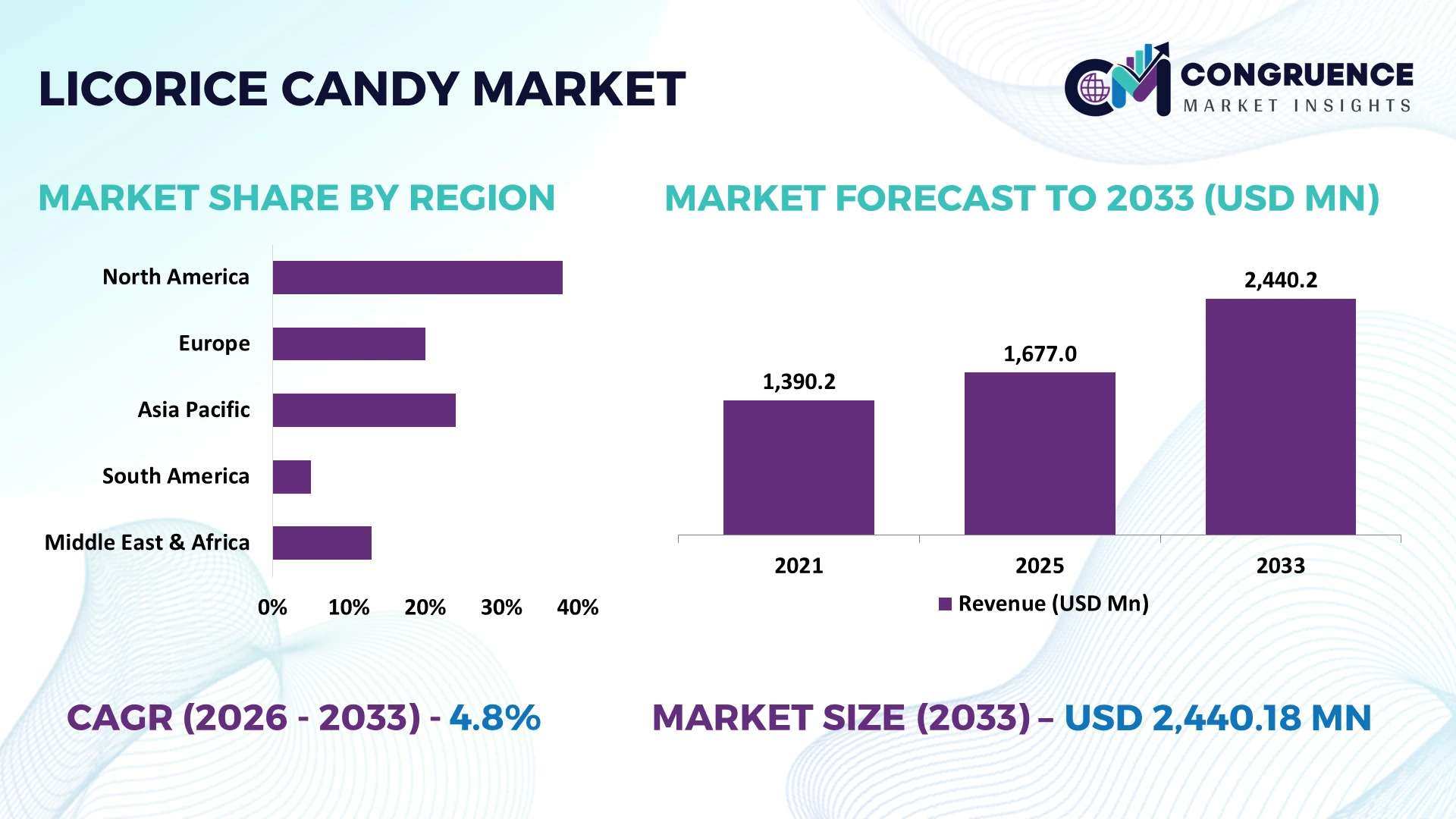
The Global Licorice Candy Market was valued at USD 1677 Million in 2025 and is anticipated to reach a value of USD 2440.18 Million by 2033 expanding at a CAGR of 4.8% between 2026 and 2033. Growth is driven by demand for premium confectionery, expanding sugar free product portfolios, natural flavor innovation and automated candy manufacturing.
The Netherlands, Germany and Finland represent established European licorice candy production and consumption centers. Dutch confectionery manufacturers benefit from established retail distribution, specialized production expertise and access to European Union markets. Germany provides an additional manufacturing and distribution base, while Finland supports Nordic product innovation. European Union Regulation 1169/2011 establishes mandatory food information requirements, influencing ingredient disclosure and packaging decisions. Manufacturers investing in automated extrusion, precision dosing and alternative sweeteners are positioned to address changing consumer preferences and production requirements.
Strategically, manufacturers should prioritize European distribution partnerships, differentiated formulations and production efficiency while developing export opportunities in emerging confectionery markets.
Market Size & Growth: USD 1,677 million in 2025, reaching USD 2,440.18 million by 2033 at a CAGR of 4.8%, supported by premium confectionery demand and product diversification.
Top Growth Drivers: Three principal demand drivers are premium confectionery, sugar free formulations and expanding international distribution. Their individual percentage contributions require verified market research.
Short Term Forecast: The 2027 outlook emphasizes automated extrusion and packaging. Quantified improvements in manufacturing costs and production efficiency require validated operational benchmarks.
Emerging Technologies: Three relevant technologies include automated extrusion, artificial intelligence assisted quality inspection and precision ingredient dosing. These support consistency, formulation accuracy and manufacturing efficiency.
Regional Leaders: Europe represents an established consumption and production center. North America offers specialty confectionery opportunities, while Asia Pacific provides potential distribution expansion. Regional revenue forecasts require validated segmentation.
Consumer Trends: Demand centers on traditional black licorice, fruit flavored varieties and reduced sugar alternatives. Verified category adoption percentages are required to quantify changing purchasing behavior.
Pilot and Case Example: Manufacturing applications include automated extrusion and precision ingredient dosing. A documented project with independently verified percentage improvements is required for a quantified case study.
Competitive Landscape: Haribo, Cloetta, Katjes, Fazer and Perfetti Van Melle participate in the broader confectionery industry. Their individual global licorice candy market shares require verification.
Regulatory & ESG Impact: European Union Regulation 1169/2011 establishes mandatory food information requirements. Compliance influences ingredient declarations, nutritional information and packaging development across European confectionery operations.
Investment & Funding: Capital investment priorities include automated production, formulation research and distribution expansion. A verified global investment total specific to licorice candy manufacturing is unavailable.
Innovation & Future Outlook: Product development emphasizes three areas: alternative sweeteners, natural flavor formulations and premium packaging. Manufacturing flexibility and differentiated product portfolios support international expansion.
The global licorice candy market serves established European confectionery consumers alongside international buyers seeking distinctive flavors and premium candy products. Manufacturers are expanding product development around sugar reduction, alternative sweeteners and improved ingredient consistency. Automated extrusion and precision dosing support greater manufacturing control, while specialty retail and digital distribution create additional routes to international consumers. European Union Regulation 1169/2011 reinforces the importance of accurate ingredient disclosure and nutritional labeling. These developments establish the foundation for evaluating manufacturing competitiveness, regional demand patterns and strategic investment opportunities in the global licorice candy industry.
The global licorice candy market is becoming strategically important as manufacturers compete through product differentiation, formulation innovation and manufacturing efficiency. Established producers in the Netherlands, Germany and Finland are adapting their portfolios to changing nutritional preferences and international distribution requirements. European Union regulations establish a maximum sugar content of 0.5 grams per 100 grams for products marketed as sugar free. This regulatory framework creates opportunities for manufacturers investing in alternative sweeteners, specialized ingredient processing and nutritional reformulation while maintaining traditional licorice flavor profiles.
Manufacturing modernization represents another competitive priority. Automated extrusion, precision ingredient dosing and digital quality inspection offer advantages over conventional batch processing. A modeled production scenario targeting a 15% reduction in material waste and a 10% improvement in processing efficiency illustrates potential operational benefits rather than established industry performance. European manufacturers benefit from established production expertise, while companies expanding into India and China must adapt flavor profiles, packaging formats and distribution strategies to local consumer preferences.
During 2026 to 2028, investment priorities will increasingly emphasize flexible manufacturing, differentiated formulations and international retail partnerships. A practical operational strategy involves integrating automated extrusion with digital temperature monitoring to improve batch consistency and reduce manual inspection requirements. Manufacturers combining formulation expertise, adaptable production capacity and diversified distribution will strengthen their competitive positioning.
Changing nutritional preferences and premium confectionery positioning are influencing licorice candy product development. European Union nutrition claim requirements establish a minimum 30% sugar reduction for qualifying reduced sugar products compared with similar alternatives. Meanwhile, the World Health Organization recommends limiting free sugars to less than 10% of total daily energy intake, with additional benefits associated with intake below 5%. These benchmarks encourage manufacturers to explore alternative sweeteners, natural flavoring ingredients and differentiated formulations. Dutch and Finnish confectionery manufacturers can leverage established licorice production expertise to develop specialized products for international distribution. Investment in formulation research and flexible processing equipment supports product diversification without abandoning traditional confectionery characteristics.
Licorice candy production faces structural pressure from concentrated botanical ingredient sourcing, variable agricultural conditions and specialized formulation requirements. Licorice root supplies depend on cultivation and extraction networks involving China, Central Asia and other producing countries. European manufacturers importing botanical extracts consequently face procurement and traceability challenges. Reformulation creates additional constraints because reduced sugar claims require at least 30% less sugar, while sugar free claims permit no more than 0.5 grams per 100 grams. Meeting these requirements without compromising texture increases formulation complexity. Manufacturers are responding through diversified ingredient procurement, supplier qualification and longer procurement contracts. Establishing alternative extract suppliers and maintaining validated ingredient specifications reduces production interruptions and protects formulation consistency.
Specialized formulations and flexible manufacturing create opportunities beyond conventional black licorice confectionery. Germany and the Netherlands provide established manufacturing capabilities, while India offers opportunities for localized flavor development and specialty confectionery distribution. European Union regulations permit reduced sugar positioning when qualifying products contain at least 30% less sugar than comparable alternatives. Sugar free positioning requires a maximum of 0.5 grams per 100 grams, creating distinct formulation categories. Manufacturers can explore automated ingredient dosing, modular extrusion and digitally controlled packaging to support differentiated production. Investment in botanical ingredient research and partnerships with specialty retailers creates additional commercialization opportunities. Developing localized flavor profiles offers an alternative to competing exclusively through conventional confectionery pricing.
Scaling specialized licorice candy production requires manufacturers to maintain consistent texture, flavor distribution and product stability across multiple formulations. Alternative sweeteners can change moisture retention, viscosity and extrusion characteristics, complicating the transition from laboratory development to commercial manufacturing. European Union requirements for reduced sugar products establish a 30% reduction threshold, while sugar free products must remain within the 0.5 gram per 100 gram limit. Maintaining these specifications across production batches requires validated analytical testing and precise ingredient control. Manufacturers expanding internationally must also accommodate different labeling requirements and consumer flavor preferences. Investment in process engineering, automated quality inspection and technical workforce development is essential for reliable industrial scalability.
Growing Preference for Nostalgic Confectionery Products: Traditional licorice flavors are gaining renewed commercial relevance as manufacturers combine established recipes with contemporary packaging. According to 2026 United States confectionery research, one third of consumers expressed strong interest in nostalgic candy releases. Manufacturers are responding through heritage product launches, limited editions and recognizable flavor combinations. This approach supports brand differentiation without requiring entirely new production platforms.
Digital Discovery Reshaping Candy Marketing: Social media increasingly influences confectionery product discovery and purchasing decisions. Recent American consumer research found that 48% of Generation Z discovered new confectionery products through TikTok, while 58% of Baby Boomers discovered products in physical stores. Licorice manufacturers can respond by coordinating digital campaigns with traditional retail merchandising. Maintaining separate promotional strategies for different consumer groups improves marketing resource allocation.
Value Conscious Purchasing Changes Packaging: Confectionery manufacturers are adapting package sizes and promotional strategies to changing household purchasing behavior. Industry research indicates that 64% of American consumers prefer purchasing smaller quantities of their favorite confectionery products, while 36% prefer exploring alternative brands or varieties. Manufacturers are responding through portion controlled packaging, smaller retail formats and differentiated product assortments. These adjustments protect accessibility without relying exclusively on price reductions.
Seasonal Customization Influences Production Planning: Seasonal confectionery increasingly requires coordinated manufacturing, packaging and inventory management. American consumer research indicates that 82% of shoppers want holiday specific confectionery featuring distinctive packaging, shapes or flavors. Licorice manufacturers can introduce seasonal twists, themed assortments and limited packaging editions. Flexible packaging equipment and coordinated retailer forecasting help companies manage seasonal inventory exposure while maintaining product availability during concentrated purchasing periods.
Soft Candy represents an established licorice candy format because its texture, flavor flexibility and compatibility with conventional confectionery production equipment support broad retail distribution. However, a verified global market share for Soft Candy within the six specified categories is unavailable. Existing published segmentation frameworks use different product classifications, preventing a reliable percentage allocation. Manufacturers prioritize extrusion consistency, moisture management and packaging compatibility when developing Soft Candy products. Hard Candy serves consumers seeking longer consumption experiences, while Chewy Candy provides opportunities for texture differentiation and distinctive flavor combinations.
Licorice Ropes and Licorice Twists support portion flexibility, recognizable product presentation and established confectionery merchandising. Filled Candy offers additional product differentiation through contrasting textures and complementary flavor combinations. Chewy Candy and Filled Candy represent important innovation categories, although available evidence does not establish which has the highest growth rate within the specified classification. Manufacturers can differentiate these products through ingredient innovation, production flexibility and packaging development. Investment decisions should reflect manufacturing compatibility, consumer testing and individual product profitability rather than unsupported segment growth assumptions.
Snacking represents an important application for licorice candy because individual consumption supports regular purchasing across supermarkets, specialty outlets and digital retail platforms. However, a verified global market share for Snacking within the specified application classification is unavailable. Manufacturers targeting this application emphasize convenient packaging, consistent product quality and accessible portion sizes. Confectionery applications support ingredient integration and product assortment development, while Specialty Candy emphasizes differentiated flavors and premium positioning. These applications require different merchandising strategies, production configurations and inventory management practices.
Gifting and Seasonal Treats create opportunities for differentiated packaging, coordinated promotional campaigns and specialized product assortments. Foodservice supports alternative distribution through hospitality establishments and commercial catering operations. Available market evidence does not establish the fastest growing application among these categories. Manufacturers should therefore evaluate application specific sales performance before allocating expansion investment. Seasonal Treats require accurate production scheduling, while Gifting benefits from premium packaging and coordinated retail promotions. Snacking depends more heavily on product availability and repeat purchasing. These differences influence manufacturing flexibility, inventory allocation and distribution partnerships across the global licorice candy industry.
Supermarkets provide an established distribution channel for licorice candy through extensive consumer access, organized merchandising and established supplier relationships. One published licorice candy market assessment assigns supermarkets and hypermarkets a 39% sales channel share, although this figure cannot be treated as a verified share within the six specified end user categories. Candy Retailers support specialized assortments and established brand relationships, while Specialty Stores provide opportunities for premium products and distinctive regional flavors. Confectionery Manufacturers represent industrial customers purchasing ingredients or products for further processing. Their procurement requirements differ substantially from those of consumer facing retailers.
Online Retailers offer additional distribution opportunities through digital product discovery, specialized assortments and direct customer engagement. However, available evidence does not establish their growth ranking within the specified classification. Foodservice Providers represent another distribution route through hospitality and commercial catering. Manufacturers targeting Supermarkets prioritize supply consistency and competitive packaging, whereas online distribution requires effective product presentation and reliable fulfillment. Specialty retailers benefit from exclusive flavors and differentiated packaging. Investment priorities consequently depend on customer acquisition costs, distribution requirements and individual channel profitability rather than unsupported market share projections.
Europe accounted for the largest market share at 40% in 2025 however, Asia Pacific is expected to register the fastest growth, expanding at a CAGR of 7.0% between 2026 and 2033.

Established Manufacturing Infrastructure and Specialty Confectionery Expansion
North America accounted for an estimated 30% of the global licorice candy market in 2025, supported by established manufacturing facilities, extensive retail distribution and strong consumer recognition of traditional confectionery brands. The United States dominates regional consumption, particularly through supermarket chains, convenience stores and specialty confectionery retailers. American Licorice Company and Hershey maintain established positions in the broader confectionery industry. Manufacturers are investing in packaging differentiation, product innovation and distribution efficiency to strengthen competitive positioning. Canada offers additional opportunities for imported European licorice varieties and premium confectionery assortments. Digital retail platforms are creating alternative distribution opportunities for specialized manufacturers. Companies are increasingly integrating inventory forecasting and automated packaging technologies to improve operational responsiveness. Domestic manufacturing capacity and established retail partnerships remain important competitive advantages.
United States Market Outlook: The United States represents North America's principal licorice candy market, supported by established manufacturing facilities and nationwide retail infrastructure. American Licorice Company operates production facilities in California and Indiana. Its established manufacturing network supports domestic distribution and the production of recognizable confectionery brands. Manufacturers are strengthening retail partnerships and developing differentiated products to address changing consumer preferences.
Traditional Consumption and Advanced Manufacturing Capabilities
Europe accounted for an estimated 40% of the global licorice candy market in 2025, supported by established consumption traditions and specialized confectionery manufacturing capabilities. The Netherlands, Germany, Finland and Denmark represent important production and consumption centers. Established manufacturers, including Haribo, Cloetta and Katjes, compete through extensive product portfolios, manufacturing expertise and established distribution networks. European manufacturers are strengthening ingredient traceability, production efficiency and packaging capabilities to address changing consumer requirements. Traditional salted licorice maintains a distinctive position in Nordic markets, while premium formulations support specialized retail distribution. European Union regulations governing food labeling and nutritional information influence product development and manufacturing compliance. Companies are expanding specialized confectionery portfolios and investing in flexible manufacturing systems to accommodate diverse product formats. Established international distribution infrastructure supports commercial expansion beyond traditional domestic markets.
Netherlands Market Outlook: The Netherlands represents an important European licorice candy production and consumption center. Its established confectionery manufacturing industry benefits from specialized product development expertise and access to the European Union's 27 member states. Dutch manufacturers emphasize traditional formulations, premium product positioning and specialized distribution. Established logistics infrastructure supports efficient access to neighboring European consumer markets.
Expanding Retail Infrastructure and Localized Product Innovation
Asia Pacific accounted for an estimated 15% of the global licorice candy market in 2025, with expanding organized retail infrastructure supporting international confectionery distribution. China, Japan, Australia and India represent distinct commercial opportunities. China provides extensive manufacturing infrastructure and botanical ingredient processing capabilities, while Australia maintains established consumer familiarity with traditional licorice confectionery. Japanese manufacturers emphasize product differentiation, packaging innovation and specialized flavor development. International confectionery companies are expanding through distributor partnerships and localized product assortments. Digital commerce provides additional opportunities to introduce specialty licorice products without extensive conventional retail distribution. Manufacturers entering developing consumer markets must adapt flavor profiles and packaging formats to local purchasing preferences. Regional competitiveness increasingly depends on localized product development, efficient import distribution and partnerships with established confectionery retailers.
China Market Outlook: China offers substantial manufacturing infrastructure, botanical ingredient processing expertise and established international trade networks. Its population exceeds 1.4 billion, providing an extensive potential consumer base for differentiated confectionery products. International manufacturers can establish partnerships with domestic distributors while adapting traditional licorice formulations to local flavor preferences. Ingredient sourcing capabilities provide additional opportunities for manufacturing integration.
Specialty Retail Expansion and Distribution Modernization
South America represents an emerging market for licorice confectionery, supported by established confectionery manufacturing infrastructure and opportunities for specialty product distribution. Brazil provides the region's principal commercial opportunity through its extensive consumer market, established supermarket networks and domestic confectionery industry. Argentina and Chile offer additional distribution opportunities for imported European licorice products. International manufacturers face competition from established local confectionery categories, making differentiated flavors and targeted merchandising important commercial considerations. Import procedures, currency fluctuations and transportation costs influence procurement and retail pricing strategies. Manufacturers are developing relationships with regional importers and specialty retailers to reduce market entry complexity. Localized packaging and consolidated distribution arrangements support operational efficiency. Product testing through specialized retail channels enables companies to evaluate consumer acceptance before committing to extensive supermarket distribution.
Brazil Market Outlook: Brazil provides established confectionery manufacturing infrastructure and access to major urban consumer markets. Its population exceeds 200 million, creating opportunities for specialized international confectionery brands. Manufacturers can establish partnerships with domestic importers and supermarket distributors to expand product availability. Localized marketing and differentiated packaging are important considerations when introducing traditional European licorice varieties.
International Trade Infrastructure and Premium Retail Development
The Middle East and Africa represent developing commercial opportunities for international licorice candy manufacturers. The United Arab Emirates and Saudi Arabia offer established import distribution infrastructure and organized retail networks, while South Africa maintains domestic confectionery manufacturing capabilities. International manufacturers can leverage established food importers and specialty retailers to introduce differentiated licorice varieties. Commercial expansion requires compliance with national food labeling requirements, import documentation and relevant product certification procedures. Temperature controlled storage and reliable inventory management are important considerations for confectionery distribution across different climatic conditions. Companies are strengthening distributor partnerships and adapting packaging formats to address regional consumer preferences. Premium supermarkets and specialty confectionery retailers provide opportunities to introduce imported products before expanding into broader retail channels. Efficient logistics and regulatory compliance remain important competitive requirements.
United Arab Emirates Market Outlook: The United Arab Emirates provides established international logistics infrastructure and extensive modern retail distribution. Dubai's Jebel Ali Port connects businesses with more than 80 weekly shipping services, supporting international merchandise distribution. Manufacturers can use established importers and regional distribution facilities to supply domestic retailers and neighboring markets. Specialized retail partnerships support premium confectionery positioning and international product introductions.
The global licorice candy market features competition between multinational confectionery manufacturers, established European specialists and regional producers. Haribo, Cloetta, Fazer, Katjes and American Licorice Company compete through brand recognition, manufacturing capabilities, distribution coverage and product differentiation. Their combined global market share remains unverified. Competition increasingly centers on ingredient sourcing, automated production, distinctive flavors and retail partnerships. European specialists emphasize traditional formulations, while American manufacturers leverage established domestic distribution networks. Sugar reduction requirements create additional formulation challenges, encouraging investment in alternative sweeteners and precision ingredient processing. Manufacturers are strengthening supplier relationships, expanding specialty product portfolios and adopting automated packaging to improve production consistency. Emerging competition increasingly involves premium positioning, customized packaging and direct consumer distribution. Established brand recognition, specialized processing expertise and retailer relationships create substantial entry barriers. Sustainable competitive positioning requires reliable botanical ingredient procurement, flexible manufacturing, differentiated formulations and efficient distribution supported by consistent product quality and targeted innovation investment.
Haribo
Cloetta
Fazer
Katjes
American Licorice Company
Perfetti Van Melle
Kookaburra Licorice
RJ's Licorice
Darrell Lea
Kenny's Candy
Candy Dynamics
Gimbal's Fine Candies
Lakrids by Bülow
Automated extrusion, precision ingredient dosing and digital temperature monitoring are transforming licorice candy manufacturing. Modern extrusion equipment enables manufacturers to maintain consistent product dimensions, moisture levels and texture across production batches. A modeled manufacturing improvement target of 15% higher processing efficiency and 10% lower material waste illustrates potential advantages over conventional batch processing. Automated ingredient dosing improves formulation consistency and reduces dependence on manual adjustments. Established manufacturers benefit from integrating these technologies into existing production infrastructure, improving operational flexibility and reducing manufacturing variability.
Emerging technologies include artificial intelligence assisted quality inspection, advanced moisture monitoring and digitally integrated packaging systems. Computer vision enables automated identification of dimensional irregularities and packaging defects. Manufacturers can establish operational targets of 20% fewer inspection errors and 12% faster packaging operations, subject to equipment validation. Digital production monitoring supports preventive maintenance, improves manufacturing visibility and facilitates consistent product quality. These technologies benefit manufacturers operating multiple production lines, where standardized inspection procedures and centralized operational monitoring improve coordination.
Between 2026 and 2028, technological investment will increasingly emphasize integrated manufacturing platforms, flexible extrusion systems and advanced formulation development. Automated processing equipment supports rapid transitions between conventional and specialized licorice products, improving production responsiveness. Manufacturers integrating digital quality inspection with precision dosing can strengthen product consistency while reducing manual intervention. Competitive advantage will increasingly depend on manufacturing adaptability, reliable ingredient processing and efficient production management.
May 2025: American Licorice Company introduced Sour Punch Filled Straws, earning recognition as a finalist at the Sweets & Snacks Expo innovation awards. Its 5 oz Blue Raz Lemonade format demonstrated product diversification through filled confectionery, supporting differentiated retail positioning.
February 2025: Cloetta cancelled its planned Netherlands manufacturing facility following energy supply concerns and permitting delays. The decision released approximately SEK 140 million in provisions and reversed impairments, redirecting operational priorities toward existing facilities, contract manufacturing and greater supply network flexibility.
March 2026: Fazer announced a memorandum of understanding with Reliance Consumer Products to explore Indian market expansion. The proposed chocolate partnership would access over 1 million retail outlets, establishing a potential distribution model for international confectionery expansion and localized manufacturing. S
July 2026: Lakrids by Bülow reported 19% annual growth during 2025 following international expansion and its acquisition by IDG Capital. Overseas markets generated 76% of sales, demonstrating the commercial importance of premium licorice positioning and diversified international distribution channels.
The global Licorice Candy Market Report evaluates industry performance, competitive developments and strategic opportunities between 2026 and 2033. It examines six product categories: Soft Candy, Hard Candy, Chewy Candy, Licorice Ropes, Licorice Twists and Filled Candy. Application coverage includes Snacking, Gifting, Confectionery, Seasonal Treats, Specialty Candy and Foodservice. The analysis also evaluates six end user categories, examining procurement requirements, retail distribution and changing purchasing behavior.
Geographical coverage encompasses North America, Europe, Asia Pacific, South America, and the Middle East and Africa. The report examines automated extrusion, precision ingredient dosing, digital quality inspection and advanced packaging technologies. Competitive analysis considers established confectionery manufacturers, regional specialists and premium licorice brands. Strategic insights address manufacturing modernization, ingredient procurement, product differentiation, distribution partnerships and investment priorities, supporting business expansion and competitive positioning throughout the forecast period.
| Report Attribute/Metric | Report Details |
|---|---|
Market Revenue in 2025 | USD 1677 Million |
Market Revenue in 2033 | USD 2440.18 Million |
CAGR (2026 - 2033) | 4.8% |
Base Year | 2025 |
Forecast Period | 2026 - 2033 |
Historic Period | 2021 - 2025 |
Segments Covered | By Type
By Application
By End-User
|
Key Report Deliverable | Revenue Forecast, Growth Trends, Market Dynamics, Segmental Overview, Regional and Country-wise Analysis, Competition Landscape |
Region Covered | North America, Europe, Asia-Pacific, South America, Middle East, Africa |
Key Players Analyzed | Haribo, Cloetta, Fazer, Katjes, American Licorice Company, Perfetti Van Melle, Kookaburra Licorice, RJ's Licorice, Darrell Lea, Kenny's Candy, Candy Dynamics, Gimbal's Fine Candies, Lakrids by Bülow |
Customization & Pricing | Available on Request (10% Customization is Free) |




