
Reports
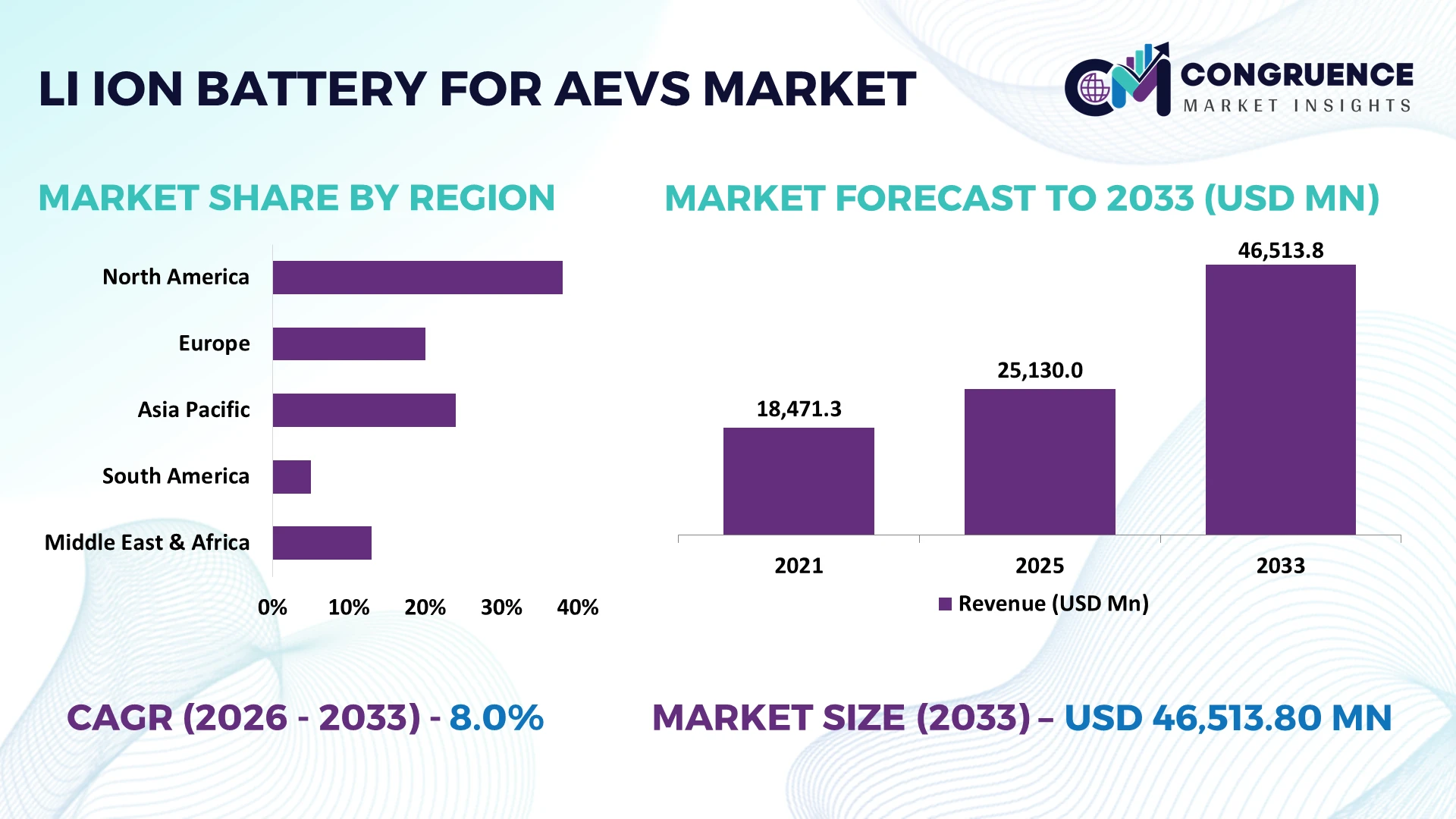
The Global Li ion Battery for AEVs Market was valued at USD 25130 Million in 2025 and is anticipated to reach a value of USD 46513.8 Million by 2033 expanding at a CAGR of 8% between 2026 and 2033. Growth is driven by accelerating all-electric vehicle production, lithium iron phosphate battery adoption, high-energy-density cell development, and expansion of localized automotive battery manufacturing.
China dominates the global lithium-ion battery supply chain for all-electric vehicles, accounting for more than 70% of global electric vehicle battery cell production capacity and approximately 80% of cathode active material manufacturing. CATL and BYD lead domestic battery innovation through lithium iron phosphate chemistry, cell-to-pack integration, and rapid-charging architectures. Compared with the United States, where battery localization is supported by federal manufacturing incentives, China benefits from integrated mineral refining, electrode production, and automotive assembly ecosystems. This concentration strengthens its influence over international battery procurement and technology competitiveness.
Strategically, manufacturers prioritizing battery chemistry diversification, regional cell production, and high-efficiency pack integration are positioned to improve supply security and vehicle cost competitiveness.
Market Size & Growth: USD 25,130 million in 2025, reaching USD 46,513.8 million by 2033 at 8% CAGR, supported by expanding electric vehicle battery installations.
Top Growth Drivers: Electric vehicle sales expansion exceeding 20%, LFP adoption surpassing 50%, and battery pack price reductions of approximately 20% strengthen electrification economics.
Short-Term Forecast: By 2028, manufacturing optimization and cell integration advances target 10–15% reductions in battery pack production costs.
Emerging Technologies: Silicon-enhanced anodes, AI-enabled battery management, and cell-to-chassis designs target energy-density improvements exceeding 10%.
Regional Leaders: Asia-Pacific dominates manufacturing, Europe prioritizes low-carbon battery supply, and North America expands domestic gigafactories across 3 major automotive production hubs.
End-User Trends: LFP batteries account for more than 50% of global electric vehicle battery demand, reflecting preference for affordability and cycle durability.
Pilot/Case Example: BYD's 2025 Super e-Platform introduced 1,000 kW peak charging capability, advancing ultra-fast-charging battery architecture.
Competitive Landscape: CATL leads global EV battery installations with approximately 38% share, competing with BYD, LG Energy Solution, Panasonic Energy, and Samsung SDI.
Regulatory & ESG Impact: EU battery regulations introduce mandatory carbon footprint declarations from 2028, strengthening traceability and low-emission manufacturing requirements.
Investment & Funding: Battery manufacturing projects increasingly target gigafactory capacities above 20 GWh annually through automotive joint ventures and localized supply agreements.
Innovation & Future Outlook: Next-generation 800 V vehicle architectures and 4C–6C charging cells accelerate high-performance battery integration and thermal management innovation.
The Li ion Battery for AEVs Market is undergoing significant technological restructuring as automakers prioritize affordable energy storage, faster charging, and improved battery durability. Lithium iron phosphate chemistry is strengthening its position in mass-market electric vehicles, while nickel-rich cathodes remain important for premium long-range models. Cell-to-pack integration improves volumetric utilization by eliminating intermediate module structures, supporting packaging efficiency gains of approximately 10–20% in suitable designs. Meanwhile, European battery passport requirements are encouraging digital material traceability and supplier-level emissions monitoring. These developments are shifting procurement strategies toward integrated cell manufacturing, chemistry-specific platform design, and resilient regional supply chains.
Lithium-ion batteries are becoming strategically critical to all-electric vehicle competitiveness as automakers restructure manufacturing around battery cost, charging performance, and localized component supply. Battery cells account for a substantial proportion of vehicle production costs, making chemistry selection central to pricing strategies. China's integrated manufacturing ecosystem supports high-volume production, while European manufacturers are reorganizing procurement around battery traceability and domestic sourcing. The transition toward vertically integrated cathode production, automated cell assembly, and software-defined battery management is changing supplier relationships and capital allocation priorities.
Lithium iron phosphate batteries offer approximately 15–25% lower cell costs than comparable nickel-rich chemistries under typical manufacturing conditions, although nickel-based batteries retain advantages in gravimetric energy density. China leads commercial LFP deployment, whereas South Korea emphasizes high-nickel cell innovation and the United States expands localized manufacturing partnerships. Between 2026 and 2028, silicon-enhanced anodes, improved electrolyte formulations, and automated formation processes will influence charging performance, manufacturing yields, and battery lifecycle economics.
BYD's Blade Battery demonstrates practical cell-to-pack integration by eliminating conventional intermediate module structures and improving battery packaging efficiency. Automotive manufacturers are expanding direct cell procurement agreements, establishing battery joint ventures, and adapting vehicle platforms to multiple chemistries. Competitive advantage increasingly depends on combining dependable cell supply, vehicle-level energy efficiency, and scalable manufacturing rather than pursuing maximum battery capacity alone.
Declining battery manufacturing costs are strengthening the commercial viability of all-electric vehicles across passenger and commercial transportation. Global lithium-ion battery pack prices declined approximately 20% during 2024, reflecting manufacturing scale, lower raw material costs, and competitive supplier pricing. Lithium iron phosphate batteries now represent more than 50% of global electric vehicle battery demand, supporting wider adoption in cost-sensitive vehicle categories. China's integrated cell manufacturing infrastructure enables rapid production scaling and chemistry-specific vehicle platform development. Automakers are responding through long-term supply agreements, localized battery assembly, and increased adoption of standardized cell formats. Lower battery costs directly improve vehicle pricing flexibility, while diversified chemistry portfolios allow manufacturers to optimize driving range, safety, and production economics across different customer segments.
Lithium-ion battery manufacturers face structural exposure to concentrated mineral refining, cathode production, and specialized battery material processing. China controls approximately 90% of global rare earth processing and dominates graphite anode material manufacturing, creating procurement dependencies for international automotive producers. Battery-grade graphite processing is particularly concentrated, with China accounting for more than 90% of global anode material production. Meanwhile, lithium carbonate prices experienced substantial fluctuations during recent market cycles, complicating long-term procurement negotiations and inventory planning. United States and European manufacturers face additional localization challenges because domestic electrode production capacity remains less developed than cell assembly investment. Companies are reducing exposure through alternative graphite sourcing, regional refining partnerships, and multiyear material contracts. Securing qualified battery-grade inputs remains essential for stable production scheduling and manufacturing margins.
Silicon-enhanced anode technology creates opportunities to improve electric vehicle energy storage without proportionately increasing battery pack size. Commercial graphite-silicon composite designs target approximately 10–20% improvements in cell energy density, depending on silicon content and electrode architecture. Advanced manufacturing techniques, including dry electrode coating and automated defect inspection, offer potential reductions in solvent consumption and production complexity. South Korean battery manufacturers are investing in high-silicon materials and advanced cell architectures for premium electric vehicle platforms. Meanwhile, India's battery manufacturing incentive programs encourage domestic cell production and technology localization. Suppliers are expanding materials research, electrode engineering partnerships, and pilot manufacturing capabilities. Companies that commercialize high-performance anodes while controlling electrode expansion and cycle degradation will gain advantages in vehicle range, charging performance, and battery packaging efficiency.
Increasing charging power introduces complex thermal management, electrochemical degradation, and battery safety challenges for all-electric vehicles. Modern high-performance battery systems support charging rates of 4C–6C, requiring precise coordination between cell chemistry, cooling systems, and charging infrastructure. Lithium plating risk increases under unfavorable temperature and charging conditions, potentially reducing usable capacity and accelerating degradation. Automotive manufacturers commonly target battery retention of at least 70–80% after extended vehicle operation, placing pressure on lifetime validation. China's expanding ultra-fast-charging infrastructure demonstrates the importance of integrating vehicle battery controls with high-power charging networks. Manufacturers must improve thermal propagation protection, battery management algorithms, and cell-level monitoring. Competitive performance increasingly depends on delivering rapid charging without sacrificing warranty durability, operational safety, or consistent vehicle range.
Battery Passport Integration Restructures Supplier Reporting: European battery manufacturers are implementing digital traceability systems ahead of mandatory battery passport requirements from February 2027. Batteries exceeding 2 kWh fall within the relevant electric vehicle battery reporting framework. Suppliers are integrating material provenance, carbon footprint records, and lifecycle identifiers into enterprise software, strengthening regulatory readiness while increasing demand for standardized data exchange across automotive supply chains.
Automated Cell Inspection Improves Production Quality: Battery gigafactories increasingly deploy machine vision, inline X-ray inspection, and AI-assisted defect classification across electrode coating and cell assembly. High-volume production lines target manufacturing yields above 95%, while early defect identification reduces downstream cell rejection. Manufacturers are integrating real-time quality analytics with production execution systems to improve process consistency and limit material losses during capacity expansion.
Battery Swapping Expands Commercial Vehicle Utilization: China's battery swapping infrastructure is advancing standardized battery exchange for high-utilization electric vehicles. NIO reported more than 3,000 operating battery swap stations in China during 2025, demonstrating infrastructure deployment at commercial scale. Battery suppliers are developing interchangeable pack architectures, automated locking mechanisms, and digital health monitoring to reduce vehicle downtime and support recurring battery service models.
Recycling Partnerships Strengthen Material Recovery Networks: Automotive battery manufacturers are expanding closed-loop recycling agreements to recover lithium, nickel, cobalt, and copper from production scrap and retired packs. Advanced hydrometallurgical processes target recovery efficiencies exceeding 90% for selected metals. European recycling partnerships increasingly integrate battery collection, material refining, and cathode precursor production, reducing exposure to imported materials and strengthening long-term manufacturing resilience.
Lithium Iron Phosphate (LFP) represents the leading chemistry in the global lithium-ion battery market for all-electric vehicles, accounting for approximately 55% of electric vehicle battery demand. Its competitive position reflects lower material costs, strong thermal stability, and suitability for high-volume automotive manufacturing. Nickel Manganese Cobalt (NMC) batteries remain important for vehicles requiring higher energy density and extended driving range. Nickel Cobalt Aluminum (NCA) technology serves performance-oriented applications where energy density and established manufacturing processes influence cell selection.
LFP is also among the fastest-expanding established chemistries as automakers increase its deployment beyond entry-level vehicles. NMC and NCA retain advantages in applications requiring compact, high-capacity battery packs. Lithium Manganese Oxide (LMO) offers power delivery characteristics suited to selected automotive configurations, while Lithium Titanate (LTO) supports rapid charging and extended cycle life in specialized applications. Commercial LTO cells can exceed 10,000 charge-discharge cycles under suitable conditions. CATL, BYD, and other manufacturers are expanding chemistry-specific production lines and improving electrode formulations. Investment increasingly favors differentiated cell portfolios rather than dependence on a single battery chemistry.
Electric Cars represent the dominant application for lithium-ion batteries in all-electric vehicles, supported by large production volumes, standardized battery platforms, and expanding vehicle electrification programs. Global electric car sales exceeded 17 million units in 2024, creating substantial demand for automotive-grade cells and integrated battery packs. Passenger vehicle manufacturers typically deploy battery capacities ranging from approximately 40 kWh to more than 100 kWh, depending on vehicle class and driving range requirements. Electric Buses represent an established commercial application, particularly in China, where fleet electrification supports predictable battery procurement and charging infrastructure utilization.
Electric Trucks are emerging as a rapidly expanding application as logistics operators electrify urban delivery and regional freight operations. Their larger battery capacities increase cell demand per vehicle, making commercial fleet electrification strategically important despite lower unit sales. Electric Two-Wheelers and Electric Three-Wheelers support high-volume adoption in India and Southeast Asia, while Autonomous Electric Vehicles require advanced battery monitoring and dependable power delivery for onboard computing systems. Manufacturers are developing application-specific battery modules, charging interfaces, and thermal management solutions to address different duty cycles and operating requirements.
Automotive OEMs represent the largest end-user group for lithium-ion batteries in all-electric vehicles because vehicle manufacturers control battery platform design, supplier qualification, and large-volume cell procurement. Leading automakers establish multiyear battery supply agreements and integrate cell specifications directly into vehicle engineering programs. Battery systems can account for approximately 30–40% of electric vehicle manufacturing costs, making supplier pricing and chemistry selection critical procurement considerations. Commercial Fleet Operators represent an expanding customer group as transportation businesses evaluate electric vehicle operating costs, charging availability, and battery warranty performance.
Logistics Companies are emerging as a particularly important growth segment because predictable delivery routes support centralized charging and battery utilization planning. Public Transport Operators emphasize battery durability and scheduled fleet availability, while Mobility Service Providers prioritize high-cycle performance and operational uptime. Government Transport Agencies influence procurement through fleet electrification programs and charging infrastructure investment. Manufacturers are responding with fleet-specific battery warranties, modular pack configurations, and digital battery health monitoring. Competitive positioning increasingly depends on matching battery performance to vehicle utilization rather than maximizing energy capacity across every application.
Asia-Pacific accounted for the largest market share at an estimated 65% in 2025 however, Asia-Pacific is expected to register the fastest growth, expanding at a CAGR of approximately 9.5% between 2026 and 2033.
Domestic Gigafactory Expansion Restructures Automotive Battery Supply Chains
North America represents an important lithium-ion battery market for all-electric vehicles, supported by automotive manufacturing, battery localization initiatives, and expanding cell production infrastructure. The United States dominates regional battery procurement, while Canada contributes critical mineral resources, cathode material development, and battery manufacturing investments. Battery production clusters across Michigan, Ohio, Tennessee, and Kentucky are strengthening connections between automotive assembly facilities and cell manufacturers. The Ultium Cells joint venture established battery manufacturing facilities with planned capacities exceeding 30 GWh annually at individual locations, demonstrating industrial-scale localization. Regional automakers are increasingly integrating battery engineering, thermal management, and pack assembly into vehicle development programs. However, dependence on imported anode materials and specialized processing equipment continues to influence supplier selection. Manufacturers are prioritizing domestic production agreements, automated quality control, and diversified electrode material procurement.
United States Market Outlook: The United States benefits from established automotive manufacturers, advanced battery research institutions, and expanding electric vehicle production facilities. Tesla's Nevada Gigafactory integrates battery manufacturing with automotive energy storage technology development, while Panasonic Energy supports cylindrical cell production. Domestic automotive manufacturers are investing in battery platform standardization and supplier partnerships. The country's annual electric car sales exceeded 1.5 million units in 2024, sustaining demand for locally manufactured cells and integrated battery packs.
Battery Localization and Traceability Reshape Automotive Procurement
Europe's lithium-ion battery market for all-electric vehicles is shaped by automotive electrification, manufacturing localization, and increasingly stringent battery sustainability requirements. Germany, France, Hungary, and Poland represent important production and automotive integration centers. The European Union's Battery Regulation introduces digital battery passport requirements from February 2027, encouraging manufacturers to establish traceable material sourcing and lifecycle information systems. European automakers are diversifying battery suppliers while investing in regional cell assembly, cathode production, and recycling infrastructure. Hungary has attracted substantial battery manufacturing investment from Asian producers, strengthening its role within European automotive supply chains. Germany contributes established vehicle engineering and battery pack integration capabilities. Competitive positioning increasingly depends on manufacturing efficiency, regulatory compliance, and dependable supplier qualification. Companies are integrating digital product records and carbon accounting into procurement systems to support vehicle production continuity.
Germany Market Outlook: Germany maintains a strong position through Volkswagen, BMW, Mercedes-Benz, and established automotive component manufacturers. Volkswagen's PowerCo battery facility in Salzgitter is designed for an initial annual production capacity of 20 GWh, with expansion potential linked to automotive demand. German manufacturers are emphasizing standardized cell architectures, high-voltage battery systems, and automated assembly. Domestic engineering expertise supports battery integration into premium and mass-market electric vehicle platforms, while recycling partnerships strengthen material recovery capabilities.
Integrated Cell Manufacturing Strengthens Global Battery Supply Leadership
Asia-Pacific dominates the lithium-ion battery market for all-electric vehicles through concentrated cell manufacturing, mineral processing, and automotive production infrastructure. China leads regional manufacturing, while South Korea and Japan contribute advanced electrode materials, high-performance cell technologies, and international automotive supply partnerships. India is expanding domestic battery manufacturing investment through production-linked incentive programs and electric mobility initiatives. Chinese battery manufacturers benefit from extensive lithium refining, graphite processing, and cathode manufacturing ecosystems, enabling close coordination between raw material suppliers and cell production facilities. South Korean producers maintain strong positions in nickel-rich battery technology, while Japanese manufacturers emphasize cylindrical cell engineering and manufacturing precision. Regional manufacturers are increasingly expanding overseas production partnerships to serve international automakers. This manufacturing concentration strengthens supply-chain efficiency but also encourages automotive customers to diversify procurement across multiple countries and battery technologies.
China Market Outlook: China maintains a dominant competitive position through CATL, BYD, CALB, and other major battery manufacturers. The country accounts for more than 75% of global electric vehicle battery manufacturing capacity, supported by integrated industrial clusters across Fujian, Jiangsu, and Guangdong. Chinese manufacturers are commercializing cell-to-pack configurations, high-rate charging technologies, and automated electrode production. Domestic automotive demand supports large-scale production utilization, while overseas manufacturing investments strengthen access to international vehicle manufacturers.
Lithium Resource Development Supports Emerging Battery Value Chains
South America's lithium-ion battery market for all-electric vehicles is developing through electric mobility adoption, lithium resource processing, and emerging automotive battery supply initiatives. Chile, Argentina, and Brazil contribute distinct capabilities across lithium extraction, chemical processing, vehicle manufacturing, and electric transportation. Chile and Argentina form important parts of the Lithium Triangle, which contains substantial lithium brine resources supporting international battery supply chains. Brazil provides the region's largest automotive manufacturing base and expanding electric vehicle assembly activity. However, local battery cell manufacturing remains limited compared with mineral extraction and vehicle assembly capabilities. Regional companies are evaluating partnerships connecting lithium processing with cathode materials and battery pack manufacturing. Investment priorities increasingly emphasize local value addition, mineral processing infrastructure, and dependable electricity supply. The development of domestic battery ecosystems depends on converting mineral availability into commercially competitive industrial production capabilities.
Brazil Market Outlook: Brazil represents a strategically important market through its established automotive industry, expanding electric mobility infrastructure, and domestic lithium resource development. BYD's vehicle manufacturing investment in Bahia strengthens opportunities for localized electric vehicle component sourcing and battery pack integration. Brazil recorded more than 170,000 electrified light-vehicle registrations in 2024, including battery-electric and hybrid models. Automotive suppliers are adapting assembly operations, thermal management systems, and electrical architectures to support growing demand for electric mobility.
Electric Mobility Investments Strengthen Battery Manufacturing Ambitions
The Middle East & Africa lithium-ion battery market for all-electric vehicles is evolving through industrial diversification, electric mobility investment, and critical mineral development. Saudi Arabia, the United Arab Emirates, Morocco, and South Africa represent important centers for automotive electrification and battery-related industrial activity. Morocco benefits from established automotive manufacturing infrastructure and access to European vehicle supply chains, attracting investment in battery materials and component production. Saudi Arabia is developing domestic electric vehicle manufacturing through industrial partnerships and investment programs, while the UAE is expanding charging infrastructure and electric mobility initiatives. South Africa contributes established automotive assembly capabilities and mineral processing expertise. Regional battery procurement remains dependent on international cell suppliers, encouraging localization agreements and industrial partnerships. Competitive opportunities center on battery pack assembly, component distribution, and manufacturing integration rather than immediate large-scale cell production dominance.
Morocco Market Outlook: Morocco is strengthening its position in automotive battery supply chains through established vehicle manufacturing infrastructure, renewable electricity development, and battery investment commitments. Gotion High-Tech announced plans for a battery manufacturing facility with an initial annual capacity of 20 GWh, supporting the country's ambition to develop localized cell production. Morocco's proximity to European automotive manufacturing centers provides logistical advantages for battery exports. Industrial development around Kenitra and other automotive clusters supports supplier integration, workforce development, and battery component manufacturing.
CATL, BYD, LG Energy Solution, SK On, and Samsung SDI anchor the Li-ion battery for AEVs market, with the top five players commanding approximately 72% of global EV battery installed capacity. CATL leads at 39.2% global share and BYD follows at 16.4%, giving Chinese manufacturers 55.6% combined market control. Competition bifurcates between Chinese volume leaders leveraging LFP cost advantages at USD 53 per kWh and Korean/Japanese specialists competing on NMC energy density for premium AEV platforms. BorgWarner has emerged as a localization challenger, securing its first AEV battery contract with HOLON for Level 4 autonomous shuttles using Buy America-compliant dual 57 kWh NMC packs with production starting Q2 2027. The competitive shift is toward FEOC-compliant regional supply chains, as US AEV programs require domestic battery sourcing. Entry barriers center on AEV-specific certification for autonomous vehicle integration and functional safety.
CATL
BYD
LG Energy Solution
SK On
Samsung SDI
Panasonic Energy
Northvolt
BorgWarner
EVE Energy
Gotion High-Tech
Sunwoda Electronic
Farasis Energy
AESC
ProLogium Technology
Current lithium-ion battery technologies combine graphite anodes, liquid electrolytes, precision thermal management, and intelligent battery management systems. Nickel-rich cells support long-range vehicles, while lithium iron phosphate configurations prioritize durability and manufacturing simplicity. Compared with conventional module-based battery packs, cell-to-pack architectures improve volumetric packaging efficiency by approximately 10–20% in suitable designs. Automotive manufacturers increasingly integrate wireless monitoring and predictive state-of-health estimation, improving diagnostic visibility across thousands of interconnected cells and reducing maintenance uncertainty.
Emerging technologies emphasize manganese-rich cathodes, advanced separators, and electrolyte additives that stabilize high-voltage operation. Manganese-rich formulations reduce dependence on expensive nickel and cobalt inputs, while optimized separator coatings improve thermal resilience. High-throughput electrode manufacturing combines laser processing, automated metrology, and digital process control to improve consistency. Suppliers developing integrated electrode materials and production equipment gain competitive advantages through faster qualification, reduced scrap, and more predictable automotive delivery schedules.
Between 2026 and 2028, disruptive development will concentrate on solid-state electrolytes, lithium-metal interfaces, and battery software integration. Solid-state prototypes target energy-density improvements exceeding 20% against selected conventional designs, although commercial performance depends on cycle durability and scalable production. Automakers are investing in pilot lines, interface engineering, and validation partnerships. Early commercialization will favor manufacturers combining materials expertise, industrial processing capability, and vehicle-level integration.
October 2025: BorgWarner secured its first autonomous vehicle battery contract with HOLON, supplying dual 57 kWh NMC 5AKM cylindrical cell packs for 15-person Level 4 autonomous shuttles. Production begins Q2 2027 in Seneca, South Carolina, meeting Buy America and FEOC compliance requirements. Source: borgwarner.com
January 2025: LG Energy Solution signed a seven-year agreement with Aptera Motors to supply 4.4 GWh of 2170 cylindrical batteries for solar-powered electric vehicles from 2025 to 2031. The 643 km range vehicles received over 50,000 pre-orders, expanding LG's portfolio into next-generation mobility. Source: lgensol.com
September 2026: ProLogium began mass production of its Gen 3.5 all-solid-state lithium ceramic battery achieving 381 Wh/kg and 903 Wh/L, verified by TÜV Rheinland. The Taiwan facility produces approximately 6,000 packs annually, marking the industry's first large-format all-solid-state automotive cell production. Source: prologium.com
July 2025: Panasonic Energy opened its Kansas factory producing 2170 cylindrical cells with 32 GWh planned annual capacity, achieving 20% higher productivity than its Nevada plant. The facility supports North American EV battery localization and creates up to 4,000 direct jobs. Source: panasonic.com
The Li ion Battery for AEVs Market Report examines five battery chemistries: Lithium Iron Phosphate (LFP), Nickel Manganese Cobalt (NMC), Nickel Cobalt Aluminum (NCA), Lithium Manganese Oxide (LMO), and Lithium Titanate (LTO). Application analysis covers electric cars, buses, trucks, two-wheelers, three-wheelers, and autonomous electric vehicles. End-user coverage evaluates automotive OEMs, commercial fleet operators, public transport operators, logistics companies, mobility service providers, and government transport agencies, distinguishing manufacturing procurement from fleet deployment requirements.
Geographic assessment spans North America, Europe, Asia-Pacific, South America, and the Middle East & Africa. Technology coverage includes advanced electrode materials, battery management software, thermal protection, and cell manufacturing automation. Competitive analysis examines supplier concentration, production localization, manufacturing partnerships, and emerging automotive battery applications. The 2026–2033 outlook supports investment prioritization, production expansion, supplier selection, and technology commercialization decisions.
| Report Attribute/Metric | Report Details |
|---|---|
Market Revenue in 2025 | USD 25130 Million |
Market Revenue in 2033 | USD 46513.8 Million |
CAGR (2026 - 2033) | 8% |
Base Year | 2025 |
Forecast Period | 2026 - 2033 |
Historic Period | 2021 - 2025 |
Segments Covered | By Type
By Application
By End-User
|
Key Report Deliverable | Revenue Forecast, Growth Trends, Market Dynamics, Segmental Overview, Regional and Country-wise Analysis, Competition Landscape |
Region Covered | North America, Europe, Asia-Pacific, South America, Middle East, Africa |
Key Players Analyzed | CATL, BYD, LG Energy Solution, SK On, Samsung SDI, Panasonic Energy, Northvolt, BorgWarner, EVE Energy, Gotion High-Tech, Sunwoda Electronic, Farasis Energy, AESC, ProLogium Technology |
Customization & Pricing | Available on Request (10% Customization is Free) |




