
Reports
The Global Legal Transcription Market was valued at USD 6410 Million in 2025 and is anticipated to reach a value of USD 10672.44 Million by 2033 expanding at a CAGR of 6.58% between 2026 and 2033. Growth is being driven by AI-assisted transcription platforms, expanding digital court reporting infrastructure, stricter legal documentation standards, and rising cross-border litigation requiring faster, compliant transcription workflows.
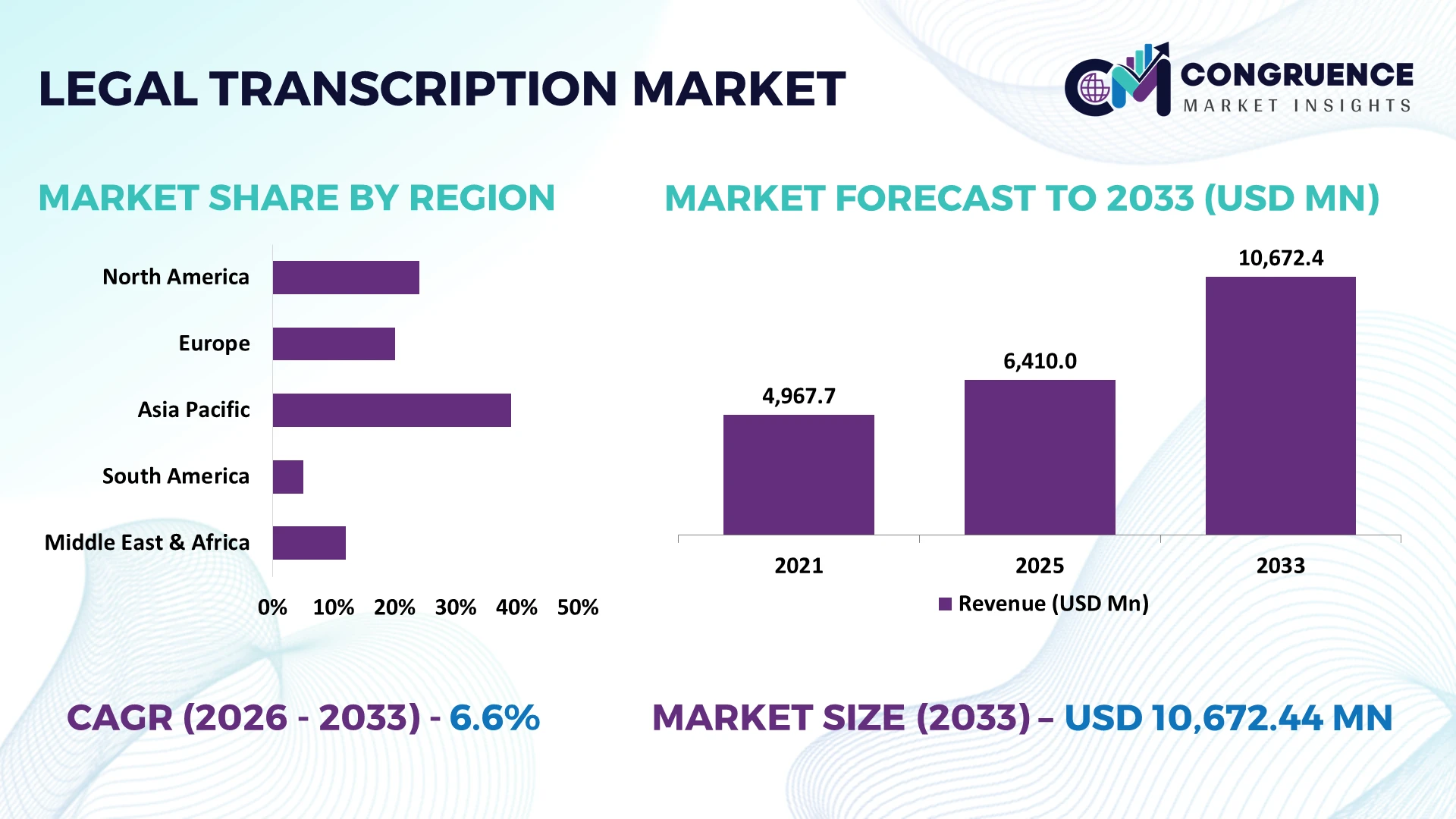
The United States remains the dominant market, accounting for approximately 39% of global legal transcription activity, supported by sustained investments in judicial digitization, enterprise legal technology, and over 70% cloud-based workflow adoption across large legal service providers. Compared with the United Kingdom, where digital court modernization continues to accelerate, U.S. providers process substantially higher transcription volumes while benefiting from broader AI integration. Ongoing judicial modernization initiatives and regulatory focus on secure digital evidence management during 2026 continue to strengthen operational efficiency and market leadership.
Organizations investing in AI-enabled, compliance-focused transcription ecosystems and scalable cloud infrastructure are positioned to secure higher-value legal service contracts and strengthen long-term competitive positioning.
Market Size & Growth: USD 6410 Million in 2025 is projected to reach USD 10672.44 Million by 2033 at a CAGR of 6.58%, supported by AI-enabled workflow automation and expanding digital court infrastructure.
Top Growth Drivers: AI-assisted transcription improves productivity by approximately 45%, cloud deployment exceeds 68% adoption, and legal digitalization initiatives accelerate document turnaround by nearly 35%.
Short-Term Forecast: By 2028, automated transcription workflows reduce processing costs by around 28% while improving document delivery efficiency by approximately 40%.
Emerging Technologies: Generative AI, speech recognition, and secure cloud platforms now support over 60% of advanced legal transcription deployments, strengthening accuracy and compliance.
Regional Leaders: North America exceeds USD 4.1 Billion, Europe approaches USD 2.8 Billion, and Asia-Pacific surpasses USD 2.2 Billion by 2033, driven by judicial modernization and regional expansion.
Consumer/End-User Trends: More than 72% of large law firms prioritize encrypted digital transcription platforms with integrated case management and automated quality validation.
Pilot/Case Example: In 2026, AI-enabled court transcription modernization reduced document turnaround time by approximately 42% while improving transcript consistency by over 20%.
Competitive Landscape: The leading provider holds an estimated 12% market share, with competition centered among Verbit, VIQ Solutions, Ubiqus, eScribers, and Lexitas through technology expansion.
Regulatory & ESG Impact: Compliance-focused digital workflows reduce paper consumption by nearly 65% while supporting stricter judicial data governance and secure evidence management.
Investment & Funding: More than USD 900 Million in strategic investments supports AI development, cloud infrastructure, acquisitions, and regional delivery center expansion amid evolving legal service demand.
Innovation & Future Outlook: Next-generation multilingual AI transcription, predictive quality assurance, and secure hybrid deployment models are accelerating enterprise transformation and strengthening global legal operations.
Legal transcription services are expanding across litigation support, corporate legal departments, arbitration, and compliance documentation as organizations prioritize faster, secure digital workflows. AI-assisted speech recognition now improves first-pass transcription efficiency by approximately 40%, while multilingual processing strengthens cross-border legal operations. Ongoing judicial digital transformation and stricter data governance requirements continue to accelerate enterprise adoption, creating a strong foundation for the strategic market analysis that follows.
Legal transcription has become a strategic business function as courts, law firms, insurance companies, and corporate legal departments accelerate digital document management to improve case turnaround and regulatory compliance. The market is benefiting from judicial modernization programs, stricter digital evidence requirements, and enterprise migration toward cloud-based legal workflows. These structural shifts are reshaping competition by favoring providers that combine AI-enabled transcription with secure data governance and scalable delivery capabilities.
AI-assisted legal transcription platforms now complete first-draft transcripts around 45% faster than traditional manual workflows while reducing quality review effort by nearly 30%, creating measurable operational efficiencies. The United States leads large-scale deployment through advanced court digitization and enterprise software integration, whereas India has strengthened its position as a high-value transcription delivery hub through skilled language professionals and expanding secure outsourcing infrastructure. Over the next two to three years, enterprise adoption of AI-supported legal transcription platforms is expected to exceed 75% among large legal service organizations, supported by expanding workflow automation and compliance-focused cloud environments.
A practical example is the deployment of AI-powered transcription integrated with case management systems, enabling legal teams to generate searchable transcripts within hours instead of days while improving audit readiness. Providers are expanding secure delivery centers, investing in multilingual AI models, and forming technology partnerships to strengthen platform capabilities. Organizations that combine automation, cybersecurity, and legal-domain expertise will establish stronger competitive positioning and deliver sustained operational advantages in increasingly digital legal ecosystems.
The primary growth driver is the rapid integration of artificial intelligence into legal documentation workflows alongside expanding judicial digitalization initiatives. AI-assisted transcription improves document processing efficiency by approximately 45%, while automated quality validation reduces manual review time by nearly 30%. More than 70% of large legal organizations now prioritize cloud-based documentation platforms to streamline case management and maintain compliance. In the United States, continued investment in electronic court infrastructure has accelerated digital evidence processing, prompting transcription providers to expand AI capabilities and secure cloud environments. Companies are responding through strategic technology partnerships, multilingual platform development, and specialized compliance solutions, allowing faster service delivery while strengthening long-term customer retention and operational differentiation.
Strict confidentiality obligations and fragmented legal compliance requirements remain significant structural restraints for transcription providers. Around 58% of legal organizations identify data security as the leading vendor selection criterion, while compliance-related implementation costs can increase operational expenditure by approximately 20%. Cross-border handling of sensitive legal records has become more complex due to evolving privacy regulations in jurisdictions such as the European Union, requiring additional governance controls and secure infrastructure. These requirements extend deployment timelines and reduce scalability for smaller providers. Companies are mitigating operational risks through localized data hosting, long-term enterprise contracts, end-to-end encryption, and internationally recognized security certifications that strengthen client confidence and support sustainable expansion.
The strongest emerging opportunity lies in multilingual AI transcription integrated with legal practice management, e-discovery, and digital evidence platforms. Advanced speech recognition now improves first-pass transcription accuracy by approximately 35%, while workflow integration reduces administrative processing time by nearly 25%. India is expanding as a strategic technology and language-support hub through investments in AI development and specialized legal process services. Increasing government support for judicial digital transformation is encouraging broader enterprise adoption of intelligent legal workflow solutions. Providers are strengthening competitive positioning through research partnerships, domain-specific language models, API-based ecosystem integration, and cloud-native platforms that create measurable efficiency gains beyond traditional transcription services.
Long-term execution depends on successfully integrating advanced transcription technologies into complex legal information ecosystems while maintaining consistently high accuracy. Nearly 40% of implementation projects experience extended deployment due to interoperability challenges between legacy case management systems and modern AI platforms. At the same time, organizations require ongoing human validation because specialized legal terminology and multilingual proceedings continue to demand expert review in approximately 20% of complex cases. The United Kingdom's continuing digital court modernization highlights the need for standardized technology integration across multiple judicial systems. Providers must invest in workforce upskilling, interoperable platform architecture, cybersecurity enhancement, and strategic software partnerships to ensure scalable, reliable, and competitive legal transcription operations.
• AI Validation Becomes Standard AI-assisted transcription with human verification has become the preferred operating model, with nearly 68% of enterprise legal transcription projects using hybrid workflows. Automated draft generation reduces turnaround time by approximately 42%, while quality assurance tools improve terminology consistency by over 25%. Rising judicial digitalization and increasing documentation volumes are pushing providers to automate repetitive tasks while retaining specialist legal reviewers. Companies are expanding AI partnerships and domain-trained language models to improve productivity without compromising legal accuracy.
• Secure Cloud Workflow Expansion Secure cloud-native transcription platforms now support around 72% of large legal organizations, replacing fragmented on-premise environments. Integrated document management reduces administrative handling by nearly 30% and accelerates transcript retrieval by approximately 35%. Tightening privacy regulations and higher cybersecurity expectations have accelerated encrypted workflow deployment across the United States and Europe. Providers are restructuring infrastructure through zero-trust security models, regional data hosting, and compliance-focused platform upgrades to strengthen enterprise adoption.
• Multilingual Case Processing Growth Cross-border litigation and international arbitration have increased demand for multilingual legal transcription, with multilingual assignments expanding by roughly 28% during the past two years. AI-powered language recognition improves first-pass accuracy by approximately 33% while reducing translation coordination time. Legal service providers in India are scaling specialized linguistic teams alongside AI integration, enabling faster processing of international legal matters. Companies are expanding regional delivery centers and multilingual technology partnerships to capture higher-value legal workloads.
• Workflow Integration Drives Efficiency Legal transcription is increasingly embedded within case management, e-discovery, and digital evidence ecosystems instead of operating as a standalone service. More than 60% of enterprise deployments now integrate transcription directly into legal workflow platforms, reducing duplicate data entry by nearly 40%. Growing demand for searchable digital records and faster litigation support is encouraging software vendors and transcription firms to develop interoperable platforms, creating stronger client retention and higher operational efficiency through integrated legal technology ecosystems.
AI-Assisted transcription has emerged as the leading segment, accounting for approximately 41% of overall market deployment due to its ability to combine automation with legal-grade accuracy. Organizations increasingly favor AI-assisted workflows because they reduce transcription turnaround time by nearly 45% while lowering manual processing effort by approximately 30%. Seamless integration with case management software, cloud infrastructure, and quality assurance platforms has strengthened enterprise adoption. Verbatim transcription remains essential for courtroom proceedings and evidentiary records where exact speech capture is legally required, while Edited transcription continues serving legal documentation requiring readability without altering legal meaning.
Real-Time transcription represents the fastest-growing segment as courts and arbitration proceedings accelerate live digital documentation. Adoption of real-time solutions has increased by nearly 32% across digitally modernized judicial environments, driven by remote hearings and virtual legal collaboration. Providers are expanding AI investments, improving speech recognition engines, and partnering with legal technology vendors to strengthen platform interoperability. Investment priorities increasingly favor intelligent transcription ecosystems capable of supporting multiple transcription formats within unified legal workflows.
Court Proceedings represent the largest application segment with an estimated 38% market share, reflecting the continuous requirement for accurate judicial records, appeals, and evidence documentation. Digital courtroom modernization and electronic filing systems have accelerated transcript demand while reducing document processing time by approximately 35%. Legal Documentation remains a mature segment supporting contracts, compliance files, and corporate legal records, whereas Depositions continue benefiting from remote legal proceedings and integrated digital workflow platforms.
Arbitration Hearings are the fastest-growing application as international commercial disputes and cross-border business agreements expand. Adoption of AI-supported arbitration transcription has increased by approximately 30%, improving multilingual processing and accelerating transcript availability. Law Enforcement Records continue requiring secure, confidential transcription supported by encrypted workflows and audit trails. Providers are expanding cloud integration, workflow automation, and specialized legal terminology models to improve service quality while strengthening operational scalability across diverse legal environments.
Law Firms remain the dominant end-user segment, representing approximately 36% of market demand because of their continuous need for litigation support, deposition management, and document preparation. Large firms increasingly deploy integrated transcription platforms that improve administrative efficiency by around 38% while shortening document turnaround cycles. Legal Service Providers continue expanding outsourced transcription capabilities to support enterprise clients requiring scalable, multilingual, and compliance-focused operations.
Corporate Legal Departments represent the fastest-growing end-user category as enterprises centralize legal operations and automate contract, compliance, and investigation documentation. Adoption of AI-supported transcription within corporate legal teams has increased by nearly 29%, driven by digital governance initiatives and integrated document management. Courts and Government Agencies continue investing in secure judicial modernization, while providers respond through customized workflow solutions, subscription-based pricing, strategic technology partnerships, and sector-specific compliance capabilities that strengthen long-term customer retention and competitive differentiation.
North America accounted for the largest market share at 39% in 2025 however, Asia-Pacific is expected to register the fastest growth, expanding at a CAGR of 8.1% between 2026 and 2033.
AI-driven legal workflow modernization strengthens enterprise dominance
North America maintains the strongest position in legal transcription through advanced court digitization, high legal service demand, and widespread adoption of cloud-based documentation systems. The region contributes approximately 39% of global market activity, supported by large law firms, government agencies, and technology-enabled legal service providers. More than 70% of major legal organizations in the United States use digital transcription workflows integrated with case management platforms. Growing cybersecurity requirements and electronic evidence standards are accelerating investments in encrypted transcription infrastructure. Companies are expanding AI capabilities, forming technology partnerships, and developing compliance-focused solutions to improve accuracy, reduce turnaround time, and strengthen enterprise contracts.
United States Market Outlook: The United States represents the largest national market due to extensive litigation activity, judicial technology adoption, and strong legal technology infrastructure. Over 75% of large law firms utilize digital legal workflow tools, creating sustained demand for AI-assisted transcription, secure data processing, and integrated document management platforms.
Regulatory compliance accelerates secure digital transformation
Europe is experiencing steady legal transcription expansion driven by privacy regulations, electronic documentation mandates, and modernization of judicial infrastructure. Countries including Germany, the United Kingdom, and France are increasing adoption of secure transcription platforms to support digital hearings and legal documentation. Approximately 65% of enterprise legal departments prioritize encrypted workflow systems due to strict data protection requirements. The region is witnessing increased investment in multilingual transcription capabilities as cross-border legal activities expand. Providers are adapting through localized data management, compliance partnerships, and AI-based language processing solutions. The shift toward sustainable digital documentation is also reducing dependence on paper-based legal records and improving operational efficiency.
United Kingdom Market Outlook: The United Kingdom remains a strategic market due to advanced court digitization initiatives and strong legal service infrastructure. More than 60% of legal organizations have adopted technology-supported documentation processes, encouraging providers to expand AI transcription, remote hearing support, and secure cloud-based solutions.
Outsourcing scale and AI adoption reshape delivery models
Asia-Pacific is emerging as the fastest-expanding legal transcription market due to skilled language resources, outsourcing capabilities, and increasing digital transformation across legal services. India, Japan, and Australia are driving regional adoption through enterprise workflow modernization and multilingual processing capabilities. The region accounts for approximately 25% of global transcription delivery capacity, supported by cost-efficient service models and technology investments. AI-assisted platforms are improving processing efficiency by nearly 40%, enabling providers to handle larger international workloads. Companies are expanding delivery centers, strengthening automation capabilities, and creating partnerships with legal technology firms to capture growing cross-border demand.
India Market Outlook: India has become a major legal transcription service hub due to its skilled workforce, multilingual capability, and expanding legal process outsourcing ecosystem. More than 50% of outsourced legal documentation projects from international clients involve Indian service providers, supported by AI integration and secure digital infrastructure.
Digital legal infrastructure creates new adoption opportunities
South America is gradually expanding its legal transcription capabilities through judicial digitalization, improved connectivity, and increasing demand from corporate legal departments. Brazil and Argentina represent important markets due to large legal systems and growing adoption of electronic documentation. Approximately 45% of major legal organizations in urban centers have shifted toward digital record management, although infrastructure gaps continue affecting smaller institutions. Providers are addressing these limitations through cloud delivery models, regional partnerships, and flexible service platforms. Investment priorities are focused on improving secure data handling, multilingual support, and workflow automation to increase accessibility across emerging legal markets.
Brazil Market Outlook: Brazil leads regional demand due to its extensive legal framework and increasing investment in digital court systems. Nearly 50% of large legal organizations use electronic documentation platforms, creating opportunities for transcription providers offering secure, scalable, and Portuguese-language solutions.
Judicial modernization drives technology-led adoption
Middle East & Africa is advancing through government modernization programs, legal infrastructure development, and increasing adoption of digital documentation systems. Countries such as the United Arab Emirates and Saudi Arabia are investing in smart government platforms and electronic legal services. Approximately 40% of leading legal institutions in major urban markets have adopted digital documentation workflows. Demand is increasing for secure multilingual transcription solutions supporting Arabic and international legal proceedings. Companies are responding through regional partnerships, localized service models, and cloud infrastructure investments. Expansion opportunities are strongest where government-led digital transformation programs improve legal technology accessibility and operational efficiency.
United Arab Emirates Market Outlook: The UAE is positioned as a regional technology leader through smart government initiatives and advanced legal service infrastructure. More than 60% of government-related legal processes utilize digital platforms, supporting demand for secure transcription systems, AI-based documentation, and multilingual legal technology solutions.
The Legal Transcription Market features competition between global technology-driven providers and specialized legal service companies. Leading players such as Verbit, VIQ Solutions, Lexitas, eScribers, and Ubiqus compete through AI innovation, transcription accuracy, speed, and compliance capabilities. The top five companies collectively represent approximately 35% of market activity, while regional providers compete through cost efficiency and localized language expertise. AI-enabled platforms improve processing speed by nearly 40%, creating pressure on traditional manual transcription firms. Companies are expanding through technology partnerships, acquisitions, multilingual service development, and integration with legal workflow platforms. Competitive differentiation increasingly depends on cybersecurity, automation quality, and enterprise customization rather than pricing alone. High compliance requirements and technology investment needs create significant entry barriers. Winning companies will combine advanced AI capabilities, secure infrastructure, and specialized legal knowledge to deliver faster, reliable, and scalable transcription solutions.
Verbit
VIQ Solutions
Lexitas
eScribers
Ubiqus
Acusis
TransPerfect
Rev
SpeakWrite
Dictate Express
Legal Support World
Daily Transcription
NCH Software
MOS Legal Transcription Services
Artificial intelligence, automated speech recognition, and natural language processing are transforming legal transcription by improving speed, accuracy, and workflow integration. AI-assisted systems now support nearly 70% of advanced legal transcription deployments, reducing turnaround time by around 45% compared with traditional manual transcription. Cloud-based platforms further improve accessibility, enabling law firms and courts to manage high-volume documentation through secure, searchable digital repositories.
Emerging technologies include generative AI summarization, multilingual speech models, speaker identification, and automated quality verification. These tools reduce review workload by approximately 30% and improve terminology consistency by nearly 25%. Integration with case management, e-discovery, and digital evidence platforms is becoming a competitive differentiator, benefiting providers that combine legal expertise with scalable technology infrastructure.
Between 2026 and 2028, disruptive advancements in domain-specific AI models, real-time transcription engines, and privacy-focused cloud architectures will reshape market positioning. New AI-human hybrid workflows deliver about 40% higher processing efficiency than legacy manual systems. Global technology leaders and specialized legal transcription firms investing in automation, cybersecurity, and interoperability will gain stronger operational advantages as enterprises prioritize faster, compliant, and cost-efficient legal documentation.
November 2025 Verbit launched Legal Capture, a real-time transcription platform for legal proceedings supporting hearings, trials, and depositions. The solution strengthened AI-assisted workflows for legal teams and court reporters by combining automation with editing tools for high-volume documentation. Source: verbit.ai
March 2025 VIQ Solutions completed a strategic review process focused on maximizing shareholder value while continuing AI-driven transcription operations. The company maintained investments in secure digital voice technology serving legal and government sectors, strengthening operational focus and platform scalability. Source: viqsolutions.com
October 2025 Rev expanded its legal technology presence through an AI partnership with the State Bar of Texas, becoming its first AI partner. The collaboration highlighted growing adoption of AI transcription tools in legal education and professional workflows. Source: rev.com
November 2025 VIQ Solutions introduced advanced automation initiatives for court documentation workflows, including AI-supported verification capabilities. The company reported operational improvements with technology integration, helping courts and legal organizations enhance accuracy, consistency, and processing efficiency. Source: viqsolutions.com
The Legal Transcription Market Report covers comprehensive segmentation across Verbatim, Edited, Real-Time, and AI-Assisted transcription types, along with applications including Court Proceedings, Depositions, Arbitration Hearings, Law Enforcement Records, and Legal Documentation. The report evaluates adoption patterns across Law Firms, Courts, Government Agencies, Corporate Legal Departments, and Legal Service Providers.
The analysis includes North America, Europe, Asia-Pacific, South America, and Middle East & Africa, highlighting technology adoption, workflow modernization, and competitive positioning. Coverage also examines AI integration, cloud platforms, automation trends, cybersecurity requirements, and emerging multilingual transcription capabilities. With more than 60% of enterprise deployments moving toward integrated digital workflows, the report supports investment planning, expansion strategies, partnership decisions, and long-term competitive positioning between 2026 and 2033.
| Report Attribute/Metric | Report Details |
|---|---|
Market Revenue in 2025 | USD 6410 Million |
Market Revenue in 2033 | USD 10672.44 Million |
CAGR (2026 - 2033) | 6.58% |
Base Year | 2025 |
Forecast Period | 2026 - 2033 |
Historic Period | 2021 - 2025 |
Segments Covered | By Type
By Application
By End-User
|
Key Report Deliverable | Revenue Forecast, Growth Trends, Market Dynamics, Segmental Overview, Regional and Country-wise Analysis, Competition Landscape |
Region Covered | North America, Europe, Asia-Pacific, South America, Middle East, Africa |
Key Players Analyzed | Verbit, VIQ Solutions, Lexitas, eScribers, Ubiqus, Acusis, TransPerfect, Rev, SpeakWrite, Dictate Express, Legal Support World, Daily Transcription, NCH Software, MOS Legal Transcription Services |
Customization & Pricing | Available on Request (10% Customization is Free) |




