
Reports
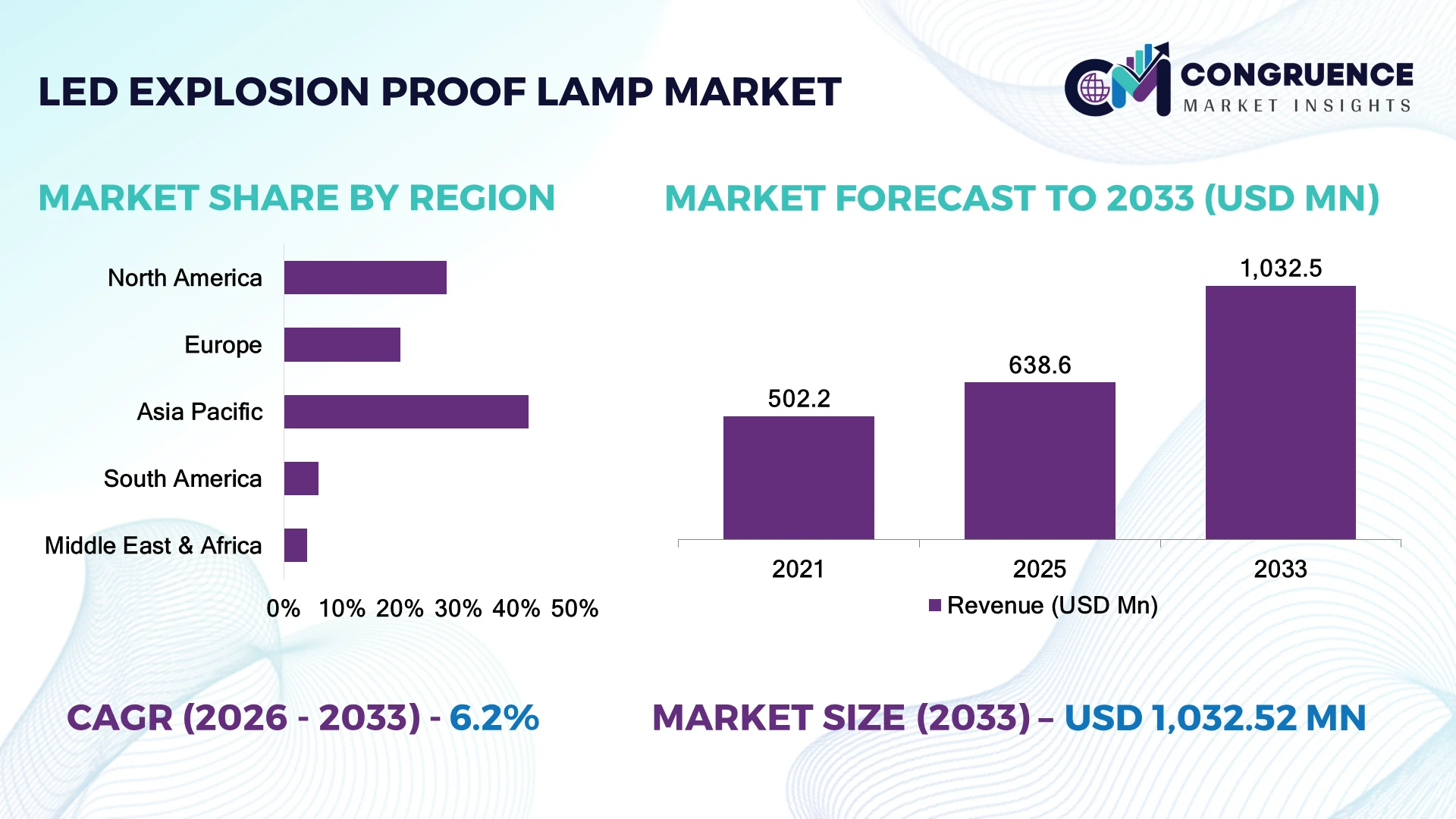
The Global LED Explosion-Proof Lamp Market was valued at USD 638.6 Million in 2025 and is anticipated to reach a value of USD 1,032.5 Million by 2033 expanding at a CAGR of 6.19% between 2026 and 2033. Growth is driven by stricter hazardous-area safety standards, rapid LED retrofitting across oil & gas facilities, and industrial automation adoption in explosion-prone environments.
China dominates the market with nearly 35% share, supported by large-scale manufacturing capacity, mining expansion, and petrochemical investments exceeding USD 100 billion annually. The country’s industrial LED conversion rate has surpassed 60% in major facilities, while the United States maintains higher-value deployments through advanced safety infrastructure and energy-sector modernization. The EU’s ATEX compliance framework continues accelerating certified lighting adoption across chemical and manufacturing plants.
Strategic focus on certified innovation and localized production will define competitive positioning.
Market Size & Growth: USD 638.6 Million (2025) to USD 1,032.5 Million (2033), 6.19% CAGR, driven by LED replacement programs and hazardous-area safety upgrades.
Top Growth Drivers: Industrial automation (35%), energy-sector modernization (30%), and regulatory compliance adoption (25%) are the leading growth factors.
Short-Term Forecast: By 2028, smart explosion-proof lighting adoption increases 30%, reducing maintenance downtime by 20%.
Emerging Technologies: AI-enabled monitoring, IoT-connected lighting controls, and advanced thermal management materials are reshaping industrial lighting systems.
Regional Leaders: Asia-Pacific reaches USD 420 Million by 2033 with manufacturing expansion; North America reaches USD 310 Million with smart industrial adoption; Europe reaches USD 220 Million through ATEX-driven upgrades.
Consumer/End-User Trends: More than 55% of industrial users prioritize energy-efficient hazardous lighting solutions for operational cost reduction.
Pilot/Case Example: A 2024 petrochemical facility upgrade using intelligent LED explosion-proof systems achieved 35% lower maintenance requirements.
Competitive Landscape: Leading manufacturers include Eaton, Emerson, Dialight, Phoenix Lighting, and Hubbell, with top players accounting for approximately 45% market share.
Regulatory & ESG Impact: Energy-efficient LED conversion programs reduce industrial lighting electricity consumption by 50–70% while supporting ESG targets.
Investment & Funding: More than USD 2 billion is directed toward industrial automation and safety infrastructure partnerships globally.
Innovation & Future Outlook: Next-generation systems combine wireless monitoring, predictive maintenance, and modular designs to strengthen industrial safety performance.
The LED Explosion-Proof Lamp Market is gaining importance across oil & gas, mining, chemical processing, and manufacturing sectors as industries replace conventional hazardous lighting with durable, energy-efficient, and connected solutions. Approximately 60% of new industrial lighting installations in developed markets now emphasize smart monitoring capabilities. Supply-chain diversification after global disruptions and stricter workplace safety enforcement are accelerating demand for certified lighting technologies, creating new opportunities for manufacturers focused on reliability and digital integration.
The LED Explosion-Proof Lamp Market is becoming strategically important as industries prioritize worker safety, operational efficiency, and digital transformation across hazardous environments. Mining, chemical processing, and energy companies are restructuring lighting infrastructure investments toward connected and low-maintenance systems, particularly after global supply-chain disruptions exposed dependence on limited component sources.
Modern LED explosion-proof systems deliver up to 70% lower energy consumption and nearly 50% longer service life compared with traditional high-pressure sodium or halogen solutions. China and India are scaling industrial deployments through manufacturing expansion, while Germany and the United States focus on advanced certification, automation integration, and predictive maintenance capabilities.
Operational examples include refinery modernization projects where smart LED systems integrate sensors for temperature monitoring and equipment diagnostics, reducing inspection requirements by approximately 25%. Companies are expanding through technology partnerships, localized manufacturing, and product certification programs to address regional safety requirements.
Over the next 2–3 years, competitive advantage will depend on combining certified hardware, intelligent monitoring platforms, and resilient supply networks. Companies that align innovation with industrial safety transformation will strengthen long-term market relevance.
Increasing workplace safety regulations and industrial automation are major drivers for LED explosion-proof lamp adoption. Hazardous industries including oil & gas, mining, and chemical processing are replacing conventional lighting systems, with LED retrofits reducing electricity usage by 50–70% and maintenance frequency by nearly 40%. China’s petrochemical expansion and India’s industrial corridor development are increasing demand for certified lighting solutions. The implementation of stricter explosion-protection standards under frameworks such as ATEX and IECEx is accelerating procurement decisions. Companies are responding through expanded certified product portfolios, regional manufacturing facilities, and partnerships with industrial automation providers to integrate smart monitoring capabilities.
High certification expenses and dependence on specialized electronic components remain key limitations for market scalability. Compliance testing can increase product development costs by 15–25%, while imported LED drivers and semiconductor components create supply-chain exposure for manufacturers. European and North American markets require extensive safety validation, increasing deployment timelines for new products. Volatility in aluminum, semiconductor, and thermal management material prices affects production margins. Companies are reducing risks through supplier diversification, localized component sourcing, and long-term procurement contracts. Strategic localization in countries such as India and Vietnam is becoming essential for improving cost control and reducing dependency on concentrated manufacturing hubs.
The integration of IoT, wireless monitoring, and predictive maintenance technologies creates significant opportunities for advanced LED explosion-proof systems. Smart industrial lighting adoption is expected to exceed 40% in new hazardous-area installations as companies seek operational visibility and energy optimization. Digital platforms can reduce inspection workloads by approximately 25% through real-time performance tracking. Emerging manufacturing hubs in India, Southeast Asia, and the Middle East are increasing infrastructure investments in refineries, chemical plants, and logistics facilities. Companies are positioning through R&D investments, cloud-connected lighting solutions, and partnerships with automation firms. The next competitive shift will come from combining safety-certified lighting with industrial intelligence platforms.
Complex installation environments and compatibility issues remain major challenges for widespread deployment. Around 30% of industrial facilities still operate with legacy electrical systems that require infrastructure upgrades before advanced LED solutions can be implemented. Harsh operating conditions, cybersecurity concerns in connected systems, and limited skilled workforce availability create execution barriers. Facilities in remote mining and energy locations face additional challenges related to maintenance access and technical support. Companies must invest in modular designs, cybersecurity-enabled platforms, and workforce training programs to ensure consistent deployment. Long-term competitiveness will depend on delivering reliable systems that integrate seamlessly with evolving industrial automation networks.
Smart Lighting Integration Growth: Industrial facilities are adopting connected explosion-proof lighting systems, with smart monitoring deployment increasing by nearly 40% and predictive maintenance adoption rising by 30%. Manufacturing companies in China and Germany are integrating IoT-enabled lamps to improve asset visibility, reduce inspection frequency, and optimize energy management through automated control platforms.
Energy Efficiency Retrofitting Shift: Enterprises are accelerating replacement of conventional hazardous lighting, with LED retrofit projects achieving 50–70% energy savings and extending operational lifecycles by over 40%. Rising electricity costs and sustainability targets are pushing oil & gas operators and chemical plants to partner with lighting providers for large-scale modernization programs.
Supply Chain Localization Expansion: Component sourcing strategies are changing as manufacturers reduce dependence on concentrated suppliers, with localized production initiatives increasing by approximately 25% in India and Southeast Asia. Companies are expanding regional assembly facilities and supplier networks to improve delivery reliability, manage semiconductor constraints, and support faster industrial project execution.
Safety Automation Adoption: Hazardous industries are combining explosion-proof lamps with digital safety systems, with automated monitoring usage increasing by around 35% across advanced industrial sites. Regulatory enforcement and workforce safety priorities are driving companies to deploy integrated lighting solutions that support remote diagnostics, compliance tracking, and reduced maintenance risks.
LED explosion-proof lamps dominate the market by type, accounting for approximately 65% share due to superior energy efficiency, longer operating life, and compatibility with hazardous-area certification requirements. Traditional explosion-proof lighting solutions maintain relevance in cost-sensitive facilities, but their lower efficiency and higher maintenance requirements are accelerating replacement activity. High-power LED variants are increasingly preferred in oil & gas terminals, mining sites, and chemical processing plants where illumination reliability is critical. The fastest-growing segment is smart LED explosion-proof lamps, supported by increasing integration with industrial IoT platforms and automated monitoring systems. Adoption of connected lighting solutions is rising by nearly 35% as enterprises seek real-time performance data and reduced downtime. Companies are expanding smart product portfolios, developing wireless-enabled systems, and forming automation partnerships to capture demand from digitally transformed industrial facilities.
Oil & gas applications represent the leading application segment with approximately 38% market share due to extensive use of explosion-proof lighting across refineries, drilling operations, and processing facilities. Chemical plants and mining operations follow closely, supported by increasing safety requirements and modernization programs. Industrial warehouses and other hazardous environments are adopting these solutions gradually as automation expands. The fastest-growing application segment is chemical processing, where digital safety upgrades and stricter compliance requirements are increasing adoption by nearly 30%. Mining operations are also expanding LED deployment as companies seek lower maintenance requirements in remote locations. Manufacturers are responding by creating application-specific lighting systems with improved thermal management, higher protection ratings, and easier installation features.
The oil & gas industry leads end-user adoption with approximately 42% market share due to extensive hazardous-area infrastructure and continuous demand for certified lighting systems. Refineries, offshore platforms, and petrochemical facilities require reliable illumination solutions that support safety compliance and operational continuity. Mining and chemical manufacturers represent significant secondary users with growing modernization requirements. The fastest-growing end-user group is manufacturing facilities, where automation expansion is increasing demand for connected explosion-proof lighting by nearly 35%. Companies are upgrading production environments with intelligent lighting networks to improve workplace safety and reduce operational interruptions. Mining operators are focusing on durable solutions for remote environments, while chemical producers prioritize compliance-driven installations.
Asia-Pacific accounted for the largest market share at 42% in 2025 however, Middle East & Africa is expected to register the fastest growth, expanding at a CAGR of 7.1% between 2026 and 2033.
North America represented approximately 28% of the global market in 2025, supported by strong demand from oil & gas, chemical processing, mining, and manufacturing facilities. The United States drives regional adoption through advanced hazardous-area standards, refinery modernization, and industrial automation investments. More than 50% of large energy facilities are integrating energy-efficient LED systems into safety upgrades to reduce maintenance requirements. Canada contributes through mining and resource-sector deployments, particularly in remote operational environments. Companies are expanding certified product portfolios, developing connected lighting platforms, and partnering with automation providers to improve monitoring capabilities and compliance performance.
United States Market Outlook: The United States remains the leading country in North America due to its extensive petrochemical infrastructure and industrial safety regulations. More than 40% of hazardous industrial facilities are actively upgrading legacy lighting systems with LED-based alternatives. Strong demand from Gulf Coast refineries, manufacturing hubs, and smart factory projects continues supporting technology adoption and supplier expansion.
Europe accounted for nearly 20% of the market in 2025, supported by strict workplace safety regulations, ATEX certification requirements, and sustainability-driven industrial upgrades. Germany, France, and the United Kingdom represent major deployment centers due to their chemical, automotive, and manufacturing industries. Industrial facilities are increasingly replacing conventional lighting systems, with LED solutions delivering energy savings of 50% or more. The region’s focus on carbon reduction and factory automation is accelerating adoption of intelligent hazardous lighting systems. Companies are strengthening European partnerships, increasing certified production capabilities, and integrating digital monitoring features to meet evolving compliance requirements.
Germany Market Outlook: Germany leads European adoption through its advanced manufacturing ecosystem, chemical production base, and Industry 4.0 initiatives. Nearly 60% of large industrial plants have implemented energy-efficiency programs involving upgraded lighting infrastructure. Manufacturers are focusing on smart LED explosion-proof systems that integrate with automated factory management platforms to improve operational control and workplace safety.
Asia-Pacific dominates the global market with approximately 42% share in 2025, driven by manufacturing expansion, petrochemical investments, mining activity, and infrastructure development. China represents the largest production and consumption hub, supported by extensive industrial capacity and domestic LED manufacturing strength. India, Japan, and Southeast Asian countries are increasing adoption through refinery upgrades, industrial corridors, and export-oriented manufacturing projects. More than 65% of newly developed industrial facilities in major manufacturing zones are incorporating LED-based safety lighting systems. Companies are expanding regional production facilities, improving supply-chain resilience, and developing cost-efficient certified solutions to address diverse industrial requirements.
China Market Outlook: China maintains a dominant position through its large LED manufacturing ecosystem and extensive hazardous industrial infrastructure. The country contributes more than 30% of global LED component production capacity, supporting competitive pricing and faster deployment. Petrochemical complexes, mining operations, and industrial parks continue adopting advanced explosion-proof lighting technologies to improve efficiency and safety compliance.
South America contributes approximately 6% of the global market, with demand concentrated in mining, oil exploration, chemical processing, and energy infrastructure projects. Brazil and Chile represent key deployment markets due to large mining operations and industrial expansion. Adoption remains supported by modernization initiatives, although infrastructure limitations and import dependency affect project timelines. Mining companies are increasingly replacing older lighting systems with LED alternatives to reduce maintenance requirements in remote locations. Approximately 35% of large mining operators are prioritizing energy-efficient equipment upgrades as part of operational improvement programs. Manufacturers are developing localized partnerships and distribution networks to strengthen market access.
Brazil Market Outlook: Brazil represents the largest market in South America due to its mining, offshore energy, and industrial processing sectors. More than 40% of regional demand originates from industrial and resource-based applications. Companies are increasing investment in certified lighting solutions for offshore platforms, processing plants, and large-scale infrastructure projects.
Middle East & Africa is emerging as the fastest-expanding market, supported by oil & gas investments, industrial diversification programs, and large infrastructure modernization projects. Countries including Saudi Arabia, the UAE, and South Africa are increasing deployment of advanced explosion-proof lighting across refineries, petrochemical facilities, and industrial zones. More than 30% of new energy infrastructure projects in Gulf countries include upgraded safety lighting specifications. Digital transformation initiatives and sustainability programs are encouraging adoption of efficient LED systems with remote monitoring capabilities. Companies are forming regional partnerships, expanding service networks, and investing in customized solutions for extreme environmental conditions.
Saudi Arabia Market Outlook: Saudi Arabia holds a strategic position due to its large petroleum infrastructure and industrial diversification initiatives under Vision 2030. The country is upgrading major energy facilities with advanced safety technologies, with more than 50% of new industrial projects incorporating energy-efficient lighting standards. Suppliers are expanding partnerships with local contractors to support large-scale deployment.
The LED Explosion-Proof Lamp Market features global safety lighting leaders such as Eaton, Emerson, Dialight, and Hubbell competing with regional manufacturers and specialized industrial lighting suppliers. Global OEMs compete through certification strength, technology integration, and international distribution, while regional players compete through pricing and customization. The top five companies collectively hold approximately 45% market share, creating a moderately consolidated structure. Competition is based on energy efficiency, smart monitoring capabilities, product durability, and supply-chain reliability, with advanced LED systems improving operational efficiency by 30–50% compared with conventional solutions. Leading companies are expanding manufacturing capacity, forming automation partnerships, and developing IoT-enabled hazardous lighting platforms. The competitive landscape is shifting toward connected safety ecosystems, localized production, and faster project execution. High certification requirements, technical expertise, and compliance capabilities remain major entry barriers. Winning companies must combine certified innovation, responsive supply networks, and application-specific solutions.
Emerson Electric Co.
Dialight plc
Hubbell Incorporated
Phoenix Lighting
Larson Electronics
R. STAHL AG
GE Lighting
Cree Lighting
ABB Ltd.
Osram GmbH
Shenzhen Green Lighting Co., Ltd.
WorkSite Lighting
Shenzhen CREE Technology Co., Ltd.
LED explosion-proof lighting technology is shifting from conventional fixed illumination toward intelligent, connected industrial systems. IoT-enabled lamps with wireless monitoring capabilities are being deployed in more than 35% of newly upgraded hazardous facilities, allowing predictive maintenance and remote diagnostics. Compared with traditional metal halide systems, advanced LED solutions deliver 50–70% lower energy consumption and significantly longer operational life. Companies benefit through reduced downtime, lower maintenance costs, and improved safety compliance.
Advanced thermal management materials, high-efficiency LED chips, and smart control systems are improving performance in extreme industrial environments. Modern fixtures achieve approximately 30% better heat dissipation and 20% higher operational reliability than older designs. Global manufacturers are investing in modular platforms, sensor integration, and automation compatibility to strengthen competitive positioning.
Between 2026 and 2028, connected explosion-proof lighting will become increasingly integrated with industrial automation networks, especially in oil & gas, chemical, and mining facilities. Companies adopting intelligent lighting ecosystems will gain advantages through real-time monitoring, operational visibility, and reduced lifecycle costs. The technology shift favors suppliers combining safety certification, digital capabilities, and scalable industrial solutions.
September 2025 — Eaton enhanced its Crouse-Hinds hazardous-area lighting portfolio by upgrading FMVA and PFMA LED fixtures with Class II, Division 1 ratings for dust-prone environments. The fixtures provide 9,000–15,000 lumen output, expanding certified lighting options for industrial safety applications. Source: www.eaton.com
May 2025 — Dialight partnered with Swivelpole to combine hazardous-area LED fixtures with safer lowering-pole maintenance technology. The solution enables ground-level servicing without lifts or scaffolding, reducing maintenance risks and improving operational efficiency at industrial facilities. Source: www.dialight.com
January 2026 — R. STAHL introduced the EXLUX PRO 6009 LED emergency luminaire for hazardous environments, integrating digital controls and improved efficiency. The system delivers up to three hours of emergency operation and achieves approximately 25% higher efficiency than the previous generation. Source: r-stahl.com
June 2025 — Dialight expanded its ProSite Floodlight family with a Heavy-Duty Series designed for ports, mining, and mobile industrial equipment. The new fixtures deliver up to 65,000 lumens and operate in extreme conditions from -40°C to +65°C, improving reliability in harsh environments.
The LED Explosion-Proof Lamp Market Report covers comprehensive analysis across product types, including standard LED fixtures, high-power LED systems, and smart connected lighting solutions. The report evaluates applications across oil & gas, chemical processing, mining, manufacturing, warehouses, and other hazardous environments. It also examines end-user adoption patterns among industrial operators, infrastructure companies, and energy enterprises across major global markets.
The study includes regional assessment covering North America, Europe, Asia-Pacific, South America, and Middle East & Africa, with focus on industrial deployment trends, regulatory influences, technology adoption, and competitive positioning. Covering more than 10 major industry participants, the report provides strategic insights into investment planning, expansion opportunities, supply-chain developments, automation integration, and future technology direction from 2026 to 2033.
| Report Attribute / Metric | Details |
|---|---|
| Market Revenue (2025) | USD 638.6 Million |
| Market Revenue (2033) | USD 1,032.5 Million |
| CAGR (2026–2033) | 6.19% |
| Base Year | 2025 |
| Forecast Period | 2026–2033 |
| Historic Period | 2021–2025 |
| Segments Covered |
By Type
By Application
By End-User
|
| Key Deliverables | Revenue Forecast; Market Trends; Growth Drivers & Restraints; Technology Insights; Segmentation Analysis; Regional Insights; Competitive Landscape; Regulatory & ESG Overview; Recent Developments |
| Regions Covered | North America; Europe; Asia-Pacific; South America; Middle East & Africa |
| Companies Profiled | Eaton Corporation; Emerson Electric Co.; Dialight plc; Hubbell Incorporated; Phoenix Lighting; Larson Electronics; R. STAHL AG; GE Lighting; Cree Lighting; ABB Ltd.; Osram GmbH; WorkSite Lighting; Shenzhen Green Lighting Co., Ltd.; Shenzhen CREE Technology Co., Ltd. |
| Customization & Pricing | Available on Request (10% Customization Free) |




