
Reports
The Global Learning and Development Tool Market was valued at USD 46,024.5 Million in 2025 and is anticipated to reach a value of USD 138,843.1 Million by 2033 expanding at a CAGR of 14.8% between 2026 and 2033. Growth is being driven by enterprise-wide AI adoption, skills-based workforce transformation, hybrid work models, and expanding investment in personalized digital learning platforms.
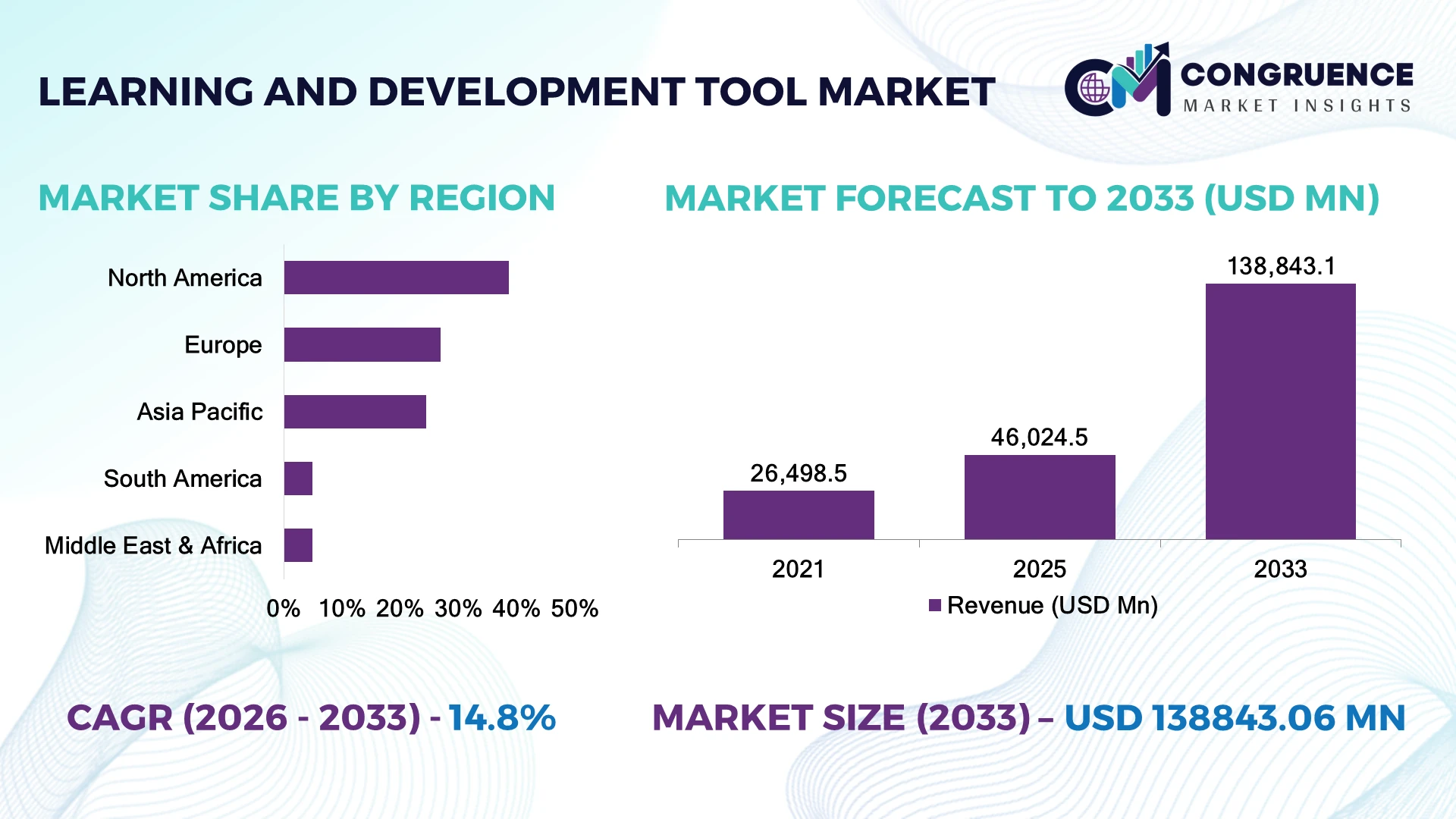
The United States accounts for approximately 36% of global Learning and Development Tool deployment, supported by large enterprise software investments, widespread AI integration, and mature corporate training ecosystems across technology, healthcare, finance, and manufacturing industries. Compared with Germany's compliance-focused workforce development model, U.S. organizations achieve nearly 68% AI-enabled learning adoption, while enterprise investment accelerated following digital transformation initiatives reinforced after evolving global cybersecurity and data governance regulations.
Organizations investing in AI-powered learning ecosystems, skills intelligence, and enterprise integration will establish stronger workforce competitiveness and long-term productivity advantages.
Market Size & Growth: USD 46,024.5 Million in 2025, projected to reach USD 138,843.1 Million by 2033 at a CAGR of 14.8%, driven by enterprise AI learning adoption.
Top Growth Drivers: AI-powered learning (48%), skills-based hiring (41%), and hybrid workforce expansion (37%) are accelerating implementation.
Short-Term Forecast: By 2028, automated learning administration is expected to reduce training costs by nearly 22% while increasing completion rates.
Emerging Technologies: Generative AI, adaptive learning engines, and learning analytics are transforming enterprise workforce development.
Regional Leaders: North America exceeds USD 51 Billion, Europe approaches USD 34 Billion, and Asia-Pacific surpasses USD 39 Billion through enterprise digitalization.
Consumer/End-User Trends: More than 72% of enterprise employees now prefer personalized digital learning experiences over traditional classroom training.
Pilot/Case Example: A 2026 AI-enabled corporate learning deployment improved learner engagement by 31% while reducing onboarding time by 26%.
Competitive Landscape: The top provider holds approximately 13% share alongside Cornerstone, SAP, Oracle, Workday, and Docebo.
Regulatory & ESG Impact: Compliance-focused digital learning programs improved mandatory certification completion by over 35% across regulated industries.
Investment & Funding: More than USD 3.8 Billion has been invested in AI learning technologies, strategic partnerships, and platform expansion amid global digital transformation.
Innovation & Future Outlook: Skills intelligence, AI coaching, and immersive learning technologies are redefining workforce capability development.
Learning and Development Tool Market adoption is expanding across corporate training, employee onboarding, compliance management, higher education, and frontline workforce development. AI-powered content generation, adaptive learning pathways, and skills analytics are improving learning effectiveness while reducing administrative effort. Nearly 64% of enterprise learning platforms now incorporate generative AI capabilities, supported by increasing digital workplace transformation and stricter workforce compliance requirements, setting the foundation for broader strategic workforce modernization.
Learning and Development Tools have become a strategic priority as organizations compete through workforce capability, digital transformation, and continuous skills development rather than traditional talent acquisition alone. The rapid shift toward AI-enabled enterprise operations and evolving workforce regulations is driving organizations to modernize learning infrastructure, integrate skills intelligence, and automate competency management across global operations.
Modern AI-powered learning platforms improve content creation efficiency by approximately 40% compared with legacy learning management systems while reducing administrative workload by nearly 25% through intelligent automation. North America leads enterprise-scale AI deployment and platform integration, whereas Asia-Pacific is expanding rapidly through large-scale workforce digitization and cloud-based learning adoption. Over the next two to three years, more than 70% of enterprise learning ecosystems are expected to integrate AI-driven personalization, predictive skills assessment, and real-time learning analytics into employee development strategies.
Large enterprises are increasingly deploying integrated learning experience platforms connected with HR, talent management, and performance systems to create unified workforce development environments. Software providers are expanding AI capabilities, strengthening cloud partnerships, and investing in industry-specific learning solutions that improve compliance, productivity, and employee retention. Organizations capable of combining intelligent learning automation with measurable workforce outcomes will strengthen competitive positioning, accelerate digital transformation, and build sustainable long-term organizational resilience.
AI-driven skills intelligence is transforming enterprise learning from content delivery into continuous workforce capability management. More than 72% of large organizations now prioritize skills-based learning over role-based training, while AI-generated learning content reduces course development time by nearly 45% and adaptive learning pathways improve learner completion rates by approximately 28%. The rapid adoption of generative AI following enterprise digital transformation initiatives in the United States has accelerated demand for integrated learning ecosystems connected with HR and talent platforms. This shift enables organizations to identify skill gaps in real time and improve workforce readiness. Software vendors are expanding AI capabilities, investing in intelligent learning assistants, and forming strategic HR technology partnerships to strengthen platform differentiation and long-term enterprise retention.
Complex integration with existing HR, ERP, identity management, and compliance systems remains a major structural limitation for Learning and Development Tool deployment. Nearly 43% of enterprises report interoperability challenges during implementation, while large-scale system integration increases deployment timelines by approximately 30%. The European Union's evolving AI governance and employee data protection requirements have added additional compliance validation for multinational organizations operating across multiple jurisdictions. These factors increase implementation costs, delay workforce onboarding, and complicate enterprise-wide scalability. Platform providers are mitigating these constraints through API-first architectures, localized cloud infrastructure, standardized integration frameworks, and strategic partnerships with enterprise software vendors to simplify deployment while improving long-term operational flexibility.
Agentic AI, predictive skills intelligence, and immersive learning environments are creating high-value opportunities beyond traditional digital training. AI-driven learning recommendations improve skill proficiency by nearly 35%, while competency forecasting reduces workforce planning gaps by approximately 22%. Japan and Singapore are expanding enterprise investment in AI-enabled workforce development to address demographic change and productivity priorities. Vendors are building ecosystem partnerships with HR technology providers, assessment platforms, and content developers to deliver continuously personalized learning experiences. A particularly valuable opportunity is emerging in frontline workforce enablement, where multilingual AI coaches and real-time performance guidance reduce training dependency while improving operational consistency across distributed organizations.
Maintaining trustworthy, secure, and explainable AI-driven learning at enterprise scale remains a significant execution challenge. More than 47% of organizations require human validation for AI-generated learning content, while cybersecurity reviews extend deployment cycles by approximately 18% for regulated industries. Large enterprises in the United States increasingly demand transparent AI governance, role-based content controls, and secure integration with enterprise knowledge repositories before organization-wide deployment. Companies must strengthen AI governance frameworks, expand cybersecurity investment, and establish rigorous content validation processes to maintain learning accuracy and regulatory compliance. Organizations capable of balancing intelligent automation with enterprise trust will secure stronger long-term competitive positioning in workforce development.
Generative AI Content Automation Enterprise learning teams are replacing manual course creation with generative AI, reducing content development time by nearly 45% while increasing update frequency by approximately 30%. Labor shortages and faster technology adoption cycles are accelerating deployment. Vendors are expanding AI authoring capabilities and strategic content partnerships to deliver continuously updated learning experiences with lower operational effort.
Skills-Based Workforce Planning Organizations are shifting from role-centric training toward enterprise-wide skills intelligence, with nearly 68% integrating competency frameworks into talent management workflows and improving internal mobility by approximately 24%. Companies are restructuring learning platforms around measurable business capabilities, enabling HR teams to align workforce planning more closely with operational priorities and future hiring requirements.
Immersive Learning Deployment Virtual reality, augmented reality, and simulation-based learning have improved practical training retention by approximately 32% while reducing instructor-led training time by nearly 21%. Manufacturing, healthcare, and industrial enterprises are scaling immersive learning programs following increased workplace safety requirements. Technology providers are expanding hardware partnerships and cloud-based deployment models to simplify enterprise adoption.
Learning Experience Platform Consolidation Enterprises are replacing fragmented learning ecosystems with unified learning experience platforms integrating HR, collaboration, assessment, and analytics capabilities. Platform consolidation has reduced administrative workload by approximately 26% while increasing learner engagement by nearly 19%. Software providers are accelerating acquisitions, ecosystem integrations, and workflow automation to strengthen customer retention and create differentiated enterprise learning environments.
Cloud-based Learning and Development Tools account for approximately 58% of the market, driven by rapid scalability, seamless integration with HR ecosystems, lower infrastructure costs, and continuous feature updates. Their ability to support hybrid workforces, multilingual learning, and AI-powered personalization makes them the preferred deployment model for large enterprises. AI-native learning platforms represent the fastest-growing type as organizations increasingly adopt intelligent content generation, adaptive learning paths, and predictive skills analytics. On-premise solutions continue serving highly regulated industries requiring strict data control, while hybrid deployments remain strategically relevant for enterprises transitioning legacy infrastructure.
Software providers are strengthening cloud-native architectures, embedding generative AI capabilities, and expanding integration partnerships with HRIS and ERP vendors. More than 67% of newly deployed enterprise learning platforms are cloud-based, while AI-enabled platforms improve learner engagement by nearly 29% and reduce administrative effort by approximately 24%. Investment priorities are shifting toward intelligent, interoperable platforms that deliver measurable workforce outcomes rather than standalone learning management functionality.
According to 2026 enterprise workforce technology findings published by the Association for Talent Development (ATD), cloud-native learning ecosystems have become the preferred deployment model for large organizations implementing AI-enabled workforce development and continuous skills management.
Corporate training represents approximately 44% of Learning and Development Tool adoption, supported by enterprise investments in workforce upskilling, compliance management, leadership development, and digital transformation. The concentration of demand reflects continuous learning requirements across technology, financial services, healthcare, and manufacturing organizations. Skills development and workforce reskilling is the fastest-growing application as AI adoption, automation, and changing job requirements accelerate competency transformation. Employee onboarding, compliance training, sales enablement, and technical certification continue expanding through personalized digital learning workflows and measurable performance tracking.
Organizations are integrating learning platforms with HR systems, collaboration software, and performance management applications to improve learning effectiveness and workforce visibility. More than 70% of enterprise learning deployments now include skills analytics, while automated learning pathways improve certification completion by approximately 27%. Vendors are expanding industry-specific learning libraries, AI-powered content creation, and enterprise consulting services to address increasingly specialized workforce development requirements.
According to 2025 enterprise learning benchmark findings released by Brandon Hall Group, organizations increasingly prioritize skills development and continuous workforce learning as the primary business objective when investing in next-generation learning technology platforms.
Large enterprises account for approximately 61% of Learning and Development Tool demand due to their extensive workforce, complex organizational structures, regulatory obligations, and continuous skills development requirements. Enterprise-wide deployment across multiple business units and global operations creates sustained investment in integrated learning ecosystems. Small and medium-sized enterprises (SMEs) represent the fastest-growing end-user segment as cloud-native subscription platforms reduce implementation costs and improve access to AI-powered learning capabilities previously available only to large organizations.
Government organizations, educational institutions, healthcare providers, and nonprofit organizations continue expanding adoption through digital learning modernization and workforce capability initiatives. Nearly 66% of enterprise buyers now prioritize platforms integrating learning, skills intelligence, and performance management within a unified environment. Vendors are responding through modular pricing, industry-specific solutions, strategic implementation partnerships, and AI-driven personalization that improves accessibility while supporting organizations of varying operational scale.
According to a 2026 enterprise digital workplace assessment published by the International Data Corporation (IDC), large organizations continue leading investment in AI-enabled learning platforms, while SMEs are recording the fastest adoption of cloud-based workforce development solutions due to lower deployment complexity and subscription-based delivery models.
North America accounted for the largest market share at 38.6% in 2025 however, Asia-Pacific is expected to register the fastest growth, expanding at a CAGR of 17.1% between 2026 and 2033.
AI-Driven Workforce Transformation Reinforces Enterprise Leadership
North America remains the leading regional market, supported by advanced enterprise software ecosystems, widespread cloud adoption, and continuous investment in workforce transformation. The region contributes approximately 38.6% of global Learning and Development Tool adoption, driven by technology, healthcare, financial services, manufacturing, and professional services organizations. More than 72% of large enterprises now integrate AI-enabled learning capabilities into talent management workflows, while enterprise investments in learning experience platforms have reduced employee onboarding time by nearly 25%. Organizations continue expanding strategic partnerships between HR technology providers, cloud infrastructure vendors, and AI developers to improve workforce agility, personalize learning pathways, and strengthen skills intelligence across distributed workforces.
United States Market Outlook: The United States dominates the regional market through its mature enterprise software industry, advanced AI ecosystem, and high concentration of multinational organizations. Corporate investment increasingly focuses on integrated learning, talent, and workforce analytics platforms. Nearly 70% of Fortune 500 organizations now deploy AI-supported learning technologies within enterprise HR environments, encouraging vendors to expand cloud infrastructure, strengthen strategic acquisitions, and accelerate innovation in adaptive learning and workforce intelligence.
Compliance-Led Digital Learning Modernization Accelerates Adoption
Europe continues expanding enterprise learning modernization through strong digital workplace strategies, workforce reskilling initiatives, and regulatory compliance requirements. The region represents approximately 27% of global market demand, with organizations increasingly integrating learning platforms into broader human capital management environments. More than 65% of enterprise learning deployments now emphasize digital compliance management, multilingual content delivery, and AI-assisted workforce development. Vendors are strengthening regional cloud infrastructure, expanding localized learning content, and developing industry-specific solutions that support regulated sectors while improving operational efficiency and employee engagement.
Germany Market Outlook: Germany leads the European market through advanced industrial digitization, engineering excellence, and continuous investment in workforce development. Manufacturing, automotive, and industrial enterprises are expanding digital learning initiatives to support automation and advanced production technologies. AI-enabled competency management and technical certification platforms are becoming standard across large organizations, helping employers improve workforce productivity while maintaining strict compliance with evolving labor and data governance requirements.
Enterprise Digitalization Creates Large-Scale Adoption Momentum
Asia-Pacific is the fastest-expanding regional market, supported by rapid enterprise digitalization, cloud infrastructure growth, and government-backed workforce modernization programs. The region accounts for approximately 24% of global market activity, with large-scale deployment across technology, education, financial services, and manufacturing sectors. More than 68% of newly implemented enterprise learning platforms are cloud-native, while AI-enabled learning adoption continues accelerating across major digital economies. Vendors are expanding regional data centers, strengthening channel partnerships, and localizing multilingual learning content to support organizations undergoing large-scale digital workforce transformation.
China Market Outlook: China represents the region's largest market through its extensive digital economy, expanding enterprise software sector, and sustained investment in AI technologies. Large enterprises increasingly integrate learning platforms with workforce analytics and intelligent talent management systems. More than 60% of enterprise digital transformation programs now include AI-supported employee learning initiatives, encouraging software providers to strengthen localized cloud services and enterprise ecosystem partnerships.
Corporate Upskilling Supports Digital Workforce Expansion
South America is steadily advancing enterprise learning adoption as organizations modernize workforce development and strengthen digital capabilities. The region contributes approximately 5% of global demand, with growing implementation across financial services, telecommunications, retail, and public sector organizations. Cloud-based learning platforms have reduced deployment complexity by nearly 30%, allowing enterprises to expand digital training with lower infrastructure investment. Vendors are strengthening regional implementation partnerships and localized customer support while addressing connectivity and enterprise integration challenges that influence deployment consistency across emerging markets.
Brazil Market Outlook: Brazil leads the regional market through its large enterprise sector, expanding technology investments, and increasing focus on workforce productivity. Organizations are replacing conventional classroom training with cloud-based learning platforms integrated with performance management systems. Digital skills initiatives across banking, retail, and industrial enterprises continue driving demand for AI-enabled learning solutions that improve employee engagement and operational readiness.
National Digital Strategies Accelerate Workforce Modernization
The Middle East & Africa market is gaining momentum through public-sector digital transformation, economic diversification programs, and enterprise investment in workforce capability development. The region accounts for approximately 5% of global market demand, supported by expanding adoption across government organizations, financial institutions, healthcare providers, and energy companies. More than 55% of newly deployed enterprise learning systems are cloud-based, enabling faster implementation and centralized workforce development. Technology providers are expanding regional cloud partnerships, localized training content, and managed learning services to support national digital transformation priorities.
Saudi Arabia Market Outlook: Saudi Arabia leads regional growth through ambitious workforce development initiatives aligned with economic diversification and digital transformation programs. Large enterprises and government agencies are investing in AI-enabled learning platforms to strengthen national workforce capabilities and improve organizational productivity. Continuous investment in cloud infrastructure and enterprise technology ecosystems is encouraging solution providers to expand regional operations and deliver industry-specific learning solutions tailored to rapidly evolving workforce requirements.
Competition is led by Cornerstone OnDemand, Docebo, SAP, Workday, Oracle, and 360Learning, with enterprise HCM providers competing against specialist learning platform vendors, while AI-native innovators challenge established LMS providers through automation and personalization. The top five players collectively account for approximately 48% of the market, creating a moderately consolidated competitive landscape. Vendors compete through AI capabilities, ecosystem integration, implementation speed, and industry-specific customization rather than pricing alone. AI-powered content generation reduces course development time by nearly 40%, integrated HR-learning platforms improve administrative efficiency by approximately 25%, and cloud deployment shortens implementation timelines by almost 30%. Companies are strengthening positions through acquisitions, strategic cloud partnerships, embedded skills intelligence, and vertical integration with talent management suites. Competition is shifting rapidly toward agentic AI, unified workforce intelligence, and end-to-end employee experience platforms. Enterprise integration complexity and high customer switching costs remain key barriers. Success depends on delivering measurable workforce outcomes, scalable AI innovation, seamless interoperability, and trusted enterprise security.
Cornerstone OnDemand
Docebo Inc.
SAP SE
Oracle Corporation
Workday, Inc.
360Learning
Absorb Software
Moodle Pty Ltd.
D2L Corporation
Skillsoft Corp.
Learning Technologies Group plc
CrossKnowledge
CYPHER Learning
TalentLMS
Learning and Development platforms are rapidly evolving through generative AI, adaptive learning engines, skills intelligence, and learning analytics integrated with enterprise HR ecosystems. More than 68% of newly deployed enterprise learning platforms now incorporate AI-driven recommendations, while adaptive learning pathways improve learner completion rates by approximately 28%. Intelligent content generation reduces instructional design effort and enables continuous course updates, helping organizations respond faster to changing business priorities.
Compared with conventional learning management systems, AI-powered learning platforms reduce content creation time by nearly 40% and improve administrative efficiency by approximately 25% through automated assessments, skills mapping, and workflow orchestration. Organizations integrating learning platforms with HR, collaboration, and performance management systems gain stronger workforce visibility and faster competency development. Global enterprises, regulated industries, and technology-intensive organizations benefit most because unified talent ecosystems improve operational decision-making and accelerate internal mobility.
Between 2026 and 2028, agentic AI, immersive simulation-based learning, enterprise knowledge graphs, and predictive workforce intelligence will redefine digital learning. Vendors investing in explainable AI, multilingual learning automation, and secure enterprise integrations will strengthen competitive positioning. Organizations acting now will establish scalable workforce capability frameworks, improve employee productivity, and build long-term resilience through continuously evolving learning ecosystems.
April 2025 – Docebo unveiled its AI-First Learning Platform at Docebo Inspire 2025, introducing Harmony, AI Creator, AI Virtual Coaching, and AI Video Presenter to automate enterprise learning workflows and accelerate content creation at scale. Source: Docebo
February 2025 – Cornerstone OnDemand highlighted accelerated workforce agility initiatives following the integration of SkyHive and Talespin, strengthening AI-powered skills intelligence and immersive learning capabilities to expand enterprise workforce readiness solutions. Source: Cornerstone OnDemand
January 2026 – Docebo announced the acquisition of 365Talents, expanding its skills intelligence capabilities and combining AI-powered workforce skills management with enterprise learning execution to deliver a unified talent development ecosystem. Source: Docebo Investor News
September 2025 – Workday agreed to acquire AI startup Sana for approximately USD 1.1 billion, strengthening AI-native learning, knowledge management, and autonomous workforce intelligence capabilities across its enterprise platform.
This report delivers comprehensive analysis of the Learning and Development Tool Market across cloud-based, on-premise, hybrid, and AI-native learning platforms. It evaluates adoption across corporate training, employee onboarding, compliance management, skills development, leadership training, and technical certification while assessing demand among large enterprises, SMEs, educational institutions, government organizations, healthcare providers, and other major end users. Regional coverage spans North America, Europe, Asia-Pacific, South America, and the Middle East & Africa, profiling more than 20 strategically significant country markets and 12 leading technology providers.
The study examines AI-powered learning, adaptive learning engines, immersive training, skills intelligence, learning analytics, enterprise integrations, and cloud-native deployment models shaping workforce transformation between 2026 and 2033. It highlights deployment patterns, competitive positioning, digital adoption trends, and enterprise modernization strategies that support investment planning, product expansion, technology selection, competitive benchmarking, and long-term business decision-making across rapidly evolving learning ecosystems.
| Report Attribute/Metric | Report Details |
|---|---|
|
Market Revenue in 2025 |
USD 46,024.5 Million |
|
Market Revenue in 2033 |
USD 138,843.1 Million |
|
CAGR (2026 - 2033) |
14.8% |
|
Base Year |
2025 |
|
Forecast Period |
2026 - 2033 |
|
Historic Period |
2021 - 2025 |
|
Segments Covered |
By Type
By Application
By End-User
|
|
Key Report Deliverable |
Revenue Forecast, Growth Trends, Market Dynamics, Segmental Overview, Regional and Country-wise Analysis, Competition Landscape |
|
Region Covered |
North America, Europe, Asia-Pacific, South America, Middle East, Africa |
|
Key Players Analyzed |
Cornerstone OnDemand, Docebo Inc., SAP SE, Oracle Corporation, Workday, Inc., 360Learning, Absorb Software, Moodle Pty Ltd., D2L Corporation, Skillsoft Corp., Learning Technologies Group plc, CrossKnowledge, CYPHER Learning, TalentLMS |
|
Customization & Pricing |
Available on Request (10% Customization is Free) |




