
Reports
The Global Leaf Vegetable Seeds Market was valued at USD 2346 Million in 2025 and is anticipated to reach a value of USD 3113.19 Million by 2033 expanding at a CAGR of 3.6% between 2026 and 2033. Growth is supported by rapid adoption of disease-resistant hybrids, precision seed breeding, protected cultivation, and expanding commercial vegetable production across intensive farming regions.
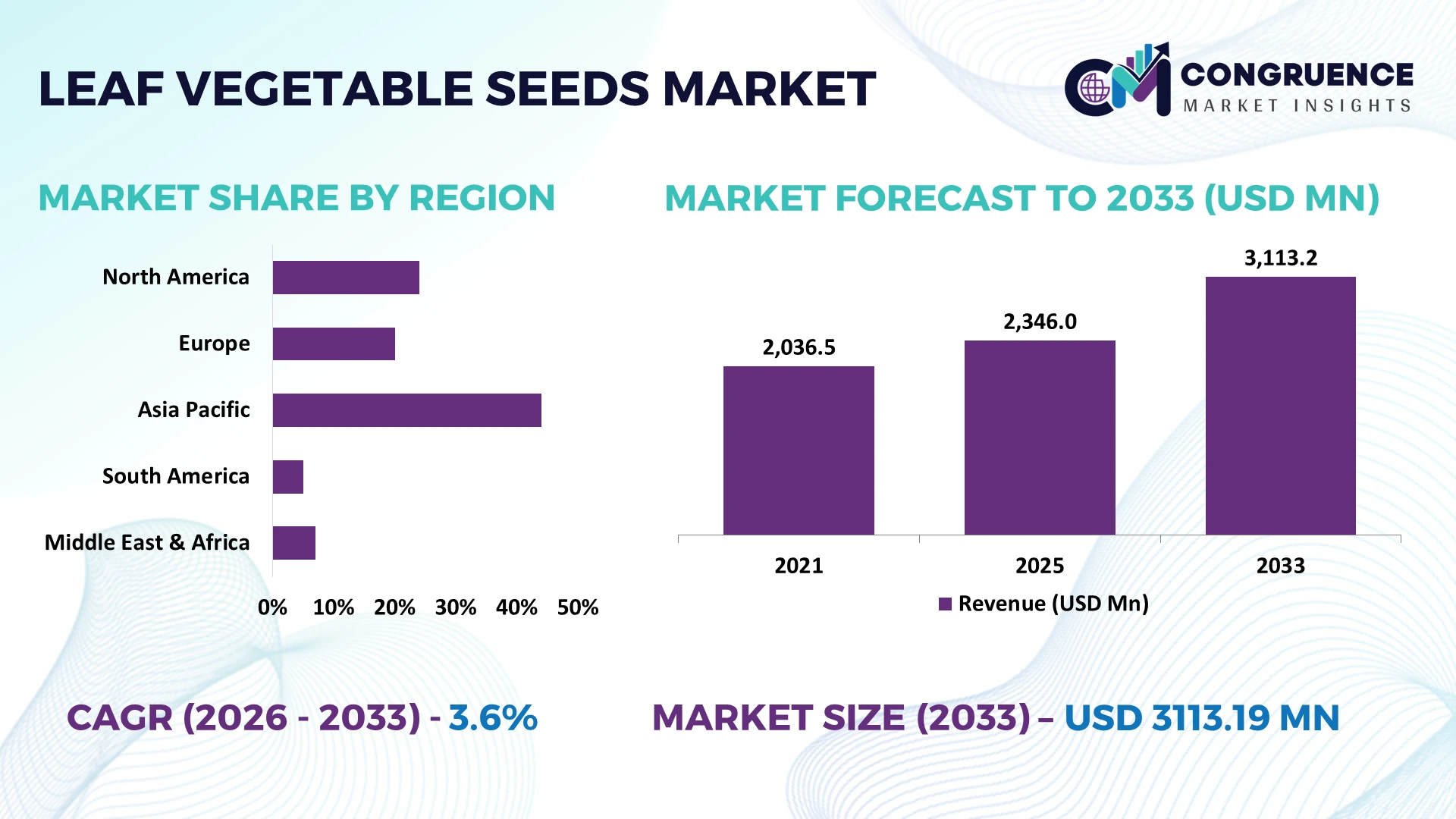
China remains the dominant country, accounting for approximately 29% of global leaf vegetable seed production, supported by over USD 1 billion in annual protected horticulture investments and greenhouse cultivation exceeding 4 million hectares. Compared with India, where hybrid seed adoption remains below 45%, China surpasses 70% adoption across commercial leafy vegetable farms. Ongoing food security initiatives and post-pandemic agricultural resilience policies continue to strengthen production efficiency and export competitiveness.
For market participants, strengthening regional breeding capabilities and localized hybrid seed portfolios will be essential to capture long-term commercial opportunities and improve supply-chain resilience.
Market Size & Growth: USD 2346 Million (2025) to USD 3113.19 Million (2033) at 3.6% CAGR, driven by advanced hybrid breeding and precision agriculture adoption.
Top Growth Drivers: Hybrid seed adoption exceeds 70% in commercial farming, disease-resistant varieties improve yields by 18%, and protected cultivation expands by 12% annually.
Short-Term Forecast: By 2028, seed processing efficiency improves by 15% through automated grading and digital quality monitoring.
Emerging Technologies: AI-assisted breeding, genomic selection, and automated seed treatment reduce breeding cycles by nearly 20% while improving uniformity.
Regional Leaders: Asia Pacific approaches USD 1.45 billion, Europe exceeds USD 620 million, and North America reaches USD 510 million, supported by controlled-environment farming expansion.
Consumer/End-User Trends: Nearly 64% of commercial growers prioritize high-germination hybrid seeds for consistent leafy vegetable production and reduced crop losses.
Pilot/Case Example: In 2026, precision greenhouse seed programs improved germination consistency by 16% while lowering production waste across commercial vegetable operations.
Competitive Landscape: The leading supplier holds approximately 18% market share, with competition driven by Bayer, Syngenta, BASF, Sakata Seed Corporation, and Enza Zaden.
Regulatory & ESG Impact: Sustainable seed production initiatives reduce water consumption by approximately 14%, supported by stronger agricultural sustainability frameworks and regional compliance standards.
Investment & Funding: More than USD 900 million supports breeding facilities, strategic partnerships, and regional production expansion amid ongoing global supply-chain diversification.
Innovation & Future Outlook: Next-generation genome-assisted breeding and climate-resilient seed development accelerate product commercialization, strengthening long-term competitiveness in the global leaf vegetable seeds market.
The Leaf Vegetable Seeds Market is expanding through stronger demand from greenhouse cultivation, hydroponic farming, and commercial vegetable producers seeking uniform, high-performance varieties. Advanced genomic breeding and seed coating technologies improve establishment rates by approximately 18%, while regional seed localization strategies strengthen supply continuity amid evolving agricultural regulations and cross-border logistics adjustments, setting the foundation for the strategic market assessment that follows.
The Leaf Vegetable Seeds Market has become strategically important as food security policies, protected cultivation, and commercial horticulture reshape global agricultural competitiveness. Seed companies are prioritizing resilient breeding programs to secure long-term supply, while supply-chain restructuring encourages localized multiplication and processing to reduce dependence on cross-border seed movement. This shift is strengthening investment in breeding infrastructure and accelerating commercialization of climate-resilient leafy vegetable varieties.
Modern genomic-assisted breeding reduces variety development time by approximately 25% compared with conventional breeding while improving disease-resistance selection accuracy by nearly 20%, lowering development costs per commercial variety. China continues to lead large-scale protected cultivation and hybrid deployment, whereas the Netherlands maintains an innovation advantage through advanced breeding technologies and high-value greenhouse production. Over the next two to three years, digital phenotyping adoption is expected to exceed 45% among leading breeding programs, improving selection efficiency and shortening product launch cycles.
Commercial seed producers are expanding collaborative breeding networks with greenhouse operators and research institutions to validate varieties under diverse climatic conditions before large-scale release. Companies are also increasing investments in localized seed production, automated quality testing, and precision seed treatment to improve consistency. Organizations that integrate advanced breeding technologies with resilient regional supply networks will secure stronger competitive positioning and long-term operational advantages.
Commercial horticulture is increasingly shifting toward hybrid leaf vegetable seeds that deliver higher uniformity, disease resistance, and improved field performance. Hybrid adoption exceeds 70% in China's commercial leafy vegetable production, while protected cultivation has expanded by nearly 12% annually across major vegetable-growing clusters. Precision seed coating improves germination consistency by approximately 15%, reducing crop establishment losses. Government support for controlled-environment agriculture and food security initiatives is accelerating demand for premium seed genetics. In response, leading companies are expanding breeding stations, investing in marker-assisted selection technologies, and forming partnerships with commercial growers to develop region-specific varieties that improve productivity and strengthen market differentiation.
Seed production remains vulnerable to climatic variability, rising labor costs, and specialized multiplication requirements. Seed processing costs have increased by approximately 10%, while adverse weather has reduced seed yields by nearly 8% in several production zones during recent growing seasons. Dependence on a limited number of seed multiplication locations creates operational pressure when logistics or export regulations tighten. These constraints affect production planning, inventory availability, and profit margins for commercial suppliers. Companies are reducing exposure through geographically diversified production networks, localized multiplication programs, and longer-term contract farming agreements that stabilize seed availability while improving operational resilience.
Artificial intelligence, genomic analytics, and automated phenotyping are creating new opportunities to accelerate breeding efficiency and expand premium product portfolios. AI-supported trait selection improves breeding precision by approximately 22%, while digital field monitoring reduces evaluation time by nearly 18%. India is strengthening public-private collaboration to expand high-quality vegetable seed development, creating new commercialization opportunities for advanced breeding technologies. Companies are increasing investment in climate-resilient varieties capable of performing under water stress and variable temperatures while expanding partnerships with research institutions. The combination of digital breeding and localized innovation ecosystems creates a competitive advantage beyond traditional seed performance metrics.
Deploying advanced seed genetics consistently across different climates, farming practices, and production scales remains a significant execution challenge. Performance variation between controlled and open-field cultivation can exceed 15%, while breeder shortages of approximately 20% in specialized genetics programs slow product development. Increasing phytosanitary compliance requirements also extend commercialization timelines for international seed movement. These factors complicate global portfolio standardization and delay market deployment. Companies must strengthen breeder training, expand regional testing infrastructure, and invest in digital quality management platforms to ensure consistent varietal performance, regulatory compliance, and long-term competitiveness across diverse agricultural production environments.
Advanced Seed Trait Integration Hybrid breeding programs increasingly combine disease resistance, heat tolerance, and rapid maturity into single varieties, improving commercial field performance by approximately 18% while reducing crop losses by nearly 14%. Chinese breeding companies are expanding genomic screening platforms and collaborative testing networks as stricter food security priorities accelerate premium seed deployment across intensive vegetable production systems.
Automated Seed Processing Expansion Automated grading, optical sorting, and precision seed treatment now improve processing throughput by around 22% while lowering manual handling requirements by 17%. Labor shortages and rising quality compliance standards are encouraging producers to modernize processing facilities, with companies restructuring operations through digital quality control and centralized processing hubs to achieve consistent seed uniformity.
Localized Production Network Growth Seed producers are shifting multiplication activities closer to major cultivation regions, reducing average delivery times by approximately 15% and lowering logistics disruptions by nearly 12%. Regulatory changes affecting cross-border agricultural inputs have accelerated regional production partnerships, enabling companies to strengthen inventory planning while improving seasonal supply reliability for commercial growers.
Data-Driven Variety Validation Digital field monitoring and remote phenotyping increase trial evaluation efficiency by approximately 20%, while commercial validation cycles shorten by nearly 16%. Netherlands-based breeding organizations increasingly integrate AI-supported analytics with multi-location performance trials, allowing faster product positioning and more accurate recommendations for greenhouse, hydroponic, and open-field production environments.
Lettuce Seeds represent the leading segment with an estimated 36% market share due to broad commercial cultivation, rapid crop turnover, and compatibility with greenhouse, hydroponic, and open-field production systems. Their high germination consistency and extensive hybrid portfolio support year-round production, making them the preferred choice for commercial vegetable suppliers. Cabbage Seeds and Spinach Seeds continue to maintain stable demand through established retail supply chains, while Leafy Greens Seeds provide diversified opportunities for specialty and mixed-leaf cultivation. Companies continue expanding hybrid portfolios and localized breeding programs to improve disease resistance and climatic adaptability.
Kale Seeds are the fastest-growing segment as health-oriented consumption and premium leafy vegetable production expand across developed markets. Commercial adoption has increased by approximately 17%, while precision breeding improves field uniformity by nearly 15%. Seed companies are prioritizing advanced genetics, strategic licensing agreements, and regional product launches to capture premium demand. The market is gradually shifting from volume-focused seed production toward value-added varieties with stronger resistance traits and extended harvest flexibility, strengthening long-term competitive positioning.
Commercial Farming accounts for approximately 48% of total demand because of its large cultivation scale, contract production systems, and continuous requirement for uniform, high-quality seeds. Large vegetable producers increasingly standardize hybrid varieties to improve harvest consistency and reduce production variability. Open Field Farming remains a major application due to extensive cultivation acreage, while Organic Farming continues expanding through certified production programs requiring specialized untreated seed varieties. Seed suppliers are strengthening technical support services and expanding distribution partnerships to improve adoption across large commercial operations.
Hydroponics is the fastest-growing application, supported by controlled-environment agriculture and precision nutrient management. Commercial hydroponic facilities report productivity improvements approaching 20%, while premium leafy vegetable production cycles shorten by approximately 15%. Greenhouse Cultivation also continues strengthening through automated climate management and precision irrigation technologies. Companies are introducing application-specific seed portfolios optimized for controlled cultivation systems, enabling growers to achieve better uniformity, predictable harvest scheduling, and higher operational efficiency across diversified production models.
Commercial Growers represent the largest end-user group with approximately 46% market share due to intensive production volumes, established procurement networks, and year-round planting schedules. Their purchasing decisions emphasize disease resistance, germination performance, and production consistency. Seed Companies remain important buyers for breeding, multiplication, and distribution activities, while Contract Farmers increasingly participate through structured supply agreements supporting large vegetable processors. Companies are responding by offering customized hybrid portfolios, technical advisory services, and long-term supply contracts tailored to commercial operations.
Greenhouse Operators are the fastest-growing end-user segment as controlled-environment agriculture expands and precision cultivation becomes more widespread. Adoption of premium hybrid seed varieties has increased by nearly 19%, while automated greenhouse deployment continues rising by approximately 16%. Research Institutes remain essential for pre-commercial breeding validation and trait evaluation, driving collaborative innovation with private seed developers. Suppliers are strengthening partnerships, expanding demonstration trials, and introducing performance-based product positioning to improve customer retention and accelerate adoption among technologically advanced production systems.
Asia-Pacific accounted for the largest market share at 44.8% in 2025 however, Middle East & Africa is expected to register the fastest growth, expanding at a 4.8% between 2026 and 2033.

Advanced Protected Cultivation Strengthens Premium Seed Demand
North America represents a mature leaf vegetable seeds market supported by advanced greenhouse infrastructure, precision agriculture, and large-scale commercial vegetable production. The region contributes approximately 24% of global demand, with premium hybrid varieties increasingly replacing conventional seed portfolios. Automated seed treatment, digital crop monitoring, and controlled-environment farming continue improving planting consistency and reducing production variability. More than 65% of commercial greenhouse vegetable operations utilize hybrid leafy vegetable seeds, reflecting strong adoption of high-performance genetics. Seed developers are expanding regional breeding programs and strengthening collaborations with commercial growers to accelerate variety validation while improving resilience against evolving disease pressures and climate variability.
United States Market Outlook: The United States remains the region's largest market because of its extensive commercial vegetable production, sophisticated seed distribution network, and advanced breeding capabilities. Large greenhouse operators continue expanding controlled-environment cultivation, while precision agriculture technologies improve planting efficiency by approximately 18%. Seed companies are increasing investments in localized breeding, digital field trials, and strategic partnerships with commercial producers to strengthen product differentiation and accelerate deployment across high-value leafy vegetable cultivation systems.
Innovation-Led Breeding Drives Competitive Advantage
Europe maintains a strong competitive position through advanced breeding technologies, strict seed quality standards, and highly efficient greenhouse production systems. The region accounts for approximately 22% of global market activity, supported by sustained investment in genomic breeding, automated seed processing, and sustainable cultivation practices. Digital phenotyping platforms have improved breeding efficiency by nearly 20%, enabling faster commercialization of disease-resistant leafy vegetable varieties. Companies continue strengthening cross-border breeding collaborations while modernizing production facilities to meet evolving sustainability requirements and improve operational consistency across commercial seed portfolios.
Netherlands Market Outlook: The Netherlands serves as Europe's technology leader through its globally recognized seed breeding ecosystem, intensive greenhouse horticulture, and strong research collaboration. Commercial breeding facilities increasingly integrate AI-assisted selection and automated greenhouse testing, reducing breeding cycle durations by approximately 25%. Dutch enterprises continue expanding international licensing agreements and regional research partnerships, reinforcing their leadership in premium leafy vegetable genetics and high-performance seed innovation.
Large-Scale Production and Hybrid Adoption Lead Growth
Asia-Pacific remains the largest production and consumption hub for leaf vegetable seeds, supported by extensive vegetable cultivation, expanding protected agriculture, and continuous hybrid seed adoption. The region contributes approximately 44.8% of global market activity, with commercial hybrid penetration exceeding 70% in leading production clusters. Large-scale greenhouse expansion, precision irrigation, and modern seed processing infrastructure continue strengthening supply capabilities. Companies are investing in localized breeding stations, automated processing technologies, and regional multiplication facilities to improve supply reliability and develop varieties adapted to diverse climatic conditions.
China Market Outlook: China dominates the regional market through its extensive vegetable cultivation base, advanced greenhouse infrastructure, and integrated seed production network. Protected cultivation exceeds 4 million hectares, creating sustained demand for premium hybrid leafy vegetable seeds. Domestic seed enterprises continue investing in genomic breeding, regional multiplication facilities, and automated processing technologies, enabling stronger varietal performance while supporting national food security objectives and export competitiveness.
Commercial Vegetable Expansion Supports Seed Modernization
South America continues strengthening its position through expanding commercial vegetable farming, improving seed distribution networks, and increasing adoption of hybrid leafy vegetable varieties. The region represents approximately 6.5% of global market demand, with commercial producers increasingly adopting premium genetics to improve crop uniformity and productivity. Modern irrigation systems and precision cultivation practices improve production efficiency by approximately 14%, while seed suppliers expand technical support services to improve grower performance. Investment in regional multiplication facilities is gradually reducing dependence on imported seed inventories despite remaining logistical challenges.
Brazil Market Outlook: Brazil leads regional demand through its extensive commercial horticulture sector and expanding protected cultivation infrastructure. Professional vegetable producers increasingly adopt disease-resistant hybrid seeds to improve productivity under diverse climatic conditions. Commercial planting efficiency has improved by nearly 16% through precision cultivation practices, encouraging seed companies to strengthen local production partnerships, demonstration programs, and regional breeding activities that support long-term market development.
Controlled Agriculture Accelerates Market Transformation
The Middle East & Africa market is advancing through investments in controlled-environment agriculture, water-efficient production systems, and modern greenhouse infrastructure. The region contributes approximately 2.7% of global demand but continues increasing adoption of premium hybrid leafy vegetable seeds across commercial cultivation projects. Hydroponic farming capacity has expanded by nearly 18%, supported by government-backed agricultural modernization initiatives and food security strategies. Seed companies are strengthening partnerships with greenhouse operators while introducing varieties optimized for high-temperature cultivation and water-limited production environments.
United Arab Emirates Market Outlook: The United Arab Emirates leads regional modernization through advanced greenhouse investments, hydroponic farming expansion, and technology-intensive vegetable production. Commercial controlled-environment farms continue integrating automated climate management and precision irrigation, improving production consistency by approximately 20%. Seed suppliers are prioritizing heat-tolerant hybrid varieties and collaborative demonstration projects, strengthening operational performance while supporting long-term agricultural diversification initiatives.
The Leaf Vegetable Seeds Market is led by Bayer, Syngenta, BASF, Sakata Seed Corporation, and Enza Zaden, competing directly against specialized regional breeders and independent vegetable seed developers. The top five companies collectively control approximately 56% of the market through extensive breeding pipelines, global distribution, and premium hybrid portfolios. Competition centers on genetic performance, disease resistance, supply reliability, and localized adaptation rather than price alone. Advanced genomic breeding shortens variety development by nearly 25%, while precision seed treatment improves germination consistency by approximately 15%, creating measurable product differentiation. Global leaders strengthen positions through regional breeding centers, strategic licensing, grower partnerships, and vertically integrated seed production, whereas regional companies compete with locally adapted varieties and faster commercialization cycles. The competitive landscape is shifting toward digital breeding, climate-resilient genetics, and localized seed multiplication as supply-chain resilience becomes a strategic priority. High breeding investment requirements and lengthy variety validation remain key entry barriers. Sustainable competitive success depends on combining advanced genetics, regional adaptability, reliable supply networks, and rapid commercialization.
Bayer
Syngenta
BASF
Sakata Seed Corporation
Enza Zaden
Rijk Zwaan
Bejo Zaden
Takii & Co., Ltd.
East-West Seed
Limagrain
Vilmorin
Known-You Seed Co., Ltd.
Advanced genomic breeding, marker-assisted selection, and AI-enabled trait analysis are redefining commercial leaf vegetable seed development. Compared with conventional breeding, genomic-assisted programs reduce breeding cycles by approximately 25% while improving trait selection accuracy by nearly 20%. Around 55% of leading vegetable seed developers now integrate molecular breeding tools into commercial programs, enabling faster release of disease-resistant and climate-adapted varieties. Companies adopting these technologies gain stronger product differentiation and accelerate entry into premium cultivation segments.
Precision seed coating, optical sorting, and automated quality inspection are improving production efficiency across commercial seed operations. Modern automated processing increases grading accuracy by approximately 18% while reducing manual quality control costs by nearly 15% compared with legacy processing systems. Large multinational breeders benefit most through vertically integrated production, while regional companies increasingly adopt modular automation to improve consistency and strengthen competitiveness without major infrastructure expansion.
Between 2026 and 2028, AI-assisted phenotyping, digital field analytics, and predictive breeding platforms will become core competitive technologies. Commercial deployment is expected to exceed 60% among leading breeding organizations as digital trial management expands. Businesses investing early in integrated breeding, automation, and data-driven product validation will strengthen operational resilience, shorten commercialization timelines, and secure sustainable competitive advantages in increasingly performance-driven seed markets.
July 2024 Enza Zaden introduced lettuce varieties resistant to the new Bremia lactucae race Bl:41EU, strengthening disease resilience across commercial leafy vegetable production. The new resistance targets 100% of the newly identified pathogen race, improving crop reliability and reducing production risk for growers.
October 2024 Enza Zaden officially opened a new production hub in Tanzania to strengthen regional seed multiplication and supply-chain resilience for vegetable seeds. The facility serves 2 continents through improved logistics and localized production, enhancing delivery efficiency and supply continuity. Source: Enza Zaden
July 2025 Sakata Seed Corporation announced the acquisition of Brazilian onion seed company Agritu Sementes, expanding its vegetable seed portfolio and South American breeding capabilities. The transaction added 1 dedicated seed company to Sakata's global network, reinforcing regional product development and market reach.
June 2026 Sakata Seed Corporation inaugurated its Ishigaki Research Station in Okinawa to accelerate breeding for tropical and subtropical crops, including leafy vegetables. The new site establishes 1 dedicated research station supporting faster varietal development and stronger climate-adaptation capabilities. Source: Sakata Global
This report provides a comprehensive assessment of the global Leaf Vegetable Seeds Market across Lettuce Seeds, Spinach Seeds, Cabbage Seeds, Kale Seeds, and Leafy Greens Seeds, together with application analysis covering Open Field Farming, Greenhouse Cultivation, Hydroponics, Organic Farming, and Commercial Farming. It further evaluates demand across Commercial Growers, Greenhouse Operators, Seed Companies, Research Institutes, and Contract Farmers while examining competitive positioning across five major geographic regions. Hybrid seed adoption exceeding 70% in leading commercial production systems and increasing deployment of precision breeding technologies are incorporated into the analysis.
The report evaluates breeding innovation, genomic selection, automated seed processing, protected cultivation, and digital phenotyping as major technology themes shaping industry competitiveness between 2026 and 2033. Strategic insights include company positioning, regional expansion priorities, product differentiation, supply-chain localization, investment opportunities, and evolving deployment patterns. Coverage also extends to emerging controlled-environment agriculture, climate-resilient seed development, premium hybrid portfolios, and enterprise strategies that support operational efficiency, market expansion, and long-term competitive decision-making.
| Report Attribute/Metric | Report Details |
|---|---|
Market Revenue in 2025 | USD 2346 Million |
Market Revenue in 2033 | USD 3113.19 Million |
CAGR (2026 - 2033) | 3.6% |
Base Year | 2025 |
Forecast Period | 2026 - 2033 |
Historic Period | 2021 - 2025 |
Segments Covered | By Type
By Application
By End-User
|
Key Report Deliverable | Revenue Forecast, Growth Trends, Market Dynamics, Segmental Overview, Regional and Country-wise Analysis, Competition Landscape |
Region Covered | North America, Europe, Asia-Pacific, South America, Middle East, Africa |
Key Players Analyzed | Bayer, Syngenta, BASF, Sakata Seed Corporation, Enza Zaden, Rijk Zwaan, Bejo Zaden, Takii & Co., Ltd., East-West Seed, Limagrain, Vilmorin, Known-You Seed Co., Ltd. |
Customization & Pricing | Available on Request (10% Customization is Free) |




