
Reports
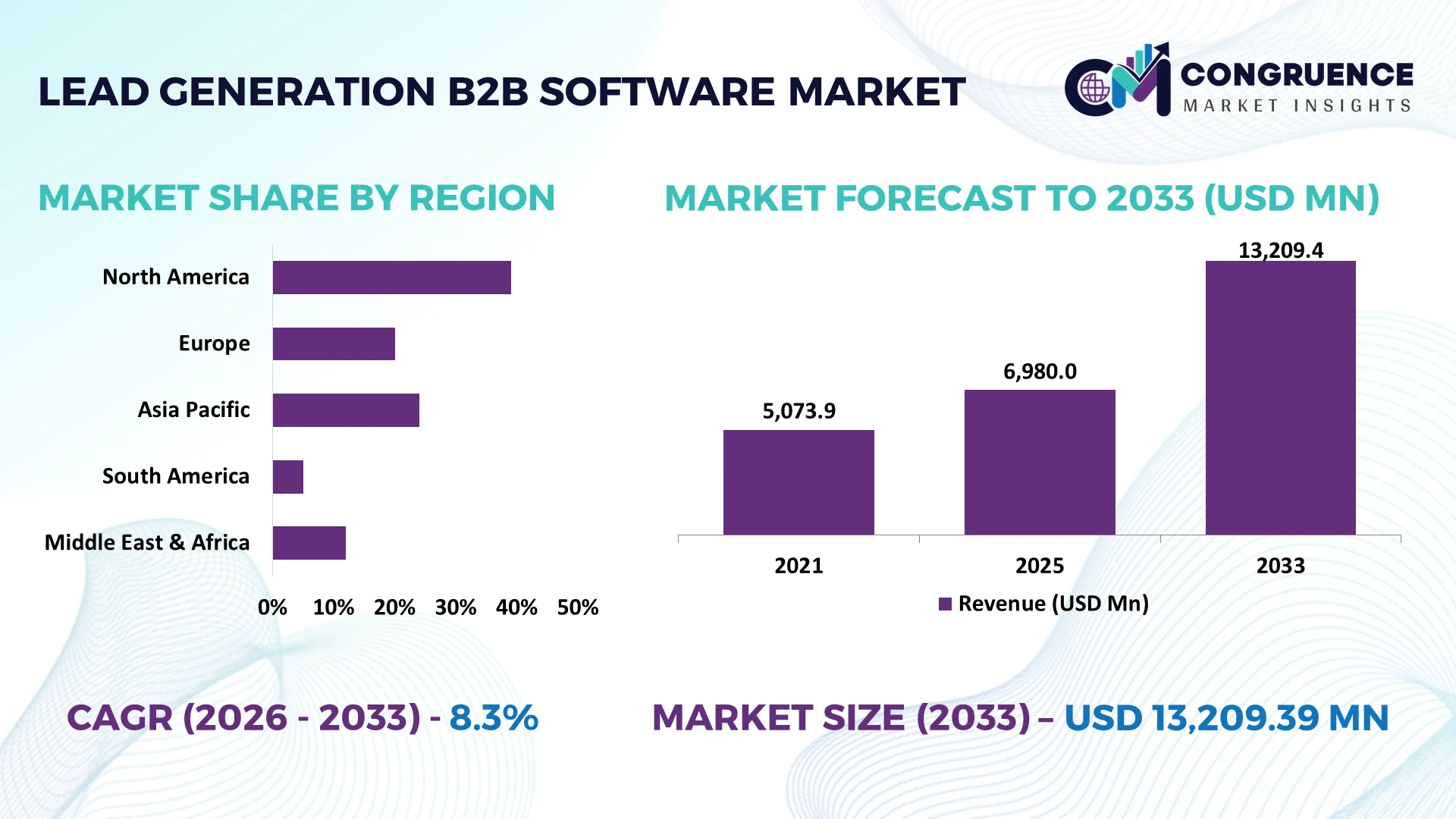
The Global Lead Generation B2B Software Market was valued at USD 6980 Million in 2025 and is anticipated to reach a value of USD 13209.39 Million by 2033 expanding at a CAGR of 8.3% between 2026 and 2033. AI-powered prospect identification, predictive lead scoring, intent-data enrichment, and automated multichannel outreach are driving adoption as B2B sales teams replace manual prospecting with integrated, data-led workflows.
The United States remains the dominant adoption hub, supported by North America’s approximately 71.6% CRM adoption rate, compared with 67.9% in Asia-Pacific and 62.1% in Europe. U.S. technology, financial services, professional services, and SaaS companies are major users, while 89% of sales teams in India reported implementing or experimenting with AI, demonstrating faster AI-led sales transformation across emerging enterprise markets. The expansion of U.S. state privacy laws and Europe’s GDPR framework is accelerating investment in consent-based prospect data, first-party intelligence, compliant enrichment, and auditable AI sales technologies.
Vendors combining verified B2B data, AI agents, CRM integration, and privacy-first prospecting will hold the strongest position as enterprises consolidate fragmented sales technology stacks.
Market Size & Growth: USD 6.98 billion in 2025 is projected to reach USD 13.21 billion by 2033 at an 8.3% CAGR, supported by AI-native prospecting and automated lead qualification.
Top Growth Drivers: 87% sales-AI usage, 54% AI-agent adoption, and 88% planned agent adoption by 2027 reinforce the shift toward automated B2B prospecting.
Short-Term Forecast: By 2027, AI agents are positioned to reduce prospect-research time by approximately 34%, expanding SDR account coverage and sales productivity.
Emerging Technologies: AI agents, predictive scoring, intent-data platforms, and generative personalization are advancing rapidly, with 92% of sellers using agents reporting prospecting benefits.
Regional Leaders: North America represents an estimated USD 2.9 billion opportunity, Europe USD 1.8 billion, and Asia-Pacific USD 1.6 billion, supported by expanding CRM and AI adoption.
Consumer/End-User Trends: 96% of prospects conduct independent research before engaging sales teams, increasing enterprise investment in buyer-intent identification and digital engagement tools.
Pilot/Case Example: In 2024, 74% of surveyed AI sales-tool users reported that AI helped increase responses across warm and cold calling activities, strengthening automated outreach performance.
Competitive Landscape: No single provider controls 20% of the global market; Salesforce, HubSpot, ZoomInfo, LinkedIn, Apollo.io, and Outreach compete across intelligence, CRM, enrichment, and engagement.
Regulatory & ESG Impact: 51% of fully AI-enabled sales organizations strengthened data-security measures before deployment, making privacy governance a measurable enterprise procurement requirement.
Investment & Funding: 81% of sales teams were already investing in AI capabilities, directing technology budgets toward integrated CRM intelligence, automation, partnerships, and platform consolidation.
Innovation & Future Outlook: 79% of high-performing sellers prioritize data hygiene versus 54% of underperformers, positioning verified data and autonomous AI workflows as next-generation competitive differentiators.
Lead generation B2B software demand is increasingly concentrated around AI-assisted prospecting, account intelligence, automated data enrichment, predictive qualification, and personalized multichannel engagement. Around 92% of sellers using AI agents report prospecting benefits, reinforcing enterprise migration toward autonomous sales workflows. At the same time, U.S. and European privacy requirements are strengthening demand for first-party data and consent-led architectures, shaping the market’s next strategic competitive phase.
Lead generation B2B software is becoming strategic infrastructure for revenue operations as companies compete on prospect intelligence, response speed, and account prioritization rather than contact volume. AI is now embedded across sales workflows: 92% of surveyed sales professionals use AI in some capacity, while 84% report time savings. The digital shift is extending beyond sellers as 74% report that AI makes product research easier for buyers, forcing platforms to identify intent earlier and personalize engagement more precisely.
AI-native platforms provide a measurable advantage over legacy manual prospecting. Sales teams expect AI agents to reduce prospect-research time by 34% and email drafting time by 36%; 54% of sellers already use agents. India is moving particularly quickly, with 91% of surveyed sales professionals viewing AI agents as mission-critical, while mature U.S. deployments increasingly emphasize CRM-integrated automation, enrichment, and orchestration.
Operationally, AI agents now research accounts, qualify prospects, generate outreach, and schedule follow-ups around the clock, shifting investment from standalone databases toward integrated revenue platforms. Over the next two to three years, agent adoption is positioned to approach nine in ten sales organizations, while EU AI Act transparency enforcement raises governance requirements for AI-enabled workflows. Competitive advantage will increasingly depend on combining trusted data, autonomous prospecting, human oversight, and CRM interoperability within one governed sales architecture.
AI adoption is structurally changing B2B prospecting from labor-intensive list building to continuous, signal-based lead qualification. About 92% of sales professionals use AI in some capacity, 84% report time savings, and 82% gain stronger insights from data. In India, 54% of sales professionals already use AI for prospecting, with another 41% planning adoption, highlighting rapid automation of outbound workflows. This shift enables companies to process larger account pools without proportional SDR headcount expansion. Vendors are responding by embedding generative AI, autonomous agents, intent signals, enrichment, and CRM synchronization into unified platforms. The non-obvious advantage is capacity: automation converts previously uneconomic lower-priority accounts into addressable opportunities by reducing research and qualification effort.
Lead generation platforms face structural constraints from fragmented customer data, privacy requirements, and inconsistent CRM records. Although 82% of sellers report that AI improves data insights, automation amplifies inaccurate records when identity resolution, enrichment, and deduplication are weak; meanwhile, 83% report improved personalization, making reliable underlying data increasingly consequential. Europe adds another operational layer: EU AI Act transparency requirements became applicable in August 2026, alongside established GDPR obligations governing personal-data processing. Vendors must therefore balance automated enrichment with consent, traceability, and data minimization. Companies are responding by consolidating point solutions, strengthening first-party data strategies, and integrating governed enrichment directly with CRM systems. Strategically, database accuracy is becoming an automation constraint rather than simply a marketing-quality metric.
The next opportunity lies in combining autonomous prospecting with new digital buying signals. Around 54% of sellers have used AI agents, while nearly 90% plan adoption by 2027; deployed agents are expected to reduce research time by 34%. A less obvious opportunity is AI-search intelligence: 42% of surveyed CRM decision-makers used AI search during evaluation, and those users were 36% more likely to purchase than non-users. This creates a new signal layer beyond conventional website visits, email opens, and form submissions. Software providers are investing in agentic workflows, conversational intelligence, first-party intent data, and ecosystem integrations. Companies capable of connecting AI-search discovery with account identification and CRM activation can establish an earlier position in increasingly self-directed B2B purchasing journeys.
Long-term execution depends on scaling autonomous sales technology without sacrificing accuracy, security, or human control. While 87% of salespeople report that AI integrations increase CRM usage, 64% of AI-enabled sellers say automation saves one to five hours weekly, demonstrating both integration value and rising dependence on connected systems. The challenge intensifies as agents access CRM histories, prospect attributes, communication tools, and proprietary account data simultaneously. In the European Union, AI transparency requirements are already enforceable, while additional high-risk system obligations begin in December 2027. Enterprises must invest in permission controls, audit trails, model monitoring, human escalation, and interoperable data architectures. Competitive durability will depend less on deploying the most agents and more on governing autonomous workflows consistently across complex revenue technology stacks.
Sales Stacks Shift Toward Consolidation: Enterprises are replacing disconnected prospecting applications with CRM-centered workflows as 87% of salespeople report AI integrations increase CRM usage, while only 8% of sellers report using no AI. AI also ranks as the highest-return sales technology for 31% of professionals. Companies are consolidating enrichment, engagement, and workflow automation to reduce context switching and duplicated data processing.
Buyer Signals Become More Granular: B2B platforms are moving beyond static contact attributes toward behavioral, firmographic, and engagement signals. Market leaders are four times more likely to deploy one-to-one personalization, at 20% versus 5% among peers, while 43% of leading organizations apply sales-led ownership to account-based marketing. Enterprises are restructuring lead-routing rules around account-level signals rather than conventional form submissions.
Human Roles Shift Toward Validation: Automation is changing SDR workload allocation rather than simply replacing prospecting tasks. AI-enabled commercial workflows can release around 10% of seller time, while advanced sales automation has historically delivered 10–15% efficiency improvements. Companies are redirecting representatives toward relationship building, opportunity validation, negotiation, and complex accounts while automated systems handle repetitive research and preparation.
AI Scaling Exposes Change Costs: Deployment is shifting from experimentation toward workflow redesign, yet fewer than 10% of organizations have scaled AI within any individual function. For every USD 1 allocated to AI deployment, companies can require roughly USD 3 for change management. Firms are therefore increasing investment in seller training, governance, workflow redesign, and cross-functional implementation teams instead of treating software installation as the primary transformation expense.
Lead Databases represent the leading type, accounting for an estimated 30–32% share of the Lead Generation B2B Software Market. Their position reflects broad use as the foundational data layer for company records, decision-maker profiles, contact information, firmographics, and territory planning. Large sales organizations prioritize database scale and CRM connectivity, while Lead Intelligence increasingly adds behavioral and account-level context. Prospecting Tools hold a substantial mature position by combining search, sequencing, and outreach functionality, particularly among high-volume SDR organizations.
Lead Enrichment is emerging as the fastest-growing type as companies shift from purchasing static records toward continuously refreshed CRM intelligence. Approximately 87% of salespeople report that AI integrations increase CRM usage, highlighting the operational value of richer connected datasets. Lead Scoring is also becoming more strategic as predictive models replace rule-based prioritization. Vendors are consequently investing in real-time enrichment, AI-driven scoring, data verification, and API partnerships. Investment priorities are moving from maximum contact volume toward data freshness, signal quality, and workflow interoperability.
Sales Prospecting is the leading application, representing an estimated 31–33% market share as enterprises use B2B lead generation platforms to research accounts, prioritize contacts, execute outreach, and maintain pipeline coverage. Prospect Identification remains closely connected to this workflow, particularly for companies expanding into new verticals or territories. Contact Discovery retains operational importance for SDR teams, although standalone lookup activity is increasingly being absorbed into integrated prospecting platforms.
Account-Based Marketing is the fastest-growing application as enterprises move from broad lead generation toward coordinated, high-value account engagement. Leading B2B organizations are four times more likely to deploy one-to-one personalization, at 20% versus 5% among peers, while 43% of top-performing organizations apply sales-led ownership across ABM activities. Lead Qualification is simultaneously shifting toward predictive and behavioral scoring. Vendors are integrating intent signals, CRM activity, automated research, and personalized engagement into unified workflows. Demand is therefore strengthening around platforms capable of converting fragmented prospect signals into prioritized account actions rather than simply generating larger lead volumes.
IT & Software represents the leading end-user group with an estimated 34–36% market share, supported by large digital prospect pools, subscription-based selling, global customer acquisition, and mature CRM infrastructure. Software companies operate data-intensive SDR and account-executive models where automated prospect identification and enrichment can scale without proportional headcount additions. Professional Services also maintains strong adoption because relationship-driven firms increasingly require account intelligence and personalized outreach. Financial Services prioritizes governed data, auditable qualification, and permission controls, producing more compliance-intensive purchasing requirements.
Manufacturing is emerging as the fastest-growing end-user segment as industrial sellers digitize historically relationship-led prospecting and distributor-oriented commercial processes. McKinsey indicates that 71% of organizations use generative AI in at least one business function, with technology companies leading cross-functional adoption. Healthcare adoption remains more controlled because prospect data and commercial workflows intersect with stricter governance requirements. Providers are responding with industry-specific datasets, configurable compliance controls, vertical scoring models, and CRM partnerships, shifting competition toward specialized ecosystems rather than standardized prospecting products.
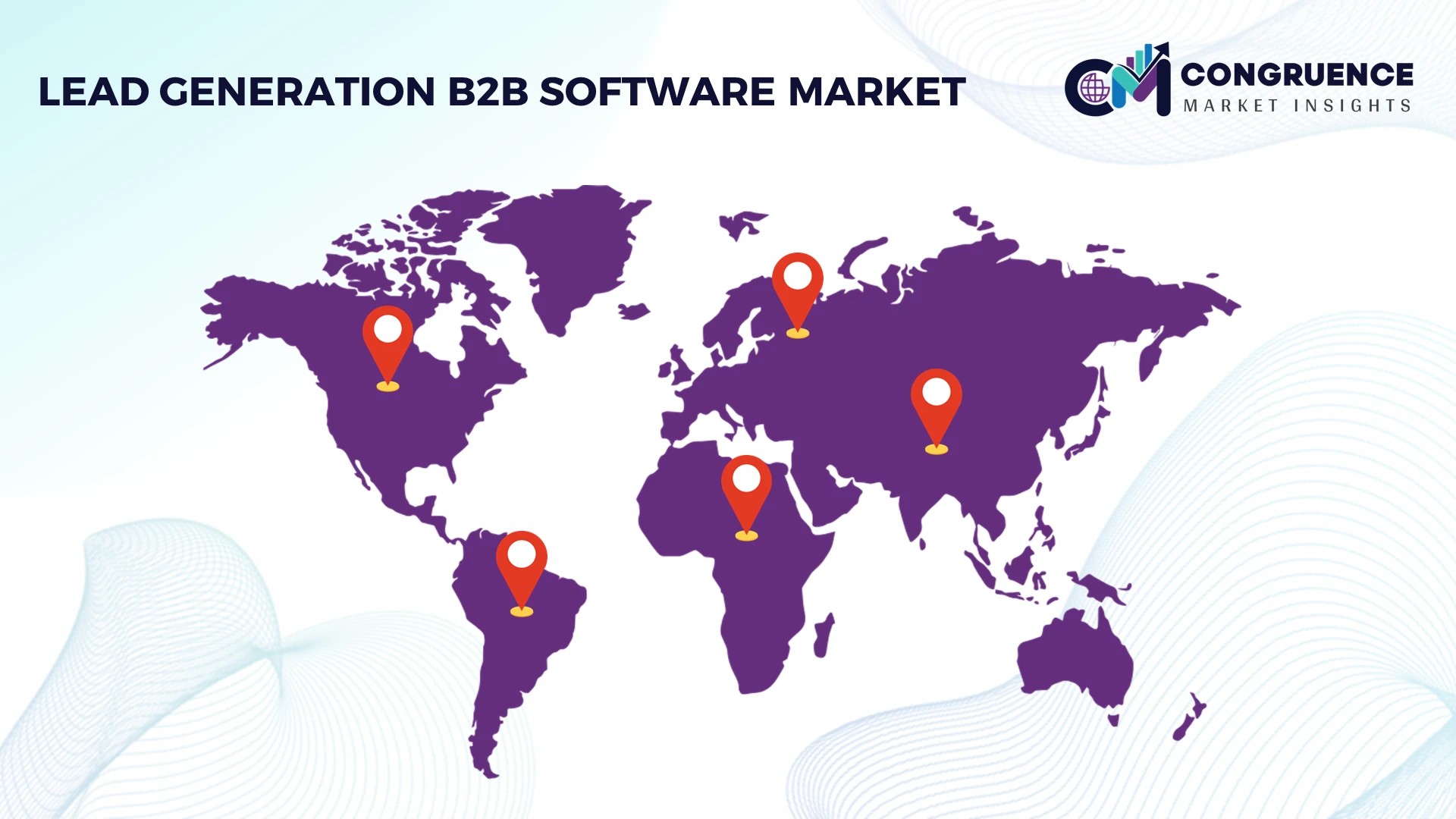
North America accounted for the largest market share at approximately 41% in 2025 however, Asia-Pacific is expected to register the fastest growth, expanding at a CAGR of approximately 10.2% between 2026 and 2033.
AI-Native Revenue Operations Reshape Enterprise Deployment
North America holds approximately 41% of global deployment value, anchored by extensive CRM penetration, mature SaaS procurement, and concentrated adoption among technology, financial services, professional services, and business-service enterprises. U.S. sales organizations are rapidly integrating generative AI with prospect intelligence, sequencing, enrichment, and CRM workflows, reducing dependence on standalone contact databases. Approximately 71.6% CRM adoption across North American organizations provides an established infrastructure layer for deploying advanced lead-generation applications. Enterprises are increasingly consolidating sales technology as duplicated data subscriptions and disconnected workflow tools raise operating complexity. Canadian companies are also adopting AI-assisted sales processes, particularly across technology and professional services. Privacy changes across U.S. states are simultaneously pushing vendors toward permission controls, first-party signals, auditable enrichment, and configurable data-retention architecture, making governance a product-selection factor alongside prospect coverage.
United States Market Outlook: The United States remains the region’s principal technology and enterprise deployment center, supported by the headquarters presence of Salesforce, HubSpot, ZoomInfo, LinkedIn, Apollo.io, and Outreach. With approximately 87% of sales organizations using some form of AI, enterprise purchasing is moving toward platforms combining autonomous research, scoring, enrichment, engagement, and CRM orchestration rather than isolated lead-generation functionality.
Privacy-First Automation Redefines Sales Intelligence
Europe accounts for approximately 25% of the global market, with the UK, Germany, France, and the Netherlands representing important enterprise deployment centers. Adoption is shifting toward consent-aware enrichment, first-party account intelligence, CRM-integrated prospecting, and governed AI as organizations reconcile sales automation with GDPR requirements. The EU AI Act adds another operational layer, particularly around transparency, documentation, and governance of AI-enabled commercial workflows. Approximately 62% CRM penetration indicates a substantial installed foundation while leaving further digitization capacity among mid-market organizations. UK SaaS and professional-services businesses remain comparatively aggressive adopters, whereas German enterprises emphasize data sovereignty, integration reliability, and compliance. Vendors are responding with European data hosting, configurable retention controls, localized datasets, and stronger governance capabilities. This regulatory structure creates an unusual competitive advantage for platforms capable of proving data provenance rather than simply maximizing database scale.
United Kingdom Market Outlook: The UK combines a large professional-services economy, mature SaaS ecosystem, strong fintech activity, and extensive English-language B2B commerce, making it Europe’s strategically important deployment market. Around 68% of UK organizations reported using at least one AI technology in 2025, strengthening demand for AI-assisted account research, personalization, qualification, and revenue intelligence while increasing requirements for transparent data processing.
Rapid AI Adoption Expands Digital Prospecting
Asia-Pacific represents approximately 22% of global market activity, with India, Australia, Singapore, Japan, and technologically advanced Southeast Asian economies driving deployment. The region combines expanding SaaS ecosystems with large digitally enabled sales workforces, creating favorable conditions for cloud-based prospecting, enrichment, and automated qualification. CRM adoption is estimated near 67.9%, while India stands out for particularly aggressive AI integration: 91% of surveyed sales professionals consider AI agents mission-critical to business success. Multinational software providers are expanding localized datasets, language capabilities, CRM integrations, and partner ecosystems to serve heterogeneous markets. Australia and Singapore provide mature cloud environments, while Japan requires deeper localization and workflow integration. The operational shift is toward mobile-accessible, AI-assisted platforms capable of supporting high-volume cross-border prospecting without equivalent increases in SDR staffing, strengthening the economics of regional expansion.
India Market Outlook: India combines a large technology-services workforce, expanding domestic SaaS ecosystem, and extensive outbound selling operations serving North America and Europe. Approximately 54% of surveyed Indian sales professionals already use AI for prospecting and another 41% plan to do so. This creates an unusually large deployment environment for automated research, multilingual engagement, lead scoring, and AI-agent-based qualification.
Cloud Sales Platforms Broaden Enterprise Access
South America accounts for approximately 7% of global market activity, with Brazil serving as the primary deployment center and Argentina, Chile, and Colombia supporting incremental demand. Cloud-based CRM adoption is lowering infrastructure barriers for mid-sized enterprises that previously relied on spreadsheets, basic contact lists, and fragmented outreach applications. Brazil’s large financial-services, technology, professional-services, and e-commerce ecosystems provide the strongest addressable enterprise base. WhatsApp-centric commercial communication also creates distinct integration requirements compared with email-heavy U.S. sales workflows, encouraging vendors to support conversational prospecting and omnichannel engagement. Local currency volatility and constrained technology budgets remain operational limitations, increasing preference for modular SaaS pricing and rapid implementation. Global providers are consequently expanding Portuguese and Spanish localization, channel partnerships, regional data coverage, and lower-friction deployment models rather than relying exclusively on enterprise-wide contracts.
Brazil Market Outlook: Brazil offers the strongest scale advantage in South America, supported by more than 20 million active companies and a large digital-services ecosystem. Its established fintech, SaaS, telecommunications, and professional-services sectors create concentrated demand for prospect identification and qualification. Vendors increasingly differentiate through Portuguese-language AI, WhatsApp integration, localized contact intelligence, and flexible subscription structures tailored to mid-market buyers.
Digital Transformation Accelerates Commercial Automation
Middle East & Africa represents approximately 5% of global market activity, led by the UAE, Saudi Arabia, Israel, and South Africa. Government-backed digital transformation, cloud infrastructure investment, expanding technology ecosystems, and enterprise modernization are creating stronger foundations for CRM-integrated prospecting. Saudi Arabia’s Vision 2030 programs and the UAE’s digital-economy strategy are encouraging enterprises to modernize customer acquisition across technology, financial services, real estate, logistics, and professional services. Microsoft, Oracle, Salesforce, and major hyperscalers have expanded cloud and enterprise technology infrastructure across Gulf markets, reducing deployment friction for integrated sales applications. African adoption remains more uneven because of smaller enterprise technology budgets and fragmented business datasets. Vendors are responding through cloud-first deployments, local implementation partnerships, Arabic-language capabilities, and sector-focused integrations, with data availability becoming a more significant competitive constraint than basic software access.
United Arab Emirates Market Outlook: The UAE provides a concentrated enterprise environment supported by high cloud penetration, multinational headquarters, free-zone business clusters, and rapid AI adoption. More than 90% of government services are available digitally, creating a broader technology-ready operating environment. Dubai and Abu Dhabi are particularly attractive for platforms targeting financial services, technology, logistics, consulting, and cross-border B2B sales teams.
Salesforce, HubSpot, ZoomInfo, LinkedIn, Apollo.io, and Outreach compete across overlapping CRM, sales intelligence, contact data, and engagement workflows, with platform leaders challenging specialized prospecting vendors through integrated AI. The top five players collectively account for an estimated 35–40% share, reflecting a fragmented structure despite enterprise-scale incumbents. Technology now outweighs database size alone: AI-enabled workflows can reduce prospect research time by 34%, while integrated automation releases roughly 10% of seller capacity. Premium vendors compete through data accuracy, intent signals, workflow depth, and enterprise governance; challengers emphasize rapid deployment, flexible pricing, and unified prospecting. Salesforce and HubSpot are expanding native AI, while ZoomInfo, Apollo.io, and Outreach deepen intelligence and automation capabilities. Consolidation around CRM-connected ecosystems is pressuring standalone databases. Data provenance, privacy compliance, integration complexity, and continuously refreshed contact intelligence remain major entry barriers. Winning requires verified proprietary data, embedded AI, workflow interoperability, and measurable seller-productivity gains at enterprise scale.
Salesforce
HubSpot
ZoomInfo
Apollo.io
Outreach
Cognism
LeadIQ
Lusha
Demandbase
6sense
RocketReach
Leadfeeder
Seamless.AI
AI agents are becoming the core technology layer in B2B lead generation, moving platforms from recommendation engines toward autonomous research, qualification, enrichment, and outreach. Current deployments show 54% of sellers using agents, while AI-assisted prospecting can reduce research time by 34%. Generative personalization and predictive scoring compress preparation cycles, giving data-rich platforms an advantage over standalone contact databases.
Integration is shifting toward unified CRM, intent-data, conversation-intelligence, and third-party enrichment architectures. Compared with legacy sequence-based prospecting, HubSpot customer deployments show AI prospecting increasing meeting-booking rates from 22% to 40%, an 82% relative improvement. Connected agents also surface complete buying committees and synchronize signals without application switching. Enterprises benefit most because automation scales account coverage without proportional SDR headcount, while smaller firms gain targeting with lower operating complexity.
Between 2026 and 2028, agentic orchestration, multimodal buyer intelligence, AI-search signals, and Model Context Protocol connectivity will become disruptive layers. Agentic enterprise software adoption is expected to accelerate sharply, while autonomous workflows coordinate research, messaging, CRM updates, and next-best actions. Vendors combining proprietary data with governed AI will outperform point solutions. Companies should act now because data quality, integrations, permissions, and workflow redesign require implementation time before autonomous prospecting can operate reliably at scale.
September 2025 — HubSpot launched more than 200 product updates, including new Breeze Agents and an always-on Prospecting Agent for researching accounts, monitoring buying signals, and personalizing outreach. The expansion accelerates enterprise migration from manual prospecting toward integrated agentic workflows. Source: HubSpot.
March 2025 — Outreach made its AI Prospecting Agent available to customers, automating account research and personalized outreach. Early users recorded up to a 10× productivity increase, demonstrating how autonomous prospecting can materially expand seller capacity without equivalent headcount growth.
May 2025 — Apollo.io reported 500% year-over-year growth for its AI platform and more than 50,000 weekly active AI users. The company also planned 300 additional hires, signaling aggressive investment in engineering and go-to-market capacity as AI-led sales intelligence adoption scales. Source: Apollo.
June 2026 — Outreach launched a revenue-orchestration app in ChatGPT and an MCP Server for Codex, connecting pipeline context with generative-AI workflows. The architecture extends agentic selling beyond standalone applications, allowing sales, RevOps, and customer-success teams to execute through 2 OpenAI environments.
The Lead Generation B2B Software Market report evaluates the competitive and technology landscape across Lead Databases, Lead Intelligence, Prospecting Tools, Lead Scoring, and Lead Enrichment. Application coverage includes Prospect Identification, Contact Discovery, Lead Qualification, Account-Based Marketing, and Sales Prospecting, while end-user analysis examines IT & Software, Financial Services, Healthcare, Manufacturing, and Professional Services. North America currently represents approximately 41% of market activity, providing a benchmark for regional deployment intensity.
The report further assesses Europe, Asia-Pacific, South America, and Middle East & Africa, including country-level adoption patterns and emerging enterprise opportunities. Technology coverage addresses AI agents, predictive scoring, generative personalization, intent intelligence, automated enrichment, CRM integration, and agentic orchestration. Competitive analysis tracks major platform providers and evolving ecosystem partnerships. The 2026–2033 outlook supports investment planning, geographic expansion, product positioning, partnership decisions, and identification of high-potential deployment areas as autonomous prospecting reshapes enterprise revenue operations.
| Report Attribute/Metric | Report Details |
|---|---|
Market Revenue in 2025 | USD 6980 Million |
Market Revenue in 2033 | USD 13209.39 Million |
CAGR (2026 - 2033) | 8.3% |
Base Year | 2025 |
Forecast Period | 2026 - 2033 |
Historic Period | 2021 - 2025 |
Segments Covered | By Type
By Application
By End-User
|
Key Report Deliverable | Revenue Forecast, Growth Trends, Market Dynamics, Segmental Overview, Regional and Country-wise Analysis, Competition Landscape |
Region Covered | North America, Europe, Asia-Pacific, South America, Middle East, Africa |
Key Players Analyzed | Salesforce, HubSpot, ZoomInfo, LinkedIn, Apollo.io, Outreach, Cognism, LeadIQ, Lusha, Demandbase, 6sense, RocketReach, Leadfeeder, Seamless.AI |
Customization & Pricing | Available on Request (10% Customization is Free) |




