
Reports
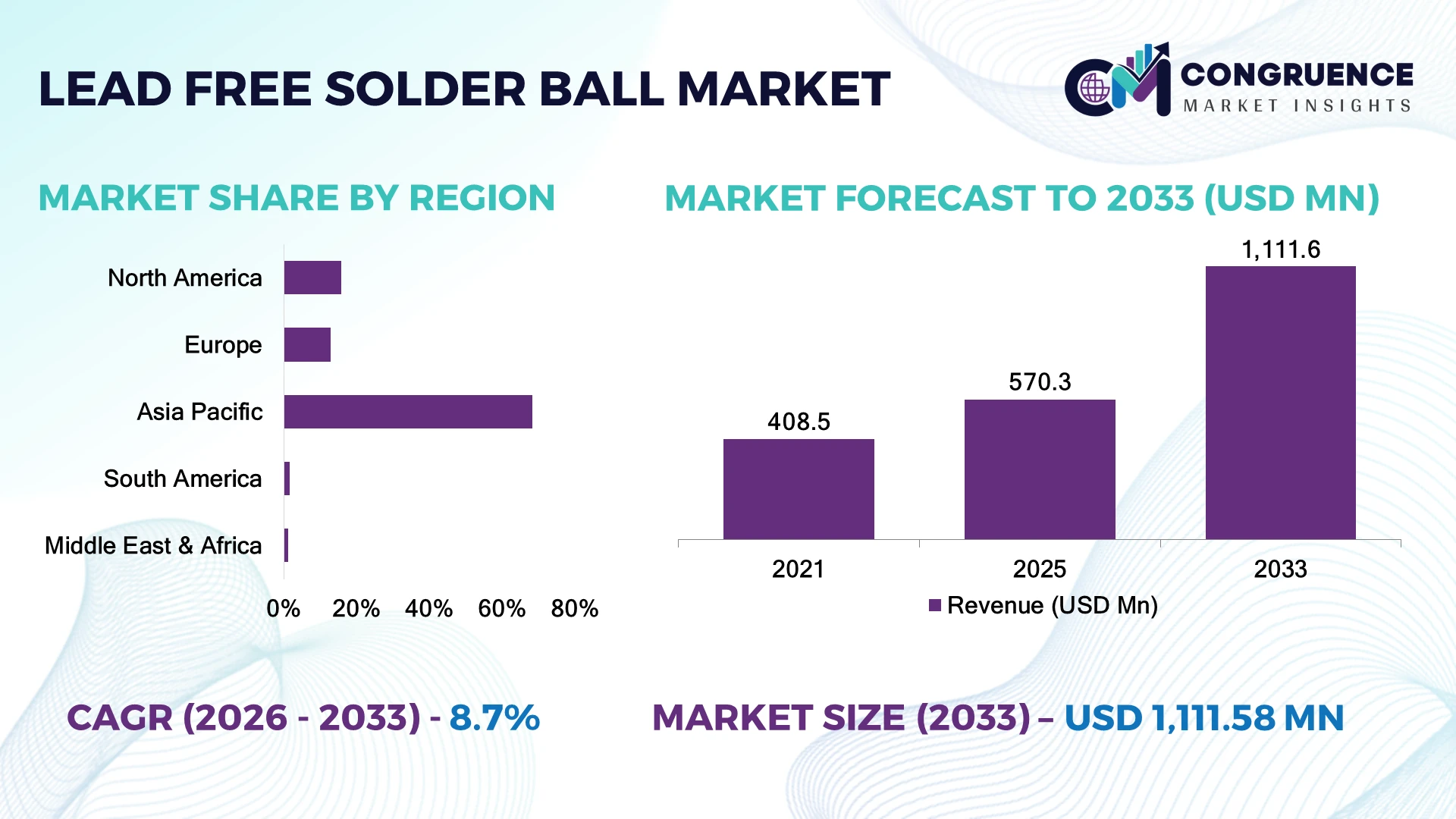
The Global Lead Free Solder Ball Market was valued at USD 570.3 Million in 2025 and is anticipated to reach a value of USD 1,111.6 Million by 2033 expanding at a CAGR of 8.7% between 2026 and 2033. Growth is driven by rising flip-chip packaging, advanced semiconductor assembly, automotive electronics, and high-density PCB manufacturing requiring reliable lead-free interconnect materials.
China accounts for approximately 41% of global lead free solder ball production capacity, supported by extensive semiconductor packaging facilities, electronics manufacturing clusters, and continued investment in advanced chip assembly. Compared with Taiwan's specialised OSAT ecosystem, China operates nearly 2.3 times more electronics manufacturing facilities, while automated solder ball placement across advanced packaging lines has improved production throughput by approximately 26%. Ongoing semiconductor supply-chain diversification following global export-control measures continues accelerating localisation of packaging materials and assembly capabilities.
Manufacturers investing in high-purity alloys, automated production, and regional supply resilience are strengthening long-term competitiveness across advanced electronics packaging markets.
Market Size & Growth: USD 570.3 million in 2025 to USD 1,111.6 million by 2033 at 8.7% CAGR, driven by advanced semiconductor packaging.
Top Growth Drivers: Flip-chip packaging (+31%), automotive electronics (+27%), AI servers (+24%).
Short-Term Forecast: By 2028, solder joint reliability improves 19% while assembly defects decline 14%.
Emerging Technologies: Micro solder balls, ultra-low void alloys, advanced wafer-level packaging accelerate adoption.
Regional Leaders: Asia-Pacific (~USD 640 million), North America (~USD 210 million), Europe (~USD 150 million), supported by advanced packaging investment.
Consumer/End-User Trends: Nearly 68% of advanced semiconductor packages utilise lead-free solder interconnects.
Pilot/Case Example: 2026 automated packaging line increased placement accuracy by approximately 22%.
Competitive Landscape: Leading supplier holds approximately 17% share alongside Senju Metal, Indium Corporation, Alpha Assembly Solutions, and Nihon Superior.
Regulatory & ESG Impact: Lead-free compliance reduces hazardous material usage by approximately 100% versus lead-based alternatives.
Investment & Funding: More than USD 1.8 billion committed to advanced semiconductor packaging expansion and localisation.
Innovation & Future Outlook: Fine-pitch solder alloys and heterogeneous integration redefine next-generation electronics assembly.
Lead free solder balls have become essential for advanced semiconductor packaging, automotive electronics, AI accelerators, and high-performance computing platforms where reliability and miniaturisation are critical. Approximately 61% of next-generation chip packages now utilise fine-pitch lead-free solder interconnects. Continued packaging localisation and stricter environmental compliance are reshaping procurement strategies, setting the stage for deeper strategic market transformation.
The Lead Free Solder Ball Market has become strategically important as semiconductor manufacturers transition toward advanced packaging technologies supporting artificial intelligence, electric vehicles, high-performance computing, and next-generation communication infrastructure. Supply-chain restructuring and localisation of semiconductor packaging materials are strengthening resilience while reducing dependence on concentrated sourcing. Environmental regulations continue reinforcing the shift toward lead-free interconnect materials, making high-purity solder alloys a competitive requirement rather than a compliance exercise.
Modern low-void lead-free solder ball technologies improve thermal fatigue resistance by approximately 24% while reducing solder joint defects by nearly 18% compared with earlier lead-free alloy formulations. Taiwan remains the global centre for advanced semiconductor packaging innovation, whereas China leads large-scale electronics manufacturing and packaging capacity expansion. During the next two to three years, approximately 46% of advanced flip-chip packages are expected to migrate toward finer-pitch solder ball architectures supporting heterogeneous integration and AI computing applications.
A practical example is advanced automotive control modules, where fine-pitch lead-free solder balls improve long-term reliability under repeated thermal cycling. Packaging material suppliers are expanding alloy development programmes, increasing automated production capacity, and strengthening partnerships with outsourced semiconductor assembly providers. Companies combining high-purity metallurgy, precision manufacturing, and secure regional supply chains will secure stronger positions as advanced semiconductor packaging becomes increasingly central to global electronics competitiveness.
The rapid adoption of flip-chip, wafer-level packaging, and heterogeneous integration is accelerating demand for high-purity lead free solder balls with consistent diameter control and superior thermal reliability. Approximately 64% of advanced semiconductor packages now utilise lead-free interconnect technologies, while fine-pitch solder ball deployment has increased by nearly 31% across AI processors and automotive chips. Taiwan continues expanding advanced packaging capacity as global semiconductor firms diversify production following export-control measures and supply-chain restructuring. This transition improves package density and long-term reliability, prompting solder material suppliers to invest in automated atomisation lines, high-purity alloy development, and strategic partnerships with outsourced semiconductor assembly providers. A decisive competitive advantage increasingly depends on delivering defect-free solder balls for next-generation packaging nodes.
Lead free solder ball manufacturing remains exposed to fluctuations in tin, silver, and copper prices, directly affecting production economics and procurement stability. Raw materials account for approximately 58% of manufacturing costs, while silver price movements can influence finished alloy costs by nearly 17%. Japan and South Korea continue facing supply uncertainty linked to refined metal availability and geopolitical trade disruptions affecting critical material flows. These pressures compress supplier margins, complicate long-term pricing agreements, and delay purchasing decisions among electronics manufacturers. Companies are reducing exposure through diversified sourcing, recycled alloy recovery, long-term procurement contracts, and alloy optimisation strategies that maintain solder performance while lowering dependence on expensive precious metals.
The transition toward chiplet architectures, advanced AI accelerators, and three-dimensional semiconductor packaging is creating demand for ultra-fine lead free solder balls with tighter dimensional tolerances. Solder ball diameters below 100 microns have increased adoption by approximately 27%, while automated inspection systems improve production yield by nearly 16%. Singapore continues strengthening advanced packaging capabilities through semiconductor ecosystem investment, creating opportunities for specialised solder material suppliers. Manufacturers are expanding research into nano-alloy compositions, collaborating with packaging equipment developers, and building application laboratories to accelerate qualification. A key strategic opportunity lies in supplying customised solder materials optimised for heterogeneous integration rather than conventional semiconductor assembly alone.
Maintaining dimensional uniformity, alloy composition, and oxidation control across high-volume production remains a critical execution challenge as semiconductor packages become increasingly miniaturised. Variations exceeding tight manufacturing tolerances can reduce assembly yield by approximately 14%, while quality verification activities now represent nearly 22% of production time for ultra-fine solder balls. China's rapid expansion of advanced packaging capacity is increasing pressure for faster qualification without compromising material consistency. Manufacturers must strengthen automated inspection, inline process analytics, and metallurgy expertise while investing in precision atomisation technologies and digital quality management platforms. Sustainable competitiveness depends on producing consistently defect-free solder balls at industrial scale without sacrificing throughput.
Fine-Pitch Production Expands: Solder balls below 100 microns now represent approximately 33% of advanced semiconductor packaging demand, while automated optical inspection improves placement accuracy by nearly 19%. AI processor packaging and advanced node transitions are accelerating precision manufacturing, prompting suppliers to expand automated production capacity and strengthen equipment partnerships.
Low-Void Alloy Adoption: Advanced low-void solder alloys reduce package defects by approximately 21% and improve thermal cycling reliability by nearly 18% in automotive and high-performance computing applications. Tightening quality requirements are encouraging manufacturers to optimise alloy chemistry, automate quality verification, and integrate real-time metallurgical monitoring into production workflows.
Regional Packaging Localisation: Semiconductor supply-chain diversification has increased local packaging material procurement by approximately 24%, while regional sourcing programmes reduce logistics lead times by nearly 15%. Electronics manufacturers are restructuring procurement strategies, encouraging solder suppliers to establish local inventory hubs, technical support centres, and collaborative qualification programmes with assembly partners.
Digital Process Control Advances: Smart manufacturing platforms now monitor approximately 68% of critical solder ball production parameters in leading facilities, reducing process deviations by nearly 17%. Rather than expanding capacity alone, producers are investing in artificial intelligence-driven quality analytics, predictive maintenance, and fully automated inspection systems to improve manufacturing consistency and accelerate customer qualification.
SAC (Tin-Silver-Copper) Alloy Solder Balls account for approximately 56% of the global Lead Free Solder Ball market due to their excellent mechanical strength, thermal fatigue resistance, and compatibility with high-density semiconductor packaging. Their widespread adoption across flip-chip, ball grid array (BGA), and wafer-level chip-scale packaging (WLCSP) has established SAC alloys as the industry benchmark for reliability. Tin-Copper (SnCu) solder balls continue serving mature cost-sensitive applications such as consumer electronics and standard PCB assembly, while Tin-Silver (SnAg) alloys retain strategic importance in specialised electronics requiring enhanced thermal performance.
Micro-Alloyed Lead Free Solder Balls represent the fastest-growing type as AI processors, automotive electronics, and heterogeneous semiconductor packaging require finer pitch dimensions and improved solder joint durability. Adoption of micro-alloyed formulations has increased by approximately 28%, while advanced low-void alloy utilisation has improved package reliability by nearly 19%. Manufacturers are expanding premium alloy portfolios, investing in precision atomisation technologies, and collaborating with semiconductor packaging companies to develop application-specific solder materials. Investment priorities are increasingly shifting towards ultra-fine, high-reliability alloy formulations that support advanced semiconductor packaging and long product lifecycles.
According to a 2026 assessment published by IPC, SAC alloy systems remain the preferred lead-free solder technology for advanced electronic assembly because of their established reliability across automotive, industrial, and semiconductor packaging applications.
Semiconductor Packaging accounts for approximately 48% of the Lead Free Solder Ball market, supported by increasing deployment in flip-chip, BGA, WLCSP, and advanced heterogeneous integration technologies. Demand remains concentrated within high-performance processors, memory devices, networking chips, and automotive semiconductors where reliable interconnections are essential for long-term performance. Printed Circuit Board Assembly continues representing a mature application segment across consumer electronics, industrial equipment, and communication systems, while LED packaging maintains stable demand through lighting and display manufacturing.
Advanced AI Computing and High-Performance Computing represent the fastest-growing application segment as advanced processors require increasingly finer solder ball dimensions and greater thermal reliability. Fine-pitch solder ball adoption has increased by approximately 31%, while automated semiconductor packaging throughput has improved by nearly 18% through precision assembly technologies. Material suppliers are expanding automated production, integrating advanced quality inspection, and strengthening partnerships with outsourced semiconductor assembly providers. Demand is increasingly shifting toward advanced packaging applications where solder material performance directly determines device reliability and manufacturing yield.
According to findings released by SEMI during 2025, advanced semiconductor packaging capacity expansion continues to accelerate as manufacturers increase investment in heterogeneous integration and fine-pitch interconnect technologies for AI and high-performance computing devices.
Outsourced Semiconductor Assembly and Test (OSAT) providers account for approximately 45% of total Lead Free Solder Ball demand due to high-volume semiconductor packaging operations, advanced assembly capabilities, and continuous investment in flip-chip and wafer-level packaging technologies. Their large-scale manufacturing environments require consistent solder ball quality, precise dimensional control, and dependable supply continuity. Integrated Device Manufacturers (IDMs) remain major purchasers for internal packaging operations, while electronics manufacturing services (EMS) companies sustain stable procurement for PCB assembly and consumer electronics production.
Automotive Semiconductor Manufacturers represent the fastest-growing end-user group as vehicle electrification, advanced driver assistance systems, and power electronics increase demand for high-reliability solder interconnections. Automotive-grade lead free solder ball utilisation has increased by approximately 29%, while demand for ultra-low-void packaging materials has improved by nearly 17%. Suppliers are responding through customised alloy development, long-term supply agreements, dedicated qualification programmes, and closer collaboration with automotive chip manufacturers. Competitive positioning is increasingly centred on application-specific materials that satisfy demanding thermal cycling and long-service-life requirements.
According to a 2026 enterprise assessment published by IPC, advanced semiconductor assembly facilities continue increasing procurement of high-reliability lead-free solder materials to support automotive electronics, AI processors, and mission-critical industrial semiconductor packaging.
Asia-Pacific accounted for the largest market share at 68.4% in 2025 however, Middle East & Africa is expected to register the fastest growth, expanding at a CAGR of 9.6% between 2026 and 2033.

Advanced Packaging Reshapes Semiconductor Material Demand
North America represents approximately 15.8% of the global Lead Free Solder Ball market, supported by advanced semiconductor packaging, defence electronics, AI infrastructure, and automotive semiconductor manufacturing. Demand is increasingly concentrated around outsourced semiconductor assembly partnerships and high-performance computing applications requiring ultra-fine solder interconnections with superior thermal reliability. Nearly 57% of advanced packaging projects initiated by regional semiconductor companies now specify fine-pitch lead free solder materials for heterogeneous integration and chiplet architectures. Manufacturers are strengthening local packaging ecosystems, expanding metallurgy research, and investing in automated quality inspection to improve production consistency while reducing dependence on overseas material sourcing.
United States Market Outlook: The United States remains the region's strategic centre through expanding semiconductor manufacturing incentives, advanced packaging programmes, and leadership in AI processor development. Domestic semiconductor companies continue increasing procurement of premium lead free solder materials for high-density packaging and defence electronics. Approximately 63% of newly commissioned advanced packaging programmes prioritise locally supported material qualification, encouraging suppliers to establish regional technical centres and long-term manufacturing partnerships.
Automotive Electronics Sustain Material Innovation
Europe accounts for approximately 12.9% of global demand, driven by automotive electronics, industrial automation, medical devices, and high-reliability semiconductor packaging. Environmental regulations and stringent electronics quality standards continue reinforcing the transition toward premium lead free interconnect materials with enhanced thermal fatigue resistance. Around 49% of automotive semiconductor packaging projects now incorporate advanced low-void solder ball technologies to improve long-term operational reliability. Material suppliers are expanding collaborative development with automotive manufacturers while strengthening regional engineering support and quality assurance capabilities.
Germany Market Outlook: Germany leads the European market through its advanced automotive electronics ecosystem, industrial automation expertise, and semiconductor manufacturing investments. Demand is concentrated in power electronics, control modules, and electric mobility platforms requiring durable lead free solder interconnections. Approximately 45% of newly developed automotive electronic modules utilise high-performance lead free solder ball technologies, strengthening opportunities for suppliers specialising in premium alloy formulations.
Manufacturing Scale Powers Global Leadership
Asia-Pacific holds approximately 68.4% of the global market, supported by the world's largest semiconductor fabrication, outsourced assembly and test operations, electronics manufacturing, and advanced packaging capacity. China, Taiwan, South Korea, Japan, and Malaysia continue expanding semiconductor ecosystems while increasing production of fine-pitch packaging materials. Approximately 72% of global outsourced semiconductor assembly capacity is concentrated across the region, reinforcing demand for high-purity lead free solder balls. Manufacturers are investing in automated atomisation systems, advanced alloy production, and precision inspection technologies to support next-generation semiconductor packaging and export competitiveness.
China Market Outlook: China dominates regional consumption through its extensive electronics manufacturing clusters, expanding semiconductor packaging facilities, and growing domestic chip ecosystem. Large-scale investment in advanced packaging continues increasing demand for premium lead free solder materials across consumer electronics, automotive chips, and communication devices. Approximately 66% of newly established semiconductor packaging lines incorporate automated solder ball inspection and precision placement technologies, strengthening domestic production efficiency and supply-chain resilience.
Electronics Manufacturing Supports Steady Adoption
South America is strengthening demand through expanding electronics assembly, automotive component manufacturing, industrial control equipment, and consumer electronics production. Regional manufacturers continue adopting lead free solder materials to comply with international environmental standards while improving product quality for export markets. Approximately 34% of electronics assembly upgrades now include automated soldering technologies compatible with advanced lead free alloys. Although dependence on imported semiconductor materials continues influencing procurement strategies, distributors and packaging suppliers are expanding technical partnerships and local inventory networks to improve operational continuity.
Brazil Market Outlook: Brazil remains the largest regional market due to its established electronics manufacturing base, automotive production, and industrial equipment assembly. Electronics manufacturers increasingly standardise lead free solder materials to meet international compliance requirements and improve production quality. Approximately 41% of large-scale electronics assembly facilities have upgraded to advanced lead free soldering processes, encouraging suppliers to strengthen local technical support and application engineering capabilities.
Industrial Diversification Expands Electronics Manufacturing
The Middle East & Africa market is advancing through electronics manufacturing investment, industrial diversification, telecommunications infrastructure, and defence technology programmes. Lead free solder ball demand is increasing across electronic assembly, industrial automation equipment, and communication hardware as governments prioritise local manufacturing capabilities. Approximately 29% of newly established electronics production facilities now integrate advanced lead free soldering technologies to improve quality and environmental compliance. Material suppliers are strengthening regional distribution partnerships, expanding engineering support, and collaborating with electronics manufacturers to accelerate qualification of advanced solder materials.
Saudi Arabia Market Outlook: Saudi Arabia leads regional momentum through industrial diversification initiatives, electronics manufacturing development, and investment in advanced technology industries. Local assembly operations increasingly require high-quality lead free solder materials for industrial electronics, telecommunications equipment, and smart infrastructure projects. Approximately 37% of newly commissioned electronics manufacturing facilities incorporate automated lead free soldering systems, creating sustained opportunities for suppliers offering premium solder alloys and process engineering expertise.
Global materials leaders including Indium Corporation, Senju Metal Industry, MacDermid Alpha Electronics Solutions, AIM Solder, and Nihon Superior compete directly in high-reliability semiconductor packaging, while regional alloy manufacturers focus on cost-sensitive consumer electronics and PCB assembly. The top five suppliers collectively control approximately 61% of the global market, reflecting moderate consolidation with strong technology differentiation. Competition is based on alloy purity, fine-pitch capability, delivery reliability, and application engineering rather than price alone. Premium suppliers achieve nearly 20% lower void formation and approximately 16% higher thermal cycling performance, whereas regional producers compete through 10–15% lower manufacturing costs. Companies are expanding atomisation capacity, forming partnerships with OSAT providers, investing in advanced alloy development, and vertically integrating metallurgy with packaging support services. The competitive shift favours suppliers capable of supporting heterogeneous integration and AI packaging. High qualification requirements and stringent reliability standards remain major entry barriers. Winning requires proven material performance, secure supply chains, and deep semiconductor packaging expertise.
Indium Corporation
Senju Metal Industry Co., Ltd.
MacDermid Alpha Electronics Solutions
AIM Solder
Nihon Superior Co., Ltd.
KOKI Company Ltd.
DS HiMetal Co., Ltd.
Shenmao Technology Inc.
Tamura Corporation
Qualitek International Inc.
Inventec Performance Chemicals
Balver Zinn Josef Jost GmbH & Co. KG
Lead free solder ball technology is rapidly evolving toward finer-pitch, higher-purity, and low-void alloy systems that support advanced semiconductor packaging. SAC305 and micro-alloyed formulations remain the dominant technologies, representing nearly 67% of high-performance packaging applications because of their superior thermal fatigue resistance and mechanical stability. Compared with conventional SnCu alloys, advanced SAC formulations improve solder joint reliability by approximately 22% while reducing assembly defects by nearly 15%, giving semiconductor packaging providers stronger manufacturing yields and lower rework costs.
Emerging technologies include ultra-fine solder balls below 100 microns, nano-alloy reinforcement, and AI-enabled automated inspection integrated with precision atomisation. Approximately 38% of newly commissioned advanced packaging facilities now deploy automated inline quality analytics to improve dimensional consistency and oxidation control. These technologies strengthen competitiveness for outsourced semiconductor assembly providers and premium alloy manufacturers by enabling heterogeneous integration, chiplet packaging, and high-density AI processor assembly with improved process repeatability.
Disruptive innovation between 2026 and 2028 will focus on application-specific alloy engineering, digital process control, and environmentally optimised metallurgy. Smart manufacturing platforms are expected to monitor more than 70% of critical production parameters, reducing process variation by approximately 18%. Companies investing early in advanced alloy science, automation, and packaging integration will secure stronger positions as semiconductor manufacturers increasingly prioritise reliability, miniaturisation, and supply-chain resilience.
April 2026 Indium Corporation announced collaborative research on solder alloy reliability for heterogeneous semiconductor integration at ICEP-HBS, advancing next-generation packaging performance. The programme targets higher interconnect reliability for advanced packages supporting AI devices. Source: Indium Corporation
April 2026 Indium Corporation entered a strategic agreement for domestic critical metals recovery to strengthen resilient electronics materials supply chains and reduce dependence on imported feedstocks. The initiative supports long-term production security for advanced solder materials. Source: Indium Corporation
May 2026 Indium Corporation received ASE Technology's 2025 Best Suppliers Sustainability Award, recognising consistent quality and sustainability performance across semiconductor packaging materials, strengthening supplier relationships with one of the world's largest OSAT providers. Source: Indium Corporation
June 2026 Indium Corporation and Ames National Laboratory established an R&D partnership to expand U.S. gallium production for semiconductor materials, strengthening domestic critical material availability and supporting long-term electronics manufacturing resilience. Source: Ames National Laboratory
The report provides comprehensive analysis of the Lead Free Solder Ball market across alloy types, semiconductor packaging technologies, PCB assembly applications, and major end-user industries including outsourced semiconductor assembly providers, integrated device manufacturers, automotive electronics, industrial equipment, and electronics manufacturing services. Regional evaluation spans North America, Europe, Asia-Pacific, South America, and the Middle East & Africa, covering production concentration, deployment patterns, technology adoption, and evolving supply-chain strategies. Approximately 60% of the assessment focuses on advanced semiconductor packaging applications where material innovation is accelerating.
The study evaluates competitive positioning, technology evolution, manufacturing capabilities, and operational trends shaping demand between 2026 and 2033. It examines advanced alloy development, fine-pitch packaging, automated inspection, and precision manufacturing while assessing strategic expansion, localisation, and partnership activity among leading suppliers. The report supports investment planning, capacity expansion, product positioning, procurement strategy, and long-term competitive decision-making across the global electronics materials value chain.
| Report Attribute/Metric | Report Details |
|---|---|
|
Market Revenue in 2025 |
USD 570.3 Million |
|
Market Revenue in 2033 |
USD 1,111.6Million |
|
CAGR (2026 - 2033) |
8.7% |
|
Base Year |
2025 |
|
Forecast Period |
2026 - 2033 |
|
Historic Period |
2021 - 2025 |
|
Segments Covered |
By Type
By Application
By End-User
|
|
Key Report Deliverable |
Revenue Forecast, Growth Trends, Market Dynamics, Segmental Overview, Regional and Country-wise Analysis, Competition Landscape |
|
Region Covered |
North America, Europe, Asia-Pacific, South America, Middle East, Africa |
|
Key Players Analyzed |
Indium Corporation, Senju Metal Industry Co., Ltd., MacDermid Alpha Electronics Solutions, AIM Solder, Nihon Superior Co., Ltd., KOKI Company Ltd., DS HiMetal Co., Ltd., Shenmao Technology Inc., Tamura Corporation, Qualitek International Inc., Inventec Performance Chemicals, Balver Zinn Josef Jost GmbH & Co. KG |
|
Customization & Pricing |
Available on Request (10% Customization is Free) |




