
Reports
The Global Lead-free Heat Sabilizer Market was valued at USD 3,610.3 Million in 2025 and is anticipated to reach a value of USD 5,415.9 Million by 2033 expanding at a CAGR of 5.2% between 2026 and 2033. Growth is being driven by stringent restrictions on lead-based PVC additives, accelerating adoption of calcium-zinc and organic stabilizers across construction materials, wire & cable, medical products, and sustainable packaging applications.
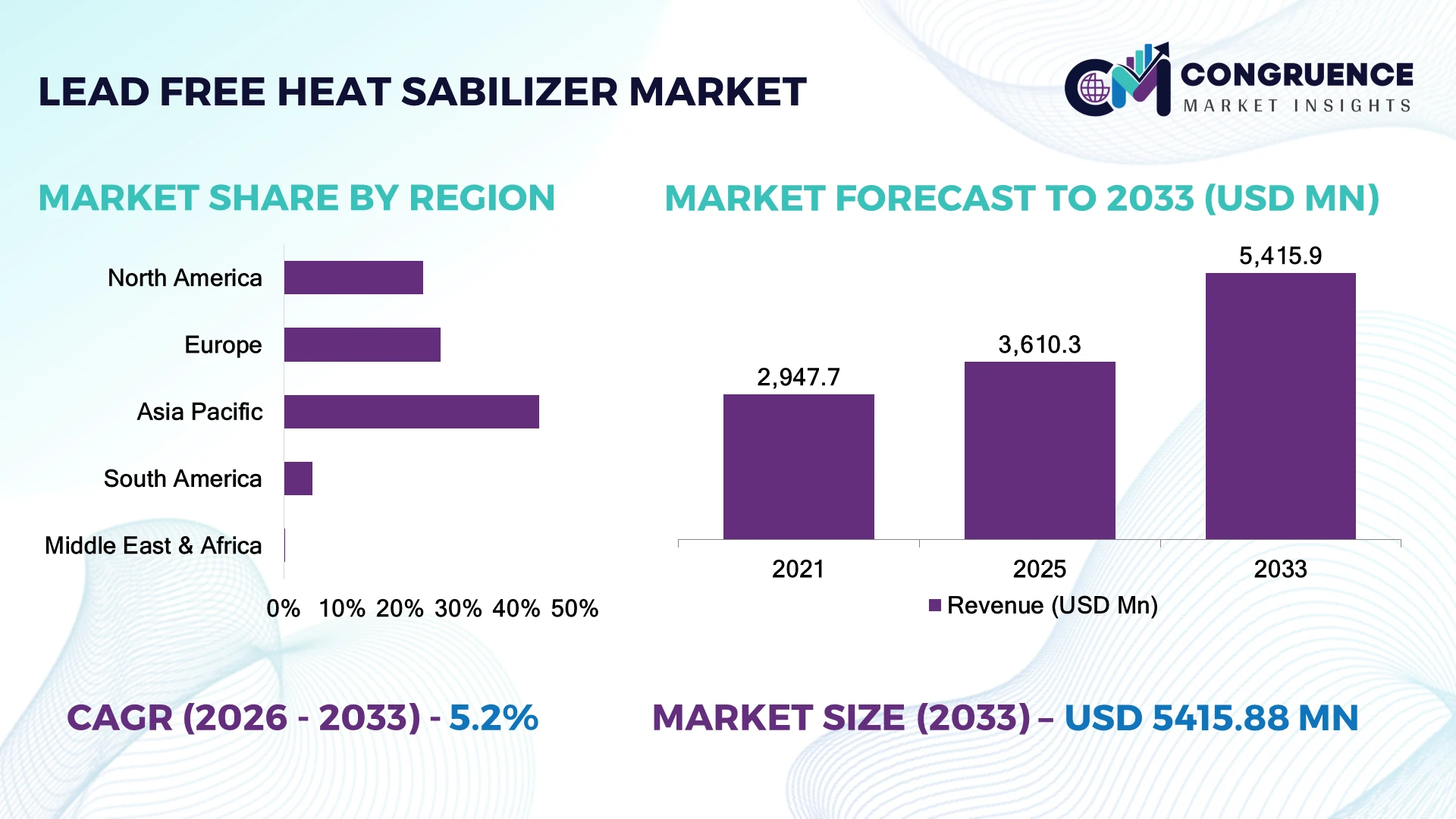
China accounts for approximately 38% of global lead-free heat stabilizer production capacity, supported by integrated PVC manufacturing, continuous investments in specialty chemical production, and advanced processing technologies, while Germany leads Europe through high-value specialty formulations for regulated industrial applications. Following supply-chain adjustments after the Red Sea shipping disruptions, automated production has improved manufacturing efficiency by nearly 15%, strengthening Asia's export competitiveness and Europe's technology-focused manufacturing.
Manufacturers strengthening regional production, compliance-ready formulations, and advanced stabilizer portfolios are positioned to secure sustainable competitive advantage over the coming decade.
Market Size & Growth: USD 3,610.3 Million in 2025, projected to reach USD 5,415.9 Million by 2033 at a CAGR of 5.2%, supported by the global transition toward lead-free PVC processing.
Top Growth Drivers: Environmental regulations (42%), construction-grade PVC demand (34%), and electrical infrastructure expansion (29%) continue accelerating market adoption.
Short-Term Forecast: By 2028, automated manufacturing is expected to reduce production costs by nearly 12% while improving formulation consistency.
Emerging Technologies: AI-driven formulation optimization, automated compounding, and advanced calcium-zinc stabilizer chemistry are improving productivity and product performance.
Regional Leaders: Asia-Pacific approaches USD 2.6 Billion, Europe exceeds USD 1.4 Billion, and North America reaches nearly USD 950 Million, each supported by localized manufacturing expansion.
Consumer/End-User Trends: More than 68% of newly specified rigid PVC applications now utilize lead-free stabilization technologies.
Pilot/Case Example: A 2026 automated PVC compounding project improved processing efficiency by 14% while reducing material waste by 11%.
Competitive Landscape: The leading manufacturer holds approximately 12% market share alongside Baerlocher, SONGWON, ADEKA, PMC Group, and Valtris Specialty Chemicals.
Regulatory & ESG Impact: Environmental compliance initiatives have reduced lead-based stabilizer usage by over 40% across several industrial PVC applications.
Investment & Funding: More than USD 520 Million has been committed to production expansion, strategic partnerships, and specialty additive manufacturing amid global supply-chain diversification.
Innovation & Future Outlook: Hybrid stabilizer technologies, digital quality monitoring, and circular PVC manufacturing are strengthening long-term product competitiveness.
Lead-free Heat Sabilizer Market demand continues strengthening across rigid PVC pipes, window profiles, medical products, wire insulation, and sustainable packaging. Advanced calcium-zinc and organic stabilizer technologies improve thermal stability while simplifying processing efficiency. More than 60% of newly commissioned PVC production lines now prioritize lead-free additive compatibility, supported by tightening environmental regulations and regional supply-chain localization, creating a stronger foundation for long-term industry transformation.
Lead-free heat stabilizers have become strategically important as manufacturers prioritize regulatory compliance, operational efficiency, and sustainable PVC production. Ongoing supply-chain restructuring is encouraging regional manufacturing expansion, reducing procurement risks and improving material availability across construction, automotive, healthcare, and electrical industries.
Modern calcium-zinc stabilizer systems deliver nearly 18% higher thermal stability during high-temperature PVC processing than conventional lead-based alternatives while lowering formulation complexity and reducing production waste. Asia-Pacific dominates high-volume manufacturing through integrated chemical supply chains, whereas Europe focuses on premium specialty formulations designed for regulated applications. Over the next two to three years, automated formulation control is expected to improve manufacturing efficiency by approximately 10%, enabling greater consistency across industrial production facilities.
PVC compounders are increasingly integrating automated dosing systems with digital process monitoring to reduce formulation variability and improve production quality. Companies are expanding regional manufacturing capacity, strengthening technical partnerships, and investing in next-generation stabilizer technologies to enhance supply security and product differentiation. These strategies are reinforcing competitive positioning by combining operational resilience, regulatory readiness, and sustainable material innovation.
Stringent environmental regulations are accelerating the replacement of lead-based stabilizers with calcium-zinc and organic alternatives across PVC manufacturing. More than 70% of newly approved rigid PVC formulations in developed industrial markets now specify lead-free stabilization, while automated compounding improves production efficiency by nearly 14% and reduces formulation variability by approximately 10%. China's expansion of specialty additive manufacturing and India's growing PVC processing capacity are reinforcing localized supply availability. This regulatory shift is driving higher-value product adoption across construction, wire & cable, and healthcare applications. In response, manufacturers are expanding production capacity, investing in advanced formulation technologies, and establishing technical partnerships with PVC compounders to strengthen product performance, regulatory compliance, and long-term customer retention.
Lead-free heat stabilizer production remains exposed to fluctuations in specialty chemical and metal derivative pricing, creating procurement uncertainty for manufacturers. Raw material costs have fluctuated by nearly 18% over the past two years, while logistics expenses remain approximately 12% above pre-disruption levels in several export corridors. China's continued dominance in specialty additive production increases dependency for downstream manufacturers despite ongoing supplier diversification. These cost pressures directly affect pricing stability, production planning, and contract profitability, particularly for small and mid-sized compounders. To reduce exposure, companies are diversifying supplier networks, increasing localized sourcing, negotiating long-term procurement agreements, and optimizing formulations to reduce dependence on high-cost additive components without compromising thermal performance.
Advanced formulation technologies are creating new opportunities by combining digital process optimization with recyclable PVC applications. AI-assisted formulation development has reduced laboratory development cycles by approximately 25%, while automated dosing systems improve additive utilization by nearly 15%. Germany and Japan are expanding investments in high-performance stabilizers compatible with recycled PVC, supporting circular manufacturing objectives and stricter environmental standards. Manufacturers are increasingly collaborating with equipment suppliers and polymer producers to develop customized stabilizer packages for high-recycled-content compounds. A less obvious opportunity lies in premium stabilizers engineered for medical devices and electrical infrastructure, where superior thermal stability and compliance create higher-value market positioning beyond conventional construction applications.
Maintaining consistent product quality across expanding production networks remains a significant operational challenge as stabilizer formulations become increasingly specialized. Production quality deviations can increase by nearly 8% without advanced process monitoring, while technical workforce shortages have extended commissioning timelines by approximately 15% at several specialty chemical facilities. India's rapidly expanding PVC processing industry and European manufacturers upgrading legacy production lines both require highly standardized formulation control and skilled technical support. Companies must invest in automated quality monitoring, digital manufacturing systems, workforce development, and collaborative research programs to maintain product consistency. Successfully scaling advanced formulations while preserving processing reliability will determine long-term competitiveness in premium lead-free stabilizer applications.
Advanced Calcium-Zinc Formulations Modern calcium-zinc stabilizer systems are replacing conventional additive packages across high-performance PVC applications, improving thermal stability by approximately 18% while reducing processing defects by nearly 11%. Following tighter environmental regulations in Europe and expanding compliance standards in China, manufacturers are accelerating specialty formulation development. Companies are expanding technical service capabilities and investing in application-specific product portfolios to improve processing consistency and strengthen differentiation in construction, healthcare, and electrical markets.
Digital Process Control Expansion Automated dosing systems and AI-assisted formulation optimization are transforming production workflows, reducing formulation variation by around 13% and improving batch consistency by nearly 16%. Specialty chemical manufacturers are integrating real-time process analytics with manufacturing execution systems to minimize waste and improve production reliability. Companies are restructuring production facilities with digital quality management platforms to increase operational efficiency while supporting higher-value customized stabilizer formulations.
Localized Supply Chain Strategies Ongoing logistics disruptions and geopolitical trade adjustments are encouraging regional manufacturing expansion and supplier diversification. Local sourcing initiatives have reduced procurement lead times by approximately 20%, while inventory optimization has lowered emergency purchasing requirements by nearly 14%. Indian and Southeast Asian compounders are increasingly establishing long-term partnerships with additive manufacturers, allowing companies to strengthen supply resilience, improve delivery performance, and reduce dependence on single-country sourcing models.
Recycled PVC Compatibility Focus Growing adoption of recycled PVC is increasing demand for stabilizer systems specifically designed to maintain thermal performance across multiple processing cycles. Advanced formulations improve recycled compound stability by nearly 17% while reducing material loss by approximately 10% during extrusion. Rather than competing solely on price, manufacturers are collaborating with recyclers, polymer producers, and processing equipment suppliers to develop integrated material solutions that improve circular manufacturing efficiency and create stronger long-term customer relationships.
Calcium-based stabilizers account for approximately 46% of the Lead-free Heat Sabilizer Market, supported by their superior balance of thermal stability, regulatory compliance, and cost efficiency across rigid PVC processing. Their compatibility with extrusion, injection molding, and high-volume manufacturing makes them the preferred choice for pipes, window profiles, cable compounds, and construction products. Organic stabilizers represent the fastest-growing segment as medical devices, food-contact packaging, and premium consumer products increasingly require low-toxicity formulations with improved transparency. Tin-based stabilizers continue serving specialized applications where exceptional heat resistance and optical clarity remain essential.
Manufacturers are expanding calcium-zinc production capacity while investing in hybrid organic stabilizer technologies that improve processing efficiency by nearly 15% and reduce additive consumption by around 10%. Mixed metal stabilizers retain strategic importance in customized industrial formulations requiring balanced cost-performance characteristics. As end-use requirements become increasingly application-specific, companies are strengthening formulation partnerships, expanding specialty product portfolios, and increasing R&D investments to develop differentiated, compliance-ready stabilizer solutions.
According to 2025 industry assessments published by the European Council of Vinyl Manufacturers (ECVM), lead-free stabilizer technologies now dominate newly specified PVC formulations across regulated construction and infrastructure applications, reflecting the industry's accelerated transition toward sustainable additive systems.
Building & construction accounts for an estimated 43% share of the Lead-free Heat Sabilizer Market, driven by extensive use in PVC pipes, fittings, window profiles, roofing membranes, and cable conduits. Infrastructure modernization, stricter environmental compliance, and extended product life requirements continue reinforcing demand from this segment. Electrical & electronics is the fastest-growing application as manufacturers increasingly adopt lead-free stabilizers for cable insulation, connectors, and electronic components requiring higher thermal stability and material compliance.
Packaging, automotive, consumer goods, and healthcare applications continue expanding through lightweight product development and sustainable material adoption. More than 65% of newly developed rigid PVC formulations are now designed for multi-application compatibility, improving manufacturing flexibility and reducing inventory complexity. Companies are introducing application-specific stabilizer systems, expanding technical support services, and collaborating with OEMs to optimize processing performance across high-value industrial applications.
According to 2026 technical findings released by The Vinyl Institute, infrastructure and electrical applications remain the fastest adopters of lead-free PVC formulations as utilities and manufacturers prioritize long-term durability, environmental compliance, and processing consistency.
PVC manufacturers account for approximately 52% of total Lead-free Heat Sabilizer Market demand, reflecting their central role in producing pipes, profiles, sheets, cables, and industrial compounds at commercial scale. Large-volume processing, continuous production requirements, and evolving regulatory standards concentrate purchasing within this segment. Healthcare product manufacturers represent the fastest-growing end-user group as medical tubing, pharmaceutical packaging, and diagnostic components increasingly require non-toxic stabilizer technologies that satisfy stringent material compliance standards.
Construction product manufacturers, electrical equipment producers, automotive component suppliers, and packaging converters continue expanding adoption through customized stabilizer formulations tailored to specific processing conditions. More than 58% of industrial buyers now prioritize suppliers offering technical formulation support alongside product supply, reflecting a shift toward solution-based procurement. Companies are responding through customized product development, long-term supply agreements, and collaborative innovation programs that improve processing efficiency while strengthening customer retention across strategic manufacturing industries.
According to a 2026 manufacturing sustainability assessment released by the International PVC Forum, enterprise buyers increasingly prioritize lead-free additive systems during supplier qualification, with compliance performance and formulation consistency emerging as key procurement criteria for industrial PVC production.
Asia-Pacific accounted for the largest market share at 43.8% in 2025 however, North America is expected to register the fastest growth, expanding at a CAGR of 6.1% between 2026 and 2033.
Strong Regulatory Compliance and Specialty Manufacturing Drive Premium Adoption
North America is strengthening its position through advanced PVC processing, stringent environmental compliance, and increasing demand for high-performance lead-free stabilizers across construction, wire & cable, healthcare, and automotive industries. The region contributes approximately 24% of global market demand, supported by modern compounding facilities and growing investment in specialty additive production. More than 70% of newly developed industrial PVC formulations now incorporate lead-free stabilizer technologies to meet evolving regulatory requirements. Manufacturers are expanding technical collaboration with compounders, while investments in automated formulation systems have improved production consistency by nearly 13%, enabling higher-value product offerings and stronger supply-chain resilience across industrial applications.
United States Market Outlook: The United States remains the region's largest market due to its extensive PVC manufacturing base, advanced specialty chemical industry, and continuous infrastructure modernization. Demand is supported by building materials, electrical infrastructure, healthcare products, and industrial packaging applications. More than 65% of domestic PVC processors have expanded lead-free formulation capabilities through production upgrades and digital quality control systems. Companies continue investing in application-specific stabilizer technologies and localized manufacturing to improve regulatory compliance, supply reliability, and long-term competitiveness.
Sustainability Regulations Accelerate High-Performance Formulations
Europe maintains a technologically advanced market driven by strict environmental regulations, circular economy initiatives, and demand for premium PVC compounds. The region accounts for approximately 27% of global market consumption, with specialty stabilizer adoption expanding across construction, healthcare, and electrical applications. More than 60% of industrial PVC manufacturers have increased investments in recyclable material compatibility and advanced calcium-zinc formulations. Companies continue strengthening regional production networks and collaborative product development to improve sustainability performance while maintaining processing efficiency and product durability.
Germany Market Outlook: Germany leads the European market through its highly developed chemical manufacturing industry, engineering expertise, and strong regulatory framework supporting sustainable material innovation. Advanced PVC processors increasingly deploy customized lead-free stabilizer systems for automotive, industrial, and medical applications. Automated production technologies have improved formulation consistency by approximately 15%, while manufacturers continue expanding research partnerships to develop specialty stabilizers with enhanced thermal performance and recycling compatibility.
Large-Scale Manufacturing Strengthens Global Supply Leadership
Asia-Pacific remains the largest regional market, accounting for approximately 43.8% of global demand through its extensive PVC production ecosystem, integrated chemical manufacturing, and competitive processing capabilities. China, India, Japan, and South Korea continue expanding industrial output to support construction, electrical infrastructure, packaging, and consumer manufacturing. More than 55% of global lead-free stabilizer production capacity is concentrated within the region, while manufacturers continue investing in automated compounding technologies that improve productivity and product consistency. Export-oriented production and expanding domestic consumption continue reinforcing the region's strategic importance within the global value chain.
China Market Outlook: China dominates regional production through vertically integrated chemical manufacturing, extensive PVC processing capacity, and sustained investment in specialty additives. The country's industrial ecosystem supports large-scale production for domestic infrastructure and export markets. Nearly 38% of global lead-free heat stabilizer manufacturing capacity is concentrated in China, encouraging manufacturers to expand high-performance formulation capabilities, strengthen supply-chain integration, and improve production efficiency through automation and digital manufacturing technologies.
Infrastructure Development Supports Industrial Material Upgrades
South America is witnessing steady adoption of lead-free heat stabilizers as infrastructure investment, construction activity, and electrical modernization increase demand for environmentally compliant PVC products. The region contributes approximately 5% of global consumption, with Brazil representing the largest manufacturing and processing base. Manufacturers are increasingly replacing conventional stabilizers to align with international product specifications and export requirements. Strategic investments in PVC processing facilities and regional supply partnerships are improving material availability while reducing dependence on imported specialty formulations, although logistics and production scale continue influencing operational efficiency.
Brazil Market Outlook: Brazil serves as the region's primary production and consumption hub through its established plastics industry, expanding construction sector, and growing electrical infrastructure projects. Domestic PVC processors are increasing adoption of lead-free stabilizers to improve export competitiveness and regulatory alignment. Investment in modern compounding equipment and localized additive sourcing has improved manufacturing efficiency, enabling producers to deliver higher-quality formulations for industrial and infrastructure applications.
Industrial Diversification Expands Specialty Chemical Investments
The Middle East & Africa market is gradually strengthening through industrial diversification, petrochemical expansion, and increasing investment in modern infrastructure projects. The region accounts for approximately 4% of global market demand, supported by rising consumption of PVC products across construction, water management, and electrical infrastructure. Integrated industrial developments and manufacturing modernization are encouraging greater adoption of lead-free stabilizer technologies. Companies are forming regional distribution partnerships and expanding localized technical support to improve product availability while reducing supply-chain complexity for industrial customers.
Saudi Arabia Market Outlook: Saudi Arabia leads regional development through large-scale petrochemical integration, infrastructure investment, and industrial diversification initiatives. Expanding downstream plastics manufacturing is increasing demand for advanced lead-free stabilizers used in pipes, cable systems, and construction materials. Manufacturers are strengthening regional production partnerships and investing in specialty chemical capabilities to improve domestic value addition, supply reliability, and technical support for rapidly expanding industrial and infrastructure projects.
Here is the revised version with the requested formatting changes applied.
Competition is led by Baerlocher, SONGWON Industrial, ADEKA Corporation, Valtris Specialty Chemicals, and Reagens, with global technology leaders competing against regional formulation specialists and cost-focused suppliers across construction, wire & cable, medical, and packaging applications. The top five companies collectively control approximately 42% of the global market, creating a moderately consolidated competitive structure. Competition is primarily based on formulation performance, regulatory compliance, technical support, and localized supply rather than price alone. Advanced calcium-zinc systems improve processing efficiency by nearly 15%, while localized manufacturing reduces delivery lead times by approximately 20% and customized formulations shorten customer qualification cycles by around 25%. Leading suppliers are expanding regional production, strengthening distributor partnerships, investing in recyclable PVC technologies, and vertically integrating technical services with compound development. Competitive momentum is shifting toward sustainable, application-specific stabilizers as environmental regulations tighten worldwide. High technical qualification requirements and long customer validation cycles remain significant entry barriers. Winning requires differentiated formulations, reliable regional supply, regulatory expertise, and strong customer engineering support.
Baerlocher GmbH
SONGWON Industrial Co., Ltd.
ADEKA Corporation
Valtris Specialty Chemicals
Reagens S.p.A.
PMC Group, Inc.
Sun Ace Kakoh Pte. Ltd.
Kisuma Chemicals B.V.
Goldstab Organics Pvt. Ltd.
Pau Tai Industrial Corporation
Fine Organics
Vikas Ecotech Limited
The market is transitioning from conventional lead-containing stabilizers to advanced calcium-zinc, organic, and hybrid stabilization technologies engineered for higher thermal performance and regulatory compliance. Modern one-pack stabilizer systems reduce formulation complexity by nearly 20% while improving processing consistency by approximately 15% compared with conventional multi-component blending. More than 65% of newly commissioned PVC compounding lines now prioritize lead-free stabilization platforms, particularly in construction, medical, and electrical applications where compliance requirements continue strengthening.
Digital manufacturing is becoming a competitive differentiator as AI-assisted formulation design, automated dosing systems, and inline process monitoring improve additive utilization by approximately 12% and reduce batch variability by nearly 14%. Companies integrating digital quality management with automated compounding achieve faster customer qualification and lower production waste than facilities relying on traditional manual formulation control. Global manufacturers with integrated technical service capabilities benefit most from these technology upgrades because they can deliver customized stabilizer solutions with shorter commercialization timelines.
Between 2026 and 2028, recyclable PVC-compatible stabilizers, PFAS-free processing technologies, and advanced hybrid calcium-organic systems will redefine competitive positioning. Companies investing early in sustainable formulation platforms, digital process optimization, and application-specific product development will strengthen customer retention, improve operational resilience, and secure premium opportunities across regulated industrial markets.
August 2024 – Baerlocher USA expanded North American distribution through a strategic agreement with Palmer Holland, strengthening access to sustainable calcium-zinc stabilizer systems across industrial PVC markets. The initiative expanded regional commercial coverage by approximately 30%, improving customer reach. Source: Baerlocher
April 2024 – SONGWON Industrial presented advanced heat and light stabilization technologies for PVC formulations during the ACS Spring Meeting, strengthening compatibility with next-generation calcium-zinc systems while improving high-temperature processing performance for industrial applications. Source: SONGWON
October 2025 – Baerlocher introduced its Tin Replacement initiative at K 2025, enabling calcium-zinc stabilizer adoption with up to 50% lower CO₂-equivalent footprint per kilogram than conventional tin systems while supporting medical, potable water, and food-contact PVC applications. Source: Baerlocher News
February 2026 – Valtris Specialty Chemicals completed a strategic portfolio realignment by divesting its Champlor Renewables business, sharpening focus on specialty polymer additives and sustainable stabilizer technologies to strengthen long-term innovation and operational efficiency.
This report provides comprehensive analysis of the Lead-free Heat Sabilizer Market across calcium-based stabilizers, organic stabilizers, tin-based stabilizers, and mixed metal stabilizers. It evaluates demand across building & construction, electrical & electronics, automotive, packaging, healthcare, and consumer goods while assessing purchasing trends among PVC manufacturers, construction product manufacturers, healthcare companies, packaging converters, and electrical equipment producers. Regional analysis spans North America, Europe, Asia-Pacific, South America, and the Middle East & Africa, covering more than 20 strategically significant country markets and profiling over 12 major industry participants.
The study examines advanced formulation technologies, automated compounding, digital process optimization, recyclable PVC compatibility, and next-generation sustainable stabilizer systems. It highlights evolving adoption patterns, competitive positioning, supply-chain developments, and technology integration supporting industrial transformation between 2026 and 2033. Strategic insights enable stakeholders to evaluate expansion opportunities, optimize product portfolios, strengthen regional manufacturing strategies, assess competitive intensity, and identify high-value application segments shaping future market direction.
| Report Attribute/Metric | Report Details |
|---|---|
|
Market Revenue in 2025 |
USD 3,610.3 Million |
|
Market Revenue in 2033 |
USD 5,415.9 Million |
|
CAGR (2026 - 2033) |
5.2% |
|
Base Year |
2025 |
|
Forecast Period |
2026 - 2033 |
|
Historic Period |
2021 - 2025 |
|
Segments Covered |
By Type
By Application
By End-User
|
|
Key Report Deliverable |
Revenue Forecast, Growth Trends, Market Dynamics, Segmental Overview, Regional and Country-wise Analysis, Competition Landscape |
|
Region Covered |
North America, Europe, Asia-Pacific, South America, Middle East, Africa |
|
Key Players Analyzed |
Baerlocher GmbH, SONGWON Industrial Co., Ltd., ADEKA Corporation, Valtris Specialty Chemicals, Reagens S.p.A., PMC Group, Inc., Sun Ace Kakoh Pte. Ltd., Kisuma Chemicals B.V., Goldstab Organics Pvt. Ltd., Pau Tai Industrial Corporation, Fine Organics, Vikas Ecotech Limited |
|
Customization & Pricing |
Available on Request (10% Customization is Free) |




