
Reports
The Global Layer Breeding System Market was valued at USD 348.0 Million in 2025 and is anticipated to reach a value of USD 465.4 Million by 2033 expanding at a CAGR of 3.7% between 2026 and 2033. Growth is driven by automated poultry breeding platforms, precision genetics, and increasing investments in climate-controlled layer production facilities.
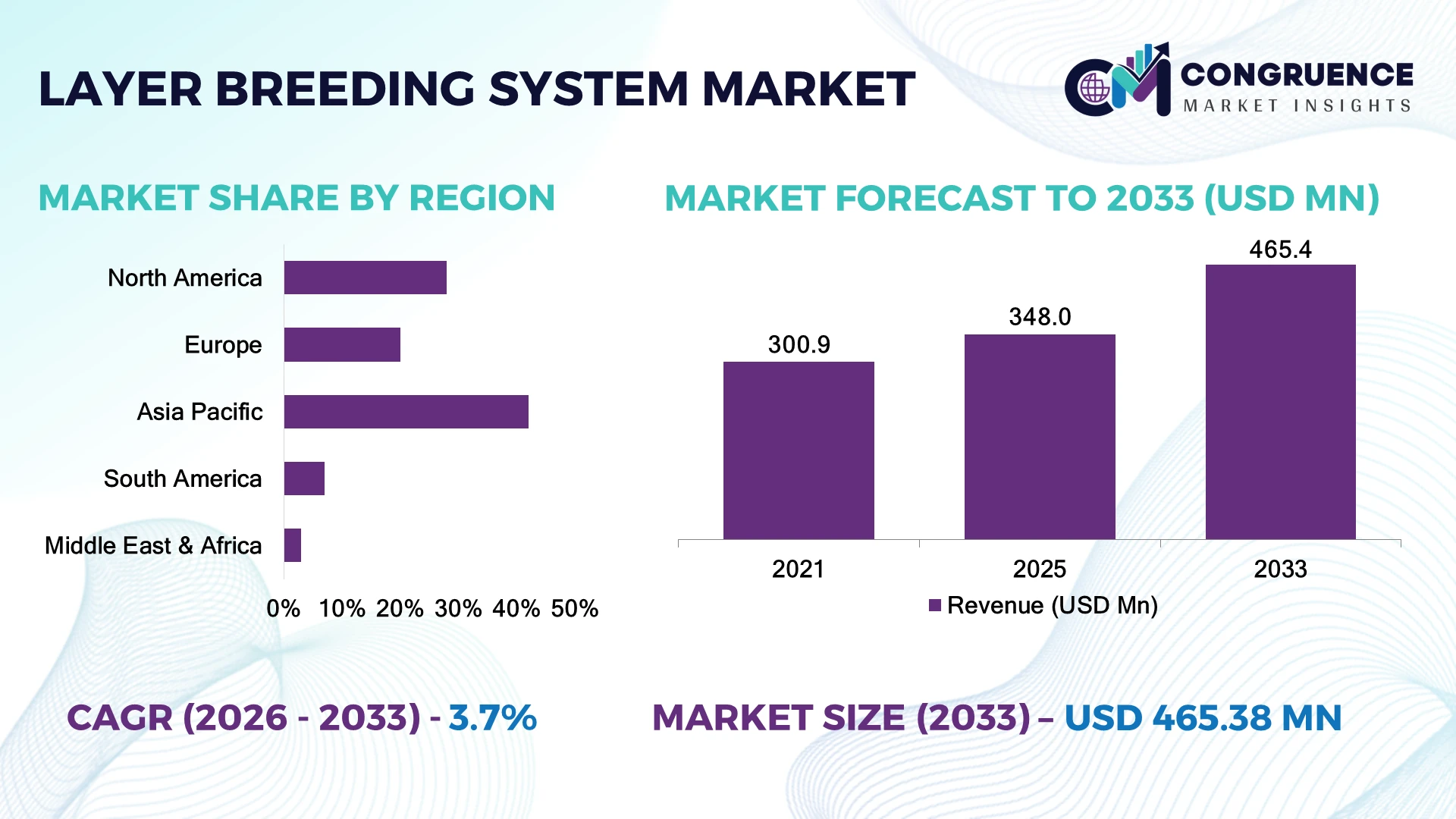
China dominates the global layer breeding system landscape, accounting for nearly 35% of installed commercial layer capacity, supported by large-scale poultry modernization programs and investments exceeding USD 1 billion in smart livestock infrastructure. The United States follows with advanced automated breeding adoption across more than 60% of large poultry operations, while India is accelerating deployment through integrated poultry farming expansion. China’s production scale remains over 2× larger than several emerging markets, creating a strong technology demand base.
Strategic implication companies prioritizing automation, genetic optimization, and localized breeding solutions will gain stronger competitive positioning in the evolving poultry production ecosystem.
Market Size & Growth: Valued at USD 348.0 Million in 2025 and projected at USD 465.4 Million by 2033 with 3.7% CAGR, supported by AI-enabled breeding automation and precision poultry management.
Top Growth Drivers: Automation adoption (45%), genetic optimization demand (38%), and smart farm integration (32%) are accelerating global layer breeding system deployment.
Short-Term Forecast: By 2028, automated monitoring systems are expected to improve breeding efficiency by 20% and reduce manual intervention costs by 15%.
Emerging Technologies: AI-based flock analytics, IoT monitoring, robotic feeding systems, and genomic selection platforms are reshaping advanced layer breeding operations.
Regional Leaders: Asia Pacific is projected at USD 210 Million, North America at USD 120 Million, and Europe at USD 95 Million by 2033, driven by automation adoption and sustainable poultry modernization.
Consumer/End-User Trends: Over 55% of commercial poultry operators are adopting digital monitoring tools to improve productivity and animal management accuracy.
Pilot/Case Example: In 2024, smart poultry facilities in China reported approximately 18% improvement in operational efficiency through automated environmental control and data analytics.
Competitive Landscape: Leading players including Big Dutchman, Vencomatic Group, FACCO, Jansen Poultry Equipment, and GEA Group compete through automation, breeding infrastructure, and smart farming solutions.
Regulatory & ESG Impact: Sustainable poultry policies in Europe and Asia are pushing farms toward resource-efficient systems, reducing operational waste by up to 25%.
Investment & Funding: Global poultry technology investments surpassed USD 2 billion in recent years, with partnerships focusing on automation, genetics, and farm digitization.
Innovation & Future Outlook: Next-generation breeding systems integrating AI, predictive analytics, and climate-resilient genetics are creating a strategic shift toward high-efficiency poultry production.
The Layer Breeding System Market is increasingly shaped by precision agriculture, automated farm infrastructure, and advanced genetic technologies. Demand is concentrated among commercial poultry producers seeking higher flock productivity, with automated breeding solutions improving operational accuracy by nearly 20%. Innovations such as AI-based monitoring and data-driven breeding decisions are expanding adoption, while supply-chain restructuring and stricter animal welfare regulations are encouraging producers to modernize facilities.
The Layer Breeding System Market is becoming strategically important as poultry producers worldwide shift toward technology-driven production models focused on efficiency, traceability, and sustainable output. Rising food security priorities, stricter animal welfare regulations, and modernization programs in countries such as China and India are accelerating investments in advanced breeding infrastructure.
Digital breeding platforms using AI analytics and automated monitoring deliver measurable operational advantages compared with traditional systems, improving flock management efficiency by approximately 15–25% while reducing labor dependency. Developed markets such as the United States and Germany emphasize precision automation and sustainability compliance, whereas emerging economies prioritize scalable breeding capacity and cost-efficient deployment.
Over the next 2–3 years, adoption of connected poultry systems is expected to increase as producers integrate sensors, predictive analytics, and automated feeding technologies. Large commercial farms are deploying integrated solutions that combine genetics, environmental control, and performance tracking. Companies are responding through strategic partnerships, regional manufacturing expansion, and investment in smart poultry ecosystems.
The strongest market participants will be those combining biological expertise with digital infrastructure to achieve superior productivity, operational resilience, and long-term competitive advantage.
The primary growth driver for layer breeding systems is the rapid adoption of automated poultry management technologies. Commercial farms are increasingly implementing AI monitoring, robotic feeding, and environmental control systems to improve efficiency. Automated solutions can reduce labor requirements by 20–30% while improving flock monitoring accuracy by more than 15%. China’s large-scale poultry modernization initiatives and India’s integrated poultry expansion programs are accelerating technology adoption. Companies are responding through smart farm partnerships, localized equipment manufacturing, and investment in digital breeding platforms. The strategic shift is moving from capacity expansion alone toward data-driven productivity optimization, enabling producers to achieve higher output consistency with fewer operational disruptions.
High installation costs and uneven infrastructure availability remain major barriers for layer breeding system adoption. Advanced automated facilities require significant capital investment, with technology upgrades accounting for nearly 20–35% of total farm modernization expenses. Developing markets face challenges related to skilled workforce availability, maintenance capabilities, and imported equipment dependency. In countries such as India and Brazil, smaller poultry operators often delay automation adoption due to financing limitations and fragmented production structures. Companies are reducing these barriers through modular equipment designs, local supply chains, financing partnerships, and hybrid technology models. The key operational challenge is balancing automation benefits with affordability across diverse farm sizes.
Emerging opportunities are centered on AI-driven breeding analytics, genomic optimization, and connected poultry ecosystems. Digital platforms can improve breeding decision accuracy by 20% or more through real-time performance tracking and predictive analysis. Countries including China, India, and Vietnam are expanding commercial poultry infrastructure, creating demand for scalable technology solutions. Integration of IoT sensors, cloud-based farm management, and automated environmental systems is opening new business models based on subscription services and data platforms. Companies are increasing R&D investment and forming technology partnerships to capture these opportunities. A major strategic opportunity lies in combining genetic improvement with operational analytics to deliver measurable productivity gains rather than standalone equipment solutions.
Long-term market expansion faces challenges related to system integration, cybersecurity, workforce skills, and technology standardization. Approximately 30% of poultry operators still operate with limited digital infrastructure, creating difficulties in adopting fully connected breeding systems. Increasing data dependence introduces cybersecurity requirements, while integration between genetics, automation, and farm management software remains complex. Advanced poultry producers in the United States and Europe are investing in secure digital platforms, while emerging markets require stronger technical support networks. Companies must address interoperability, training, and infrastructure development through partnerships and continuous innovation. The future competitive advantage will depend on delivering reliable, scalable systems that maintain performance across different production environments.
AI-Based Breeding Optimization Shift: Poultry producers are rapidly adopting AI-powered flock analytics and predictive breeding tools, with digital monitoring penetration increasing by nearly 25% across large commercial farms. Companies in China and the United States are integrating machine learning models with genetic selection workflows to improve breeding accuracy by 15–20%. This shift is reducing manual evaluation cycles, accelerating decision-making, and encouraging technology partnerships between poultry equipment providers and software developers.
Automated Farm Integration Expansion: Large-scale layer producers are moving toward fully integrated breeding environments combining automated feeding, climate control, and health monitoring systems. Adoption of automated housing solutions has increased by approximately 30% in advanced poultry operations, driven by labor shortages and rising operational costs. European producers are restructuring facilities to comply with stricter animal welfare requirements, while equipment manufacturers are scaling modular automation platforms for different farm sizes.
Genetic Data Management Advancement: Breeding companies are increasingly using genomic databases and performance tracking systems to improve productivity outcomes. Modern genetic platforms are delivering approximately 10–15% improvement in selection efficiency by analyzing large-scale flock performance data. A non-obvious market shift is the growing demand for data ownership and interoperability, prompting companies to develop secure cloud-based breeding ecosystems and collaborative data platforms.
Sustainable Production System Adoption: Environmental compliance and supply-chain pressure are pushing poultry operators toward resource-efficient breeding infrastructure. Farms implementing smart environmental controls report water and energy optimization improvements of 15–20%, particularly in regions facing stricter sustainability requirements. Companies are responding through energy-efficient equipment upgrades, strategic partnerships, and investments in low-waste production models aligned with evolving global food security priorities.
Automated layer breeding systems represent the leading type segment, accounting for approximately 42% of the market, supported by scalability, reduced labor dependency, and improved flock management accuracy. Large commercial farms in China, the United States, and Germany are prioritizing automated feeding, monitoring, and environmental control systems to enhance operational consistency. Traditional semi-automated systems maintain relevance among mid-sized producers due to lower installation costs, while manual breeding setups continue serving smaller farms with limited infrastructure investment.
The fastest-growing segment is AI-integrated breeding systems, expanding as producers seek predictive analytics and real-time genetic performance insights. Adoption of intelligent breeding platforms is increasing by nearly 20%, driven by demand for higher productivity and lower resource consumption. Companies are shifting investments toward connected solutions that combine automation, sensors, and genomic analysis. This transition is creating competitive advantages for providers offering complete digital breeding ecosystems rather than standalone equipment.
Commercial layer farms dominate the application segment with an estimated 55% market share, supported by large-scale egg production operations requiring consistent breeding performance, automation, and monitoring capabilities. These facilities benefit from integrated systems that optimize flock health, productivity tracking, and operational planning. Hatchery applications remain strategically important, particularly for genetic improvement programs, while research and institutional breeding facilities contribute through innovation and testing activities.
The fastest-growing application is smart hatchery and genetic development operations, where adoption is increasing by approximately 18% as companies invest in precision breeding workflows. Emerging producers in India and Southeast Asia are expanding commercial poultry infrastructure, creating demand for scalable breeding technologies. Companies are responding by developing modular systems, improving software integration, and expanding service-based deployment models. The application landscape is shifting from equipment-focused adoption toward complete breeding management solutions.
Large poultry integrators represent the dominant end-user segment, contributing approximately 60% of adoption due to their extensive production networks, higher automation requirements, and ability to invest in advanced breeding infrastructure. These enterprises require integrated solutions covering genetics, environmental management, and operational analytics. Independent poultry farms remain an important user group, particularly in developing economies where gradual automation adoption is replacing conventional production methods.
The fastest-growing end-user category is contract farming networks, expanding as approximately 25% of emerging poultry producers adopt technology-supported production partnerships. These models enable smaller operators to access advanced breeding systems without independent capital-intensive investments. Companies are targeting this segment through financing models, localized service networks, and partnership-based deployment strategies. Future demand is shifting toward flexible systems capable of supporting diverse farm sizes while maintaining enterprise-level efficiency.
Asia-Pacific accounted for the largest market share at 42% in 2025 however, North America is expected to register the fastest growth, expanding at a CAGR of 4.2% between 2026 and 2033.

North America represents a mature Layer Breeding System Market supported by advanced poultry infrastructure, integrated production networks, and high adoption of automated management technologies. The region contributes approximately 28% of global demand, with the United States accounting for the majority of deployments due to its large-scale egg production industry. More than 65% of major commercial poultry operators in the country use automated monitoring, feeding, or environmental control systems. Companies are expanding AI-enabled breeding platforms and precision livestock technologies to improve productivity, reduce labor dependency, and strengthen operational consistency.
United States Market Outlook: The United States remains the leading country market due to its established poultry production ecosystem, advanced agricultural technology adoption, and strong presence of commercial egg producers. The country maintains a laying hen population exceeding 300 million birds, supporting continuous demand for automated breeding and farm management solutions. Poultry enterprises are investing in connected systems, data analytics, and efficient production infrastructure to improve flock performance.
Europe maintains a strong position in the Layer Breeding System Market due to strict animal welfare regulations, sustainability initiatives, and advanced agricultural automation. The region contributes approximately 20% of global adoption, with Germany, the Netherlands, and France representing major deployment markets. Around 50% of large-scale poultry operations in Western Europe have integrated digital monitoring or automated production technologies. Regulatory pressure related to resource efficiency and animal welfare is encouraging producers to modernize breeding facilities. Companies are responding through energy-efficient equipment, smart farm solutions, and partnerships focused on sustainable poultry production.
Germany Market Outlook: Germany leads European adoption through advanced engineering capabilities, strong poultry technology suppliers, and regulatory-driven modernization. More than 60% of large poultry farms utilize automated management technologies, supporting demand for precision breeding systems. German companies are focusing on digital flock monitoring, efficient resource utilization, and integrated breeding infrastructure to maintain competitiveness.
Asia-Pacific dominates the global Layer Breeding System Market due to extensive poultry production capacity, rising egg consumption, and rapid agricultural modernization. The region accounts for nearly 42% of global market adoption, supported by China, India, and Japan. China represents the largest deployment base, while India is expanding commercial poultry infrastructure through integrated farming models. Large producers are increasingly adopting automated breeding, climate control, and monitoring systems, with smart farm implementation increasing by approximately 25% across advanced operations. Companies are strengthening local manufacturing, partnerships, and service networks to support diverse production requirements.
China Market Outlook: China represents the largest country-level market due to its extensive poultry production scale and advanced agricultural modernization programs. The country produces more than 30% of global egg output and continues investing in automated breeding infrastructure. Large poultry enterprises are deploying AI monitoring, precision genetics, and environmental management systems to improve productivity and maintain supply-chain reliability.
South America is an emerging market for layer breeding systems, supported by expanding poultry production, export-oriented farming, and modernization of commercial operations. The region contributes approximately 7% of global adoption, with Brazil accounting for the majority of demand due to its established poultry industry. Large producers are increasingly implementing automated feeding, environmental control, and breeding management systems to improve operational efficiency. However, fragmented farm structures and infrastructure limitations continue influencing adoption rates. Companies are addressing these challenges through modular technologies, regional partnerships, and localized service models to improve accessibility.
Brazil Market Outlook: Brazil is the key country market due to its large poultry production base, export capabilities, and advanced agricultural infrastructure. The country produces more than 50 billion eggs annually and continues expanding technology adoption across commercial farms. Poultry companies are investing in automated breeding systems, digital monitoring platforms, and efficient production processes to improve quality control and operational performance.
The Middle East & Africa market is developing through food security initiatives, poultry production expansion, and investment in controlled-environment farming systems. The region accounts for a smaller share of 3% of global adoption but is witnessing increasing deployment in Saudi Arabia, the UAE, and South Africa. Government-supported agricultural programs are encouraging modernization of poultry facilities, with automated climate control and breeding management solutions becoming more common. Companies are expanding through technology partnerships, localized production strategies, and infrastructure development initiatives to support domestic poultry supply.
Saudi Arabia Market Outlook: Saudi Arabia is emerging as a strategically important market due to national food security programs and investments in domestic poultry production. The country is expanding controlled farming infrastructure and adopting automated breeding technologies to reduce dependence on imports. Poultry operators are implementing advanced monitoring systems, efficient resource management solutions, and modern production technologies to strengthen local egg supply capabilities.
The Layer Breeding System Market features competition between global poultry technology leaders, automation OEMs, and specialized breeding solution providers. Companies such as Big Dutchman, Vencomatic Group, FACCO, and Jansen Poultry Equipment compete with regional suppliers through automation capabilities, system reliability, and customization. The top five players collectively account for approximately 45% of the market, reflecting a moderately consolidated structure. Competition is driven by technology integration, with advanced automated systems improving operational efficiency by 15–25%, while cost-focused suppliers compete through localized manufacturing and flexible pricing. Leading players are expanding through strategic partnerships, smart farming solutions, and vertical integration across equipment and digital platforms. The competitive landscape is shifting toward AI-enabled monitoring, connected farm ecosystems, and supply-chain control. High capital requirements, technical expertise, and service networks create entry barriers. Winning players must combine innovation, scalable deployment, and strong customer support to outperform established competitors.
Vencomatic Group
FACCO
Jansen Poultry Equipment
GEA Group
Petersime
Roxell
Valco Companies
TEXHA
SKA Poultry Equipment
VDL Agrotech
Hartmann Lebensmitteltechnik
Chore-Time
Salmet
Layer breeding systems are increasingly adopting automation, artificial intelligence, IoT monitoring, and precision livestock technologies to improve productivity and operational control. Automated feeding, climate management, and flock monitoring systems are reducing manual intervention by approximately 20% and improving resource utilization by 15%. Adoption is strongest among large commercial poultry operators, where connected farm platforms are becoming standard infrastructure.
AI-driven breeding analytics and genomic selection technologies are transforming traditional methods by enabling faster genetic evaluation and more accurate flock performance prediction. Compared with conventional manual monitoring approaches, advanced digital systems improve decision accuracy by nearly 25% and provide competitive advantages to technology-focused producers. Companies integrating data platforms with breeding equipment are gaining stronger operational visibility and scalability.
Between 2026 and 2028, smart breeding ecosystems will expand as producers prioritize efficiency, traceability, and sustainable production. Cloud-based analytics, robotic automation, and predictive maintenance will become important differentiators. Technology leaders and vertically integrated poultry enterprises will benefit most, while smaller operators will increasingly rely on modular solutions and service partnerships to access advanced capabilities.
November 2025 — Big Dutchman presented its smart poultry production portfolio at VIV MEA 2025, highlighting BFN Fusion cloud-based farm management technology that connects equipment, sensors, and workflows. The platform supports real-time production monitoring across multiple locations, strengthening digital farm control. Source: Big Dutchman Official Website
March 2025 — Vencomatic Group announced a strategic partnership with Felleskjøpet for the Norwegian poultry market, expanding access to precision poultry solutions and breeder technologies. The partnership strengthens distribution capabilities and supports wider adoption of automated poultry systems. Source: Vencomatic Group Official Website
October 2025 — Vencomatic Group highlighted its breeder infrastructure development through a Canadian customer project involving a double-wide barn equipped for 40,000 breeders. The deployment demonstrates large-scale breeder housing modernization and improved operational scalability. Source: Vencomatic Group Official Website
February 2026 — Big Dutchman expanded its precision poultry technology portfolio with EasyCheck wireless weighing systems designed for continuous flock monitoring. The solution improves data-driven decision-making by providing accurate weight tracking and supporting feed optimization in breeder operations. Source: Big Dutchman Official Website
The Layer Breeding System Market Report covers comprehensive analysis across major system types, applications, end-users, and geographic markets. The study evaluates automated breeding systems, smart monitoring technologies, commercial poultry farms, hatcheries, and integrated production facilities across North America, Europe, Asia-Pacific, South America, and Middle East & Africa. The report examines deployment patterns, technology adoption trends, and evolving operational requirements shaping the industry.
The report provides strategic insights into automation integration, AI-based breeding analytics, supply-chain developments, competitive positioning, and emerging investment opportunities. Coverage includes established producers, technology innovators, and regional suppliers influencing market direction. The analysis supports business planning by identifying expansion priorities, partnership opportunities, technology shifts, and competitive strategies expected to influence industry transformation between 2026 and 2033.
| Report Attribute / Metric | Details |
|---|---|
| Market Revenue (2025) | USD 348.0 Million |
| Market Revenue (2033) | USD 465.4 Million |
| CAGR (2026–2033) | 3.7% |
| Base Year | 2025 |
| Forecast Period | 2026–2033 |
| Historic Period | 2021–2025 |
| Segments Covered |
By Type
By Application
By End-User
|
| Key Deliverables | Revenue Forecast; Market Trends; Growth Drivers & Restraints; Technology Insights; Segmentation Analysis; Regional Insights; Competitive Landscape; Regulatory & ESG Overview; Recent Developments |
| Regions Covered | North America; Europe; Asia-Pacific; South America; Middle East & Africa |
| Companies Profiled | Big Dutchman; Vencomatic Group; FACCO; Jansen Poultry Equipment; GEA Group; Petersime; Roxell; Valco Companies; TEXHA; SKA Poultry Equipment; VDL Agrotech; Hartmann Lebensmitteltechnik; Chore-Time; Salmet |
| Customization & Pricing | Available on Request (10% Customization Free) |




