
Reports
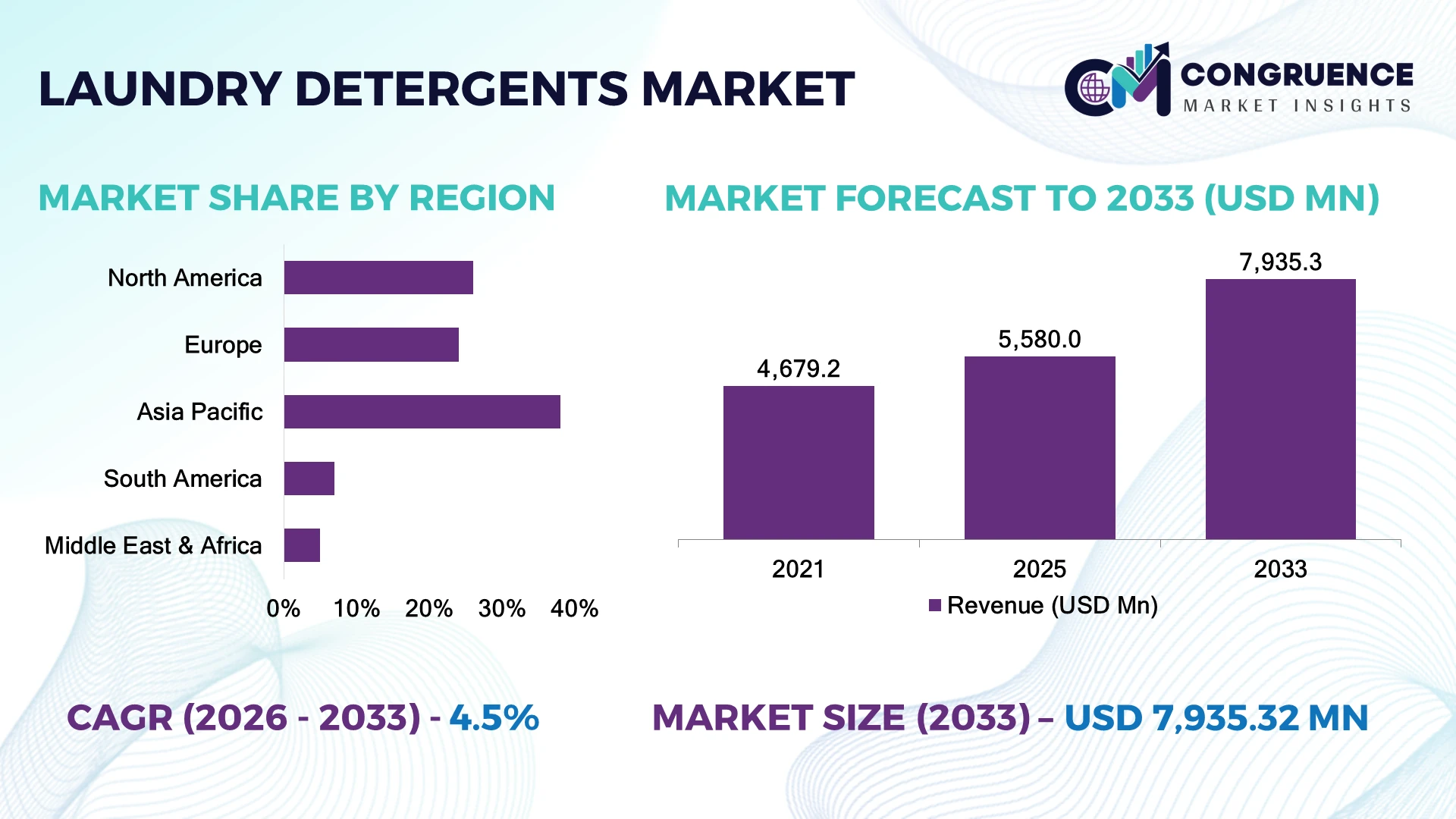
The Global Laundry Detergents Market was valued at USD 5,580.0 Million in 2025 and is anticipated to reach a value of USD 7,935.3 Million by 2033 expanding at a CAGR of 4.5% between 2026 and 2033. Growth is being driven by the rapid shift toward concentrated liquid detergents, enzyme-based formulations, and high-efficiency washing machines that reduce water and energy consumption across residential and commercial laundry applications.
China remains the dominant country in the global laundry detergents landscape, accounting for approximately 28% of global production capacity, supported by large-scale chemical manufacturing clusters and investments exceeding USD 2 billion in surfactant and specialty ingredient expansion projects. Household washing machine penetration exceeds 97%, compared with nearly 89% in India, while automated detergent dosing adoption is growing at over 15% annually. Ongoing Red Sea shipping disruptions have accelerated regional sourcing strategies among detergent manufacturers.
Strategic implication companies prioritizing localized supply chains and premium formulation capabilities are strengthening market leadership and margin resilience.
Market Size & Growth: USD 5,580.0 Million in 2025, projected to reach USD 7,935.3 Million by 2033 at 4.5% CAGR, supported by enzyme-based formulations and concentrated detergent adoption.
Top Growth Drivers: Premium liquid detergent penetration (+18%), eco-friendly product adoption (+22%), and automatic washing machine usage (+15%) are the primary growth catalysts.
Short-Term Forecast: By 2028, concentrated detergent formats are expected to reduce packaging material usage by 20% and logistics costs by nearly 12%.
Emerging Technologies: AI-driven formulation optimization, bio-based surfactants, and smart dosing systems are improving cleaning efficiency by up to 25%.
Regional Leaders: Asia Pacific leads with approximately USD 3.2 Billion value, North America exceeds USD 1.4 Billion, and Europe approaches USD 1.2 Billion, supported by premiumization and sustainable product adoption.
Consumer/End-User Trends: More than 45% of urban consumers prefer liquid detergents, while eco-labeled detergent purchases have increased by 19% globally.
Pilot/Case Example: In 2024, a smart laundry dosing deployment in Germany reduced detergent consumption by 18% and water usage by 11%.
Competitive Landscape: Procter & Gamble holds roughly 20% share, followed by Unilever, Henkel, Kao Corporation, and Church & Dwight.
Regulatory & ESG Impact: Low-phosphate detergent adoption exceeds 60% across several developed markets, reducing wastewater treatment burden by approximately 15%.
Investment & Funding: More than USD 1.5 Billion has been allocated toward manufacturing expansion, sustainable packaging, and specialty surfactant development.
Innovation & Future Outlook: Advanced enzyme systems, refill-pack ecosystems, and digital consumer engagement platforms are reshaping competitive differentiation and operational efficiency.
Laundry detergents are increasingly positioned at the intersection of cleaning performance, sustainability, and consumer convenience. Demand remains strongest across liquid detergents, pods, and commercial laundry solutions, while enzyme-enhanced formulations continue to improve stain-removal efficiency by over 20%. Manufacturers are accelerating biodegradable ingredient adoption amid tightening environmental standards and supply-chain localization efforts, creating a favorable environment for premium, technology-driven product innovation and strategic market expansion.
The laundry detergents market has become strategically important as manufacturers compete through formulation technology, sustainability performance, and supply-chain resilience rather than volume alone. Regulatory pressure on phosphates, packaging waste, and carbon emissions is reshaping procurement, production, and product development strategies. At the same time, retailers are prioritizing high-margin premium detergent portfolios that align with consumer sustainability preferences.
Technology adoption is creating measurable operational advantages. Advanced enzyme-based detergents can deliver equivalent cleaning performance at temperatures 20–30% lower than conventional formulations, reducing household energy consumption and improving product differentiation. China continues to lead large-scale manufacturing and ingredient integration, while Germany and Japan are advancing premium concentrated and eco-certified detergent technologies. This contrast highlights the growing importance of innovation-led positioning over pure production scale.
Over the next two to three years, refill systems, biodegradable surfactants, and smart dispensing technologies are expected to gain wider deployment. For example, commercial laundry operators implementing automated dosing systems have reported detergent savings exceeding 15%. Major companies are increasing investments in localized manufacturing, sustainable packaging partnerships, and specialty ingredient development. Organizations that combine operational efficiency, environmental compliance, and premium product innovation will secure stronger competitive positioning across evolving global detergent value chains.
The transition toward concentrated liquid detergents and enzyme-enhanced formulations is accelerating category transformation. More than 55% of new detergent launches now emphasize concentrated or high-efficiency performance, while low-temperature washing adoption has increased by nearly 20% in developed economies. In China, automated washing machine penetration exceeds 97%, creating strong demand for optimized detergent formulations. The shift toward energy-efficient household appliances directly increases demand for specialized detergents capable of maintaining cleaning performance under lower water and temperature conditions. In response, manufacturers are expanding enzyme technology investments, increasing R&D budgets, and forming ingredient partnerships. A key strategic insight is that detergent brands aligned with appliance innovation ecosystems are capturing stronger premium pricing and higher consumer retention rates.
Volatility in petrochemical-derived surfactants and specialty chemical inputs remains a significant structural limitation. Key detergent ingredients experienced price fluctuations of 15–25% during recent supply disruptions, while freight costs in certain shipping corridors increased by more than 30% during geopolitical trade disruptions. Manufacturers in India and Southeast Asia remain exposed to imported specialty chemical dependencies, affecting production planning and inventory management. These cost pressures directly impact profitability and pricing flexibility in highly competitive retail channels. To reduce exposure, leading companies are diversifying supplier networks, localizing ingredient sourcing, and securing long-term procurement contracts. A critical operational insight is that supply-chain flexibility increasingly determines competitive resilience as much as formulation performance.
Bio-based surfactants, refill ecosystems, and intelligent dosing technologies present substantial untapped opportunities. Consumer preference for sustainable household products has risen by more than 22%, while refill-pack adoption in selected European markets has increased by approximately 18%. Japan and South Korea are actively advancing compact detergent formats that reduce packaging volumes by over 30%. Emerging innovation trends include biotechnology-derived cleaning agents and AI-assisted formulation optimization for improved cleaning efficiency. Companies are responding through strategic R&D collaborations, sustainable packaging investments, and ecosystem partnerships with appliance manufacturers. One non-obvious opportunity lies in subscription-based detergent replenishment systems that combine consumer convenience with stronger brand loyalty and demand predictability.
Maintaining cleaning effectiveness while meeting increasingly stringent sustainability requirements remains a complex execution challenge. Nearly 65% of consumers prioritize environmental credentials, yet more than 70% still rank stain-removal performance as their primary purchasing criterion. Manufacturers must simultaneously reduce packaging waste, lower chemical intensity, and maintain product efficacy across diverse washing conditions. Regulatory frameworks in Europe and parts of North America continue to evolve, increasing testing, certification, and compliance complexity. Companies are investing in advanced formulation science, sustainable ingredient development, and performance validation programs to address these pressures. A crucial strategic challenge is ensuring that environmental innovation strengthens rather than compromises consumer trust, product consistency, and long-term brand competitiveness.
Smart Dosing Systems Expand Automated detergent dispensing is becoming standard across commercial laundries and premium residential appliances. Adoption of smart dosing solutions increased by nearly 18% during the past year, while detergent waste declined by approximately 15% and water consumption improved by 10%. Labor shortages in institutional laundry operations are accelerating deployment. Manufacturers are partnering with appliance OEMs and software providers to integrate dosing analytics, improving operational consistency and lowering per-cycle consumption.
Concentrated Formats Reshape Logistics Concentrated liquids and compact detergent formats are reducing transportation and storage requirements across global supply chains. Packaging volumes have declined by roughly 25%, while freight efficiency improved by nearly 12% and warehouse utilization increased by 8%. Rising shipping disruptions and higher container costs have encouraged manufacturers in China and the U.S. to prioritize lightweight formulations. Companies are restructuring packaging operations and expanding refill-based distribution models to strengthen supply-chain resilience.
Bio-Based Ingredients Accelerate Enzyme-enhanced and plant-derived surfactant formulations are gaining traction as regulatory scrutiny of chemical ingredients intensifies. Sustainable detergent launches increased by more than 20%, while low-phosphate product penetration surpassed 60% in several developed markets. Compliance requirements and retailer sustainability targets are driving reformulation efforts. Leading brands are scaling biotechnology partnerships and expanding specialty ingredient sourcing networks to improve environmental performance without compromising cleaning efficacy.
Premium Laundry Care Diversifies Consumer preferences are shifting toward specialized products for sensitive skin, fabric protection, and cold-water washing. Premium detergent purchases rose by approximately 16%, while fragrance-specific variants expanded by 12% and hypoallergenic products exceeded 10% of new launches. A non-obvious trend is the growing use of textile-specific detergents designed for performance apparel. Companies are broadening product portfolios, investing in formulation differentiation, and strengthening direct-to-consumer engagement strategies.
Powder detergents remain the leading segment, accounting for approximately 33% of global market demand. Their dominance stems from cost efficiency, extended shelf life, and strong cleaning performance across heavily soiled garments and large household loads. Powder formulations continue to maintain strong penetration in India, China, and several African markets where affordability remains a primary purchasing factor. Liquid detergents follow closely, benefiting from compatibility with modern washing machines and improved performance in cold-water cycles. Together, powder and liquid formats represent more than 65% of overall consumption.
Detergent pods and tablets represent the fastest-growing segment, supported by convenience, precise dosing, and premium positioning. Pod adoption has increased by nearly 14% in urban markets, while concentrated liquid formats continue expanding among environmentally conscious consumers. Gel detergents maintain strategic relevance through superior solubility and specialized stain-removal applications. Manufacturers are prioritizing premium liquid variants, capsule technologies, and concentrated formulations through product innovation and capacity expansion. Investment priorities are steadily shifting toward high-margin formats that improve consumer convenience while reducing packaging intensity.
Household applications dominate the laundry detergents market with an estimated share exceeding 70% of global consumption. Demand concentration is supported by recurring residential washing cycles, growing appliance ownership, and increasing preference for specialized detergent formulations. Regular household usage remains highly resilient because laundry care is a non-discretionary activity. Premium liquid detergents, enzyme-based products, and concentrated formats are increasingly adopted by residential consumers seeking convenience and fabric protection. Household demand also benefits from growing e-commerce penetration and subscription-based replenishment models.
Commercial laundry is the fastest-growing application segment, supported by expansion across hospitality, healthcare, and professional laundry services. Automated dosing systems have improved detergent utilization efficiency by approximately 15%, while standardized cleaning programs have reduced operational variability. Industrial laundry applications continue serving manufacturing uniforms, textile processing, and specialized cleaning environments where bulk-volume procurement remains important. Companies are expanding commercial product portfolios, developing machine-compatible formulations, and strengthening service partnerships. Demand is becoming increasingly operationally critical within healthcare facilities and large hotel chains where hygiene consistency directly impacts service quality.
Households represent the largest end-user segment, accounting for approximately 75% of overall detergent consumption. Demand concentration is supported by large consumer populations, frequent washing cycles, and increasing ownership of automatic washing machines. Residential buyers continue favoring powder detergents in value-focused markets while premium liquid and pod formats gain traction among urban consumers. More than 45% of metropolitan consumers now actively seek specialized detergent features such as fabric care, fragrance enhancement, or hypoallergenic performance. Manufacturers are targeting households through product differentiation, digital marketing, and subscription-driven purchasing ecosystems.
Commercial and institutional buyers represent the fastest-growing end-user group. Hotels, hospitals, laundromats, and healthcare facilities are increasing adoption of concentrated formulations and automated dispensing systems to improve operational efficiency. Hospitality-related detergent consumption has increased by approximately 12% alongside rising travel activity, while healthcare laundry requirements continue expanding under stricter hygiene protocols. Industrial users maintain steady demand for workwear and textile-processing applications. Companies are responding through customized formulations, long-term supply agreements, and integrated service offerings. Future demand is increasingly shifting toward professional buyers that prioritize consistency, compliance, and measurable operating efficiencies.
Asia-Pacific accounted for the largest market share at 38% in 2025 however, Middle East & Africa is expected to register the fastest growth, expanding at a CAGR of 5.8% between 2026 and 2033.
North America accounted for approximately 26% of the global laundry detergents market in 2025, supported by high appliance penetration, mature retail networks, and strong adoption of premium detergent formats. Liquid detergents dominate regional consumption, while concentrated formulations continue gaining shelf space due to packaging efficiency and sustainability objectives. Commercial laundry operators across hospitality and healthcare are increasingly deploying automated dispensing technologies to improve dosing accuracy and reduce chemical waste. More than 70% of households utilize high-efficiency washing machines, creating demand for specialized formulations optimized for low-water cycles. Manufacturers are investing in smart packaging, refill systems, and digital consumer engagement platforms. Strategic partnerships between detergent brands and appliance manufacturers are strengthening product integration and improving customer retention across premium product categories.
United States Market Outlook: The United States remains the largest detergent market in North America due to its extensive consumer base, advanced retail infrastructure, and strong innovation ecosystem. Household washing machine penetration exceeds 85%, while premium detergent products represent more than 40% of new product introductions. Companies continue expanding enzyme-based and concentrated formulations to align with sustainability goals and consumer convenience preferences. The country also benefits from a well-developed chemical manufacturing sector that supports formulation innovation, ingredient availability, and rapid commercialization of next-generation laundry care technologies.
Europe represented approximately 24% of global market demand in 2025, supported by stringent environmental regulations and strong consumer preference for sustainable household products. Regulatory emphasis on biodegradable ingredients and phosphate reduction is accelerating reformulation initiatives across the detergent value chain. Concentrated detergents and refill-pack solutions are increasingly adopted as retailers prioritize waste reduction targets. Commercial laundries continue investing in automated chemical management systems to improve operational efficiency and compliance performance. More than 60% of detergent launches emphasize sustainability-focused claims, reflecting evolving consumer expectations. Manufacturers are modernizing production facilities and strengthening partnerships with specialty chemical suppliers to improve formulation performance while meeting environmental requirements.
Germany Market Outlook: Germany serves as the region’s most influential detergent manufacturing and innovation hub, supported by advanced chemical processing capabilities and strict sustainability standards. The country maintains strong demand for premium laundry care products, while eco-certified formulations continue gaining traction among consumers. Automated laundry technologies are widely deployed across commercial facilities, supporting efficient detergent utilization and consistent cleaning outcomes. Germany’s extensive industrial base and research infrastructure enable rapid development of bio-based surfactants, advanced enzymes, and packaging innovations that influence product strategies across the broader European market.
Asia-Pacific led the global laundry detergents market with approximately 38% share in 2025, supported by large population centers, expanding middle-class consumption, and extensive manufacturing capacity. The region accounts for a significant portion of global detergent production, benefiting from integrated chemical supply chains and cost-efficient manufacturing operations. Rising urbanization and increasing washing machine ownership are accelerating demand for liquid detergents and premium fabric-care solutions. Major manufacturers continue expanding production facilities and distribution networks to address evolving consumer preferences. Several countries have increased investments in specialty surfactants and sustainable packaging infrastructure, strengthening regional competitiveness. Export-oriented production capabilities further support the region’s strategic importance within global detergent supply chains.
China Market Outlook: China remains the largest detergent-producing country globally, accounting for roughly 28% of worldwide production capacity. The country benefits from extensive chemical manufacturing clusters, integrated supply chains, and advanced packaging infrastructure. Household washing machine penetration exceeds 97%, supporting widespread adoption of machine-compatible detergent formulations. Domestic manufacturers continue investing in concentrated liquids, enzyme technologies, and environmentally optimized products. Strong manufacturing efficiency and logistics capabilities allow Chinese producers to serve both domestic demand and export markets while maintaining competitive cost structures and innovation capacity.
South America accounted for approximately 7% of global laundry detergent demand in 2025, driven primarily by urban household consumption and expanding retail distribution networks. Powder detergents remain widely used due to affordability advantages, although liquid detergent penetration continues increasing among middle-income consumers. Modern retail expansion and growing e-commerce activity are improving product accessibility across major metropolitan areas. Commercial laundry services linked to hospitality and healthcare sectors are also contributing to demand diversification. Infrastructure limitations and periodic input cost volatility remain operational challenges; however, manufacturers are improving regional production capabilities and strengthening local sourcing strategies to enhance supply stability and cost management.
Brazil Market Outlook: Brazil represents the largest laundry detergent market in South America due to its sizeable population, established consumer goods sector, and broad retail infrastructure. Urban households account for the majority of detergent consumption, while premium laundry products are gaining visibility in major cities. The country maintains significant domestic manufacturing capacity that supports regional supply requirements. Investments in packaging modernization, logistics optimization, and formulation efficiency are helping producers improve competitiveness. Brazil’s expanding supermarket and e-commerce channels continue enhancing consumer access to diversified detergent product portfolios.
Middle East & Africa represented approximately 5% of global market demand in 2025, with growth supported by expanding urban populations, industrial investment, and consumer goods manufacturing development. Governments and private investors are increasing focus on domestic production capabilities to reduce import dependence and improve supply security. Laundry detergent manufacturers are establishing localized packaging and blending operations to serve growing household demand more efficiently. Modern retail expansion and rising appliance ownership are contributing to changing purchasing patterns. Several countries are investing in industrial zones and logistics infrastructure, creating more favorable operating conditions for detergent producers and distributors. Strategic localization initiatives are becoming increasingly important across the regional consumer goods sector.
Saudi Arabia Market Outlook: Saudi Arabia has emerged as the most strategically significant detergent market within the region due to its industrial diversification agenda, manufacturing investments, and expanding consumer base. The country is strengthening domestic production capabilities through industrial development programs and improved logistics infrastructure. Household appliance ownership continues rising, supporting greater adoption of machine-wash detergent formulations. Local manufacturers are expanding capacity and improving packaging efficiency to meet growing domestic demand. Saudi Arabia’s position as a regional trade and distribution hub further enhances its importance for multinational detergent companies seeking long-term operational expansion opportunities.
The competitive landscape is led by Procter & Gamble, Unilever, Henkel, Kao Corporation, and Church & Dwight, which compete directly against regional manufacturers in Asia and Latin America and private-label retailers in mature consumer markets. The top five players collectively control approximately 55% of global market activity, creating a moderately consolidated structure. Competition centers on formulation performance, supply-chain efficiency, sustainability credentials, and retail shelf dominance. Premium detergent formats command margins roughly 20% higher than conventional products, while concentrated products reduce packaging requirements by nearly 25% and logistics costs by about 12%. Global leaders are expanding production capacity, strengthening retailer partnerships, and investing in enzyme-based formulations and refill systems. Regional players compete through localized pricing, market-specific fragrances, and distribution reach. The current shift favors companies controlling specialty ingredients and sustainable packaging ecosystems. High R&D requirements and retailer access remain major barriers. Winning requires differentiated formulations, resilient sourcing, rapid innovation, and strong omnichannel execution.
Unilever PLC
Henkel AG & Co. KGaA
Kao Corporation
Church & Dwight Co., Inc.
Lion Corporation
Colgate-Palmolive Company
Reckitt Benckiser Group plc
The Clorox Company
Amway Corporation
RSPL Limited
Nirma Limited
LG Household & Health Care Ltd.
Wings Corporation
Technology development is increasingly focused on improving cleaning performance while reducing resource consumption. Advanced enzyme systems have become a core innovation area, enabling effective stain removal at temperatures 20–30% lower than conventional detergent formulations. More than 45% of premium detergent launches now incorporate multi-enzyme technologies designed to optimize performance across diverse fabric types. Manufacturers benefit through stronger product differentiation, while consumers gain lower energy consumption and improved fabric care outcomes.
Emerging technologies include AI-assisted formulation development, smart dosing systems, and biotechnology-derived surfactants. Automated dosing solutions have demonstrated detergent savings of approximately 15% and water-use reductions near 10% in commercial laundry environments. Compared with traditional manual dispensing, digital dosing technologies improve chemical accuracy by over 20%, reducing operational variability. Companies with integrated appliance partnerships gain a competitive advantage by embedding detergent optimization directly into washing ecosystems.
Between 2026 and 2028, disruptive innovation is expected to center on bio-based chemistry, refill-enabled packaging platforms, and intelligent laundry management systems. Adoption of sustainable surfactants is projected to exceed 30% across premium product categories. Organizations that accelerate technology integration, ingredient innovation, and digital consumer engagement will strengthen brand loyalty, improve operating efficiency, and secure higher-value market positioning.
September 2025 – Procter & Gamble (Tide) announced the largest upgrade to Tide Original Liquid Detergent in two decades, introducing its most advanced liquid formula and nationwide rollout. The new formulation delivers higher cleaning performance without increasing consumer cost, reinforcing Tide’s premium positioning and innovation leadership.
April 2025 – Henkel launched new concentrated formulas across its all®, Persil®, and Snuggle® liquid laundry portfolios. The reformulation enables consumers to use approximately 16% less detergent per load, reducing packaging material, transportation requirements, and manufacturing resource consumption while strengthening sustainability-driven product differentiation. Source: Henkel Press Release
February 2025 – Unilever introduced Wonder Wash, its fastest global home-care launch, designed to clean laundry in wash cycles as short as 15 minutes. The innovation addresses growing consumer demand for speed and convenience while demonstrating Unilever’s ability to rapidly scale production, retail deployment, and product commercialization across multiple markets. Source: Unilever Newsroom – Wonder Wash Launch
July 2025 – Kao Corporation expanded its Attack detergent portfolio with the launch of the Attack Liquid 3kg Refill Spout Pouch, delivering approximately 8% cost savings versus smaller refill formats. The initiative strengthens Kao’s refill-focused packaging strategy, improves consumer value, and supports broader adoption of lower-waste laundry care solutions. Source: Kao Newsroom – Attack Refill Launch
This report provides comprehensive coverage of the global laundry detergents market across major product categories, applications, end-user groups, and regional markets. The analysis evaluates powder detergents, liquid detergents, pods, tablets, gels, and emerging concentrated formats. Application coverage includes household, commercial, and industrial laundry operations, while end-user assessment spans residential consumers, hospitality operators, healthcare facilities, laundromats, and industrial organizations. Regional analysis covers North America, Europe, Asia-Pacific, South America, and the Middle East & Africa, representing more than 95% of global market activity.
The study examines formulation innovation, enzyme technologies, smart dosing systems, sustainable packaging solutions, and bio-based surfactant adoption trends. More than half of market activity is influenced by leading multinational detergent manufacturers, while regional players continue shaping local competitive dynamics. Strategic insights support investment prioritization, capacity expansion planning, product portfolio optimization, supply-chain resilience initiatives, partnership development, and long-term competitive positioning between 2026 and 2033.
| Report Attribute / Metric | Details |
|---|---|
| Market Revenue (2025) | USD 5,580.0 Million |
| Market Revenue (2033) | USD 7,935.3 Million |
| CAGR (2026–2033) | 4.5% |
| Base Year | 2025 |
| Forecast Period | 2026–2033 |
| Historic Period | 2021–2025 |
| Segments Covered |
By Type
By Application
By End-User
|
| Key Deliverables | Revenue Forecast; Market Trends; Growth Drivers & Restraints; Technology Insights; Segmentation Analysis; Regional Insights; Competitive Landscape; Regulatory & ESG Overview; Recent Developments |
| Regions Covered | North America; Europe; Asia-Pacific; South America; Middle East & Africa |
| Companies Profiled | Procter & Gamble; Unilever PLC; Henkel AG & Co. KGaA; Kao Corporation; Church & Dwight Co., Inc.; Lion Corporation; Colgate-Palmolive Company; Reckitt Benckiser Group plc; The Clorox Company; Amway Corporation; RSPL Limited; Nirma Limited; LG Household & Health Care Ltd.; Wings Corporation |
| Customization & Pricing | Available on Request (10% Customization Free) |




