
Reports
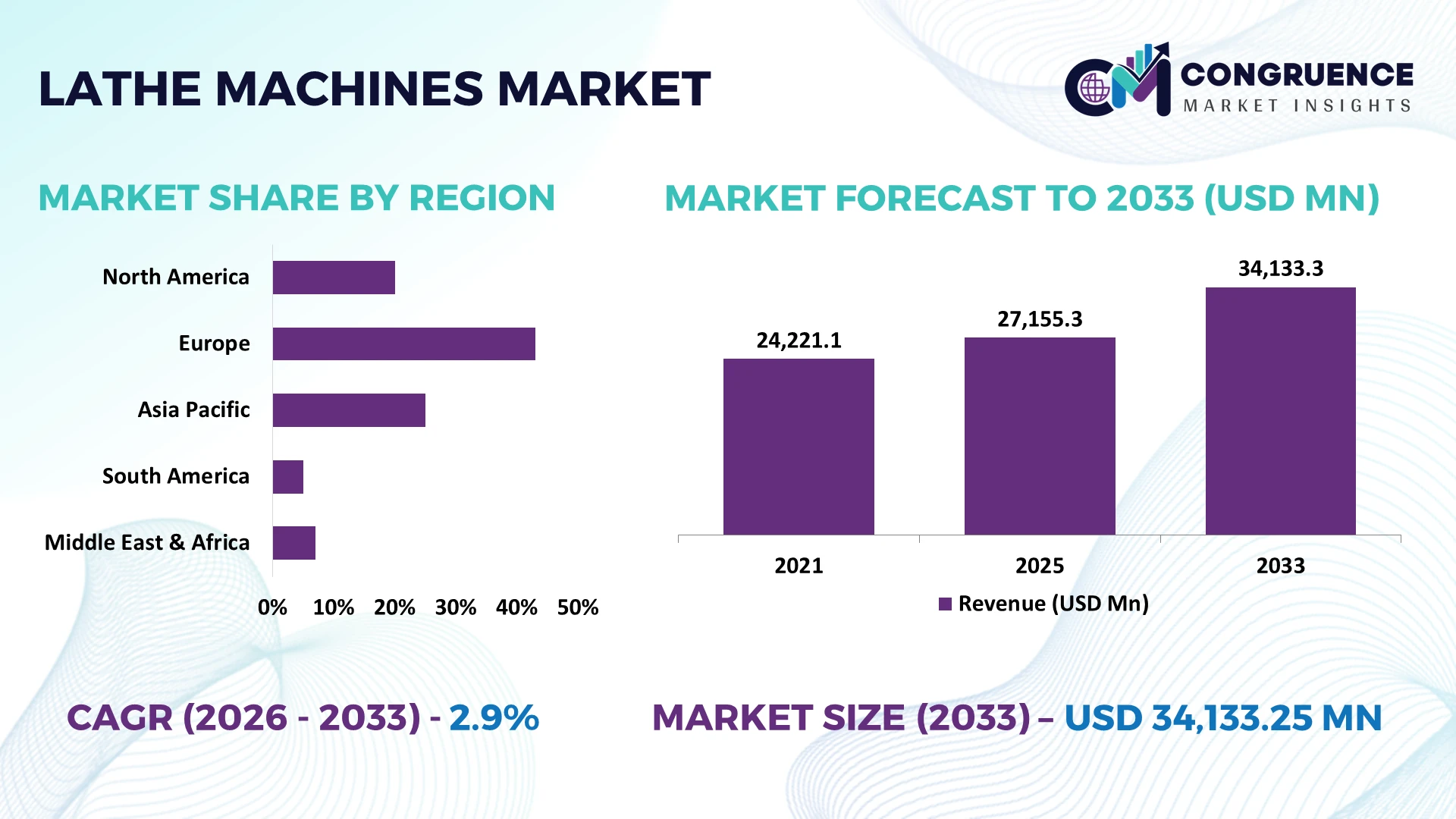
The Global Lathe Machines Market was valued at USD 27155.31 Million in 2025 and is anticipated to reach a value of USD 34133.25 Million by 2033 expanding at a CAGR of 2.9% between 2026 and 2033. Growth is driven by CNC replacement cycles, robotic machine tending, multi-axis turn-mill consolidation, EV component machining, aerospace precision requirements, and factory investment in lights-out production.
China is the dominant manufacturing country, accounting for approximately 37% of global machine-tool production in 2025, ahead of Germany at 12% and Japan at 10%. Its scale is reinforced by automotive, electronics, industrial machinery, and EV supply chains, while domestic producers increasingly integrate CNC controls, automated loading, predictive maintenance, and multi-axis turning. Compared with Japan, where approximately 73% of 2025 machine-tool orders came from overseas customers, China benefits from a substantially larger domestic production ecosystem. U.S. tariff pressure and manufacturing localization are simultaneously reshaping procurement, encouraging buyers to secure regional machine capacity and reduce dependence on long-distance machine-tool supply chains.
Strategically, suppliers should prioritize automated CNC lathes, turn-mill integration, localized service capacity, and flexible production cells because purchasing decisions are shifting toward throughput, labor substitution, and lifecycle productivity rather than standalone machine price.
Market Size & Growth: USD 27.16 billion in 2025 reaches USD 34.13 billion by 2033 at 2.9%, supported by CNC replacement and automated turning.
Top Growth Drivers: CNC machines represent about 81.9%, automotive applications approximately 28.5%, and Asia-Pacific around 48.1% of market activity.
Short-Term Forecast: By 2028, automated lathe cells can increase annual spindle utilization from approximately 1,560 hours toward 6,552 hours under optimized 24/7 operation.
Emerging Technologies: AI predictive maintenance, robotic loading, digital twins, and multi-axis turn-mill systems are advancing, while energy-optimized turning platforms can reduce consumption by up to 10%.
Regional Leaders: Applying the 2025 regional mix, Asia-Pacific represents approximately USD 13.0 billion, Europe USD 6.0 billion, and North America USD 5.1 billion, supported by automation upgrades.
Consumer/End-User Trends: Horizontal CNC lathes account for roughly 65.5% of CNC-lathe configurations, reflecting demand for versatile shaft, housing, and automotive-component machining.
Pilot/Case Example: In 2025, Interroll expanded automated turning capacity supporting component delivery within 5 days and emergency service fulfillment within 24 hours.
Competitive Landscape: Yamazaki Mazak, DMG MORI, Okuma, Haas Automation, and DN Solutions form a leading global supplier group with significant exposure to automated CNC turning.
Regulatory & ESG Impact: Advanced energy-management technologies can reduce machine electricity consumption by up to 10%, making lifecycle efficiency increasingly important in equipment procurement.
Investment & Funding: Japan’s 2025 machine-tool orders increased approximately 8–9%, while overseas orders expanded about 12–13%, indicating stronger export-oriented capital-equipment demand.
Innovation & Future Outlook: Automated production configurations can reach approximately 6,552 spindle hours annually, shifting investment toward unmanned operation, process consolidation, and digitally monitored machining.
Lathe Machines Market demand is increasingly concentrated in automotive components, aerospace structures, industrial machinery, medical parts, and precision subcontracting. CNC systems represent approximately 82% of market activity, while robotic tending, turn-mill consolidation, predictive maintenance, and energy-efficient drives are changing machine economics. Tariff pressure and manufacturing localization are reinforcing regional service networks, creating a direct transition into strategic market evaluation.
Lathe machines are becoming strategically important as manufacturers restructure production around automation, shorter supply chains, and higher component precision. CNC systems already represent about 82% of lathe-machine activity, while U.S. tariff pressure and localization policies are encouraging automotive, aerospace, and industrial suppliers to secure machining capacity closer to assembly plants. China’s roughly 37% share of global machine-tool production reinforces its manufacturing-scale advantage.
Modern CNC turning cells combine robotic loading, tool monitoring, digital controls, and unattended operation. Compared with a conventional single-shift lathe operating roughly 1,560 spindle hours annually, optimized automated cells can approach 6,552 hours, providing more than four times the productive availability. China leads manufacturing scale, while Germany and Japan differentiate through precision engineering, multi-axis machining, controls, and automation-intensive production.
A practical automotive cell links bar feeding, CNC turning, robotic unloading, inspection, and predictive maintenance with minimal operator intervention. Through 2026–2028, manufacturers are prioritizing turn-mill platforms, automation packages, localized service centers, and software partnerships; energy-management functions can reduce machine consumption by about 10%. Competitive positioning will increasingly depend on maximizing spindle utilization, consolidating machining steps, and delivering reliable unattended production rather than competing primarily on equipment price.
CNC penetration, labor constraints, and production localization are accelerating replacement of conventional turning equipment. CNC machines represent approximately 82% of lathe-machine activity, automotive applications account for about 28–29%, and horizontal configurations represent roughly 65% of CNC-lathe installations. Japan’s overseas machine-tool orders increased approximately 12–13% in 2025, reflecting renewed investment in automated production equipment. Automotive and precision-component plants increasingly combine lathes with bar feeders, robots, probing, and tool monitoring to reduce manual intervention. DMG MORI, Mazak, Okuma, and DN Solutions are responding with integrated automation and turn-mill platforms. The operational insight is utilization: automated cells convert machining investment from single-shift capacity into extended unattended production, allowing manufacturers to absorb labor shortages without proportionally expanding factory headcount.
Advanced CNC lathes require substantially higher upfront investment than conventional machines because servo systems, controls, live tooling, robotics, probing, and software are increasingly bundled into production cells. Machine-tool utilization can fall below 50% in poorly balanced job shops, undermining returns on expensive automation, while financing costs remain elevated in several manufacturing economies. Germany’s machine-tool production declined approximately 8% in 2025, illustrating weak capital-equipment conditions despite strong engineering capability. Imported controls, precision bearings, ball screws, and electronics also expose manufacturers to currency and supply-chain volatility. Buyers are responding through equipment leasing, phased automation, standardized platforms, and regional sourcing. Suppliers are expanding financing and lifecycle-service packages. The non-obvious constraint is therefore not machine price alone; insufficient production volume can make technically superior automation economically inefficient.
Multi-axis turn-mill systems create a high-value opportunity by replacing separate turning, milling, drilling, and secondary handling operations with single-machine processing. Automated configurations can raise productive availability from roughly 1,560 annual spindle hours toward 6,552 hours, while energy-management functions can lower electricity consumption by up to 10%. India provides a particularly attractive deployment environment as automotive, defense, electronics, railway, and aerospace suppliers increase domestic precision manufacturing under localization programs. Through 2026–2028, digital twins, AI-assisted process optimization, in-machine metrology, and adaptive tool monitoring will extend unattended machining. OEMs are investing in compact automation cells, local application centers, and integration partnerships. Strategically, process consolidation creates value beyond labor savings: fewer setups reduce work-in-progress, floor-space requirements, transfer errors, and lead-time variability simultaneously.
Scaling automated turning requires programmers, mechatronics technicians, process engineers, and maintenance specialists capable of integrating CNC controls, robots, probing, tooling, and production software. Manufacturing employers in advanced economies continue reporting skilled-worker shortages, while automated cells can exceed 80% utilization only when programming, preventive maintenance, and material flow remain synchronized. Cybersecurity adds another execution layer as connected CNC machines exchange production data through factory networks; manufacturing consistently represents more than 20% of observed industrial cyber incidents. Japan and Germany face additional workforce aging, increasing pressure for unattended machining while simultaneously reducing experienced technical labor. Manufacturers are responding with simulation software, remote diagnostics, standardized robot interfaces, apprenticeships, and OEM training centers. The strategic challenge is organizational: purchasing automation is faster than building the process discipline required to operate it consistently at high utilization.
Unattended Turning Gains Production Share: Manufacturers are extending spindle utilization through robotic loading, bar feeding, in-process gauging, and automated tool monitoring. Japan’s NC machine-tool ratio reached approximately 93.5%, while foreign machine-tool orders represented 70.3% of total orders. Labor shortages and reshoring pressure are pushing suppliers toward standardized automation packages that reduce operator dependence and improve multi-shift production consistency.
Turn-Mill Platforms Replace Separate Machines: Multi-tasking lathes are consolidating turning, milling, drilling, and probing within one setup, reducing workpiece transfers and accumulated positioning errors. Modern automated cells can raise productive availability from roughly 1,560 to more than 6,500 spindle hours annually. OEMs are expanding integrated turn-mill portfolios as aerospace, medical, and precision-component manufacturers prioritize shorter lead times and reduced work-in-progress.
Energy Monitoring Enters Machine Procurement: Machine builders are embedding energy dashboards, regenerative drives, adaptive standby modes, and digitally optimized auxiliary systems. Advanced energy-management packages can reduce electricity consumption by about 10%, while automated shutdown of pumps and peripherals lowers non-cutting consumption further. European manufacturers are increasingly evaluating lifecycle energy alongside cycle time, prompting suppliers to redesign coolant, hydraulic, and drive architectures.
Export Demand Reshapes Production Networks: Japanese foreign machine-tool orders increased 3.4% in 2024 and represented more than 70% of total orders, while Asian orders advanced 21%. Manufacturers are strengthening overseas service, localized assembly, spare-parts inventories, and application centers. The non-obvious shift is service localization: machine availability increasingly determines supplier selection as globally distributed factories demand faster technical support.
CNC Lathes lead the type segment with an estimated 60–65% share, reflecting their scalability across automotive, machinery, aerospace, and precision-component production. Numerical control enables repeatable tolerances, automated tool changes, live tooling, and integration with robots and bar feeders, giving CNC systems a decisive productivity advantage over Engine Lathes. Engine Lathes retain relevance in maintenance, training, repair shops, and low-volume work where programming overhead is less economical. Turret Lathes remain useful for repetitive component batches requiring multiple sequential tools.
Swiss-Type Lathes represent the fastest-growing type, supported by medical devices, electronics, connectors, and miniature aerospace components requiring tight tolerances and high length-to-diameter ratios. Their share is estimated near 12–15%, while Vertical Lathes account for roughly 10–12% and remain strategically important for large-diameter parts such as wheels, turbine components, and heavy-equipment rings. OEM investment is shifting toward Swiss automation, multi-axis CNC platforms, and integrated metrology rather than conventional standalone machines.
Turning leads application demand with an estimated 45–50% share because cylindrical shafts, housings, bushings, pins, axles, and rotating components require external-diameter machining across automotive, industrial machinery, energy, and aerospace production. Facing represents approximately 15–18% of application activity and remains a routine preparatory or finishing process in most turned-component workflows. Threading also maintains strong utilization where fasteners, connectors, hydraulic fittings, and oilfield components require controlled pitch and repeatable geometry.
Boring is the fastest-strengthening application, representing roughly 12–15% of demand as manufacturers increasingly produce precision internal diameters, bearing seats, valve bodies, and aerospace housings on integrated CNC platforms. Knurling remains smaller but strategically relevant for tool handles, fittings, medical instruments, and operator-contact surfaces. Machine builders are expanding live tooling, programmable boring cycles, rigid threading, and in-process probing. Investment is moving toward machines capable of completing multiple operations without rechucking, reducing setup time and dimensional variation.
Automotive Manufacturers represent the leading end-user group with an estimated 30–35% share, supported by high-volume production of shafts, hubs, transmission components, brake parts, bearings, and powertrain housings. Automotive orders remain sensitive to vehicle production cycles, but EV platforms are shifting machining demand toward motor shafts, thermal-management components, and precision transmission parts. Industrial Machinery follows with approximately 25–28% share, benefiting from diverse demand for gears, rollers, spindles, hydraulic components, and equipment assemblies.
Aerospace Manufacturers are the fastest-growing end-user group as titanium, nickel alloys, landing-gear components, shafts, and engine hardware require high-precision multi-axis turning. Metal Fabrication remains an established buyer for job-shop and subcontract machining, while Oil & Gas sustains specialized demand for threaded tubulars, valves, couplings, and large-bore components. Suppliers are targeting aerospace through rigid turn-mill systems and traceable process monitoring, while automotive customers receive high-throughput automation cells designed around cycle-time reduction and repeatability.
Asia-Pacific accounted for the largest market share at 48.1% in 2025 however, Asia-Pacific is expected to register the fastest growth, expanding at a CAGR of 3.4% between 2026 and 2033.

Automation Investment Supports Reshoring Capacity
North America represents approximately 18–19% of lathe-machine demand, with the United States driving deployment across automotive, aerospace, defense, medical devices, and general machining. Reshoring and tariff-related supply-chain restructuring are strengthening investment in CNC turning centers, robotic tending, and multi-axis systems. U.S. manufacturers are prioritizing machines that reduce setup time, support unattended operation, and integrate inspection directly into production cells. Aerospace and defense suppliers are especially focused on rigid turning platforms capable of machining nickel alloys, titanium, and high-value cylindrical components. Machine-tool builders are expanding application centers, automation partnerships, and localized technical support because service responsiveness now influences equipment selection alongside spindle performance. The strongest operational shift is toward flexible cells capable of producing multiple part families without extensive manual changeovers.
United States Market Outlook: The United States combines large aerospace, automotive, defense, and subcontract machining bases with strong demand for automated CNC equipment. Manufacturing reshoring is increasing interest in domestic machining capacity, while aerospace suppliers require tight-tolerance turning for shafts, landing-gear parts, and engine components. Buyers increasingly favor robotic loading, in-process probing, digital monitoring, and local service networks to protect uptime.
Precision Engineering Drives High-End Replacement
Europe accounts for approximately 22–23% of lathe-machine demand, anchored by Germany, Italy, Switzerland, France, and the Czech Republic. The region’s advantage lies in precision engineering, complex component production, and advanced machine-tool integration rather than low-cost volume manufacturing. Germany remains central to automotive, industrial machinery, aerospace, and automation-intensive machining, while Italy contributes a strong specialist machine-building base. Manufacturers are replacing older turning equipment with multi-axis, energy-efficient, and digitally monitored systems that reduce secondary operations. Energy costs and stricter industrial-efficiency targets are increasing interest in regenerative drives and optimized auxiliary systems, with some platforms reducing machine electricity consumption by about 10%. Suppliers are expanding software integration, retrofit packages, and service-based lifecycle support. Competitive advantage increasingly comes from combining accuracy, automation, and energy performance in one platform.
Germany Market Outlook: Germany remains Europe’s most strategically important lathe-machine market because of its dense automotive, industrial-equipment, and precision-engineering ecosystem. Machine-tool production declined around 8% in 2025, increasing pressure on suppliers to differentiate through automation, lifecycle efficiency, and export competitiveness. German buyers favor turn-mill platforms, closed-loop measurement, predictive maintenance, and reliable service infrastructure to maximize utilization.
Manufacturing Scale Sustains Global Leadership
Asia-Pacific holds approximately 48.1% of global lathe-machine demand, supported by China, Japan, India, South Korea, and Taiwan. China alone accounts for roughly 37% of global machine-tool production, giving the region unmatched manufacturing scale and a dense supplier base for controls, bearings, spindles, castings, robotics, and automation systems. Japan remains a technology leader in precision CNC systems, while India is expanding domestic machining capacity across automotive, railways, aerospace, defense, and industrial machinery. Japanese foreign machine-tool orders represented more than 70% of total orders in 2024, illustrating the region’s export importance. Suppliers are increasing localized assembly, dealer coverage, application engineering, and automation integration. Asia-Pacific’s structural advantage is not only volume; rapid supplier coordination allows faster customization and shorter product-development cycles.
China Market Outlook: China is the world’s largest machine-tool production base and benefits from deep automotive, EV, electronics, machinery, and industrial supply chains. Its approximately 37% share of global machine-tool production supports extensive domestic demand for CNC lathes and automated turning cells. Chinese manufacturers increasingly compete through lower acquisition cost, localized controls, fast customization, and integration with domestic robotics and factory-automation ecosystems.
Industrial Modernization Centers on Brazil
South America represents approximately 4–5% of global lathe-machine demand, with Brazil accounting for the majority of regional activity. Automotive manufacturing, agricultural machinery, oilfield equipment, mining, and metal fabrication underpin lathe utilization, while Argentina contributes demand from transport equipment and industrial workshops. Brazil’s installed manufacturing base supports both conventional engine lathes and increasingly automated CNC turning systems, particularly among Tier 1 automotive suppliers and precision subcontractors. Currency volatility and imported machine costs constrain modernization speed, encouraging phased upgrades and used-equipment purchases. Suppliers are responding with local distributors, financing packages, retrofit services, and spare-parts inventories to reduce ownership risk. The strongest commercial opportunity lies in replacing aging equipment where measurable productivity gains justify capital expenditure despite tighter financing conditions.
Brazil Market Outlook: Brazil combines the region’s largest automotive, agricultural-equipment, mining, and oilfield manufacturing base with an established network of machine shops and industrial suppliers. Automotive production exceeds 2 million vehicles annually, supporting sustained demand for shafts, hubs, transmission parts, and machined housings. Local buyers increasingly prioritize CNC retrofits, flexible automation, and supplier financing to manage capital constraints while improving throughput.
Industrial Diversification Expands Machining Demand
Middle East & Africa accounts for approximately 6–7% of lathe-machine demand, with activity concentrated in Saudi Arabia, the UAE, Turkey, South Africa, and selected North African industrial hubs. Saudi industrial diversification is expanding requirements for precision machining in defense, energy equipment, maintenance, and localized manufacturing, while the UAE is strengthening aerospace and advanced-manufacturing capabilities. South Africa contributes mining, automotive, fabrication, and repair demand. Oilfield service companies remain major users of large-bore lathes for valves, couplings, threaded components, and rotating equipment. Localization programs are encouraging investment in domestic machining capability rather than imported finished components. Machine suppliers are building regional service partnerships, training programs, and turnkey production cells. The key execution requirement is dependable after-sales support because downtime and imported spare-parts delays materially affect machine economics.
Saudi Arabia Market Outlook: Saudi Arabia is the most strategically significant market as Vision 2030 localization increases investment in defense, energy, industrial equipment, and advanced manufacturing. Domestic-content programs are encouraging suppliers to establish machining, maintenance, and assembly capability locally. Demand is strongest for CNC lathes, large-bore turning centers, and automated cells supported by training, spare-parts availability, and technical-service partnerships.
DMG MORI, Yamazaki Mazak, Okuma, DN Solutions, and Haas Automation compete directly in advanced CNC turning, while lower-cost Asian OEMs pressure pricing in standardized machine categories. The top five players collectively hold approximately 30–35% of global lathe-machine demand. Competition centers on automation, precision, lifecycle service, and acquisition cost; integrated robotic cells can raise spindle utilization by more than 300%, while energy-management systems reduce consumption by up to 10%. Japanese and German suppliers defend premium positioning through multi-axis capability, software integration, and reliability, whereas Korean and Chinese manufacturers compete through faster customization and lower capital cost. Players are expanding application centers, local assembly, automation partnerships, and digital-service platforms. The competitive shift favors complete machining ecosystems over standalone equipment. Entry barriers include control expertise, spindle engineering, service infrastructure, and application knowledge. Winning requires high uptime, automation-ready platforms, fast local support, and competitive total cost of ownership.
DMG MORI
Yamazaki Mazak
Okuma Corporation
DN Solutions
Haas Automation
JTEKT Machinery
EMAG GmbH
INDEX-Werke
Tsugami Corporation
Citizen Machinery
Hurco Companies
Hyundai WIA
Takisawa Machine Tool
Hardinge Inc.
Current lathe technology centers on CNC controls, servo drives, live tooling, robotic tending, in-process probing, and spindle-condition monitoring. CNC systems represent roughly 82% of lathe-machine activity, while automated cells can lift annual spindle availability from about 1,560 hours to more than 6,500 hours. Energy-management packages reduce machine electricity consumption by up to 10%, improving utilization economics and lowering operating cost for high-volume manufacturers.
Emerging platforms combine digital twins, AI-assisted tool-life prediction, adaptive cutting, automated workholding, and turn-mill integration. Compared with conventional standalone lathes, multi-tasking systems can eliminate 20–30% of secondary setups by combining turning, milling, drilling, and probing in one cycle. Adoption is strongest among automotive, aerospace, medical, and precision-engineering plants requiring repeatability, shorter lead times, and reduced operator intervention. Suppliers with integrated automation and software ecosystems gain stronger lifecycle-service positions.
Between 2026 and 2028, disruptive development will center on autonomous process optimization, closed-loop metrology, edge analytics, and standardized machine connectivity. Predictive maintenance can cut unplanned downtime by roughly 15–25% in connected machining environments. Manufacturers acting now can build higher machine availability, lower work-in-progress, and stronger data-driven process control before autonomous turning becomes a baseline procurement requirement. This matters because machining data increasingly determines productivity, service differentiation, and customer retention.
September 2024 Okuma launched the LB2000 EX III and LB4000 EX III horizontal lathes at IMTS, alongside OSP-P500 controls; 11 of 14 displayed CNC machines used automation, strengthening its integrated turning, robotics, and digital-production proposition for manufacturers globally. Source: okuma.com
October 2025 Mazak unveiled the QRX-50MSY CNC turning center with a 15% smaller footprint while retaining high-volume throughput, combining twin spindles, milling, and Y-axis capability to improve floor-space productivity for EV shafts, fittings, and small precision components manufacturers. Source: mazak.com
October 2024 DMG MORI launched the CLX 550 TC turn-mill center with 12,000-rpm spindle, 60-tool capacity, and automated feature recognition accelerating programming by up to 80%, improving six-sided machining efficiency and reducing setup dependence for complex, high-mix production. Source: etmm-online.com
April 2026 DMG MORI joined CCMT Shanghai as German exhibitors totaled about 140 across 6,000 square meters; its China-focused turning and automation presence strengthened access to the world’s largest machine-tool market and supported localized industrial partnerships and production. Source: vdw.de
The Lathe Machines Market Report covers Engine Lathes, CNC Lathes, Turret Lathes, Swiss-Type Lathes, and Vertical Lathes across Turning, Threading, Facing, Boring, and Knurling. CNC Lathes account for approximately 60–65% of type demand, while Automotive Manufacturers represent about 30–35% of end-user activity. Aerospace Manufacturers, Industrial Machinery, Metal Fabrication, and Oil & Gas are assessed through application intensity, precision requirements, automation readiness, and replacement cycles.
Regional analysis spans North America, Europe, Asia-Pacific, South America, and Middle East & Africa, evaluating manufacturing density, localization, capital-equipment investment, service infrastructure, and CNC adoption. Technology coverage includes robotic tending, turn-mill integration, digital twins, predictive maintenance, in-process probing, and energy-management systems. The 2026–2033 framework supports investment planning, plant expansion, supplier selection, competitive positioning, and identification of high-value opportunities in Swiss-type machining, unattended production, aerospace turning, and localized service ecosystems.
| Report Attribute/Metric | Report Details |
|---|---|
Market Revenue in 2025 | USD 27155.31 Million |
Market Revenue in 2033 | USD 34133.25 Million |
CAGR (2026 - 2033) | 2.9% |
Base Year | 2025 |
Forecast Period | 2026 - 2033 |
Historic Period | 2021 - 2025 |
Segments Covered | By Type
By Application
By End-User
|
Key Report Deliverable | Revenue Forecast, Growth Trends, Market Dynamics, Segmental Overview, Regional and Country-wise Analysis, Competition Landscape |
Region Covered | North America, Europe, Asia-Pacific, South America, Middle East, Africa |
Key Players Analyzed | DMG MORI, Yamazaki Mazak, Okuma Corporation, DN Solutions, Haas Automation, JTEKT Machinery, EMAG GmbH, INDEX-Werke, Tsugami Corporation, Citizen Machinery, Hurco Companies, Hyundai WIA, Takisawa Machine Tool, Hardinge Inc. |
Customization & Pricing | Available on Request (10% Customization is Free) |




