
Reports
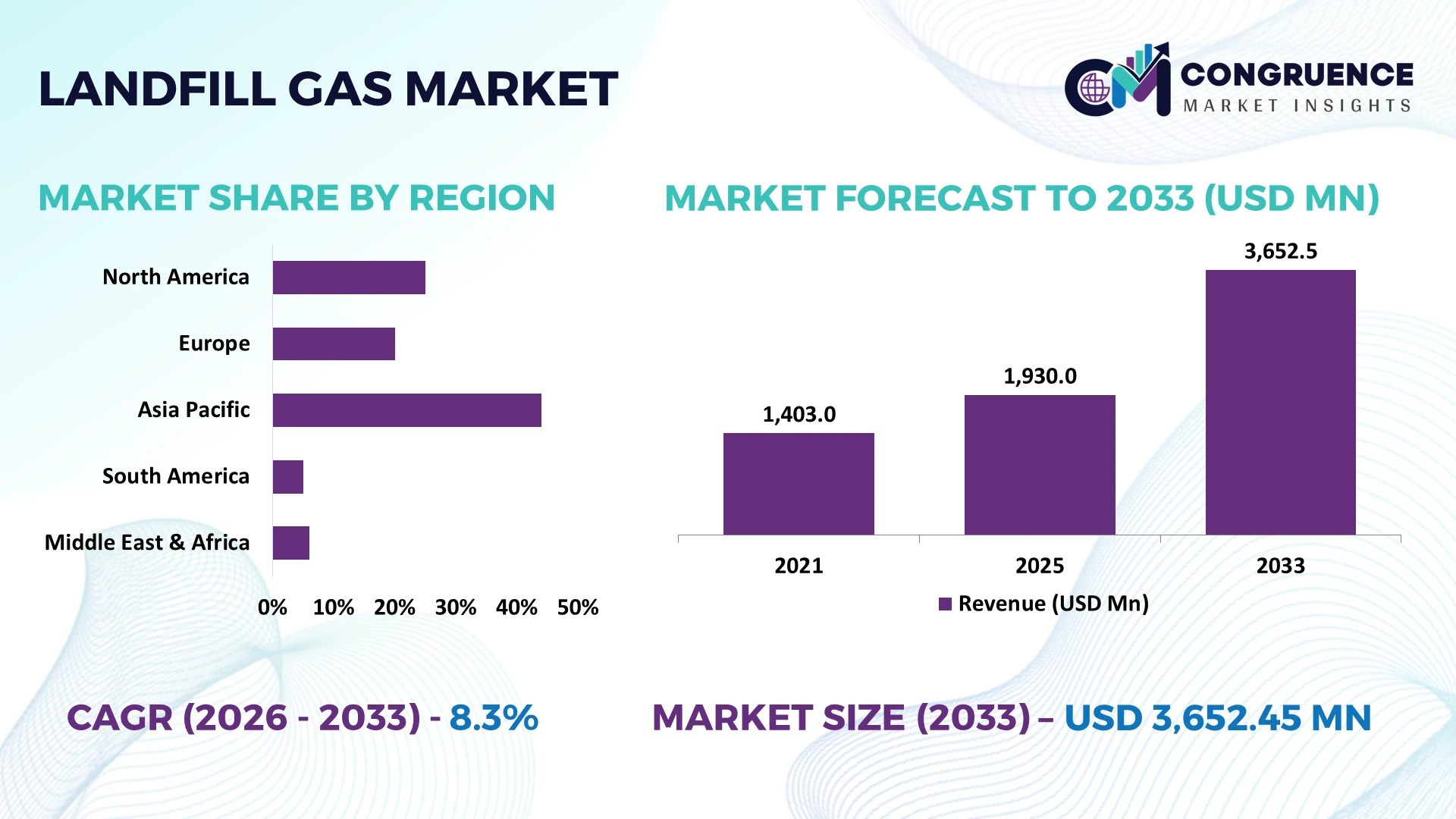
The Global Landfill Gas Market was valued at USD 1930 Million in 2025 and is anticipated to reach a value of USD 3652.45 Million by 2033 expanding at a CAGR of 8.3% between 2026 and 2033. Growth is driven by stricter methane-emission regulations, landfill-gas-to-energy investments, and advanced upgrading systems that convert captured methane into pipeline-quality renewable natural gas (RNG).
The United States leads in established commercial deployment, with 542 operational landfill-gas energy projects across 488 municipal solid-waste landfills as of September 2024. Its market benefits from mature waste-management infrastructure, established gas collection systems, and electricity and RNG offtake opportunities. Europe emphasizes biomethane upgrading and grid injection, supported by decarbonization policies and cross-border energy-security priorities following Russia's invasion of Ukraine. Spain's Can Mata project demonstrates this approach, producing approximately 70 GWh of renewable gas annually. These contrasting models position North America around deployment scale and Europe around biomethane integration.
Strategic implication: Prioritize landfills with stable methane volumes, established collection infrastructure, accessible gas grids, and contracted offtake to optimize project economics and reduce investment risk.
Market Size & Growth: Valued at USD 1930 Million in 2025, projected to USD 3652.45 Million by 2033 at 8.3% CAGR, driven by renewable natural gas demand from utilities and transportation sectors .
Top Growth Drivers: RNG demand from utilities at 38.5% segment share, municipal solid waste generation growth from urbanization, and methane emission regulations driving capture infrastructure investment .
Short-Term Forecast: By 2027, gas upgrading technology adoption expands as developers pursue pipeline-quality RNG, delivering higher revenue per unit than electricity generation pathways .
Emerging Technologies: Membrane upgrading systems with higher methane recovery rates, green hydrogen production from landfill gas reforming, and AI-enabled leak detection using drones and satellite monitoring .
Regional Leaders: North America at 38.5% share with mature RNG infrastructure, Asia-Pacific fastest-growing at 10.5% CAGR through China and India expansion, and Europe driven by Germany and France biomethane mandates .
Consumer/End-User Trends: Electricity generation commands 70.56% of application share; utility segment represents 38.5% and growing at 7.1% annually as RNG integrates into decarbonization portfolios .
Pilot/Case Example: Waga Energy and PreZero commissioned WAGABOX unit at Can Mata, Spain producing 70 GWh of grid-compliant biomethane annually, avoiding 17,000 tonnes CO2 equivalent per year .
Competitive Landscape: Waste Management, Republic Services, and Waste Connections lead; Ameresco, Waga Energy, and Bioenergy Infrastructure Group compete on RNG project development and upgrading technology .
Regulatory & ESG Impact: Global Methane Pledge signatories drive policy momentum; US state-level landfill rules exceeding EPA standards target methane reductions of 800,000 metric tons annually .
Investment & Funding: EU Innovation Fund provided EUR 2.4 million grant for Can Mata project; Global Methane Hub committed USD 30 million to scale organic waste methane mitigation .
Innovation & Future Outlook: Green hydrogen from landfill gas reforming, modular processing technologies reducing project costs, and advanced membrane materials overcoming pressure swing adsorption limitations reshape market economics .
The landfill gas market is increasingly shaped by municipal waste operators, renewable energy developers, utilities, and industrial facilities seeking reliable methane recovery and lower-carbon fuel supplies. Demand concentrates on landfill-gas collection systems, gas engines, flare upgrades, hydrogen sulfide removal, and advanced biomethane purification. Treatment technologies targeting 15% higher throughput and an 80% reduction in operating costs strengthen the business case for retrofits when supported by verified project data. As grid-injection projects expand, interconnection approvals, gas-quality compliance, and long-term purchase agreements increasingly determine project feasibility and capital allocation.
The landfill gas market is becoming strategically important as waste operators compete to convert methane emissions into dependable energy assets. Methane regulations, renewable fuel procurement, and energy-security priorities are redirecting capital toward gas collection, purification, and grid-injection infrastructure. In the United States, 542 operational landfill-gas energy projects across 488 municipal solid-waste landfills demonstrate the scale of an established deployment base. For investors, the differentiator is increasingly the ability to monetize recovered gas through contracted electricity sales or renewable natural gas offtake rather than relying solely on disposal-site operations.
Technology selection is reshaping project economics. Conventional flaring destroys methane without recovering its energy value, whereas gas upgrading removes carbon dioxide and contaminants to produce pipeline-quality biomethane. Membrane separation and automated gas-quality monitoring improve process control, although actual efficiency and cost advantages depend on feed-gas composition, plant scale, and maintenance requirements. Spain's Can Mata facility, producing approximately 70 GWh of renewable gas annually, illustrates how upgrading infrastructure connects landfill operations with established gas networks.
Over the next two to three years, investment priorities will favor retrofit-ready landfills, reliable methane measurement, and infrastructure with secured offtake. U.S. operators benefit from a mature project base, while European developers face stronger incentives to integrate biomethane into decarbonization and energy-security strategies. Companies are strengthening positions through technology partnerships, gas-grid agreements, and long-term supply contracts. Competitive advantage will depend on verified methane recovery, consistent gas quality, and the ability to convert environmental compliance into predictable operating returns.
Methane-abatement requirements and industrial demand for lower-carbon fuels are accelerating landfill-gas utilization. Raw landfill gas typically contains 45–60% methane, creating an opportunity to recover energy while reducing uncontrolled emissions. Gas collection, however, must capture methane before it escapes through landfill surfaces. In the United States, established landfill-gas energy infrastructure provides a foundation for expanding recovery and upgrading capacity. Companies are responding by modernizing collection wells, installing automated flow controls, and partnering with energy marketers. The strategic advantage lies in integrating emissions management with commercial energy production, enabling operators to turn regulatory obligations into productive assets without treating every landfill as an identical investment opportunity.
Landfill-gas commercialization faces constraints from variable methane concentration, contaminant loads, and uneven access to energy infrastructure. Typical raw gas contains approximately 45–60% methane and 35–50% carbon dioxide, requiring treatment before pipeline injection or higher-specification industrial use. Collection efficiency also varies substantially with landfill design, moisture, cover integrity, and wellfield management; engineering assessments commonly evaluate capture rates across a broad 50–90% range. These variations affect equipment sizing, treatment costs, and delivered-gas consistency. In India, fragmented waste infrastructure and differences in landfill engineering complicate project standardization. Developers are mitigating exposure through site-specific gas assessments, modular upgrading systems, and long-term offtake contracts. The central constraint is bankability: recoverable methane volume matters more than nominal landfill size.
Biomethane upgrading creates opportunities to supply gas-grid operators, industrial heat users, and transport-fuel markets from existing waste infrastructure. Raw landfill gas typically contains 45–60% methane, while upgraded biomethane must meet the applicable receiving network's stringent gas-quality specifications. Spain's Can Mata facility, with approximately 70 GWh of annual production, demonstrates the potential to connect landfill recovery with established gas distribution infrastructure. In the next phase, AI-assisted wellfield balancing, continuous methane measurement, and advanced membrane systems can improve operational decisions and identify underperforming collection zones. Companies should prioritize retrofits at sites with stable gas generation, develop partnerships with gas distributors, and structure offtake agreements before committing to major upgrading capacity.
Maintaining reliable landfill-gas production requires coordinated control of gas wells, condensate removal, treatment equipment, and downstream energy systems. Methane concentrations of approximately 45–60% create a variable feedstock that demands continuous monitoring, while changing waste decomposition rates alter gas availability over a landfill's operating life. Operators must also maintain equipment performance during fluctuations in moisture, hydrogen sulfide, and siloxane concentrations. These pressures complicate automation, predictive maintenance, and consistent delivery to power plants or gas networks. Companies need integrated monitoring systems, trained field technicians, and interoperable control platforms that connect landfill operations with upgrading and offtake infrastructure. Competitive resilience will depend on sustaining verified capture performance and reliable gas quality throughout the asset lifecycle.
Methane is the principal value-bearing component of landfill gas, typically accounting for approximately 45–60% of raw gas composition. Its energy content supports electricity generation, industrial combustion, and renewable natural gas production, making methane recovery the primary commercial objective. Carbon dioxide commonly represents approximately 35–50% of raw gas, creating separation requirements for biomethane upgrading. Trace gases, including hydrogen sulfide, siloxanes, and volatile organic compounds, occur at lower concentrations but can damage engines, contaminate equipment, and compromise gas quality. These composition ranges vary by landfill and should not be interpreted as market revenue shares.
Methane utilization remains the established commercial priority, while demand for carbon dioxide separation is increasing alongside pipeline-quality gas production. Trace-gas removal remains essential to equipment protection and specification compliance. Companies are investing in selective membranes, adsorption systems, and monitoring technologies to improve treatment reliability. Investment decisions increasingly favor integrated treatment trains that recover methane efficiently while controlling contaminants and minimizing downtime.
Electricity generation remains the leading established application, supported by mature engine-generator technology, existing grid connections, and proven operating models. Grand View Research estimated that electricity generation accounted for approximately 43% of global landfill gas market revenue in 2025. Its commercial advantage lies in converting captured gas into power without requiring the extensive purification necessary for pipeline injection. Direct thermal energy and combined heat and power (CHP) provide additional value where industrial facilities can use recovered heat. Industrial fuel applications similarly benefit when landfill sites are located near suitable consumers.
Renewable natural gas is gaining strategic importance as upgrading technology enables pipeline injection and vehicle-fuel applications. The U.S. Environmental Protection Agency recorded 102 operational RNG projects in 2023, compared with 347 electricity projects, indicating a smaller but established alternative utilization pathway. Companies are expanding gas purification, compression, and grid-interconnection capabilities to serve utilities and fuel buyers. The strongest investment cases combine dependable gas output with accessible infrastructure and contracted demand.
Power generation plants represent a major established end-user group because landfill gas engines and turbines can convert recovered methane into electricity using proven equipment. Their operating models benefit from existing grid infrastructure, established maintenance practices, and relatively straightforward energy delivery. Natural gas utilities are increasingly relevant buyers as developers upgrade landfill gas to pipeline-quality biomethane. Industrial facilities also offer localized demand for thermal energy, steam, and CHP, particularly where fuel substitution can be integrated into existing production systems. Municipal authorities and waste management companies remain central to project development because they control landfill operations, collection infrastructure, and access agreements.
Transportation fuel providers represent an emerging demand channel as RNG upgrading supports compressed natural gas and other compatible fuel applications. U.S. EPA data recorded 102 operational RNG projects in 2023, compared with 347 electricity projects, illustrating the difference in deployment maturity. Companies are responding through utility partnerships, fuel-supply contracts, and integrated development agreements linking landfill operators with gas processors and end-users. Future positioning will depend on matching gas quality, delivery infrastructure, and contract structures to each buyer's operating requirements.
North America accounted for the largest market share at 38.6% in 2025; however, Asia-Pacific is expected to register the fastest growth between 2026 and 2033, driven by increasing municipal waste generation, landfill infrastructure modernization, and methane-recovery investments.
Established infrastructure shifts competition toward recovery efficiency and gas monetization
North America benefits from mature landfill operations, established gas collection networks, experienced waste-management companies, and proven electricity-generation systems. The United States anchors regional deployment, with investment increasingly extending beyond conventional gas engines into renewable natural gas (RNG) upgrading, compression, and pipeline injection. The U.S. Environmental Protection Agency recorded 542 operational landfill-gas energy projects across 488 municipal solid-waste landfills in September 2024. This installed base supports retrofit opportunities, although individual project economics depend on methane availability, contaminant levels, and proximity to energy infrastructure. Technology suppliers compete on recovery performance, equipment reliability, and lifecycle servicing, while operators prioritize contracted offtake and asset utilization. Canadian projects add opportunities through municipal waste management and renewable-fuel development. Companies that integrate collection, treatment, and energy sales are better positioned to capture value from existing landfill assets.
United States Market Outlook: The United States remains the region's operational benchmark because established waste-management operators, environmental compliance frameworks, and specialist technology providers support deployment at scale. The EPA's landfill methane program identifies additional candidate sites for project development, enabling developers to screen facilities for collection-system upgrades and energy recovery. Investment priorities center on reliable methane measurement, modular upgrading equipment, and agreements with utilities and fuel buyers.
Biomethane integration reshapes landfill investment priorities
European landfill-gas development is increasingly influenced by methane-emission controls, renewable-gas integration, and energy-security priorities. EU decarbonization policy encourages improved management of biodegradable waste and supports the broader transition toward renewable fuels, although landfill diversion requirements also constrain long-term feedstock availability in some markets. Developers are therefore focusing on recovering gas from operating and legacy landfill sites rather than assuming a continuously expanding waste base. Spain's Can Mata facility demonstrates the upgrading pathway, producing approximately 70 GWh of biomethane annually. Germany, France, and the United Kingdom contribute through waste-treatment infrastructure, engineering capabilities, and established energy networks. Gas-quality specifications, grid access, and permitting remain decisive commercial variables. Companies are strengthening positions through upgrading partnerships and utility agreements, prioritizing sites with predictable gas production and dependable biomethane offtake.
Germany Market Outlook: Germany's advanced waste-treatment infrastructure, industrial engineering base, and established gas distribution system support specialized gas recovery and purification projects. Developers must assess landfill-specific methane availability alongside stringent environmental requirements and competing waste-treatment pathways. Technology providers can differentiate through contaminant removal, process automation, and service contracts that improve equipment availability and reduce interruptions to energy delivery.
Urban waste growth creates demand for engineered methane recovery
Asia-Pacific offers substantial deployment potential as urbanization increases municipal waste volumes and governments modernize waste-treatment infrastructure. China benefits from large-scale municipal waste management and established environmental engineering capabilities, while Japan emphasizes advanced waste processing and operational efficiency. India and Indonesia present opportunities to improve methane collection at existing disposal sites, although open dumping, inconsistent waste segregation, and uneven landfill engineering restrict project suitability. The Institute for Global Environmental Strategies reported that Asia generated an estimated 684.5 million tonnes of carbon-dioxide-equivalent methane emissions from the waste sector in 2024, underscoring the scale of the mitigation requirement. This figure covers the broader waste sector, not landfill gas alone. Developers are targeting engineered sites with measurable gas potential and combining collection upgrades with local power generation to reduce dependence on extensive pipeline infrastructure.
China Market Outlook: China's large municipal waste-treatment base, industrial equipment supply chains, and environmental infrastructure investment support landfill-gas collection and utilization. Project developers can draw on domestic engineering and automation capabilities to deploy monitoring equipment, gas treatment, and energy recovery systems. However, investment screening must distinguish engineered landfills with stable methane generation from facilities where waste diversion or operating conditions limit recoverable gas. Partnerships with municipal waste authorities and local energy users are central to improving project economics.
Established urban landfill projects anchor regional commercialization
South America offers landfill-gas opportunities concentrated around major urban waste systems, particularly in Brazil, where established landfill projects have demonstrated methane recovery, flaring, and electricity generation. The United Nations Framework Convention on Climate Change's 2024 national inventory report for Brazil identified 51 landfill methane recovery projects operating during 2003–2022, of which 37 submitted monitoring reports. This historical deployment base demonstrates project experience but does not represent the current operating fleet. Developers face uneven access to financing, grid connections, and standardized landfill infrastructure across countries. Carbon-market mechanisms and emissions-reduction programs can improve project economics when monitoring and verification requirements are met. Companies are prioritizing large municipal landfills, local utility partnerships, and phased collection-system investments to limit upfront exposure. Commercial success depends on reliable gas production and a viable energy or emissions-credit revenue pathway.
Brazil Market Outlook: Brazil benefits from experience with landfill-gas management projects across large metropolitan waste systems, including São Paulo and Rio de Janeiro. Its established environmental project-development capabilities provide a foundation for expanding collection, flaring, and energy recovery. Developers should prioritize facilities with verified methane availability, clear landfill operating rights, and dependable grid access. Carbon-credit verification and municipal contracting remain important factors in securing finance and sustaining project performance.
Waste infrastructure modernization creates selective investment opportunities
The Middle East and Africa market is shaped by landfill modernization, urban waste growth, and investment in more controlled waste-disposal systems. South Africa has an established municipal landfill-gas project history, while the United Arab Emirates and Saudi Arabia are investing in broader waste-management and circular-economy infrastructure. However, landfill-gas deployment remains uneven, and a large waste stream does not automatically translate into commercially recoverable methane. Site engineering, organic-waste composition, gas collection coverage, and access to power or gas infrastructure determine project feasibility. Developers are increasingly evaluating integrated waste-management contracts that combine landfill operations, emissions control, and energy recovery. Modular systems can reduce initial deployment exposure at suitable sites, while partnerships with municipalities and infrastructure investors help address procurement and financing barriers. Project selection must prioritize measurable methane potential over headline waste volumes.
United Arab Emirates Market Outlook: The UAE's investment capacity, municipal infrastructure programs, and focus on resource efficiency create opportunities for engineered landfill-gas recovery where site conditions support it. Developers can integrate methane monitoring and gas utilization into broader waste-management concessions, reducing the need for stand-alone project procurement. Commercial viability depends on landfill-specific gas assessments, reliable maintenance capability, and a defined electricity or fuel offtake route. Partnerships with municipal authorities and environmental service providers remain essential for converting infrastructure modernization into operating projects.
The landfill gas market combines integrated waste operators, specialist renewable natural gas developers, and equipment suppliers competing across distinct value-chain positions. Veolia and SUEZ compete through waste-management infrastructure, municipal contracts, and integrated gas recovery. Waste Management and Republic Services leverage U.S. landfill portfolios, while Waga Energy differentiates through biomethane upgrading technology. Ameresco and Montauk Renewables compete in project development, energy recovery, and RNG production. One market estimate places the combined share of the five leading companies at approximately 35%, indicating a moderately fragmented structure, although ownership and market definitions affect comparisons. Competition centers on recovery performance, gas-treatment reliability, project financing, and access to landfill feedstock. A 50–90% range in site-specific methane capture performance underscores the importance of collection-system engineering. Players are pursuing long-term municipal agreements, technology partnerships, and integrated project delivery to secure supply and reduce operating variability. High capital requirements, permitting, and interconnection access constrain new entrants. Winning requires secured gas rights, verified recovery performance, reliable offtake, and competitive lifecycle costs.
Veolia
SUEZ
Waste Management
Republic Services
Waga Energy
Ameresco
Montauk Renewables
Brightmark
OPAL Fuels
Greenlane Renewables
DMT Environmental Technology
EDL
Infinis Energy
Wärtsilä
Landfill-gas technology is shifting from conventional flaring and engine-based electricity generation toward advanced gas upgrading, automated wellfield control, and continuous emissions monitoring. Traditional systems prioritize methane destruction or power production, whereas membrane separation and integrated purification enable pipeline-quality renewable natural gas. Waga Energy reports 95% facility availability across its technology portfolio, demonstrating the operational importance of equipment reliability and process integration. Actual performance varies with feed-gas composition and maintenance conditions.
Digital monitoring is becoming a competitive differentiator. Sensors, automated valves, and analytics help operators identify extraction imbalances, detect abnormal emissions, and coordinate maintenance. The U.S. Environmental Protection Agency's 2024 landfill-gas calculator incorporated site-specific RNG project inputs, including methane recovery rates, pipeline injection, and electricity requirements. This improves project screening and strengthens investment decisions by aligning technical assumptions with site conditions.
Between 2026 and 2028, integrated upgrading and automation will favor operators with dependable feedstock, grid access, and technical-service partnerships. Electricity-generation specialists retain advantages at sites with established power connections, while RNG developers benefit from access to gas networks and fuel buyers. Investment should prioritize verified methane recovery, modular treatment capacity, and continuous performance monitoring. Technology selection must reflect gas quality, throughput, interconnection costs, and contracted offtake rather than equipment specifications alone.
The report examines the global landfill gas market across three gas types: methane, carbon dioxide, and trace gases. Application coverage includes electricity generation, renewable natural gas, direct thermal energy, combined heat and power, vehicle fuel, and industrial fuel. End-user analysis spans power generation plants, natural gas utilities, industrial facilities, municipal authorities, waste management companies, and transportation fuel providers. Regional assessment covers North America, Europe, Asia-Pacific, South America, and the Middle East and Africa, emphasizing country-level deployment patterns, infrastructure maturity, regulatory conditions, and commercialization opportunities.
Technology coverage includes gas collection, wellfield optimization, contaminant removal, membrane separation, biomethane upgrading, automated monitoring, and emissions measurement. Competitive analysis evaluates established waste operators, project developers, and specialist equipment suppliers, examining partnerships, technology differentiation, and deployment strategies. The report supports investment screening, market-entry planning, capacity expansion, and competitive positioning for 2026–2033 by identifying infrastructure requirements, end-user priorities, emerging applications, and operational factors influencing project feasibility and long-term asset utilization.
| Report Attribute/Metric | Report Details |
|---|---|
Market Revenue in 2025 | USD 1930 Million |
Market Revenue in 2033 | USD 3652.45 Million |
CAGR (2026 - 2033) | 8.3% |
Base Year | 2025 |
Forecast Period | 2026 - 2033 |
Historic Period | 2021 - 2025 |
Segments Covered | By Type
By Application
By End-User
|
Key Report Deliverable | Revenue Forecast, Growth Trends, Market Dynamics, Segmental Overview, Regional and Country-wise Analysis, Competition Landscape |
Region Covered | North America, Europe, Asia-Pacific, South America, Middle East, Africa |
Key Players Analyzed | Veolia, SUEZ, Waste Management, Republic Services, Waga Energy, Ameresco, Montauk Renewables, Brightmark, OPAL Fuels, Greenlane Renewables, DMT Environmental Technology, EDL, Infinis Energy, Wärtsilä |
Customization & Pricing | Available on Request (10% Customization is Free) |




