
Reports
The Global Land Based C4ISR Market was valued at USD 9421.75 Million in 2025 and is anticipated to reach a value of USD 11569.39 Million by 2033 expanding at a CAGR of 2.6% between 2026 and 2033. Growth is driven by battlefield network modernization, AI-enabled intelligence fusion, electronic warfare integration, and procurement of secure tactical communication systems.
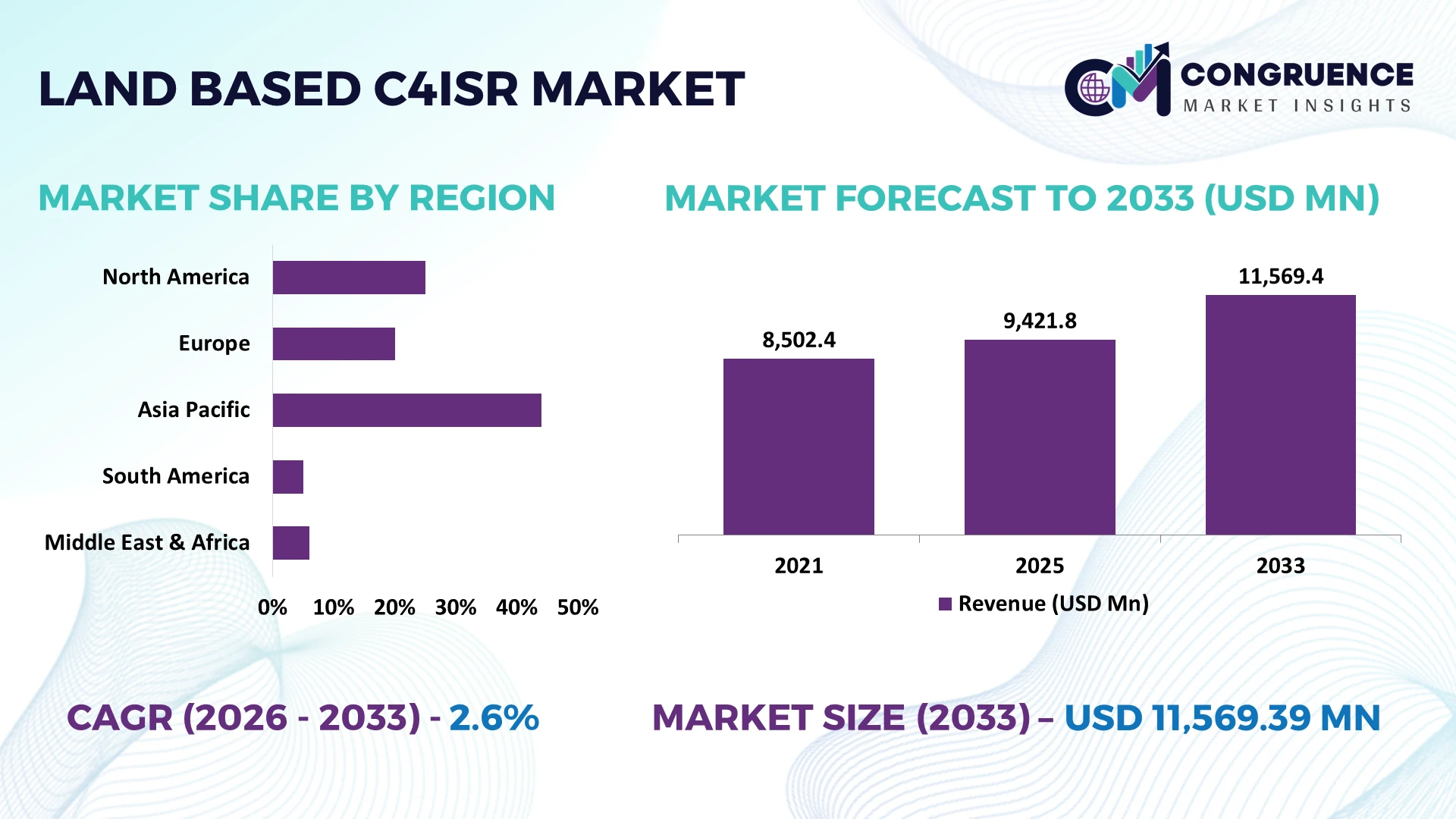
The United States dominates the land-based C4ISR landscape through extensive military modernization, advanced defense electronics manufacturing, and integrated battlefield command networks. Its FY2025 defense budget requested USD 143.2 billion for research, development, testing, and evaluation, supporting technologies across military domains. Compared with India, which earmarked 75% of its FY2025–26 defense modernization procurement budget for domestic suppliers, the United States maintains a more established defense technology ecosystem. Russia–Ukraine conflict lessons are accelerating investment in resilient communications, unmanned surveillance integration, and electronic warfare capabilities.
Defense contractors prioritizing interoperable command architectures, resilient communications, and modular sensor integration are positioned to capture long-term modernization contracts.
Market Size & Growth: Valued at USD 36.6 billion in 2025, projected to USD 67.7 billion by 2035 at 6.3% CAGR, driven by multi-domain battlefield awareness and network-centric warfare adoption .
Top Growth Drivers: Communications segment commanding 30% share, hardware at USD 19 billion in 2025, and electronic warfare fastest-growing at 6.77% CAGR through 2031 .
Short-Term Forecast: By 2027, autonomous ground systems expand as L3Harris and Carnegie Robotics field Diamondback UGV for ISR, electronic warfare, and logistics missions .
Emerging Technologies: Open-architecture C2 platforms enabling multi-sensor fusion, AI-enabled edge analytics for real-time battlefield intelligence, and modular software-defined radios supporting dynamic spectrum operations .
Regional Leaders: North America at 39.3% share with USD 1.01 trillion FY2026 defense budget, Europe at 25.6% share with NATO interoperability programs, and Asia-Pacific at 6.34% CAGR with Japan and South Korea leading .
Consumer/End-User Trends: Defense and space commands dominant end-user share; homeland security agencies represent fastest-growing segment through border security and counter-terrorism modernization .
Pilot/Case Example: U.S. Army fielded autonomous Small Multipurpose Equipment Transport vehicles with tethered UAS ISR payloads to the 125th Intelligence and Electronic Warfare Battalion in 2024, demonstrating forward-deployed C4ISR node capability .
Competitive Landscape: Lockheed Martin, Northrop Grumman, BAE Systems, RTX, and Thales lead; L3Harris, General Dynamics, Elbit Systems, and Leonardo compete across command-and-control platforms .
Regulatory & ESG Impact: NATO's USD 40 billion Drone Edge counter-UAS initiative and 5% GDP defense spending pledge by 2035 reshape allied procurement priorities .
Investment & Funding: NATO allies announced more than USD 50 billion in new defense procurement deals at July 2026 Ankara summit; Northrop Grumman secured USD 900 million award for Poland's IBCS iteration .
Innovation & Future Outlook: Modular open systems architecture and CMOSS-type standards lower long-run switching costs; AI-driven analytics and edge processing transform land force intelligence capabilities .
The Land Based C4ISR Market is increasingly shaped by defense investments in integrated battlefield management, tactical intelligence systems, and secure communications infrastructure. Military organizations are prioritizing AI-enabled threat identification, distributed command networks, and interoperable surveillance technologies to improve decision-making under contested operational conditions. NATO's commitment to allocate at least 3.5% of GDP toward core defense requirements by 2035 reinforces long-term modernization priorities. Meanwhile, software-defined tactical radios, edge computing, and unmanned ground surveillance platforms are reshaping procurement specifications. These developments establish important strategic considerations for defense contractors evaluating technology investments, military partnerships, and regional expansion opportunities.
Land Based C4ISR capabilities are becoming strategically critical as military forces transition from platform-centric command structures toward integrated, software-defined battlefield architectures. Defense procurement increasingly emphasizes real-time intelligence distribution, resilient tactical networks, and automated sensor coordination. NATO's commitment to allocate 5% of GDP toward defense and security requirements by 2035 reinforces infrastructure modernization, while software interoperability becomes a decisive factor in contractor selection. Companies developing modular architectures gain advantages through faster upgrades and reduced dependence on proprietary hardware.
AI-enabled intelligence processing is transforming operational productivity. The Maven Smart System demonstrated approximately tenfold higher targeting throughput than earlier workflows, illustrating significant improvements over manual intelligence coordination. The United States leads large-scale software integration, whereas India emphasizes indigenous electronics manufacturing and localized tactical communication capabilities. Between 2026 and 2028, procurement priorities increasingly favor edge computing, automated threat classification, and secure multidomain information exchange.
The U.S. Army's Next Generation Command and Control program provides a practical example through integrated data architectures connecting operational units. Anduril, Palantir, and technology partners are expanding software integration capabilities and battlefield networking investments. Competitive differentiation increasingly depends on delivering adaptable command systems that remain operational under contested electromagnetic conditions.
Modernization of battlefield command infrastructure is strengthening procurement of integrated surveillance, intelligence processing, and secure tactical communications. NATO's commitment to 5% defense and security investment includes at least 3.5% for core military requirements and up to 1.5% for resilience, infrastructure, and innovation by 2035. These commitments reinforce demand for interoperable command-and-control systems across military formations. Poland and Germany are prioritizing network-enabled defense capabilities alongside force expansion and operational readiness. Defense contractors, including Thales and Rheinmetall, are strengthening digital integration portfolios and military communications partnerships. The strategic advantage increasingly lies in connecting existing weapons platforms through unified information architectures rather than replacing entire vehicle fleets, improving procurement flexibility and accelerating capability upgrades.
Land-based C4ISR manufacturers face procurement restrictions, semiconductor dependencies, and complex qualification requirements that constrain international supplier flexibility. The European Union's SAFE procurement framework limits components originating outside eligible countries to 35% of estimated component costs, effectively requiring at least 65% eligible sourcing. Separately, the European Critical Raw Materials Act establishes a 25% recycling benchmark for strategic materials by 2030. These requirements affect sourcing strategies for electronic assemblies, communications hardware, and specialized defense components. Companies operating in France and Germany are expanding supplier qualification programs, localizing electronics integration, and negotiating longer-term procurement agreements. Maintaining access to qualified components without compromising cybersecurity certification or equipment reliability becomes essential for protecting manufacturing schedules and contract profitability.
India presents significant opportunities for domestic battlefield electronics developers through localization policies and expanding defense research participation. The FY2026–27 defense budget reserves approximately 75% of capital acquisition allocations for domestic suppliers, while 25% of defense research funding has been opened to industry, startups, and academia. Capital acquisition allocations also increased by approximately 24%, strengthening the procurement environment. These measures create opportunities for indigenous software-defined radios, tactical data links, and AI-enabled surveillance processors. Bharat Electronics and domestic technology specialists are positioned to deepen development partnerships with military research institutions. From 2026 through 2028, integrating locally developed edge intelligence into existing armored vehicle and command networks offers an attractive alternative to complete hardware replacement.
Deploying advanced C4ISR architectures across dispersed military formations creates persistent challenges involving cybersecurity validation, software interoperability, and contested-spectrum reliability. The U.S. Department of Defense's zero-trust implementation roadmap identifies 152 target activities, with 91 activities, approximately 60%, forming its fiscal 2027 implementation objective. The remaining 40% illustrates the broader complexity of achieving comprehensive security maturity. During the U.S. Army's 2026 Project Convergence exercises, communication disruptions and equipment failures exposed operational weaknesses in emerging digital battlefield systems. Contractors must strengthen cybersecure edge processing, resilient networking, and continuous software testing. Long-term competitiveness depends on maintaining dependable command connectivity while integrating autonomous platforms, legacy military equipment, and rapidly evolving software applications.
• Software-Defined Battlefield Networks Gain Momentum: The U.S. Army's Next Generation Command and Control initiative is replacing fragmented applications with a unified four-layer architecture covering transport, infrastructure, data, and applications. During 2025–2026, trials expanded across the 4th and 25th Infantry Divisions. Anduril and technology partners are scaling modular software integration, enabling commanders to access synchronized operational information without maintaining separate interfaces for each battlefield function.
• Digital Targeting Workflows Accelerate Decisions: Britain's ASGARD program is converting sequential reconnaissance and fire-control processes into digitally connected sensor-to-shooter operations. Prototypes reached NATO exercises within four months of January 2025 contracting, reducing targeting workflows from hours to minutes. Defense technology companies are integrating automated decision support and secure communications, supporting the British Army's stated tenfold lethality improvement ambition over ten years.
• Persistent Border Monitoring Becomes Networked: Poland's East Shield modernization combines unattended sensors, surveillance platforms, and autonomous observation capabilities. Four planned aerostats, incorporating radar systems with approximately 300-kilometer detection range, strengthen persistent monitoring. A five-kilometer defensive section was completed in July 2025. Equipment providers are emphasizing interoperable sensor interfaces and remote monitoring, reducing reliance on continuously staffed observation positions.
• Counter-Drone Experimentation Reshapes Product Development: The UK-led VANAHEIM initiative assessed technologies from 13 industry suppliers through exercises in Germany and Poland during 2025. Additional testing progressed into Lithuania in 2026. Defense contractors are adopting soldier-led evaluation and iterative software refinement, allowing equipment weaknesses to emerge before procurement scaling while aligning detection systems with operational requirements.
Command and Control Systems represent the leading strategic category within the Land Based C4ISR Market, supported by their central role in coordinating tactical formations, intelligence feeds, and mission execution. The U.S. Army's Next Generation Command and Control architecture integrates four technology layers and supports experimentation across two infantry divisions, demonstrating the scale of command modernization. Communication Systems maintain substantial procurement importance because resilient voice, data, and tactical networking infrastructure remains essential for distributed operations. Intelligence Systems increasingly emphasize automated information processing, while Surveillance Systems support persistent battlefield observation and threat identification. Procurement is shifting toward integrated platforms that reduce dependence on isolated hardware configurations.
Electronic Warfare Systems represent a particularly dynamic growth category as militaries prioritize spectrum awareness, electronic protection, and counter-drone operations. Reconnaissance Systems are advancing through autonomous ground platforms and networked sensor payloads, reducing dependence on conventional observation techniques. Lockheed Martin, L3Harris, and Thales are expanding software integration, secure communications, and electronic warfare capabilities. Competitive differentiation increasingly depends on delivering equipment that supports multiple operational functions through common interfaces.
Battlefield Management represents the principal application area within the Land Based C4ISR Market because ground forces require continuous coordination of combat formations, sensor information, and operational decisions. The U.S. Army's Next Generation Command and Control initiative connects four architectural layers, illustrating the operational importance of unified battlefield information management. Tactical Communications remains a mature application supporting secure connectivity between mobile units, while Situational Awareness integrates intelligence feeds into accessible operational displays. Mission Planning increasingly incorporates digital mapping, automated intelligence analysis, and collaborative decision-support tools. These applications maintain strong procurement relevance because command effectiveness depends on reliable information distribution across multiple military formations.
Threat Detection is emerging as a particularly dynamic application through increasing requirements for counter-drone monitoring and automated threat classification. Britain's ASGARD demonstrations reduced targeting decisions from hours to minutes, strengthening the operational case for Target Acquisition modernization. Border Security emphasizes persistent sensor coverage, while Electronic Intelligence supports electromagnetic threat identification. Defense suppliers are integrating surveillance analytics, secure communications, and automated alert generation, shifting investment toward multifunctional platforms rather than separate application-specific equipment.
Army Forces represent the leading operational end-user category in the Land Based C4ISR Market because ground formations require extensive tactical communications, battlefield surveillance, and integrated command infrastructure. The U.S. Army's modernization activities span the 4th and 25th Infantry Divisions, illustrating sustained institutional demand for scalable tactical information systems. Defense Ministries remain influential procurement authorities, establishing technical specifications, security requirements, and acquisition priorities. Military Intelligence Agencies emphasize advanced intelligence fusion, secure data processing, and electronic monitoring capabilities. These established buyers favor interoperable systems that integrate with existing military equipment while supporting incremental modernization and operational continuity.
Homeland Security Agencies represent an expanding end-user opportunity through border monitoring, counter-drone surveillance, and critical infrastructure protection. Poland's East Shield initiative includes four planned surveillance aerostats, demonstrating investment in persistent observation capabilities. Special Operations Forces increasingly require lightweight, portable command systems supporting rapid deployment and decentralized intelligence sharing. Defense Contractors are also becoming important integration and evaluation participants. Companies including General Dynamics, Thales, and L3Harris are adapting product architectures, supporting field evaluations, and developing specialized communication solutions to address different mission profiles and procurement requirements.
North America leads the global Land Based C4ISR Market in 2025, while Asia-Pacific is positioned for the fastest expansion between 2026 and 2033, supported by military digitalization, indigenous defense electronics manufacturing, and tactical network upgrades.

Advanced Tactical Networking and Software-Defined Command Modernization
North America maintains a dominant position in land-based C4ISR deployment, supported by extensive defense electronics manufacturing, established military communications infrastructure, and large-scale battlefield modernization programs. The United States anchors regional procurement through integrated command systems, secure tactical data transmission, and intelligence processing platforms. The U.S. Army's Next Generation Command and Control program transitioned toward operational software delivery in October 2026, extending capabilities from division-level prototyping to I Corps. This advancement strengthens requirements for commercially developed applications, common data architectures, and continuous software updates. Canada contributes specialized communications engineering, intelligence interoperability, and NATO-aligned defense modernization capabilities. L3Harris, General Dynamics, and Lockheed Martin maintain strong industrial positions through tactical networking, mission systems integration, and cybersecurity technologies. The region's competitive advantage increasingly reflects established integration capabilities and defense software engineering expertise.
United States Market Outlook: The United States benefits from an extensive military research ecosystem and advanced defense technology companies concentrated in Virginia, Maryland, and other established industrial centers. During Project Convergence 2026, approximately 9,700 personnel participated in exercises evaluating AI-assisted battlefield operations, unmanned systems, and contested communications. These evaluations strengthen demand for resilient networking equipment, autonomous intelligence applications, and operationally tested battlefield management software.
Accelerated Ground Forces Digitalization and Industrial Integration
Europe represents a major modernization center for land-based C4ISR systems, driven by military readiness requirements, the Russia–Ukraine conflict, and expanding investment in interoperable communications. European Union defense expenditure increased 19% in 2024, while equipment procurement rose 39%, demonstrating substantial acceleration in defense modernization activity. Germany, France, and the United Kingdom support regional innovation through tactical radio development, battlefield management platforms, and electronic warfare engineering. The European Union's Security Action for Europe initiative is strengthening collaborative procurement and domestic industrial capacity. Companies including Thales, Rheinmetall, and Saab are expanding integration services and next-generation military communications portfolios. Procurement increasingly emphasizes compatibility between armored vehicles, operational headquarters, and mobile reconnaissance assets. This transition creates opportunities for suppliers delivering standardized interfaces, secure data exchange, and upgrades compatible with existing military platforms.
Germany Market Outlook: Germany is advancing its Digitisation of Land-Based Operations program, targeting approximately 16,000 existing military vehicles and platforms for initial digital equipment integration. Rheinmetall and blackned are supporting implementation through additional production and installation capabilities. The program prioritizes encrypted communications, interconnected command posts, and secure battlefield information sharing, strengthening Germany's position in military systems engineering and tactical network integration.
Indigenous Defense Electronics and Networked Battlefield Expansion
Asia-Pacific is positioned for rapid land-based C4ISR adoption as China, India, Japan, South Korea, and Australia modernize military surveillance and tactical communication infrastructure. China's emphasis on integrated information operations supports advanced battlefield networking and electronic warfare development, while Japan is strengthening joint operational command capabilities. South Korea contributes established defense electronics manufacturing and digitally equipped ground platforms, supported by companies such as Hanwha Systems and LIG Nex1. India's procurement localization policies are encouraging domestic command systems, software-defined radios, and military intelligence technologies. Australia's Land 200 modernization activities reinforce requirements for interoperable battlefield communications and digital command integration. Regional competition increasingly centers on domestic manufacturing capabilities, sovereign data security, and deployment of networked ground systems. These developments favor suppliers combining localized production with software integration and long-term maintenance support.
India Market Outlook: India is strengthening its defense electronics ecosystem through Bharat Electronics, Tata Advanced Systems, and domestic engineering enterprises. The government allocated 75% of the FY2025–26 military modernization procurement budget to domestic sourcing. Bengaluru and Hyderabad provide substantial design, manufacturing, and software development capabilities supporting tactical communications, electronic warfare equipment, and surveillance integration. Indigenous supply chains improve procurement flexibility and strengthen opportunities for locally developed military technologies.
Integrated Border Surveillance and Remote Terrain Monitoring
South America's land-based C4ISR development is concentrated in border surveillance, military communications modernization, and integrated intelligence infrastructure. Brazil represents the principal operational market, supported by its extensive territorial boundaries and requirements for monitoring remote forest, agricultural, and cross-border corridors. Colombia prioritizes intelligence coordination and tactical communications for counter-narcotics operations, while Chile emphasizes military communications reliability across mountainous and geographically dispersed installations. Brazil's Integrated Border Monitoring System, SISFRON, provides a significant deployment framework combining radar, communications, geospatial intelligence, and command infrastructure. Military organizations are increasingly integrating fixed observation assets with mobile surveillance platforms to improve detection and information exchange. However, difficult terrain, uneven telecommunications coverage, and public procurement constraints complicate implementation. Technology providers capable of delivering modular, remotely maintainable systems hold advantages in managing infrastructure costs and operational continuity.
Brazil Market Outlook: Brazil's strategic position reflects its 16,886 kilometers of land borders shared with 10 countries. SISFRON supports coordinated surveillance and intelligence exchange across geographically challenging territories. Domestic defense companies, including Embraer and AEL Sistemas, contribute electronics engineering and systems integration capabilities. Continued modernization creates procurement opportunities for secure communications, distributed sensors, geospatial intelligence processing, and command infrastructure adapted to remote operational environments.
Defense Localization and Integrated Security Infrastructure Modernization
The Middle East & Africa land-based C4ISR landscape is shaped by military modernization, border protection requirements, and investment in domestic defense technology capabilities. Saudi Arabia and the United Arab Emirates are strengthening defense manufacturing ecosystems through partnerships involving electronics production, military communications, and integrated surveillance systems. Saudi Arabia's military industry localization rate reached 24.89% by the end of 2024, demonstrating progress toward greater domestic industrial participation. Israel maintains advanced capabilities in battlefield intelligence, electronic warfare, and tactical networking, supported by established defense technology suppliers. African demand concentrates on border monitoring, counterinsurgency operations, and mobile surveillance infrastructure, particularly in countries facing extensive territorial security requirements. South Africa contributes indigenous military radar and communications engineering expertise. Regional suppliers increasingly emphasize local assembly, technical training, and lifecycle support as important conditions for sustainable procurement partnerships.
Saudi Arabia Market Outlook: Saudi Arabia is developing its defense electronics manufacturing base through Saudi Arabian Military Industries and partnerships with international defense contractors. The General Authority for Military Industries targets localization exceeding 50% of military equipment and services expenditure by 2030. Riyadh's expanding defense industrial ecosystem supports opportunities in secure communications, electronic warfare integration, surveillance equipment, and technical maintenance services. Localization requirements strengthen demand for technology transfer, domestic engineering expertise, and long-term manufacturing partnerships.
Lockheed Martin, Northrop Grumman, BAE Systems, RTX, and Thales anchor the land-based C4ISR market, with the top five players commanding approximately 52–58% of global defense C4ISR revenue through prime contractor integration depth and long-term government program positions. Competition bifurcates between global defense primes competing on full-spectrum systems integration and security-certified architectures, and specialized innovators including L3Harris, Elbit Systems, and Palantir competing on software-defined command platforms and AI-enabled analytics. The basis of competition centers on secure interoperability within installed architectures rather than unit pricing: open-architecture compliance and cybersecurity certification determine program wins. Players compete through NATO procurement partnerships, localized industrial offsets, and vertical integration into sensor-to-shooter chains. The competitive shift is toward software-defined, modular platforms where interface control and configuration management replace hardware performance as the decisive procurement criterion. Entry barriers center on security clearance, multi-year program relationships, and export control compliance.
Lockheed Martin
Northrop Grumman
BAE Systems
RTX Corporation
Thales Group
L3Harris Technologies
General Dynamics
Elbit Systems
Leonardo
Rafael Advanced Defense Systems
Saab
Aselsan
Indra Sistemas
Hanwha Systems
Existing land-based C4ISR systems combine software-defined radios, encrypted tactical networks, and sensor-fusion platforms. Modern waveform technology enables secure voice, video, and intelligence exchange across dispersed formations. Thales' Irish defense program covers more than 6,000 software-defined radios, demonstrating substantial deployment. Compared with fixed-function legacy radios, reprogrammable platforms allow waveform upgrades without equipment replacement. A 15% reduction in maintenance effort represents a procurement performance target. Suppliers benefit through longer product lifecycles and software support.
Emerging edge computing and AI-assisted intelligence fusion move analysis closer to deployed units, reducing dependence on distant processing facilities. The U.S. Army's Next Generation Command and Control program integrates four architectural layers across operational formations. A 20% reduction in information-transfer latency provides a qualification benchmark rather than a documented program outcome. Private 5G, resilient mesh networking, and shared data services enable applications to exchange targeting and logistics information despite intermittent connectivity.
Disruptive architectures combine autonomous reconnaissance, electromagnetic sensing, and cloud-to-edge software distribution within interoperable command environments. During 2026–2028, cybersecurity verification, cross-vendor compatibility, and degraded-network performance will determine deployment decisions. Firms offering open interfaces and validated algorithms gain procurement advantages over proprietary hardware vendors. Buyers should prioritize operational availability, upgrade cycles, and integration costs before scaling capabilities.
• June 2024, Thales secured Ireland's program to supply more than 6,000 software-defined radios, covering handheld, vehicle, and airborne configurations. The agreement expands interoperable tactical communications and includes maintenance services, strengthening lifecycle support across all three Irish defense branches. Source: thalesgroup.com.
• May 2025, L3Harris received German military orders totaling $214 million under the Digitalization–Land Based Operations program. Its interoperable communications equipment supports secure tactical connectivity and coalition operations, expanding the company's participation in Germany's ground forces modernization and digital transformation. Source: l3harris.com.
• September 2026, Palantir entered the production phase of the Army's TITAN intelligence system, alongside Anduril, covering eight initial units. Production advances battlefield sensor fusion and targeting support beyond prototypes, creating a deployable intelligence architecture for sustained ground operations. Source: army.mil.
• March 2026, Palantir's Maven artificial intelligence platform was designated a core U.S. military program, with integration targeted by September 2026. The decision institutionalizes automated intelligence analysis across military branches and expands long-term software deployment opportunities throughout defense operations. Source: reuters.com.
The Land Based C4ISR Market Report provides comprehensive analysis of six system types: Command and Control Systems, Communication Systems, Intelligence Systems, Surveillance Systems, Reconnaissance Systems, and Electronic Warfare Systems. Application coverage spans eight operational categories, including Battlefield Management, Border Security, Target Acquisition, Threat Detection, Tactical Communications, Mission Planning, Situational Awareness, and Electronic Intelligence. The report evaluates six end-user groups, examining procurement priorities, deployment requirements, and systems integration strategies.
Geographical coverage encompasses North America, Europe, Asia-Pacific, South America, and the Middle East & Africa, with country-level assessment of defense modernization and manufacturing capabilities. Technology analysis addresses AI-enabled intelligence fusion, software-defined networking, autonomous surveillance, and cybersecurity architectures. Competitive benchmarking examines procurement positioning, localization strategies, and integration partnerships, supporting investment evaluation, geographic expansion, and strategic planning throughout 2026–2033.
| Report Attribute/Metric | Report Details |
|---|---|
Market Revenue in 2025 | USD 9421.75 Million |
Market Revenue in 2033 | USD 11569.39 Million |
CAGR (2026 - 2033) | 2.6% |
Base Year | 2025 |
Forecast Period | 2026 - 2033 |
Historic Period | 2021 - 2025 |
Segments Covered | By Type
By Application
By End-User
|
Key Report Deliverable | Revenue Forecast, Growth Trends, Market Dynamics, Segmental Overview, Regional and Country-wise Analysis, Competition Landscape |
Region Covered | North America, Europe, Asia-Pacific, South America, Middle East, Africa |
Key Players Analyzed | Lockheed Martin, Northrop Grumman, BAE Systems, RTX Corporation, Thales Group, L3Harris Technologies, General Dynamics, Elbit Systems, Leonardo, Rafael Advanced Defense Systems, Saab, Aselsan, Indra Sistemas, Hanwha Systems |
Customization & Pricing | Available on Request (10% Customization is Free) |




