
Reports
The Global Lactose-Free Products Market was valued at USD 8909.79 Million in 2025 and is anticipated to reach a value of USD 15772.55 Million by 2033 expanding at a CAGR of 7.4% between 2026 and 2033. Growth is accelerating through advanced enzyme-processing technologies, expanding retail penetration, dairy reformulation investments, and rising premium functional nutrition portfolios across global food and beverage manufacturers.
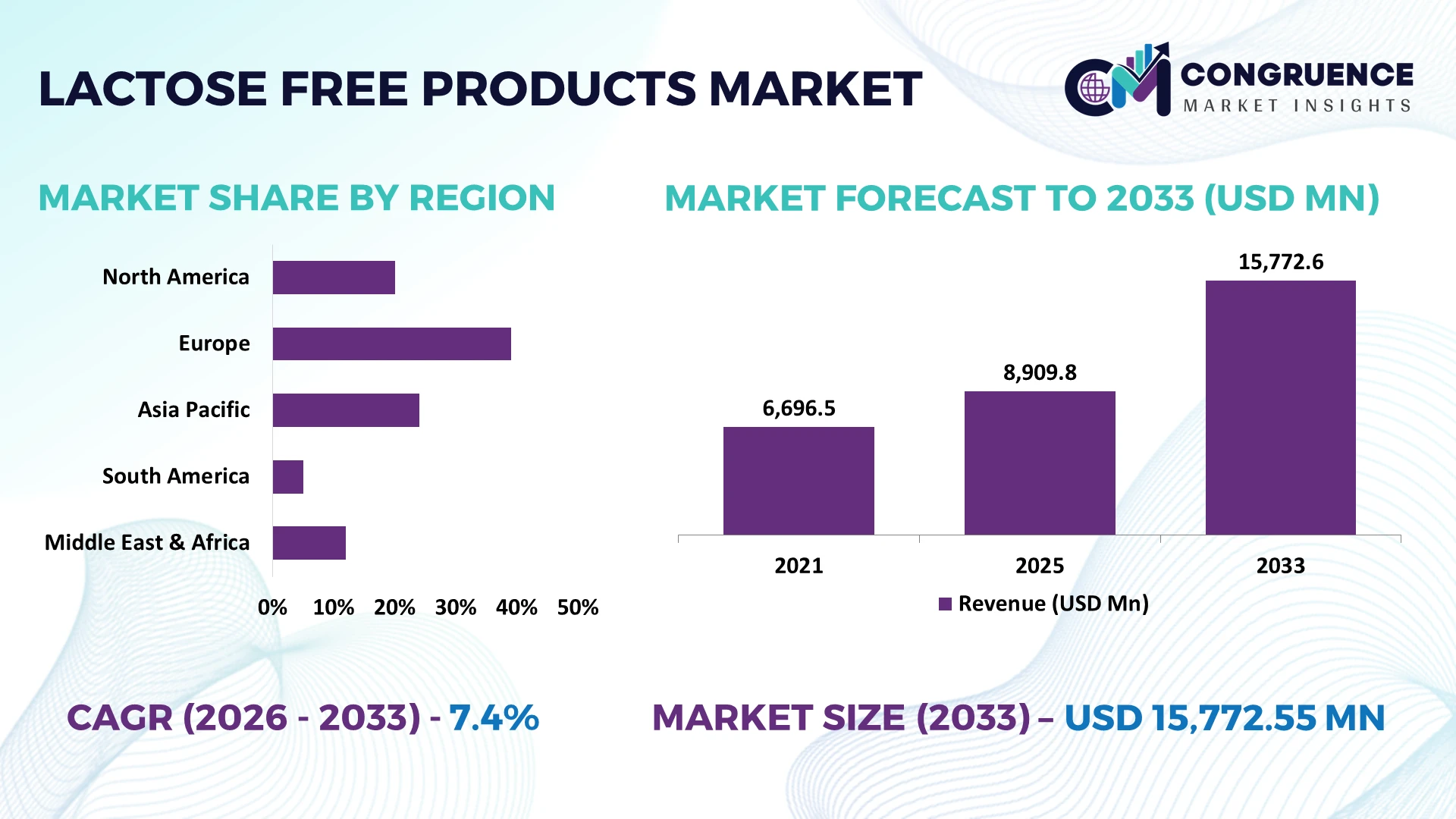
The United States remains the dominant market, accounting for approximately 31% of global consumption, supported by large-scale dairy processing, investments exceeding USD 1.2 billion in product modernization, and over 68% retail penetration of lactose-free dairy alternatives. Compared with Germany, where advanced dairy innovation supports nearly 18% higher manufacturing efficiency, U.S. production benefits from wider distribution networks despite evolving trade policies and supply-chain diversification following global tariff adjustments in 2026. Strategic investment in processing capacity and premium product innovation strengthens long-term competitive positioning across mature and emerging markets.
Market Size & Growth: USD 8909.79 Million in 2025 reaching USD 15772.55 Million by 2033 at 7.4% CAGR, supported by advanced enzyme processing and premium dairy innovation.
Top Growth Drivers: Lactase enzyme efficiency improved by 22%, premium dairy demand expanded 18%, and modern retail distribution increased 15% globally.
Short-Term Forecast: By 2028, production efficiency rises 14% while manufacturing waste declines 11% through automated processing and optimized supply chains.
Emerging Technologies: AI quality monitoring, precision fermentation, and automated membrane filtration improve production consistency by approximately 20%.
Regional Leaders: North America exceeds USD 5.1 billion, Europe reaches USD 4.4 billion, and Asia-Pacific surpasses USD 3.8 billion, driven by premium dairy adoption and regional expansion.
Consumer/End-User Trends: More than 46% of health-conscious consumers actively choose lactose-free dairy products for digestive wellness and clean-label preferences.
Pilot/Case Example: In 2026, an automated dairy processing project reduced energy consumption by 13% while increasing production throughput by 16%.
Competitive Landscape: Leading manufacturers collectively hold approximately 36% market share, with Arla Foods, Danone, Nestlé, Valio, and Lactalis strengthening premium portfolios.
Regulatory & ESG Impact: Sustainable packaging initiatives reduce plastic usage by nearly 18%, while stricter labeling standards improve product transparency across international markets.
Investment & Funding: More than USD 1.5 billion supports processing expansion, strategic partnerships, and regional manufacturing diversification amid global supply-chain realignment.
Innovation & Future Outlook: High-growth protein-enriched lactose-free formulations and precision dairy technologies accelerate product differentiation and premium market positioning.
Increasing demand across dairy beverages, infant nutrition, yogurt, cheese, and functional foods continues to reshape product development strategies. Advanced enzyme optimization and precision processing improve product quality, while clean-label formulations expand consumer acceptance by approximately 19%. Ongoing packaging modernization and regional supply-chain diversification under evolving food compliance standards reinforce manufacturing resilience, setting the foundation for the strategic market discussion.
The lactose-free products market has become strategically important as food manufacturers compete through premium nutrition portfolios, resilient dairy supply networks, and differentiated processing capabilities. Industry transformation is increasingly driven by supply-chain restructuring, with manufacturers expanding localized production to reduce import dependency and improve delivery reliability. Around 44% of leading dairy processors are accelerating digital quality management and production monitoring, enabling faster commercialization while strengthening compliance with evolving food-labeling standards.
Modern enzymatic lactose hydrolysis combined with AI-assisted process control delivers approximately 18% higher production efficiency and reduces product losses by nearly 12% compared with conventional batch processing. The United States leads large-scale commercial deployment through integrated dairy infrastructure, while the Netherlands advances specialized innovation with high-value dairy ingredients and precision processing. During the next two to three years, automated quality inspection is expected to exceed 55% adoption among major processing facilities, improving consistency and operational responsiveness.
A practical example is the deployment of automated inline lactose monitoring, allowing manufacturers to optimize enzyme dosage while minimizing production variability and energy consumption. Companies are expanding regional processing plants, strengthening dairy partnerships, and investing in premium functional formulations with recyclable packaging. Organizations combining manufacturing flexibility, digital production intelligence, and sustainable processing practices will secure stronger competitive positioning and long-term operational resilience.
Growing investment in advanced dairy processing and functional nutrition is reshaping competitive dynamics across the lactose-free products market. More than 52% of new dairy product launches now include digestive-health positioning, while enzymatic processing improves lactose conversion efficiency by nearly 20% and reduces production losses by around 11%. In the United States, processors continue expanding localized manufacturing to strengthen supply resilience following recent logistics realignment across food ingredients. The result is faster product availability, broader retail penetration, and improved production economics. Companies are responding through processing-capacity expansion, enzyme technology partnerships, and premium product innovation, creating differentiated portfolios that strengthen margins and accelerate market access in high-value consumer segments.
Milk price fluctuations, specialized enzyme procurement, and premium manufacturing requirements continue limiting operational efficiency. Processing expenses remain approximately 14% higher than conventional dairy production, while imported enzyme dependence exceeds 35% for several manufacturers outside established dairy-processing countries. Periodic disruptions in cold-chain logistics further increase inventory management complexity and production planning costs. These structural constraints reduce pricing flexibility and pressure profitability, particularly for mid-sized processors. Companies are mitigating exposure by securing long-term dairy procurement contracts, expanding domestic enzyme sourcing, and localizing production facilities to reduce transportation costs and improve supply continuity, strengthening operational resilience against market volatility.
High-value opportunities are emerging through protein-enriched lactose-free dairy, personalized nutrition, and precision fermentation technologies. Advanced formulation platforms improve ingredient utilization by approximately 17%, while automated production scheduling enhances factory throughput by nearly 15%. Japan continues investing in functional food innovation supported by aging-population nutrition initiatives, encouraging manufacturers to commercialize clinically positioned dairy products. Companies are accelerating research partnerships, expanding premium product portfolios, and integrating AI-driven production analytics to shorten commercialization timelines. An additional strategic advantage lies in combining digestive wellness with high-protein formulations, enabling stronger product differentiation and greater penetration into sports nutrition and clinical dietary applications.
Maintaining consistent product quality across expanding production networks remains a major execution challenge. Nearly 29% of manufacturers report difficulties integrating advanced processing systems with legacy manufacturing infrastructure, while skilled technical workforce shortages affect approximately 21% of specialized dairy facilities. Increasing compliance requirements for product verification and traceability also raise implementation complexity across multinational operations. These factors slow standardized deployment and increase operational costs despite rising automation. Companies must strengthen workforce training, modernize manufacturing infrastructure, and establish technology partnerships that enable interoperable digital production systems. Businesses achieving scalable quality control and standardized processing will strengthen long-term competitiveness while supporting sustainable manufacturing expansion.
Advanced Enzyme Processing Expansion Advanced lactase enzyme technologies are improving production yields by approximately 19% while reducing processing time by nearly 14%. More than 48% of large dairy manufacturers are integrating automated dosing systems to improve consistency and minimize raw material waste. Rising energy efficiency requirements and stricter food-quality regulations are accelerating modernization, prompting companies to scale continuous processing lines and establish technology partnerships that enhance operational flexibility and manufacturing precision.
Private Label Portfolio Growth Retailers are expanding premium lactose-free private-label offerings, with shelf availability increasing by approximately 22% and category penetration improving by 17% across major supermarket chains. Inflation-driven purchasing behavior is encouraging portfolio diversification without compromising quality standards. Manufacturers are responding through contract manufacturing agreements, localized production strategies, and packaging optimization, strengthening supply reliability while reducing logistics costs and improving inventory turnover across domestic distribution networks.
Digital Traceability Integration Around 46% of leading dairy processors now deploy digital traceability platforms linking ingredient sourcing, production monitoring, and product verification. QR-enabled product transparency and automated compliance reporting reduce documentation time by nearly 18% while supporting evolving food-labeling requirements. Companies are restructuring supplier ecosystems and investing in cloud-based quality management systems to improve recall readiness, strengthen consumer confidence, and streamline multinational operations.
Premium Functional Product Diversification Protein-enriched, probiotic, and clean-label lactose-free products are expanding rapidly, with premium product launches increasing by approximately 24% and recyclable packaging adoption exceeding 37%. Consumer preference is shifting toward multifunctional nutrition rather than simple lactose elimination, creating a non-obvious competitive advantage for integrated health-focused formulations. Companies are expanding R&D partnerships, accelerating premium portfolio development, and optimizing regional manufacturing capacity to shorten product launch cycles.
Milk remains the leading segment, accounting for approximately 46% of market demand due to established consumer acceptance, large-scale processing infrastructure, and broad retail availability. Standardized production systems, efficient cold-chain logistics, and competitive manufacturing costs enable producers to maintain consistent supply while supporting premium and fortified product variants. Cheese continues expanding through specialty formulations for food processing and retail, while ice cream strengthens seasonal premium consumption through improved texture technologies and enzyme-based reformulation.
Yogurt represents the fastest-growing segment as functional nutrition and probiotic integration reshape purchasing behavior. Product innovation has increased by nearly 23%, while premium cultured dairy adoption has expanded by approximately 18% across urban consumer markets. Companies are investing in high-protein formulations, localized manufacturing, and strategic dairy partnerships to strengthen product differentiation. Investment priorities are steadily shifting toward value-added cultured dairy products while maintaining milk as the operational backbone of large-scale lactose-free manufacturing.
Dairy Products remain the dominant application, representing approximately 58% of total demand because of established household consumption, broad product diversity, and integrated processing infrastructure. Manufacturers continue expanding production automation and packaging efficiency, improving output consistency by nearly 16%. Food Service supports commercial menu diversification, while Infant Nutrition maintains specialized demand through stringent formulation standards and enhanced quality assurance systems.
Clinical Nutrition is emerging as the fastest-growing application as healthcare providers increasingly recommend specialized dairy formulations for digestive health and nutritional support. Product utilization within medical nutrition programs has expanded by approximately 20%, while specialized formulation adoption has improved by nearly 17%. Companies are strengthening hospital partnerships, investing in clinical-grade manufacturing, and expanding premium nutrition portfolios. Demand is shifting toward evidence-based nutritional solutions that combine digestive tolerance with higher protein and micronutrient content, strengthening long-term positioning across healthcare and specialized nutrition markets.
Food & Beverage remains the dominant end-user, accounting for approximately 54% of market demand through extensive manufacturing capacity, diversified product portfolios, and established retail distribution. Large processors continue improving production automation, increasing operational efficiency by around 15% while reducing formulation variability. Retail remains strategically important through expanding premium shelf space, whereas Hospitality increasingly incorporates lactose-free offerings into standardized menu development to meet evolving dietary preferences.
Healthcare is the fastest-growing end-user as hospitals, nutrition providers, and specialized care facilities integrate lactose-free formulations into patient dietary management. Procurement volumes have increased by approximately 18%, while institutional adoption has expanded by nearly 16% through standardized nutritional protocols. Companies are responding with customized product lines, healthcare partnerships, and targeted pricing strategies that strengthen long-term customer relationships. Future purchasing momentum is increasingly shifting toward clinically validated nutrition products supported by integrated healthcare distribution ecosystems.
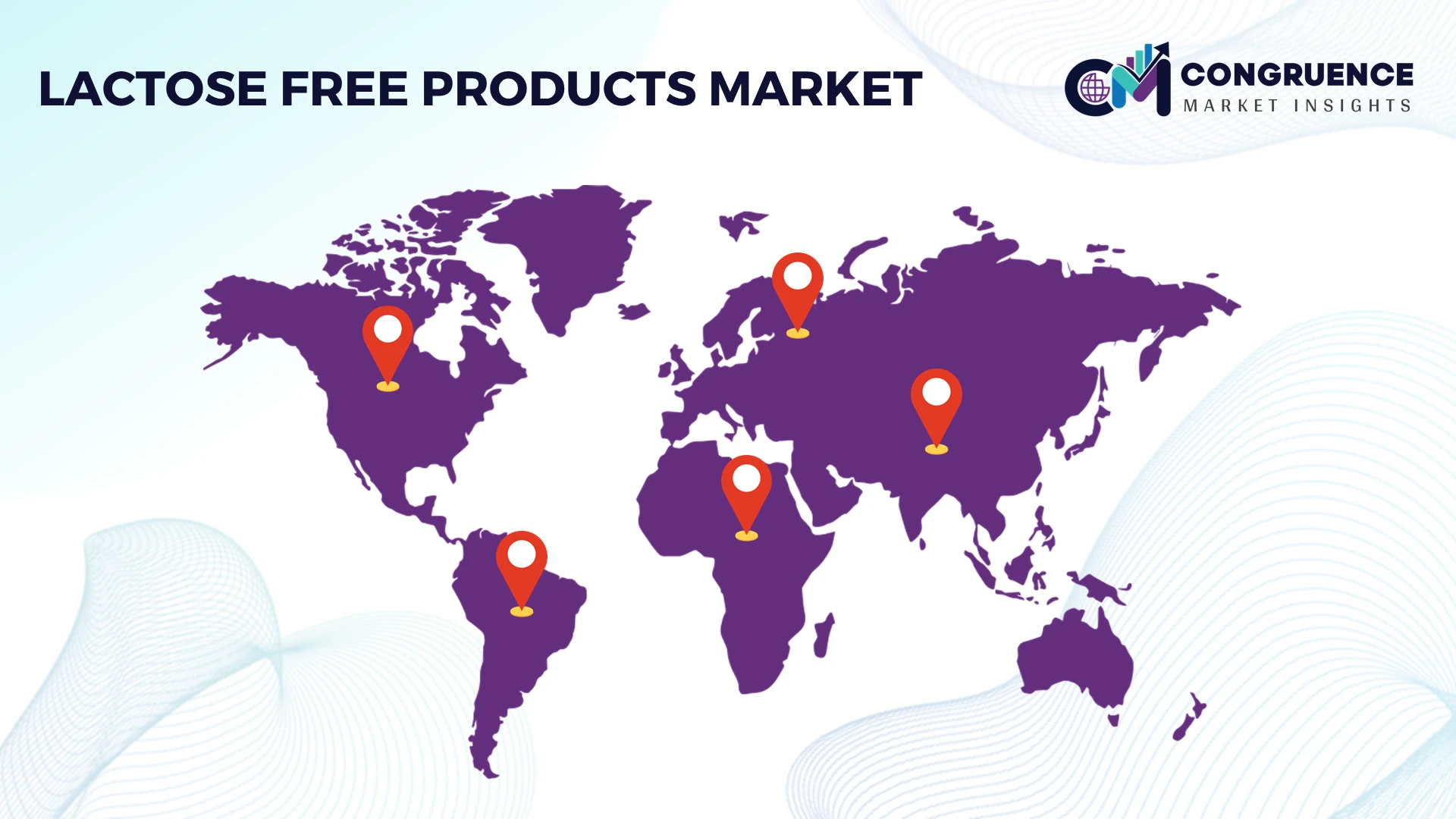
North America accounted for the largest market share at 38.2% in 2025 however, Asia-Pacific is expected to register the fastest growth, expanding at a CAGR of 8.6% between 2026 and 2033.
Advanced Dairy Processing and Premium Portfolio Expansion
North America maintains its leadership through highly integrated dairy infrastructure, advanced enzyme-processing capabilities, and extensive retail distribution networks. The region contributes approximately 38.2% of global demand, supported by large-scale processing facilities and strong penetration of premium dairy products. More than 57% of major processors have implemented automated quality monitoring and digital production management, reducing manufacturing variability while improving operational efficiency. Investment continues toward capacity modernization, sustainable packaging, and localized ingredient sourcing following recent food supply-chain restructuring. Strategic collaborations between dairy producers and retail chains are accelerating product availability, while enterprise investments in value-added nutrition strengthen premium positioning across mature consumer markets.
United States Market Outlook: The United States leads regional production through extensive dairy manufacturing capacity, established cold-chain logistics, and advanced processing technologies. More than 68% of national grocery retailers maintain dedicated lactose-free dairy categories, while automated processing deployment exceeds 55% among major dairy manufacturers. Companies continue investing in premium milk, yogurt, and functional dairy products supported by localized production expansion and advanced enzyme-processing systems that improve manufacturing consistency and supply reliability.
Sustainability-Driven Dairy Modernization
Europe remains a highly mature market supported by advanced dairy innovation, strong regulatory compliance, and sustainability-focused manufacturing investments. The region accounts for approximately 29.4% of global market activity, with producers integrating renewable energy systems and recyclable packaging into processing operations. Nearly 49% of dairy facilities have upgraded production technologies to improve energy efficiency and product consistency. Modernized processing infrastructure and premium product positioning continue strengthening competitiveness across retail and food manufacturing channels. Strategic investments increasingly prioritize clean-label formulations, precision processing, and environmentally responsible production practices aligned with evolving consumer expectations.
Germany Market Outlook: Germany serves as a strategic manufacturing hub through highly automated dairy facilities, advanced food engineering expertise, and efficient logistics infrastructure. Processing automation has improved manufacturing productivity by approximately 18%, while enterprise investment continues supporting premium dairy innovation and sustainable production technologies. Strong collaboration between processors, retailers, and food technology providers reinforces Germany's position as a leading center for high-quality lactose-free product development.
Manufacturing Scale and Consumer Expansion
Asia-Pacific represents the fastest-evolving regional market as dairy consumption, manufacturing investment, and premium nutrition awareness continue expanding. The region contributes approximately 24.8% of global demand while recording the highest pace of production capacity additions. More than 21% of recently commissioned dairy-processing facilities include dedicated lactose-free production capabilities. Food manufacturers are investing in localized processing plants, digital quality systems, and advanced packaging technologies to improve operational efficiency and reduce import dependence. Rising urban consumption and expanding modern retail infrastructure continue strengthening enterprise deployment across multiple national markets.
China Market Outlook: China leads regional expansion through significant dairy infrastructure investment, large-scale manufacturing capacity, and rapid premium food commercialization. Automated processing adoption exceeds 47% among leading dairy enterprises, supported by continuous investment in advanced quality control and localized production. Domestic manufacturers are expanding partnerships with ingredient technology providers while increasing production of premium functional dairy products to strengthen long-term supply resilience.
Retail Expansion Supporting Premium Dairy
South America is strengthening its market position through expanding organized retail, improving dairy processing infrastructure, and rising consumer preference for specialized nutrition products. The region represents approximately 5.1% of global market demand, supported by modernization of dairy production and wider supermarket penetration. Processing efficiency has improved by nearly 12% following investment in automated packaging and production technologies. Infrastructure limitations remain in selected markets, yet strategic partnerships between processors and distributors continue improving supply consistency and premium product availability throughout urban consumption centers.
Brazil Market Outlook: Brazil remains the region's largest market because of its extensive dairy production base, expanding food processing sector, and strong domestic consumption. Modern dairy facilities have increased automated packaging deployment by approximately 19%, supporting higher production efficiency and improved product quality. Manufacturers continue investing in localized processing capacity and premium retail partnerships to strengthen nationwide distribution while reducing logistics complexity.
Food Infrastructure and Manufacturing Investment
The Middle East & Africa market continues evolving through food manufacturing modernization, cold-chain expansion, and strategic investment in premium packaged nutrition. The region accounts for approximately 2.5% of global demand, with governments and private enterprises investing in food security and domestic processing capabilities. Cold-chain infrastructure utilization has increased by around 16%, improving product stability and retail availability. International dairy companies are strengthening partnerships with regional distributors while expanding localized packaging operations to improve supply continuity and operational efficiency.
Saudi Arabia Market Outlook: Saudi Arabia leads regional development through food manufacturing investment, modern distribution infrastructure, and national food diversification initiatives. Advanced processing facilities continue expanding production capabilities, while premium dairy product availability has increased by approximately 20% across organized retail networks. Enterprise investment in localized manufacturing and strategic international partnerships strengthens domestic supply resilience while supporting long-term food industry modernization.
Global dairy leaders including Danone, Nestlé, Lactalis, Arla Foods, and Valio compete directly with regional dairy specialists and private-label manufacturers for premium lactose-free product leadership. The top five companies collectively control approximately 42% of the market, creating competition based on processing technology, product quality, distribution reach, and manufacturing scale rather than price alone. Advanced enzyme-processing systems improve production efficiency by nearly 18%, while automated quality control reduces operational losses by approximately 12%, giving technology-focused producers a measurable advantage over cost-driven competitors. Companies increasingly compete through manufacturing expansion, ingredient partnerships, localized production, premium product innovation, and selective vertical integration to strengthen supply security. Competitive pressure is shifting toward functional nutrition, clean-label formulations, and sustainable packaging as retailers prioritize differentiated premium offerings. High capital investment requirements, strict food compliance standards, and specialized processing expertise remain significant entry barriers. Winning requires scalable production, continuous innovation, resilient supply networks, and premium brand differentiation supported by operational excellence.
Danone
Nestlé
Arla Foods
Lactalis
Valio
FrieslandCampina
Fonterra Co-operative Group
Saputo Inc.
Dairy Farmers of America
Organic Valley
Yili Group
Mengniu Dairy
Almarai
Emmi Group
Advanced enzymatic lactose hydrolysis remains the core production technology, enabling manufacturers to achieve lactose levels below 0.1% while preserving protein functionality and product taste. Automated inline process monitoring improves production efficiency by approximately 16%, and digital quality management reduces batch variability by nearly 12%. Around 54% of large dairy processors have integrated sensor-based production control into commercial operations, strengthening traceability, quality consistency, and regulatory compliance while lowering operational costs through optimized enzyme utilization.
Emerging technologies between 2026 and 2028 include AI-enabled production analytics, membrane filtration optimization, precision fermentation, and cloud-connected manufacturing execution systems. AI-supported production scheduling improves plant utilization by approximately 14%, while advanced membrane filtration reduces ingredient losses by around 10% compared with conventional separation methods. Adoption of integrated digital manufacturing platforms has reached nearly 47% among major dairy enterprises, enabling faster product reformulation, predictive maintenance, and stronger supply-chain coordination across multiple production facilities.
Disruptive innovation is shifting toward precision dairy ingredients, digital twins, and continuous processing systems. Compared with conventional batch manufacturing, continuous automated processing delivers approximately 20% higher throughput and reduces energy consumption by nearly 15%. Global dairy leaders investing in intelligent manufacturing, proprietary enzyme technologies, and integrated quality analytics gain faster commercialization, premium product differentiation, and stronger supply resilience. Companies delaying technology modernization risk higher operating costs and slower response to evolving consumer and regulatory requirements through 2028.
November 2024 Valio highlighted its patented lactose-free technology portfolio, expanding commercialization of more than 100 lactose-free dairy products across multiple categories while reinforcing its global innovation leadership. The portfolio exceeds 100 commercial products, strengthening product differentiation and export opportunities.
February 2025 Valio introduced expanded Fast Track™ lactose-free manufacturing solutions enabling dairy producers to shorten commercialization timelines from years to months while supporting premium product launches. One featured concept delivers 44% more protein and 31% less sugar, improving competitive positioning.
March 2025 Valio expanded its market-development support for food manufacturers through lactose-free product launch services, helping brands accelerate entry into digestive wellness categories with end-to-end development assistance. The company highlighted a projected 25% category expansion through 2028, reinforcing strategic investment priorities. Source: valio.com
May 2026 Valio outlined next-generation lactose-free process innovation, emphasizing advanced research, digestive wellness applications, and future manufacturing technologies supporting premium dairy development. The company noted consumer willingness to pay approximately 44% more for premium lactose-free milk, strengthening long-term innovation investment.
This report provides comprehensive coverage of the lactose-free products market across milk, yogurt, cheese, and ice cream, together with detailed assessment of dairy products, infant nutrition, clinical nutrition, and food service applications. It further evaluates demand across Food & Beverage, Healthcare, Retail, and Hospitality end-users while examining market performance across North America, Europe, Asia-Pacific, South America, and the Middle East & Africa. More than 40% of the assessment emphasizes operational trends, technology deployment, manufacturing modernization, and evolving consumer adoption patterns.
The analysis covers advanced enzyme-processing technologies, digital manufacturing systems, precision filtration, quality automation, and sustainable production strategies shaping industry competitiveness between 2026 and 2033. Strategic evaluation includes company positioning, regional expansion priorities, partnership activity, product innovation, supply-chain transformation, and investment direction. The report supports business expansion, portfolio optimization, competitive benchmarking, manufacturing decisions, and long-term market planning through actionable operational and technology-focused insights.
| Report Attribute/Metric | Report Details |
|---|---|
Market Revenue in 2025 | USD 8909.79 Million |
Market Revenue in 2033 | USD 15772.55 Million |
CAGR (2026 - 2033) | 7.4% |
Base Year | 2025 |
Forecast Period | 2026 - 2033 |
Historic Period | 2021 - 2025 |
Segments Covered | By Type
By Application
By End-User
|
Key Report Deliverable | Revenue Forecast, Growth Trends, Market Dynamics, Segmental Overview, Regional and Country-wise Analysis, Competition Landscape |
Region Covered | North America, Europe, Asia-Pacific, South America, Middle East, Africa |
Key Players Analyzed | Danone, Nestlé, Arla Foods, Lactalis, Valio, FrieslandCampina, Fonterra Co-operative Group, Saputo Inc., Dairy Farmers of America, Organic Valley, Yili Group, Mengniu Dairy, Almarai, Emmi Group |
Customization & Pricing | Available on Request (10% Customization is Free) |




