
Reports
The Global Kratom Market was valued at USD 184.33 Million in 2025 and is anticipated to reach a value of USD 336.17 Million by 2033 expanding at a CAGR of 7.8% between 2026 and 2033. Growth is driven by standardized botanical processing, expanding specialty retail and e-commerce distribution, alkaloid testing, and formalization of Southeast Asian kratom cultivation and exports.
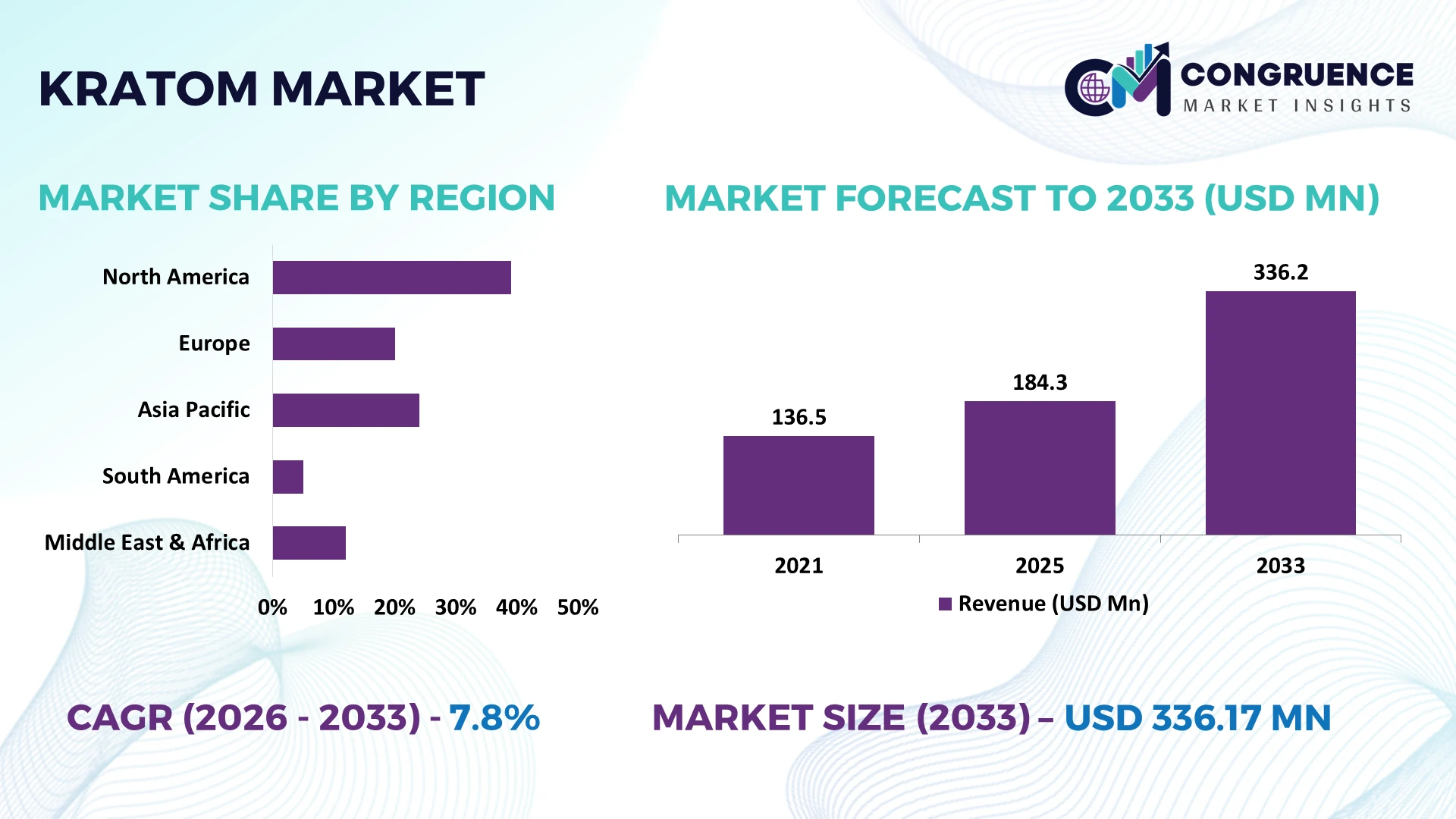
The United States represents the largest commercial consumer market, accounting for an estimated 40%+ of global demand, while Indonesia remains the pivotal upstream supplier through extensive Mitragyna speciosa cultivation in Kalimantan. Approximately 15 million U.S. adults report current kratom use, supporting specialized botanical retail and laboratory-testing demand. Indonesia’s 2024 export regulation formalized quality and documentation requirements, reinforcing its supply-chain position. Compared with Thailand, where kratom was decriminalized nationally in 2021, Indonesia maintains substantially greater export-oriented production capacity.
Strategically, processors controlling Indonesian sourcing, contaminant testing, alkaloid standardization, and regulatory compliance hold the strongest position as the global kratom market transitions toward traceable commercial supply.
Market Size & Growth: USD 184.33 million in 2025 reaches USD 336.17 million by 2033 at 7.8%, supported by standardized processing and formalized botanical distribution.
Top Growth Drivers: U.S. demand contributes approximately 40%+, specialty channels represent about 65%, and standardized-product penetration approaches 35% across organized commercial supply.
Short-Term Forecast: By 2028, expanded batch testing and supplier qualification are positioned to reduce rejected or non-compliant shipments by approximately 15–20%.
Emerging Technologies: LC-MS/MS alkaloid profiling, microbial screening and digital batch traceability are advancing quality control across commercial kratom processing.
Regional Leaders: North America approaches USD 145 million, Asia-Pacific USD 100 million and Europe USD 55 million by 2033, with regulation determining channel development.
Consumer/End-User Trends: Approximately 15 million U.S. adults report current kratom consumption, supporting demand for powders, capsules, extracts and standardized formats.
Pilot/Case Example: Indonesia’s 2024 regulated export framework introduced formal documentation and quality controls, shifting international procurement toward qualified supply chains.
Competitive Landscape: Leading organized brands collectively represent an estimated 25–30% share, including OPMS, MIT45, Happy Hippo, Kats Botanicals and Kraken Kratom.
Regulatory & ESG Impact: Thailand removed kratom from its narcotics list in 2021, enabling legal cultivation while strengthening formal agricultural and processing participation.
Investment & Funding: Commercial investment increasingly targets GMP-aligned processing, laboratory testing and extraction capacity rather than large disclosed institutional funding rounds.
Innovation & Future Outlook: Standardized alkaloid profiles and traceable batches are shifting competition toward measurable composition, with mitragynine testing becoming a central quality benchmark.
The Kratom Market is transitioning from fragmented botanical trading toward more structured cultivation, extraction, laboratory verification and specialty distribution. Demand concentrates across powders, capsules and extracts, while LC-MS/MS alkaloid profiling and microbial screening are strengthening batch consistency. The United States remains the primary commercial consumption center, with approximately 15 million adults reporting current use, while Indonesia anchors upstream supply. Indonesia’s tighter 2024 export framework is pushing importers toward documented, tested shipments, making traceability and standardized processing increasingly important to the market’s strategic direction.
Kratom is becoming strategically important as commercial advantage shifts from loosely documented botanical trading toward traceable cultivation, laboratory-verified composition, and regulated cross-border supply. Indonesia’s 2024 export framework strengthened documentation and quality requirements around the industry’s principal sourcing base, increasing the value of qualified processors. With roughly 15 million U.S. adults reporting current use, regulatory positioning and dependable Indonesian procurement increasingly influence competitive scale.
Laboratory modernization is strengthening product control. LC-MS/MS testing can simultaneously quantify mitragynine and other alkaloids with substantially greater selectivity than basic colorimetric screening, while automated sample workflows can reduce laboratory handling time by roughly 20–30%. Indonesia dominates export-oriented raw-material supply; Thailand, by contrast, has developed a legalized domestic cultivation and consumption framework since removing kratom from its narcotics list in 2021.
Through 2026–2028, investment will concentrate on validated testing, GMP-aligned processing, supplier qualification, and digital batch traceability. Importers are already requiring certificates of analysis covering alkaloids, microorganisms, and contaminants before accepting shipments. Processors are therefore strengthening laboratory partnerships and controlled sourcing. Competitive leadership will depend on converting botanical supply into consistently specified, traceable material that can withstand tightening regulatory and buyer scrutiny.
Commercial kratom demand is increasingly moving toward tested, documented products rather than anonymous bulk powder. The United States represents an estimated 40%+ of organized global demand, while approximately 15 million American adults report current use, creating scale for specialized botanical distribution. Indonesia’s 2024 export framework introduced stronger exporter registration, documentation, and quality-control requirements, accelerating procurement formalization at the industry’s principal upstream base. Organized suppliers increasingly test 100% of commercial batches for microbial contamination, heavy metals, and alkaloid composition before release. This shift reduces buyer uncertainty and improves consistency for importers managing large inventories. Companies are responding through direct Indonesian sourcing relationships, third-party laboratory partnerships, GMP-oriented facilities, and batch-level certificates of analysis. The strategic advantage is traceability: verified upstream control increasingly determines retailer acceptance and repeat procurement.
Regulatory fragmentation restricts uniform commercialization because kratom’s legal status varies materially between countries and even within the United States. Six U.S. states maintain statewide kratom prohibitions, while regulated states increasingly impose age limits, labeling requirements, or product standards. This creates compliance fragmentation within a market representing more than 40% of organized global demand. Indonesia’s export controls add another operational layer because qualified shipments require documentation and approved supply arrangements. Businesses consequently face duplicated packaging, legal-review, testing, and inventory requirements rather than one standardized national model. Larger suppliers are mitigating exposure through jurisdiction-specific SKUs, distributor screening, regulatory monitoring, and diversified fulfillment networks. A critical operational insight is that regulatory fragmentation raises working-capital requirements: inventory acceptable in one jurisdiction cannot automatically be redirected to another when composition or labeling rules differ.
Standardized botanical processing creates an opportunity to move beyond commodity leaf powder toward precisely characterized products. Commercial laboratories can quantify mitragynine at sub-1% variation between validated batches when manufacturers tightly control blending and extraction, while advanced chromatography can monitor multiple alkaloids within one analytical workflow. Approximately 15 million current U.S. users provide a sizeable addressable base for suppliers prioritizing consistent specifications. Thailand’s legalized cultivation environment also creates opportunities for agronomic research, cultivar selection, and controlled processing outside Indonesia’s established export chain. Through 2026–2028, companies are positioned to invest in extraction optimization, standardized raw materials, digital certificates of analysis, and contract testing. The non-obvious opportunity is B2B ingredient standardization: processors capable of supplying repeatable botanical specifications can capture higher-value manufacturer relationships while reducing dependence on volatile consumer-brand acquisition.
Agricultural variability creates a long-term execution challenge because alkaloid composition changes with plant genetics, leaf maturity, geography, harvesting, drying, and storage conditions. Commercial kratom leaf commonly contains mitragynine at roughly 0.5–2% of dry weight, meaning uncontrolled sourcing can produce substantial batch-to-batch differences before manufacturing begins. At the same time, roughly 15 million U.S. users increase the consequences of quality failures across scaled distribution. FDA enforcement history involving contaminated botanical products has made microbial control and supply-chain hygiene operational priorities. Companies must therefore solve variability through supplier qualification, controlled drying, representative sampling, chromatographic fingerprinting, blending, and environmental monitoring. Indonesian processors are investing in cleaner handling and documented export workflows, while U.S. brands increasingly require independent laboratory verification. Sustainable competitive scale depends on reproducing specifications consistently despite inherently variable agricultural inputs.
Export Controls Restructure Indonesian Sourcing: Indonesia’s 2024 export framework moved kratom toward controlled trade, with exporters facing documentation, testing, and traceability requirements before shipment. Indonesia supplies an estimated 90%+ of internationally traded kratom, while the United States absorbs a substantial share. Importers are consolidating purchases around qualified processors and increasing laboratory verification, reducing exposure to undocumented intermediaries and rejected shipments.
Laboratory Testing Becomes Procurement Standard: Commercial brands increasingly test batches for mitragynine, microbial contamination, heavy metals, and adulterants rather than relying on supplier certificates alone. Mitragynine typically represents roughly 0.5–2% of dried leaf, creating meaningful natural variability. Suppliers are expanding LC-MS/MS and HPLC partnerships, while larger processors adopt standardized sampling workflows, making analytical consistency increasingly important for retailer acceptance and inventory release speed.
Concentrated Products Face Greater Scrutiny: Market attention is shifting from conventional leaf products toward concentrated extracts and formulations containing elevated alkaloid levels. Seven-hydroxymitragynine occurs naturally at substantially lower concentrations than mitragynine, making highly concentrated commercial formulations a distinct regulatory concern. Companies are separating traditional kratom portfolios from enhanced products, tightening formulation controls and reassessing labeling as U.S. regulators intensify scrutiny of concentrated 7-OH offerings.
State Rules Fragment Retail Execution: U.S. commercialization increasingly depends on state-level requirements covering age restrictions, labeling, composition, and product registration. Six states maintain broad kratom prohibitions, while multiple others regulate legal sales. Brands are deploying jurisdiction-specific compliance systems, retailer screening, and SKU controls. The non-obvious impact is logistical: fragmented rules reduce inventory fungibility, forcing distributors to manage market-specific stock rather than one nationally interchangeable assortment.
Red Vein represents the leading type with an estimated 40% share, supported by broad consumer familiarity and extensive availability across specialty and online channels. Its commercial advantage comes from established sourcing, wide SKU representation, and positioning around relaxation-oriented use. Green Vein accounts for approximately 27%, balancing characteristics commonly associated by consumers with red and white varieties. White Vein maintains a smaller but established position around energy-oriented consumer preferences, while Yellow Vein remains comparatively niche because processing and naming conventions are less standardized across suppliers.
Blended Strains represent the fastest-growing type, with an estimated low-double-digit share, as sellers combine differently marketed vein categories to create differentiated product profiles and reduce reliance on single-strain merchandising. Manufacturers are investing in controlled blending, alkaloid testing, and batch standardization rather than simply expanding strain names. Commercially, this shifts portfolio investment toward repeatable chemical specifications because vein color alone does not reliably establish alkaloid composition. Companies able to demonstrate batch consistency gain stronger differentiation than suppliers relying exclusively on strain-based branding.
Recent scientific assessments continue to show substantial chemical variability among commercial kratom samples, reinforcing that named vein categories do not consistently predict alkaloid profiles. This supports greater industry emphasis on analytical characterization rather than color designation alone.
Pain Management represents the leading application with an estimated 40% share of use-related demand, reflecting persistent consumer-reported use of kratom for chronic and acute discomfort. Relaxation represents approximately 20%, while Mood Support and Energy Enhancement capture distinct consumption occasions influenced by product amount and individual response. Opioid Withdrawal Support remains strategically significant because surveys consistently identify withdrawal management and substitution among important motivations for a subset of users, although kratom is not an approved treatment for opioid-use disorder.
Opioid Withdrawal Support represents the fastest-developing application area from a research perspective as investigators examine mitragynine pharmacology, dependence, and withdrawal outcomes. Surveys have found pain relief among the most frequently reported reasons for kratom use, with opioid reduction or withdrawal reported by smaller but clinically important user groups. Suppliers are responding through clearer composition labeling and laboratory characterization, while research institutions emphasize controlled studies rather than commercial therapeutic claims. Business relevance increasingly depends on separating consumer-reported applications from medically validated indications, reducing regulatory exposure while preserving legitimate botanical-market positioning.
National Institute on Drug Abuse materials updated through 2025 continue to identify pain, fatigue, mental-health symptoms, and opioid withdrawal among reported reasons for kratom consumption, while emphasizing that kratom has not been approved for medical use.
Online Retailers represent the largest end-user segment with an estimated 45% share, reflecting kratom’s digitally concentrated distribution model, broad SKU availability, direct-to-consumer fulfillment, and limited mainstream retail penetration. Specialty Retailers account for approximately 30%, benefiting from immediate product access and staff-assisted purchasing. Herbal Product Manufacturers occupy a smaller but strategically important position as standardized botanical inputs become more valuable. Wellness Centers remain constrained by uncertain therapeutic positioning, while Research Institutions purchase comparatively limited volumes but exert disproportionate influence on analytical standards and product understanding.
Research Institutions represent the fastest-growing strategic end-user group as work expands around mitragynine, 7-hydroxymitragynine, pharmacokinetics, dependence, and toxicology. Online sellers are simultaneously strengthening age controls, batch documentation, laboratory certificates, and jurisdiction-specific shipping restrictions. Specialty retailers increasingly favor tested brands to reduce compliance exposure. The competitive implication is clear: digital reach remains essential for volume, but analytical credibility increasingly determines durable channel access. Manufacturers are therefore building laboratory partnerships and traceable supplier networks alongside e-commerce capabilities.
North America accounted for the largest market share at 43% in 2025 however, Asia-Pacific is expected to register the fastest growth, expanding at a CAGR of 9.1% between 2026 and 2033.
Testing Standards Reshape Commercial Distribution
North America represents approximately 43% of organized global kratom demand, with the United States dominating through online retailers, specialty botanical stores, processors, and independent testing laboratories. An estimated 15 million U.S. adults currently use kratom, creating substantial throughput requirements for imported leaf, powders, capsules, and extracts. Commercial procurement is shifting toward laboratory-characterized batches covering mitragynine, microorganisms, heavy metals, and adulterants. State-level regulation increasingly shapes distribution: six states maintain broad prohibitions, while multiple legal jurisdictions apply age, labeling, or composition requirements. This fragmentation forces national sellers to operate state-specific shipping controls and inventory rules. Suppliers are responding with third-party laboratory verification, batch-linked certificates of analysis, restricted-jurisdiction fulfillment systems, and qualified Indonesian sourcing. Regulatory execution is therefore becoming as commercially important as consumer acquisition.
United States Market Outlook: The United States provides the deepest commercial ecosystem through established e-commerce fulfillment, botanical testing laboratories, specialty retail, and a large user population. Several states have adopted Kratom Consumer Protection Act-style requirements covering labeling and product composition. Companies capable of integrating batch traceability with jurisdiction-specific sales controls gain an operational advantage over sellers dependent on undifferentiated bulk imports.
National Regulations Fragment Commercial Access
Europe accounts for an estimated 17% of global kratom demand, but commercialization remains fragmented because legal treatment differs substantially between individual countries. Germany represents one of the more visible consumer markets, while several European jurisdictions classify kratom or principal alkaloids under controlled-substance frameworks. Consequently, suppliers cannot establish a uniform EU-wide product portfolio comparable with conventional botanical supplements. Imports largely depend on Southeast Asian material, making documentation, customs classification, analytical testing, and distributor compliance critical operating requirements. European laboratories offer sophisticated chromatography and contaminant-screening infrastructure, supporting higher-quality verification for legally traded botanical material. Suppliers are concentrating commercial activity in permissible jurisdictions while using country-specific legal reviews and controlled distribution. The market’s defining structural feature is therefore regulatory segmentation: geographic proximity does not translate into interchangeable inventory, marketing, or fulfillment practices across national borders.
Germany Market Outlook: Germany is strategically relevant because of its large botanical-product consumer base, developed analytical laboratory network, and substantial e-commerce infrastructure. With more than 80 million residents, it provides scale unavailable in smaller European markets. Commercial operators nevertheless require careful product classification, labeling, claims management, and import documentation, making compliance capability central to sustainable participation.
Southeast Asia Controls Upstream Supply
Asia-Pacific accounts for approximately 32% of global market activity and dominates upstream kratom cultivation, primary processing, and export supply. Indonesia, particularly West Kalimantan, remains the principal international sourcing hub, benefiting from established farmer networks and natural Mitragyna speciosa cultivation. Its 2024 export framework strengthened documentation, exporter qualification, and quality requirements, shifting procurement toward formal supply relationships. Thailand provides a contrasting model after removing kratom from its narcotics list in 2021, enabling legal domestic cultivation and traditional consumption under a regulated framework. Processors are investing in controlled drying, milling, contaminant screening, and alkaloid testing to improve export acceptance. The regional competitive advantage lies less in low-cost agricultural production alone and increasingly in converting variable harvested leaves into traceable, specification-controlled material acceptable to sophisticated overseas buyers.
Indonesia Market Outlook: Indonesia is the market’s most strategically important sourcing country, supplying an estimated 90%+ of internationally traded kratom material. West Kalimantan provides concentrated cultivation and processing expertise supported by established export networks. Stronger export controls are encouraging processors to improve traceability, laboratory documentation, hygienic handling, and supplier qualification, raising the competitive advantage of professionally managed operations.
Digital Channels Shape Niche Demand
South America represents approximately 4% of organized global kratom demand, with commercial activity concentrated primarily through digital botanical channels rather than extensive physical retail networks. Brazil offers the largest potential consumer base, exceeding 200 million people, alongside established herbal-product and e-commerce industries. However, kratom lacks the mature category infrastructure found in the United States, while country-specific botanical, customs, and health-product rules complicate commercial scaling. Dependence on imported Southeast Asian material creates longer replenishment cycles and increases exposure to freight, customs clearance, and documentation requirements. Suppliers serving the region therefore emphasize lightweight powders and concentrated product portfolios that improve logistics economics. Local distributors increasingly rely on digital customer acquisition and imported batch documentation rather than maintaining extensive product assortments. Market development remains dependent on regulatory clarity and reliable cross-border supply.
Brazil Market Outlook: Brazil combines the region’s largest population with sophisticated e-commerce, pharmaceutical, and botanical-product distribution capabilities, giving it the strongest potential operating base. Its extensive customs and health-regulatory framework nevertheless requires careful product classification before scaling. Companies entering Brazil need reliable import documentation, laboratory specifications, controlled claims, and efficient inventory planning to offset long Southeast Asian replenishment routes.
Regulatory Restrictions Constrain Formal Expansion
Middle East & Africa represents approximately 4% of global kratom activity, with commercial development constrained by highly variable controlled-substance, botanical-product, and import regulations. South Africa provides comparatively stronger herbal-product retail and analytical infrastructure, while several Gulf jurisdictions maintain strict controls around psychoactive or unregistered substances, sharply limiting conventional distribution opportunities. Supply is almost entirely import-dependent because commercial Mitragyna speciosa cultivation is concentrated in tropical Southeast Asia. This increases freight, customs, documentation, and inventory exposure for legally operating distributors. Where lawful, digital channels and specialist botanical sellers offer lower infrastructure requirements than nationwide physical distribution. Companies must prioritize jurisdictional screening, customs classification, laboratory documentation, and conservative inventory deployment rather than aggressive regional expansion. The operational reality is clear: regulatory accessibility determines commercial viability before consumer demand or retail investment becomes relevant.
South Africa Market Outlook: South Africa offers the region’s most practical commercial infrastructure through established herbal-product channels, modern logistics, laboratory capacity, and a population exceeding 60 million. Import-dependent suppliers still face long sourcing routes from Southeast Asia. Strong documentation, contaminant testing, customs compliance, and carefully controlled product positioning are therefore essential for maintaining reliable availability and minimizing regulatory disruption.
OPMS, MIT45, Happy Hippo, Kats Botanicals, and Kraken Kratom compete against specialist online brands and vertically integrated extract processors across U.S.-centered commercial demand. The top five organized brands hold an estimated 25–30% combined share, leaving substantial volume fragmented among smaller sellers. Premium operators compete through laboratory verification, alkaloid consistency, extracts, and delivery speed, while value brands can price commodity powders approximately 15–25% lower. Standardized processing can reduce batch variability by roughly 20%, strengthening repeat purchasing and retailer acceptance. Leading companies are expanding direct Indonesian sourcing, laboratory partnerships, automated packaging, subscription channels, and higher-specification extract portfolios. Competition is shifting from strain-name proliferation toward documented alkaloid profiles, traceability, and compliance. Indonesian export controls and U.S. state-level rules increase sourcing and legal barriers for new entrants. Reliable supply, independent testing, transparent specifications, disciplined claims, and efficient direct-to-consumer fulfillment now determine which brands can defend share against established specialists while maintaining regulatory resilience across markets.
OPMS
MIT45
Happy Hippo
Kats Botanicals
Kraken Kratom
Super Speciosa
Golden Monk
Kingdom Kratom
New Dawn Kratom
Nova Kratom
Christopher’s Organic Botanicals
Amazing Botanicals
PA Botanicals
Left Coast Kratom
Current kratom processing uses HPLC and LC-MS/MS alkaloid profiling, microbial screening, heavy-metal analysis, and QR-linked certificates of analysis to replace visual inspection and supplier-only specifications. Chromatographic workflows quantify mitragynine and trace alkaloids while automated sample preparation can improve laboratory throughput by approximately 20% versus manual workflows. Adoption is strongest among GMP-oriented U.S. brands, where batch testing is becoming a procurement requirement and reduces release uncertainty.
Emerging technology centers on standardized extraction, controlled blending, digital batch traceability, and near-real-time production monitoring. Automated filling, weighing, and packaging systems can improve packaging-line efficiency by roughly 15–25% compared with manual filling, while barcode-linked lot control shortens recall tracing from hours to minutes. Advanced processors integrate supplier records, contaminant results, alkaloid profiles, and finished-product specifications in one workflow, giving scaled brands an advantage in retailer qualification and multi-jurisdiction compliance.
Through 2026–2028, high-resolution mass spectrometry, chemometric fingerprinting, and AI-assisted anomaly detection will become important for distinguishing natural leaf chemistry from concentrated or adulterated formulations. Digital quality systems can reduce documentation handling by approximately 20% while strengthening audit readiness. Large processors benefit most because testing costs spread across greater batch volumes. Investment now matters because regulatory scrutiny increasingly rewards traceable chemistry, reproducible specifications, and rapid compliance response.
July 2024 FDA warned against OPMS Black Liquid Kratom after receiving one death report and serious adverse-event reports. The action intensified safety scrutiny around concentrated extracts, increasing compliance pressure on OPMS and competitors across U.S. retail channels. Source: FDA
May 2025 Super Speciosa reported serving more than 100,000 customers nationwide while offering lab-tested powders, capsules, extracts, and gummies. Its QR-linked third-party testing and U.S. packaging strategy strengthened market transparency as consumers increasingly prioritized verified alkaloid composition. Source: GlobeNewswire g
June 2025 Independent testing of MIT45 Black liquid shot measured 119.7 mg mitragynine against a 112.5 mg label claim, earning full accuracy grading. The result highlighted third-party potency verification as a competitive differentiator for established extract brands. Source: TestMyKratom
July 2026 DEA initiated Schedule I proceedings covering 7-OH above a specified threshold plus three related synthetic substances, while excluding botanical kratom below that threshold. The action forces companies to separate traditional leaf portfolios from synthetic formulations. Source: DEA
The Kratom Market Report evaluates Red Vein, Green Vein, White Vein, Yellow Vein, and Blended Strains across Pain Management, Relaxation, Energy Enhancement, Mood Support, and Opioid Withdrawal Support. End-user coverage includes Specialty Retailers, Online Retailers, Wellness Centers, Herbal Product Manufacturers, and Research Institutions. Geographic assessment spans North America, Europe, Asia-Pacific, South America, and Middle East & Africa, including Indonesia’s strategic position in upstream botanical supply.
Technology coverage examines chromatographic alkaloid profiling, standardized extraction, microbial and heavy-metal testing, automated packaging, digital batch traceability, and chemometric quality control. Analysis also addresses concentrated-product scrutiny and emerging differentiation between botanical leaf and synthetic 7-OH formulations. With online retailers representing an estimated 45% of organized channel demand, the report evaluates sourcing, compliance, distribution, and product-standardization priorities supporting investment planning, geographic expansion, competitive positioning, and strategic market direction through 2026–2033.
| Report Attribute/Metric | Report Details |
|---|---|
Market Revenue in 2025 | USD 184.33 Million |
Market Revenue in 2033 | USD 336.17 Million |
CAGR (2026 - 2033) | 7.8% |
Base Year | 2025 |
Forecast Period | 2026 - 2033 |
Historic Period | 2021 - 2025 |
Segments Covered | By Type
By Application
By End-User
|
Key Report Deliverable | Revenue Forecast, Growth Trends, Market Dynamics, Segmental Overview, Regional and Country-wise Analysis, Competition Landscape |
Region Covered | North America, Europe, Asia-Pacific, South America, Middle East, Africa |
Key Players Analyzed | OPMS, MIT45, Happy Hippo, Kats Botanicals, Kraken Kratom, Super Speciosa, Golden Monk, Kingdom Kratom, New Dawn Kratom, Nova Kratom, Christopher’s Organic Botanicals, Amazing Botanicals, PA Botanicals, Left Coast Kratom |
Customization & Pricing | Available on Request (10% Customization is Free) |




