
Reports
The Global Kitchen Cabinet Market was valued at USD 105,147.2 Million in 2025 and is anticipated to reach a value of USD 168,857.7 Million by 2033 expanding at a CAGR of 6.1% between 2026 and 2033. Growth is being driven by modular kitchen adoption, renovation activity, compact-space storage optimization, and rising demand for digitally configured cabinetry with soft-close, concealed-hardware, and integrated organizational systems.
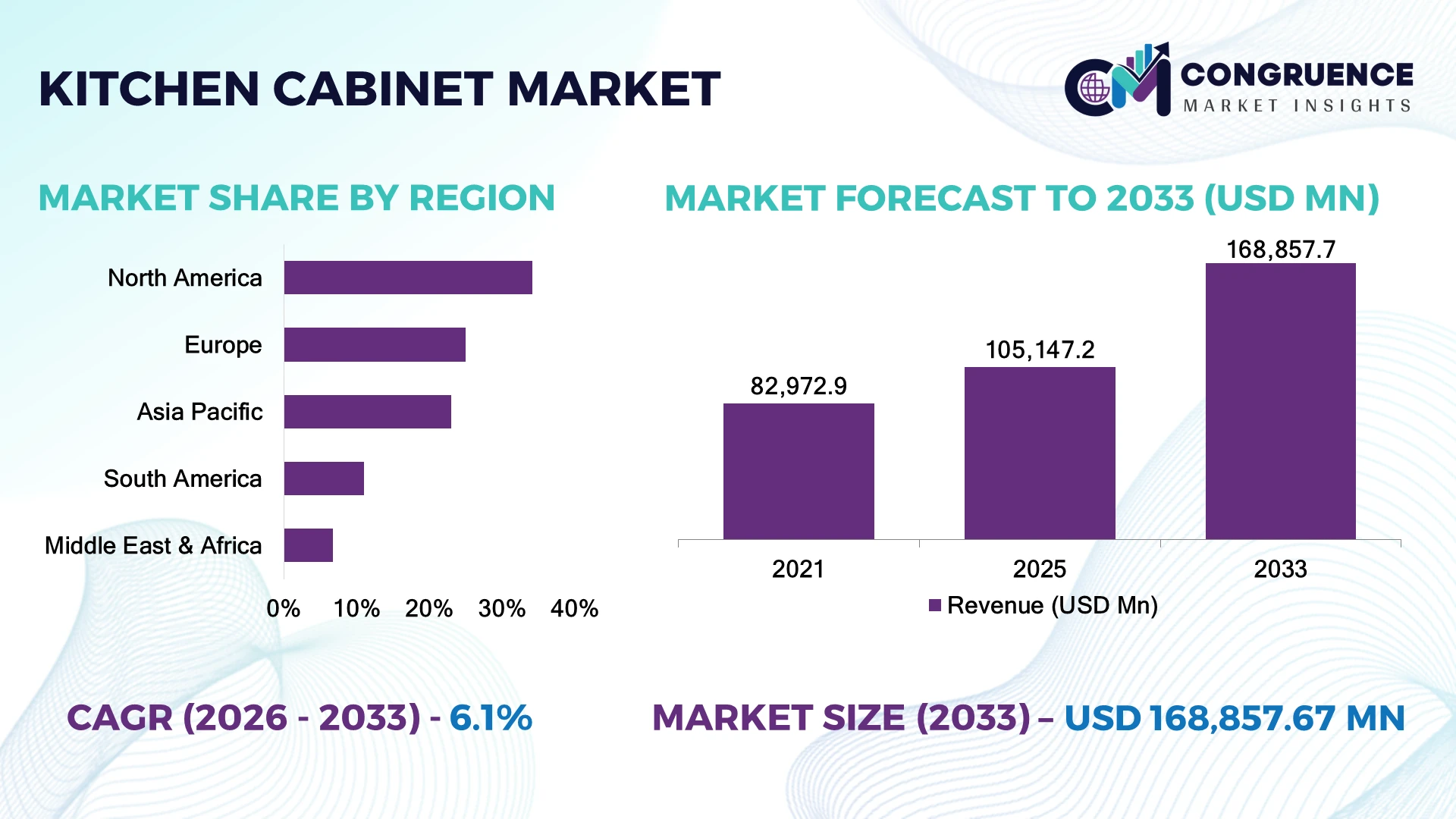
The United States remains the dominant country market, representing approximately 31% of global kitchen cabinet demand, supported by residential remodeling, new housing, and large-scale home-improvement channels. Germany follows at roughly 7%, while China combines extensive panel-processing capacity with rapidly expanding urban housing demand. U.S. manufacturers are increasing automated CNC and precision-edge processing, with advanced production lines improving cutting efficiency by approximately 15%. Supply-chain restructuring following Red Sea disruptions is also encouraging regional sourcing.
Strategic priority is shifting toward automated manufacturing, localized supply networks, modular product platforms, and differentiated storage functionality.
Market Size & Growth: USD 105.1 billion in 2025 to USD 168.9 billion by 2033 at 6.1% CAGR, supported by remodeling and modular-kitchen adoption.
Top Growth Drivers: Remodeling 32%, new housing 27%, modular kitchens 21%—three forces sustaining high-growth cabinet demand.
Short-Term Forecast: By 2028, CNC automation can reduce cutting and drilling costs 8–12% while improving production efficiency 15%.
Emerging Technologies: AI-assisted design, CNC machining, automated edge-banding, and digital configurators are accelerating customization and reducing rework by 10%.
Regional Leaders: North America reaches about USD 56 billion, Europe USD 43 billion, and Asia-Pacific USD 48 billion, with digital configuration adoption rising.
Consumer/End-User Trends: Approximately 38% of remodeling buyers increasingly prioritize integrated storage, soft-close hardware, and space-efficient cabinet layouts.
Pilot/Case Example: 2025 automated cabinet-production programs demonstrated roughly 15% higher throughput and 10% lower material waste through optimized nesting.
Competitive Landscape: Leading manufacturers collectively control about 20% of global demand, competing through IKEA, MasterBrand, Nobilia, Häcker Küchen, and Poggenpohl-style premium positioning.
Regulatory & ESG Impact: Low-emission panels and certified wood sourcing are increasing specification requirements, with compliant materials representing more than 30% of premium-project procurement.
Investment & Funding: More than USD 2 billion is being directed toward manufacturing automation, capacity upgrades, digital retailing, and localized component supply chains.
Innovation & Future Outlook: Frameless systems, recycled panels, sensor-enabled storage, and AI room visualization will shift competition toward customization speed, material efficiency, and integrated kitchen ecosystems.
The Kitchen Cabinet Market is increasingly centered on remodeling, modular housing, premium storage systems, and digitally configured purchases. Approximately 38% of renovation-oriented buyers prioritize integrated organization and space utilization, while CNC-enabled production is reducing material handling and fabrication inefficiencies. In 2026, manufacturers are also strengthening regional sourcing to manage logistics disruption and shorten cabinet delivery cycles, creating a stronger transition toward localized, technology-enabled production.
Kitchen cabinetry is becoming strategically important because manufacturers are competing on manufacturing flexibility, installation speed, storage functionality, and digital customer engagement rather than basic panel production. Remodeling represents a substantial share of purchasing activity, making renovation-cycle responsiveness critical for manufacturers, distributors, and retailers. The market is also shifting toward modular and semi-custom configurations that reduce project complexity while preserving design differentiation.
Automation is strengthening this transition. CNC-based cutting, drilling, and nesting can improve production throughput by roughly 15% compared with conventional manual workflows, while automated edge-banding reduces repetitive finishing work and rework. North American manufacturers emphasize high-volume remodeling fulfillment, whereas German and Italian producers focus more heavily on precision engineering, premium finishes, and digitally integrated configuration.
Between 2026 and 2028, cabinet producers are expected to increase automated machining, AI-assisted design, digital visualization, and inventory synchronization across dealer networks. A practical deployment model combines CNC production with online configurators, allowing standardized cabinet modules to be customized without rebuilding the manufacturing workflow. Companies are therefore prioritizing flexible automation, regional component sourcing, and partnerships with appliance and hardware suppliers. Competitive advantage will increasingly depend on delivering customization at near-standardized production economics.
Kitchen renovation and modular-home construction are shifting cabinet purchasing toward standardized modules with configurable finishes, hardware, and storage accessories. Approximately 38% of renovation buyers prioritize integrated storage, while modular cabinet configurations can shorten installation time by 15–20% versus heavily customized site-built systems. In the United States, persistent remodeling activity is reinforcing demand for faster fulfillment and digitally specified products. Manufacturers are responding by expanding CNC machining, automated edge-banding, and modular product libraries. The non-obvious advantage is manufacturing flexibility: standardized carcasses combined with configurable fronts allow producers to broaden product variety without proportionally increasing production complexity, improving inventory productivity and protecting margins.
Kitchen cabinet manufacturers remain exposed to volatility in engineered wood, hardwood, laminates, hardware, and specialty finishes. Panel products and hardware can collectively represent more than 50% of cabinet manufacturing input costs, while imported components in some production networks account for 20–30% of bill-of-material value. Freight disruption around major maritime corridors has increased pressure on replenishment schedules and working capital. Smaller manufacturers face greater difficulty absorbing input swings than vertically integrated producers. Companies are responding through dual sourcing, domestic panel procurement, longer-term supplier contracts, and standardized hardware platforms. The strategic constraint is not material availability alone but maintaining consistent specifications across substitute suppliers without increasing rejection rates or installation complexity.
AI-assisted kitchen design and digitally connected manufacturing are creating a high-value opportunity to link customer visualization directly with production planning. Digital configurators can reduce design-to-quotation cycles by approximately 30%, while automated nesting can lower panel waste by 8–12% compared with less optimized cutting workflows. China and India offer particularly attractive expansion opportunities as modular kitchen adoption spreads through urban housing and organized retail channels. Manufacturers are investing in CNC automation, cloud-based configuration libraries, and dealer integrations that convert customized orders into production-ready specifications. A distinctive opportunity lies in mass customization: companies can use common cabinet modules while varying dimensions, finishes, and accessories, creating premium differentiation without rebuilding core manufacturing processes.
Cabinet production is becoming more technologically integrated, but workforce capability has not advanced uniformly with CNC machining, automated assembly, digital design, and installation software. Approximately 20–25% of manufacturers in fragmented production environments still rely heavily on manual fabrication, creating consistency and throughput gaps against automated competitors. Integrating design platforms with CNC equipment, ERP systems, inventory controls, and dealer ordering also introduces workflow complexity. In the United States and Europe, experienced installers remain particularly important for premium and complex configurations. Companies must therefore invest in operator training, standardized digital workflows, machine interoperability, and installer partnerships. The critical long-term differentiator will be the ability to synchronize digital specifications with physical installation without creating costly measurement, production, or fitment errors.
AI-Enabled Kitchen Visualization: AI room-planning and 3D configurators are moving into mainstream cabinet sales, with digitally assisted design reducing quotation and specification cycles by roughly 25–30%. Retailers are connecting visualization tools with product databases and automated bills of materials, allowing customers to customize finishes and storage while manufacturers preserve standardized production workflows.
CNC Automation Reshapes Production: Automated cutting, drilling, and edge-banding are expanding across high-volume cabinet factories, improving throughput by approximately 15% and reducing repetitive manual processing by 20%. Labor shortages and tighter delivery windows are accelerating adoption, particularly among larger manufacturers. Producers are prioritizing flexible CNC cells capable of switching between cabinet dimensions without lengthy tooling changes.
Low-Emission Materials Gain Share: Demand is shifting toward low-formaldehyde engineered wood, recycled-content panels, water-based coatings, and responsibly sourced timber. Sustainable material specifications now influence more than 30% of premium residential projects in developed markets. Manufacturers are restructuring supplier portfolios and redesigning product lines around compliant panels, while retailers increasingly position environmental credentials alongside durability and design.
Faster Modular Fulfillment Models: Cabinet businesses are shortening fulfillment cycles through regional inventory hubs, standardized carcasses, and localized finishing. Modular platforms can reduce installation schedules by 15–20% compared with highly site-customized cabinetry. Ongoing shipping volatility is reinforcing this model, prompting manufacturers to hold critical hardware and panels closer to end markets while using centralized plants for core cabinet production.
Modular kitchen cabinets represent the leading type, estimated at approximately 58% of global demand, supported by standardized dimensions, faster installation, repeatable manufacturing, and compatibility with mass-market housing projects. Their production economics give manufacturers stronger inventory control than fully custom cabinetry, while digital configuration tools increasingly reduce design-to-production friction. Custom cabinets retain strategic relevance in premium residential and luxury remodeling, where personalization supports higher margins. Semi-custom formats occupy the middle ground, capturing roughly 24% of demand by balancing specification flexibility with standardized components.
The fastest-growing shift is toward digitally configured modular systems, with adoption rising around 8%–10% annually across organized distributors and large residential projects. Manufacturers are investing in CNC machining, automated edge-banding, and configurable hardware platforms to compress lead times by 15%–20%. Investment is therefore moving from broad product proliferation toward scalable platforms, localized component sourcing, and modular designs that preserve customization without sacrificing factory efficiency.
The National Kitchen & Bath Association reported in 2025 that kitchen projects increasingly prioritize functional storage, layout optimization, and integrated features, reinforcing manufacturers’ focus on configurable cabinet systems.
Residential applications account for the largest share, estimated at approximately 67%, reflecting sustained replacement cycles, kitchen renovations, and new-home installations. Demand is concentrated in North America and Western Europe, where homeowners increasingly specify storage optimization, integrated appliances, and durable finishes. New construction remains important, but remodeling generates more varied specifications and shorter purchasing cycles. Commercial applications represent a smaller but operationally significant base, particularly in hospitality, multifamily housing, and institutional facilities.
The fastest-growing application is multifamily residential development, with organized procurement adoption increasing roughly 9%–11% as developers standardize kitchen packages across projects. Commercial demand emphasizes durability and installation consistency, while individual residential remodeling favors customization. Manufacturers are responding with project-based pricing, standardized SKU platforms, installation partnerships, and digital design-to-order workflows. The business implication is clear: suppliers that combine configurable designs with predictable delivery are gaining specification influence, particularly where developers manage hundreds of units under compressed construction schedules.
In 2025, the National Association of Home Builders highlighted continued remodeling activity and kitchen upgrades as important components of residential improvement spending, supporting sustained cabinet replacement and renovation demand.
Residential end-users account for approximately 72% of kitchen cabinet demand, reflecting the scale of homeowner renovations, new-home construction, and replacement purchases. Their buying behavior increasingly combines aesthetic personalization with practical requirements such as storage density, soft-close hardware, and durable surfaces. Professional contractors and kitchen specialists form the fastest-growing procurement channel, with organized installation-led purchasing expanding about 8%–10% as consumers seek coordinated design, manufacturing, and fitting.
Commercial developers and hospitality operators remain smaller but strategically important end-users because purchasing is concentrated and specification-driven. Their procurement emphasizes lifecycle durability, standardized dimensions, installation speed, and repeatability rather than extensive customization. Manufacturers are therefore separating product portfolios by buyer economics: consumer-facing ranges emphasize finishes and configuration, while contractor and developer programs emphasize volume pricing, rapid fulfillment, and installation support. This shift is strengthening the role of ecosystem partnerships between cabinet manufacturers, designers, builders, distributors, and installation networks.
The National Association of Home Builders’ 2025 industry findings continued to identify kitchen functionality and cabinetry among important considerations in residential construction and remodeling decisions.
North America accounted for the largest market share at 34.2% in 2025 however, Asia-Pacific is expected to register the fastest growth, expanding at a CAGR of 7.4% between 2026 and 2033.

Remodeling-led demand is accelerating digital, semi-custom cabinet production
North America maintains the strongest revenue concentration in the global kitchen cabinet market, supported by extensive remodeling activity, established distributor networks, and high penetration of premium storage systems. The United States dominates regional demand, while Canada strengthens the market through residential renovation and multifamily construction. Approximately 68% of purchases are linked to residential applications, keeping replacement cycles commercially important. Digital kitchen visualization, CNC machining, automated finishing, and ready-to-assemble production are increasingly integrated into manufacturing workflows, reducing design-to-production delays. Manufacturers are expanding regional distribution capacity and strengthening contractor partnerships to improve fulfillment reliability. The region also benefits from reshoring and localized sourcing strategies as manufacturers seek greater control over hardware, panels, and engineered wood inputs. Competitive advantage increasingly depends on balancing customization with standardized production economics.
United States Market Outlook: The United States remains the region’s principal manufacturing, distribution, and consumption hub, supported by a large remodeling ecosystem and extensive home-improvement retail infrastructure. Cabinet manufacturers are prioritizing semi-custom configurations, faster fulfillment, and digitally assisted design. Approximately 70% of U.S. kitchen renovation projects involve cabinet replacement or substantial cabinet modification, reinforcing recurring demand for modular and configurable product platforms.
Energy efficiency and circular-material requirements are reshaping cabinet manufacturing
Europe represents a highly specification-driven kitchen cabinet market, with Germany, Italy, France, and the United Kingdom forming major demand and production centers. Sustainability requirements are pushing manufacturers toward recycled panels, low-emission adhesives, water-based coatings, and certified timber inputs. Approximately 55% of organized European manufacturers increasingly incorporate sustainability criteria into product development or procurement decisions. Germany emphasizes automated manufacturing and precision engineering, while Italy retains strength in premium design and customized cabinetry. Manufacturers are localizing selected component sourcing and investing in flexible production lines to accommodate shorter runs without materially increasing unit costs.
Germany Market Outlook: Germany provides Europe’s strongest combination of cabinet manufacturing capability, engineering expertise, and automated production infrastructure. Manufacturers increasingly integrate CNC machining, robotic handling, and digital production planning to improve precision and reduce material waste. Automated workflows can reduce machining and handling time by approximately 15%–20%, strengthening German suppliers’ competitiveness in standardized and high-specification kitchen systems.
Manufacturing scale is shifting toward digitally enabled modular production
Asia-Pacific is becoming the principal expansion engine for kitchen cabinet manufacturing and consumption, supported by urban housing development, rising middle-income households, and increasingly organized home-improvement channels. China remains the largest production base, while India, Vietnam, Indonesia, and Southeast Asian manufacturing hubs are expanding their roles in engineered-wood processing and furniture exports. Modular and ready-to-assemble systems account for an estimated 60% of organized-market demand in major urban centers. Manufacturers are investing in automated panel processing, edge-banding, and digital design platforms to increase throughput while maintaining configuration flexibility. Supply-chain diversification is also shifting selected production from China toward Vietnam and India, creating opportunities for regional component ecosystems.
China Market Outlook: China retains a decisive advantage through integrated panel production, hardware availability, furniture manufacturing clusters, and export-oriented logistics. Large-scale factories increasingly use CNC nesting, automated drilling, and robotic material handling to improve production consistency. Approximately 65% of organized manufacturers in major manufacturing hubs use some form of computer-controlled production equipment, supporting faster customization and high-volume fulfillment for domestic and international buyers.
Localized manufacturing is gaining importance as import exposure tightens
South America remains a manufacturing-sensitive kitchen cabinet market, with Brazil accounting for the largest concentration of production, distribution, and residential demand. Engineered wood, modular cabinetry, and locally manufactured hardware dominate mainstream purchasing because domestic sourcing helps limit currency and freight exposure. Organized manufacturers increasingly target apartment developments and middle-income housing with standardized cabinet packages. Approximately 52% of organized cabinet purchases are estimated to involve modular or semi-custom formats, reflecting the need to control installation and material costs. Brazil’s established furniture clusters provide manufacturing depth, but logistics variability and financing conditions continue to influence purchasing cycles. Companies are responding through localized component procurement, distributor partnerships, and narrower product portfolios that improve inventory turnover.
Brazil Market Outlook: Brazil offers the strongest industrial base in South America through established furniture clusters, domestic engineered-wood availability, and a large residential consumer market. Manufacturers are increasingly combining modular designs with localized hardware and digital cutting technologies. Approximately 58% of organized cabinet production is concentrated in standardized or semi-standardized product formats, allowing producers to manage material costs while serving varied residential layouts.
Construction modernization is accelerating specification-led cabinet demand
Middle East & Africa demand is increasingly tied to hospitality development, luxury residential construction, urban housing, and large-scale mixed-use projects. The United Arab Emirates and Saudi Arabia are key procurement centers, with project developers emphasizing imported premium cabinetry alongside locally assembled modular systems. Approximately 45% of high-end project specifications increasingly include integrated storage, concealed hardware, and premium surface finishes. Saudi Arabia’s large-scale urban development pipeline is strengthening demand for standardized cabinet packages capable of rapid installation across multiple properties. Manufacturers and distributors are responding through regional showrooms, project partnerships, localized assembly, and direct relationships with developers. The competitive priority is shifting from standalone product sales toward specification management and dependable project fulfillment.
Saudi Arabia Market Outlook: Saudi Arabia presents the strongest project-driven opportunity through large residential, hospitality, and mixed-use developments. Developers increasingly favor standardized cabinetry that can be installed consistently across repeated units while maintaining premium finishes. Modular procurement can reduce installation complexity by approximately 15%, strengthening demand for suppliers with regional warehousing, project-management capabilities, and reliable after-sales support.
IKEA and MasterBrand compete on scale, standardized modularity, and value, while American Woodmark, Masco, Nobilia, and Oppein target differentiated dealer, premium, and digitally configured segments. The market remains fragmented: the top five players collectively account for approximately 34% of global sales. Price remains decisive for roughly 35% of purchase decisions, while customization influences about 30%; delivery reliability and supply-chain control affect nearly 25% of specification choices. Leading manufacturers are expanding automated plants, integrating CNC and digital design-to-production systems, and strengthening distributor and designer partnerships. Howdens is deepening vertical integration, while Oppein and Nobilia emphasize intelligent manufacturing and configurable production. The competitive shift is moving from cabinet variety toward manufacturing responsiveness, localized sourcing, and digitally managed customization. High capital requirements, dealer relationships, engineered-wood procurement, and installation networks raise entry barriers. Winners will combine low unit economics, rapid configuration, dependable fulfillment, and localized service without sacrificing design differentiation at scale across markets.
MasterBrand Cabinets Inc.
American Woodmark Corporation
Masco Corporation
IKEA
Nobilia Küchen
Oppein Home Group
Hanssem Co., Ltd.
ZBOM Holding Group
GoldenHome Living
Howden Joinery Group
Fabuwood Cabinetry
SieMatic Möbelwerke
Digital design-to-manufacturing platforms are becoming the operational backbone of kitchen cabinet production, linking CAD, configuration, pricing, CNC nesting, drilling, and scheduling. Approximately 35%–40% of organized manufacturers use integrated digital workflows, with CPQ and automated nesting cutting order-processing time by 15%–20%. Compared with manual planning, connected workflows improve efficiency by about 12%–18% and reduce rework by 8%–12%. This improves quotation accuracy and dealer visibility into component availability.
Robotic panel handling, CNC machining, automated edge-banding, and vision-based inspection are moving from high-volume factories into flexible batch production. Deployment among advanced manufacturers is estimated at 25%–30%, with integrated automation delivering 10%–15% higher throughput and 5%–8% lower material waste. Nobilia, Oppein, and large North American producers benefit most because scale converts automation into faster customization and tighter quality control. Batch-size-one capability is increasingly important for customized orders.
From 2026 to 2028, AI-assisted design, digital twins, predictive maintenance, and cloud-based production orchestration will become more commercially important. Early adopters can reduce machine downtime by 8%–12% and shorten configuration-to-production cycles by another 10%–15%. The competitive advantage shifts toward manufacturers that connect showroom data with factory scheduling and supply planning, making technology integration—not isolated machinery—the decisive investment priority. Delayed integration increases labor exposure and weakens customization economics.
March 2025 — Howdens Joinery commenced a Runcorn cabinet and panel upgrade, adding high-volume machining and automated work-in-progress storage. The project targets higher capacity and flexibility, strengthening vertical integration and reducing reliance on externally sourced components and suppliers. Source: howdenjoinerygroupplc.com (Howden Joinery Group Plc)
January 2025 — Interio by Godrej expanded its modular-kitchen network to 250 galleries across 120 Indian cities, supported by a facility producing up to 250 kitchens daily. The move strengthens localized customization, manufacturing scale, and Tier-2/Tier-3 market penetration. Source: godrejenterprises.com (Godrej Enterprises)
March 2025 — GoldenHome opened an intelligent manufacturing facility in Texas integrating robotic arms, CNC drilling machines, edgebanders, and electric saws. The expansion supports customized production closer to customers, strengthens U.S. supply resilience, and extends manufacturing beyond China. Source: woodworkingnetwork.com (Woodworking Network)
2025 — American Woodmark expanded facilities in Monterrey and Hamlet while advancing platform design and automation. More than 30% of Made-to-Order sales came from products launched within three years, strengthening freshness, capacity utilization, and channel competitiveness across remodeling. Source: americanwoodmark.com (AWC Corporate)
The Global Kitchen Cabinet Market Report covers modular, semi-custom, and custom cabinet formats across residential construction, remodeling, multifamily housing, hospitality, and commercial applications. The analysis evaluates purchasing patterns among homeowners, contractors, developers, designers, distributors, and institutional buyers, with segmentation by type, application, and end-user. It assesses organized and emerging channels, including ready-to-assemble systems, digitally configured cabinetry, premium built-ins, and project-based procurement.
Regional coverage spans North America, Europe, Asia-Pacific, South America, and the Middle East & Africa, with country-level analysis of manufacturing concentration, distribution infrastructure, housing activity, and technology adoption. The report examines CNC machining, robotic handling, automated finishing, digital design-to-production, AI-assisted configuration, engineered materials, and sustainability-oriented manufacturing. Competitive analysis covers 10–14 major companies and identifies investment priorities, expansion opportunities, supply-chain strategies, technology gaps, and positioning pathways through 2033.
| Report Attribute/Metric | Report Details |
|---|---|
|
Market Revenue in 2025 |
USD 105,147.2 Million |
|
Market Revenue in 2033 |
USD 168,857.7 Million |
|
CAGR (2026 - 2033) |
6.1% |
|
Base Year |
2025 |
|
Forecast Period |
2026 - 2033 |
|
Historic Period |
2021 - 2025 |
|
Segments Covered |
By Type
By Application
By End-User
|
|
Key Report Deliverable |
Revenue Forecast, Growth Trends, Market Dynamics, Segmental Overview, Regional and Country-wise Analysis, Competition Landscape |
|
Region Covered |
North America, Europe, Asia-Pacific, South America, Middle East, Africa |
|
Key Players Analyzed |
MasterBrand Cabinets Inc., American Woodmark Corporation, Masco Corporation, IKEA, Nobilia Küchen, Oppein Home Group, Hanssem Co., Ltd., ZBOM Holding Group, GoldenHome Living, Howden Joinery Group, Fabuwood Cabinetry, SieMatic Möbelwerke |
|
Customization & Pricing |
Available on Request (10% Customization is Free) |




