Global Kids Sportwear Market Report Overview
The Global Kids Sportwear Market was valued at USD 19587.72 Million in 2025 and is anticipated to reach a value of USD 36524.93 Million by 2033 expanding at a CAGR of 8.1% between 2026 and 2033. Growth is driven by increasing youth participation in organized sports, expansion of school athletics programs, and adoption of moisture management fabrics, recycled polyester, and specialized performance apparel for children.
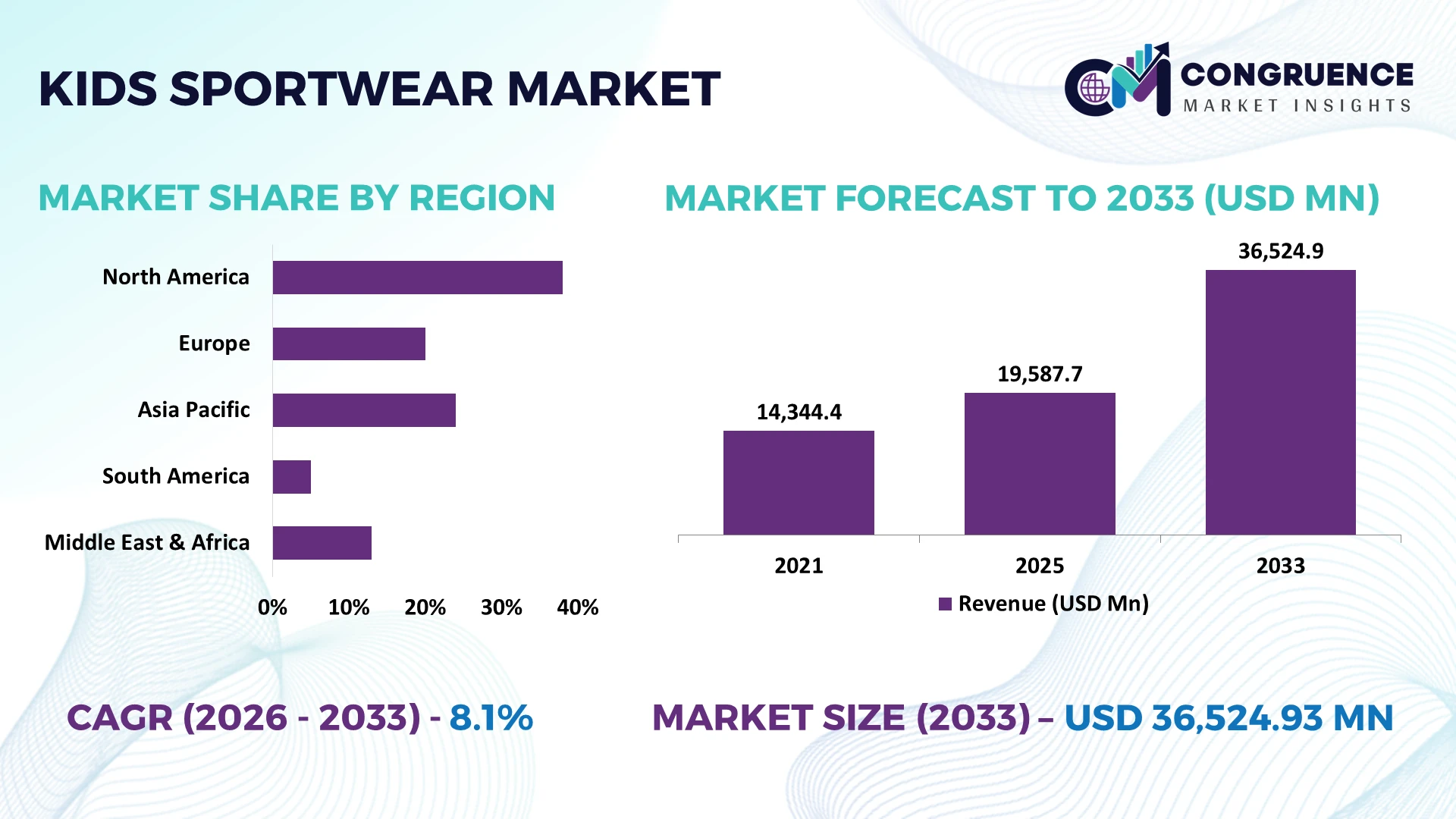
The United States represents a leading consumption market, supported by established school sports infrastructure, athletic footwear retailers, and advanced omnichannel distribution. Approximately 55.4% of American children aged 6 to 17 participated in organized sports in 2023, while participation in high school athletics reached 8.27 million during 2024 to 2025. North America accounted for an estimated 36.3% of global kids sportswear demand in 2026, supported by specialized sportswear manufacturers and digital retail networks. In comparison, China demonstrates substantial manufacturing and retail scale, with ANTA operating 2,652 dedicated ANTA KIDS stores in 2025.
Strategically, manufacturers should prioritize North American performance apparel demand and China's specialized retail infrastructure, leveraging 36.3% regional market concentration and 2,652 ANTA KIDS outlets to optimize product development, inventory allocation, and distribution partnerships.
Key Highlights of the Global Kids Sportwear Market
-
Market Size & Growth: USD 19,587.72 million in 2025, reaching USD 36,524.93 million by 2033 at 8.1% CAGR, supported by organized youth athletics and performance fabric innovation.
-
Top Growth Drivers: Three measurable indicators include 55.4% US youth sports participation, 20.2% digital sales penetration at Decathlon, and 99% recycled polyester utilization at Adidas.
-
Short Term Forecast: By 2027, projected market expansion reaches 16.9% against 2025, strengthening inventory requirements for specialized children's athletic apparel.
-
Emerging Technologies: Three innovations dominate product development: AI sizing systems, automated textile manufacturing, and advanced moisture management materials.
-
Regional Leaders: Indicative 2033 allocations are North America USD 11,965.57 million, Asia Pacific USD 10,796.77 million, and Europe USD 9,496.48 million, using constant 2025 regional shares; adoption priorities are teamwear, digital retail, and circular apparel, respectively.
-
Consumer Trends: Sports apparel represented an estimated 61.3% of category sales in 2026, highlighting demand for functional everyday athletic clothing.
-
Pilot/Case Example: Decathlon's 2025 ecodesign initiative increased qualifying product sales penetration from 48.5% to 53.9%, improving sustainable assortment coverage by 5.4 percentage points.
-
Competitive Landscape: ANTA held approximately 21.8% of China's overall sportswear market in 2025; major competitors include Nike, Adidas, Puma, and Decathlon.
-
Regulatory & ESG Impact: The EU's 2026 restrictions on destroying unsold apparel strengthen inventory recovery requirements, while Adidas reports 60% recycled or sustainably sourced renewable materials.
-
Investment & Funding: Decathlon announced USD 111 million for Indian expansion, targeting 190 stores and increased domestic manufacturing.
-
Innovation & Future Outlook: Adidas targets 10% recycled textile waste content in polyester by 2030, accelerating circular material innovation and supplier differentiation.
The Global Kids Sportwear Market increasingly concentrates on technical athletic clothing, specialized footwear, school sports uniforms, and versatile activewear designed for everyday movement. Product innovation emphasizes lightweight stretch fabrics, breathable construction, recycled fibers, and digital sizing technology that improves purchasing convenience. In 2025, Decathlon reported that 53.9% of its sales came from products benefiting from its ecodesign approach, demonstrating commercial adoption of sustainable product development across its broader portfolio. Meanwhile, India's expanding domestic sportswear manufacturing ecosystem strengthens regional sourcing alternatives. These developments establish the foundation for evaluating competitive positioning, technological differentiation, and strategic investment priorities.
What Is the Strategic Relevance and Future Pathways of the Kids Sportwear Market?
The Kids Sportwear Market is becoming strategically important as athletic apparel manufacturers compete through specialized product engineering, digital retail integration, and localized supply chains. In the United States, regular youth team sports participation approached 41% in 2025, strengthening the commercial importance of performance apparel and junior athletic footwear. Meanwhile, Adidas manufactured 92% of its total product volume in Asia, demonstrating how production concentration influences sourcing decisions and distribution competitiveness.
Digital product development is transforming manufacturing economics. Research on three dimensional garment sampling demonstrated up to 73% shorter sample preparation times compared with conventional physical prototyping, supporting faster product development and fewer manufacturing iterations. The United States leads through organized athletics and premium branded products, while China combines specialized children's retail networks with advanced textile manufacturing capabilities. Between 2026 and 2028, investments in virtual sampling, inventory analytics, and automated production planning will strengthen assortment flexibility.
Decathlon demonstrates practical operational integration through its digital channels, which represented 20.2% of total sales in 2025. Manufacturers are expanding supplier partnerships, improving size prediction systems, and introducing recyclable performance fabrics. Competitive advantage increasingly depends on efficient product development, responsive distribution, and differentiated children's sportswear portfolios.
Kids Sportwear Market Dynamics
DRIVER:
Expanding Youth Sports Participation and Specialized Athletic Apparel
Rising participation in organized youth athletics is strengthening demand for specialized children's performance clothing, training uniforms, and lightweight sports footwear. In the United States, nearly 41% of children aged 6 to 17 regularly participated in team sports during 2025, representing a 4% increase from the previous year. Flag football participation among children aged 6 to 12 increased 26% between 2019 and 2025, creating opportunities for specialized teamwear and protective athletic accessories. The expansion of school athletics and community sports programs is encouraging manufacturers to develop breathable, flexible, and durable apparel collections. Nike, Adidas, and Under Armour are responding through junior performance product innovation, sports partnerships, and differentiated footwear designs.
RESTRAINT:
Manufacturing Concentration and Rising Participation Costs
Concentrated textile manufacturing and increasing household sports expenditure restrict pricing flexibility across children's athletic apparel categories. Adidas sourced 27% of its total product volume from Vietnam, 18% from Indonesia, and 16% from China during 2025, illustrating dependence on established Asian manufacturing hubs. Changes in United States import tariffs and transportation costs directly affect procurement economics, inventory planning, and retail pricing. Meanwhile, American household expenditure on children's primary sports activities increased 46% between 2019 and 2024, intensifying affordability constraints. Manufacturers are responding through supplier diversification, alternative material procurement, localized inventory management, and competitively priced product collections. Maintaining accessible pricing without sacrificing durability remains essential for protecting market penetration among budget conscious families.
OPPORTUNITY:
Digital Product Engineering and Circular Sportswear Innovation
Digital garment engineering and circular material development create opportunities to improve product customization, manufacturing flexibility, and inventory efficiency. Research into virtual garment sampling identified potential reductions of up to 73% in sample preparation time and 87% in associated carbon emissions compared with physical sampling. India offers opportunities for technology enabled sportswear manufacturing through its expanding textile infrastructure and growing domestic athletic apparel ecosystem. Adidas reported that 99% of its polyester came from recycled sources in 2025, demonstrating technical feasibility for broader sustainable material integration. Manufacturers are investing in virtual fitting platforms, recyclable fabrics, and automated pattern development. Children's rapid size progression also creates opportunities for standardized sizing platforms and resale compatible apparel collections.
CHALLENGE:
Product Lifecycle Complexity and Sustainability Compliance
Managing frequent size changes, product durability, and evolving sustainability regulations presents significant execution challenges for children's sportswear manufacturers. The European Union introduced restrictions on destroying unsold apparel in July 2026, requiring large manufacturers and retailers to strengthen inventory recovery and product traceability systems. European estimates indicate that approximately 4% to 9% of unsold textiles were previously destroyed before use, highlighting the operational importance of accurate demand forecasting. Decathlon reported that 53.9% of its 2025 sales involved products benefiting from its ecodesign approach, demonstrating progress in sustainable assortment transformation. Companies must integrate digital inventory tracking, standardized product specifications, and circular distribution partnerships to maintain regulatory compliance, operational scalability, and competitive differentiation.
Kids Sportwear Market Latest Trends
-
Expanding Omnichannel Sportswear Retail Networks: Children's athletic apparel retailers are integrating physical stores, mobile shopping, and centralized inventory systems. Decathlon reported 20.2% digital sales penetration in 2025, while its global network exceeded 1,800 stores. Retailers are improving stock visibility, localized fulfillment, and online assortment availability. Unified inventory management supports faster replenishment and reduces dependence on individual store inventories.
-
Growing Preference for Multipurpose Athletic Collections: Children increasingly use sportswear across physical education, recreational activities, and casual settings. Industry participation data indicates that 33.3 million American children aged 6 to 17 played team sports in 2025, with 61.6% participating frequently. Manufacturers are responding through versatile sports tops, coordinated bottoms, and adaptable outerwear, reducing assortment fragmentation while supporting multiple wearing occasions.
-
Specialized Teamwear Customization Gains Momentum: Schools and sports organizations are adopting coordinated apparel procurement, personalized graphics, and standardized team collections. American high school athletics recorded 8.27 million participation entries during 2024 to 2025, increasing by approximately 204,000. Manufacturers are introducing digital ordering interfaces, automated printing, and consolidated team fulfillment, improving order accuracy and reducing administrative complexity for institutional buyers.
-
Retail Assortments Reflect Changing Gender Participation: Sportswear brands are adjusting children's product allocations as girls' organized athletics participation strengthens. American girls' regular team sports participation increased from 33% in 2019 to 38% in 2025, while boys reached 43%. Retailers are expanding girls' technical apparel, adjusting size availability, and developing sport specific collections, strengthening merchandising relevance and reducing overlooked demand.
Segmentation Analysis
By Type
Sports Tops Dominate Through Versatile Performance Applications
Sports Tops represent the leading product category, with an estimated 38% share of the global Kids Sportwear Market. Their dominance reflects frequent usage across training sessions, physical education, recreational activities, and competitive athletics. Lightweight polyester jerseys, breathable training shirts, and moisture management fabrics support standardized manufacturing and broad retail distribution. Sports Bottoms account for an estimated 29% share, benefiting from consistent demand for stretchable shorts, leggings, and training trousers. Manufacturers prioritize fabric durability, unrestricted movement, and garment flexibility to improve product differentiation while managing production costs.
Sportswear Sets are positioned as the fastest growing category, supported by coordinated school uniforms, team apparel procurement, and simplified purchasing decisions. Their estimated 21% share highlights increasing commercial relevance for bundled athletic clothing. Sports Outerwear accounts for approximately 12%, serving demand for lightweight training jackets, insulated layers, and weather resistant garments. Nike, Adidas, Puma, and Decathlon are expanding coordinated collections and improving textile performance. Investment priorities increasingly favor adaptable fabric platforms, standardized sizing, and consolidated product assortments that enable efficient merchandising across different activity categories.
- The National Federation of State High School Associations recorded 8,266,244 athletic participation entries during the 2024 to 2025 academic year. This extensive institutional participation base supports demand for standardized Sports Tops, Sports Bottoms, and coordinated Sportswear Sets.
By Application
Running Leads Through Broad Athletic Participation
Running represents the leading application, accounting for an estimated 28% of the global Kids Sportwear Market. Its dominance reflects extensive usage in school athletics, recreational fitness, and endurance training. Lightweight fabrics, breathable construction, and flexible garment designs support consistent demand across different age groups. Basketball holds an estimated 24% share, benefiting from organized school competitions and demand for specialized jerseys, shorts, and training apparel. Football follows with approximately 23%, supported by club participation, school teams, and coordinated uniform procurement. Manufacturers emphasize movement flexibility, abrasion resistance, and moisture management to differentiate products across these established applications.
Swimming is positioned as the fastest growing application within this illustrative segmentation, reflecting opportunities in technical swimwear, chlorine resistant materials, and specialized training apparel. Gymnastics maintains a smaller but technically demanding position, requiring stretch recovery, secure garment fit, and unrestricted movement. Nike and Adidas prioritize performance engineering for Running, Basketball, and Football, while specialized manufacturers develop products for Swimming and Gymnastics. Future assortment investment increasingly depends on sport specific functionality, repeat purchasing patterns, and institutional distribution relationships.
- The National Federation of State High School Associations reported 896,944 Basketball participants and 257,405 Swimming and Diving participants during 2024 to 2025. These participation levels demonstrate the importance of sport specific apparel engineering and institutional distribution.
By End-User
Boys Lead While Unisex Sportswear Expands
Boys represent the leading end user segment, accounting for an estimated 43% of the global Kids Sportwear Market. Their dominance reflects substantial participation in organized Football, Basketball, and Running activities, alongside established purchasing patterns for performance clothing and athletic uniforms. Manufacturers emphasize durable fabrics, reinforced seams, and sport specific garment construction to address intensive training requirements. Girls account for approximately 35% of market demand, supported by expanding participation in school athletics and increasing availability of specialized performance apparel. Nike, Adidas, and Puma are strengthening girls' product assortments through improved garment fit, differentiated technical fabrics, and athlete focused merchandising.
Unisex sportswear represents the fastest growing segment, with an estimated 22% share, driven by demand for versatile designs, standardized sizing, and coordinated institutional apparel. Gender neutral collections allow manufacturers to consolidate product variants and simplify inventory management across retail channels. Decathlon and other mass market retailers are positioned to benefit from adaptable sportswear designs and accessible pricing. Investment priorities increasingly emphasize inclusive sizing, multifunctional garments, and flexible assortment planning to address evolving purchasing preferences.
- The Aspen Institute's Project Play analysis of 2025 participation data found regular team sports participation among 38% of girls and 43% of boys. This narrowing participation gap supports more balanced product development and merchandising investment across end user categories.
Region-Wise Market Insights
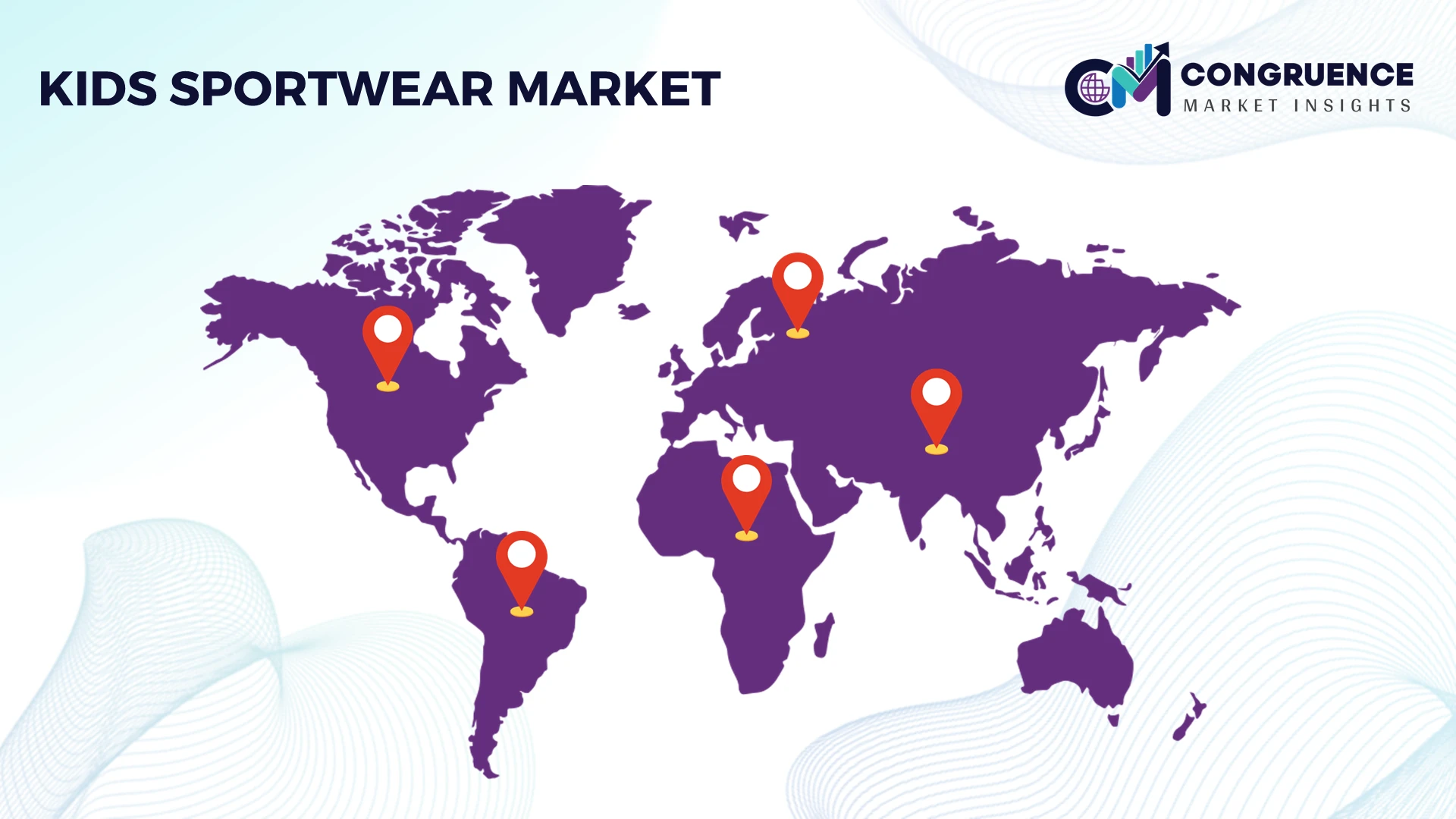
North America accounted for the largest estimated market share at 36.3% in 2025 however, Asia Pacific is expected to register the fastest growth, expanding at a CAGR of approximately 10.2% between 2026 and 2033.
North America Kids Sportwear Market
Organized Athletics Strengthen Premium Sportswear Distribution
North America maintains an estimated 36.3% share of the global Kids Sportwear Market, supported by established school athletics infrastructure, premium sportswear consumption, and extensive omnichannel retail distribution. The United States dominates regional demand through organized youth leagues, institutional sports procurement, and specialized athletic footwear networks. During the 2024 to 2025 academic year, American high school athletic participation reached approximately 8.27 million entries, demonstrating the scale of organized sporting infrastructure. Nike, Under Armour, and New Balance benefit from established brand recognition, specialized performance apparel development, and extensive retail partnerships. Canadian retailers increasingly integrate digital purchasing channels with localized inventory management to improve seasonal assortment availability. Manufacturers prioritize technical fabric development, customized teamwear, and efficient replenishment systems, strengthening competitive positioning across institutional and consumer purchasing channels.
United States Market Outlook: The United States benefits from advanced sportswear product engineering, extensive retail infrastructure, and established institutional procurement networks. Nike and Under Armour maintain strong domestic brand positioning through performance innovation and youth athlete partnerships. Approximately 55.4% of American children aged 6 to 17 participated in organized sports during 2023, supporting demand for specialized training apparel, durable uniforms, and age appropriate athletic clothing.
Europe Kids Sportwear Market
Circular Textile Regulation Reshapes Apparel Manufacturing
Europe represents an estimated 26.0% of the global Kids Sportwear Market, supported by established football participation, organized school athletics, and advanced sportswear manufacturing capabilities. Germany, France, and the United Kingdom anchor demand through sports clubs, specialized retailers, and established athletic apparel brands. European Union textile regulations are accelerating investments in product durability, material traceability, and inventory recovery systems. Restrictions on destroying unsold apparel introduced in 2026 are encouraging retailers to improve demand forecasting and reverse logistics operations. Adidas, Puma, and Decathlon are strengthening recycled material integration, product development efficiency, and digital merchandising capabilities. Decathlon reported that 53.9% of its sales in 2025 involved products benefiting from its ecodesign approach. Manufacturers increasingly prioritize compliant textile sourcing, circular product design, and localized distribution partnerships to maintain operational efficiency.
Germany Market Outlook: Germany combines advanced sportswear product development with extensive organized football infrastructure and established textile engineering capabilities. Adidas and Puma maintain major corporate operations in Herzogenaurach, supporting performance material innovation and global supplier coordination. The German Football Association reported more than 8 million memberships in its 2025 statistics, reinforcing the importance of organized sporting infrastructure for specialized junior football apparel and institutional teamwear procurement.
Asia-Pacific Kids Sportwear Market
Integrated Manufacturing and Specialized Retail Drive Scale
Asia Pacific accounts for an estimated 29.6% of global Kids Sportwear Market demand, combining extensive textile manufacturing capacity with expanding domestic athletic apparel distribution. China, India, Vietnam, and Indonesia contribute through garment manufacturing, technical fabric production, and international sportswear supply chains. China maintains strong domestic retail infrastructure, while Vietnam and Indonesia provide export oriented production capacity for multinational athletic brands. India is strengthening sportswear manufacturing through textile modernization initiatives and expanding organized retail networks. ANTA Sports operates specialized children's apparel channels alongside its broader performance footwear and clothing portfolio, demonstrating the commercial importance of dedicated junior product distribution. Manufacturers are investing in automated garment production, advanced polyester processing, and digital inventory systems. The region's strategic advantage lies in connecting manufacturing scale with localized product development and increasingly sophisticated consumer distribution.
China Market Outlook: China combines advanced textile manufacturing infrastructure with specialized children's sportswear retail networks. ANTA Sports operates dedicated ANTA KIDS outlets, supporting targeted merchandising and age specific athletic product development. Domestic manufacturers benefit from integrated synthetic fabric production, established footwear supply chains, and extensive digital commerce infrastructure. Competitive priorities include performance material innovation, rapid assortment renewal, and coordinated online and physical retail distribution.
South America Kids Sportwear Market
Football Culture Supports Localized Athletic Apparel Distribution
South America represents an estimated 5.1% of global Kids Sportwear Market demand, with Brazil and Argentina providing important consumption and manufacturing centers. Football remains central to junior athletic apparel purchasing, supporting demand for training jerseys, shorts, coordinated uniforms, and lightweight performance clothing. Brazil benefits from an established domestic textile and footwear manufacturing ecosystem, enabling localized product development and regional distribution. Argentina maintains organized football infrastructure and specialized sporting goods retail networks, although import restrictions and currency fluctuations complicate international procurement. Global brands compete with domestic manufacturers through licensed merchandise, sports club partnerships, and differentiated product pricing. Retailers are expanding digital storefronts and integrating domestic suppliers to improve product availability. Regional competitiveness depends on balancing affordable athletic apparel with technical performance, particularly across price sensitive household purchasing segments.
Brazil Market Outlook: Brazil maintains significant advantages through domestic apparel manufacturing, established football institutions, and extensive urban retail networks. The Brazilian Textile and Apparel Industry Association identifies the country as an important integrated textile production center, supporting local fabric sourcing and garment manufacturing. Manufacturers leverage domestic production to serve school sports programs, football academies, and regional sporting goods retailers while reducing dependence on imported finished apparel.
Middle East & Africa Kids Sportwear Market
Sports Infrastructure Investment Accelerates Institutional Demand
The Middle East and Africa account for an estimated 3.0% of the global Kids Sportwear Market, supported by expanding sports infrastructure, educational modernization, and government backed physical activity initiatives. Saudi Arabia and the United Arab Emirates are strengthening organized recreation through school athletics, community sports facilities, and private training academies. Saudi Arabia's Vision 2030 initiatives encourage greater sports participation, creating opportunities for specialized children's training apparel and institutional uniforms. In 2025, approximately 19.0% of Saudi children and adolescents aged 5 to 17 achieved at least 60 minutes of daily physical activity, indicating substantial room for participation expansion. South Africa contributes established sporting goods distribution and domestic apparel manufacturing capabilities. Companies are strengthening franchise partnerships, localized product assortments, and institutional procurement relationships to address differences in purchasing power and retail infrastructure.
Saudi Arabia Market Outlook: Saudi Arabia is developing a stronger youth sports ecosystem through Vision 2030, school recreation programs, and expanding community athletics infrastructure. Physical activity participation among children and adolescents increased from 18.7% in 2024 to 19.0% in 2025. This measurable improvement supports opportunities for junior training apparel, school sports uniforms, and specialized athletic footwear. Retailers are prioritizing Riyadh and Jeddah for distribution expansion and partnerships with sports academies.
Market Competition Landscape
The global Kids Sportwear Market combines premium athletic brands, mass market sporting goods retailers, and specialized children's apparel manufacturers. Nike, Adidas, Puma, Under Armour, and Decathlon compete through performance innovation, brand partnerships, pricing, and distribution reach. Their combined category share is provisionally estimated at 35% to 45%, rather than independently verified, because companies do not consistently disclose children's sportswear sales separately. Nike and Adidas emphasize technical fabrics and athlete associations, while Decathlon competes through integrated product design and accessible pricing. Decathlon's 20.2% digital sales penetration demonstrates the importance of connected retail operations, although this figure covers its entire business. Its 53.9% ecodesign product sales contribution also illustrates material innovation across broader assortments. ANTA Sports challenges international brands through dedicated children's stores and localized merchandising in China. Brand licensing, size specific inventory complexity, and school procurement relationships create entry barriers. Winning requires dependable fit, efficient replenishment, differentiated performance, and disciplined pricing.
Companies Profiled in the Kids Sportwear Market Report
-
Nike, Inc.
-
Adidas AG
-
Puma SE
-
Under Armour, Inc.
-
Decathlon
-
ANTA Sports Products Limited
-
Li Ning Company Limited
-
ASICS Corporation
-
New Balance Athletics, Inc.
-
Columbia Sportswear Company
-
Skechers U.S.A., Inc.
-
FILA Holdings Corp.
-
Mizuno Corporation
-
JD Sports Fashion plc
Technology Insights for the Kids Sportwear Market
Current technologies in children's sportswear emphasize moisture management fabrics, automated pattern cutting, and digital inventory integration. Advanced polyester constructions improve drying performance, while seamless knitting reduces garment assembly requirements. Adidas reported 99% recycled polyester utilization in 2025, demonstrating substantial material adoption across its broader product portfolio. Digital merchandising strengthens size availability and replenishment planning, particularly for children's rapidly changing measurements. Manufacturers benefit through standardized production, improved fabric consistency, and reduced inventory fragmentation.
Emerging technologies include three dimensional garment simulation, artificial intelligence sizing recommendations, and automated textile inspection. Published garment development research indicates virtual sampling can reduce preparation time by approximately 73% compared with conventional physical prototyping. This improvement accelerates design validation and reduces dependence on repeated physical samples. Computer vision inspection and predictive sizing analytics support quality consistency, although verified category specific efficiency percentages remain limited. Larger manufacturers gain advantages through integrated design platforms and supplier coordination.
Disruptive innovation centers on recyclable performance textiles, digital product identification, and adaptable garment construction. Between 2026 and 2028, manufacturers will increasingly connect material traceability with automated production planning and inventory forecasting. Smaller brands benefit from accessible digital design services, while established suppliers strengthen competitive differentiation through scalable technical manufacturing. Investment priorities favor verified durability, accurate sizing, and responsive production systems.
Recent Developments in the Global Kids Sportwear Market
-
November 2024: Nike introduced Cosmic Runner, its first children's silhouette featuring layered haptic printing, alongside a reinforced toe and Nike Grind outsole. The launch extends durability engineering into junior running footwear and strengthens differentiation across everyday athletic products. Source: nike.com
-
January 2025: PUMA unveiled its Hot Wheels collaboration for children, covering 3 footwear silhouettes alongside apparel and accessories. The licensed collection combines basketball and running design references, expanding cross category merchandising and character driven product differentiation across youth retail channels. Source: puma.com
-
August 2025: Decathlon launched its Blue Products initiative in Britain, offering more than 200 essential sporting items at permanently low prices, starting at £1.99. The assortment supports affordable school sports participation while strengthening omnichannel access for cost conscious families. Source: prezly.com
-
March 2026: ANTA Sports outlined plans to establish 1,000 Southeast Asian points of sale by 2028 while targeting 2,500 to 2,600 ANTA KIDS stores during 2026. Distribution restructuring strengthens regional reach and supports localized inventory management and expansion. Source: sgx.com
Scope of the Kids Sportwear Market Report
The Kids Sportwear Market Report examines industry developments, competitive structures, and technology adoption between 2026 and 2033. Segmentation covers Sports Tops, Sports Bottoms, Sportswear Sets, and Sports Outerwear, alongside Running, Football, Basketball, Swimming, and Gymnastics applications. End user analysis evaluates Boys, Girls, and Unisex categories, emphasizing purchasing behavior, product specialization, and distribution efficiency. Regional coverage includes North America, Europe, Asia Pacific, South America, and the Middle East and Africa.
The report evaluates moisture management textiles, automated garment production, digital sizing, and sustainable material integration. North America's estimated 36.3% market share provides a benchmark for regional investment assessment. Analysis of established manufacturers, specialized retailers, and emerging production hubs supports supplier selection, competitive benchmarking, geographic expansion, and strategic product development decisions across children's performance apparel categories.
Kids Sportwear Market Report Summary
| Report Attribute/Metric | Report Details |
|---|
Market Revenue in 2025 | USD 19587.72 Million |
Market Revenue in 2033 | USD 36524.93 Million |
CAGR (2026 - 2033) | 8.1% |
Base Year | 2025 |
Forecast Period | 2026 - 2033 |
Historic Period | 2021 - 2025 |
Segments Covered | By TypeBy ApplicationBy End-User |
Key Report Deliverable | Revenue Forecast, Growth Trends, Market Dynamics, Segmental Overview, Regional and Country-wise Analysis, Competition Landscape |
Region Covered | North America, Europe, Asia-Pacific, South America, Middle East, Africa |
Key Players Analyzed | Nike, Inc., Adidas AG, Puma SE, Under Armour, Inc., Decathlon, ANTA Sports Products Limited, Li Ning Company Limited, ASICS Corporation, New Balance Athletics, Inc., Columbia Sportswear Company, Skechers U.S.A., Inc., FILA Holdings Corp., Mizuno Corporation, JD Sports Fashion plc |
Customization & Pricing | Available on Request (10% Customization is Free) |





