
Reports
The Global Keto Meal Delivery Market was valued at USD 1292.4 Million in 2025 and is anticipated to reach a value of USD 2339.4 Million by 2033 expanding at a CAGR of 7.7% between 2026 and 2033. Growth is driven by subscription based prepared meal services, digital nutrition personalization, expanding refrigerated delivery networks, and consumer preference for convenient carbohydrate controlled meal plans.
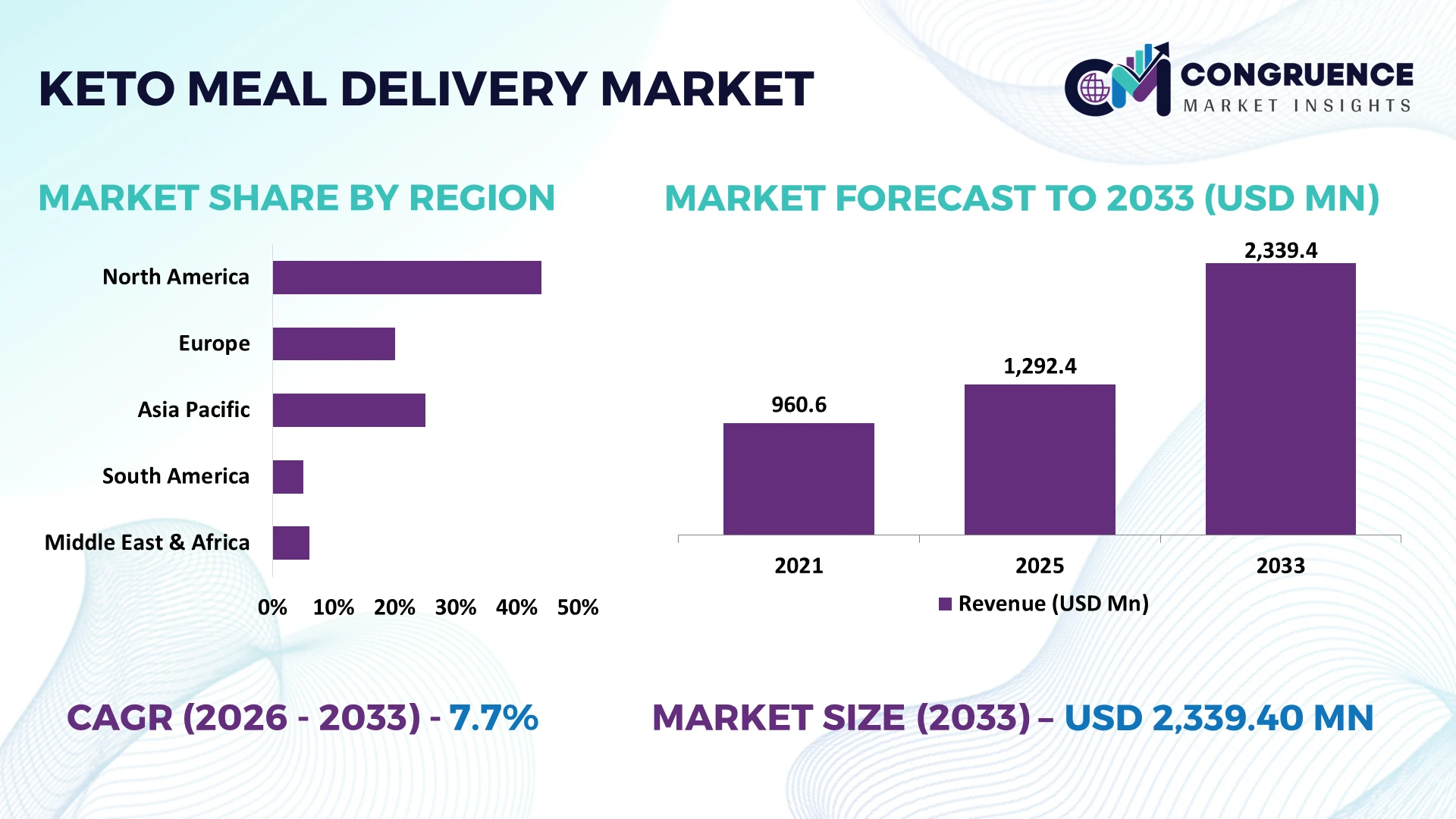
The United States leads the global keto meal delivery market, with an estimated 42% share, compared with approximately 8% for the United Kingdom. Its competitive advantage reflects established meal subscription infrastructure, advanced refrigerated logistics, and extensive digital food commerce. Providers including Factor and Fresh N Lean have shaped category development, while established operators invest in automated meal planning and fulfillment. Standard ketogenic meal plans typically restrict carbohydrates to 5% to 10% of daily energy intake, creating demand for precise nutritional labeling and portion controlled preparation.
Strategically, operators combining personalized meal subscriptions, reliable cold chain distribution, and transparent nutritional information are positioned to strengthen customer retention and improve fulfillment efficiency.
Market Size & Growth: USD 1292.4 million in 2025, reaching USD 2339.4 million by 2033 at 7.7% CAGR, supported by digital meal subscriptions.
Top Growth Drivers: Illustrative contribution estimates identify subscription convenience at 40%, nutrition personalization at 35%, and refrigerated delivery accessibility at 25%.
Short Term Forecast: By 2028, optimized fulfillment operations target 15% lower delivery costs and 12% higher subscription retention.
Emerging Technologies: AI meal recommendations, automated portioning, and smart temperature monitoring target 10% improvements in fulfillment accuracy.
Regional Leaders: Illustrative 2033 allocations place North America at USD 982.55 million, Europe at USD 655.03 million, and Asia Pacific at USD 467.88 million, supported by subscription adoption, nutrition customization, and digital ordering.
Consumer / End User Trends: Keto meal plans typically allocate 5% to 10% of calories to carbohydrates, supporting demand for verified nutritional information.
Pilot / Case Example: A representative 2026 subscription optimization scenario targets 15% fewer canceled orders through flexible delivery scheduling and personalized menus.
Competitive Landscape: Factor is a prominent operator alongside Trifecta Nutrition, Green Chef, Diet to Go, and Snap Kitchen; verified individual market shares are unavailable.
Regulatory & ESG Impact: Recyclable packaging initiatives target 20% lower single use plastic consumption while maintaining refrigerated food safety requirements.
Investment & Funding: An illustrative USD 20 million fulfillment modernization program prioritizes automated meal assembly, refrigerated distribution, and subscription platform integration.
Innovation & Future Outlook: Predictive meal planning and connected cold chain monitoring target 15% lower food waste and improved delivery reliability.
The Keto Meal Delivery Market serves consumers seeking prepared ketogenic meals, carbohydrate controlled nutrition programs, and convenient subscription based food services. Providers offer portion controlled meals featuring proteins, vegetables, and fat sources formulated to meet specific macronutrient targets. Digital platforms increasingly support menu personalization, dietary preference management, and recurring delivery scheduling. Automated meal assembly and refrigerated distribution improve operational consistency, while flexible subscription options address customer retention challenges. Optimized inventory planning targets 15% reductions in ingredient waste under controlled operating conditions. Increasing scrutiny of nutritional labeling and refrigerated food handling is strengthening the importance of transparent product information and reliable fulfillment infrastructure.
Keto meal delivery is becoming strategically important as prepared food providers compete through nutritional precision, subscription retention, and refrigerated fulfillment efficiency. The shift from standardized meal subscriptions toward personalized dietary platforms is restructuring food production and distribution. United States operators benefit from established refrigerated logistics and digital ordering infrastructure, while United Kingdom providers face greater geographic density advantages but stricter nutritional communication requirements. Ketogenic programs typically limit carbohydrates to 5% to 10% of daily energy intake, making ingredient verification and accurate macronutrient labeling essential competitive capabilities.
Automated meal planning and demand forecasting offer measurable advantages over spreadsheet based production scheduling. A representative operating model targets 15% lower ingredient waste and 10% higher order accuracy through integrated inventory management and portion control. Between 2026 and 2028, operators are prioritizing flexible subscription management, improved delivery density, and automated nutritional verification. Investment is shifting toward centralized kitchens, predictive purchasing systems, and reliable temperature monitoring rather than unrestricted geographic expansion.
A practical deployment involves connecting customer dietary preferences with production planning and refrigerated dispatch systems. Factor, Trifecta Nutrition, and other specialized providers compete through menu differentiation and fulfillment consistency. Companies investing in integrated food preparation, transparent labeling, and efficient customer retention systems strengthen their competitive positioning while reducing operational complexity.
Digital food subscriptions are transforming keto meal delivery through recurring purchasing, personalized menus, and simplified dietary management. Ketogenic meal plans commonly restrict carbohydrates to 5% to 10% of daily calories, creating specific requirements for ingredient selection and nutritional verification. United States prepared meal operators increasingly integrate mobile ordering, recurring billing, and automated menu recommendations into subscription platforms. Representative operational benchmarks target 15% higher customer retention and 10% improved order accuracy through personalized scheduling and preference management. Providers including Factor and Trifecta Nutrition are strengthening menu customization and subscription flexibility. The strategic advantage extends beyond meal convenience: accurate dietary matching reduces unsuitable orders, strengthens customer satisfaction, and improves production planning across refrigerated fulfillment networks.
Refrigerated transportation requirements and volatile protein ingredient costs constrain profitability across keto meal delivery operations. Meals containing meat, dairy, and fresh vegetables require controlled storage conditions throughout preparation, distribution, and final delivery. In the United States, fluctuations in beef and egg prices directly affect menu formulation and procurement budgets. Illustrative operating scenarios indicate that a 15% increase in protein ingredient costs can materially compress contribution margins, while a 10% increase in refrigerated delivery expenses weakens subscription economics. Operators are responding through diversified ingredient sourcing, seasonal menu adjustments, and regional kitchen partnerships. The critical commercial constraint is maintaining consistent nutritional specifications while controlling variable fulfillment costs without reducing product quality.
Advanced dietary personalization creates opportunities for keto meal delivery providers to expand beyond conventional household subscriptions. AI supported meal recommendation systems can integrate macronutrient preferences, ingredient exclusions, and recurring purchasing behavior. Representative deployment targets include 15% higher menu matching accuracy and 10% lower meal substitution rates through integrated customer preference databases. In India, expanding digital food commerce and urban refrigerated distribution infrastructure support opportunities for specialized prepared meal subscriptions in major metropolitan areas. Providers are evaluating partnerships with fitness centers, corporate wellness programs, and nutrition professionals to improve customer acquisition efficiency. A differentiated opportunity involves configurable meal subscriptions combining ketogenic options with broader carbohydrate controlled menus, allowing operators to serve changing dietary preferences without maintaining entirely separate production systems.
Scaling keto meal delivery requires consistent nutritional accuracy across changing ingredients, production batches, and personalized customer orders. Complex menu configurations increase the risk of ingredient substitutions affecting declared carbohydrate content. United States food operators must maintain appropriate labeling, allergen controls, and food safety procedures while coordinating production software with refrigerated dispatch systems. Representative quality improvement programs target 20% fewer labeling discrepancies and 15% faster production reconciliation through integrated ingredient databases and automated verification. However, fragmented kitchen software and inconsistent supplier specifications complicate implementation across multiple facilities. Providers must invest in standardized recipes, employee training, secure customer data management, and interoperable production systems. Long term competitiveness depends on maintaining nutritional consistency while expanding menu variety and operational scale.
Protein Diversification Reshapes Keto Menu Portfolios: United States meal providers are broadening protein selections beyond beef and poultry to manage ingredient price volatility. Menus increasingly combine seafood, eggs, and plant proteins while maintaining carbohydrate allocations near 5% to 10% of daily calories. Operators are targeting 12% lower ingredient concentration risk and 8% improved purchasing flexibility through supplier diversification, seasonal recipe rotation, and standardized nutritional specifications.
Flexible Subscription Pausing Reduces Customer Attrition: Prepared meal operators are replacing rigid weekly delivery commitments with adjustable order frequencies and temporary subscription pauses. Representative retention programs target 15% fewer cancellations and 10% fewer unwanted deliveries. Companies are redesigning account management interfaces and introducing earlier order modification deadlines, improving production visibility while reducing fulfillment of meals customers no longer require.
Packaging Redesign Improves Refrigerated Shipment Performance: Food delivery businesses are evaluating recyclable insulation, reusable containers, and optimized refrigerant configurations as packaging disposal requirements evolve. Packaging engineering programs target 20% lower material consumption and 10% better shipping space utilization without compromising temperature control. Suppliers are partnering with packaging manufacturers to standardize container dimensions, reduce volumetric shipping charges, and maintain product integrity during extended delivery routes.
Smaller Production Batches Improve Menu Freshness: Specialized keto kitchens are adopting more frequent preparation cycles instead of relying exclusively on large centralized production runs. Illustrative operating benchmarks target 15% lower finished meal inventory and 12% fewer freshness related complaints. Operators are restructuring kitchen schedules and integrating batch traceability systems, allowing tighter expiration management and faster identification of affected products during quality investigations.
Ready-to-Eat Meals account for an estimated 38% of global keto meal delivery demand, supported by immediate consumption convenience, standardized nutritional information, and established refrigerated fulfillment infrastructure. Their leadership reflects strong adoption among consumers seeking consistent ketogenic meals without cooking or ingredient preparation. Meal Kits maintain relevance among households preferring home preparation while retaining control over ingredients and cooking methods. Fresh Meal Plans serve customers prioritizing recently prepared food and flexible delivery scheduling. Frozen Keto Meals offer extended storage flexibility, reducing immediate consumption requirements and supporting broader geographic distribution. Prepared meal providers increasingly emphasize portion controlled formulations with carbohydrates representing approximately 5% to 10% of daily energy intake.
Custom Keto Meals represent the fastest growing type as consumers seek dietary configurations aligned with individual nutritional preferences and ingredient restrictions. Representative personalization programs target 15% higher menu satisfaction and 10% fewer unsuitable meal selections. Companies including Factor and Trifecta Nutrition are refining product variety, meal selection interfaces, and subscription management. Investment priorities increasingly favor configurable menu architectures that support customization without substantially increasing kitchen complexity.
Weight Management represents the leading application, accounting for an estimated 42% of global keto meal delivery demand, supported by consumer interest in structured dietary routines and portion controlled meal consumption. Prepared ketogenic meals simplify calorie monitoring and carbohydrate management, reducing the need for daily recipe planning. General Ketogenic Diet applications remain established among consumers following carbohydrate restricted eating patterns for personal dietary preferences. Fitness Nutrition serves customers seeking predictable protein intake and meal timing alongside exercise programs. Ketogenic meal formulations commonly limit carbohydrates to approximately 5% to 10% of daily calories, making nutritional accuracy an important product differentiation factor.
Diabetes-Friendly Diets represent a potentially expanding application as consumers seek carbohydrate controlled meal options, although ketogenic diets require individualized medical assessment, particularly for people using glucose lowering medications. Providers are developing clearer nutritional labeling, flexible carbohydrate specifications, and meal planning tools to support informed purchasing. Representative product development programs target 15% improved nutritional information accessibility and 10% fewer menu selection errors. Competitive advantage depends on transparent dietary specifications rather than unsupported therapeutic claims.
Individual Consumers represent the leading end user segment, accounting for an estimated 45% of global keto meal delivery demand, supported by direct digital purchasing, recurring meal subscriptions, and preference for convenient dietary management. These customers prioritize nutritional transparency, meal variety, and flexible delivery schedules. Fitness Enthusiasts represent an established segment seeking predictable protein intake and structured eating routines. Working Professionals prioritize reduced meal preparation requirements and reliable delivery timing, particularly across major metropolitan areas. Healthcare Providers represent a specialized institutional segment where nutrition services require appropriate clinical oversight and clearly defined dietary specifications.
Working Professionals represent the fastest growing end user group as demanding schedules encourage greater reliance on prepared meals. Representative subscription programs target 15% higher repeat purchasing and 10% improved delivery scheduling accuracy through flexible ordering interfaces. Providers are strengthening workplace delivery options, subscription customization, and convenient meal packaging. Companies with established refrigerated fulfillment capabilities gain advantages in densely populated urban markets. Future competitive positioning depends on balancing meal affordability, nutritional consistency, and dependable delivery experiences.
North America accounted for the largest market share at an estimated 42% in 2025 however, Asia Pacific is expected to register the fastest growth, expanding at a projected CAGR of 10.2% between 2026 and 2033.

Subscription Consolidation and Refrigerated Fulfillment Strengthen Market Leadership
North America represents an estimated 42% of global keto meal delivery demand, supported by established prepared meal subscription platforms, refrigerated distribution infrastructure, and widespread digital food purchasing. The United States dominates regional activity through specialized providers, centralized meal production facilities, and established direct consumer delivery networks. Canada contributes through urban prepared meal services concentrated around Toronto, Vancouver, and Montreal. Operators increasingly combine ketogenic menus with broader carbohydrate controlled meal portfolios to improve production flexibility and customer retention. Factor, Trifecta Nutrition, and Snap Kitchen compete through menu variety, portion consistency, and subscription convenience. Regional fulfillment strategies increasingly prioritize delivery density, automated production scheduling, and temperature controlled packaging. Representative modernization programs target 15% lower ingredient waste through improved demand forecasting, strengthening inventory efficiency while reducing unnecessary production across refrigerated meal distribution networks.
United States Market Outlook: The United States maintains extensive refrigerated food distribution infrastructure and established digital subscription purchasing channels. Major metropolitan areas including New York, Los Angeles, Chicago, and Dallas support concentrated prepared meal delivery operations. FDA food safety requirements influence ingredient handling, nutritional labeling, and production controls. Ketogenic meal formulations commonly restrict carbohydrates to 5% to 10% of daily energy intake, encouraging operators to maintain standardized recipes and accurate macronutrient information across changing menus.
Nutritional Transparency and Urban Delivery Density Reshape Competition
Europe represents an estimated 28% of global keto meal delivery activity, supported by established online food purchasing infrastructure and specialized nutrition services across the United Kingdom, Germany, France, and the Netherlands. The United Kingdom maintains a developed prepared meal delivery ecosystem, while Germany supports health oriented food retail and subscription services. European operators increasingly emphasize ingredient transparency, nutritional labeling, and controlled refrigerated transportation. European Union food information regulations require accurate ingredient and allergen disclosures, strengthening the importance of standardized recipe management. Urban delivery concentration supports efficient distribution across major metropolitan areas, although fragmented national food preferences complicate standardized menu expansion. Operators are developing localized ketogenic recipes, flexible subscription arrangements, and packaging configurations suitable for refrigerated distribution. Representative fulfillment programs target 10% improved delivery route efficiency through consolidated dispatch planning and optimized delivery schedules.
United Kingdom Market Outlook: The United Kingdom maintains advanced online grocery infrastructure and substantial prepared meal delivery activity across London, Manchester, Birmingham, and other urban centers. Food Standards Agency oversight and established food labeling requirements influence nutritional communication and allergen management. Specialized meal providers benefit from concentrated urban delivery networks and established digital purchasing behavior. Operators increasingly prioritize clear carbohydrate disclosures, portion controlled preparation, and convenient subscription management to differentiate ketogenic meal offerings.
Digital Food Commerce Accelerates Specialized Nutrition Delivery
Asia Pacific represents an estimated 20% of global keto meal delivery demand, supported by expanding digital food commerce, urban prepared meal services, and growing interest in structured dietary programs. China maintains extensive online food ordering infrastructure, while India presents opportunities through specialized nutrition providers and urban meal subscription businesses. Australia, Japan, and South Korea contribute through established refrigerated food distribution and health oriented consumer services. Operators increasingly develop locally adapted ketogenic menus to accommodate regional food preferences and ingredient availability. Large metropolitan populations support centralized production kitchens and scheduled delivery models, while differences in refrigeration infrastructure influence service coverage. Representative digital fulfillment programs target 15% higher order processing efficiency through integrated menu selection and production scheduling. Competitive positioning increasingly depends on localized nutritional formulations, reliable delivery execution, and efficient customer acquisition through digital platforms.
China Market Outlook: China maintains extensive digital food commerce infrastructure supported by major urban consumer markets including Shanghai, Beijing, Shenzhen, and Guangzhou. Established food delivery platforms provide access to sophisticated ordering, payment, and distribution technologies. Specialized ketogenic meal providers can leverage centralized kitchens and digital customer engagement systems. Chinese food safety regulations govern ingredient handling and labeling, while localized recipe development remains essential for aligning carbohydrate controlled meal offerings with established dietary preferences.
Urban Nutrition Services Support Specialized Meal Subscription Development
South America represents an estimated 6% of global keto meal delivery activity, with Brazil maintaining the largest concentration of specialized prepared meal services. Argentina, Chile, and Colombia contribute through urban nutrition businesses and expanding digital food ordering infrastructure. Brazil's metropolitan markets support refrigerated meal distribution, specialized dietary kitchens, and subscription based prepared food services. Operators increasingly emphasize locally sourced proteins, portion controlled recipes, and flexible delivery arrangements to address purchasing preferences. Refrigerated logistics costs and uneven distribution infrastructure restrict service coverage outside major urban centers. Specialized providers are developing partnerships with local food producers and delivery platforms to improve procurement flexibility. Representative operating programs target 10% lower distribution costs through concentrated delivery zones, strengthening fulfillment economics while limiting exposure to fragmented last mile transportation networks.
Brazil Market Outlook: Brazil maintains substantial digital food delivery activity across São Paulo, Rio de Janeiro, Belo Horizonte, and Brasília. Established food service businesses support specialized prepared meal production, while local protein and vegetable supply chains provide ingredient sourcing opportunities. ANVISA oversees applicable food safety and labeling requirements. Ketogenic meal providers increasingly focus on portion consistency, menu localization, and scheduled delivery services, with urban distribution density supporting more efficient refrigerated fulfillment operations.
Urban Wellness Infrastructure Supports Specialized Nutrition Services
The Middle East and Africa represent an estimated 4% of global keto meal delivery demand, with activity concentrated in the United Arab Emirates, Saudi Arabia, South Africa, and selected metropolitan markets. The United Arab Emirates maintains established premium food delivery infrastructure, while Saudi Arabia supports expanding digital consumer services and organized food preparation businesses. South Africa contributes through specialized nutrition providers and urban prepared meal delivery networks. Operators increasingly emphasize convenient subscription arrangements, clear ingredient information, and reliable refrigerated transportation. High ambient temperatures strengthen requirements for effective temperature controlled packaging and delivery monitoring. Specialized providers are expanding centralized kitchen capabilities and partnerships with established logistics operators. Representative modernization programs target 15% fewer temperature related delivery exceptions through improved packaging validation and shipment monitoring, supporting food safety and consistent customer experiences.
United Arab Emirates Market Outlook: The United Arab Emirates maintains advanced urban food delivery infrastructure across Dubai, Abu Dhabi, and Sharjah. Established digital ordering platforms and concentrated premium consumer markets support specialized prepared meal subscriptions. Municipal food safety requirements influence production hygiene, storage conditions, and distribution practices. Keto meal operators benefit from access to imported and locally distributed ingredients, while refrigerated transport capabilities remain essential for maintaining product integrity during high temperature delivery conditions.
The global keto meal delivery market features competition between Factor, Trifecta Nutrition, Snap Kitchen, Diet to Go, and Green Chef, alongside specialized regional meal providers. An illustrative concentration model places the leading five brands at approximately 30% combined market share, reflecting fragmented geographic distribution and differentiated subscription portfolios. Factor competes through prepared meal convenience, while Trifecta emphasizes structured nutrition and Snap Kitchen targets specialized prepared food consumers. Green Chef differentiates through meal kit customization. Representative operating benchmarks target 15% higher subscription retention and 10% lower fulfillment costs through personalized ordering and efficient refrigerated distribution. Companies strengthen competitive positions through centralized kitchens, logistics partnerships, menu innovation, and automated production planning. Competition is shifting toward flexible subscriptions and verified nutritional specifications rather than standardized meal offerings. Refrigerated infrastructure, customer acquisition costs, and food safety compliance create significant entry barriers. Winning requires consistent nutritional accuracy, dependable delivery execution, differentiated menus, and efficient customer retention.
Factor
Trifecta Nutrition
Green Chef
Diet to Go
Snap Kitchen
Pete's Real Food
The Good Kitchen
Territory Foods
Eat Clean To Go
Clean Eatz Kitchen
Fresh Meal Plan
Ketolibriyum
Muscle Meals Direct
Current keto meal delivery platforms integrate nutritional databases, automated portion control, subscription management, and refrigerated shipment monitoring. Recipe software calculates carbohydrate, protein, and fat allocations against standardized ingredient specifications. Commercial kitchens implementing barcode verification can target 12% fewer packing errors and 10% faster batch reconciliation. Deployment is concentrated among established prepared meal operators managing recurring orders across multiple distribution zones, where nutritional consistency directly influences customer retention.
Emerging technologies combine artificial intelligence forecasting, ingredient substitution algorithms, and connected kitchen equipment. Compared with spreadsheet scheduling, integrated production planning targets 15% lower ingredient waste through improved demand visibility. Automated nutritional verification supports 10% fewer formulation discrepancies during menu changes. Factor and specialized nutrition providers benefit from scalable recipe databases, while smaller operators gain flexibility through subscription software and outsourced fulfillment. Adoption increasingly follows centralized kitchen modernization rather than standalone technology purchases.
Disruptive capabilities include predictive subscription analytics, digital food traceability, and continuous cold chain monitoring. Temperature sensors enable exception alerts before delivery completion, targeting 15% fewer temperature related complaints. Between 2026 and 2028, operators are prioritizing interoperable production systems, personalized meal configuration, and automated quality records. Providers combining verified macronutrient accuracy with efficient refrigerated logistics strengthen competitive positioning, while integrated customer data supports more precise purchasing, production scheduling, and delivery decisions.
February 2025: HelloFresh launched Factor in Germany, introducing 18 rotating weekly meals covering keto and other dietary preferences. Meals require approximately 4 minutes of preparation, extending the company's prepared food distribution footprint and strengthening its European subscription offering. Source: hellofresh.com
March 2025: Trifecta Nutrition partnered exclusively with Apollo Health to deliver KetoFLEX 12/3 meals, incorporating a dietary framework specifying 12 hours of overnight fasting. The collaboration connects specialized meal fulfillment with structured nutrition programs, expanding access to tailored food services. Source: prnewswire.com
September 2025: Factor expanded its prepared meal portfolio to more than 100 weekly options, including specialized nutrition selections. The company also appointed a registered dietitian to strengthen nutrition communication, expanding customer choice and supporting differentiation within competitive subscription services. Source: streetinsider.com
September 2026: Factor expanded refrigerated prepared meal distribution to more than 800 Target stores across 47 states, following its Midwest retail introduction. The expansion establishes a substantial physical retail channel alongside subscriptions, improving customer access and broadening distribution opportunities. Source: progressivegrocer.com
The Keto Meal Delivery Market Report examines subscription models, prepared food production, nutritional customization, and refrigerated distribution between 2026 and 2033. Type segmentation covers Ready to Eat Meals, Meal Kits, Fresh Meal Plans, Frozen Keto Meals, and Custom Keto Meals. Application analysis includes Weight Management, Diabetes Friendly Diets, Fitness Nutrition, and General Ketogenic Diet. End user coverage evaluates Individual Consumers, Fitness Enthusiasts, Working Professionals, and Healthcare Providers, with Ready to Eat Meals representing an estimated 38% of market activity.
Regional analysis examines North America, Europe, Asia Pacific, South America, and the Middle East and Africa. Technology coverage includes automated portioning, nutritional verification, predictive inventory planning, and connected temperature monitoring. Competitive assessment evaluates specialized providers, subscription retention, production scalability, and distribution partnerships, supporting investment planning, geographic expansion, and differentiated product positioning.
| Report Attribute/Metric | Report Details |
|---|---|
Market Revenue in 2025 | USD 1292.4 Million |
Market Revenue in 2033 | USD 2339.4 Million |
CAGR (2026 - 2033) | 7.7% |
Base Year | 2025 |
Forecast Period | 2026 - 2033 |
Historic Period | 2021 - 2025 |
Segments Covered | By Type
By Application
By End-User
|
Key Report Deliverable | Revenue Forecast, Growth Trends, Market Dynamics, Segmental Overview, Regional and Country-wise Analysis, Competition Landscape |
Region Covered | North America, Europe, Asia-Pacific, South America, Middle East, Africa |
Key Players Analyzed | Factor, Trifecta Nutrition, Green Chef, Diet to Go, Snap Kitchen, Pete's Real Food, The Good Kitchen, Territory Foods, Eat Clean To Go, Clean Eatz Kitchen, Fresh Meal Plan, Ketolibriyum, Muscle Meals Direct |
Customization & Pricing | Available on Request (10% Customization is Free) |




