
Reports
The Global Ketchup Market was valued at USD 2,592.0 Million in 2025 and is anticipated to reach a value of USD 4,165.7 Million by 2033 expanding at a CAGR of 6.11% between 2026 and 2033. Growth is driven by rising quick-service restaurant penetration, innovative low-sugar and flavored formulations, and convenient squeeze and single-serve packaging.
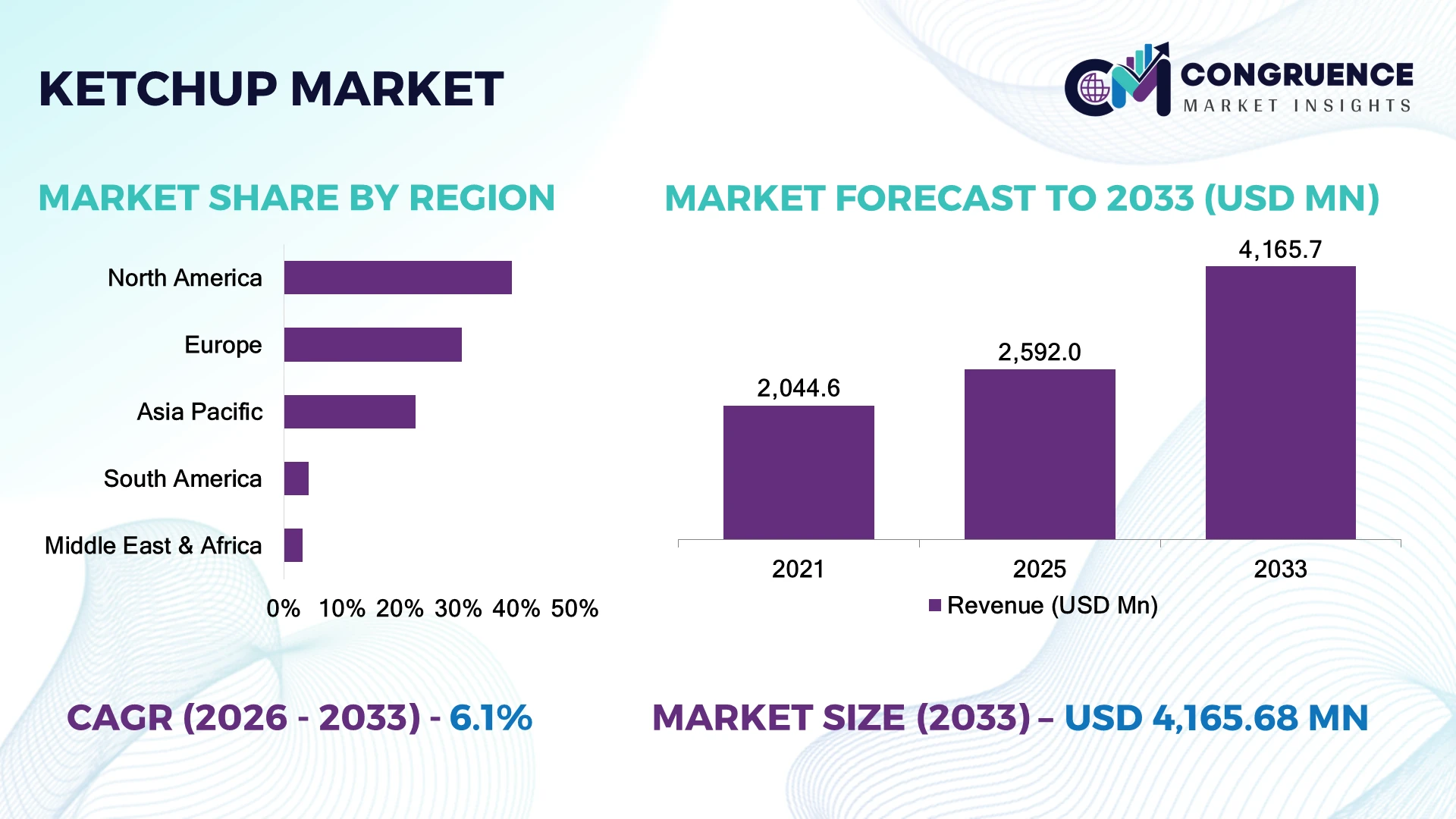
North America held 39.18% of the global market in 2025, with the U.S. serving as the dominant consumption and foodservice hub; the region generated approximately USD 10.16 billion. Asia Pacific reached USD 5.85 billion, while Europe recorded USD 7.93 billion, reflecting stronger processed-food adoption and premium condiment innovation. India is expanding digital retail and packaged-food distribution faster than mature U.S. channels.
Strategic decisions should prioritize North American brand strength while accelerating localized product innovation and distribution across Asia Pacific.
Market Size & Growth: USD 2,592.0 million in 2025 is projected to reach USD 4,165.7 million by 2033 at a 6.11% CAGR, supported by convenience-food and foodservice expansion.
Top Growth Drivers: Processed-food consumption +8%; flavored-product adoption +5.34%; online condiment sales +6%.
Short-Term Forecast: By 2028, automated filling and precision dosing are positioned to reduce packaging waste by 8–12%.
Emerging Technologies: AI-assisted demand forecasting, automated filling, and recyclable mono-material packaging are reshaping high-volume production.
Regional Leaders: North America reaches USD 10.16 billion; Europe USD 7.93 billion; Asia Pacific USD 5.85 billion, with Asia Pacific showing the strongest adoption momentum.
Consumer/End-User Trends: Regular ketchup represented 70.98% of product demand in 2025, while flavored variants expand through localized taste profiles.
Pilot/Case Example: In 2025, packaging innovation and recyclable formats accelerated sustainability programs, targeting measurable reductions in plastic intensity across high-volume condiment lines.
Competitive Landscape: Kraft Heinz remains the leading branded player at roughly 40% in ketchup, alongside Del Monte, Conagra Brands, Nestlé, and Unilever.
Regulatory & ESG Impact: Recyclable packaging programs and stricter food-labeling requirements are pushing manufacturers toward material reductions of approximately 10% or more.
Investment & Funding: Kraft Heinz committed USD 600 million to marketing and research in 2026, reinforcing investment in sauces, condiments, and brand-led innovation.
Innovation & Future Outlook: Low-sugar, organic, spicy, regional-flavor, and digitally distributed ketchup lines are shifting competition toward formulation agility and localized manufacturing.
The Ketchup Market is increasingly shaped by premium formulations, foodservice penetration, and packaging redesign. Regular products retained 70.98% share in 2025, while flavored variants gained momentum through localized tastes and product experimentation. Tomato supply remains operationally sensitive; weather disruptions in India during 2025 temporarily pushed tomato prices sharply higher, reinforcing the value of sourcing diversification and inventory planning.
The ketchup market is becoming strategically important because brand scale, formulation agility, packaging economics, and foodservice partnerships increasingly determine category leadership. North America accounted for 39.18% of global demand in 2025, while Asia Pacific is gaining strategic importance through processed-food adoption and localized flavor development. This is shifting investment from conventional mass-market products toward differentiated formulations and channel-specific portfolios.
Technology is strengthening manufacturing economics. Automated filling, vision inspection, and predictive demand planning can reduce packaging and production losses by roughly 8–12% versus less automated legacy operations. PET and glass bottles still represented 60.84% of packaging demand, but pouches and sachets are expanding as manufacturers target lower material intensity and logistics costs.
Operationally, companies are diversifying tomato sourcing, expanding foodservice partnerships, and testing recyclable packaging to manage agricultural volatility. India's 2025 tomato-price disruption demonstrated how weather-related supply shocks can affect condiment manufacturing inputs. Over the next 2–3 years, competitive advantage will increasingly come from localized sourcing, automated production, digital distribution, and rapid flavor innovation. Companies that integrate these capabilities will secure stronger margins and more resilient market positions.
The strongest growth driver is the structural expansion of quick-service restaurants, convenience meals, and away-from-home consumption. North America captured 39.18% of global demand in 2025, while regular ketchup held 70.98%, demonstrating the strength of standardized high-volume products. Flavored ketchup is gaining traction at 5.34% growth as brands localize recipes with spicy, smoky, and regional profiles. The shift toward foodservice and delivery is encouraging manufacturers to expand single-serve sachets, bulk formats, and automated filling capacity. Companies are responding through foodservice partnerships, localized production, and formulation R&D. The strategic advantage lies in balancing mass-market consistency with localized flavor innovation without creating excessive SKU complexity.
Raw-material volatility remains a direct constraint because tomato availability and pricing can change rapidly with weather and agricultural conditions. India's 2025 rainfall disruptions temporarily pushed Delhi tomato prices to ₹73 per kg, after reaching ₹85 per kg, creating immediate procurement pressure. Input volatility of 10–20% can materially affect manufacturing margins when contracts lack adequate price-adjustment mechanisms. Manufacturers are reducing exposure through multi-country sourcing, supplier contracts, processing inventories, and greater use of concentrated tomato inputs. Packaging costs add another pressure point as PET, glass, and transport expenses fluctuate. The key operational priority is procurement resilience: companies with diversified supplier networks and stronger inventory visibility can protect production continuity and pricing discipline more effectively.
Premium and health-oriented formulations offer a strong opportunity beyond conventional tomato ketchup. Organic products are positioned for approximately 6.03% growth, while flavored ketchup is expanding at 5.34%, creating space for low-sugar, no-salt, spicy, and regionally inspired variants. In India, Southeast Asia, and Japan, localized flavor profiles can increase differentiation without requiring entirely new condiment categories. Digital commerce further reduces the cost of testing niche SKUs before nationwide distribution. Companies are investing in R&D, recyclable packaging, and direct-to-consumer experimentation to capture these segments. A non-obvious opportunity is modular production: flexible filling and formulation systems allow manufacturers to serve multiple flavor variants using shared infrastructure, improving asset utilization while reducing commercialization time.
Long-term competitiveness increasingly depends on controlling complexity created by expanding flavors, pack sizes, channels, and regulatory requirements. A portfolio dominated by regular ketchup at 70.98% still requires manufacturers to accommodate faster-growing specialty products without disrupting core production efficiency. Flavored variants growing at 5.34% increase formulation, procurement, quality-control, and inventory requirements. Packaging diversification adds further operational pressure as bottles, pouches, and sachets require different filling and distribution configurations. Companies must strengthen production flexibility, digital inventory systems, quality automation, and supplier integration to maintain consistency. The strategic challenge is not simply launching more products; it is building manufacturing platforms capable of supporting customization while keeping changeover losses, obsolete inventory, and compliance costs under control.
Clean-Label Reformulation Accelerates: Low-sugar, no-added-sugar, organic, and naturally sweetened ketchup lines are expanding as manufacturers respond to health-focused purchasing. Organic ketchup is recording growth of about 6.03%, while reduced-sugar formulations are gaining shelf space. In 2025, jaggery-sweetened sugar-free launches demonstrated how brands are replacing refined sugar while preserving familiar texture and taste.
Packaging Moves Toward Circularity: Recyclable PET, lightweight bottles, pouches, and refill-oriented formats are reshaping packaging workflows. About 55% of global consumers have indicated willingness to pay more for eco-friendly packaging, increasing pressure on manufacturers to redesign materials. India's 2025 FSSAI sustainable-packaging consultation involving more than 1,500 stakeholders reinforced the transition toward recyclable and biodegradable food packaging.
Flavor Localization Gains Scale: Flavored ketchup is moving from niche positioning toward structured product-line expansion, with growth of approximately 5.34%. Spicy, garlic, curry, smoky, and fruit-infused variants allow manufacturers to localize taste profiles across India, Germany, Japan, and the United States. Companies are increasingly using limited releases and modular formulations to test demand without creating large-scale production complexity.
Digital Retail Reshapes Procurement: Online ketchup purchasing is strengthening as e-commerce improves access to premium, imported, specialty, and low-volume products. Digital channels are particularly useful for niche SKUs that require targeted discovery rather than mass shelf placement. Manufacturers are responding with direct-to-consumer programs, platform partnerships, smaller trial packs, and digitally driven promotions, while demand forecasting increasingly links online sales data with production and inventory planning.
Regular ketchup remains the leading type, accounting for approximately 70.98% of the global market in 2025. Its dominance comes from standardized taste, broad foodservice compatibility, high production scalability, and established household purchasing habits. Flavored ketchup is the fastest-growing type, expanding at about 5.34%, as consumers increasingly seek spicy, garlic, smoky, curry, and regionally adapted profiles.
The mature regular segment continues to benefit from economies of scale, while flavored and specialty products command stronger differentiation and premium positioning. Organic, reduced-sugar, and other formulations are gaining strategic relevance as manufacturers respond to health-oriented purchasing. Companies are therefore protecting high-volume regular portfolios while directing R&D toward differentiated flavors and reformulated products. The shift is changing investment priorities from purely volume-driven production toward flexible manufacturing capable of supporting multiple formulations without disrupting core throughput.
Household application represents the leading demand center, accounting for approximately 65.39% of global ketchup consumption in 2025. Daily meal preparation, dipping occasions, children's meals, sandwiches, and snack consumption sustain high-frequency usage. Commercial applications account for about 34.61%, with restaurants, QSRs, catering operators, and institutional kitchens prioritizing standardized flavor, portion control, and predictable bulk supply.
Commercial use is the faster-moving operational segment because organized foodservice requires consistent condiment specifications across multiple outlets. Household demand remains more stable, while commercial procurement is increasingly tied to menu engineering, centralized purchasing, and single-serve packaging. Companies are responding by separating retail and foodservice portfolios, expanding bulk formats for commercial kitchens, and developing smaller packs for household trial and convenience.
Households remain the dominant end-user group, representing approximately 55.6% of global ketchup demand in 2025. Their purchasing behavior is driven by repeat consumption, pantry stocking, familiar brands, and versatility across meals. Foodservice accounts for about 22.4%, while industrial and other institutional buyers represent the remaining demand, creating a more concentrated but operationally intensive procurement environment.
Foodservice is the fastest-expanding strategic buyer group as QSRs, restaurants, cafés, and catering operators standardize flavor and portioning across locations. Household purchasing remains brand- and price-sensitive, whereas commercial buyers emphasize supply reliability, pack economics, and consistency. Companies are responding with differentiated contract pricing, bulk packaging, foodservice partnerships, and customized formulations. Industrial buyers are also gaining relevance as ketchup becomes an ingredient in prepared foods, sauces, marinades, and ready meals, encouraging manufacturers to develop specifications suited to automated food-processing lines.
North America accounted for the largest market share at 39.2% in 2025 however, Asia-Pacific is expected to register the fastest growth, expanding at a CAGR of 6.11% between 2026 and 2033.

North America held 39.2% of the global ketchup market in 2025, supported by strong household penetration, QSR consumption, established retail infrastructure, and major branded manufacturers. The United States remains the primary market, while Canada and Mexico provide additional demand through retail and foodservice channels. Manufacturers are strengthening low-sugar formulations, convenient packaging, and automated production to protect volume while responding to changing consumer preferences. The region's mature distribution system also supports rapid product placement and nationwide brand expansion.
United States Market Outlook: The United States is the dominant country in North America, supported by high per-capita ketchup consumption, extensive supermarket coverage, and a large QSR industry. U.S. imports of tomato ketchup and sauces reached approximately 30.6 million kilograms in 2022, demonstrating the importance of integrated international supply networks. Companies continue investing in product reformulation, packaging innovation, and foodservice partnerships.
Europe accounted for 30.6% of the global ketchup market in 2025, making it the second-largest regional market. Germany, the United Kingdom, France, Italy, and Spain provide the strongest consumption bases. Demand is supported by ready-meal consumption, home cooking, ethnic flavors, and established supermarket distribution. Regulatory attention toward nutrition and packaging is encouraging manufacturers to reformulate products and increase recyclable-material usage. Companies are also expanding premium, organic, spicy, and clean-label offerings to strengthen differentiation in mature retail channels.
Germany Market Outlook: Germany represents a strategically important European market because of its advanced food-processing industry, strong supermarket network, and established private-label manufacturing base. The country's large-scale retail infrastructure enables manufacturers to introduce new ketchup formulations efficiently while maintaining high production volumes. Companies are increasingly balancing conventional products with organic, reduced-sugar, and premium variants to address evolving retailer and consumer requirements.
Asia-Pacific accounted for 22.6% of the global ketchup market in 2025 and represents the fastest-growing major regional opportunity. China, India, and Japan form the principal markets, while Southeast Asia is expanding through modern retail, foodservice, and packaged-food consumption. Rising disposable incomes and urbanization are increasing adoption of Western-style foods, while local manufacturers are developing spicy, garlic, smoky, and regionally adapted formulations. Companies are expanding smaller packs, digital distribution, and localized production to address diverse consumption patterns.
China Market Outlook: China is the leading Asia-Pacific market, supported by its large consumer base, expanding processed-food industry, and extensive manufacturing infrastructure. Manufacturers are increasingly adapting ketchup to local cuisine and foodservice requirements rather than relying exclusively on traditional Western applications. Growing modern retail and digital commerce are also enabling wider distribution of premium and specialty formulations.
South America accounted for 4.3% of the global ketchup market in 2025. Brazil represents the region's principal market, supported by its large consumer base, developed food-processing industry, modern retail expansion, and strong foodservice activity. Mexico is also strategically relevant to regional supply chains, particularly for processed tomato products. Manufacturers are emphasizing affordable pack sizes, domestic sourcing, and foodservice partnerships to manage price sensitivity and improve distribution efficiency. Local production also helps reduce exposure to international logistics disruptions.
Brazil Market Outlook: Brazil is the most strategically significant South American market because of its large food-processing ecosystem and extensive retail and foodservice infrastructure. The country's established tomato-processing capabilities provide manufacturers with opportunities to strengthen local sourcing and shorten supply chains. Companies are focusing on localized flavors, competitive pricing, and partnerships with foodservice operators to expand distribution.
Middle East & Africa accounted for 3.3% of the global ketchup market in 2025. Saudi Arabia, the UAE, and South Africa are important demand centers, supported by modern grocery development, hospitality investment, tourism, and expanding restaurant networks. Import dependence remains higher than in mature markets, making distributor relationships and inventory planning important competitive factors. Manufacturers are responding with halal-compliant products, foodservice formats, localized packaging, and regional distribution partnerships to improve market access and supply reliability.
Saudi Arabia Market Outlook: Saudi Arabia is the leading market in the region, supported by expanding hospitality infrastructure, modern retail, and foodservice development. Tomato-ketchup consumption reached approximately 4.9 kg per capita in 2024, highlighting the country's strong category penetration. Manufacturers are strengthening local distributor networks, foodservice contracts, and packaging strategies to capture demand from restaurants, hotels, and households.
HEINZ, Kraft Heinz, competes with Conagra’s Hunt’s, Del Monte, Unilever’s Kissan, and regional private-label producers, with global brands competing against cost-focused local manufacturers. The top five players hold an estimated 55.0% combined share. Competition centers on price, brand reach, formulation, packaging, and supply control, with premium variants gaining about 5.0% traction and sustainable packaging adoption rising roughly 10.0%. Kraft Heinz is expanding partnerships and limited launches, while regional players use localized flavors and smaller packs. Vertical sourcing, tomato procurement, and flexible manufacturing increasingly determine resilience as input volatility pressures margins. Entry barriers remain high because established brands control retail visibility, foodservice contracts, tomato-processing relationships, and distribution. The competitive shift is moving from conventional ketchup scale toward faster product testing, health-oriented reformulation, and packaging innovation. Winning requires a strong core portfolio, efficient sourcing, localized innovation, and direct foodservice and retail partnerships that convert brand equity into measurable shelf and menu presence.
The Kraft Heinz Company
Conagra Brands, Inc.
Unilever PLC
Del Monte Pacific Limited
Nestlé S.A.
McCormick & Company, Inc.
The J.M. Smucker Co.
Premier Foods plc
Kikkoman Corporation
General Mills, Inc.
Annie's Homegrown
Organicville
Red Gold, Inc.
Wingreens Farms
Ketchup manufacturing is moving from conventional batch controls toward automation, machine vision, digital dosing, and predictive production planning. Automated filling and inspection can improve line efficiency by 8–12% and reduce material losses by 3–5%, giving large producers a measurable cost advantage. AI-based forecasting is linked with retailer and foodservice demand data, reducing overproduction and improving inventory responsiveness.
Packaging technology is also changing. Lightweight PET, recyclable mono-material structures, and improved squeeze systems can reduce packaging material use by 10–15% while preserving dispensing performance. Heinz’s recyclable packaging programs and Del Monte’s resealable pouch formats illustrate how packaging engineering is becoming a competitive tool rather than a compliance exercise. Flexible formats benefit regional brands seeking lower logistics costs.
From 2026–2028, the strongest impact will come from combining automation with formulation flexibility, digital demand sensing, and sustainable packaging. Global leaders with large manufacturing networks benefit because they can spread technology investment across higher volumes. Regional manufacturers can narrow the gap through contract manufacturing, equipment partnerships, and modular production cells. Companies acting now can improve throughput, reduce waste, accelerate SKU changeovers, and respond faster to localized flavor demand while strengthening supply resilience across tomato and packaging supply chains while improving service levels across retail and foodservice channels now.
March 2025 — Kraft Heinz launched HEINZ Chip Dip in a wide-mouth glass jar as a limited test. Less than 10% of surveyed North Americans regularly dip potato chips in ketchup, creating a new consumption occasion. Source: kraftheinzcompany.com
May 2025 — Kraft Heinz and Uber Eats launched HEINZ Verified across 6 major U.S. markets. The program identified restaurants serving HEINZ, with 84% of surveyed consumers saying they would like a restaurant more if it served HEINZ Ketchup.
September 2025 — Del Monte Pacific reported that its Sweet Blend Ketchup achieved an average 25% reduction in added sugar and sodium, implemented from September 2024. The reformulation strengthened its nutrition-focused portfolio and supported healthier product positioning. Source: delmontepacific.com
February 2026 — Nestlé reported that 90% of sales volume across its eight priority nutrition categories met defined sodium targets by end-2025, including ketchup, with a 1,020 mg/100 g ketchup target. This strengthens reformulation and nutrition-compliance capabilities. Source: nestle.com
The Ketchup Market Report covers product segmentation by type, including regular, flavored, organic, and specialty formulations, alongside applications across household and commercial consumption. End-user analysis evaluates households, foodservice operators, industrial processors, and institutional buyers. The report assesses competitive positioning across North America, Europe, Asia-Pacific, South America, and the Middle East & Africa.
Coverage also evaluates packaging innovation, automated filling, digital demand forecasting, sustainable tomato sourcing, recyclable materials, and health-oriented reformulation. Regular ketchup represents approximately 71.0% of product demand, while household consumption accounts for about 65.4% of application demand. The analysis supports investment planning, product portfolio decisions, manufacturing expansion, sourcing diversification, partnership development, and competitive positioning. It also identifies localized flavor opportunities, premium formulations, foodservice formats, and digital distribution priorities shaping strategic decisions between 2026 and 2033.
| Report Attribute / Metric | Details |
|---|---|
| Market Revenue (2025) | USD 2,592.0 Million |
| Market Revenue (2033) | USD 4,165.7 Million |
| CAGR (2026–2033) | 6.11% |
| Base Year | 2025 |
| Forecast Period | 2026–2033 |
| Historic Period | 2021–2025 |
| Segments Covered |
By Type
By Application
By End-User
|
| Key Deliverables | Revenue Forecast; Market Trends; Growth Drivers & Restraints; Technology Insights; Segmentation Analysis; Regional Insights; Competitive Landscape; Regulatory & ESG Overview; Recent Developments |
| Regions Covered | North America; Europe; Asia-Pacific; South America; Middle East & Africa |
| Companies Profiled | The Kraft Heinz Company; Conagra Brands, Inc.; Unilever PLC; Del Monte Pacific Limited; Nestlé S.A.; McCormick & Company, Inc.; The J.M. Smucker Co.; Premier Foods plc; Kikkoman Corporation; General Mills, Inc.; Annie's Homegrown; Organicville; Red Gold, Inc.; Wingreens Farms |
| Customization & Pricing | Available on Request (10% Customization Free) |




