
Reports
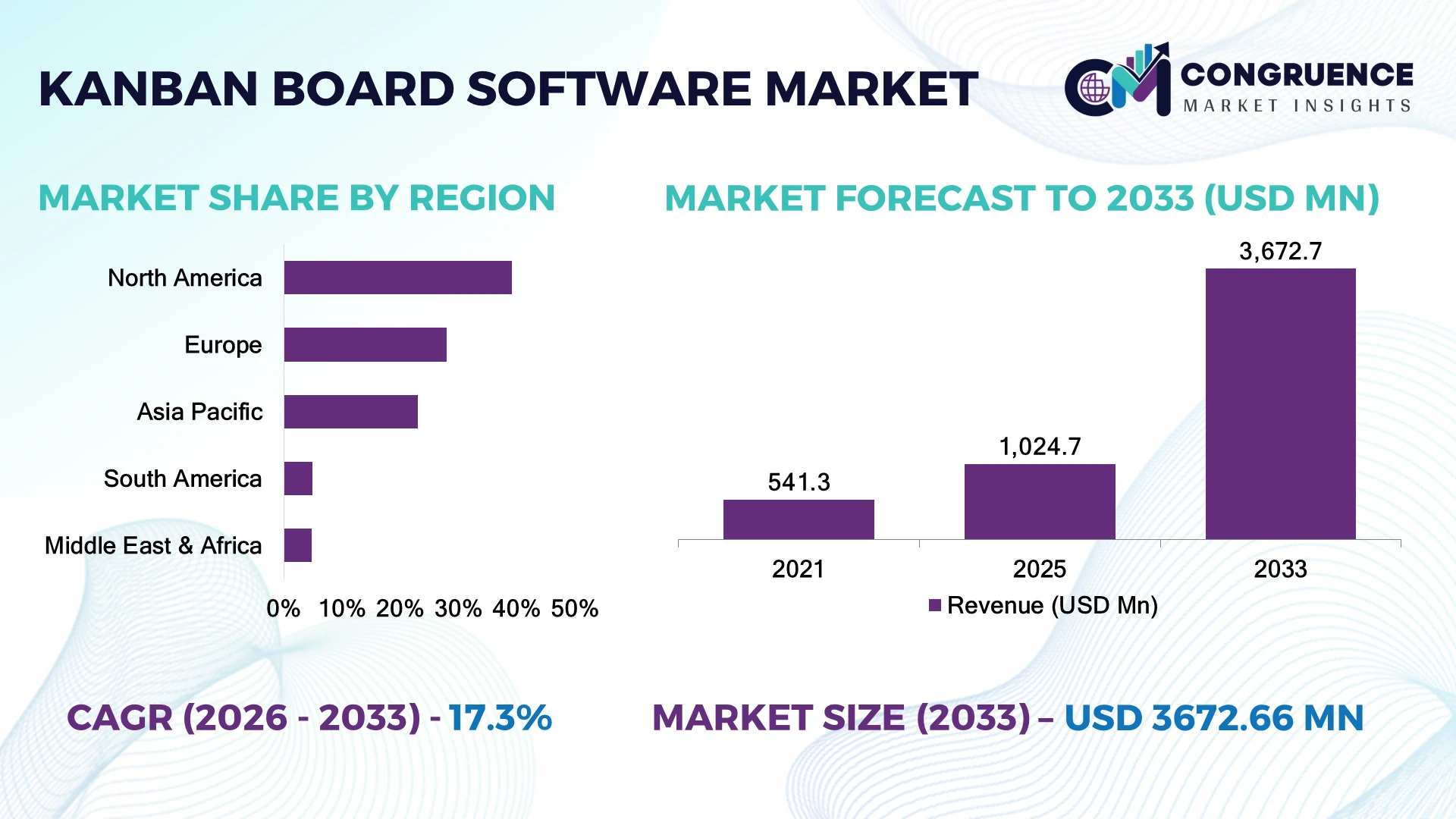
The Global Kanban Board Software Market was valued at USD 1,024.7 Million in 2025 and is anticipated to reach a value of USD 3,672.7 Million by 2033 expanding at a CAGR of 17.3% between 2026 and 2033. Growth is being driven by enterprise-wide agile transformation, AI-assisted project management, DevOps integration, and expanding adoption of collaborative workflow automation across distributed teams.
The United States accounts for approximately 39% of global Kanban Board Software adoption, supported by advanced SaaS ecosystems, widespread agile software development, and strong enterprise investment across technology, financial services, healthcare, and manufacturing. Compared with Japan's manufacturing-focused workflow optimization, U.S. organizations report nearly 74% adoption of cloud-based project management platforms. Continued enterprise digitalization following heightened cybersecurity and data governance priorities has accelerated deployment of integrated workflow management solutions.
Organizations investing in AI-enabled workflow orchestration, enterprise integrations, and scalable collaborative platforms will establish stronger operational agility and long-term competitive differentiation.
Market Size & Growth: USD 1,024.7 Million in 2025, projected to reach USD 3,672.7 Million by 2033 at a CAGR of 17.3%, driven by enterprise agile transformation and cloud collaboration.
Top Growth Drivers: AI-powered workflow automation (46%), hybrid work adoption (39%), and DevOps integration (35%) continue accelerating deployment.
Short-Term Forecast: By 2028, intelligent workflow automation is expected to improve project delivery efficiency by nearly 24%.
Emerging Technologies: Generative AI, predictive workflow analytics, and no-code automation are reshaping collaborative work management.
Regional Leaders: North America exceeds USD 1.3 Billion, Europe approaches USD 940 Million, and Asia-Pacific surpasses USD 890 Million through enterprise digitalization.
Consumer/End-User Trends: More than 71% of enterprise teams now prefer visual workflow platforms for project coordination and task management.
Pilot/Case Example: A 2026 enterprise agile deployment reduced project cycle time by 29% while improving task visibility by 34%.
Competitive Landscape: The leading platform holds approximately 15% market share alongside Atlassian, Monday.com, Asana, Trello, and ClickUp.
Regulatory & ESG Impact: Digital workflow adoption reduced paper-based project documentation by over 48% across enterprise operations.
Investment & Funding: More than USD 2.4 Billion has supported AI workflow software, platform expansion, and enterprise partnerships amid global digital transformation.
Innovation & Future Outlook: Autonomous task prioritization, AI copilots, and enterprise workflow intelligence are redefining collaborative project execution.
Kanban Board Software Market demand is expanding across software development, IT operations, marketing, manufacturing, and professional services where real-time workflow visibility has become operationally critical. AI-powered task recommendations, intelligent workload balancing, and predictive analytics are improving project execution efficiency. Nearly 63% of newly deployed enterprise work management platforms now include embedded AI functionality, supported by increasing digital workplace modernization and stronger governance requirements, creating a foundation for broader strategic transformation.
Kanban Board Software has become strategically important as enterprises transition from static project tracking to intelligent workflow orchestration that supports agile execution, cross-functional collaboration, and continuous operational improvement. Increasing digital workplace adoption and enterprise automation strategies are positioning visual workflow platforms as core productivity infrastructure rather than standalone project management tools.
Modern AI-enabled Kanban platforms improve task prioritization accuracy by approximately 32% compared with conventional project management systems while reducing manual workflow administration by nearly 27% through automation and predictive analytics. North America leads enterprise-scale deployment through mature SaaS ecosystems and DevOps adoption, whereas Asia-Pacific is expanding rapidly as manufacturing, technology, and service organizations accelerate digital workplace transformation. Over the next two to three years, integrated workflow intelligence and AI-driven resource planning are expected to become standard capabilities across enterprise work management environments.
Organizations are increasingly integrating Kanban platforms with ERP, CRM, software development, and communication tools to establish unified operational workflows. Vendors are strengthening AI capabilities, expanding API ecosystems, and investing in strategic technology partnerships to improve enterprise interoperability. Companies that combine intelligent workflow automation with scalable integration, governance, and real-time operational visibility will secure stronger competitive positioning and long-term productivity advantages.
Enterprise-wide workflow digitalization is transforming Kanban Board Software into a core operational platform for project execution, software development, and cross-functional collaboration. Nearly 73% of large organizations now use agile work management frameworks, while AI-assisted workflow automation improves task completion rates by approximately 31% and reduces project coordination effort by nearly 24%. The United States continues expanding enterprise DevOps and hybrid workplace initiatives, accelerating demand for integrated visual workflow platforms connected with HR, ERP, and software development ecosystems. This shift enables faster decision-making, greater resource visibility, and continuous process optimization. Vendors are responding through AI-powered workflow assistants, expanded API ecosystems, strategic cloud partnerships, and industry-specific platform enhancements that strengthen enterprise productivity and long-term customer retention.
Integrating Kanban platforms with legacy enterprise systems, governance frameworks, and fragmented application environments remains a significant structural constraint. Approximately 41% of enterprise deployments encounter interoperability challenges, while integration projects increase implementation timelines by nearly 28% for organizations operating across multiple business systems. Germany's highly regulated manufacturing sector illustrates how compliance, identity management, and process standardization requirements extend deployment complexity for enterprise work management platforms. These constraints reduce implementation speed and increase operational costs, particularly for multinational organizations. Software providers are reducing deployment risk through API-first architectures, low-code integrations, strategic technology alliances, and regional cloud infrastructure that improves interoperability while supporting enterprise-scale digital transformation.
AI copilots, predictive workflow intelligence, and autonomous task orchestration are redefining the future value of Kanban Board Software beyond project visualization. Intelligent workload balancing improves resource utilization by approximately 27%, while predictive delivery analytics reduce project delays by nearly 22%. Japan and Singapore are accelerating investment in AI-enabled workplace productivity platforms to strengthen knowledge-worker efficiency and digital operations. Vendors are expanding R&D, partnering with collaboration software providers, and integrating enterprise knowledge management capabilities into workflow platforms. A particularly valuable opportunity is emerging through operational intelligence dashboards that combine workflow data with business performance metrics, enabling executives to optimize organizational productivity using real-time decision support.
Scaling AI-enabled Kanban platforms across global enterprises requires balancing intelligent automation with security, governance, and organizational consistency. Nearly 46% of enterprise IT leaders require additional validation before deploying AI-driven workflow recommendations, while cybersecurity assessments extend implementation timelines by approximately 17% in regulated industries. Organizations in the United States increasingly require granular access controls, audit trails, and explainable AI for workflow automation before approving enterprise-wide deployment. Vendors must strengthen secure integrations, invest in responsible AI governance, and expand enterprise-grade compliance capabilities. Companies that establish trusted automation frameworks while maintaining operational transparency will strengthen customer confidence and sustain long-term competitive advantage.
AI Copilots Reshape Workflows AI copilots are automating task prioritization, dependency tracking, and workflow recommendations, improving planning efficiency by approximately 33% while reducing manual project administration by nearly 26%. Enterprise demand for productivity optimization is encouraging vendors to expand AI-assisted workflow capabilities and deepen integrations with communication and development platforms.
Unified Work Management Platforms Organizations are replacing standalone project applications with integrated work management ecosystems connecting Kanban boards, documentation, messaging, and business applications. Nearly 69% of enterprise deployments now prioritize unified platforms, reducing workflow fragmentation by approximately 23%. Software providers are accelerating acquisitions and ecosystem partnerships to strengthen enterprise collaboration capabilities.
Industry-Specific Workflow Templates Manufacturing, financial services, healthcare, and professional services organizations increasingly deploy preconfigured workflow templates aligned with sector-specific operational requirements. Template-based implementation shortens deployment time by nearly 30% while improving process standardization by approximately 21%. Vendors are expanding vertical product portfolios and consulting partnerships to accelerate enterprise onboarding and operational consistency.
Cross-Platform Automation Expansion Workflow automation is extending beyond project management through integration with ERP, CRM, DevOps, and customer support platforms. Connected workflows reduce repetitive administrative activities by approximately 28% while improving cross-functional task visibility by nearly 25%. As organizations modernize digital workplaces and governance requirements strengthen, vendors are investing in automation frameworks, secure APIs, and enterprise integration capabilities to deliver end-to-end operational visibility.
Cloud-based Kanban Board Software accounts for approximately 69% of the market, supported by rapid deployment, lower infrastructure costs, seamless scalability, and native integration with enterprise collaboration ecosystems. Cloud platforms have become the preferred choice for organizations managing distributed teams, DevOps environments, and hybrid workplaces. AI-enabled cloud solutions represent the fastest-growing segment as enterprises increasingly adopt predictive workflow automation, intelligent task prioritization, and real-time project analytics. On-premise deployments remain relevant for government agencies, defense organizations, and highly regulated industries requiring strict control over data residency, while hybrid deployment models continue gaining traction among enterprises modernizing legacy project management infrastructure.
Software vendors are strengthening cloud-native architectures, expanding AI functionality, and enhancing API ecosystems to improve enterprise interoperability. Nearly 74% of newly deployed Kanban platforms are cloud-based, while AI-assisted workflow management improves project visibility by approximately 29% and reduces manual coordination by nearly 24%. Investment priorities continue shifting toward intelligent SaaS platforms capable of supporting enterprise-scale workflow automation and integrated digital operations.
According to 2026 enterprise collaboration technology findings published by the Project Management Institute (PMI), cloud-based agile work management platforms remain the preferred deployment model for organizations expanding enterprise-wide digital project execution and cross-functional workflow visibility.
IT and software development accounts for approximately 42% of Kanban Board Software adoption, driven by agile development methodologies, DevOps implementation, sprint planning, and continuous software delivery. High deployment concentration reflects the need for real-time workflow visibility, backlog management, and collaborative release coordination. Business operations and enterprise project management represent the fastest-growing application as organizations extend Kanban methodologies beyond technology teams into HR, finance, marketing, procurement, and customer service. Manufacturing, product development, and professional services continue expanding adoption through visual workflow standardization and operational process optimization.
Organizations increasingly integrate Kanban platforms with CI/CD pipelines, ERP applications, CRM systems, and enterprise collaboration tools to improve operational transparency. More than 68% of newly deployed enterprise workflow platforms now support cross-functional process orchestration, while automated workflow rules improve task completion efficiency by approximately 26%. Vendors are introducing industry-specific workflow templates, AI-driven analytics, and enterprise integration capabilities to strengthen adoption across diverse operational environments.
According to 2025 enterprise agile benchmarking conducted by the Scrum Alliance, organizations increasingly extend Kanban practices beyond software development into enterprise-wide operational management to improve workflow transparency, resource allocation, and delivery consistency.
Large enterprises account for approximately 63% of Kanban Board Software demand due to complex project portfolios, global workforce coordination, and extensive digital transformation initiatives. Enterprise-scale operations require integrated workflow management across multiple business functions, increasing reliance on advanced Kanban platforms with AI automation and enterprise governance capabilities. Small and medium-sized enterprises (SMEs) represent the fastest-growing end-user segment as subscription-based SaaS platforms lower implementation barriers and provide affordable access to enterprise-grade workflow management capabilities.
Technology companies remain the largest purchasing group, while manufacturing, healthcare, banking, retail, education, and professional services continue accelerating adoption through process standardization and collaborative work management. Nearly 66% of enterprise buyers now prioritize workflow platforms that integrate with communication, productivity, and business intelligence tools. Vendors are expanding modular pricing strategies, industry-focused feature sets, and implementation partnerships to address evolving operational requirements while improving customer retention and long-term platform adoption.
According to a 2026 enterprise workplace technology assessment published by IDC, large organizations continue leading investment in AI-enabled workflow platforms, while SMEs are recording the fastest adoption of cloud-native Kanban solutions because of faster deployment and lower operational complexity.
North America accounted for the largest market share at 39.2% in 2025 however, Asia-Pacific is expected to register the fastest growth, expanding at a CAGR of 19.4% between 2026 and 2033.
AI-Powered Work Management Strengthens Enterprise Productivity
North America leads the Kanban Board Software Market through mature SaaS infrastructure, widespread agile adoption, and deep enterprise investment in digital workplace transformation. The region contributes approximately 39.2% of global market demand, with strong deployment across software development, financial services, healthcare, manufacturing, and professional services. More than 74% of enterprise agile teams now utilize cloud-based Kanban platforms integrated with DevOps, collaboration, and productivity ecosystems. Organizations are increasingly embedding AI-powered workflow automation and predictive task management into daily operations, while strategic partnerships between enterprise software providers and cloud vendors continue improving interoperability, operational visibility, and cross-functional project execution.
United States Market Outlook: The United States remains the largest market because of its advanced enterprise software ecosystem, high concentration of agile organizations, and rapid AI adoption. Large enterprises are integrating Kanban platforms with HR, ERP, CRM, and software development environments to create unified operational workflows. Nearly 70% of Fortune 1000 organizations now operate enterprise-wide agile delivery frameworks, encouraging continuous investment in workflow intelligence, automation, and enterprise collaboration technologies.
Enterprise Governance Drives Agile Platform Modernization
Europe continues strengthening Kanban platform adoption through enterprise modernization, digital workplace initiatives, and increasing demand for secure collaborative work management. The region accounts for approximately 28% of global market activity, supported by manufacturing, financial services, automotive, and public sector organizations. More than 66% of enterprise deployments now emphasize workflow governance, compliance monitoring, and integrated project visibility across distributed teams. Software providers are expanding regional cloud infrastructure, strengthening enterprise integrations, and introducing industry-focused workflow automation capabilities that improve operational efficiency while supporting evolving regulatory requirements.
Germany Market Outlook: Germany leads the regional market through advanced industrial digitization, strong manufacturing ecosystems, and broad implementation of agile project management across engineering and automotive sectors. Large enterprises increasingly deploy Kanban platforms alongside ERP and product lifecycle management systems to improve operational transparency. AI-enabled workflow analytics and standardized project governance continue strengthening enterprise productivity while supporting complex cross-functional manufacturing operations.
Cloud Adoption Accelerates Agile Enterprise Expansion
Asia-Pacific is the fastest-growing regional market, supported by enterprise cloud migration, expanding software development ecosystems, and accelerating digital transformation across manufacturing, technology, telecommunications, and financial services. The region represents approximately 23% of global market demand, with strong adoption among organizations modernizing project execution and workflow management. Nearly 69% of newly implemented Kanban solutions are cloud-native, while AI-enabled workflow features continue expanding across enterprise deployments. Vendors are investing in localized cloud infrastructure, strategic reseller partnerships, and multilingual platform capabilities to strengthen enterprise adoption across rapidly digitizing economies.
China Market Outlook: China remains the largest market within Asia-Pacific due to its rapidly expanding enterprise software industry, large developer community, and strong digital transformation initiatives. Technology firms, manufacturers, and internet companies increasingly integrate Kanban platforms with collaboration, DevOps, and business intelligence applications. More than 62% of enterprise digital workplace projects now include visual workflow management, driving continued investment in intelligent project management capabilities.
Enterprise Digitalization Expands Collaborative Workflows
South America is steadily increasing Kanban software adoption as organizations modernize project management and strengthen digital workplace capabilities. The region contributes approximately 5% of global demand, with growing implementation across banking, telecommunications, retail, manufacturing, and professional services. Cloud-based workflow platforms have reduced deployment complexity by nearly 28%, enabling enterprises to improve project visibility without major infrastructure investment. Vendors are strengthening implementation partnerships, regional support capabilities, and cloud delivery models while balancing expanding demand with enterprise integration and connectivity challenges.
Brazil Market Outlook: Brazil leads the regional market through its growing technology sector, expanding enterprise digitization programs, and increasing adoption of agile management practices. Large organizations are replacing spreadsheet-based project tracking with integrated Kanban platforms connected to collaboration and productivity applications. Growing investment in cloud technologies and workforce modernization continues supporting broader enterprise deployment across multiple industries.
Digital Transformation Programs Strengthen Enterprise Adoption
The Middle East & Africa market is expanding through enterprise modernization, government digital initiatives, and increasing cloud infrastructure investment. The region accounts for approximately 4.8% of global market demand, supported by adoption across government, financial services, energy, healthcare, and telecommunications sectors. More than 57% of newly implemented enterprise workflow platforms utilize cloud deployment, enabling faster implementation and centralized project management. Technology providers are expanding regional cloud partnerships, enterprise consulting services, and localized platform support to strengthen digital workplace transformation across public and private organizations.
Saudi Arabia Market Outlook: Saudi Arabia represents the region's strongest growth market through large-scale digital transformation initiatives, enterprise modernization programs, and sustained investment in cloud technologies. Government agencies and large corporations increasingly deploy Kanban platforms to improve project governance, resource allocation, and operational transparency. Expanding enterprise software adoption and workforce digitalization continue creating strong demand for AI-enabled workflow management solutions across strategic economic sectors.
Competition is led by Atlassian, Monday.com, Asana, ClickUp, and Smartsheet, with enterprise work management platforms competing against agile-focused Kanban specialists, while AI-native workflow innovators challenge traditional task management vendors through intelligent automation and predictive execution. The top five providers collectively account for approximately 51% of the market, reflecting a moderately consolidated competitive structure. Competition centers on AI capabilities, ecosystem integration, deployment speed, and workflow customization rather than pricing alone. AI-assisted workflow automation improves task planning efficiency by nearly 32%, enterprise integrations reduce administrative effort by approximately 26%, and configurable workflow templates shorten implementation time by almost 30%. Vendors are expanding through strategic acquisitions, cloud partnerships, AI innovation, and deeper integration with DevOps, CRM, and productivity ecosystems. Competitive momentum is shifting toward autonomous workflow orchestration and unified digital workspaces. Enterprise switching costs, complex integrations, and governance requirements remain key barriers. Winning requires intelligent automation, scalable integrations, strong security, and measurable operational productivity.
Atlassian Corporation
Monday.com Ltd.
Asana, Inc.
ClickUp
Smartsheet Inc.
Wrike, Inc.
Zoho Corporation
MeisterLabs GmbH
Kanbanize
Businessmap
Planview, Inc.
Notion Labs, Inc.
Airtable, Inc.
Miro
Kanban Board Software is rapidly evolving through AI copilots, predictive workflow analytics, no-code automation, and intelligent resource optimization integrated with enterprise collaboration ecosystems. More than 69% of newly deployed enterprise work management platforms now include AI-assisted task recommendations, while predictive workflow analytics improve project visibility by approximately 30%. Embedded automation minimizes repetitive administration and enables real-time operational adjustments, allowing organizations to manage increasingly complex project portfolios with greater precision.
Compared with conventional Kanban platforms, AI-enabled workflow management solutions improve task prioritization accuracy by nearly 32% and reduce manual coordination effort by approximately 27% through automated scheduling, dependency mapping, and intelligent notifications. Organizations integrating Kanban software with ERP, CRM, DevOps, and communication platforms achieve greater operational consistency and faster project execution. Large enterprises, software development teams, and digital-first organizations gain the strongest competitive advantage because unified workflow intelligence supports data-driven operational decisions across multiple business functions.
Between 2026 and 2028, autonomous workflow orchestration, digital work assistants, enterprise knowledge graphs, and AI-driven capacity planning will redefine collaborative work management. Vendors investing in explainable AI, secure enterprise integrations, and industry-specific workflow intelligence will strengthen competitive positioning. Organizations adopting these technologies early will improve execution speed, operational transparency, and enterprise agility while establishing scalable digital workflow ecosystems for long-term productivity.
February 2025 – Atlassian introduced AI-powered Trello Inbox and Planner with Slack, Siri, and email integrations, enabling centralized task capture and intelligent organization for millions of users. The release expanded AI-assisted productivity across Trello's workflow ecosystem. Source: Atlassian
May 2025 – Atlassian launched the new Trello experience with Inbox, Planner, Mirror Cards, and enhanced AI capabilities, improving cross-board collaboration and enterprise workflow visibility through a phased global rollout. Source: Atlassian Blog
April 2025 – Atlassian announced OAuth 2.0 support for the Trello platform, strengthening authentication, token security, and developer integration capabilities for enterprise applications. Source: Atlassian Developer Documentation
January 2025 – Atlassian released Jira Plans Program Board from beta, enabling enterprise teams to visualize cross-project dependencies and improve agile portfolio planning. Source: Atlassian Documentation
This report provides comprehensive analysis of the Kanban Board Software Market across cloud-based, on-premise, hybrid, and AI-enabled deployment models. It evaluates adoption across software development, enterprise project management, business operations, marketing, manufacturing, customer service, and product development while assessing demand from large enterprises, SMEs, government organizations, and technology-intensive industries. Regional analysis spans North America, Europe, Asia-Pacific, South America, and the Middle East & Africa, covering more than 20 strategically significant country markets and profiling 14 leading software providers.
The study examines AI-powered workflow automation, predictive analytics, no-code workflow orchestration, DevOps integration, enterprise collaboration technologies, and cloud-native work management platforms shaping digital operations between 2026 and 2033. It highlights deployment trends, enterprise adoption patterns, competitive positioning, integration strategies, and workflow modernization initiatives, enabling stakeholders to evaluate expansion opportunities, technology investments, operational efficiency improvements, and long-term competitive strategy across evolving digital workplace ecosystems.
| Report Attribute/Metric | Report Details |
|---|---|
|
Market Revenue in 2025 |
USD 1,024.7 Million |
|
Market Revenue in 2033 |
USD 3,672.7 Million |
|
CAGR (2026 - 2033) |
17.3% |
|
Base Year |
2025 |
|
Forecast Period |
2026 - 2033 |
|
Historic Period |
2021 - 2025 |
|
Segments Covered |
By Type
By Application
By End-User
|
|
Key Report Deliverable |
Revenue Forecast, Growth Trends, Market Dynamics, Segmental Overview, Regional and Country-wise Analysis, Competition Landscape |
|
Region Covered |
North America, Europe, Asia-Pacific, South America, Middle East, Africa |
|
Key Players Analyzed |
Atlassian Corporation, Monday.com Ltd., Asana, Inc., ClickUp, Smartsheet Inc., Wrike, Inc., Zoho Corporation, MeisterLabs GmbH, Kanbanize, Businessmap, Planview, Inc., Notion Labs, Inc., Airtable, Inc., Miro |
|
Customization & Pricing |
Available on Request (10% Customization is Free) |




