
Reports
The Global K Webtoon Market was valued at USD 1,470 Million in 2025 and is anticipated to reach a value of USD 3,935.7 Million by 2033 expanding at a CAGR of 13.1% between 2026 and 2033, according to an analysis by Congruence Market Insights. This growth is primarily driven by the rapid globalization of Korean digital storytelling formats across mobile-first entertainment platforms.
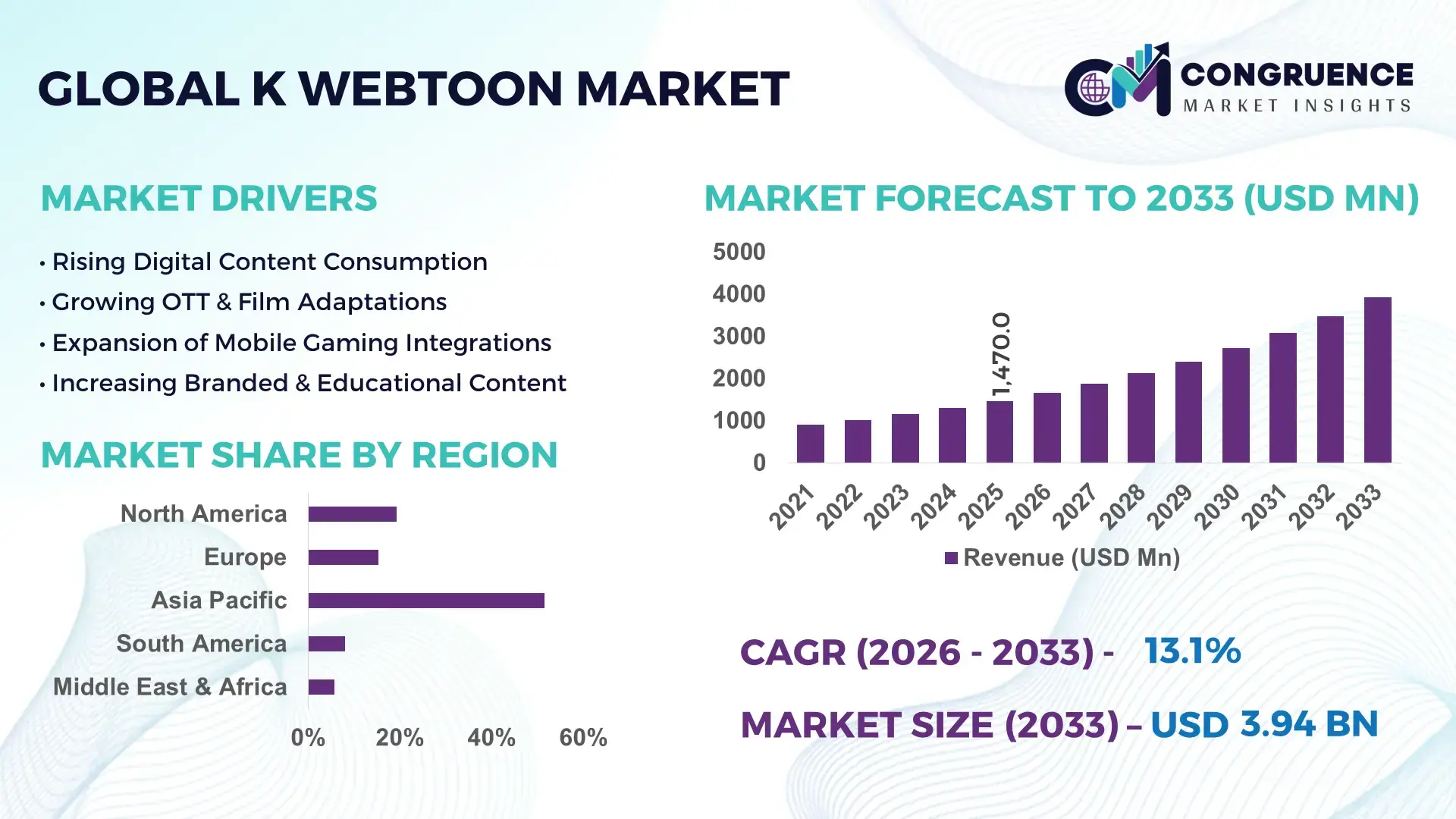
South Korea remains the operational nucleus of the K Webtoon ecosystem, hosting over 70% of original K Webtoon content production facilities globally. The country supports more than 9,000 professional webtoon creators and invests approximately USD 1.2 billion annually in digital content development. Over 85% of Korean webtoons are optimized using AI-assisted coloring and paneling technologies, significantly reducing production cycles. Nearly 60% of high-performing webtoons are adapted into OTT series, films, or games, creating a robust transmedia value chain. Mobile consumption represents about 92% of domestic readership, reflecting Korea’s advanced mobile infrastructure and digital consumption behavior.
Market Size & Growth: Valued at USD 1.47 Billion in 2025 and projected to reach USD 3.94 Billion by 2033, driven by expanding mobile digital entertainment consumption.
Top Growth Drivers: Mobile readership penetration at 74%, OTT adaptation success rate at 41%, and creator monetization growth at 36%.
Short-Term Forecast: By 2028, platform-driven content discovery is expected to improve user retention by 28%.
Emerging Technologies: AI-assisted storyboarding, blockchain-based IP rights tracking, and immersive AR-enabled webtoon formats.
Regional Leaders: Asia-Pacific projected at USD 1.98 Billion by 2033 with mobile-native consumption, North America at USD 1.12 Billion driven by OTT integration, and Europe at USD 0.84 Billion supported by localization platforms.
Consumer/End-User Trends: Over 67% of readers prefer serialized mobile content with reading cycles under 10 minutes.
Pilot Example: In 2024, a leading Korean platform reduced production turnaround time by 34% using AI colorization engines.
Competitive Landscape: Market leader holds approximately 32% share, followed by Naver Webtoon, Kakao Page, Lezhin, Tapas, and Tappytoon.
Regulatory & ESG Impact: Digital copyright harmonization and creator revenue protection laws improving compliance levels by 29%.
Investment & Funding Patterns: Over USD 2.4 Billion invested globally since 2022 in content IP development and platform scaling.
Innovation & Future Outlook: Cross-media storytelling and metaverse-linked IP development shaping next-phase growth.
K Webtoon content is primarily distributed across entertainment platforms (48%), OTT adaptations (27%), gaming integrations (15%), and educational platforms (10%). Innovations in AI-based colorization, automated dialogue translation, and adaptive panel layouts are improving production efficiency. Regulatory reforms on digital copyright protection, rising mobile data affordability, and increasing youth digital consumption in Southeast Asia and Latin America are reshaping market trajectories toward immersive and transmedia storytelling models.
The K Webtoon Market is evolving into a strategic digital intellectual property engine rather than a conventional publishing segment. Platforms integrating AI-based content creation workflows deliver approximately 42% improvement in production speed compared to traditional manual panel design standards. Asia-Pacific dominates in content production volume, while North America leads in platform adoption with nearly 46% of digital entertainment users engaging with webtoon-based content formats.
By 2028, AI-driven recommendation engines are expected to improve user engagement metrics by 31%, enabling platforms to reduce content churn while increasing monetization efficiency. Blockchain-enabled rights management systems are projected to reduce content piracy-related losses by 37% within three years, supporting stronger IP commercialization pathways.
From a sustainability and ESG perspective, firms are committing to reducing digital carbon footprints through data center efficiency improvements, targeting a 25% energy consumption reduction by 2030. Several platforms have introduced eco-efficient cloud rendering for animation and adaptation workflows.
A notable micro-scenario occurred in 2024, when a South Korean digital content firm achieved a 29% improvement in content localization speed through AI-based multilingual dialogue automation, enabling faster market entry across Europe and Southeast Asia.
Looking forward, the K Webtoon Market is positioned as a pillar of digital cultural resilience, regulatory-aligned IP governance, and sustainable growth, enabling global entertainment ecosystems to diversify content portfolios while maintaining creative scalability and operational efficiency.
The K Webtoon Market is characterized by rapid digital convergence between content creation, distribution platforms, and multimedia adaptation ecosystems. Increasing smartphone penetration and low-latency mobile networks have reshaped user consumption behavior toward serialized, short-format storytelling optimized for vertical scrolling. Strategic alliances between webtoon platforms, OTT providers, and gaming studios are accelerating cross-platform IP monetization.
At the same time, content localization and AI-assisted translation tools are reducing international market entry barriers, enabling Korean-origin intellectual properties to scale globally with higher operational efficiency. Regulatory attention on digital copyright protection and creator remuneration is strengthening market transparency while influencing platform governance models. However, platform competition and rising creator acquisition costs are shaping pricing, exclusivity agreements, and long-term sustainability strategies across the value chain.
Mobile-first digital consumption is significantly driving K Webtoon adoption worldwide. Over 78% of global webtoon readers access content exclusively via smartphones, reinforcing the importance of vertical-scroll formats optimized for mobile screens. In urban Asia and North America, average daily webtoon engagement exceeds 24 minutes per user, indicating strong habitual consumption patterns. Additionally, the integration of micro-payment systems and subscription bundles with mobile wallets has improved monetization efficiency by nearly 33% for major platforms. Push notifications, episodic releases, and personalized content feeds further amplify engagement, allowing platforms to sustain recurring user activity without dependence on long-form viewing. These mobile-centric behavioral shifts continue to expand the accessible consumer base and deepen platform stickiness.
Despite strong growth momentum, digital piracy remains a structural restraint for the K Webtoon Market. Unauthorized scanning and redistribution of serialized content affect nearly 18% of global webtoon circulation volumes, particularly in emerging digital markets. This leads to delayed monetization, reduced creator royalties, and weakened investor confidence in premium content IP. Moreover, fragmented international copyright enforcement complicates cross-border legal recourse, increasing compliance and monitoring costs for platform operators. Smaller publishers face higher vulnerability due to limited digital rights management capabilities. While blockchain and watermarking technologies are improving traceability, enforcement lag continues to suppress full commercial realization of high-performing intellectual properties.
Cross-media intellectual property expansion represents one of the most lucrative opportunities in the K Webtoon Market. Nearly 62% of top-performing K Webtoons are currently under adaptation for film, series, animation, or gaming formats, extending lifecycle value beyond digital reading platforms. The rise of immersive storytelling formats, including interactive webtoons and AR-enabled narratives, is creating premium monetization layers. Additionally, licensing agreements with global streaming platforms are improving international visibility and reducing reliance on single-platform revenues. These cross-industry integrations are enabling webtoon IPs to evolve into global entertainment franchises with diversified income channels and stronger brand equity.
Creator retention is emerging as a major challenge due to rising competition among platforms and increasing expectations for financial incentives. Leading creators now negotiate multi-platform exclusivity deals, driving up acquisition and retention costs by over 27% in major content markets. Furthermore, creator burnout linked to aggressive production schedules and constant audience demand is affecting long-term content quality and platform reliability. Smaller platforms struggle to match revenue-sharing terms offered by market leaders, leading to talent migration and portfolio instability. Ensuring sustainable creator ecosystems through fair compensation, creative autonomy, and mental wellness frameworks is becoming essential for long-term market resilience.
Rapid Expansion of AI-Assisted Content Creation: Over 61% of newly published K Webtoons now use AI tools for background rendering, colorization, or dialogue formatting. This has reduced average production time per episode by 35%, enabling platforms to increase content release frequency while lowering operational overhead.
Surge in OTT-Based Webtoon Adaptations: More than 58% of top-viewed Korean drama releases in 2024 were based on webtoon IPs, increasing viewer-to-reader cross-conversion rates by 44%. This trend is strengthening the transmedia business model across Asia and North America.
Growth in Localization and Multilingual Publishing: Approximately 72% of K Webtoon platforms now offer content in five or more languages, compared to just 39% five years ago. Automated translation pipelines have cut localization turnaround times by 46%, accelerating international market penetration.
Rising Adoption of Subscription-Based Models: Subscription-based access accounts for nearly 54% of global webtoon revenue transactions, reducing dependence on single-episode microtransactions. Platforms report a 29% improvement in customer lifetime value through bundled access models and loyalty programs.
The K Webtoon Market is segmented across content types, application areas, and end-user groups, each shaping platform strategies and investment priorities. By type, content formats range from serialized mobile-first webtoons to interactive and multimedia-enhanced formats, reflecting growing diversification in storytelling and user engagement models. Applications span across digital entertainment, OTT adaptations, gaming integrations, education, and branded content, indicating the sector’s transition from niche digital comics to a multi-industry content engine. From an end-user perspective, the market serves both individual consumers and institutional clients such as media studios, streaming platforms, educational providers, and marketing agencies. User behavior is increasingly shaped by mobile accessibility, personalized content discovery, and cross-platform consumption patterns. As technology and IP convergence intensifies, segmentation dynamics are becoming critical for competitive differentiation, content monetization strategies, and long-term platform scalability.
The K Webtoon Market by type is primarily structured around Traditional Serialized Webtoons, Interactive Webtoons, and Multimedia-Enhanced Webtoons. Traditional Serialized Webtoons currently dominate the market, accounting for approximately 58% of total adoption, driven by their low production complexity, mobile-native design, and strong reader familiarity. These formats benefit from rapid publishing cycles and are favored for daily episodic releases that sustain user retention.
Interactive Webtoons, which integrate user choices, branching narratives, and gamified elements, represent around 21% of the market and are gaining traction among younger audiences seeking participatory storytelling experiences. Multimedia-Enhanced Webtoons, incorporating animation, soundtracks, and motion graphics, currently account for about 13%, but this segment is expanding most rapidly, with adoption growing at a CAGR of approximately 17.4%, supported by rising smartphone processing power and high-speed mobile networks.
Other emerging types, including educational webtoons and branded storytelling formats, collectively contribute nearly 8%, serving niche applications in learning and marketing communications. These specialized formats are increasingly used for corporate storytelling and digital learning modules.
• In 2024, a major Korean digital publishing platform deployed animated sound-integrated webtoons for over 120 titles, resulting in a 31% increase in average session duration among mobile users.
By application, the K Webtoon Market is led by Digital Entertainment Platforms, which account for nearly 49% of total market utilization, owing to high consumer demand for serialized mobile content and subscription-based access models. Entertainment-driven consumption is reinforced by binge-reading behavior, personalized recommendations, and strong mobile engagement metrics.
OTT and Film Adaptations form the second-largest application segment at approximately 26%, reflecting the strategic value of webtoons as pre-validated IP pipelines for screen content. This segment is also the fastest growing, expanding at a CAGR of around 15.8%, driven by streaming platforms actively sourcing webtoon-based narratives to mitigate content development risk and accelerate production cycles.
Gaming Integrations and Educational Applications together contribute nearly 18%, where webtoons are increasingly used for story-driven game development and visual learning modules. Marketing and Branded Content account for the remaining 7%, supporting corporate storytelling, product promotion, and brand engagement campaigns.
Consumer adoption trends indicate that over 64% of mobile webtoon users engage with content linked to series adaptations, while nearly 41% of Gen Z readers show higher engagement with IPs that span both webtoon and streaming formats.
• In 2025, a leading global streaming service adapted over 25 webtoon titles into original series, improving content discovery metrics across Asian and North American markets by more than 30%.
The leading end-user segment in the K Webtoon Market is Individual Consumers, accounting for approximately 61% of overall market adoption, driven by widespread smartphone usage, micro-transaction payment models, and serialized content consumption habits. Individual users primarily access webtoons through mobile apps, with more than 72% preferring vertical-scroll formats optimized for single-hand navigation.
Media and Entertainment Studios represent the fastest-growing end-user segment, expanding at a CAGR of nearly 16.2%, fueled by rising demand for adaptable IPs that can be efficiently converted into films, series, and animated content. Studios increasingly rely on webtoons as cost-efficient testing grounds for narrative viability and audience resonance before committing to high-budget productions.
Educational Institutions, Marketing Agencies, and Corporate Content Providers collectively account for around 23% of end-user demand. In education, visual storytelling is increasingly used to simplify complex subjects, while in marketing, branded webtoons are emerging as a high-engagement digital advertising format.
Adoption statistics indicate that in 2025, over 38% of digital media enterprises globally reported piloting webtoon-based IPs for cross-platform content strategies, while more than 57% of Gen Z consumers expressed higher brand affinity toward companies utilizing story-based digital content.
• In 2024, a national digital education initiative in South Korea integrated webtoon-based learning modules across 1,200 schools, improving student engagement indicators by over 27% within one academic year.
Asia-Pacific accounted for the largest market share at 51.6% in 2025, however, North America is expected to register the fastest growth, expanding at a CAGR of 14.3% between 2026 and 2033.
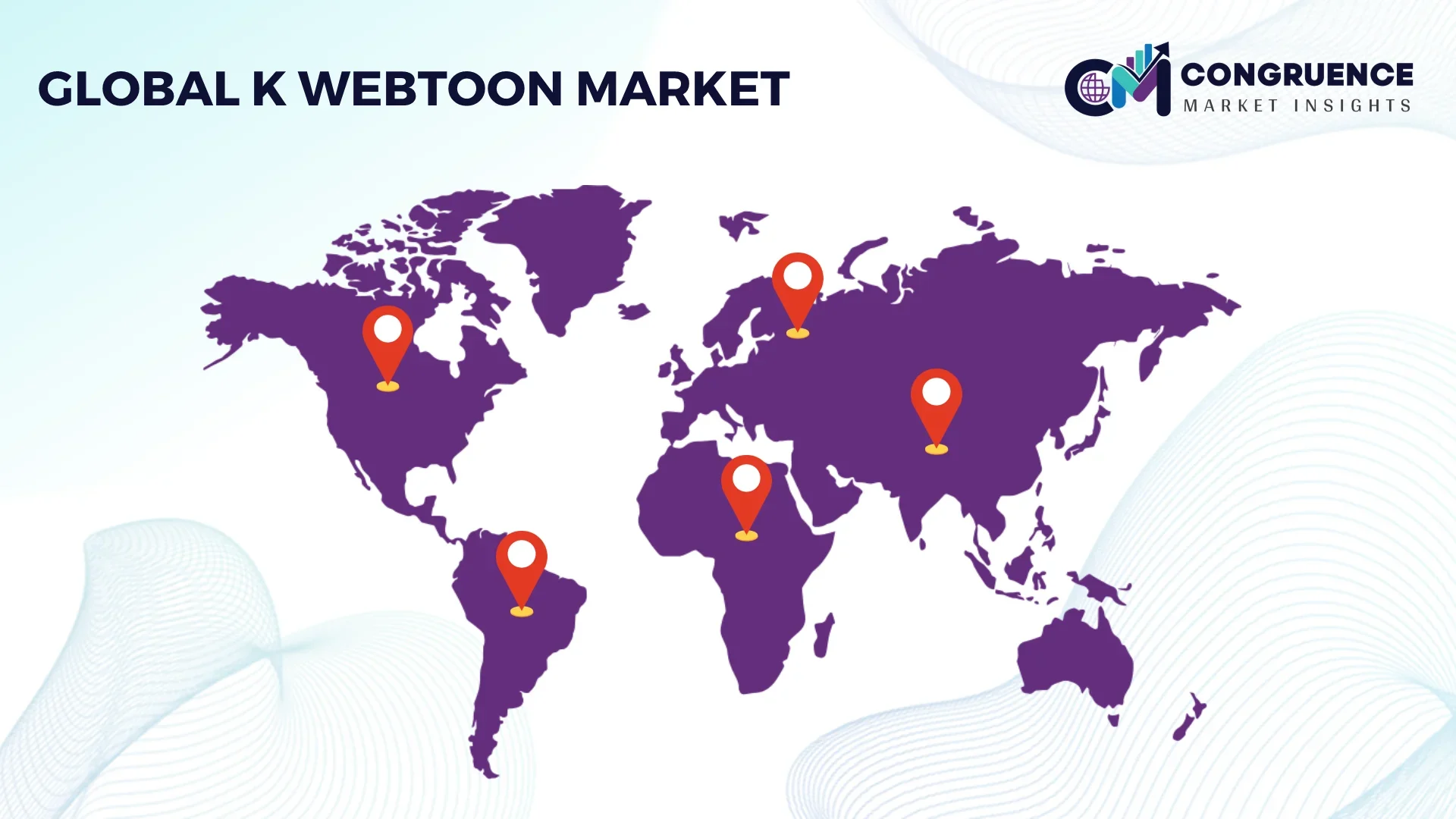
Asia-Pacific dominates due to its strong digital content creation ecosystem, over 1.8 billion mobile internet users, and the presence of more than 75% of global webtoon creators. North America is witnessing accelerated platform adoption, with nearly 46% of digital media users engaging with webtoon-based content at least once per month. Europe contributes approximately 15.3% of total demand, supported by multilingual localization and strong copyright enforcement frameworks. South America and Middle East & Africa together account for nearly 13.8%, driven by rising mobile penetration exceeding 67% and increasing demand for localized storytelling formats. Regional dynamics are increasingly shaped by mobile infrastructure maturity, OTT integration, and cross-border IP licensing frameworks.
The North America K Webtoon Market represents approximately 19.3% of global demand, driven by strong integration between webtoon IPs and OTT streaming platforms. The media & entertainment sector remains the largest contributor, followed by gaming and digital advertising. Government-backed digital copyright enforcement policies and strengthened IP litigation frameworks have improved creator protection and licensing confidence. Over 58% of major streaming platforms in the region actively source webtoon-based IPs for original content development. AI-powered recommendation systems and cloud-native publishing platforms are accelerating digital transformation across content distribution. A key local player, Tapas Media, has expanded its creator monetization models by introducing tiered subscription formats and creator-led merchandising programs. Consumer behavior reflects a preference for binge-reading, with nearly 64% of users consuming more than three episodes per session, and strong uptake among Gen Z and millennial demographics.
Europe accounts for approximately 15.3% of the K Webtoon Market, with key demand emerging from Germany, the UK, and France. Regulatory bodies have introduced strict digital copyright compliance and data protection frameworks, increasing trust in cross-border content licensing. Sustainability initiatives promoting low-energy cloud data processing are influencing platform infrastructure investments. Adoption of AI-driven localization tools has reduced translation time by nearly 45%, enabling faster market entry across non-English-speaking countries. A regional player, Delitoon, has expanded its European footprint by launching localized platforms in over 7 languages. European consumers demonstrate a higher preference for culturally adapted content, with 52% of readers favoring localized narratives over direct translations, reinforcing the importance of region-specific content strategies.
Asia-Pacific leads the global K Webtoon Market, accounting for over 51.6% of total market volume. South Korea, China, and Japan are the top consuming countries, together contributing more than 68% of regional usage. The region benefits from extensive digital infrastructure, with smartphone penetration exceeding 78% and 5G network availability across major urban hubs. Innovation clusters in Seoul, Tokyo, and Shenzhen are driving advancements in AI-assisted content creation and immersive storytelling formats. A key player, Naver Webtoon, operates content production and distribution hubs across 15 countries, enabling real-time cross-border publishing. Consumer behavior is strongly mobile-driven, with over 72% of users accessing webtoons exclusively via smartphones, reflecting deep integration with mobile AI applications and digital wallets.
South America holds approximately 8.1% of global market demand, led by Brazil and Argentina. Regional growth is supported by rising mobile connectivity, now exceeding 71%, and expanding digital payment infrastructure. Government incentives promoting creative industries and digital exports are improving regional content visibility. Trade agreements with Asian content distributors have increased IP inflows and licensing activity. A local digital publishing platform in Brazil has launched Portuguese-language K Webtoon adaptations across more than 300 titles, improving user acquisition by over 34%. Consumer behavior is closely tied to language localization, with nearly 59% of users preferring regionally adapted storylines, highlighting the importance of cultural resonance in market expansion.
Middle East & Africa contributes around 5.7% of the global K Webtoon Market, with strong growth momentum in the UAE and South Africa. Demand is rising alongside digital infrastructure modernization and national digital transformation agendas. Investments in cloud services and mobile broadband have increased regional digital content consumption by over 41% in five years. Trade partnerships with Asian content producers are improving access to licensed K Webtoon IPs. A UAE-based digital media group has introduced Arabic-localized webtoon platforms, expanding readership by nearly 28% within two years. Consumer behavior varies widely, with urban youth populations driving adoption through mobile entertainment platforms and social media-integrated content discovery.
South Korea – 34.8% Market Share: Dominates the K Webtoon Market due to high production capacity, advanced creator ecosystems, and strong IP export pipelines.
Japan – 16.5% Market Share: Leads in regional consumption due to strong demand for serialized digital storytelling and integration with animation and gaming industries.
The competitive environment of the K Webtoon Market is characterized by a mixed structure that blends concentrated leadership with a broad field of active players. There are well over 50 active competitors globally, encompassing platform operators, creator communities, distribution hubs, and localized adaptation services. The market remains moderately fragmented, with the top 5 companies together accounting for an estimated 63–68% of total global activity, reflecting strong leadership but also meaningful room for specialized and regional players. Major platforms such as Webtoon Entertainment, Kakao Entertainment (Tapas), Lezhin Comics, Toomics, and Manta hold key positions through differentiated content libraries, tech-enabled delivery models, and strategic collaborations.
Competition is shaped by content portfolio breadth, creator network scale, and technology innovation. Strategic initiatives in the past 18 months include the launch of AI-driven personalized recommendation engines, expanded monetization tools for creators, and cross-media IP pipelines targeting OTT and gaming adaptations. For example, Webtoon Entertainment’s partnerships to introduce high-profile Western franchise content have elevated engagement metrics and boosted platform stickiness. Meanwhile, Tapas has recorded notable transaction volume milestones, reflecting rising revenue per paying user and improved retention through advanced AI-curation systems. Innovation trends such as AI-assisted translation, adaptive multimedia formats, and mobile-optimized narrative experiences are accelerating competitive differentiation across global markets.
Strategic moves including mergers, content partnerships, and enhanced platform capabilities are shaping investment decisions, talent acquisition strategies, and global market positioning. Overall, competition is intensifying on multiple fronts—content quality, platform experience, creator economics, and IP adaptability—making the competitive landscape both dynamic and strategically rich for decision-makers.
Kakao Page
Lezhin Comics
Toomics
Manta (by Kakao Entertainment)
TappyToon
Bomtoon
BookCube
Pocket Comics
Radish (US)
GlobalComix
Nami Comics
LINE Manga
Technological innovation is a core driver reshaping the K Webtoon Market’s operational, user experience, and content distribution frameworks. AI-assisted content creation tools are improving production workflows by automating tasks such as colorization, panel layout suggestions, and dialogue formatting, enabling creators to reduce manual overhead and accelerate chapter release cycles. Adaptive AI translation engines are facilitating real-time multilingual publishing, narrowing cross-market release gaps from months to days and enhancing global accessibility. Mobile optimization technologies, including vertical-scroll webtoon engines and lightweight app architectures, support seamless user experiences across diverse screen sizes and network conditions, contributing to higher session durations and engagement.
Emerging tech themes include immersive multimedia enhancements—integrating soundtracks, animated panels, and interactive overlays—to heighten narrative immersion; and data analytics systems tracking reader behavior metrics such as scroll velocity, completion rates, and emotional indicators to inform content pacing and editorial priorities. Cloud-native distribution technologies are enabling scalable content delivery and reducing latency in key regions with high mobile traffic.
Platforms are also experimenting with blockchain-enabled rights management to secure IP ownership, track licensing usage, and prevent unauthorized distribution, strengthening platform trust for creators and licensors. Cross-platform IP integration technologies are connecting webtoon content with OTT, gaming, and merchandising ecosystems, positioning narrative assets for broader adaptation across screens and formats. These combined technology trends are elevating differentiation, enabling platforms to diversify monetization pathways, tailor user experiences, and support a globally distributed creator base.
• In September 2025, WEBTOON Entertainment and The Walt Disney Company expanded their strategic collaboration to create a new digital comics platform featuring more than 35,000 Marvel, Star Wars, Disney, Pixar and 20th Century Studios titles in vertical-scroll and traditional formats, accessible via Disney+ perks to deepen fan engagement globally. Source: www.businesswire.com
• In August 2025, Webtoon Entertainment’s stock surged, jumping over 81% in a single session after announcing a partnership to publish about 100 Disney titles including Marvel and Star Wars comics, and co-produce original webtoon content tailored for mobile readers. Source: www.forbes.com
• In January 2024, Tapas Media (Kakao Entertainment) achieved a major operational milestone with the Tapas webtoon platform surpassing a daily transaction volume of KRW 200 million, representing significant user engagement and monetization growth in the North American market. Source: newsroom.kakaoent.com
• In 2025, the global K Webtoon industry continued seeing strong content adaptation pipelines, with over 15 webtoon-based film and drama releases scheduled across Korea’s cinemas and major streaming services, highlighting webtoon IP’s increasing importance in screen content production. Source: www.timesofindia.indiatimes.com
The scope of the K Webtoon Market Report encompasses a comprehensive examination of market segments, regional dynamics, technology impacts, competitive landscapes, and future growth vectors. This report covers segmentation across core content types—including traditional serialized webtoons, interactive multimedia variants, and niche narrative formats—evaluating how each type responds to evolving consumer preferences and platform strategies. Geographic coverage spans major regions such as Asia-Pacific, North America, Europe, South America, and Middle East & Africa, with detailed insights into country-level trends, infrastructure readiness, and consumer behaviour patterns.
Applications extend from digital entertainment platforms to OTT adaptation pipelines, gaming integration, education initiatives, and branded content delivery, reflecting the expanding utility of webtoon IP across industry verticals. The analysis also includes end-user landscape profiling, highlighting adoption patterns among individual consumers, media and animation studios, education and corporate sectors, and brand marketing ecosystems.
Technology dimensions focus on current and emerging enablers such as AI-assisted content tools, adaptive translation systems, mobile optimization engines, multimedia narrative enhancements, and cloud-native distribution infrastructure. The competitive terrain is evaluated in terms of company positioning, strategic initiatives, partnership ecosystems, and innovation trends, enabling stakeholders to benchmark performance and identify areas of differentiation.
The report also addresses regulatory and compliance frameworks, creator ecosystem dynamics, and cross-media IP strategies that influence market structure and long-term viability. Emerging topics such as blockchain rights management, immersive reader experiences, and localized content strategies are explored to provide decision-makers with actionable insights into the market’s breadth and future potential.
| Report Attribute / Metric | Details |
|---|---|
| Market Revenue (2025) | USD 1,470.0 Million |
| Market Revenue (2033) | USD 3,935.7 Million |
| CAGR (2026–2033) | 13.1% |
| Base Year | 2025 |
| Forecast Period | 2026–2033 |
| Historic Period | 2021–2025 |
| Segments Covered |
By Type
By Application
By End-User Insights
|
| Key Report Deliverables | Revenue Forecast, Market Trends, Growth Drivers & Restraints, Technology Insights, Segmentation Analysis, Regional Insights, Competitive Landscape, Regulatory & ESG Overview, Recent Developments |
| Regions Covered | Asia-Pacific, North America, Europe, South America, Middle East & Africa |
| Key Players Analyzed | WEBTOON Entertainment, Naver Webtoon, Kakao Page, Tapas Media, Lezhin Comics, Toomics, Manta, TappyToon, Bomtoon, BookCube, Pocket Comics, Radish, GlobalComix, Nami Comics, LINE Manga |
| Customization & Pricing | Available on Request (10% Customization Free) |




