
Reports
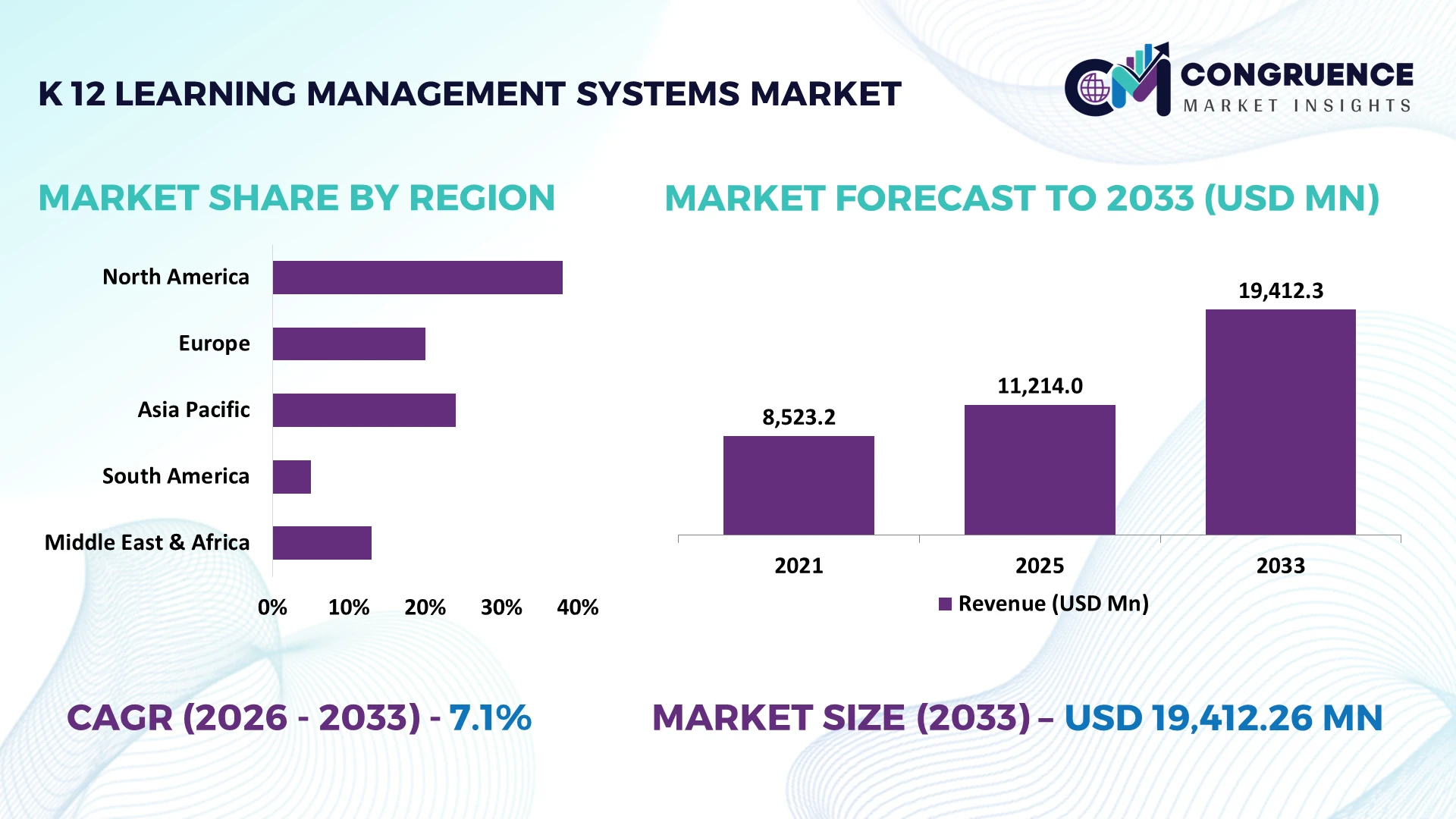
The Global K-12 Learning Management Systems Market was valued at USD 11214 Million in 2025 and is anticipated to reach a value of USD 19412.26 Million by 2033 expanding at a CAGR of 7.1% between 2026 and 2033. Growth is driven by one-to-one student devices, cloud-based curriculum delivery, AI-assisted assessment, parent communication, and district-wide consolidation of assignments, grading, analytics, and digital learning resources onto unified LMS platforms.
The United States represents an estimated 35–40% of global K-12 LMS demand, supported by approximately 50 million public-school students, near-universal school internet connectivity, and extensive Chromebook and tablet deployment. More than 95% of U.S. schools have high-speed connectivity suitable for digital instruction, strengthening Canvas, Schoology, Google Classroom, and Blackboard-linked ecosystems. India offers greater student scale but lower platform standardization. Post-pandemic learning-recovery programs and U.S.–China technology tensions are also sharpening scrutiny of student-data hosting, cybersecurity, and vendor dependency.
LMS providers combining AI-enabled personalization, district interoperability, measurable learning analytics, and rigorous student-data governance will command the strongest institutional positioning.
Market Size & Growth: USD 11,214 million in 2025 reaches USD 19,412.26 million by 2033 at 7.1% CAGR, driven by cloud curriculum and AI-assisted learning workflows.
Top Growth Drivers: One-to-one devices contribute approximately 30%, cloud learning adoption 25%, and AI-enabled assessment 20% to incremental platform demand.
Short-Term Forecast: By 2028, AI-assisted grading and content workflows are positioned to reduce repetitive teacher administration by approximately 15–25%.
Emerging Technologies: Generative AI, adaptive learning, and learning analytics increasingly automate feedback, with advanced tools targeting 20%+ faster content and assessment workflows.
Regional Leaders: North America approaches USD 7.2 billion, Europe USD 4.8 billion, and Asia-Pacific USD 5.6 billion by 2033 as cloud-based education scales.
Consumer/End-User Trends: More than 95% of U.S. schools have high-speed connectivity, enabling persistent LMS use beyond remote-learning scenarios.
Pilot/Case Example: In 2025, AI-assisted classroom workflows demonstrated approximately 20% reductions in repetitive content-preparation time across digitally mature deployments.
Competitive Landscape: Instructure holds an estimated 15%+ position, competing with PowerSchool, Google, Moodle, D2L, and Blackboard-linked learning ecosystems.
Regulatory & ESG Impact: FERPA protects education records across 100% of federally funded U.S. schools, making privacy architecture a core LMS procurement requirement.
Investment & Funding: U.S. federal broadband programs exceed USD 40 billion, strengthening connectivity infrastructure that supports cloud learning across underserved communities.
Innovation & Future Outlook: AI copilots and interoperability standards target 20–30% faster teacher workflows as LMS platforms evolve into integrated instructional operating environments.
K-12 Learning Management Systems are evolving from digital assignment repositories into instructional operating platforms connecting curriculum, assessments, analytics, communication, and student-support workflows. Demand is strongest among school districts managing one-to-one devices, blended instruction, multilingual learners, and distributed digital content. With more than 95% of U.S. schools supported by high-speed connectivity, platform competition increasingly centers on AI-assisted lesson creation, automated feedback, standards-aligned analytics, and seamless SIS integration. Student-data privacy requirements and tighter cybersecurity procurement are simultaneously reshaping vendor selection, creating a clear transition toward strategically integrated learning ecosystems.
K-12 learning management systems are becoming strategic education infrastructure as districts consolidate curriculum, assessment, communication, analytics, and intervention workflows into unified platforms. With more than 95% of U.S. schools connected to high-speed internet, competition is shifting from basic content hosting toward measurable instructional productivity. Student-data regulation, cybersecurity requirements, and rapid generative-AI adoption are simultaneously forcing districts to reassess vendor governance, interoperability, and platform architecture.
AI-assisted LMS workflows can reduce repetitive lesson preparation, assessment generation, and feedback tasks by approximately 20–30% compared with manual workflows. The United States leads integrated district deployments, while India offers substantially larger student scale but more fragmented digital infrastructure. Through 2028, platform selection will increasingly emphasize AI governance, SIS interoperability, learning analytics, accessibility, and mobile-first delivery rather than standalone classroom functionality.
A district can synchronize SIS enrollment data overnight, automatically provision courses, distribute standards-aligned assignments, and return assessment results to teacher dashboards without duplicate entry. Vendors are consequently investing in AI copilots, open APIs, cybersecurity, multilingual tools, and content partnerships. Long-term competitive positioning will depend on converting fragmented education technology into secure, measurable instructional workflows that improve teacher capacity and district-wide visibility.
Persistent device access is converting LMS platforms from supplementary repositories into daily instructional infrastructure. More than 95% of U.S. schools have high-speed connectivity, while one-to-one device availability exceeds 80% across many digitally mature districts. Cloud LMS environments can reduce manual assignment distribution and collection workflows by approximately 20–30% through automated provisioning, submissions, grading synchronization, and notifications. Post-pandemic learning recovery has reinforced demand for continuous digital access rather than emergency remote-learning tools. Providers are responding with mobile applications, offline functionality, SIS integration, standards-aligned content, and teacher workflow automation. The non-obvious advantage is data continuity: districts operating one persistent learning environment can compare engagement and assessment signals across classrooms, enabling intervention decisions that disconnected applications cannot support efficiently.
Connectivity and device availability remain uneven outside digitally mature school systems, restricting consistent LMS utilization. Globally, roughly two-thirds of school-age children have internet access at home, leaving a substantial population dependent on school infrastructure or mobile connectivity. India has more than 250 million school students, yet device access and broadband quality vary sharply between urban and rural households. Platform licensing represents only part of deployment cost; identity management, devices, connectivity, teacher training, and technical support can add 20–40% to implementation requirements. Providers are mitigating these constraints through offline synchronization, lightweight Android applications, localized pricing, shared-device support, and telecom partnerships. Strategically, vendors optimizing platforms for intermittent connectivity can address substantially larger education systems than competitors designed exclusively around persistent broadband and individual laptops.
Generative AI is opening a higher-value LMS layer around lesson generation, differentiated assignments, automated feedback, translation, and intervention recommendations. Teacher-facing copilots can reduce selected content-development and administrative workflows by approximately 20–30%, while automated translation can extend instructional access across dozens of languages without duplicating course structures. India’s multilingual school population creates a particularly attractive deployment environment, while U.S. districts increasingly demand standards-aligned AI controls and auditable outputs. Through 2028, retrieval-augmented generation, adaptive assessment, and AI tutoring will move closer to native LMS workflows. Vendors are investing in governed AI models, content partnerships, analytics, and educator controls. The strategic opportunity extends beyond automation: platforms controlling trusted curriculum context can deliver more reliable AI outputs than standalone general-purpose tools.
LMS platforms increasingly connect student identities, grades, communications, assessments, parent information, third-party applications, and cloud services, creating a broad education-data attack surface. U.S. school systems remain frequent ransomware targets, while a single district can operate more than 1,000 education applications across approved and unmanaged environments. Consolidation can reduce application sprawl by 15–25%, but deeper LMS integration also increases the operational impact of credential compromise or platform downtime. FERPA, COPPA, and expanding state privacy requirements add governance complexity around minors’ data and AI processing. Providers must strengthen multifactor authentication, encryption, role-based access, auditability, backup resilience, and third-party risk management. Competitive durability therefore depends on treating cybersecurity and privacy controls as core product architecture rather than procurement-stage compliance features.
Platform Consolidation Reduces Application Sprawl: U.S. districts are rationalizing fragmented education technology portfolios as individual schools can operate hundreds of digital applications. Consolidating course delivery, assessment, messaging, and analytics into LMS ecosystems can reduce redundant application administration by 15–25% and eliminate multiple data transfers. Providers are expanding SIS connectors, single-sign-on integration, and application marketplaces, while districts increasingly evaluate total ecosystem cost rather than standalone licensing.
Learning Analytics Moves Into Workflow: Districts are shifting analytics from periodic reporting toward classroom-level dashboards combining attendance, assignment completion, assessment, and engagement indicators. Automated data synchronization can reduce manual reporting effort by 20–30% and refresh indicators daily instead of monthly. Providers are embedding intervention alerts and standards-level visualization into teacher workflows, enabling schools to identify disengagement earlier while reducing separate business-intelligence tooling and administrative workload.
Interoperability Becomes Procurement Priority: Schools increasingly require LTI, OneRoster, and API-based interoperability as digital ecosystems expand. Standardized integrations can shorten application provisioning by 20–40% and reduce duplicate roster-management tasks across dozens of instructional applications. U.S. privacy scrutiny is reinforcing centralized vendor governance. LMS companies are strengthening open APIs, identity-management partnerships, automated rostering, and integration certification to reduce implementation friction and improve district retention.
Mobile Engagement Extends Beyond Classrooms: Parent communication and homework access are increasingly shifting toward smartphones, particularly in India and other mobile-first education systems. Mobile internet accounts for more than 50% of global web traffic, making responsive LMS workflows operationally essential. Providers are expanding push notifications, multilingual interfaces, lightweight applications, and offline synchronization. The non-obvious advantage is improved parent participation without requiring separate communication platforms, lowering administrative fragmentation.
Cloud-Based platforms account for approximately 55–60% of K-12 LMS demand, supported by centralized administration, automatic upgrades, elastic capacity, browser-based access, and simpler integration across geographically dispersed schools. Districts can eliminate dedicated application-server management and reduce infrastructure administration by approximately 20–30% compared with traditional locally hosted environments. On-Premise platforms remain relevant where institutions require direct control over student records, customized infrastructure, or restrictive data-residency policies, but hardware maintenance and upgrade requirements increasingly limit new deployments.
Hybrid is the fastest-growing type as districts retain selected identity, data, or administrative workloads locally while moving instructional services toward scalable cloud infrastructure. Hybrid configurations can shift 30–50% of suitable workloads without forcing immediate replacement of established systems. Open-Source platforms retain strategic relevance for education ministries and institutions seeking customization and licensing flexibility, although implementation requires internal technical capability. Vendors are consequently investing in cloud-native architecture, migration services, managed hosting, API ecosystems, and configurable data-governance controls.
Course Management represents an estimated 30–35% of K-12 LMS application demand because curriculum organization, assignments, learning materials, calendars, and classroom workflows generate persistent daily usage. Homework Management remains closely connected to this core function, while Virtual Classrooms retain value for remote instruction, tutoring, weather closures, and geographically distributed learning. Parent Engagement increasingly integrates attendance, assignments, grades, and notifications into unified portals rather than operating through separate communication systems.
Learning Analytics is the fastest-growing application as districts shift from storing instructional data toward identifying intervention priorities. Automated dashboards can reduce manual reporting workloads by approximately 20–30%, while daily synchronization replaces reporting cycles that previously required weeks. Student Assessment is similarly becoming more integrated as digital testing feeds results directly into instructional dashboards. Vendors are expanding analytics engines, automated assessment workflows, parent applications, and standards-level reporting. Competitive differentiation increasingly depends on turning Course Management activity into actionable student-performance intelligence rather than simply digitizing classroom administration.
Public Schools represent approximately 40–45% of K-12 LMS demand because national and local education systems manage large student populations, standardized curricula, accessibility requirements, and extensive teacher workforces. School Districts represent another strategically important purchasing segment because centralized procurement can deploy one platform across dozens or hundreds of schools, reducing fragmented technology administration by approximately 15–25%. Private Schools and International Schools generally adopt platforms faster when differentiated digital learning, multilingual delivery, and parent experience support enrollment positioning.
Education Ministries represent the fastest-growing institutional segment as countries pursue national digital-learning infrastructure and centralized content distribution. Ministry-led deployments can address millions of learners through shared identity, curriculum, assessment, and reporting frameworks. Charter Schools prioritize flexible cloud platforms and rapid implementation, while International Schools emphasize interoperability and globally transferable learning environments. Vendors are responding with enterprise pricing, multilingual interfaces, district administration consoles, accessibility tools, and government partnerships. Future competitive advantage increasingly depends on scaling from individual schools to centrally governed education networks.
North America accounted for the largest market share at 38% in 2025 however, Asia-Pacific is expected to register the fastest growth, expanding at a CAGR of 9.2% between 2026 and 2033.
District Consolidation Reshapes Digital Learning Infrastructure
North America accounted for approximately 38% of global K-12 LMS demand in 2025, supported by mature cloud infrastructure, extensive one-to-one device programs, and district-level technology procurement. U.S. public schools serve roughly 50 million students, creating substantial scale for centralized course management, assessment, analytics, and parent communication. More than 95% of schools have high-speed connectivity suitable for persistent digital instruction. Districts are increasingly consolidating fragmented classroom applications around LMS, SIS, identity-management, and single-sign-on ecosystems, reducing duplicate administration and strengthening data governance. AI-assisted assessment, accessibility, and learning analytics are becoming procurement differentiators, while FERPA and state privacy requirements intensify vendor scrutiny. Providers are expanding cloud capacity, interoperability certification, cybersecurity controls, and district implementation partnerships to secure long-duration institutional relationships.
United States Market Outlook: The United States combines approximately 13,000 public school districts with established Chromebook, tablet, and cloud-learning ecosystems. Large districts can serve more than 100,000 students through centralized digital platforms, making scalability and uptime critical procurement criteria. Vendors offering standards-aligned analytics, automated rostering, accessibility, and governed AI capabilities are positioned strongly for district-wide consolidation programs.
Privacy Governance Shapes Platform Modernization
Europe represents approximately 24% of global K-12 LMS demand, supported by high household connectivity, established digital-learning infrastructure, and government-led education modernization. The United Kingdom, Germany, France, the Netherlands, and Nordic countries maintain extensive classroom technology adoption, although procurement remains fragmented across national and local education structures. GDPR has made student-data residency, consent management, retention controls, and vendor governance central to LMS purchasing. More than 90% of EU households have internet access, supporting persistent cloud-based assignments and communication beyond school premises. Governments are simultaneously tightening scrutiny of generative AI in education, pushing providers toward explainable outputs and controlled student-data processing. LMS vendors are expanding European hosting, multilingual interfaces, open standards, accessibility functionality, and privacy administration tools rather than relying on globally standardized deployments.
United Kingdom Market Outlook: The United Kingdom combines mature broadband infrastructure with more than 10 million school pupils and extensive use of cloud productivity and virtual-learning environments. Schools increasingly prioritize integration between LMS, safeguarding, assessment, and management-information systems. Vendors offering automated rostering and centralized identity management can reduce technology administration while supporting institution-specific data-protection and accessibility obligations.
Student Scale Accelerates Mobile-First Deployment
Asia-Pacific accounts for approximately 27% of global K-12 LMS demand, combining enormous student populations with rapid cloud, smartphone, and education-platform adoption. India, China, Japan, Australia, and South Korea represent distinct deployment models ranging from government-led digital infrastructure to highly connected institutional ecosystems. India alone has more than 240 million school students, creating exceptional scale for multilingual course distribution, assessment, and teacher-support platforms. Mobile-first access is especially important where household computer ownership trails smartphone availability. Australia and South Korea emphasize analytics, interoperability, and digital curriculum, while India increasingly connects national digital-learning initiatives with state education systems. Vendors are adapting through lightweight Android applications, offline synchronization, localized content, multilingual interfaces, and cloud infrastructure partnerships. The operational advantage belongs to platforms capable of serving high concurrent usage without assuming universal laptop or fixed-broadband access.
India Market Outlook: India offers unmatched addressable learner scale and a policy environment increasingly supportive of digital education under NEP 2020 and national platforms such as DIKSHA. Internet subscriptions exceed 900 million, strengthening the infrastructure available for digital learning. Providers combining regional-language delivery, low-bandwidth operation, affordable institutional pricing, and government-system interoperability can address both private schools and public education networks.
Cloud Adoption Broadens Institutional Access
South America represents approximately 6% of global K-12 LMS demand, led by Brazil, Chile, Colombia, and Argentina. Brazil provides the largest student base, while Chile benefits from comparatively mature digital infrastructure and institutional technology adoption. Schools are increasingly moving from standalone videoconferencing and messaging tools toward structured platforms integrating assignments, assessment, attendance, and parent engagement. Internet penetration exceeds 80% in several major markets, but connectivity quality and device availability remain uneven between urban and lower-income communities. This creates demand for mobile-compatible, asynchronous, and offline-capable platforms rather than bandwidth-intensive learning environments. Providers are expanding Portuguese and Spanish interfaces, regional cloud hosting, school-network partnerships, and flexible licensing. Procurement remains cost-sensitive, making rapid deployment and low administrative overhead important competitive advantages alongside instructional functionality.
Brazil Market Outlook: Brazil serves more than 45 million basic-education students across public and private institutions, providing the region’s largest deployment base. Smartphone-led connectivity favors LMS platforms optimized for mobile assignments, notifications, and parent communication. Providers that integrate with local curriculum structures and support low-bandwidth access can extend deployment beyond premium private schools into larger municipal and state networks.
National Digitization Expands Learning Platforms
Middle East & Africa accounts for approximately 5% of global K-12 LMS demand, with adoption concentrated in Gulf education systems, South Africa, and digitally advancing African school networks. Saudi Arabia and the UAE are investing in smart classrooms, cloud infrastructure, AI-enabled education, and digital curriculum as part of broader economic transformation programs. Gulf schools benefit from high connectivity and substantial device availability, while African deployments increasingly prioritize mobile access and offline functionality. Internet penetration remains below 50% across parts of Africa, creating significant execution differences between countries. Vendors are responding through telecom partnerships, localized hosting, Arabic interfaces, lightweight applications, and government-oriented platform configurations. National education transformation programs increasingly favor centrally governed platforms capable of distributing curriculum and monitoring engagement across large school networks rather than isolated institutional deployments.
Saudi Arabia Market Outlook: Saudi Arabia combines more than 6 million school students with nationwide digital-transformation programs and extensive cloud infrastructure investment. Vision 2030 education initiatives support smart classrooms, digital curriculum, and technology-enabled teaching. LMS providers integrating Arabic content, analytics, AI-assisted workflows, and ministry-level administration can compete for deployments spanning large public and private education networks.
The K-12 Learning Management Systems market pits Instructure, PowerSchool, Google, D2L, and Moodle ecosystems against regional and open-source platforms competing on flexibility and cost. The top five capture approximately 50–55% of institutional demand, supported by district relationships, integration ecosystems, and established classroom workflows. Cloud leaders compete through scalability and interoperability, while open-source providers can lower licensing expenditure by 20–30% where institutions maintain technical teams. AI-assisted workflows can reduce selected teacher administration by 15–25%, making automation a stronger differentiator. Providers are expanding SIS integrations, content partnerships, multilingual functionality, analytics, and secure cloud hosting. Competition is shifting from standalone course delivery toward integrated instructional ecosystems connecting assessment, communication, identity, and AI. Student-data regulation, procurement cycles, migration complexity, and teacher adoption create substantial entry barriers. Winning requires reliable scale, intuitive workflows, open interoperability, measurable instructional productivity, strong privacy controls, and ecosystem depth that reduces technology fragmentation for schools.
Instructure
PowerSchool
D2L
Moodle
Anthology
Schoology
itslearning
Schoolbox
CYPHER Learning
Toddle
Seesaw Learning
Otus
PowerSchool Schoology Learning
Current K-12 LMS technology centers on cloud-native delivery, mobile access, SIS synchronization, LTI interoperability, automated rostering, and learning analytics. Cloud platforms can reduce infrastructure administration by 20–30%, while standardized integrations cut duplicate enrollment and grade-transfer workflows by 15–25%. Districts with one-to-one devices increasingly deploy LMS platforms as instructional hubs, improving scalability, data consistency, and teacher access across schools.
Emerging systems embed generative AI, adaptive assessment, translation, accessibility automation, and predictive engagement analytics directly within course workflows. AI-assisted rubric creation, feedback, and content development can shorten selected teacher tasks by 20–30%. Compared with legacy self-hosted platforms requiring manual updates and fragmented integrations, modern cloud LMS environments can improve administrative workflow efficiency by 25%. Vendors with mature SIS ecosystems, content and district governance benefit most because embedded AI operates against richer instructional context.
From 2026–2028, agentic AI, natural-language analytics, interoperable AI assistants, and controlled personalization will become disruptive differentiators. Agents capable of executing multi-step course-management tasks across hundreds of APIs will shift LMS platforms from information systems toward action systems. Districts prioritizing governed AI, open standards, and unified data architectures can target 15–20% faster instructional administration. Acting now matters because integration quality, permissions, and clean learning data determine whether automation scales safely.
December 2024 Google introduced Gemini LTI for integration with Canvas and PowerSchool Schoology Learning, bringing generative AI directly into two major LMS environments. Educators gained embedded lesson-planning and quiz-generation capabilities, reducing platform switching while strengthening AI-enabled classroom workflows. Source: googleblog.com
July 2025 Instructure launched IgniteAI, built on AWS Bedrock and integrated into Canvas and Mastery. AWS reported Canvas serves over 2.4 million teachers worldwide, giving embedded generative AI substantial deployment scale while automating classroom administration and strengthening platform differentiation. Source: aws.amazon.com
December 2025 Moodle detailed its integrated AI direction for Moodle LMS, emphasizing educator-controlled adoption without making core learning functionality AI-dependent. The strategy protects access across 100% of deployment environments, including institutions facing limited connectivity, infrastructure, or AI availability. Source: moodle.com
March 2026 Instructure launched IgniteAI Agent for Canvas, enabling educators to execute multi-step workflows through more than 500 APIs from one prompt. The rollout shifts LMS functionality toward action-oriented automation, reducing repetitive course-management steps while maintaining institutional control over deployment. Source: instructure.com
The K-12 Learning Management Systems Market Report evaluates Cloud-Based, On-Premise, Hybrid, and Open-Source platforms across Course Management, Student Assessment, Virtual Classrooms, Homework Management, Parent Engagement, and Learning Analytics. Coverage spans Public Schools, Private Schools, Charter Schools, International Schools, School Districts, and Education Ministries. Cloud-Based platforms account for approximately 55–60% of deployment demand, while Course Management represents roughly 30–35% of application usage.
Regional analysis covers North America, Europe, Asia-Pacific, South America, and Middle East & Africa, examining district digitization, connectivity, mobile learning, privacy requirements, and national education platforms. Technology coverage includes generative AI, agentic automation, adaptive assessment, SIS integration, learning analytics, LTI interoperability, and multilingual delivery. The 2026–2033 outlook supports investment planning, geographic expansion, product positioning, partnership strategy, platform modernization, and competitive decisions across established and emerging digital-learning ecosystems.
| Report Attribute/Metric | Report Details |
|---|---|
Market Revenue in 2025 | USD 11214 Million |
Market Revenue in 2033 | USD 19412.26 Million |
CAGR (2026 - 2033) | 7.1% |
Base Year | 2025 |
Forecast Period | 2026 - 2033 |
Historic Period | 2021 - 2025 |
Segments Covered | By Type
By Application
By End-User
|
Key Report Deliverable | Revenue Forecast, Growth Trends, Market Dynamics, Segmental Overview, Regional and Country-wise Analysis, Competition Landscape |
Region Covered | North America, Europe, Asia-Pacific, South America, Middle East, Africa |
Key Players Analyzed | Instructure, PowerSchool, Google, D2L, Moodle, Anthology, Schoology, itslearning, Schoolbox, CYPHER Learning, Toddle, Seesaw Learning, Otus, PowerSchool Schoology Learning |
Customization & Pricing | Available on Request (10% Customization is Free) |




