
Reports
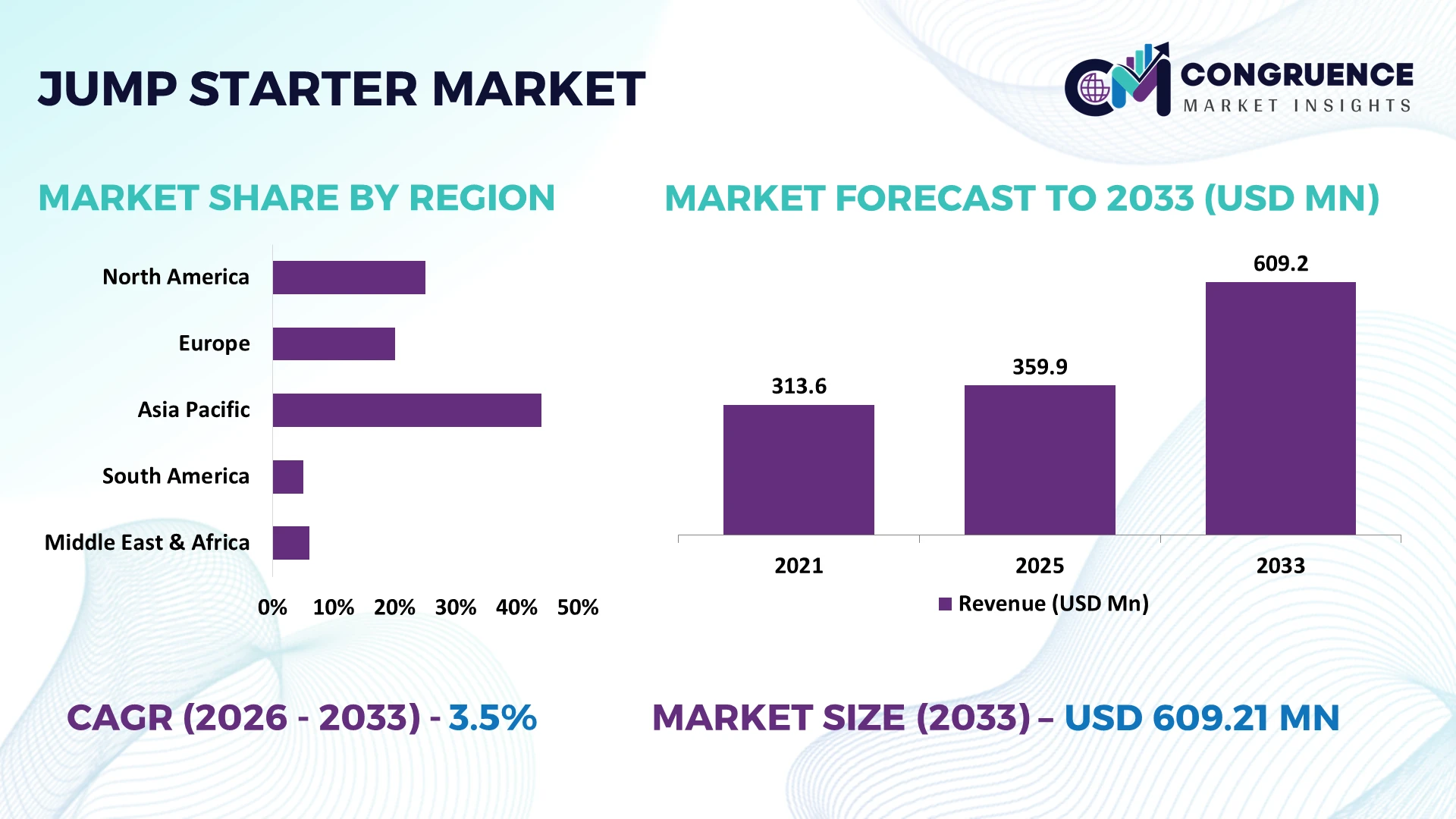
The Global Jump Starter Market was valued at USD 359.91 Million in 2025 and is anticipated to reach a value of USD 609.21 Million by 2033 expanding at a CAGR of 3.5% between 2026 and 2033. Growth is driven by lithium-ion portable booster adoption, increasing vehicle electronics dependence, and demand for independent roadside battery recovery.
The United States represents a major jump starter consumption market, supported by approximately 289 million registered motor vehicles and an automotive aftermarket exceeding 300 million annual vehicle service opportunities. The average light vehicle age reached 12.8 years in 2025, strengthening battery maintenance requirements. China leads lithium-ion battery manufacturing, accounting for over 70% of global cell production capacity, creating a manufacturing advantage over US suppliers. NOCO and Clore Automotive compete through high-current booster technology, professional distribution, and compact battery protection systems.
Strategically, suppliers should combine access to China's concentrated battery supply chain with US aftermarket distribution, targeting the 12.8-year vehicle age profile and increasingly electronics-dependent roadside recovery requirements.
Market Size & Growth: USD 359.91 million in 2025, reaching USD 609.21 million by 2033 at a stated 3.5% CAGR, supported by portable lithium battery technology.
Top Growth Drivers: Vehicle age increased approximately 3%, US vehicle parc expanded below 2%, and China's battery manufacturing share exceeded 70%.
Short-Term Forecast: By 2028, optimized lithium booster designs target 10–15% lower product weight through improved cell packaging and electronics integration.
Emerging Technologies: Three developments include lithium iron phosphate batteries, intelligent battery management systems, and automatic reverse polarity protection.
Regional Leaders: Illustrative 2033 allocations place North America at USD 243.68 million, Asia-Pacific at USD 213.22 million, and Europe at USD 121.84 million, reflecting aftermarket, manufacturing, and safety-focused adoption.
Consumer/End-User Trends: The US light vehicle fleet averaged 12.8 years in 2025, strengthening demand for independent battery recovery equipment.
Pilot/Case Example: NOCO's GBX155 platform delivers 4,250 peak amperes, demonstrating high-output portable booster engineering for larger engines.
Competitive Landscape: NOCO, Clore Automotive, Schumacher Electric, GOOLOO, and CTEK compete across consumer, professional, and premium battery support products.
Regulatory & ESG Impact: UN 38.3 transportation compliance requires lithium batteries to pass eight categories of safety testing, influencing product qualification and logistics.
Investment & Funding: The US Inflation Reduction Act provides a 30% investment tax credit for qualifying domestic battery manufacturing facilities, supporting supply-chain localization.
Innovation & Future Outlook: Next-generation 12V and 24V boosters integrate intelligent diagnostics, thermal protection, and multi-chemistry charging compatibility.
The global jump starter market serves passenger vehicles, commercial fleets, automotive workshops, and emergency roadside assistance providers. Lithium-based portable boosters are replacing bulky lead-acid equipment in applications requiring compact storage, high discharge capability, and simplified operation. Intelligent battery management systems increasingly integrate thermal monitoring, short-circuit protection, and automatic voltage detection. The US vehicle fleet's average age of 12.8 years reinforces the importance of battery recovery equipment, while lithium battery transportation regulations influence packaging and distribution. Manufacturers are differentiating through peak current capability, battery safety, and professional-grade durability, establishing clear priorities for future investment and competitive positioning.
The jump starter market is becoming strategically important as aging vehicle fleets, portable lithium battery technology, and roadside service modernization reshape automotive aftermarket competition. The United States maintained an average light vehicle age of 12.8 years in 2025, increasing the commercial relevance of independent battery recovery equipment. China's concentration of lithium battery manufacturing creates procurement advantages but also exposes international suppliers to geopolitical trade restrictions. NOCO, Clore Automotive, and Schumacher Electric are strengthening product differentiation through intelligent protection circuits, high discharge capability, and professional distribution.
Lithium jump starters offer substantial portability advantages over conventional lead-acid booster packs, with selected compact models weighing 60–80% less than comparable professional lead-acid equipment. North America emphasizes consumer ownership and workshop deployment, while China combines battery cell manufacturing scale with integrated electronics production. European suppliers prioritize electrical safety, product certification, and professional battery maintenance applications.
During 2026–2028, manufacturers will prioritize lithium iron phosphate chemistry, automatic battery diagnostics, and improved thermal management. NOCO's 4,250-ampere GBX155 demonstrates how high-output portable boosters support larger vehicle applications. Suppliers investing in validated battery systems, reliable cell sourcing, and professional service partnerships will secure stronger competitive positioning through product safety and operational dependability.
The aging vehicle population is increasing the operational importance of portable battery recovery equipment. In the United States, average light vehicle age reached 12.8 years in 2025, approximately 3% above the 2024 level of 12.6 years. Vehicles aged 12 years or older represent a substantial portion of the operating fleet, increasing exposure to battery deterioration and starting failures. Lithium booster packs can weigh 60–80% less than comparable lead-acid alternatives, improving portability for drivers and roadside technicians. NOCO and Clore Automotive are expanding high-output booster portfolios and integrating reverse polarity protection. Automotive retailers and service providers benefit from compact equipment that supports faster emergency response without requiring a second vehicle.
Jump starter manufacturers face concentrated lithium battery sourcing and increasingly demanding transportation compliance requirements. China accounts for more than 70% of global lithium-ion battery cell production, creating procurement dependence for manufacturers serving the United States and Europe. Lithium-ion batteries commonly operate at approximately 95–99% charge efficiency under favorable conditions, but high discharge applications require additional protection electronics and thermal controls. UN 38.3 transportation requirements include eight testing categories, increasing qualification and documentation obligations. Trade restrictions, shipping limitations, and battery certification costs constrain smaller suppliers. Manufacturers are diversifying cell procurement, qualifying alternative suppliers, and improving battery management systems. Maintaining traceable battery quality is essential for controlling warranty exposure and ensuring uninterrupted international distribution.
Intelligent jump starter systems are creating opportunities in commercial vehicle maintenance, fleet servicing, and automated battery diagnostics. The United States operates approximately 289 million registered motor vehicles, providing a substantial installed base for preventive battery support equipment. Lithium booster systems can reduce equipment weight by 60–80% compared with selected lead-acid alternatives, improving technician mobility and vehicle storage efficiency. Advanced battery management systems monitor temperature, voltage, and discharge conditions, supporting safer recovery operations. NOCO, CTEK, and Clore Automotive are developing differentiated charging and battery support products for professional applications. Integration with fleet maintenance workflows creates opportunities for standardized equipment procurement, reduced service interruptions, and stronger recurring relationships with commercial operators.
Delivering reliable peak current across varied operating temperatures remains a critical engineering challenge for lithium jump starter manufacturers. Lithium-ion battery performance deteriorates under extreme cold, with usable capacity potentially declining 20–40% depending on chemistry, temperature, and discharge conditions. High-current booster systems must manage thermal stress, voltage instability, and short-circuit exposure during repeated operation. Commercial products commonly support 12V electrical systems, while heavy-duty vehicles frequently require 24V compatibility, increasing circuit design complexity. Manufacturers must validate battery protection electronics, cable resistance, and cold-start performance across vehicle categories. NOCO, Clore Automotive, and Schumacher Electric are strengthening product testing and electrical protection capabilities. Long-term competitiveness depends on consistent real-world starting performance rather than advertised peak amperage alone.
USB-C Charging Standardizes Portable Boosters: Manufacturers are incorporating USB-C Power Delivery interfaces alongside conventional charging inputs. A 60W USB-C connection offers three times the nominal charging power of a 20W connection, subject to battery management limits. NOCO and competing suppliers are integrating standardized charging interfaces, reducing dependence on proprietary adapters and improving product convenience for automotive retailers.
Safety Certification Reshapes Product Qualification: Lithium jump starter suppliers are strengthening battery transportation testing and product traceability as international shipping requirements tighten. UN 38.3 specifies eight test categories, including thermal, vibration, and external short-circuit assessments. Manufacturers are implementing serialized battery documentation and standardized packaging, improving shipment acceptance while increasing compliance requirements for imported products.
Multi-Function Devices Expand Retail Positioning: Portable boosters increasingly combine emergency starting, LED illumination, and electronic device charging. Selected products integrate three functional categories within one enclosure, while USB outputs commonly support 5V charging. Schumacher Electric and GOOLOO are broadening accessory configurations and retail assortments, increasing product differentiation without requiring separate automotive emergency equipment purchases.
High-Output Models Target Engine Compatibility: Manufacturers are introducing higher-current boosters for larger gasoline and diesel engines, replacing product selection based primarily on enclosure size. NOCO's GBX155 delivers a rated 4,250 peak amperes and supports gasoline engines up to 10.0 liters and diesel engines up to 8.0 liters. Suppliers are strengthening application labeling and electrical protection to reduce incorrect product selection.
Lithium-Ion Jump Starters Lead Compact Battery Recovery
Lithium-Ion Jump Starters represent the leading technology category, with an indicative 55% market share, supported by compact construction, rechargeable battery systems, and widespread consumer retail availability. Selected lithium booster packs weigh 60–80% less than comparable lead-acid equipment, improving portability and vehicle storage convenience. Integrated battery management systems provide reverse polarity protection, thermal monitoring, and short-circuit safeguards. NOCO and GOOLOO are expanding lithium product ranges with differentiated starting capacities and charging interfaces. Lead-Acid Jump Starters retain relevance in professional workshops requiring established charging practices, rugged construction, and frequent battery recovery operations.
Capacitor-Based Jump Starters represent the fastest-growing emerging technology category, using supercapacitors to accumulate energy from partially discharged vehicle batteries or external power sources. Their operating characteristics reduce dependence on conventional battery storage, although energy availability limits certain applications. Portable Jump Starters remain a commercially important product category encompassing compact emergency starting equipment across multiple storage technologies. Manufacturers are prioritizing battery safety, high-current delivery, and application-specific product development to improve competitive differentiation.
Passenger Vehicles Dominate Emergency Starting Applications
Passenger Vehicles represent the leading application segment, with an indicative 60% share of global jump starter demand, reflecting extensive private vehicle ownership and widespread automotive accessory distribution. The United States maintains approximately 289 million registered motor vehicles, while the average light vehicle age reached 12.8 years in 2025. These operating conditions strengthen demand for compact emergency starting equipment and battery recovery accessories. NOCO, Schumacher Electric, and GOOLOO target passenger vehicle owners through portable lithium boosters, retail distribution, and engine-specific product configurations. Commercial Vehicles require higher-current systems and rugged equipment suited to frequent professional operation.
Recreational Vehicles represent an expanding specialized application category, supported by extended vehicle storage periods and independent travel requirements. Motorcycles require compact boosters compatible with smaller starting batteries, while Marine Vehicles demand moisture-resistant construction and reliable starting capability under demanding operating conditions. Manufacturers are differentiating products through peak-current ratings, battery protection systems, and environmental durability. Commercial vehicle suppliers prioritize operational uptime, while recreational and marine applications strengthen opportunities for premium equipment with specialized electrical and enclosure requirements.
Individual Vehicle Owners Lead Retail Purchasing
Individual Vehicle Owners represent the largest end-user category, with an indicative 50% share of global jump starter purchasing, supported by personal vehicle ownership and automotive accessory retail channels. Compact lithium boosters allow drivers to perform emergency starting without relying on another vehicle, improving convenience during battery failures. The United States maintains an extensive vehicle population exceeding 280 million registered units, creating substantial potential for consumer battery support equipment. NOCO, GOOLOO, and Schumacher Electric compete through product portability, starting capacity, safety features, and online distribution. Automotive Repair Shops continue using professional booster equipment for routine battery recovery and vehicle servicing.
Fleet Operators represent the fastest-expanding institutional end-user category, emphasizing standardized equipment procurement, technician efficiency, and reduced vehicle downtime. Roadside Assistance Providers require high-current systems capable of supporting varied vehicle configurations, while Automotive Service Centers prioritize reliable equipment for repeated workshop use. Manufacturers are developing professional product ranges, strengthening service distribution partnerships, and offering differentiated warranty support. Institutional purchasing increasingly rewards verified starting performance, equipment durability, and compatibility with diverse vehicle electrical systems.
North America accounted for the largest market share at an indicative 40% in 2025 however, Asia-Pacific is expected to register the fastest growth, expanding at a CAGR of an indicative 5.2% between 2026 and 2033.

Aging Vehicle Fleets Strengthen Portable Battery Recovery Demand
North America accounts for an estimated 40% of global jump starter demand, supported by extensive vehicle ownership, established automotive aftermarket distribution, and professional roadside assistance infrastructure. The United States dominates regional consumption, while Canada contributes demand for cold-weather starting equipment and commercial vehicle maintenance. The average US light vehicle age reached 12.8 years in 2025, reinforcing battery maintenance requirements across aging vehicles. NOCO, Clore Automotive, and Schumacher Electric compete through lithium booster technology, professional equipment portfolios, and automotive retail partnerships. Product development emphasizes high-current delivery, automatic polarity protection, and compact battery systems. Cold-weather reliability remains particularly important in Canada and northern US states, where reduced battery performance increases starting difficulties. Manufacturers are strengthening retail availability and professional service distribution to improve product accessibility and support recurring aftermarket demand.
United States Market Outlook: The United States maintains approximately 289 million registered motor vehicles, creating an extensive installed base for battery recovery products. NOCO and Clore Automotive benefit from established domestic distribution networks and specialized automotive service channels. High-output lithium boosters, including models rated above 4,000 peak amperes, support larger gasoline and diesel applications, while online automotive retailers strengthen consumer access to portable emergency starting equipment.
Battery Safety Compliance and Professional Equipment Modernization
Europe represents an estimated 20% of global jump starter demand, supported by established automotive service infrastructure, commercial vehicle maintenance, and regulated electrical equipment distribution. Germany, the United Kingdom, France, and Italy maintain substantial automotive aftermarket networks. European suppliers emphasize product certification, electrical protection, and battery transport compliance. The European Union Battery Regulation introduces progressively stricter requirements for battery sustainability, traceability, and lifecycle management, influencing lithium-powered automotive accessories. CTEK and other specialist suppliers compete through intelligent charging technology, professional equipment design, and established service relationships. Manufacturers are integrating improved thermal monitoring, reverse polarity protection, and standardized charging interfaces. Regional distributors prioritize compliant product documentation and dependable aftersales support. Competitive advantage increasingly depends on electrical safety verification, reliable product performance, and efficient distribution across fragmented national automotive service markets.
Germany Market Outlook: Germany combines an extensive automotive manufacturing ecosystem with established vehicle servicing infrastructure. The country maintains approximately 49 million registered passenger cars, supporting demand for battery maintenance and emergency starting equipment. Professional workshops emphasize electrical safety, diagnostic compatibility, and durable equipment. German automotive suppliers and distributors benefit from strong technical service networks, standardized product certification, and established relationships with commercial fleet maintenance providers.
Lithium Battery Manufacturing Scale and Export Integration
Asia-Pacific represents an indicative 35% of global jump starter demand, supported by extensive battery manufacturing capacity, automotive production, and electronics supply chains. China dominates lithium-ion battery cell manufacturing, accounting for more than 70% of global production, creating substantial sourcing advantages for portable booster manufacturers. Shenzhen and surrounding manufacturing centers support integrated battery pack assembly, power electronics production, and export-oriented automotive accessory manufacturing. GOOLOO and other Chinese suppliers compete through compact product engineering, competitive manufacturing costs, and international online distribution. Japan and South Korea contribute advanced battery materials and electronic component technologies, while India supports expanding automotive aftermarket consumption. Regional manufacturers are improving battery management systems, product testing, and international certification capabilities. Supply-chain integration strengthens manufacturing responsiveness, although dependence on concentrated battery production creates exposure to trade restrictions and logistics disruptions.
China Market Outlook: China maintains a leading position in lithium battery manufacturing and portable automotive electronics production. Its integrated battery supply chain supports rapid product development, component procurement, and large-scale assembly. Manufacturers are expanding lithium iron phosphate applications, intelligent protection circuits, and USB-C charging integration. Export competitiveness depends increasingly on UN 38.3 compliance, consistent battery quality, and reliable international distribution partnerships.
Automotive Aftermarket Expansion and Import Distribution Development
South America represents an indicative 3% of global jump starter demand, with Brazil, Argentina, Chile, and Colombia supporting automotive repair and battery maintenance requirements. Brazil maintains the region's largest vehicle manufacturing and aftermarket ecosystem, creating opportunities for consumer boosters and professional starting equipment. Aging vehicle fleets and commercial transportation requirements support demand for reliable battery recovery systems. Imported lithium boosters compete with established lead-acid workshop equipment, while exchange-rate fluctuations influence product affordability and inventory costs. Automotive distributors prioritize durable products, localized technical support, and compatibility with commonly used 12V vehicle electrical systems. Manufacturers are strengthening relationships with regional wholesalers and automotive service providers to improve market access. Distribution efficiency remains critical because imported equipment faces customs procedures, variable freight costs, and fragmented retail networks.
Brazil Market Outlook: Brazil maintains a passenger vehicle fleet exceeding 40 million units, supporting extensive automotive battery maintenance requirements. São Paulo concentrates major automotive distribution, repair, and logistics activities. Professional workshops continue using established lead-acid equipment, while compact lithium boosters are expanding through online retail and automotive accessory channels. Importers emphasize product certification, competitive pricing, and dependable warranty support.
Commercial Fleet Maintenance and Harsh Climate Reliability
The Middle East & Africa represents an indicative 2% of global jump starter demand, supported by commercial transportation, automotive workshops, and roadside assistance requirements. Saudi Arabia, the United Arab Emirates, and South Africa maintain established vehicle servicing networks, while Nigeria and Kenya contribute demand for affordable automotive maintenance equipment. High ambient temperatures in Gulf countries create additional requirements for battery thermal protection and reliable electrical performance. Commercial fleet operators prioritize high-current boosters capable of supporting frequent vehicle recovery operations. Regional distributors depend heavily on imported lithium and lead-acid equipment, increasing the importance of inventory management and technical support. Manufacturers are expanding partnerships with automotive wholesalers and professional service providers. Product differentiation emphasizes heat tolerance, rugged enclosures, and dependable starting performance across passenger and commercial vehicle applications.
Saudi Arabia Market Outlook: Saudi Arabia maintains substantial passenger and commercial vehicle activity, supported by extensive highway infrastructure and logistics operations. Summer temperatures frequently exceed 40°C, increasing the importance of thermal management in battery-powered equipment. Automotive service providers prioritize reliable high-current starting systems, while regional distributors strengthen product availability through established workshop networks and commercial vehicle maintenance partnerships.
NOCO, Clore Automotive, Schumacher Electric, GOOLOO, and CTEK compete across consumer lithium boosters, professional lead-acid equipment, and intelligent battery support systems. Their combined global market share is not publicly established; an indicative 45% concentration scenario requires validation against manufacturer sales data. NOCO differentiates through high-current lithium technology, while Clore Automotive emphasizes professional workshop durability. GOOLOO competes through cost-efficient electronics manufacturing, and CTEK targets premium battery management applications. Selected lithium boosters weigh 60–80% less than comparable lead-acid equipment, strengthening portable product positioning. China's battery manufacturing concentration exceeds 70%, creating procurement advantages alongside sourcing exposure. Manufacturers are expanding online distribution, improving electrical protection, and strengthening automotive service partnerships. Battery certification, thermal reliability, and high-current validation create substantial entry barriers. Competitive leadership requires dependable starting performance, traceable component quality, efficient manufacturing, and established aftermarket distribution across consumer and professional applications worldwide.
NOCO
Clore Automotive
Schumacher Electric Corporation
GOOLOO
CTEK AB
Stanley Black & Decker, Inc.
Antigravity Batteries
HULKMAN
Shenzhen Carku Technology Co., Ltd.
TOPDON
AstroAI
Lokithor
Projecta
Ring Automotive
Current jump starter technologies combine lithium-ion battery packs, high-discharge cells, and electronic protection circuits to improve portability and starting reliability. Selected lithium boosters weigh 60–80% less than comparable lead-acid equipment, substantially reducing storage requirements for vehicle owners and roadside technicians. Integrated battery management systems monitor voltage, temperature, and current while preventing reverse polarity connections. NOCO and GOOLOO compete through compact engineering, high-current delivery, and integrated safety systems, whereas Clore Automotive emphasizes professional equipment durability and repeated workshop operation.
Emerging technologies include lithium iron phosphate chemistry, USB-C Power Delivery, and adaptive charging electronics. Lithium iron phosphate cells commonly provide 2,000–5,000 charge cycles under specified operating conditions, compared with approximately 500–1,000 cycles for conventional lithium-ion chemistries. USB-C charging at 60W delivers three times the nominal power of 20W interfaces, improving recharge potential when supported by battery circuitry. Manufacturers are integrating standardized charging ports and automated thermal controls, reducing accessory complexity and strengthening product differentiation.
Disruptive developments emphasize supercapacitor-assisted starting, predictive diagnostics, and digitally monitored battery health. During 2026–2028, suppliers will prioritize cold-weather discharge performance, intelligent current regulation, and validated battery protection. Manufacturers combining reliable peak-current delivery with scalable electronics production will strengthen professional partnerships and reduce warranty exposure.
March 2026: TOPDON USA introduced the V4000 HD jump starter, delivering 4,000A peak current across 12V and 24V vehicle systems. The expansion targets fleet operators, repair workshops, and roadside professionals requiring high-output recovery equipment for commercial vehicle applications. Source: topdon.us
September 2025: CTEK announced eight new products for its US portfolio at SEMA 2025, entering booster and jump starter solutions alongside charging equipment. The diversification extends its automotive battery management offering into emergency starting applications and professional workshop equipment. Source: semashow.com
June 2025: HULKMAN introduced its Alpha Pro jump starter series with three peak current variants rated at 1,500A, 1,750A, and 2,000A. The product expansion broadens starting capacity choices for passenger vehicles, trucks, and recreational vehicle owners across American automotive markets. Source: barchart.com
January 2026: Tech'n'Tools expanded its Irish automotive equipment offering with TOPDON battery products, including the V4500 Plus jump starter delivering 4,500A peak current and up to 45 starts per charge. The distribution expansion improves professional workshop access to portable starting equipment. Source: autotrade.ie
The Jump Starter Market Report examines product development, manufacturing capabilities, distribution channels, and competitive positioning between 2026 and 2033. Type segmentation covers Lithium-Ion Jump Starters, Lead-Acid Jump Starters, Capacitor-Based Jump Starters, and Portable Jump Starters. Applications include Passenger Vehicles, Commercial Vehicles, Motorcycles, Marine Vehicles, and Recreational Vehicles. End-user coverage evaluates Individual Vehicle Owners, Automotive Repair Shops, Roadside Assistance Providers, Fleet Operators, and Automotive Service Centers across North America, Europe, Asia-Pacific, South America, and the Middle East & Africa.
Technology analysis covers high-discharge batteries, intelligent protection circuits, supercapacitors, and standardized charging interfaces. Selected lithium systems provide 60–80% weight reductions compared with conventional lead-acid equipment. The report evaluates battery sourcing, certification requirements, professional equipment procurement, aftermarket distribution, and emerging fleet applications, supporting manufacturing investment, geographic expansion, and competitive strategy through 2033.
| Report Attribute/Metric | Report Details |
|---|---|
Market Revenue in 2025 | USD 359.91 Million |
Market Revenue in 2033 | USD 609.21 Million |
CAGR (2026 - 2033) | 3.5% |
Base Year | 2025 |
Forecast Period | 2026 - 2033 |
Historic Period | 2021 - 2025 |
Segments Covered | By Type
By Application
By End-User
|
Key Report Deliverable | Revenue Forecast, Growth Trends, Market Dynamics, Segmental Overview, Regional and Country-wise Analysis, Competition Landscape |
Region Covered | North America, Europe, Asia-Pacific, South America, Middle East, Africa |
Key Players Analyzed | NOCO, Clore Automotive, Schumacher Electric Corporation, GOOLOO, CTEK AB, Stanley Black & Decker, Inc., Antigravity Batteries, HULKMAN, Shenzhen Carku Technology Co., Ltd., TOPDON, AstroAI, Lokithor, Projecta, Ring Automotive |
Customization & Pricing | Available on Request (10% Customization is Free) |




