
Reports
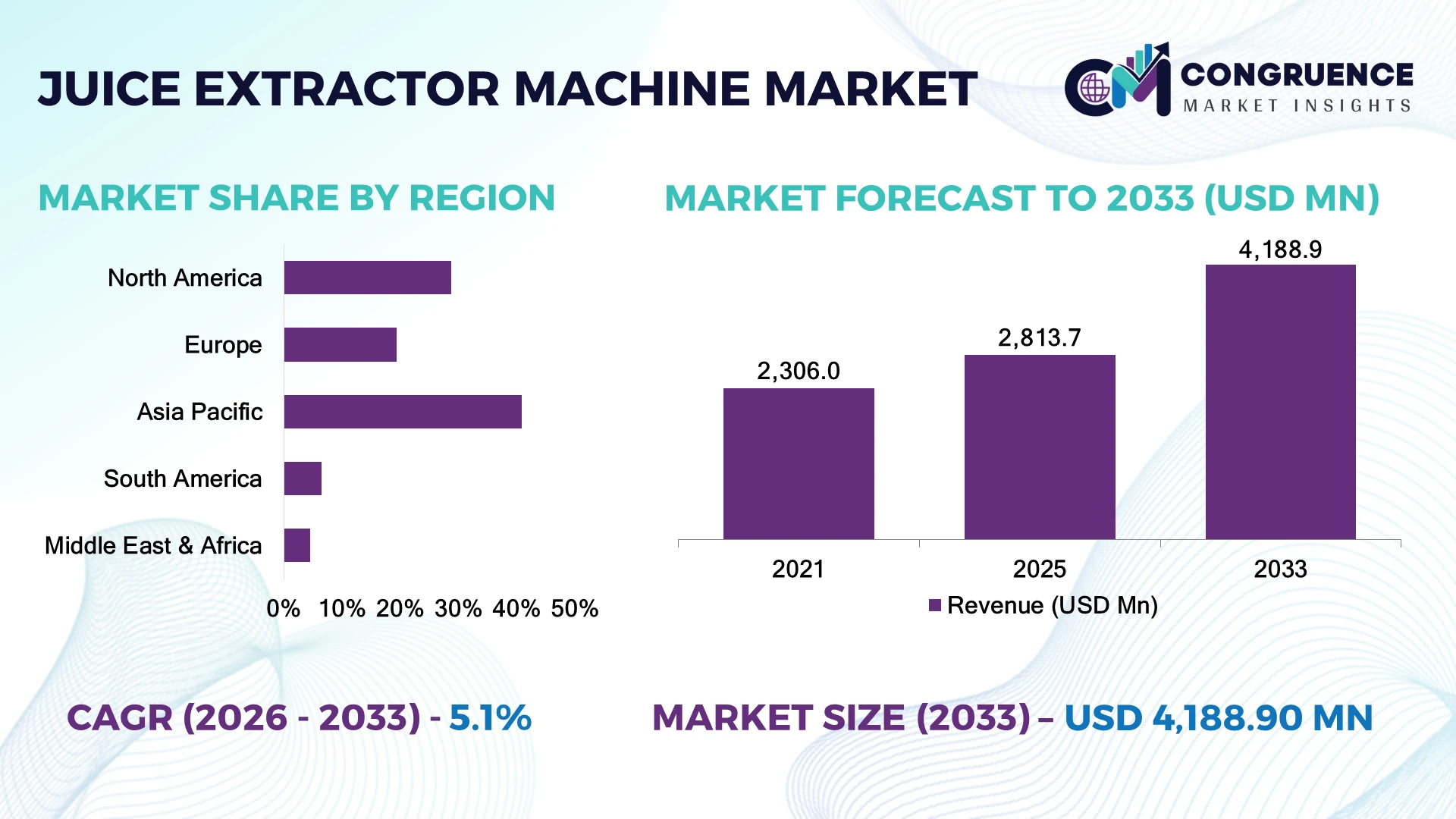
The Global Juice Extractor Machine Market was valued at USD 2,813.7 Million in 2025 and is anticipated to reach a value of USD 4,188.9 Million by 2033 expanding at a CAGR of 5.1% between 2026 and 2033. Growth is being driven by commercial juice bars, quick-service restaurants, hotels, and functional-beverage producers upgrading from manual preparation toward automated cold-press, centrifugal, and high-yield extraction equipment.
China represents approximately 26–29% of global Juice Extractor Machine demand, supported by large-scale appliance manufacturing, extensive food-service equipment production, and rapid deployment of automated beverage preparation systems. The U.S. accounts for roughly 21–24%, with stronger premium adoption across health-focused retail, cafés, and commercial kitchens. China's manufacturing base provides approximately 15–20% lower equipment costs than comparable Western-built systems, while U.S. operators increasingly prioritize low-noise, cold-press, and programmable equipment. Supply-chain diversification following Red Sea logistics disruptions is also encouraging distributors to maintain alternative sourcing channels.
Manufacturers that combine extraction yield, automation, energy efficiency, and dependable after-sales service will capture the strongest commercial equipment opportunities.
Market Size & Growth: USD 2,813.7 million in 2025 rising to USD 4,188.9 million by 2033 at 5.1% CAGR, supported by automated commercial beverage preparation.
Top Growth Drivers: Commercial food service 8–10%, cold-pressed beverages 7–9%, and functional juice formats 6–8% are strengthening equipment demand.
Short-Term Forecast: By 2028, automated cleaning adoption is expected to improve operator productivity by 15–20% and reduce preparation labor by 10–15%.
Emerging Technologies: AI-assisted controls, variable-speed motors, cold-press systems, and automated pulp separation are improving extraction consistency by 8–15%.
Regional Leaders: Asia-Pacific approaches USD 1.75 billion by 2033, North America USD 1.05 billion, and Europe USD 0.82 billion, with automation adoption accelerating across commercial kitchens.
Consumer/End-User Trends: Commercial juice bars, cafés, hotels, and QSRs increasingly prioritize equipment delivering 20–30% faster preparation and consistent portion output.
Pilot/Case Example: 2026 commercial deployments combining automated feeding and pulp separation target 10–15% lower processing labor while maintaining standardized extraction quality.
Competitive Landscape: Leading suppliers including Kuvings, Hurom, Breville, Omega, and Zumex compete through premium design, extraction performance, automation, durability, and service coverage.
Regulatory & ESG Impact: Energy-efficient motors and reduced food waste can lower equipment electricity consumption by approximately 10–20%, strengthening sustainability positioning in commercial kitchens.
Investment & Funding: Manufacturers are directing approximately 3–5% of product-development budgets toward motor efficiency, automation, controls, and connected equipment capabilities.
Innovation & Future Outlook: Next-generation machines are shifting toward modular extraction, IoT diagnostics, predictive maintenance, and closed-loop pulp utilization, strengthening lifecycle economics through 2026–2028.
The Juice Extractor Machine Market is expanding across juice bars, cafés, hotels, QSRs, supermarkets, and functional-beverage production, with cold-press and low-oxidation systems gaining premium positioning. Automated cleaning, variable-speed extraction, compact commercial designs, and smart controls are key product innovations. Commercial automation adoption is approaching 40% in advanced food-service applications, while component sourcing is diversifying across Asia to reduce logistics exposure, supporting the shift toward higher-efficiency equipment.
The Juice Extractor Machine Market is becoming strategically important as beverage operators move from labor-intensive preparation toward standardized, high-throughput extraction. Commercial kitchens and beverage chains increasingly require predictable output, faster cleaning, lower downtime, and consistent juice quality across multiple locations. This is shifting purchasing decisions from equipment price alone toward total operating cost, extraction yield, serviceability, and automation capability.
Technology differentiation is becoming measurable. Variable-speed and cold-press systems can deliver approximately 8–15% higher usable extraction efficiency than basic centrifugal equipment for suitable fruit and vegetable applications, while automated cleaning can reduce post-operation labor by 10–20%. North America and Western Europe emphasize premium extraction quality, noise reduction, and connected controls, whereas Asia-Pacific combines higher manufacturing scale with stronger price competitiveness and rapid commercial deployment.
Over the next 2–3 years, multi-location juice chains, hotels, supermarkets, and QSR operators will increasingly standardize equipment platforms across outlets. A practical deployment strategy is to pair automated extraction with centralized maintenance, spare-parts inventory, and operator training. Manufacturers that establish regional service partnerships and modular product architectures will reduce downtime while expanding account penetration. Competitive advantage will increasingly depend on delivering reliable extraction performance with lower labor intensity, energy consumption, and lifecycle cost.
Commercial beverage operators are replacing labor-intensive extraction with automated centrifugal, cold-press, and self-feeding systems, particularly across U.S. juice chains, cafés, hotels, and QSR kitchens. Automated equipment can increase preparation throughput by 15–25%, reduce operator intervention by 20–30%, and improve portion consistency by 8–12%. Labor shortages and higher wage costs are accelerating this transition, while compact machines allow smaller outlets to automate without major kitchen redesign. Manufacturers are responding with variable-speed motors, automated pulp separation, and programmable cleaning cycles. A non-obvious shift is the growing preference for machines that standardize output across multiple outlets, allowing beverage chains to centralize recipes and reduce operator-dependent quality variation.
Juice extractor manufacturers remain exposed to fluctuations in stainless steel, copper, electronic controls, motors, and food-grade polymer costs, with component inputs potentially accounting for 35–50% of equipment manufacturing cost. Imported electronic components can add 8–15% to procurement costs when logistics or currency conditions deteriorate. China-based manufacturers retain cost advantages, but dependence on concentrated component ecosystems increases disruption exposure. Companies are responding through dual sourcing, localized motor and control-board procurement, longer supplier contracts, and modular product architectures. The key operational pressure is that premium machines require tighter food-contact certification and durability standards, increasing engineering and validation costs by approximately 5–10%. Manufacturers that control component sourcing can protect margins more effectively than brands relying on fragmented import networks.
Connected extraction platforms are creating new opportunities beyond conventional appliance sales, particularly for multi-outlet beverage operators and commercial kitchens. IoT-enabled monitoring can reduce unplanned equipment downtime by 15–25%, while predictive maintenance can extend service intervals by approximately 10–20%. AI-assisted speed and pressure control can improve extraction consistency by 8–12% across variable fruit hardness and feedstock conditions. Japanese and South Korean equipment developers are well positioned to integrate compact automation with sensor-based controls, while U.S. beverage chains offer attractive deployment environments. Manufacturers are increasingly developing subscription-linked diagnostics, remote servicing, modular upgrades, and equipment-as-a-service models. The strongest opportunity lies in converting extractor machines from standalone hardware into digitally monitored production assets with measurable lifecycle-performance data.
Variable fruit hardness, fiber content, temperature, particle size, and pulp characteristics create persistent challenges for standardized extraction performance. Differences in raw material can alter usable yield by 5–15%, while inconsistent feeding can increase cycle times by 10–20%. This becomes more complex for operators sourcing seasonal produce from multiple suppliers or countries. Advanced machines require sensor calibration, recipe libraries, and operator training to maintain consistent output. Companies are responding with adaptive motor controls, programmable extraction profiles, interchangeable augers, and automated feed regulation. The longer-term challenge is integrating these systems without making equipment excessively complex or expensive to service. Manufacturers that simplify calibration and provide application-specific operating profiles will improve deployment consistency and reduce workforce dependency.
Automation Moves Into Compact Formats: Compact commercial extractors are increasingly incorporating automated feeding, pulp separation, and cleaning, reducing operator intervention by 20–30% and improving throughput by 15–25%. U.S. cafés and smaller QSR formats are adopting smaller-footprint systems to automate beverage preparation without expanding kitchen space. Manufacturers are responding with modular components and programmable operating cycles.
Cold-Press Systems Gain Premium Use: Cold-press extraction is expanding among functional-beverage producers and premium juice retailers, where slower processing is offset by positioning around freshness and controlled oxidation. Commercial adoption is increasing roughly 8–12%, while variable-speed controls can improve extraction consistency by 8–15%. Manufacturers are pairing low-speed augers with improved filtration and easier-cleaning assemblies.
Serviceability Becomes Purchase Criterion: Commercial buyers are increasingly evaluating downtime, spare-parts availability, and cleaning labor alongside extraction performance. Automated cleaning can reduce post-use labor by 10–20%, while modular components can shorten service intervention by 15–25%. Equipment manufacturers are therefore expanding regional service partnerships and designing replaceable motor, pump, and control modules.
Supply Chains Shift Toward Dual Sourcing: Red Sea shipping disruptions and electronics-component volatility are encouraging manufacturers to diversify motors, controllers, sensors, and food-contact components across multiple suppliers. Dual sourcing can reduce single-supplier exposure by approximately 30–40%, while localized assembly can shorten replenishment cycles by 15–20%. Chinese manufacturers are strengthening domestic component integration, while Western brands are increasing regional inventory buffers.
Centrifugal juice extractors account for approximately 42–46% of the global market, supported by high throughput, relatively low equipment cost, compact footprints, and rapid preparation suited to cafés, restaurants, and high-volume beverage counters. Masticating or cold-press machines represent around 30–34%, benefiting from premium juice positioning, higher perceived product quality, and growing demand for low-oxidation extraction. Triturating and other specialized systems account for roughly 20–26%, serving niche commercial and professional applications where extraction control is prioritized over speed. Manufacturers continue improving centrifugal models through variable-speed motors and automated pulp ejection, while premium brands are expanding cold-press portfolios.
Masticating systems represent the fastest-evolving type, with adoption expanding approximately 8–11% across premium commercial and health-oriented beverage outlets as operators seek differentiated products. Cold-press equipment also supports higher menu pricing and controlled recipe standardization, encouraging investment in modular augers and automated cleaning. Centrifugal remains the volume-oriented choice, while specialized systems gain relevance in high-value applications. Companies are therefore segmenting portfolios between throughput-focused machines and premium extraction platforms rather than pursuing a single technology architecture.
The National Restaurant Association reported in 2025 that 69% of restaurant operators using additional technology said it improved efficiency and productivity, supporting continued equipment automation across commercial foodservice.
Commercial juice preparation represents approximately 48–52% of Juice Extractor Machine demand, covering juice bars, cafés, restaurants, hotels, supermarkets, and quick-service beverage counters. Its dominance reflects repeated daily equipment utilization, throughput requirements, and the need for consistent output across multiple operating shifts. Household applications account for approximately 32–36%, supported by compact appliances and home wellness consumption, while industrial and institutional applications contribute around 12–16%. Commercial operators increasingly favor machines that combine extraction, pulp separation, programmable controls, and simplified cleaning because these features directly influence labor utilization and service speed.
Industrial beverage processing is the fastest-growing application category, expanding approximately 8–11% as producers automate preparation stages and integrate extraction with filtration, blending, and filling systems. Larger processors increasingly require hygienic designs, continuous-feed architecture, and remote equipment monitoring, while smaller foodservice operators prioritize compact machines with rapid cleaning cycles. Companies are responding by developing application-specific configurations, increasing commercial distribution partnerships, and adapting equipment for centralized beverage preparation. The competitive implication is clear: application-specific engineering is becoming more valuable than one-size-fits-all appliance design.
The 2025 National Restaurant Association found that 61% of restaurant operators planned investments in equipment or technology to improve front-of-house productivity, while 57% targeted back-of-house productivity, reinforcing commercial automation demand.
Restaurants, cafés, juice bars, hotels, and quick-service operators collectively represent approximately 46–50% of Juice Extractor Machine demand because of high utilization frequency, menu-driven beverage production, and recurring equipment replacement requirements. Household users account for approximately 30–34%, with purchasing decisions centered on compactness, ease of cleaning, noise, and extraction quality. Beverage manufacturers and institutional foodservice operators contribute roughly 16–22%, where higher throughput, sanitation, process integration, and equipment durability influence procurement. Commercial buyers typically prioritize lifecycle cost over purchase price, making service availability and spare-parts support important competitive differentiators.
Beverage manufacturers represent the fastest-growing end-user group, with adoption increasing approximately 8–12% as producers integrate extraction with automated preparation and downstream processing. Multi-location restaurant groups are also shifting toward standardized equipment platforms, allowing consistent recipes and operating procedures across outlets. Manufacturers are responding with leasing options, service contracts, modular components, and customized commercial configurations. In the U.S., labor efficiency is becoming particularly important: 47% of restaurant operators surveyed in 2025 reported focusing on improving staff efficiency because of hiring challenges. This supports demand for equipment that reduces manual preparation without removing operator control.
A 2025 foodservice technology study found that 88% of operators planned to invest in new technology within the following 12 months, strengthening the business case for productivity-oriented commercial equipment.
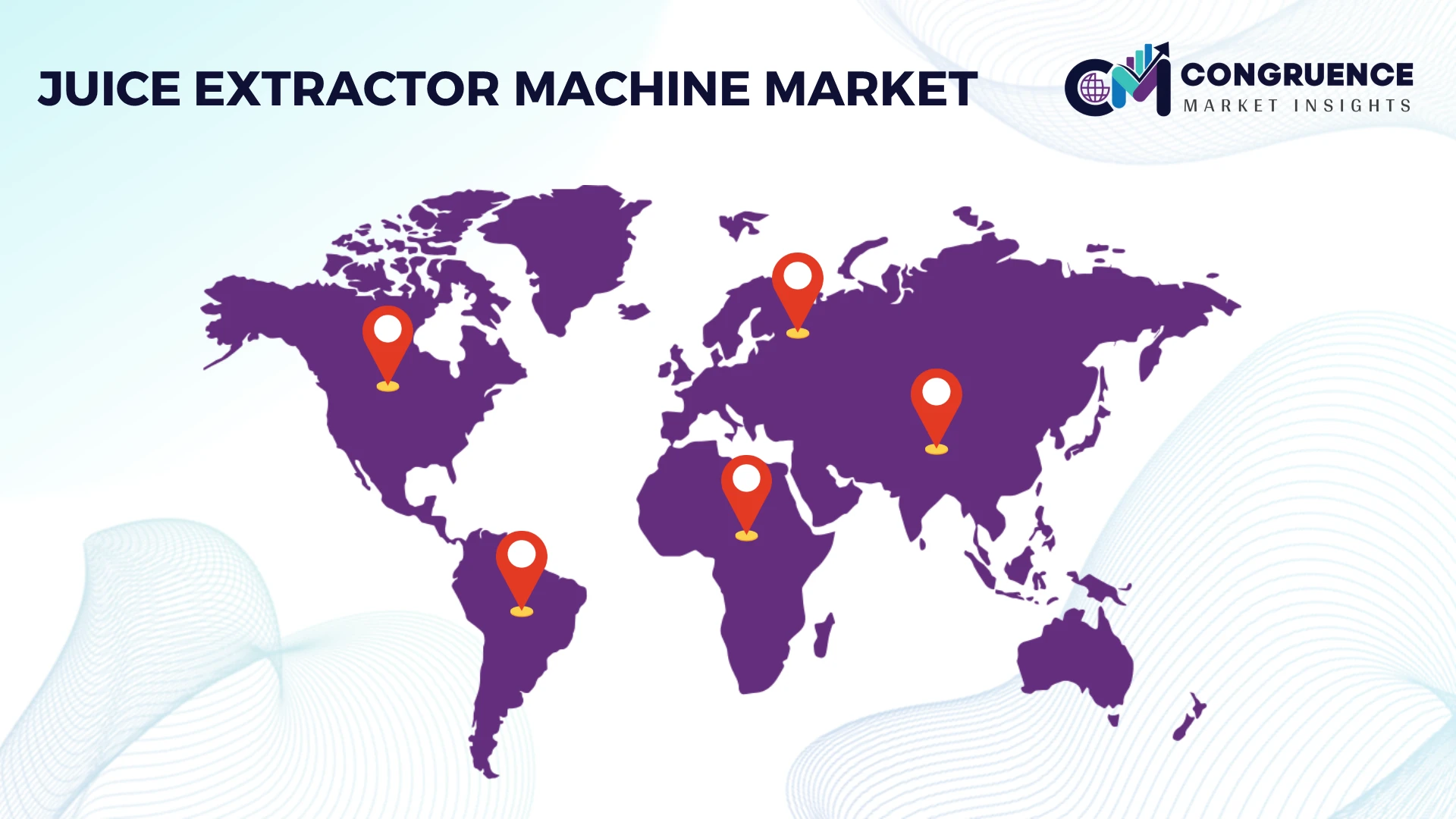
Asia-Pacific accounted for the largest market share at 40.8% in 2025 however, North America is expected to register the fastest growth, expanding at a CAGR of 5.8% between 2026 and 2033.
Commercial automation is shifting purchasing toward high-throughput, serviceable extraction platforms
North America accounts for approximately 28.7% of the global Juice Extractor Machine Market, supported by extensive café networks, juice bars, QSRs, hotels, supermarkets, and premium functional-beverage operators. The U.S. represents more than 80% of regional demand, with commercial operators increasingly prioritizing programmable extraction, automated cleaning, low-noise operation, and compact equipment footprints. Multi-location foodservice groups are standardizing equipment platforms to reduce training requirements and maintain beverage consistency. Commercial machines incorporating automated cleaning can reduce post-use labor by approximately 10–20%, strengthening their value proposition amid persistent foodservice staffing pressure. Manufacturers are responding through expanded distributor networks, service agreements, modular components, and premium cold-press portfolios.
United States Market Outlook: The U.S. remains the principal commercial market because of its large organized foodservice industry and strong premium beverage culture. Juice bars, specialty cafés, hotels, and QSRs increasingly deploy equipment capable of processing multiple beverage recipes with limited operator intervention. Approximately 40–45% of new commercial installations increasingly emphasize programmable controls or automated workflow features, supporting demand for higher-specification extraction platforms.
Premium extraction and energy-conscious equipment are reshaping commercial procurement
Europe represents approximately 19.4% of the global Juice Extractor Machine Market, with Germany, the United Kingdom, France, Italy, and Spain accounting for a substantial share of commercial installations. Buyers increasingly emphasize hygienic construction, energy efficiency, noise reduction, and simplified cleaning as foodservice operators modernize kitchens. Cold-press and slow-extraction systems command stronger premium positioning, while automated cleaning can reduce routine labor requirements by approximately 10–20%. Manufacturers are responding with stainless-steel food-contact assemblies, modular service components, variable-speed motors, and compact professional models suited to urban cafés and hospitality properties.
Germany Market Outlook: Germany provides a strong industrial and foodservice base for advanced extractor deployment, supported by established appliance engineering and professional-kitchen equipment distribution. Commercial buyers increasingly favor durable machines with serviceable components and standardized controls. Premium and professional extraction systems represent an estimated 35–40% of commercial demand, reflecting greater emphasis on equipment longevity, hygiene, and operational consistency.
Manufacturing scale and expanding urban foodservice are accelerating equipment deployment
Asia-Pacific holds the largest regional position at approximately 40.8% of global Juice Extractor Machine demand, supported by China's appliance manufacturing ecosystem, Japan's precision-engineered equipment segment, India's expanding café and juice-bar infrastructure, and Southeast Asia's growing hospitality industry. China alone represents approximately 26–29% of global demand, combining substantial domestic consumption with strong manufacturing and component availability. Manufacturers benefit from integrated motor, electronics, stainless-steel, and plastics supply chains, enabling competitive equipment pricing. Automated feeding, variable-speed controls, and compact commercial formats are gaining adoption as urban operators prioritize throughput and limited-counter-space utilization.
China Market Outlook: China is the region's largest individual market and a major production center for juice extraction equipment. Its integrated appliance supply chain supports competitive manufacturing economics and rapid product iteration. Approximately 45–50% of commercial machines produced for export-oriented applications increasingly incorporate programmable speed or automated pulp-management features, enabling manufacturers to compete across both value-focused and premium international segments.
Brazil's beverage-processing ecosystem is expanding demand for higher-throughput extraction equipment
South America accounts for approximately 6.5% of the global Juice Extractor Machine Market, with Brazil representing more than 60% of regional demand. A large fruit-processing base, extensive domestic beverage consumption, cafés, restaurants, and hospitality operations provide a strong installed-equipment environment. Commercial users increasingly require machines capable of handling tropical fruits, fibrous feedstock, and frequent cleaning cycles. Equipment capable of processing variable produce can improve usable extraction by approximately 5–12% compared with basic configurations. Manufacturers are strengthening local distributor relationships and after-sales coverage while adapting machines for regional fruit profiles and voltage requirements.
Brazil Market Outlook: Brazil's substantial fruit-processing and foodservice ecosystem makes it the region's primary equipment market. Commercial demand spans juice bars, restaurants, hotels, supermarkets, and small beverage processors, with tropical fruit handling an important equipment consideration. Approximately 35–40% of commercial buyers increasingly prioritize machines with higher pulp-handling capacity and easier sanitation, supporting demand for robust augers, wider feed chutes, and removable processing assemblies.
Hospitality investment is creating concentrated demand for durable commercial extraction systems
Middle East & Africa represents approximately 4.6% of the global Juice Extractor Machine Market, with the United Arab Emirates, Saudi Arabia, and South Africa accounting for a significant proportion of commercial demand. Hotel development, premium cafés, restaurants, catering operations, and institutional foodservice are creating concentrated equipment requirements, particularly in Dubai, Abu Dhabi, Riyadh, and Jeddah. Operators prioritize compact machines, rapid cleaning, stainless-steel construction, and continuous-use durability. Premium commercial installations can command 15–25% higher equipment values where automation and service support are bundled. Manufacturers are expanding distributor partnerships and localized service networks to support hospitality-focused deployments.
United Arab Emirates Market Outlook: The UAE is the region's most concentrated premium foodservice equipment market, supported by large hospitality properties, international restaurant chains, airports, and high-volume catering operations. Commercial buyers increasingly seek machines capable of repeated daily operation with minimal downtime. Approximately 30–35% of premium hospitality installations increasingly specify automated cleaning, programmable extraction, or integrated workflow features, strengthening demand for technologically differentiated equipment.
Philips, Breville, Hurom, Panasonic, and Omega compete as appliance brands, while Kuvings and regional manufacturers challenge them through premium slow-press specialization and cost-focused distribution. The top five players collectively hold about 36% of juicer revenue, indicating concentrated leadership without full market control.
Competition centers on price and extraction performance, with roughly 40% of demand tied to centrifugal formats while premium slow-juicing shifts value toward yield, pulp control, noise reduction, and cleaning convenience. Supply-chain reach and retail availability remain decisive. Players are expanding internationally, adding hands-free models, strengthening demonstrations, and combining product innovation with localized distribution. The competitive shift is toward automated feeding, easier cleaning, and premium specialization. Entry barriers include motor engineering, food-contact compliance, patents, retail relationships, and after-sales service. Winning requires differentiated extraction technology, reliable supply, and strong channel execution.
Breville Group Limited
Koninklijke Philips N.V.
Hurom America Inc.
Panasonic Holdings Corporation
Omega Juicers
Kuvings
Cuisinart Inc.
Hamilton Beach Brands Holding Company
Joyoung Co., Ltd.
Electrolux AB
Newell Brands Inc.
Tribest Corporation
Bajaj Electricals Ltd.
Havells India Ltd.
Centrifugal extraction remains the volume workhorse, representing about 40% of the juicer market in 2025, because high-speed shredding delivers rapid preparation at lower equipment cost. Cold-press and masticating systems are displacing older basic slow juicers by prioritizing yield, pulp control, noise reduction, and ingredient versatility. These systems can improve usability by roughly 1–2% annually through incremental motor, auger, and cleaning refinements rather than a single breakthrough.
Hands-free feeding is becoming the clearest emerging technology signal. Kuvings’ AUTO10 uses a 3,000cc hopper, allowing larger ingredient loads with less manual intervention. Compared with conventional feed-and-stop workflows, automated feeding can cut operator handling time by an estimated 10–20% in batch use, benefiting busy households, cafés, and juice bars. Self-feeding architecture also supports broader whole-fruit processing.
Through 2026–2028, technology competition will shift toward automated feeding, easier cleaning, quieter motors, multi-function strainers, and sensor-assisted controls. The practical competitive advantage will come from reducing preparation and cleanup friction while preserving extraction quality. Premium specialists benefit first, but mass brands can rapidly integrate these features as components become standardized. These gains matter most where labor, throughput, and countertop space affect utilization.
April 2024 Hurom launched the H70 Easy Clean Slow Juicer at 70 RPM, adding a self-feeding hopper and strainer-free chamber. The launch strengthened Hurom’s premium positioning by targeting users seeking batch capacity with substantially simpler cleaning and compact countertop placement. Source: PR Newswire
October 2024 Kuvings showcased the AUTO10 at Canton Fair, featuring a 3,000cc hopper and hands-free feeding. The launch supported channel expansion, with the company using the exhibition to attract buyers across more than 200 countries and accelerate premium juicer distribution. Source: Kuvings
August 2024 KitchenAid announced its Go Cordless Citrus Juicer, powered by the removable 12V Max battery used across its cordless appliance system. The move extended juicing into portable, battery-powered preparation, strengthening ecosystem interoperability and reducing dependence on fixed countertop power. Source: iF Design
April 2026 Hamilton Beach disclosed a strategic partnership with Sunkist to develop and market commercial juicers and sectionizers; its Commercial business represented approximately 10% of 2025 revenue. The partnership expands foodservice reach and reinforces Hamilton Beach’s commercial equipment growth strategy. Source: SEC
The report covers centrifugal, masticating, cold-press, triturating, hand-press, and steam extraction formats across residential, commercial, and industrial applications, with online and offline distribution examined where relevant. Regional coverage spans North America, Europe, Asia Pacific, Latin America, and the Middle East & Africa, with country-level analysis for major demand centers and emerging markets.
Technology coverage evaluates high-speed extraction, slow-squeeze mechanisms, hands-free feeding, automated cleaning, multi-function attachments, noise reduction, and energy-efficiency improvements. The study maps competitive participation, product positioning, channel expansion, pricing dynamics, and adoption patterns, including the approximately 40% 2025 share attributed to centrifugal formats and Asia Pacific’s leading regional position. The analysis supports investment planning, geographic expansion, portfolio decisions, competitive positioning, channel strategy, and technology prioritization through 2026–2033, including niche opportunities in premium wellness, cafés, juice bars, and commercial foodservice.
| Report Attribute/Metric | Report Details |
|---|---|
|
Market Revenue in 2025 |
USD 2,813.7 Million |
|
Market Revenue in 2033 |
USD 4,188.9 Million |
|
CAGR (2026 - 2033) |
5.1% |
|
Base Year |
2025 |
|
Forecast Period |
2026 - 2033 |
|
Historic Period |
2021 - 2025 |
|
Segments Covered |
By Type
By Application
By End-User
|
|
Key Report Deliverable |
Revenue Forecast, Growth Trends, Market Dynamics, Segmental Overview, Regional and Country-wise Analysis, Competition Landscape |
|
Region Covered |
North America, Europe, Asia-Pacific, South America, Middle East, Africa |
|
Key Players Analyzed |
Breville Group Limited, Koninklijke Philips N.V., Hurom America Inc., Panasonic Holdings Corporation, Omega Juicers, Kuvings, Cuisinart Inc., Hamilton Beach Brands Holding Company, Joyoung Co., Ltd., Electrolux AB, Newell Brands Inc., Tribest Corporation, Bajaj Electricals Ltd., Havells India Ltd. |
|
Customization & Pricing |
Available on Request (10% Customization is Free) |




