
Reports
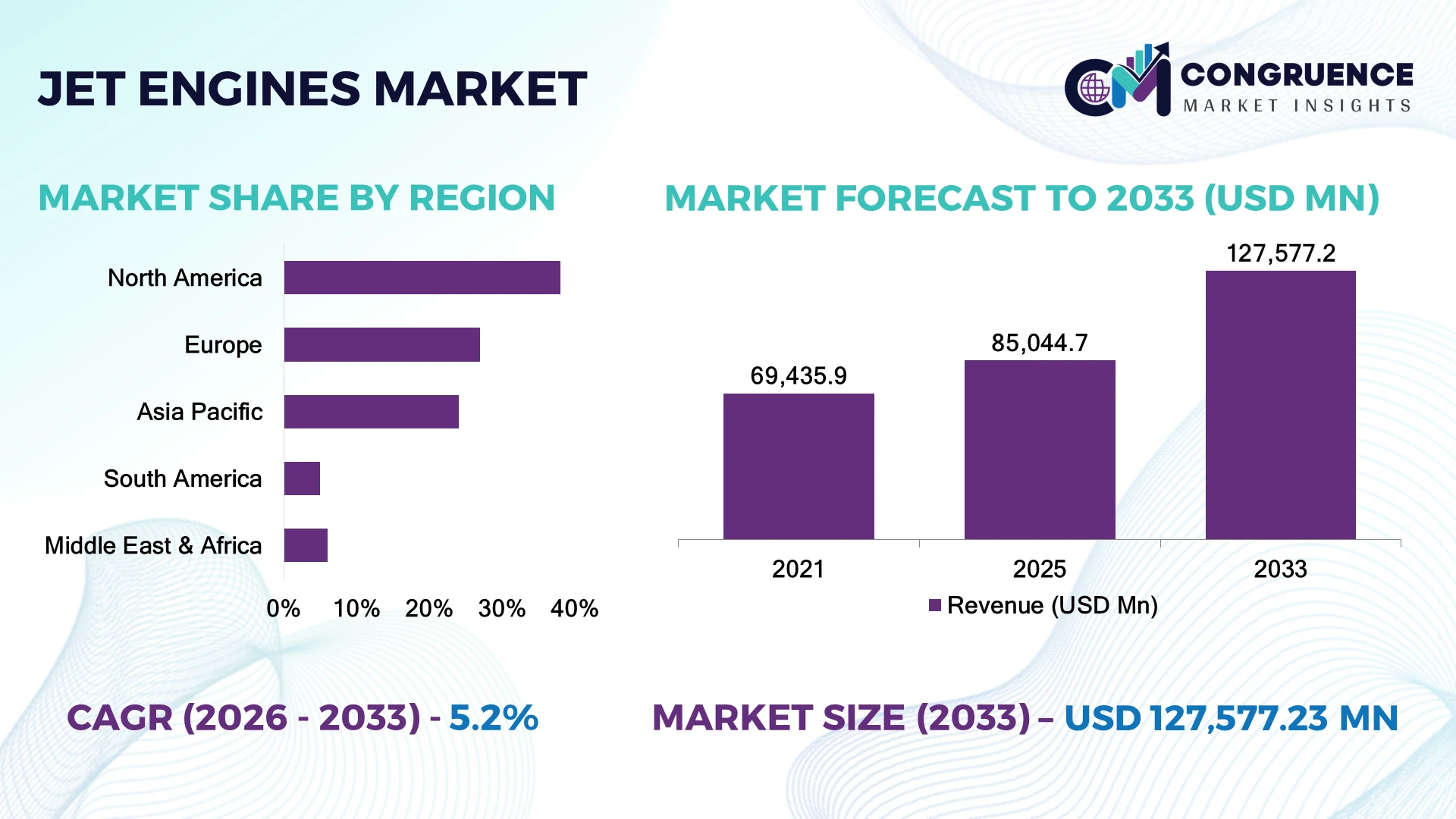
The Global Jet Engines Market was valued at USD 85,044.7 Million in 2025 and is anticipated to reach a value of USD 127,577.2 Million by 2033 expanding at a CAGR of 5.2% between 2026 and 2033. Growth is driven by narrow-body fleet replacement, rising aftermarket engine utilization, defense propulsion programs, and accelerated investment in fuel-efficient turbofans and next-generation propulsion architectures.
The United States remains the dominant country market, representing approximately 36% of commercial jet-engine demand, compared with about 21% for China. GE Aerospace delivered 2,386 commercial engines in 2025, including 1,802 LEAP engines, up 28%. Its 2026 U.S. manufacturing program adds USD 1 billion of investment and 5,000 jobs amid supply-chain restructuring.
Strategically, engine manufacturers should prioritize production capacity, aftermarket MRO, advanced materials, and localized supplier networks as geopolitical and aerospace supply-chain pressures intensify.
Market Size & Growth: USD 85.0 Billion in 2025 to USD 127.6 Billion by 2033 at 5.2% CAGR, driven by fleet renewal and fuel-efficient turbofan adoption.
Top Growth Drivers: Narrow-body fleets 58%; commercial aircraft 69%; aftermarket services 30%.
Short-Term Forecast: By 2028, automated manufacturing and predictive maintenance can improve selected engine-component throughput by 10–15%.
Emerging Technologies: Open-fan architectures, hybrid-electric systems, additive manufacturing, and advanced ceramic-matrix composites are reshaping propulsion.
Regional Leaders: North America approaches USD 55 Billion; Asia-Pacific USD 34 Billion; Europe USD 27 Billion, with Asian airlines accelerating narrow-body fleet modernization.
Consumer/End-User Trends: Commercial aviation represents roughly 69% of market demand, while airlines increasingly prioritize engines offering lower fuel burn and longer time-on-wing.
Pilot/Case Example: GE's 2025 supplier kaizen program increased a LEAP component supplier's output from 47 to more than 470 pieces weekly, a tenfold productivity gain.
Competitive Landscape: CFM International's LEAP holds more than 12,900 orders and commitments, competing with Pratt & Whitney GTF and Rolls-Royce widebody platforms.
Regulatory & ESG Impact: LEAP delivers 15–20% lower fuel consumption than the latest CFM56 generation, strengthening fleet decarbonization economics.
Investment & Funding: GE is committing USD 1 Billion to U.S. manufacturing in 2026, while Pratt & Whitney is investing USD 300 Million across Poland and Georgia capacity projects.
Innovation & Future Outlook: 2026–2028 priorities center on open-fan propulsion, hybrid-electric systems, durable turbine materials, AI-enabled MRO, and vertically integrated supply chains.
The Jet Engines Market is concentrated in narrow-body commercial aircraft, widebody fleets, military propulsion, business aviation, and aftermarket MRO. Narrow-body engines represent about 58% of commercial demand, while next-generation architectures target roughly 20% better fuel efficiency than traditional turbofans. In 2026, aerospace supply-chain localization is accelerating as OEMs expand domestic manufacturing and critical-component capacity.
Jet engines are becoming strategically important because engine availability now directly determines aircraft delivery schedules, airline fleet utilization, and defense readiness. Supply-chain bottlenecks in castings, forgings, turbine components, and specialized materials are pushing OEMs toward vertical integration. GE's 2026 USD 1 billion U.S. manufacturing program and Pratt & Whitney's capacity investments in Poland and Georgia demonstrate a decisive shift toward securing critical production assets.
Technology economics are reinforcing this transition. LEAP engines provide 15–20% lower fuel consumption than the latest CFM56 generation, while CFM's RISE open-fan architecture targets approximately 20% additional fuel-efficiency improvement over conventional turbofans. North America retains manufacturing and MRO scale, whereas Asia-Pacific is driving aircraft fleet expansion and localized aerospace production.
During 2026–2028, engine OEMs will prioritize durable hot-section materials, additive manufacturing, predictive MRO, SAF compatibility, and hybrid-electric demonstrators. GE and Safran are increasing LEAP production, while Pratt & Whitney is expanding GTF maintenance capacity; the latter's network now includes 21 engine centers and approximately 40 component-repair facilities. The strongest competitive position will come from combining engine efficiency, production resilience, aftermarket depth, and proprietary propulsion technology.
Commercial fleet replacement is strengthening demand for next-generation turbofans as airlines prioritize lower fuel burn and longer maintenance intervals. Narrow-body aircraft account for roughly 58% of commercial engine demand, while advanced engines deliver 15–20% better fuel efficiency than preceding generations. India and China are expanding narrow-body fleets rapidly, while U.S. carriers are increasing utilization of newer engines. GE Aerospace and CFM International are expanding LEAP production and supplier capacity to address delivery backlogs. The structural shift is toward higher-thrust-density engines with longer time-on-wing, making engine reliability a direct airline profitability lever. Manufacturers are therefore investing in automated production, casting capacity, advanced materials, and localized supplier qualification to increase output without compromising certification standards.
Engine manufacturing remains constrained by specialized castings, forgings, turbine components, and aerospace-grade materials, with selected suppliers operating at utilization levels above 90%. Component shortages can extend aircraft delivery schedules by 5–10%, while engine maintenance backlogs increase aircraft downtime and pressure airline fleet availability. Pratt & Whitney's GTF issues have intensified attention on powder-metal component inspections and replacement programs, exposing the cost of tightly coupled global supply chains. U.S. and European manufacturers are responding through dual sourcing, domestic capacity expansion, long-term supplier agreements, and vertical integration. The non-obvious constraint is not engine assembly capacity alone: certification-qualified component capacity is the harder bottleneck, meaning additional final-assembly lines deliver limited value unless upstream aerospace suppliers scale simultaneously.
Next-generation open-fan propulsion creates a significant opportunity as manufacturers target approximately 20% lower fuel consumption than today's most efficient conventional turbofans. Hybrid-electric architectures can additionally reduce selected aircraft propulsion energy requirements by 5–10% when combined with optimized thermal management and electric power distribution. CFM's RISE program is positioning open-fan technology for future single-aisle aircraft, while European aerospace investment is accelerating demonstrator development. Companies are increasing R&D spending on composite fan blades, geared architectures, ceramic-matrix components, and high-temperature materials. The non-obvious opportunity lies in aftermarket transformation: new propulsion architectures will require redesigned maintenance tooling, digital diagnostics, and technician certification, creating a parallel high-value services market alongside future engine deliveries.
Commercial engine development requires extensive certification, durability validation, and supply-chain qualification, making technology transitions substantially slower than software-led aerospace systems. Advanced propulsion programs can involve thousands of validated components, while additive manufacturing and ceramic-matrix components require qualification across multiple production sites. Digital engine-monitoring systems are also expanding cybersecurity exposure as aircraft increasingly connect propulsion data with airline maintenance platforms. Manufacturers are responding through digital twins, automated inspection, model-based certification, and supplier-standardization programs. The strategic challenge is scaling disruptive propulsion without fragmenting the certified production ecosystem. Companies that shorten validation cycles by even 10–15% can gain meaningful program advantages, but only if quality controls, workforce training, and component traceability remain consistent across global manufacturing networks.
LEAP Production Capacity Expands: CFM International is increasing LEAP production as its order backlog exceeds 12,000 engines. Output expansion is targeting roughly 20% higher production capability over earlier levels, while suppliers are adding machining, casting, and assembly capacity. The shift is reducing delivery pressure while strengthening localized aerospace manufacturing.
GTF Maintenance Networks Scale: Pratt & Whitney is expanding GTF MRO capacity as inspections and accelerated removals affect aircraft availability. Its network now spans more than 20 engine centers and roughly 40 component-repair facilities. Airlines are increasingly prioritizing guaranteed shop-visit slots, spare-engine pools, and predictive maintenance contracts to protect fleet utilization.
Digital Engine Diagnostics Deepen: Engine-health monitoring is moving toward predictive analytics, with connected systems targeting 10–15% reductions in unscheduled maintenance events. Airlines and OEMs are integrating vibration, temperature, pressure, and flight-cycle data into maintenance platforms. The non-obvious shift is monetizing engine data through long-term service agreements rather than relying exclusively on spare-parts sales.
Supply Chains Localize Faster: U.S. aerospace manufacturers are increasing domestic production of forgings, castings, and precision components as geopolitical tensions expose dependence on concentrated suppliers. Selected localization programs target 10–20% shorter component lead times. OEMs are simultaneously qualifying second sources, expanding inventory buffers, and investing in automated inspection to improve production continuity without weakening certification controls.
Turbofan engines dominate the Jet Engines Market with approximately 78% share, supported by superior fuel efficiency, thrust-to-weight performance, and compatibility with commercial narrow-body and widebody aircraft. Turbojet engines retain a smaller niche of about 6%, primarily in specialized military and high-speed applications, while turboprops account for roughly 10% and remain important for regional aviation. Demand remains concentrated around established narrow-body platforms, where fuel consumption, reliability, and operating economics strongly influence engine selection.
The fastest-growing shift is toward advanced turbofans incorporating geared architectures, ceramic-matrix components, and open-fan technologies. These systems target 15–20% lower fuel consumption versus previous generations, while hybrid-electric propulsion is progressing toward commercial demonstrators. Companies are prioritizing LEAP, GTF, and next-generation propulsion capacity, with GE Aerospace increasing material input from priority suppliers by more than 40% in 2025 and expanding manufacturing investment. Investment is consequently shifting toward advanced materials, high-throughput component production, and propulsion architectures capable of delivering lower lifecycle costs.
IATA reported that Airbus A321 flights increased 61.6% from 2019 to 2025, while A220 flights increased 770.4%, reinforcing the commercial shift toward newer, efficient narrow-body aircraft and associated turbofan demand.
Commercial aviation represents the leading application at approximately 69% of global jet-engine demand, reflecting the large installed passenger-aircraft base and recurring replacement requirements. Military aviation follows at roughly 23%, supported by fighter, trainer, transport, and unmanned-aircraft propulsion programs, while business and general aviation account for approximately 8%. Commercial operators prioritize fuel burn, dispatch reliability, and time-on-wing, whereas defense customers emphasize thrust, survivability, thermal performance, and mission flexibility.
Military propulsion is the fastest-changing application, particularly in the United States, where adaptive-cycle engines and autonomous combat-aircraft programs are accelerating technology development. Advanced defense propulsion programs target substantial improvements in power density and thermal management, while digital engineering can shorten selected development workflows by 10–15%. GE Aerospace is advancing adaptive-cycle propulsion for next-generation combat aircraft, while commercial manufacturers continue scaling LEAP and GTF production. Companies are therefore balancing high-volume commercial engine programs with higher-margin defense research, specialized propulsion development, and digitally enabled maintenance services.
GE Aerospace reported that commercial engine deliveries increased 25% in 2025, while defense engine deliveries increased 30%, demonstrating simultaneous strengthening across commercial and military propulsion programs.
Airlines represent the dominant end-user group at approximately 62% of global jet-engine demand because commercial fleets require large volumes of new engines, spare units, maintenance, and replacement modules. Aircraft manufacturers account for approximately 24%, purchasing engines for new-build platforms, while defense organizations and military operators represent about 14%. Airlines increasingly evaluate engines through total cost of ownership, fuel efficiency, maintenance intervals, and guaranteed availability rather than acquisition price alone, strengthening demand for long-term service agreements and predictive MRO.
Defense organizations are the fastest-changing end-user group as governments increase investment in adaptive-cycle propulsion, autonomous aircraft, and next-generation combat platforms. Defense engine deliveries increased 30% at GE Aerospace in 2025, compared with 25% growth in commercial engine deliveries. Manufacturers are responding through dedicated defense technology programs, airline MRO partnerships, predictive maintenance systems, and lifecycle contracts. Aircraft manufacturers remain strategically important because new platform launches determine future installed-engine populations. Investment is consequently shifting toward localized production, specialized defense capabilities, and integrated aftermarket ecosystems that strengthen customer retention and recurring revenue.
GE Aerospace's Pune facility has trained more than 5,000 production associates and manufactures components for GEnx, GE9X, and LEAP engines, illustrating the expansion of localized aerospace manufacturing ecosystems in India.
North America accounted for the largest market share at 38.0% in 2025 however, Asia-Pacific is expected to register the fastest growth, expanding at a CAGR of 7.1% between 2026 and 2033.

U.S. manufacturing investment is reinforcing propulsion capacity and supply-chain resilience
North America represents approximately 38% of the global Jet Engines Market, supported by the United States' concentration of commercial engine OEMs, defense propulsion programs, aerospace suppliers, and MRO infrastructure. The region remains particularly strong in narrow-body turbofan production and high-value defense engines, while airlines are increasing demand for fuel-efficient replacement platforms. GE Aerospace plans another USD 1 billion investment across U.S. manufacturing sites and suppliers during 2026, covering more than 30 communities across 17 states and supporting an additional 5,000 hires. Nearly USD 200 million is directed toward durability-kit production, while more than USD 275 million supports defense-engine facilities. This investment strengthens domestic component availability and accelerates engine-delivery capacity.
United States Market Outlook: The United States maintains the region's strongest propulsion ecosystem, combining GE Aerospace, Pratt & Whitney, Boeing, major airlines, defense agencies, and extensive MRO networks. Its technological advantage spans adaptive-cycle engines, advanced turbine materials, additive manufacturing, and digital maintenance. Continued investment in domestic castings, forgings, and high-pressure turbine components is reducing exposure to internationally constrained aerospace supply chains.
Advanced propulsion and sovereign aerospace capability are driving industrial modernization
Europe contributes approximately 27% of global jet-engine demand, anchored by the United Kingdom, France, Germany, and major Airbus production networks. The region's priorities increasingly combine fuel efficiency, aftermarket reliability, defense sovereignty, and lower-carbon propulsion. Rolls-Royce is expanding advanced manufacturing and digital service capabilities, while Safran is scaling LEAP production and MRO infrastructure. Rolls-Royce's Rotherham advanced blade-casting investment totals £21.3 million and is expected to double facility output by 2030. Europe's aerospace ecosystem is consequently shifting investment toward turbine components, additive manufacturing, composite systems, and longer time-on-wing.
United Kingdom Market Outlook: The United Kingdom remains strategically important because Rolls-Royce provides a concentrated base for civil and defense propulsion engineering. Its active Trent fleet has grown to nearly 6,000 engines, while continued investment in turbine manufacturing, additive production, and next-generation propulsion strengthens domestic technology depth. The country's participation in GCAP also creates long-term demand for advanced combat-aircraft engine development.
Fleet expansion and localized propulsion ecosystems are accelerating demand
Asia-Pacific represents approximately 24% of global jet-engine demand and is the fastest-expanding regional market, supported by rapid airline fleet growth, rising aircraft utilization, expanding MRO networks, and government-backed aerospace manufacturing. China and India are central demand centers, while Japan, Singapore, and South Korea provide specialized production and maintenance capabilities. Safran inaugurated its largest LEAP MRO facility in Hyderabad, with eventual capacity for 300 engines annually, strengthening India's role in the global aftermarket network. Regional investment is increasingly moving beyond aircraft assembly toward engine components, maintenance, repair, overhaul, and localized engineering.
India Market Outlook: India is emerging as a strategically important engine ecosystem through expanding MRO capacity, aerospace component manufacturing, and indigenous defense propulsion ambitions. Rolls-Royce and Reliance Industries announced plans in 2026 to explore an Indian aerospace gas-turbine complex for the AMCA combat-aircraft program. Safran's Hyderabad facility, designed for 300-engine annual maintenance capacity, further strengthens India's position as a regional engine-services hub.
Regional fleet renewal is strengthening demand around Brazil's aerospace ecosystem
South America accounts for approximately 5% of global jet-engine demand, with Brazil representing the principal industrial and commercial center. Demand is supported by regional aviation, fleet modernization, business aviation, and Embraer's expanding commercial-aircraft production. Engine requirements increasingly favor efficient turbofans suited to regional and short-haul operations, although financing constraints and uneven airport infrastructure limit replacement velocity in smaller markets. Embraer delivered 109 aircraft during the first half of 2026, approximately 20% above the corresponding 2025 period, strengthening the downstream requirement for propulsion systems and aftermarket support. Suppliers are responding through localized maintenance partnerships and regional service coverage.
Brazil Market Outlook: Brazil holds the strongest aerospace manufacturing position in South America through Embraer's commercial, executive, and defense aircraft programs. Its E195-E2 platform supports recurring demand for modern turbofan engines, while the company's 2026 order backlog reached USD 34.5 billion, including more than USD 15 billion in commercial aviation. This industrial base creates opportunities for engine suppliers across production, maintenance, components, and lifecycle services.
Fleet modernization and aviation-hub investment are expanding engine-service requirements
The Middle East & Africa region represents approximately 6% of global jet-engine demand, with Gulf carriers, expanding airport hubs, defense procurement, and MRO investments supporting demand. Saudi Arabia and the United Arab Emirates are particularly important because large widebody fleets require high-value engine maintenance and replacement capacity. The region is also moving toward localized aerospace services as airlines seek shorter maintenance turnaround times and greater control over fleet availability. Engine manufacturers are responding through MRO partnerships, service centers, training programs, and long-term maintenance agreements. Rising defense-aircraft procurement adds another demand layer, particularly for high-thrust propulsion and specialized military engine support.
Saudi Arabia Market Outlook: Saudi Arabia is strategically positioned because its aviation transformation is combining airline fleet expansion, airport infrastructure development, defense modernization, and localized MRO capabilities. The country's expanding aviation ecosystem is increasing demand for engine maintenance, component repair, technical training, and lifecycle-support contracts. This creates opportunities for global OEMs to establish local partnerships while supporting the Kingdom's broader aerospace industrialization objectives.
GE Aerospace, Safran/CFM International, Pratt & Whitney, and Rolls-Royce compete as propulsion leaders, while regional engine suppliers and component manufacturers compete for programs and aftermarket work. The top five players hold an estimated 70% combined share, reflecting high concentration around certified platforms, installed fleets, and service networks. Competition centers on fuel efficiency, reliability, component availability, and lifecycle economics; next-generation engines target 15–20% lower fuel consumption, while durability programs can improve time-on-wing 30–100%. GE is vertically integrating critical castings, Safran is scaling LEAP output, Pratt & Whitney is expanding forging and MRO capacity, and Rolls-Royce is upgrading Trent durability. Partnerships with airlines, aircraft OEMs, MRO providers, and suppliers reinforce installed-base advantages. The competitive shift is moving toward supply-chain control and aftermarket performance rather than engine price. Certification, capital intensity, proprietary technology, and long qualification cycles restrict entry. Winners will combine scalable production, differentiated propulsion technology, resilient sourcing, and superior lifecycle support.
GE Aerospace
RTX Corporation
Safran S.A.
Rolls-Royce Holdings plc
MTU Aero Engines AG
IHI Corporation
Kawasaki Heavy Industries Ltd.
Mitsubishi Heavy Industries Ltd.
Hanwha Aerospace
AECC Aero Engine Corporation of China
Hindustan Aeronautics Limited
Aero Engine Corporation of China
Williams International
Honeywell Aerospace
Jet-engine technology is shifting from conventional turbofans toward geared architectures, ceramic-matrix composites, additive manufacturing, digital twins, and open-fan propulsion. LEAP engines deliver 15–20% lower fuel consumption than latest CFM56 models, while additive manufacturing can reduce selected component lead times by more than 30%. Digital engine monitoring is increasingly integrated with predictive MRO, targeting 10–15% fewer unscheduled maintenance events.
Emerging propulsion combines higher-temperature materials, advanced cooling, hybrid-electric subsystems, and open-fan architectures. CFM’s RISE program targets about 20% better fuel efficiency than traditional turbofans, creating a major competitive advantage for CFM International and Safran. Rolls-Royce durability upgrades can deliver up to triple Trent 1000 time-on-wing, while nearly 50% of the TEN fleet has received improved HPT blades. These technologies shift value toward lifecycle performance rather than initial engine price.
During 2026–2028, adoption will accelerate across new aircraft programs, aftermarket analytics, manufacturing automation, and fleet retrofits across major airline fleets. AI-assisted diagnostics, automated inspection, and digital production controls can improve maintenance productivity 10–15% and shorten selected manufacturing cycles 5–10%. GE Aerospace’s FLIGHT DECK integration with manufacturing assets and Pratt & Whitney’s expanded forging capabilities illustrate the competitive shift. Companies acting now can secure certified capacity, reduce maintenance exposure, and strengthen proprietary technology positions.
September 2026 GE Aerospace agreed to acquire Consolidated Precision Products for $11.75 billion, expanding mission-critical casting capacity. CPP supplies castings across major commercial aircraft programs. The transaction significantly strengthens vertical integration, component availability, production readiness, and next-generation engine development globally. Source: GE Aerospace
February 2026 Safran reported 1,802 LEAP engine deliveries in 2025, up 28% year-on-year. Record output confirms industrial ramp-up while expanding the installed fleet, aftermarket workload, and supplier requirements, reinforcing CFM International’s position in high-volume narrow-body propulsion programs worldwide and suppliers. Source: Safran
July 2026 Rolls-Royce reported that almost 50% of the Trent 1000 TEN fleet had received improved high-pressure turbine blades. Phase 1 delivers 100% higher time-on-wing, strengthening reliability, maintenance economics, and customer retention across widebody fleets and routes globally at scale. Source: Rolls-Royce
April 2026 Pratt & Whitney announced a $100 million Rzeszów expansion for isothermal-forging capabilities, alongside a $200 million Columbus investment. The projects strengthen production capacity for GTF, F135, and F100 engines and reduce pressure on constrained critical-component supply networks worldwide. Source: prattwhitney.com
The Jet Engines Market Report covers turbofan, turbojet, turboprop, and other propulsion architectures across commercial aviation, military aviation, business aviation, and general aviation. It evaluates airlines, aircraft manufacturers, defense organizations, and other major end-users across North America, Europe, Asia-Pacific, South America, and the Middle East & Africa. The analysis distinguishes mature high-volume turbofan platforms from emerging propulsion systems and specialized applications.
Coverage includes engine production, aftermarket MRO, advanced materials, additive manufacturing, predictive diagnostics, digital twins, geared architectures, open-fan propulsion, and hybrid-electric development. Commercial aviation represents about 69% of application demand, while airlines account for roughly 62% of end-user demand. The report supports investment planning, manufacturing expansion, supplier strategy, technology prioritization, MRO positioning, competitive benchmarking, and market-entry decisions, while identifying demand shifts and strategic opportunities shaping propulsion markets through 2033.
| Report Attribute/Metric | Report Details |
|---|---|
|
Market Revenue in 2025 |
USD 85,044.7 Million |
|
Market Revenue in 2033 |
USD 127,577.2 Million |
|
CAGR (2026 - 2033) |
5.2% |
|
Base Year |
2025 |
|
Forecast Period |
2026 - 2033 |
|
Historic Period |
2021 - 2025 |
|
Segments Covered |
By Type
By Application
By End-User
|
|
Key Report Deliverable |
Revenue Forecast, Growth Trends, Market Dynamics, Segmental Overview, Regional and Country-wise Analysis, Competition Landscape |
|
Region Covered |
North America, Europe, Asia-Pacific, South America, Middle East, Africa |
|
Key Players Analyzed |
GE Aerospace, RTX Corporation, Safran S.A., Rolls-Royce Holdings plc, MTU Aero Engines AG, IHI Corporation, Kawasaki Heavy Industries Ltd., Mitsubishi Heavy Industries Ltd., Hanwha Aerospace, AECC Aero Engine Corporation of China, Hindustan Aeronautics Limited, Aero Engine Corporation of China, Williams International, Honeywell Aerospace |
|
Customization & Pricing |
Available on Request (10% Customization is Free) |




