
Reports
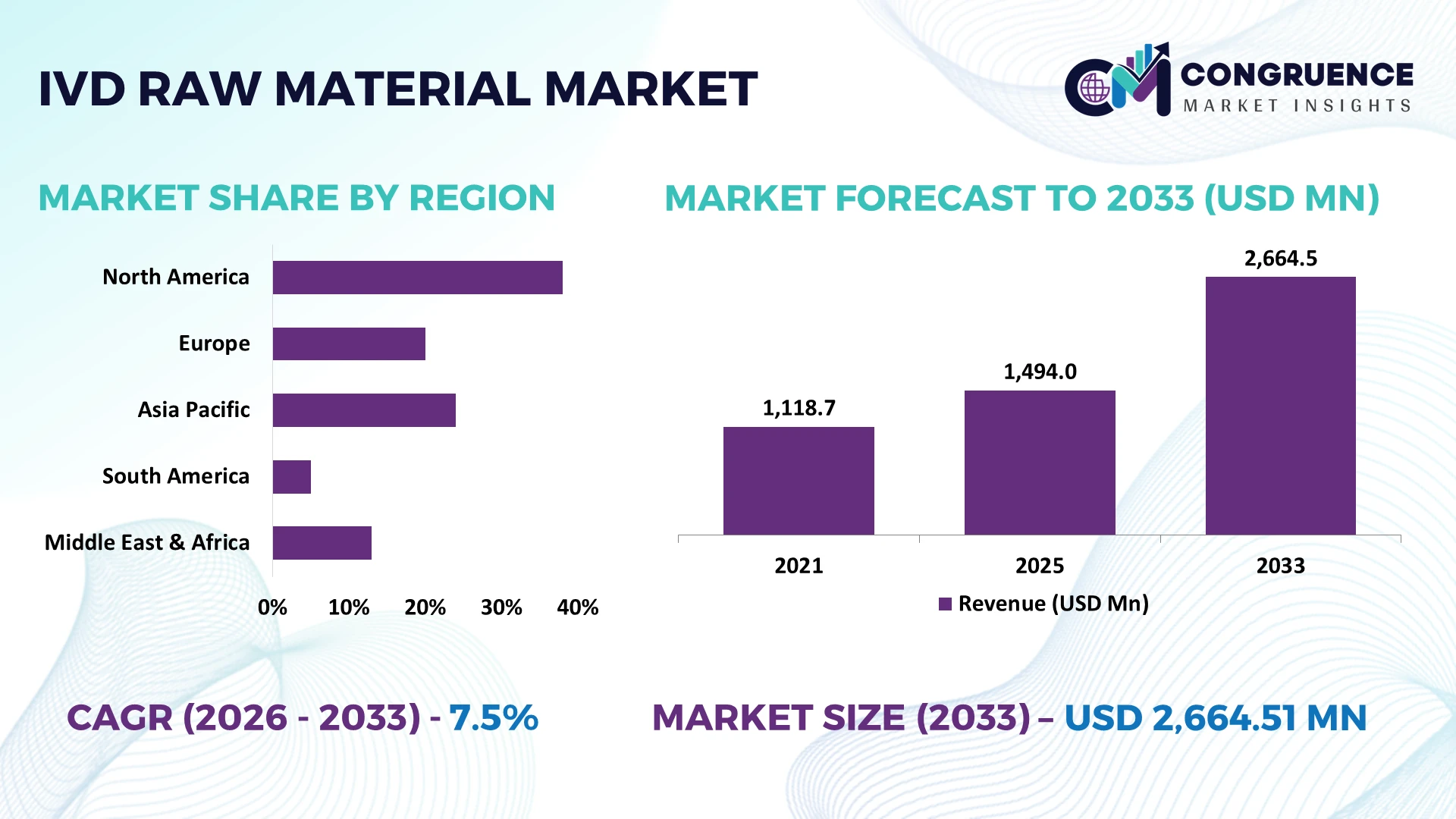
The Global IVD Raw Material Market was valued at USD 1494 Million in 2025 and is anticipated to reach a value of USD 2664.51 Million by 2033 expanding at a CAGR of 7.5% between 2026 and 2033. Growth is driven by the shift toward molecular diagnostics, multiplex immunoassays, and decentralized testing, which increases demand for high-purity enzymes, antibodies, nucleic-acid substrates, buffers, and specialty reagents.
The United States remains the dominant country, accounting for approximately 35% of advanced IVD raw-material consumption, supported by strong molecular-diagnostics manufacturing, biotechnology investment, and laboratory automation. U.S. diagnostic developers increasingly integrate automated reagent platforms, while Germany represents roughly 10% of demand through precision diagnostics and reagent manufacturing. The U.S. therefore maintains about a 25-percentage-point lead over Germany, reinforced by post-COVID supply-chain localization and continued healthcare resilience following global trade disruptions.
Strategic implication: suppliers prioritizing high-purity molecular reagents, localized production, and automated-quality control will capture the strongest opportunities in the global IVD raw material market.
Market Size & Growth: USD 1.49 billion in 2025 rising to USD 2.66 billion by 2033 at 7.5% CAGR, driven by molecular diagnostics and reagent automation.
Top Growth Driver 1: Molecular diagnostics expansion contributes approximately 9% annual demand momentum.
Top Growth Driver 2: Immunoassay innovation generates roughly 8% demand growth across advanced laboratories.
Top Growth Driver 3: Point-of-care testing adoption adds nearly 7% incremental raw-material demand.
Short-Term Forecast: By 2028, automated reagent preparation is positioned to reduce processing costs by 8% and improve production efficiency by 11%.
Emerging Technologies: AI-assisted assay development, automated reagent formulation, and engineered enzymes are reshaping high-performance IVD raw materials.
Regional Leaders: North America is projected near USD 1.0 billion, Europe near USD 0.65 billion, and Asia-Pacific near USD 0.75 billion, with automation and decentralized testing accelerating adoption.
Consumer/End-User Trends: More than 30% of diagnostic workflows increasingly incorporate molecular or multiplex testing, strengthening demand for specialized substrates and enzymes.
Pilot/Case Example: 2025 automated assay-production programs reported approximately 10% lower reagent handling requirements and faster batch validation.
Competitive Landscape: Leading suppliers collectively control more than 40% of specialized raw-material capacity, with Thermo Fisher Scientific, Merck KGaA, Bio-Rad Laboratories, Danaher, and Roche maintaining strong positions.
Regulatory & ESG Impact: Stricter traceability and quality requirements are pushing manufacturers toward digitally monitored production, while waste-reduction programs target approximately 10% lower material losses.
The IVD Raw Material Market is increasingly shaped by molecular diagnostics, immunoassays, point-of-care platforms, and multiplex testing, with specialized enzymes and high-purity antibodies gaining priority. Approximately 30% of advanced diagnostic workflows now emphasize molecular or multiplex capabilities, strengthening demand for performance-consistent inputs. Supply-chain localization and tighter regulatory traceability are also encouraging regional sourcing, automated quality control, and resilient production networks, creating a stronger strategic pathway for specialized suppliers.
The IVD Raw Material Market is becoming strategically important because raw-material consistency increasingly determines assay sensitivity, batch reproducibility, regulatory readiness, and product launch speed. Molecular diagnostics, multiplex assays, and automated platforms are shifting procurement from commodity inputs toward engineered enzymes, high-specificity antibodies, and traceable nucleic-acid materials. Over the next 2–3 years, suppliers with tighter quality controls and localized production are positioned to secure stronger contracts.
Supply-chain restructuring is accelerating as manufacturers reduce dependence on single-country sourcing and build dual-supplier networks. Regulatory changes are intensifying traceability and performance-evidence requirements, while digital identification and documentation are becoming increasingly important across IVD manufacturing. Compared with legacy manual reagent preparation, automated formulation and quality-control workflows can reduce handling time by roughly 10–15% while improving batch consistency by about 5–8%. The United States leads in commercialization scale, while Germany emphasizes regulated precision manufacturing and advanced diagnostic infrastructure.
Practical deployment increasingly combines automated dispensing, digital batch records, and predictive quality monitoring. Companies are directing investment toward enzyme engineering, regional capacity, and partnerships with diagnostic developers rather than simply expanding commodity output. By 2028, automated production adoption is positioned to exceed 40% among advanced suppliers. Strategic winners will combine technical performance, regulatory traceability, and resilient sourcing to create defensible competitive positioning.
Molecular diagnostics remain a primary structural driver as PCR, sequencing, and multiplex workflows increase consumption of enzymes, nucleic acids, primers, probes, and specialized reagents. Molecular platforms are estimated to represent more than 30% of advanced diagnostic workflows, while automation penetration in high-throughput laboratories approaches 40%. The shift toward decentralized testing further increases demand for highly stable, standardized inputs. U.S. manufacturers are responding by expanding enzyme-engineering capacity and forming supply agreements with assay developers. The non-obvious advantage is tighter raw-material specification: suppliers capable of reducing batch variability by 5–8% gain qualification advantages because diagnostic manufacturers can shorten validation cycles and protect production continuity.
Specialty IVD inputs face persistent cost and supply constraints because advanced enzymes, recombinant proteins, antibodies, and nucleic-acid components require controlled production environments. Raw-material cost volatility of 8–12% can materially affect assay economics, while qualification of an alternative supplier can extend procurement cycles by 10% or more. European manufacturers also face intensified compliance requirements, including stronger performance evidence and post-market surveillance. Companies are countering exposure through dual sourcing, regional inventory buffers, and longer-term contracts. The strongest operational response is localization of critical inputs, which reduces dependence on concentrated overseas supply chains and improves continuity during geopolitical or logistics disruptions.
Engineered enzymes, recombinant antibodies, synthetic nucleic acids, and automation-ready reagents create high-value opportunities beyond conventional raw-material supply. Engineered enzyme adoption is advancing at roughly 10% annually within specialized molecular workflows, while automated reagent preparation can deliver 8–12% lower handling costs. India and South Korea offer attractive expansion opportunities as diagnostic manufacturing capacity becomes more sophisticated and localized. Companies are increasing R&D spending on thermostable enzymes, low-background antibodies, and ready-to-use reagent systems while partnering with assay developers. A notable opportunity lies in supplying standardized inputs designed specifically for automated platforms, allowing manufacturers to capture recurring demand while reducing customer validation and integration requirements.
Scaling high-purity IVD raw materials remains difficult because biological inputs require stringent process control, reproducibility, cold-chain management, and specialized technical skills. Manufacturing deviations affecting even 2–5% of a batch can trigger costly requalification, while workforce gaps can reduce advanced production utilization by approximately 10%. Digital integration also introduces cybersecurity and data-integrity requirements as laboratories connect formulation, quality, and traceability systems. Evolving regulatory requirements continue increasing documentation and surveillance workloads. Companies must therefore invest in automated quality systems, validated digital infrastructure, workforce training, and redundant production capabilities. Long-term competitiveness will depend less on nominal capacity and more on consistently usable, regulatory-ready capacity.
Automation Reshapes Reagent Production: Automated dispensing and digital quality-control systems are expanding across advanced IVD manufacturing, reducing manual handling by approximately 10–15% and improving batch consistency by 5–8%. U.S. suppliers are integrating automated formulation with electronic batch records to increase throughput while reducing operator-dependent variability.
Traceability Becomes Commercial Standard: Regulatory transition is pushing manufacturers toward stronger material traceability, with digital identification and documentation increasingly embedded across procurement and production. Digital compliance workflows are accelerating among European-market manufacturers, strengthening documentation and quality-control requirements across IVD supply chains.
Specialty Inputs Gain Procurement Priority: High-specificity antibodies, engineered enzymes, and synthetic nucleic acids are receiving greater purchasing attention, with specialized materials capturing roughly 30–35% of premium-input procurement in advanced assay development. Companies are prioritizing performance consistency over lowest unit cost, strengthening supplier qualification requirements.
Supply Networks Become More Localized: Geopolitical disruption and logistics volatility are encouraging dual sourcing, regional inventory, and domestic production. Manufacturers targeting 10–15% lower supply interruption exposure are building partnerships with local biochemical producers and expanding qualified supplier pools, making resilience an increasingly important purchasing criterion.
Antibodies represent the leading IVD raw-material type, estimated at approximately 31% of demand, supported by extensive use across immunoassays, infectious-disease testing, oncology panels, and automated analyzers. Their established validation pathways, broad assay compatibility, and scalable recombinant production reinforce dominance. Enzymes follow with roughly 23%, while antigens account for about 19%, nucleic acids 15%, and reagents approximately 12%. Companies continue prioritizing recombinant antibody production because it improves lot consistency and reduces dependence on biological source variability.
Nucleic acids are the fastest-growing type, expanding its operational relevance as PCR, sequencing, and multiplex diagnostics gain adoption. Demand is increasingly shifting toward synthetic, high-purity inputs capable of supporting automated workflows. Suppliers are directing investment toward enzyme engineering and nucleic-acid synthesis, while mature antigen and reagent portfolios remain important for cost-sensitive routine testing. The strategic implication is clear: companies combining scalable antibody platforms with advanced nucleic-acid capabilities can address both established assay volumes and higher-complexity molecular testing.
Immunoassays remain the leading application, representing approximately 34% of raw-material consumption because hospitals and diagnostic laboratories rely heavily on antibody-antigen interactions for routine testing. Clinical chemistry follows near 23%, hematology around 16%, microbiology 11%, and molecular diagnostics approximately 16%. Immunoassays benefit from mature analyzer infrastructure and established reagent ecosystems, keeping procurement volumes stable even as newer diagnostic platforms expand.
Molecular diagnostics are the fastest-growing application, with adoption momentum of roughly 10–12% across advanced testing workflows. PCR and multiplex platforms require higher-specification enzymes, nucleic acids, primers, and probes than many conventional assays, increasing raw-material value density. Companies are expanding molecular-grade production, integrating automation, and developing assay-specific partnerships. Clinical chemistry remains a high-volume base, while hematology and microbiology increasingly incorporate automated sample processing. The business shift is toward suppliers capable of serving both high-volume routine testing and rapidly evolving molecular workflows without compromising batch consistency.
Diagnostic manufacturers represent the dominant end-user group, accounting for approximately 39% of raw-material demand because they purchase enzymes, antibodies, antigens, nucleic acids, and reagents at industrial scale. Hospitals and clinics contribute about 25%, while research laboratories represent 15%, biotechnology companies 12%, and pharmaceutical companies 9%. Manufacturers prioritize consistent specifications, long-term availability, and technical support because raw-material deviations can disrupt entire assay production batches.
Biotechnology companies are the fastest-growing end-user group, with specialized procurement expanding roughly 10% as molecular diagnostics, recombinant technologies, and assay development programs mature. Research laboratories increasingly favor smaller, high-purity customized batches, while pharmaceutical companies use IVD-grade materials for companion diagnostics and translational testing. Suppliers are responding through tiered pricing, customization, technical partnerships, and flexible production volumes. The competitive advantage is shifting toward vendors that can support both industrial-scale procurement and rapid low-volume innovation without creating separate quality standards.
North America accounted for the largest market share at 38% in 2025 however, Asia-Pacific is expected to register the fastest growth, expanding at a CAGR of 9.2% between 2026 and 2033.
Automation and localized sourcing strengthen diagnostic supply resilience
North America commands approximately 38% of global IVD raw-material demand, supported by advanced molecular diagnostics, immunoassay manufacturing, biotechnology clusters, and high-throughput laboratory infrastructure. The United States concentrates most regional activity, with sophisticated reagent production and strong integration between raw-material suppliers and diagnostic developers. Automated formulation and digital quality-control deployment across advanced facilities is approaching 40%, improving batch consistency and reducing manual processing requirements. Suppliers are increasingly investing in recombinant antibody platforms, engineered enzymes, and nucleic-acid manufacturing to reduce overseas dependency. Partnerships between diagnostic manufacturers and specialty biochemical producers are also strengthening application-specific material development. The region’s competitive advantage lies in rapid commercialization, regulatory expertise, and vertically coordinated supply networks, making North American manufacturers important anchor customers for premium raw-material suppliers.
United States Market Outlook: The United States remains the region’s principal manufacturing and technology hub, supported by extensive biotechnology infrastructure and concentrated diagnostic R&D activity. Molecular-testing platforms account for more than 30% of advanced diagnostic workflows, strengthening demand for high-purity enzymes, primers, probes, and nucleic acids. Domestic suppliers are expanding specialized capacity and establishing dual-source procurement strategies.
Regulatory precision accelerates traceable and sustainable sourcing
Europe represents approximately 25% of global IVD raw-material demand, with Germany, France, the United Kingdom, and Switzerland supporting sophisticated diagnostic manufacturing and laboratory ecosystems. Regulatory modernization is increasing emphasis on traceability, validated performance, and consistent material specifications, encouraging suppliers to strengthen digital documentation and quality-management infrastructure. Automated production adoption across advanced facilities is estimated near 35%, supporting improved process consistency and lower manual intervention. Sustainability is also influencing procurement as manufacturers seek lower-waste formulations and more efficient cold-chain logistics. European suppliers are expanding recombinant protein, antibody, and enzyme capabilities while forming partnerships with diagnostic developers to shorten qualification cycles. The region’s strategic strength lies in precision manufacturing and regulatory readiness, although compliance-intensive production increases qualification costs and favors established suppliers with robust documentation systems.
Germany Market Outlook: Germany remains Europe’s strongest industrial base for precision diagnostics, laboratory equipment, and biochemical manufacturing. Its highly regulated production environment supports advanced reagent development and quality-controlled raw-material processing. Approximately 30% of sophisticated diagnostic manufacturing workflows increasingly incorporate automated quality-control systems, strengthening demand for standardized enzymes, antibodies, and specialty reagents.
Manufacturing scale and localization reshape supply economics
Asia-Pacific represents approximately 22% of global IVD raw-material demand and is becoming increasingly important as diagnostic manufacturing shifts toward localized production. China, Japan, South Korea, and India combine large testing volumes with expanding biotechnology and reagent-production capabilities. China provides significant manufacturing scale, while Japan and South Korea emphasize high-precision molecular and biochemical technologies. India is strengthening domestic diagnostic manufacturing through localized reagent production and laboratory modernization. Regional manufacturers are increasing automation deployment, with advanced facilities approaching 30% automated processing penetration. Suppliers are also expanding export-oriented production and forming partnerships with local assay developers. The key advantage is cost-efficient manufacturing combined with rapidly improving technical capability. Companies able to pair competitive production economics with international-grade quality systems can gain share across emerging diagnostic supply chains.
China Market Outlook: China is the region’s largest manufacturing force, supported by extensive diagnostic production infrastructure and a large domestic testing base. Molecular and immunoassay platforms are driving demand for locally produced enzymes, antibodies, antigens, and nucleic acids. Domestic suppliers are increasing automated production and quality-control integration, with advanced facilities targeting 10% or greater improvements in processing efficiency.
Localized diagnostics address import dependence and infrastructure gaps
South America accounts for approximately 8% of global IVD raw-material demand, with Brazil representing the principal commercial and manufacturing center. Diagnostic demand is concentrated in major urban laboratory networks, hospitals, pharmaceutical clusters, and public-health testing programs. Brazil is increasing local production of selected reagents and diagnostic inputs to reduce exposure to imported materials, while Argentina and Colombia remain important secondary markets. Approximately 20% of advanced diagnostic workflows in major urban centers incorporate higher-complexity molecular or automated testing. However, imported specialty enzymes, antibodies, and nucleic-acid inputs remain important, creating logistics and inventory pressures. Suppliers are responding through regional distributors, local partnerships, inventory buffers, and selective production agreements. The strongest opportunity is application-specific localization that reduces lead times without requiring full-scale manufacturing replication.
Brazil Market Outlook: Brazil offers the strongest South American platform because of its large healthcare system, established laboratory networks, biotechnology base, and public diagnostic infrastructure. Major laboratories increasingly use automated molecular and immunoassay systems, supporting recurring demand for standardized raw materials. Local partnerships can reduce import-related delays while improving technical support and inventory responsiveness.
Healthcare modernization drives premium diagnostic adoption
Middle East & Africa contributes approximately 7% of global IVD raw-material demand, with demand concentrated in Saudi Arabia, the United Arab Emirates, South Africa, and major metropolitan healthcare centers. Healthcare modernization programs are increasing investment in automated laboratories, molecular testing, infectious-disease diagnostics, and centralized laboratory infrastructure. Advanced diagnostic automation adoption in leading Gulf facilities is estimated near 25%, creating stronger demand for standardized enzymes, antibodies, nucleic acids, and specialty reagents. The United Arab Emirates and Saudi Arabia are also developing healthcare technology ecosystems that encourage international supplier partnerships and localized distribution. Companies are prioritizing regional warehouses, technical service networks, and collaborations with hospital groups. The region’s strategic opportunity lies in premium diagnostic inputs linked to modernization projects, while fragmented procurement and uneven laboratory infrastructure remain important execution considerations.
Saudi Arabia Market Outlook: Saudi Arabia leads regional transformation through healthcare infrastructure modernization, laboratory digitization, and investment in advanced diagnostic capabilities. Major healthcare projects increasingly incorporate automated testing platforms, strengthening demand for reliable high-purity raw materials. Suppliers with local distribution, technical support, and partnership capabilities are positioned to benefit from expanding procurement sophistication and localization priorities.
The IVD raw-material market pits global life-science suppliers such as Thermo Fisher Scientific, Merck KGaA, Bio-Rad Laboratories, Danaher, and Roche against specialized regional biochemical producers and cost-focused manufacturers. The top five players collectively command approximately 40% of premium IVD raw-material supply, creating a moderately concentrated structure. Competition centers on purity, consistency, customization, supply reliability, and qualification speed. Premium suppliers can command 8–12% pricing advantages for application-specific enzymes, antibodies, and nucleic-acid inputs, while automated production can reduce processing costs by 10–15%. Leading companies are expanding recombinant-material capacity, forming assay-development partnerships, and integrating quality-control systems vertically. Regional suppliers counter with localized inventory, shorter lead times, and competitive pricing. The competitive shift is moving from commodity supply toward engineered, traceable, automation-ready materials. High qualification requirements and regulatory documentation create significant entry barriers. Winning requires superior material performance, resilient supply, rapid customization, and proven regulatory readiness.
Thermo Fisher Scientific
Merck KGaA
Bio-Rad Laboratories
Danaher Corporation
Roche
Agilent Technologies
Bio-Techne
Creative Diagnostics
Abcam
Fapon Biotech
GenScript Biotech
Takara Bio
Current IVD raw-material production increasingly uses automated liquid handling, digital batch records, recombinant expression, and high-throughput purification. Automated workflows can improve processing efficiency by 8–12%, while recombinant antibodies reduce lot variability by roughly 5–7%. Adoption across advanced diagnostic suppliers is approaching 40%, giving vertically integrated manufacturers stronger consistency, faster qualification, and lower operator dependence.
Emerging technologies include AI-assisted antibody engineering, thermostable enzymes, synthetic nucleic acids, and lyophilized reagent formulations. AI-supported design can shorten candidate screening cycles by 10–15%, while engineered enzymes improve assay performance by approximately 2–4%. Lyophilization can reduce cold-chain handling costs by 5–8%. By 2028, integrated automation, digital quality systems, and predictive analytics will increasingly connect raw-material development with assay manufacturing.
Disruptive platforms such as CRISPR-ready enzymes, multiplex-compatible reagents, and microfluidic-compatible materials are shifting competitive priorities toward application-specific performance. Compared with legacy manual formulation, automated production can deliver approximately 10% higher operational efficiency and 6% lower handling costs. Suppliers combining engineered materials with automated manufacturing benefit most. From 2026–2028, early investment in scalable bioprocessing, digital traceability, and precision raw-material platforms will strengthen qualification speed, supply resilience, and competitive positioning.
December 2024 Roche began construction of a €600 million Penzberg diagnostics center designed to produce more than 450 diagnostic raw materials from 2028. The automated facility strengthens supply security, manufacturing flexibility, and European production resilience for global IVD customers worldwide. Source: roche.com
July 2025 Bio-Rad launched four new ddPCR platforms after acquiring Stilla Technologies, expanding its portfolio beyond 400,000 assays. The systems support seven-color multiplexing and more than 700 samples daily, strengthening molecular diagnostics capacity and demand for specialized assay inputs directly. Source: bio-rad.com
March 2026 India’s Technology Development Board supported Acrannolife Genomics in establishing an advanced IVD manufacturing facility for indigenous diagnostic kits. The project targets scalable production of cell-free-DNA and LAMP-based tests, reducing import dependence and strengthening domestic molecular-diagnostics supply capacity at scale. Source: pib.gov.in
May 2026 Medix Biochemica approved a $5 million investment across Finland and the United States to expand recombinant antigen and cell-culture capabilities. The program targets 60-plus validated products by 2030, improving supply security, lot consistency, and sustainable sourcing for IVD manufacturers. Source: medixbiochemica.com
The report covers the IVD raw-material ecosystem across Antibodies, Antigens, Enzymes, Nucleic Acids, and Reagents, assessing demand concentration, technological maturity, sourcing patterns, production capabilities, and emerging material requirements. Application coverage spans Immunoassays, Molecular Diagnostics, Clinical Chemistry, Hematology, and Microbiology, while end-user analysis includes Diagnostic Manufacturers, Hospitals & Clinics, Research Laboratories, Biotechnology Companies, and Pharmaceutical Companies.
Geographic coverage evaluates North America, Europe, Asia-Pacific, South America, and the Middle East & Africa, with country-level emphasis on major manufacturing and adoption hubs. The analysis examines automation, recombinant-material development, engineered enzymes, synthetic nucleic acids, digital quality systems, and supply-chain localization. Segment-level indicators such as approximately 31% antibody demand, 34% immunoassay concentration, and 39% diagnostic-manufacturer participation support investment planning, expansion decisions, supplier positioning, and strategic technology priorities through 2026–2033.
| Report Attribute/Metric | Report Details |
|---|---|
Market Revenue in 2025 | USD 1494 Million |
Market Revenue in 2033 | USD 2664.51 Million |
CAGR (2026 - 2033) | 7.5% |
Base Year | 2025 |
Forecast Period | 2026 - 2033 |
Historic Period | 2021 - 2025 |
Segments Covered | By Type
By Application
By End-User
|
Key Report Deliverable | Revenue Forecast, Growth Trends, Market Dynamics, Segmental Overview, Regional and Country-wise Analysis, Competition Landscape |
Region Covered | North America, Europe, Asia-Pacific, South America, Middle East, Africa |
Key Players Analyzed | Thermo Fisher Scientific, Merck KGaA, Bio-Rad Laboratories, Danaher Corporation, Roche, Agilent Technologies, Bio-Techne, Creative Diagnostics, Abcam, Fapon Biotech, GenScript Biotech, Takara Bio |
Customization & Pricing | Available on Request (10% Customization is Free) |




