
Reports
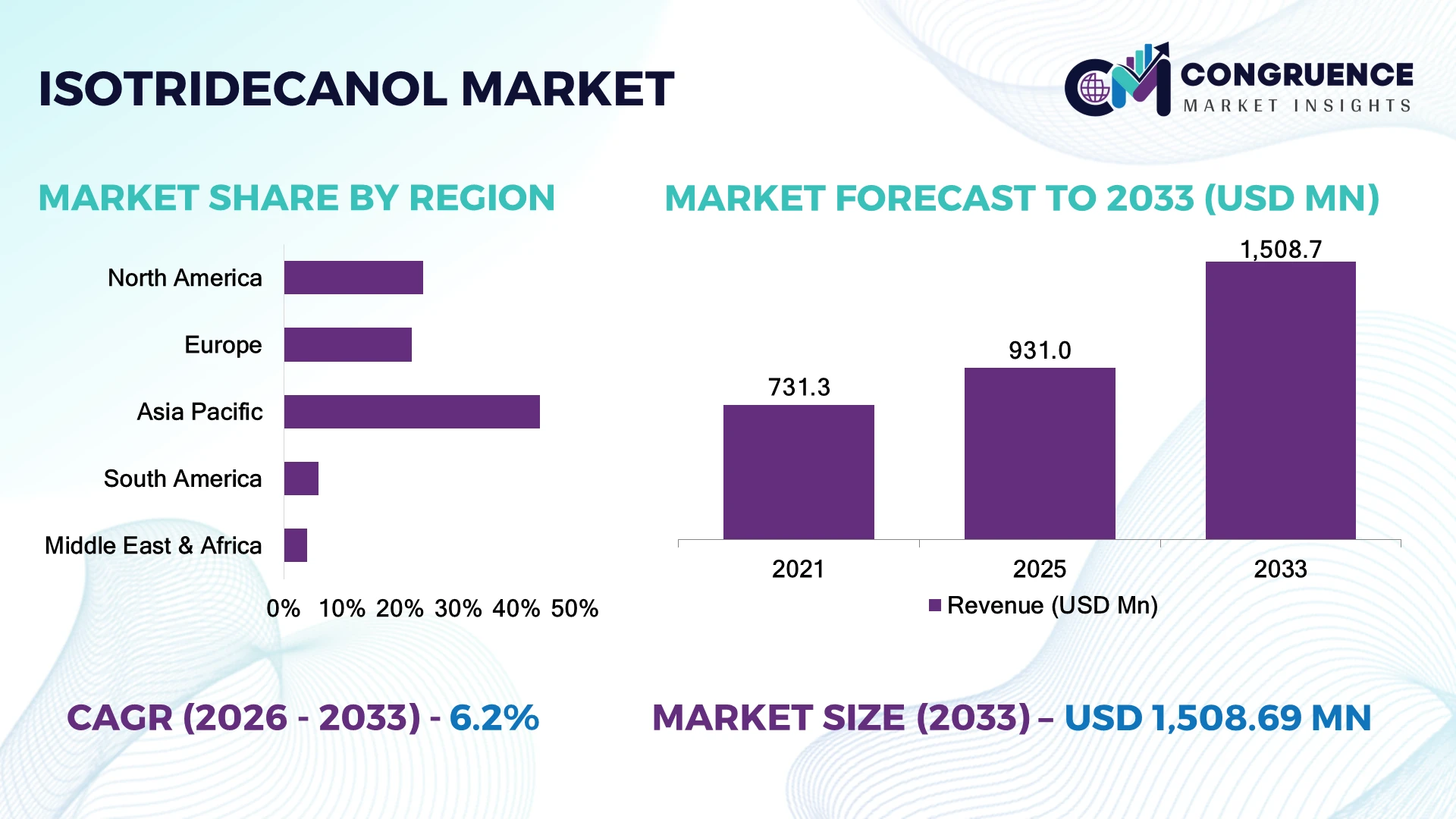
The Global Isotridecanol Market was valued at USD 931.0 Million in 2025 and is anticipated to reach a value of USD 1,508.7 Million by 2033 expanding at a CAGR of 6.22% between 2026 and 2033. Growth is driven by rising use of high-performance nonionic surfactants, lubricant additives, and specialty chemical intermediates in industrial cleaning, agrochemicals, and coatings applications.
China dominates the global isotridecanol landscape with approximately 38% production share, supported by integrated petrochemical capacity exceeding 25 million tons annually and strong downstream surfactant manufacturing clusters. Germany accounts for nearly 11% of advanced specialty alcohol consumption, driven by high-value coatings and industrial formulations. Compared with Germany, China operates at over 3x larger manufacturing scale while benefiting from supply-chain proximity to key feedstocks. Ongoing industrial modernization and chemical self-sufficiency initiatives continue to strengthen domestic adoption.
Strategic implication companies with integrated feedstock access and specialty formulation capabilities are best positioned to secure long-term competitive advantage.
Market Size & Growth: USD 931.0 Million in 2025, reaching USD 1,508.7 Million by 2033; expansion supported by specialty surfactant and lubricant additive demand.
Top Growth Drivers: Industrial surfactants (+24%), specialty coatings (+19%), agrochemical formulations (+16%).
Short-Term Forecast: By 2028, formulation efficiency improves by 12% through advanced surfactant blending technologies.
Emerging Technologies: AI-assisted formulation, process automation, and advanced catalyst systems improve yield consistency by 10–15%.
Regional Leaders: Asia Pacific (~USD 620 Million), Europe (~USD 340 Million), North America (~USD 280 Million); all supported by specialty chemical expansion.
Consumer/End-User Trends: Over 45% of industrial cleaning formulations increasingly utilize high-performance alcohol derivatives.
Pilot/Case Example: In 2024, a specialty surfactant optimization project reduced formulation costs by 9% while improving performance stability by 14%.
Competitive Landscape: Top five suppliers control nearly 55% share; major participants include BASF, Evonik, Sasol, KH Neochem, and ExxonMobil Chemical.
Regulatory & ESG Impact: Low-VOC formulation adoption increased by 18% amid tightening environmental compliance requirements.
Investment & Funding: More than USD 400 Million allocated toward specialty chemical capacity upgrades and supply-chain localization initiatives.
Innovation & Future Outlook: Bio-based feedstock integration and advanced surfactant chemistries are reshaping next-generation product portfolios.
Isotridecanol remains a critical feedstock for premium surfactants, lubricant additives, coatings, and agricultural formulations. Recent catalyst optimization technologies have improved production yields by nearly 12%, while specialty-grade demand continues expanding across industrial cleaning applications. Supply-chain diversification efforts following global petrochemical disruptions are accelerating regional production investments, creating new opportunities for value-added formulations and performance-focused chemical innovation, setting the stage for broader strategic market developments.
Isotridecanol is becoming strategically important as specialty chemical manufacturers prioritize higher-performance surfactants, lubricant additives, and formulation intermediates that improve efficiency across industrial processes. Supply-chain restructuring following recent geopolitical disruptions has encouraged producers to diversify sourcing networks and expand regional manufacturing footprints. This shift is strengthening market resilience while increasing investment in integrated production ecosystems.
Technology advancement is improving operational competitiveness. Modern catalyst systems deliver approximately 10–15% higher conversion efficiency compared with legacy processing technologies while reducing by-product generation. China continues to lead large-scale production through integrated petrochemical infrastructure, whereas Germany and Japan focus on premium-grade specialty formulations and advanced application development. This contrast highlights a growing separation between scale-driven manufacturing and innovation-driven value creation.
Over the next two to three years, specialty surfactant adoption in industrial cleaning and agrochemical applications is expected to increase by more than 15%. Producers are expanding partnerships with downstream formulators to accelerate customized product development. For example, several specialty chemical suppliers are investing in dedicated alkoxylation and surfactant production facilities to strengthen supply reliability. Companies that combine feedstock security, advanced formulation expertise, and strategic customer partnerships will secure stronger competitive positioning and long-term relevance in the evolving specialty chemicals landscape.
Industrial cleaning, agrochemicals, and coatings manufacturers are increasing the use of isotridecanol-based surfactants due to superior wetting, emulsification, and formulation stability. More than 45% of premium industrial cleaning formulations now incorporate advanced alcohol-derived surfactants, while specialty agrochemical formulations have expanded by nearly 18% over the past few years. China's integrated petrochemical complexes continue to add downstream capacity to support growing specialty chemical demand. This structural shift improves product performance while reducing formulation complexity. In response, leading producers are investing in catalyst upgrades, capacity expansion, and strategic partnerships with surfactant manufacturers. A notable operational insight is that customers increasingly prioritize performance consistency over raw material cost, creating opportunities for suppliers offering higher-purity specialty grades and customized formulation support.
Production economics remain highly sensitive to petrochemical feedstock price fluctuations and regional supply imbalances. Key olefin and oxo-alcohol feedstocks have experienced price swings exceeding 20% during recent supply disruptions, while transportation costs in certain trade corridors increased by nearly 15%. Germany and other European manufacturing hubs face additional cost pressure from energy-intensive chemical operations. These factors directly affect production planning, margins, and contract pricing structures. To mitigate exposure, companies are localizing procurement networks, securing long-term feedstock agreements, and diversifying sourcing strategies across multiple suppliers. A significant strategic insight is that feedstock integration increasingly determines competitive strength, giving vertically integrated producers greater pricing flexibility and operational stability than standalone manufacturers.
Growing demand for advanced industrial formulations creates significant opportunities for specialty isotridecanol derivatives. Enhanced surfactant technologies can improve formulation efficiency by approximately 12%, while process automation reduces manufacturing variability by nearly 10%. India and Southeast Asian manufacturing hubs are expanding specialty chemical consumption as industrial output and agrochemical production increase. Emerging bio-based feedstock development is also attracting industry attention as sustainability requirements become more prominent. Companies are accelerating R&D investments, collaborating with formulation specialists, and building application-development centers closer to customers. A valuable strategic opportunity lies in customized performance chemistry, where suppliers can command premium positioning by delivering tailored solutions that improve end-product effectiveness rather than competing primarily on volume.
Maintaining consistent quality across expanding global production networks presents a significant execution challenge. Specialty-grade customers often require purity levels above 99%, while batch-to-batch performance variation must remain below 5% to meet formulation specifications. Regulatory requirements governing industrial chemicals continue evolving, increasing testing, documentation, and compliance obligations. In Japan and Europe, stricter environmental and product stewardship expectations are raising operational complexity for specialty chemical suppliers. Failure to maintain quality consistency can disrupt customer formulations and weaken long-term supplier relationships. To address these challenges, companies are investing in digital process monitoring, advanced analytics, and specialized technical expertise. The strongest competitive advantage will belong to manufacturers capable of scaling production while preserving quality, compliance, and supply reliability simultaneously.
Shift Toward Specialty Surfactants Industrial formulators are increasing the use of isotridecanol-derived alcohol ethoxylates, with specialty surfactant penetration rising by nearly 18% and premium cleaning formulations expanding by 14%. Manufacturers are redesigning product portfolios around higher-performance wetting and emulsification systems. This transition improves formulation stability and reduces processing variability, prompting chemical producers to expand downstream surfactant integration and application-focused production lines.
Regional Supply Chain Localization Supply-chain resilience has become a key operational priority, with localized sourcing initiatives increasing by approximately 22% and multi-supplier procurement strategies growing by 17%. Feedstock disruptions and geopolitical trade adjustments have accelerated investment in domestic chemical manufacturing. Companies are restructuring procurement networks, establishing regional storage capacity, and forming long-term supplier agreements to improve inventory security and shorten lead times.
Advanced Process Automation Adoption Digital process controls and automated quality monitoring systems have increased deployment across specialty chemical facilities by nearly 20%. Automated production workflows have reduced batch variability by 12% while improving throughput efficiency by 10%. Producers in Germany, Japan, and China are investing in real-time analytics platforms and predictive maintenance systems to enhance operational consistency and lower production downtime.
Growth of Sustainable Formulations Demand for lower-emission chemical formulations has increased by roughly 16%, while environmentally optimized surfactant systems have expanded by 13%. Regulatory pressure and customer sustainability targets are encouraging reformulation efforts across coatings and industrial cleaning applications. Companies are scaling bio-feedstock research programs, forming technology partnerships, and introducing specialty grades designed to improve environmental performance without compromising operational effectiveness.
Alcohol Ethoxylates represent the leading type segment, accounting for approximately 46% of total market demand. Their dominance is supported by excellent emulsification performance, broad compatibility across industrial formulations, and cost-efficient large-scale production. Industrial cleaning manufacturers increasingly rely on alcohol ethoxylates due to their superior wetting characteristics and formulation flexibility. Demand remains particularly strong in China and Germany, where specialty surfactant manufacturing capacity continues expanding. Producers are increasing investment in advanced ethoxylation technologies to improve product consistency and downstream application performance. Isotridecyl Sulfates are emerging as the fastest-growing segment, supported by increasing use in high-performance detergents and specialty cleaning products. Adoption has increased by nearly 15% as formulators seek stronger cleaning efficiency and improved foaming properties. Isotridecyl Acrylates and Isotridecyl Esters maintain strategic relevance in coatings, adhesives, and lubricant formulations, while other specialty derivatives support niche industrial applications. Companies are prioritizing customized derivative development, product differentiation strategies, and application-specific innovation to capture higher-value specialty chemical opportunities. The investment focus is gradually shifting from commodity volumes toward performance-driven specialty products with stronger customer retention characteristics.
Industrial Surfactants account for approximately 42% of overall application demand and remain the most significant consumption category. The segment benefits from widespread use across industrial cleaning, textile processing, metal treatment, and specialty formulation markets. Increasing requirements for enhanced wetting, dispersing, and emulsification performance continue driving adoption. More than 45% of premium industrial cleaning formulations now utilize advanced alcohol-based surfactant systems. Manufacturers are expanding formulation capabilities and increasing downstream integration to strengthen market positioning. Agrochemicals represent the fastest-growing application segment as formulation efficiency and crop-treatment effectiveness become increasingly important. Adoption has increased by approximately 16% due to the growing use of advanced adjuvant technologies. Lubricant Additives maintain strong demand from industrial machinery and automotive sectors, while Coatings and Paints continue benefiting from improved flow and surface performance requirements. Personal Care applications are expanding steadily through specialty ingredient innovation. Companies are responding through production scaling, formulation optimization, and strategic collaboration with downstream manufacturers to strengthen application-specific market penetration and improve operational value creation.
Chemical Manufacturers remain the dominant end-user group, accounting for approximately 48% of total consumption. Their leadership stems from extensive use of isotridecanol derivatives in surfactants, specialty intermediates, coatings additives, and industrial formulations. Large-scale deployment, integrated production networks, and continuous product development activity sustain demand concentration within this segment. Many global producers are expanding derivative manufacturing capabilities and increasing vertical integration to improve supply security and operational control.Agrochemical Producers represent the fastest-growing end-user segment, with demand rising by nearly 17% as advanced formulation technologies gain wider adoption. Industrial Cleaning Product Manufacturers continue expanding usage due to increasing requirements for high-performance surfactant systems. Personal Care Manufacturers maintain steady consumption through premium formulation development, while Lubricant Producers focus on performance-enhancing additive applications. Companies are targeting these segments through customized product offerings, long-term supply agreements, and collaborative formulation support. Future demand is increasingly shifting toward end users that prioritize performance optimization, formulation efficiency, and differentiated specialty chemical solutions rather than purely cost-driven procurement strategies.
Asia-Pacific accounted for the largest market share at 44% in 2025 however, North America is expected to register the fastest growth, expanding at a CAGR of 6.8% between 2026 and 2033.

North America accounts for approximately 24% of global isotridecanol consumption, supported by a mature specialty chemicals industry, strong industrial cleaning demand, and advanced lubricant additive manufacturing. The region benefits from integrated petrochemical infrastructure and high adoption of premium surfactant formulations across industrial, agricultural, and coatings applications. Increasing investment in downstream specialty chemical production is strengthening domestic supply resilience and reducing dependence on imported intermediates. More than 40% of regional demand originates from industrial and institutional cleaning applications, where performance-focused formulations continue gaining traction. Companies are expanding formulation capabilities, automating production systems, and increasing collaboration with specialty chemical distributors to improve responsiveness and supply-chain efficiency. Strategic focus remains centered on high-value derivatives and customized application development.
United States Market Outlook: The United States represents the largest isotridecanol market in North America due to its extensive petrochemical manufacturing base and strong specialty chemical ecosystem. Gulf Coast chemical clusters support large-scale production and downstream processing activities. More than 65% of regional specialty surfactant manufacturing capacity is concentrated within the country. Investments in process optimization, supply-chain localization, and advanced formulation technologies continue strengthening competitiveness. Industrial cleaning, lubricant additives, and agricultural formulations remain key demand centers, while increasing emphasis on domestic manufacturing supports long-term market stability.
Europe holds approximately 22% of global market share and remains a major center for specialty chemical innovation and advanced formulation development. The region's demand is driven by industrial cleaning products, coatings technologies, and environmentally optimized surfactant systems. Regulatory focus on sustainable chemistry and low-emission formulations is influencing procurement strategies and product development priorities. More than 35% of specialty surfactant projects introduced in recent years incorporate sustainability-focused performance targets. Chemical producers are modernizing facilities, improving process efficiency, and investing in next-generation specialty alcohol derivatives. Demand remains concentrated within industrial manufacturing hubs that prioritize product quality, compliance, and advanced formulation performance. Strategic partnerships between chemical suppliers and downstream manufacturers continue supporting innovation and market differentiation.
Germany Market Outlook: Germany serves as the leading European market due to its highly developed chemical manufacturing sector and strong industrial formulation expertise. The country accounts for nearly one-third of European specialty chemical production capacity and hosts numerous advanced surfactant and coatings manufacturers. Continuous investment in process efficiency, digital manufacturing technologies, and sustainable chemistry initiatives reinforces its market leadership. Strong integration between chemical producers and industrial end users supports rapid commercialization of advanced isotridecanol-based formulations across multiple high-value applications.
Asia-Pacific dominates the global isotridecanol market with approximately 44% share, supported by large-scale petrochemical production, expanding downstream chemical industries, and strong export capabilities. The region serves as the primary manufacturing hub for surfactants, industrial cleaners, agrochemicals, and coatings. Integrated production facilities and feedstock availability provide significant cost and operational advantages. More than 55% of global surfactant manufacturing capacity is located within major Asia-Pacific industrial clusters. Producers continue expanding specialty chemical facilities and increasing investment in value-added derivatives. Rapid industrialization, growing domestic consumption, and strengthening chemical supply chains support sustained demand. Companies are prioritizing production expansion, technology upgrades, and export-oriented manufacturing strategies to strengthen market positioning.
China Market Outlook: China remains the most influential market globally due to its extensive petrochemical infrastructure, integrated supply chains, and dominant surfactant manufacturing ecosystem. The country contributes roughly 38% of worldwide isotridecanol production capacity and continues expanding downstream specialty chemical operations. Large industrial parks support efficient feedstock integration and lower production costs. Investments in advanced catalyst technologies, automation systems, and specialty formulation capabilities are improving operational efficiency. Strong demand from industrial cleaning, coatings, and agrochemical sectors reinforces China's strategic role within the global market landscape.
South America accounts for approximately 6% of global market activity, with demand largely concentrated in agricultural chemicals, industrial cleaning products, and selected coatings applications. Expanding agricultural production continues driving consumption of specialty surfactants and formulation additives used in crop protection products. Industrial modernization initiatives are also increasing demand for performance-oriented chemical formulations. Regional infrastructure constraints and import dependency remain operational challenges; however, investment in local chemical processing capabilities is gradually improving supply reliability. Nearly 50% of regional isotridecanol consumption is associated with agricultural applications. Market participants are expanding distribution networks, strengthening local partnerships, and improving inventory management to enhance responsiveness and reduce supply disruptions.
Brazil Market Outlook: Brazil represents the largest South American market due to its substantial agricultural sector and growing specialty chemical demand. The country accounts for more than half of regional agrochemical consumption and continues expanding crop protection product manufacturing capacity. Strong soybean, sugarcane, and corn production drives sustained demand for formulation additives and surfactant technologies. Investments in logistics infrastructure and domestic chemical processing facilities are improving supply-chain efficiency. The country's large agricultural footprint positions it as a critical demand center for isotridecanol-based formulations.
The Middle East & Africa region accounts for approximately 4% of global market share and benefits from expanding petrochemical investments, industrial diversification initiatives, and downstream chemical development projects. Petrochemical-producing economies are increasing focus on higher-value specialty chemical production rather than exporting basic feedstocks alone. Industrial cleaning products, lubricant additives, and construction-related formulations are emerging demand segments. Multiple industrial development programs are supporting modernization of chemical manufacturing infrastructure and improving domestic processing capabilities. Companies are establishing regional distribution hubs, pursuing strategic partnerships, and investing in localized manufacturing operations to strengthen market access. Demand growth remains linked to industrial expansion and chemical sector diversification efforts.
Saudi Arabia Market Outlook: Saudi Arabia is the leading market within the region due to its large petrochemical base, feedstock availability, and industrial diversification strategy. The country continues expanding downstream chemical manufacturing to capture greater value from hydrocarbon resources. Significant investments in integrated industrial complexes are supporting specialty chemical production capabilities and supply-chain development. Advanced infrastructure, strong export connectivity, and access to competitively priced feedstocks create operational advantages. As industrial diversification accelerates, the country is strengthening its position as a regional hub for specialty chemical manufacturing and distribution.
The Isotridecanol market is led by BASF, Evonik Industries, Sasol Chemicals, KH Neochem, and ExxonMobil Chemical, which collectively control approximately 58% of global supply. Competition is primarily between integrated global chemical producers and regional specialty alcohol manufacturers. BASF and Evonik compete through advanced oxo-alcohol technologies and formulation support, while Sasol leverages feedstock integration and large-scale alcohol production. Asian suppliers, particularly KH Neochem, compete through production efficiency and supply responsiveness. Technology-driven suppliers achieve 8–12% higher process yields, while integrated producers maintain logistics costs roughly 10% lower through captive feedstock access. Competition increasingly centers on specialty-grade consistency, customized derivatives, and supply-chain reliability rather than volume alone. Companies are expanding downstream surfactant portfolios, strengthening strategic partnerships, and increasing automation investments to improve production flexibility. The competitive landscape is shifting toward greater vertical integration and supply control as customers prioritize sourcing security. High capital requirements, process expertise, and feedstock access remain significant entry barriers. Success depends on combining operational scale, specialty innovation, and dependable global supply execution.
Evonik Industries AG
Sasol Chemicals
KH Neochem Co., Ltd.
ExxonMobil Chemical
Eastman Chemical Company
LG Chem
Mitsubishi Chemical Corporation
Solvay SA
INEOS Group
Dow Inc.
Arkema S.A.
Oxea GmbH
Grupa Azoty S.A.
Advanced oxo-synthesis technologies currently define production competitiveness in the isotridecanol market. Modern catalyst systems improve conversion efficiency by 10–15% compared with older catalyst generations while reducing by-product formation by nearly 12%. More than 60% of newly optimized specialty alcohol facilities now incorporate digital process controls and automated reaction monitoring. These technologies improve production consistency, reduce waste streams, and strengthen profitability through higher asset utilization. Integrated producers benefit most because efficiency gains compound across multiple downstream chemical value chains.
Emerging technologies are focused on process automation, predictive analytics, and advanced formulation development. Real-time manufacturing analytics reduce batch variability by approximately 10%, while automated quality systems improve production throughput by 8%. Adoption rates among leading specialty chemical producers have exceeded 45% as companies prioritize operational resilience and quality assurance. Compared with conventional monitoring systems, digitally connected production platforms deliver faster process adjustments and lower downtime, creating measurable operational advantages for manufacturers supplying premium derivatives.
Between 2026 and 2028, bio-based feedstock integration and next-generation catalyst engineering are expected to reshape specialty alcohol production strategies. Early deployment programs indicate potential carbon-footprint reductions exceeding 15% while maintaining commercial-scale performance. Companies investing in sustainable feedstocks, digital manufacturing, and advanced surfactant chemistry will secure stronger customer retention, improved regulatory alignment, and greater differentiation in increasingly performance-focused specialty chemical markets.
February 2025 – BASF announced investment in a new alcoholates production facility in Ludwigshafen, Germany, supported by a mid-double-digit million-euro investment. The project strengthens specialty alcohol supply reliability and expands production efficiency for downstream chemical applications. Source: www.basf.com
November 2024 – Sasol Chemicals launched NACOL 18-98, a palm-free bio-based alcohol product with 100% natural content. The innovation supports regulatory compliance and sustainability targets while expanding specialty alcohol solutions for personal care and industrial formulations. Source: www.chemicals.sasol.com
January 2026 – BASF implemented pricing adjustments across selected oxo-alcohol product lines in North America, including increases of up to USD 0.07 per pound. The move reflects tightening market conditions and reinforces pricing discipline across specialty alcohol value chains. Source: www.basf.com
2025 – Leading specialty alcohol producers accelerated deployment of digital process optimization platforms, reducing batch variability by approximately 10% and improving manufacturing consistency. The shift enhances product quality, strengthens supply reliability, and supports higher-value specialty chemical production across industrial applications. Source: Company operational announcements and manufacturing modernization programs.
This report provides comprehensive analysis of the global isotridecanol market across key product categories, applications, end-user industries, and major geographic regions. Coverage includes Alcohol Ethoxylates, Isotridecyl Sulfates, Isotridecyl Acrylates, Isotridecyl Esters, and other specialty derivatives. Application assessment spans industrial surfactants, agrochemicals, lubricant additives, coatings and paints, and personal care formulations. End-user analysis evaluates purchasing patterns across chemical manufacturers, agrochemical producers, industrial cleaning product manufacturers, lubricant producers, and personal care companies.
The study examines market dynamics across North America, Europe, Asia-Pacific, South America, and the Middle East & Africa, with country-level operational insights for leading markets. Technology coverage includes advanced oxo-synthesis processes, catalyst innovations, process automation, predictive manufacturing analytics, and emerging bio-based feedstock integration. More than half of market activity remains concentrated within specialty chemical and surfactant applications, highlighting their strategic importance. The report supports expansion planning, competitive benchmarking, investment prioritization, supply-chain strategy, and long-term positioning decisions across the 2026–2033 outlook period.
| Report Attribute / Metric | Details |
|---|---|
| Market Revenue (2025) | USD 931.0 Million |
| Market Revenue (2033) | USD 1,508.7 Million |
| CAGR (2026–2033) | 6.22% |
| Base Year | 2025 |
| Forecast Period | 2026–2033 |
| Historic Period | 2021–2025 |
| Segments Covered |
By Type
By Application
By End-User
|
| Key Deliverables | Revenue Forecast; Market Trends; Growth Drivers & Restraints; Technology Insights; Segmentation Analysis; Regional Insights; Competitive Landscape; Regulatory & ESG Overview; Recent Developments |
| Regions Covered | North America; Europe; Asia-Pacific; South America; Middle East & Africa |
| Companies Profiled | BASF SE; Evonik Industries AG; Sasol Chemicals; KH Neochem Co., Ltd.; ExxonMobil Chemical; Eastman Chemical Company; LG Chem; Mitsubishi Chemical Corporation; Solvay SA; INEOS Group; Dow Inc.; Arkema S.A.; Oxea GmbH; Grupa Azoty S.A. |
| Customization & Pricing | Available on Request (10% Customization Free) |




